Keratoconus Treatment Options: Contact Lenses, Lasers, and Surgery

Keratoconus is a condition in which the cornea becomes thinner and bulges forward, causing distorted vision. Treatment aims to improve vision, maintain comfort, and slow or stop worsening of the cornea.
Key Takeaways
- Keratoconus is a condition in which the cornea becomes thinner and bulges forward, causing distorted vision.
- Treatment aims to improve vision, maintain comfort, and slow or stop worsening of the cornea.
- Specialty contact lenses are often a key part of treatment when glasses no longer provide clear vision.
- Corneal cross-linking can help stabilize progressive keratoconus, especially when diagnosed early.
- Surgery may be considered when lenses are no longer effective or the cornea becomes significantly scarred.
Keratoconus treatment options depend on how advanced the condition is and whether it is still progressing. Many people do well with glasses or specialty contact lenses, while others may benefit from corneal cross-linking, ring implants, or corneal transplant surgery.
Overview of keratoconus and its treatment goals
Keratoconus is an eye condition that affects the cornea, the clear front surface of the eye. In this condition, the cornea gradually becomes thinner and takes on a more cone-like shape instead of staying round. This change bends light unevenly and can lead to blurred, distorted, or fluctuating vision.
Treatment does not follow a one-size-fits-all plan. The best approach depends on the severity of the condition, whether it is getting worse, the person’s age, and how much vision is affected in everyday life. Some people need only regular monitoring and updated glasses, while others benefit from specialty lenses or procedures designed to strengthen or reshape the cornea.
The main goals of treatment are to improve vision, keep the eyes comfortable, and prevent further progression when possible. A careful assessment by an ophthalmologist is important because early treatment can sometimes reduce the need for more invasive care later on.
Symptoms and signs that may lead to treatment
The symptoms of keratoconus often begin gradually. Early on, a person may notice mild blurring, glare, halos around lights, or increasing sensitivity to light. Vision may seem to change frequently, with glasses prescriptions needing frequent updates.
As the condition progresses, irregular astigmatism can become more pronounced. This may cause ghosting, double images in one eye, and difficulty driving at night or reading fine detail. Some people can no longer achieve good vision with standard glasses alone.
Doctors also look for signs during an eye examination, such as thinning of the cornea, changes in corneal curvature, or scarring in advanced cases. Because symptoms can overlap with other vision problems, specialist testing helps confirm whether keratoconus is the cause.
- Blurred or distorted vision
- Frequent prescription changes
- Glare and halos, especially at night
- Increasing astigmatism
- Reduced tolerance of standard soft contact lenses
Causes, risk factors, and who may need closer follow-up

The exact cause of keratoconus is not fully understood, but it is thought to involve a combination of genetic and environmental factors. It often begins in the teenage years or early adulthood, although it can be detected later as well. A family history may increase the chance of developing it.
Certain factors are linked with a higher risk of progression. These include frequent or vigorous eye rubbing, chronic eye irritation, and some allergic eye conditions. In some people, keratoconus is also associated with connective tissue disorders or other medical conditions, though many people have no clear underlying cause.
Because progression is more common in younger patients, regular follow-up is especially important for children, teenagers, and young adults. Early monitoring allows doctors to identify worsening changes on corneal scans and consider treatments such as keratoconus treatment or ophthalmic laser-based procedures when appropriate.
How keratoconus is diagnosed
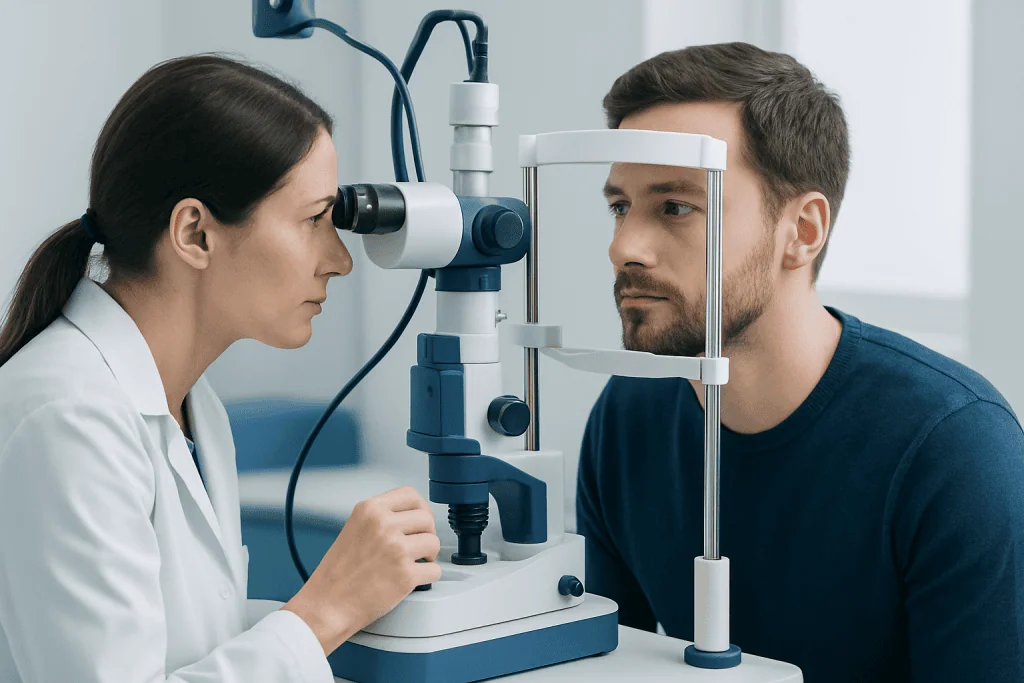
Diagnosis usually begins with a detailed eye examination. An ophthalmologist will review symptoms, check visual acuity, and perform refraction testing to see how well glasses can improve vision. Slit-lamp examination may reveal signs of corneal thinning or scarring in more advanced disease.
Specialized imaging is central to diagnosis. Corneal topography and tomography create a detailed map of the cornea’s shape and thickness, helping detect even early or subtle keratoconus. These tests are also useful over time to determine whether the condition is stable or progressing.
Additional tests may include pachymetry to measure corneal thickness and assessments of the eye surface and tear film. The results help guide treatment decisions, including whether glasses, specialty contact lenses, or a procedure may offer the best balance of vision and long-term corneal health.
Non-surgical treatment options: glasses and contact lenses
In early keratoconus, glasses may provide useful vision correction. However, as the cornea becomes more irregular, glasses often become less effective because they cannot fully compensate for the uneven surface. At that point, contact lenses are commonly used to improve the quality of vision.
Several types of lenses may be recommended. Soft toric lenses can help in mild cases, while rigid gas permeable lenses are often used when more precise optical correction is needed. Other options include hybrid lenses, which combine a rigid center with a soft outer ring, and scleral lenses, which vault over the cornea and rest on the white part of the eye. Scleral lenses can provide both clearer vision and improved comfort for many patients.
Lenses for keratoconus usually require careful fitting by an experienced eye care professional. Follow-up visits are important because the cornea can change over time, and lens fit affects both comfort and eye health. Keratoconus can also cause significant astigmatism, so treatment plans often focus on correcting this irregularity while protecting the corneal surface.
- Glasses may help in early stages
- Rigid gas permeable lenses can sharpen vision in irregular corneas
- Hybrid and scleral lenses may improve comfort and stability
- Regular fitting checks help maintain safe, effective wear
Procedures and surgery: cross-linking, rings, lasers, and transplant
When keratoconus is progressing, corneal cross-linking is one of the most important treatment options. This procedure uses riboflavin eye drops and ultraviolet light to strengthen collagen bonds within the cornea. Its main purpose is not to eliminate the need for glasses or lenses, but to help stabilize the cornea and reduce the chance of further worsening.
In selected cases, doctors may consider intracorneal ring segments, small implants placed within the cornea to help flatten and regularize its shape. These can improve contact lens tolerance or reduce distortion, although they do not cure the condition. Laser vision correction procedures are not generally suitable for untreated or unstable keratoconus, but some carefully chosen patients may undergo combined or staged approaches under specialist supervision.
If the cornea becomes severely scarred, very thin, or no longer provides useful vision despite other measures, corneal transplant surgery may be discussed. Depending on the situation, this may involve partial-thickness or full-thickness transplant techniques. Surgery is usually reserved for advanced cases after less invasive options have been considered.
People with keratoconus should not assume standard refractive procedures such as LASIK-type surgery are appropriate, because these can worsen corneal weakness in unsuitable candidates. Careful screening is essential before any corneal or laser procedure is planned.
Prevention, self-care, and living well with keratoconus
Keratoconus cannot always be prevented, but some practical steps may help protect the eyes and support treatment. Avoiding eye rubbing is especially important, as repeated rubbing may contribute to corneal stress. If allergies or chronic eye irritation are a problem, proper treatment can reduce the urge to rub.
Good contact lens habits also matter. Lenses should be cleaned, stored, and replaced exactly as advised, and any discomfort, redness, or sudden vision change should be assessed promptly. People should attend regular reviews even if symptoms seem stable, because progression can sometimes be detected on scans before it becomes obvious in daily life.
Living with keratoconus often involves adjustments rather than limitations. Better lighting, anti-glare strategies, and up-to-date corrective lenses can make reading, computer work, and night driving easier. If there are concerns about ongoing changes, an ophthalmology team can review whether newer treatment options may be helpful.
When to see a doctor
A doctor should be consulted if vision is becoming more blurred, distorted, or harder to correct with usual glasses. Repeated prescription changes, increasing glare, and poor night vision are also reasons to seek an eye examination. Early evaluation can make a meaningful difference, especially in younger people whose keratoconus may progress more quickly.
Urgent review is advisable if there is sudden worsening of vision, marked eye pain, redness, or a rapid change in the shape or comfort of the eye. These symptoms do not always mean a serious complication, but they should not be ignored. Prompt assessment helps identify whether the cornea has developed swelling, scarring, or another problem that needs treatment.
For international patients seeking specialist assessment, Acibadem International’s multidisciplinary eye teams in JCI-accredited hospitals diagnose and treat keratoconus using individualized plans based on corneal imaging, visual needs, and disease stage.
Frequently asked questions
Can keratoconus be cured completely?
Keratoconus cannot usually be reversed completely, but it can often be managed very effectively. Treatment focuses on improving vision and slowing or stopping progression. Many people maintain good day-to-day function with lenses or procedures tailored to their condition.
Are contact lenses always needed for keratoconus?
Not always. In mild cases, glasses may provide enough vision correction. As the cornea becomes more irregular, specialty contact lenses are often recommended because they can provide sharper vision than glasses.
What is corneal cross-linking used for?
Corneal cross-linking is mainly used to strengthen the cornea and reduce further worsening in progressive keratoconus. It is especially valuable when the condition is identified early. Vision may improve somewhat in some people, but the main goal is stabilization.
Is laser eye surgery safe for people with keratoconus?
Standard laser vision correction is usually not suitable for untreated or unstable keratoconus. Because the cornea is already weakened, some laser procedures may increase the risk of further thinning or distortion. Any laser-based treatment should be considered only after detailed specialist assessment.
When is surgery considered for keratoconus?
Surgery is usually considered when vision cannot be improved enough with glasses or contact lenses, or when the cornea has become scarred or significantly distorted. The type of surgery depends on the condition of the cornea. Doctors generally consider less invasive options before recommending transplant surgery.
Can keratoconus get worse with age?
It can progress, especially in younger people, but the rate varies from person to person. In many cases it becomes more stable later in adulthood. Regular follow-up is important because progression is not always noticeable without specialized corneal imaging.
References
- American Academy of Ophthalmology
- National Eye Institute
- Royal College of Ophthalmologists
- Mayo Clinic
- National Health Service
This article is for general information only and is not a substitute for professional medical advice. Please consult a qualified doctor about your individual situation.
Keratoconus Treatment in Turkey — costs, top hospitals & a free quote
JCI-accredited · board-certified surgeons · reply within 24h
Add us as a Preferred Source to see more of our trusted health content across Google Search, AI Overviews and Discover.

Ophthalmology
Comprehensive eye care from laser vision correction to retina, cornea and cataract surgery.
75 specialists in this unit