Joints and Their Types: A Clear Guide to How the Body Moves

Joints connect bones and help the body move, support weight, and maintain posture. The main structural types are fibrous, cartilaginous, and synovial joints.
Key Takeaways
- Joints connect bones and help the body move, support weight, and maintain posture.
- The main structural types are fibrous, cartilaginous, and synovial joints.
- Synovial joints are the most mobile and include hinge, ball-and-socket, pivot, saddle, condyloid, and gliding joints.
- Cartilage, ligaments, tendons, and synovial fluid all help joints work smoothly.
- Joint pain, swelling, stiffness, or reduced motion can have many causes and should be assessed if persistent.
- Healthy weight, regular exercise, and good movement habits can help protect joints over time.
Joints are the places where two or more bones meet, allowing the body to move, bend, and stay stable. Understanding joints and their types can make it easier to recognize normal movement, protect joint health, and know when symptoms need medical attention.
Overview: What Are Joints?
Joints are the structures where two or more bones meet. They allow movement, provide stability, and help the body perform everyday actions such as walking, turning the head, gripping objects, and sitting down. Some joints are designed mainly for support, while others are built to move through a wide range of motion.
Joints are more than simple meeting points between bones. They include supporting tissues such as cartilage, ligaments, tendons, and in many cases a joint capsule filled with lubricating fluid. Together, these parts help reduce friction, absorb force, and keep movement controlled and comfortable.
Doctors classify joints in a few different ways. A common and useful approach is to group them by structure: fibrous, cartilaginous, and synovial joints. Another way is by function, meaning how much movement they allow, from almost none to a large range of motion.
The Main Types of Joints
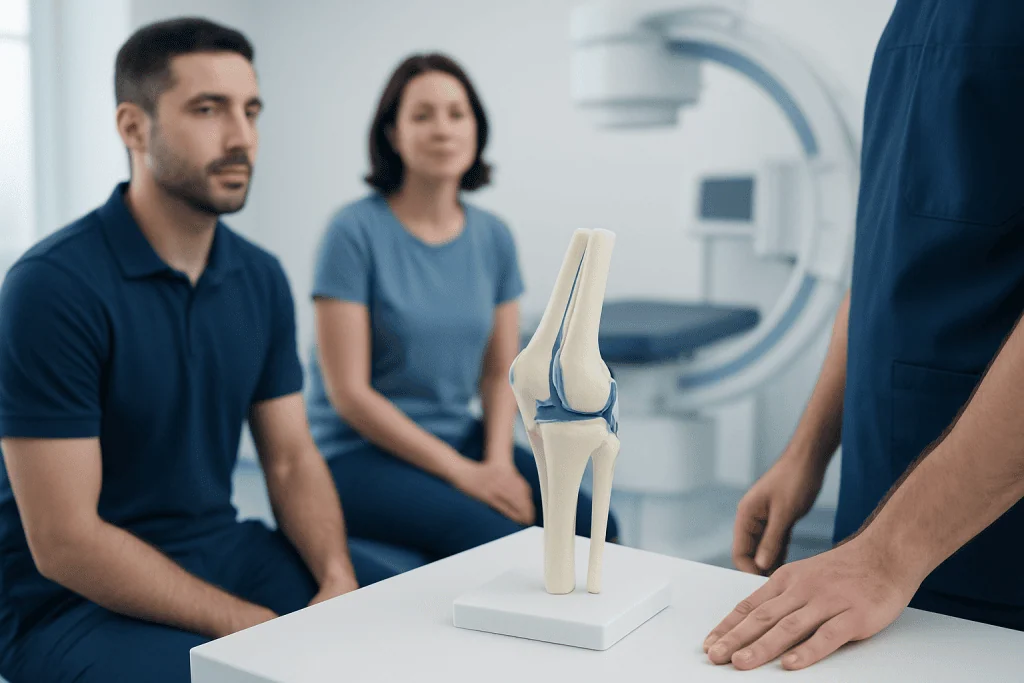
There are three main structural types of joints: fibrous, cartilaginous, and synovial. Each type has a different design and purpose within the body. This structure influences how much movement is possible and how much stability the joint can provide.
Fibrous joints are connected by dense connective tissue and usually allow little or no movement. The joints between the bones of the skull are examples. These joints are important because they protect the brain and keep the skull strong.
Cartilaginous joints are connected by cartilage. They allow a small amount of movement and help absorb pressure. Examples include the joints between the vertebrae of the spine and the joint at the front of the pelvis. These joints are especially important for support and shock absorption.
Synovial joints are the most mobile joints in the body. They have a joint space, a capsule, and synovial fluid that helps movement stay smooth. Most joints people think about, such as the knee, shoulder, hip, elbow, wrist, and ankle, are synovial joints.
Types of Synovial Joints and How They Move
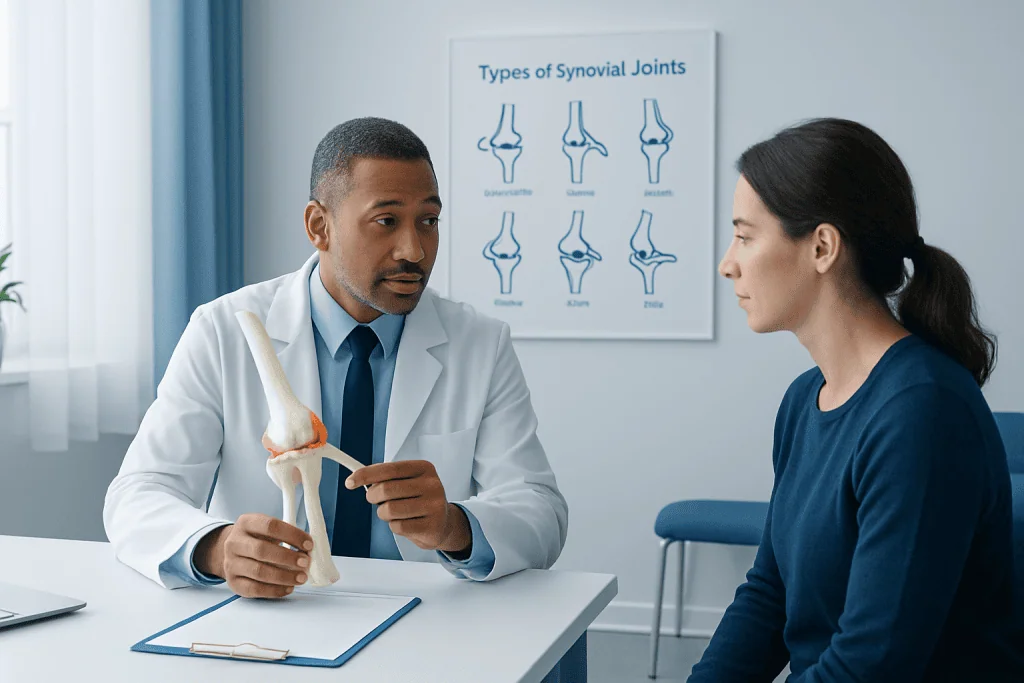
Because synovial joints are responsible for most body movement, they are further divided into several subtypes. Each has a shape that determines the kind of motion it can perform. This is why the shoulder can move more freely than the elbow, and why the thumb can oppose the fingers.
- Hinge joints: move mainly in one direction, like a door hinge. The elbow and knee are common examples.
- Ball-and-socket joints: allow movement in many directions, including rotation. The shoulder and hip belong to this group.
- Pivot joints: allow one bone to rotate around another. A key example is the joint in the neck that helps the head turn.
- Gliding joints: permit bones to slide over one another in small movements. These are found in the wrist and ankle.
- Condyloid joints: allow movement in two planes, such as bending and side-to-side motion. The wrist includes this type.
- Saddle joints: provide flexibility and stability together. The base of the thumb is the best-known example.
These different designs make human movement efficient and coordinated. For example, the hip offers strong weight-bearing support with broad mobility, while the fingers rely on smaller joints for precise control. When a synovial joint becomes inflamed, worn, or injured, daily tasks can become harder and painful.
People with persistent pain or stiffness in a major joint may be evaluated for conditions such as osteoarthritis or tendon-related problems. Understanding the type of joint involved often helps explain the symptoms and guides treatment choices.
How Joints Work: Key Parts of Joint Anatomy
Several tissues work together to help joints move smoothly. Cartilage covers the ends of bones in many joints and acts like a cushion. It reduces friction and helps distribute pressure across the joint surface. When cartilage is damaged or wears down, movement may become painful or limited.
Ligaments are strong bands of tissue that connect bone to bone. They help stabilize joints and prevent excessive movement. Tendons connect muscle to bone and allow muscles to move the joint. Around many joints, especially in the shoulder, surrounding muscles and tendons play a major role in support and control.
Synovial fluid is a slippery liquid found inside synovial joints. It helps lubricate the joint and nourish the cartilage. The joint capsule surrounds the joint and helps keep these structures in place. Small sacs called bursae may also reduce friction between tissues near the joint.
When one part of this system is irritated or injured, the entire joint can be affected. For example, a cartilage problem may lead to stiffness, while a ligament injury may cause instability. In some cases, imaging or specialist assessment is needed to identify the exact source of symptoms.
Common Joint Problems and Risk Factors
Joints can be affected by many conditions, not just aging. Common problems include sprains, strains, cartilage wear, inflammation, overuse injuries, and autoimmune disease. The symptoms may look similar at first, which is why a careful assessment is helpful if pain does not improve.
Osteoarthritis is one of the most common joint conditions. It happens when the protective cartilage in a joint gradually wears down. This can lead to pain, stiffness, reduced motion, and sometimes swelling. Weight-bearing joints such as the knees and hips are often affected, but osteoarthritis can also involve the hands and spine.
Inflammatory forms of arthritis, including rheumatoid arthritis, can also affect joints. These conditions occur when the immune system causes inflammation in joint tissues. In addition, sports injuries, repetitive movements, poor posture, obesity, previous trauma, and some occupations can increase the risk of joint damage over time.
Joint symptoms should not always be assumed to be simple wear and tear. Ongoing knee pain, for example, may relate to cartilage damage, ligament injury, or a meniscus tear. Swelling, warmth, or sudden loss of function deserves prompt medical attention.
How Joint Problems Are Diagnosed
Diagnosis usually begins with a medical history and physical examination. A doctor may ask when the symptoms started, which movements are difficult, whether there has been an injury, and if stiffness is worse in the morning or after activity. The pattern of symptoms often provides useful clues.
During the examination, the doctor may assess swelling, tenderness, strength, alignment, stability, and range of motion. Comparing one side of the body with the other can help identify subtle differences. In some cases, gait or posture may also be evaluated, especially when the hips, knees, ankles, or spine are involved.
Imaging tests may be recommended to look more closely at the joint. X-rays can show bone alignment and signs of arthritis. Ultrasound or MRI can provide more detail about soft tissues such as ligaments, tendons, cartilage, and the meniscus. Blood tests may be helpful if an inflammatory or autoimmune condition is suspected.
Accurate diagnosis is important because treatment depends on the cause. A painful shoulder, for instance, might come from bursitis, arthritis, tendon irritation, or a tear in the rotator cuff. The right diagnosis helps avoid unnecessary treatments and supports recovery.
Treatment Options for Joint Conditions
Treatment depends on the specific joint problem, its severity, the person’s age, activity level, and overall health. Many joint conditions improve with a combination of rest, activity modification, physical therapy, and medicines to reduce pain or inflammation. Gentle exercises are often recommended to maintain flexibility and strengthen the muscles that support the joint.
For some people, supportive devices such as braces, splints, insoles, or walking aids may reduce strain. Injections may also be used in selected cases to relieve pain or inflammation. The goal is usually to reduce symptoms, improve function, and protect the joint from further damage.
When conservative treatment is not enough, procedures or surgery may be considered. These can range from keyhole procedures to repair internal joint problems to partial or total joint replacement in advanced damage. Depending on the joint involved, doctors may discuss options such as knee replacement, hip replacement, or shoulder surgery when symptoms significantly affect daily life.
Specialist care may be especially helpful for complex cases, repeated injuries, or advanced arthritis. Near the end of the care pathway, some patients choose centers such as Acibadem International, where multidisciplinary specialists in JCI-accredited hospitals diagnose and treat joint conditions for international patients.
Prevention, Self-care, and When to See a Doctor
Many joint problems cannot be fully prevented, but healthy habits can lower risk and support long-term joint function. Regular physical activity helps keep the muscles around joints strong. Low-impact exercises such as walking, swimming, cycling, and stretching can improve mobility without placing excessive stress on the joints.
Maintaining a healthy weight is also important, especially for the knees, hips, and lower back. Using proper technique during sports, warming up before exercise, and avoiding repetitive strain when possible may help reduce injuries. Supportive footwear, good posture, and ergonomic workstations can also make a meaningful difference.
Simple self-care may help minor symptoms. This can include relative rest, ice or heat, and gradually returning to activity as pain improves. However, self-care should not replace medical assessment when symptoms are severe, persistent, or getting worse.
A doctor should be consulted if joint pain lasts more than a few weeks, keeps returning, limits normal movement, or is accompanied by swelling, redness, warmth, deformity, fever, or numbness. Sudden inability to bear weight, a locked joint, or significant injury should be assessed promptly.
Frequently asked questions
What are the three main types of joints?
The three main structural types of joints are fibrous, cartilaginous, and synovial joints. Fibrous joints allow little movement, cartilaginous joints allow limited movement, and synovial joints are the most mobile.
Which type of joint is the most movable?
Synovial joints are the most movable joints in the body. They include familiar joints such as the shoulder, hip, knee, elbow, and wrist, and they are designed to allow smooth motion.
What is the difference between a hinge joint and a ball-and-socket joint?
A hinge joint mainly moves in one direction, such as bending and straightening, like the elbow or knee. A ball-and-socket joint, such as the shoulder or hip, allows movement in several directions, including rotation.
Why do joints make cracking or popping sounds?
Joint sounds are often caused by movement of tendons or by tiny gas bubbles shifting in the joint fluid. If there is no pain, swelling, or loss of movement, these sounds are commonly harmless. Persistent symptoms along with noise should be checked by a doctor.
Can joint pain happen even without arthritis?
Yes, joint pain can have many causes besides arthritis. Injury, overuse, tendon irritation, bursitis, ligament strain, infection, and autoimmune conditions can all affect a joint and cause pain or stiffness.
How can people keep their joints healthy?
Regular exercise, muscle strengthening, stretching, and maintaining a healthy weight can support joint health. Avoiding repetitive strain, using proper body mechanics, and treating injuries early may also help protect joints over time.
References
- World Health Organization
- National Institute of Arthritis and Musculoskeletal and Skin Diseases
- American Academy of Orthopaedic Surgeons
- MedlinePlus
- NHS
This article is for general information only and is not a substitute for professional medical advice. Please consult a qualified doctor about your individual situation.
Joint and spine care in Turkey — expert assessment & treatment
JCI-accredited · board-certified surgeons · reply within 24h
Add us as a Preferred Source to see more of our trusted health content across Google Search, AI Overviews and Discover.