

Airport Assistance in Turkey for Patients with Reduced Mobility

Airport assistance in Turkey helps patients with reduced mobility move through arrival, check-in and transfers more smoothly in Istanbul and beyond.
If you use a wheelchair, walk slowly, tire easily, or need extra support at the airport, planning ahead can make your journey much calmer. This guide explains how airport assistance in Turkey usually works for international patients, what to request before you travel, and how to coordinate a smooth transfer to your hospital or hotel.
At a glance
- Best time to request help: When you book your flight, or at least 48 hours before departure
- Who can request it: You, your companion, your airline, or your hospital support team
- Typical support: Wheelchair service, buggy transport, boarding help, and assistance through the terminal
- Important documents: Passport, flight details, medical summary, medication list, and emergency contacts
- Transfer planning: Confirm an accessible vehicle from the airport to your hotel or hospital
- Extra language support: International patient teams and interpreters can help coordinate logistics
What airport assistance usually means in Turkey
Airport assistance in Turkey generally refers to support for passengers with reduced mobility as they move through the airport. This can include a wheelchair, help walking long distances, support at check-in, priority routing where available, transport within the terminal, and assistance during boarding or disembarkation. The exact service depends on your airport, airline, and your level of mobility.
If you are traveling for treatment, reduced mobility does not only mean full-time wheelchair use. You may also need help if you are recovering from surgery, have pain when walking, become breathless easily, have balance problems, are elderly, or cannot stand for long periods. It is usually better to ask for more support than you think you may need, especially in large international airports.
In Istanbul and other major Turkish airports, terminals can be large and walking distances can be longer than expected. Even if you usually manage independently, airport queues, luggage, fatigue, and unfamiliar surroundings can make the journey more difficult. Planning assistance in advance can reduce stress and help you conserve energy for your treatment or recovery.
When and how to request support before you fly

The simplest time to request assistance is when you book your flight. Airlines usually allow you to add mobility support during booking or later through customer service. If this was not arranged at the time of booking, contact the airline as early as possible, ideally at least 48 hours before travel, so the airport team can prepare.
Be specific about what you need. Saying “I need airport assistance” is helpful, but giving a clear description is better: for example, whether you can walk short distances, climb steps, transfer from a wheelchair, or need help from the aircraft door all the way to your vehicle. If you use your own wheelchair, tell the airline whether it is manual or powered, and provide battery information if relevant.
If you are coming to Turkey for treatment, your international patient coordinator can often help you organize the practical side of your arrival. At Acibadem International, patient support teams commonly help international patients align flight details, airport pickup timing, interpreter needs, and hospital arrival plans, which is especially useful if you are traveling after a recent procedure or with limited mobility.
- Request assistance with your airline
- Confirm whether you need help on departure, arrival, or both
- Share details about walking distance, steps, and transfers
- Declare mobility equipment in advance
- Reconfirm support 24 hours before your flight if possible
What to expect on arrival at the airport and during boarding

On your departure day, arrive earlier than usual. Assistance services are helpful, but they still need time to coordinate staff, wheelchairs, check-in, and security procedures. If you wait until the last minute, the process can feel rushed, particularly during busy travel periods.
At the airport, an assistance staff member may meet you at a designated point, check-in desk, or curbside area depending on the airport layout. They may help you move through check-in and security, then take you to the gate by wheelchair or electric buggy where available. In some cases, you may board earlier than other passengers so you can settle in more comfortably.
If you cannot manage aircraft stairs, tell the airline in advance. Some airports use ramps, lifts, or special vehicles for boarding and disembarkation. If you need help transferring from a wheelchair to an aircraft seat, this should also be arranged beforehand so the crew and ground staff are aware of your needs.
Arriving in Istanbul or elsewhere in Turkey
When you land in Turkey, arrival assistance usually continues from the aircraft to passport control, baggage reclaim, and the arrivals area. The exact route depends on the airport and your flight. If your mobility is limited, do not hesitate to wait for the assigned staff member rather than trying to walk ahead alone.
Passport control and baggage areas can involve standing and waiting, so it helps to keep your documents easy to reach in a small bag or pouch. If you are carrying medication, keep it in your hand luggage together with a brief medical note if appropriate. This makes the arrival process easier and helps you avoid searching through larger suitcases while tired.
If you are being met by a hospital or hotel transfer, confirm the meeting point before you travel. In large airports, pickup points can be busy and confusing. Many international patients find it reassuring to have a named contact, a phone number that works on arrival, and a message plan if their flight is delayed. Acibadem International patient services can help coordinate these details so your transfer from airport to hospital or accommodation is straightforward.
Planning an accessible transfer from the airport
Airport assistance ends at a certain point, usually when you reach the public arrivals area or your pre-arranged escort. That is why the transfer from the airport matters just as much as the flight itself. If you use a wheelchair, have severe pain, cannot step into a standard car easily, or need space for medical equipment, ask for an accessible or suitably sized vehicle in advance.
Think about the full route, not only the drive. Consider how far you will need to walk from the arrivals gate to the pickup zone, whether your hotel or apartment has stairs, and whether someone will help with luggage and check-in. A short car journey can still be difficult if the handover between airport and vehicle is poorly planned.
For patients traveling to hospital soon after landing, timing is important. If you have an appointment, admission, or imaging scheduled the same day, leave enough time for immigration, baggage, delays, and rest stops. Acibadem International often supports patients with hospital transfers, interpreters, and admissions coordination, which can be especially helpful if you are arriving after a long flight or with reduced stamina.
Documents, medication, and comfort items to keep with you
Keep essential items in your hand luggage, not in checked baggage. This includes your passport, visa if needed, travel insurance details, phone charger, medications, prescriptions, a brief medical summary, and the phone numbers of your airline, transfer provider, companion, and hospital contact. If you have written confirmation of your airport assistance request, keep that too.
If you take regular medication or may need pain relief during the journey, discuss timing with your own doctor before travel. Carry medicines in original packaging where possible and keep them easy to access. If you use mobility aids, cushions, braces, or compression items recommended by your clinician, pack them where they can be reached without difficulty.
Comfort also matters. A long airport journey is easier if you have water, a light snack if permitted, tissues, sanitizer, spare incontinence supplies if relevant, and a light layer of clothing in case the terminal or aircraft feels cool. Small practical steps can make you feel more in control, especially if you are tired, anxious, or traveling soon before or after treatment.
If you need extra support as a medical traveler
Traveling for treatment is different from ordinary travel. You may be anxious, fatigued, fasting for a test, sore after a recent procedure, or unsure how much walking you can manage. In that situation, it helps to create a joined-up plan covering the airline, airport assistance, ground transfer, and hospital arrival rather than treating each part separately.
If you are traveling with a companion, decide in advance who will handle documents, luggage, and communication at each stage. If you are traveling alone, ask whether your hospital’s international patient team can help coordinate arrival details and interpreter support. This can be especially useful if English is not your first language or if you feel vulnerable during travel.
Acibadem International supports many patients who need practical arrival planning, not only medical appointments. With JCI-accredited hospitals, multidisciplinary care teams, international patient services, interpreter support, and travel coordination assistance, the aim is to make your journey more manageable from the moment you land. Even so, the best results come from sharing your mobility needs early and clearly so everyone involved can prepare appropriately.
Step by step
- Book your flight and request assistance early. As soon as your travel dates are confirmed, ask your airline for reduced mobility support on every part of the trip that applies to you. Early notice gives the airline and airport more time to arrange staff, equipment, and any special boarding or seating needs.
- Describe your mobility needs clearly. Tell the airline exactly what you can and cannot do, such as walking short distances, using stairs, or transferring from a wheelchair. Clear information helps avoid mismatched support on the day of travel.
- Plan your airport pickup before departure. Do not wait until arrival to organize your transfer. Confirm who will meet you, where they will wait, what vehicle is being used, and whether it can accommodate your wheelchair, luggage, or other medical equipment.
- Keep essentials in your hand luggage. Carry your documents, medications, phone charger, hospital contact details, and a short medical summary with you. This reduces stress if checked luggage is delayed and makes it easier to answer questions during travel.
- Arrive at the airport with extra time. Assistance services still require check-in, security, and internal transfers, which can take longer in busy airports. Reaching the airport early gives you a buffer for queues, rest breaks, and any unexpected changes.
- Confirm the handover on arrival in Turkey. Before you board your flight, make sure you know how the airport assistance ends and where your driver, companion, or hospital representative will meet you. A clear handover prevents confusion in a crowded arrivals area.
- Tell your hospital if your arrival condition changes. If you become more tired, develop pain, or feel less mobile than expected during the journey, update your hospital contact as soon as possible. They may be able to adjust the transfer, timing, or arrival support to make things easier.
Your checklist
- Flight booked with reduced mobility assistance added
- Assistance reconfirmed with the airline before travel
- Passport, tickets, and hospital contact details packed in hand luggage
- Medication list and essential medicines carried onboard
- Wheelchair or mobility aid details shared with the airline
- Accessible or suitable airport transfer confirmed
- Arrival meeting point and emergency contact number saved
- Comfort items packed: water, charger, light layer, and small snacks if appropriate
Key takeaways
- Request airport assistance as early as possible, ideally when booking your flight.
- Be precise about your mobility needs so the right support is arranged.
- Plan the airport-to-hospital or hotel transfer with the same care as the flight.
- Keep medication, documents, and contact numbers in your hand luggage.
- If you are traveling for treatment, coordinated support from an international patient team can make arrival much smoother.
Frequently asked questions
How early should I request airport assistance in Turkey?
The best time is when you book your flight. If that is not possible, contact your airline at least 48 hours before departure so the airport team has time to prepare.
Can I get wheelchair assistance even if I am not a full-time wheelchair user?
Yes. Many people request assistance because they tire easily, have pain, are recovering from treatment, or cannot walk long distances in large terminals. You do not need to be a permanent wheelchair user to ask for help.
Will airport assistance take me all the way to my hospital in Istanbul?
Usually no. Airport assistance generally covers movement through the airport, while a separate transfer takes you from arrivals to your hospital or hotel. That is why pre-booking a suitable vehicle is important.
What should I do if I use my own wheelchair?
Tell the airline in advance whether your wheelchair is manual or powered and provide any battery details if required. Also ask how it will be handled at check-in, boarding, and arrival so you know what to expect.
Is language support available for international patients arriving in Turkey?
Yes, language support may be available through your hospital’s international patient services or interpreter team. At Acibadem International, interpreters and patient coordinators can help with practical communication around arrival, transfer, and admission.
What if my flight is delayed or I arrive feeling weaker than expected?
Contact your transfer provider and hospital representative as soon as you can. If your condition has changed, they may be able to adjust pickup timing, provide extra help on arrival, or revise the schedule for your first appointment.
Add us as a Preferred Source to see more of our trusted health content across Google Search, AI Overviews and Discover.
More Patient Guides

Traveling to Turkey with a Stoma: Supplies, Airport Screening, and Recovery Planning
Traveling to Turkey with a stoma is manageable with the right supplies, airport screening plan, and recovery support in Istanbul or Turkey.
8 min read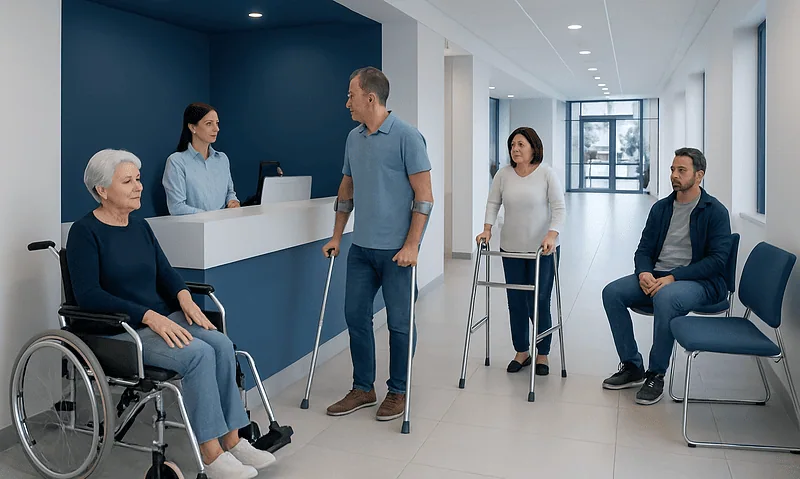
Mobility Aids in Turkey: Renting a Wheelchair, Walker, or Crutches
Mobility aids in Turkey can be rented through medical suppliers, pharmacies, and hospital-linked services in Istanbul and other cities.
9 min read
How to Handle Food Allergies and Special Diets During Treatment in Turkey
Food allergies and special diets during treatment in Turkey can be managed safely by sharing your needs early and coordinating meals with…
9 min read