

Slipped Disc vs Herniated Disc: Is There a Difference and Does It Matter?

In everyday use, slipped disc and herniated disc usually mean the same thing. A spinal disc does not truly “slip” out of place; it changes shape or tears.
Key Takeaways
- In everyday use, slipped disc and herniated disc usually mean the same thing.
- A spinal disc does not truly “slip” out of place; it changes shape or tears.
- Many disc changes cause no symptoms and are found incidentally on imaging.
- Symptoms matter more than wording on a scan report, especially leg pain, numbness, or weakness.
- Most people improve with time, activity modification, pain control, and physical therapy.
- Urgent medical care is needed for bowel or bladder changes, saddle numbness, or rapidly worsening weakness.
“Slipped disc” and “herniated disc” are often used to describe the same spinal disc problem, although doctors may use more precise terms such as bulge, protrusion, or extrusion. Understanding the language can help patients know what a scan result means and when symptoms need medical attention.
Overview: Are a Slipped Disc and a Herniated Disc Different?
In most everyday conversations, “slipped disc” and “herniated disc” mean the same thing. Both terms describe a problem involving one of the soft discs between the bones of the spine. These discs act like cushions and shock absorbers. When a disc becomes damaged, part of it may bulge outward or break through its outer layer, sometimes irritating nearby nerves and causing pain.
The phrase “slipped disc” can be misleading because the disc usually does not literally slip out of place. Instead, the disc’s outer ring may weaken or tear, allowing the inner material to push outward. For this reason, clinicians often prefer terms such as disc bulge, protrusion, prolapse, extrusion, or herniation. These words describe the shape and extent of the disc change more accurately.
Whether the report says slipped disc or herniated disc, what matters most is how the person feels and whether the disc is pressing on a nerve. Some disc changes cause significant symptoms such as back pain, neck pain, arm pain, or sciatica, while others cause no symptoms at all. A scan result alone does not always explain pain, so symptoms, examination findings, and imaging all need to be considered together.
How a Spinal Disc Works
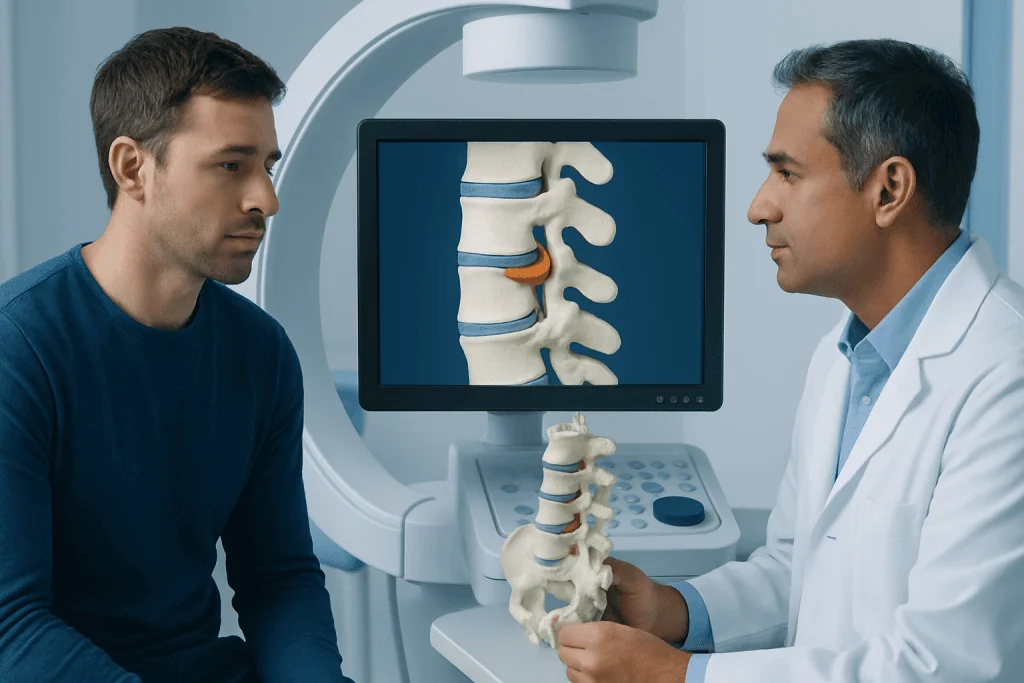
Each spinal disc sits between two vertebrae and helps the spine stay flexible while absorbing everyday forces from walking, lifting, bending, and twisting. A disc has a tough outer layer called the annulus fibrosus and a softer, gel-like center called the nucleus pulposus. Together, these structures help the spine move smoothly.
Over time, discs naturally lose some water content and elasticity as part of aging. This makes them less resilient and more likely to develop small tears or flattening. In some people, this process leads to a bulging disc, where the disc extends beyond its usual boundary. In others, the outer layer tears more significantly and the inner material pushes outward, creating a herniation.
Disc problems can happen in the neck, mid-back, or lower back, but they are most common in the lower back and the neck. When disc material touches or compresses a nearby nerve root, symptoms may travel along the path of that nerve. In the lower back, this often causes sciatica with pain radiating down the leg. In the neck, it may cause pain, tingling, or weakness in the shoulder, arm, or hand.
Symptoms: What Does a Herniated or Slipped Disc Feel Like?
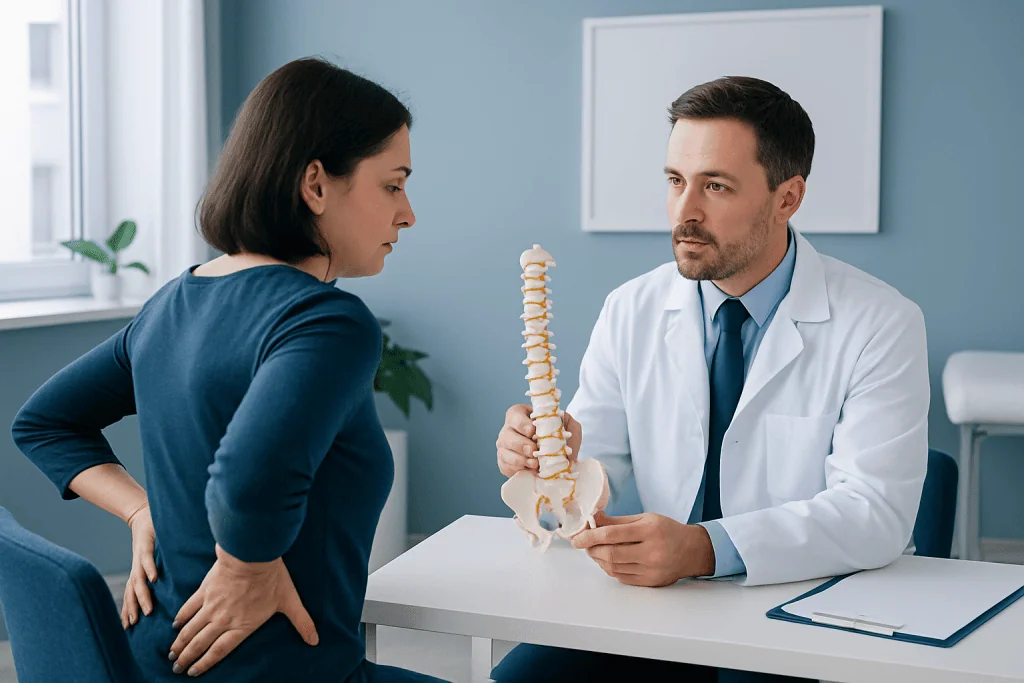
Symptoms vary depending on the location of the disc problem and whether a nerve is involved. Some people feel only local back or neck pain. Others have radiating pain, tingling, numbness, or muscle weakness. Pain may worsen with coughing, sneezing, sitting for long periods, bending forward, or lifting.
A lumbar herniated disc often causes lower back pain with pain shooting into the buttock, thigh, calf, or foot. This pattern is commonly called sciatica. A cervical herniated disc may cause neck pain that spreads into the shoulder, arm, or fingers. Some people describe burning, electric, or stabbing pain, while others mainly notice pins and needles or reduced strength.
It is also possible to have a disc herniation with no symptoms. Imaging tests frequently show disc changes in people who feel well. That is why doctors focus on whether the symptoms match the nerve affected on examination and scans.
- Common symptoms include back or neck pain
- Pain radiating into an arm or leg
- Numbness or tingling
- Muscle weakness
- Pain that worsens with certain movements or positions
Causes and Risk Factors
Most disc problems develop from a combination of age-related wear and mechanical strain rather than a single dramatic event. Repeated bending, twisting, heavy lifting, prolonged sitting, and poor lifting technique can all increase pressure on the discs. In some cases, a sudden movement or injury triggers symptoms in a disc that was already weakened.
Several factors can make disc herniation more likely. These include older age, excess body weight, physically demanding work, smoking, weak core muscles, and a sedentary lifestyle. Genetics may also play a role, meaning some people are more prone to disc degeneration even without major strain.
Risk does not always mean prevention is impossible. Healthy body mechanics, regular exercise, and avoiding tobacco can support spine health over time. However, even careful and active people can develop disc problems, so symptoms should not be viewed as a personal failure or something caused by one single movement alone.
Diagnosis: Why the Exact Term Matters Less Than the Findings
Diagnosis begins with a medical history and physical examination. The doctor asks where the pain is, when it started, what makes it better or worse, and whether there is numbness, weakness, or changes in walking. On examination, they may check muscle strength, reflexes, sensation, posture, and whether specific movements reproduce pain.
Imaging is not always needed right away. Many people with uncomplicated back or neck pain improve with conservative care, and early scans may show age-related changes that are not the true cause of symptoms. If symptoms are severe, persistent, or suggest nerve compression, an MRI is often the preferred test because it shows discs, nerves, and soft tissues clearly. X-rays can show alignment and bone changes but do not directly show the disc itself.
Radiology reports may use several terms. A disc bulge usually means the disc extends more broadly beyond its normal edges. A protrusion means a more focal outward push. An extrusion means the inner material has moved further through the outer layer. These distinctions help specialists understand anatomy, but treatment decisions depend more on symptoms, nerve involvement, and how the person is functioning than on one label alone. In some cases, a doctor may also assess related conditions such as spinal stenosis if symptoms suggest a narrower spinal canal or nerve passage.
Treatment Options
Most herniated disc symptoms improve over time without surgery. Early treatment usually focuses on relative rest, staying gently active, avoiding movements that sharply worsen symptoms, and using pain-relief strategies recommended by a doctor. Bed rest for long periods is generally not advised because gentle movement often supports recovery better than complete inactivity.
Physical therapy is a common part of treatment. A therapist may guide posture correction, stretching, core strengthening, and safe movement patterns. For many patients, a structured rehabilitation plan helps reduce pain and improve function. When symptoms continue, doctors may recommend medicines for pain and inflammation, or in selected cases, image-guided injections as part of broader care. Supportive non-surgical care may include physical therapy and rehabilitation and careful assessment with MRI when clinically indicated.
Surgery is usually considered when there is significant weakness, severe persistent pain despite conservative treatment, or urgent nerve compression symptoms. Surgical options depend on the disc location and severity. In the lower back, some patients may benefit from procedures such as microdiscectomy to remove the portion of disc pressing on a nerve. The goal of surgery is typically to relieve nerve pressure, not simply to correct an image finding.
Near the end of the care pathway, some patients benefit from evaluation by spine specialists, pain specialists, rehabilitation experts, and neurologists or neurosurgeons working together. Acibadem International’s multidisciplinary specialists and JCI-accredited hospitals diagnose and treat spinal disc conditions for international patients when this level of coordinated care is needed.
Prevention and Self-care
Not every disc problem can be prevented, but spine-friendly habits can reduce strain and support recovery. Regular physical activity helps maintain flexibility, strength, and a healthy body weight. Core and back muscle conditioning may improve spinal support, while good lifting technique can reduce pressure on the discs.
Helpful self-care often includes pacing activities, avoiding sudden heavy lifting, changing position regularly, and setting up an ergonomic workspace. When sitting for long periods, standing up, stretching, and walking briefly can help reduce stiffness. Sleep positions that keep the spine in a neutral position may also improve comfort.
Smoking cessation is especially important because smoking is linked to poorer disc health and slower healing. People should also be cautious about returning too quickly to demanding exercise or work after a painful flare. A gradual, supervised return is often safer and more sustainable than pushing through pain.
- Stay active with low-impact exercise such as walking or swimming
- Use proper lifting technique and avoid twisting while lifting
- Strengthen core and postural muscles
- Maintain a healthy weight
- Stop smoking if applicable
- Seek guidance if pain keeps returning or limits daily life
When to See a Doctor
Medical review is appropriate if back or neck pain lasts more than a few weeks, keeps returning, or starts to interfere with sleep, work, walking, or daily activities. A doctor should also assess pain that travels down an arm or leg, or symptoms such as numbness, tingling, or weakness. These signs can suggest nerve irritation that may benefit from targeted treatment.
Urgent medical attention is needed for red-flag symptoms. These include new loss of bowel or bladder control, numbness in the groin or inner thighs, rapidly worsening leg or arm weakness, severe difficulty walking, or severe pain after major trauma. These symptoms may point to serious nerve compression and should not be ignored.
Even when symptoms are not urgent, professional guidance can be helpful if there is uncertainty about the diagnosis. Because terms like slipped disc, bulging disc, and herniated disc are often used loosely, patients may feel worried when reading a scan report. A qualified clinician can explain what the findings mean, what is likely causing the symptoms, and which next steps are most appropriate.
Frequently asked questions
Is a slipped disc the same as a herniated disc?
In everyday language, yes, they usually refer to the same problem. Doctors often prefer the term herniated disc because a disc does not truly “slip” out of place. More specific words may be used on imaging reports to describe the disc’s shape and severity.
What is the difference between a bulging disc and a herniated disc?
A bulging disc generally means the disc extends outward more broadly around its edges. A herniated disc usually means there is a more focal tear or push of the inner material through the outer layer. Both can cause symptoms, but either one may also be found in people without pain.
Can a herniated disc heal without surgery?
Many people improve without surgery over weeks to months. Pain often settles as inflammation decreases and the irritated nerve recovers. Conservative treatment such as activity modification, pain management, and physical therapy is commonly effective.
How do doctors know if a disc is causing sciatica?
Doctors compare symptoms, physical examination findings, and sometimes MRI results. Sciatica usually follows a nerve pattern down the leg, and certain examination tests can suggest nerve root irritation. Imaging helps confirm whether a disc is pressing on the matching nerve.
When is a herniated disc an emergency?
It becomes urgent if there is new loss of bowel or bladder control, numbness around the groin, or rapidly worsening weakness. These symptoms can indicate significant nerve compression and need immediate medical assessment. Severe pain after a major injury should also be checked promptly.
Will exercise make a slipped disc worse?
Not necessarily. Gentle, appropriate movement is often helpful, while prolonged bed rest can sometimes slow recovery. The key is choosing safe exercises and avoiding movements that sharply worsen pain, ideally with guidance from a clinician or physical therapist.
References
- National Institute of Neurological Disorders and Stroke
- American Academy of Orthopaedic Surgeons
- National Institute of Arthritis and Musculoskeletal and Skin Diseases
- North American Spine Society
- National Health Service
This article is for general information only and is not a substitute for professional medical advice. Please consult a qualified doctor about your individual situation.
Joint and spine care in Turkey — expert assessment & treatment
JCI-accredited · board-certified surgeons · reply within 24h
Add us as a Preferred Source to see more of our trusted health content across Google Search, AI Overviews and Discover.

More from the Health Library



Related Specialists

Assoc. Prof. Dr. Bahattin Tanrıkulu
Neurosurgery
Dr. Shabnam Islamova
Emergency Service
Dr. Mehtap Baştugral
Clinical Laboratory
Prof. Dr. Yeşim Eralp
Medical Oncology