

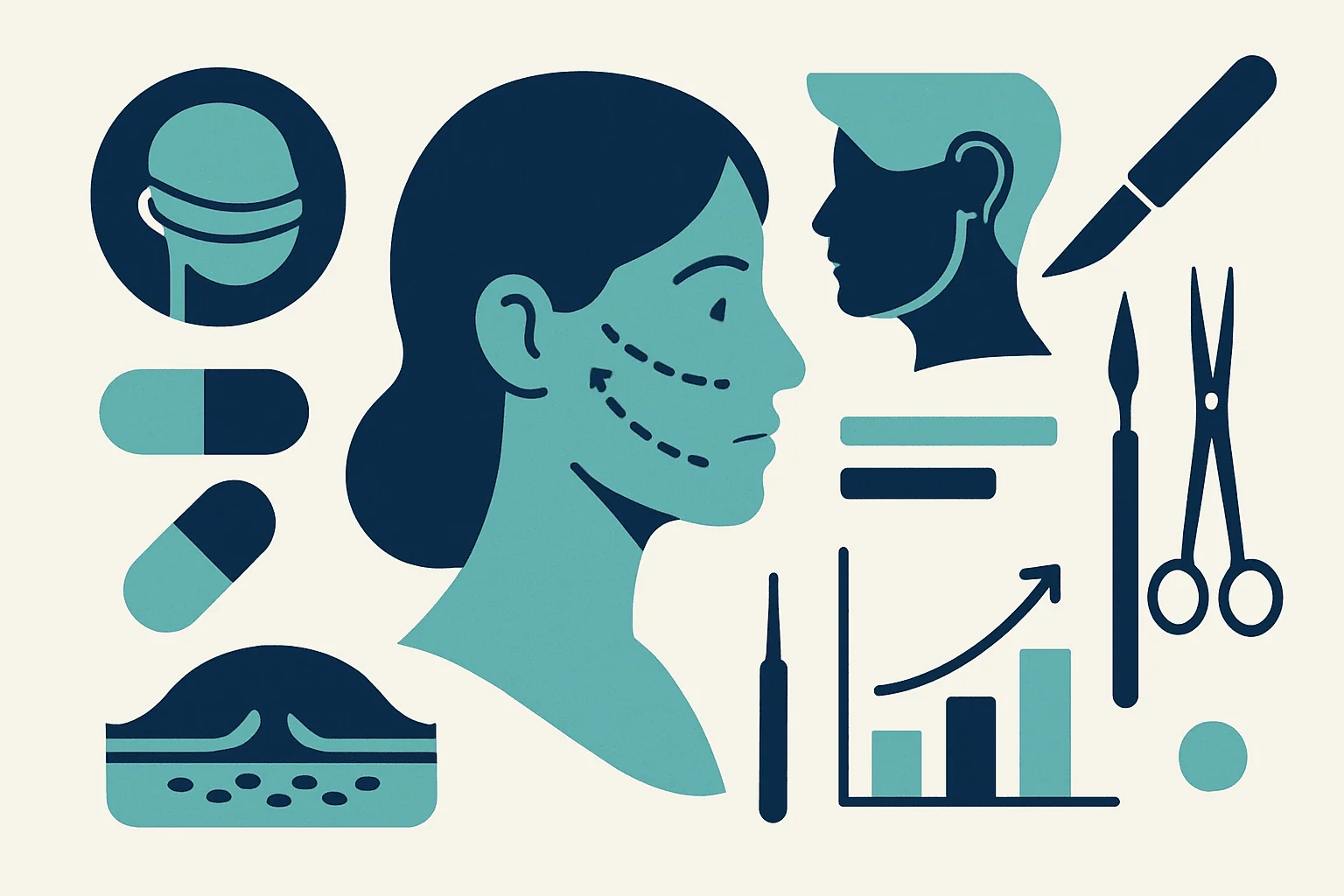
- A facelift is a surgical procedure intended to improve facial and sometimes neck sagging by repositioning deeper tissues and removing or redraping excess skin.
- There are different types of facelift procedures, including traditional, mini, and lower facelift approaches, often tailored to specific anatomical concerns.
- A facelift can improve jowls and laxity, but it does not stop aging or address every skin concern such as texture, pigmentation, or fine lines.
- Recovery, scarring, and surgical risks are part of the decision and should be discussed during an individualized consultation.
- Non-surgical treatments may help selected concerns, but they usually do not replace the lifting effect of surgery when tissue descent is more advanced.
Celebrities with facelift stories often draw public attention because they sit at the intersection of aging, appearance, privacy, and choice. When well-known people speak plainly about having a facelift, those conversations can reduce stigma and remind audiences that cosmetic procedures are personal health decisions rather than moral statements.
Openness matters here. Public figures who have voluntarily discussed their own facelift experiences can help shift the tone away from rumor and toward informed, respectful discussion. The list below focuses only on people who have personally and publicly acknowledged a facelift or lower facelift, making their comments part of the public record.
This roundup is not about judging anyone’s looks or encouraging surgery. It is an editorial overview of notable public disclosures, alongside a brief educational guide to what a facelift is, what it can and cannot do, and how treatment decisions are typically approached.
1. Jane Fonda
Jane Fonda has spoken openly for years about having cosmetic surgery, including a facelift, as part of candid conversations about aging in public. In interviews around her later career, she has acknowledged that she had work done and also reflected on feeling conflicted about beauty standards. Her openness mattered because she did not present the choice as effortless or universally empowering; instead, she described it as a personal decision shaped by the pressures many women face. That nuance helped create a more honest discussion about cosmetic procedures and aging.
2. Kris Jenner
Kris Jenner publicly shared that she had a facelift and allowed viewers to see parts of the process in a television setting before a family event. By discussing it directly rather than leaving it to speculation, she made the procedure part of a wider public conversation about cosmetic surgery among older adults. She has generally framed the experience as a personal choice about how she wanted to look and feel. Her candor stood out because it normalized discussing facial rejuvenation without pretending it was simply the result of skincare or styling.
3. Sharon Osbourne
Sharon Osbourne has repeatedly spoken publicly about cosmetic surgery, including facelifts, with unusual directness. In later interviews, she said she had undergone a facelift and also described reaching a point where she felt she had done too much, offering a rare perspective on both the appeal and the limits of repeated procedures. That kind of reflection is important because it adds realism to public conversations about aesthetic surgery. Rather than glamorizing it, she has discussed it as a serious choice with consequences, recovery, and emotional complexity.
4. Carmen Dell’Orefice
Model Carmen Dell’Orefice has openly discussed having a facelift as part of broader interviews about longevity in fashion and the realities of working in an image-focused industry. Her comments have been notable because she did not hide the role of cosmetic intervention in maintaining a public-facing career. She has spoken about the subject matter-of-factly, which helped counter the idea that every visible change must remain secret. In doing so, she contributed to a more transparent conversation about aging, work, and appearance.
5. A.J. McLean
A.J. McLean has publicly shared that he underwent a lower facelift, speaking about it in the context of self-confidence and his personal goals. His disclosure drew attention partly because facelift conversations are often framed around women, while men may face a separate stigma about discussing aesthetic procedures. By addressing it directly, he helped broaden who is seen as part of the cosmetic surgery conversation. His openness also highlighted that facial procedures can be discussed without secrecy or embarrassment.
6. Marc Jacobs
Fashion designer Marc Jacobs publicly revealed that he had a facelift and was unusually transparent about the experience, even sharing aspects of recovery on social media. That visibility made the disclosure especially clear and left little doubt that he was speaking about his own procedure. He presented the decision as personal and straightforward rather than scandalous. His posts helped normalize the idea that aesthetic surgery can be discussed openly by men as well as women, and by people outside film and television.
7. Sonja Morgan
Sonja Morgan has spoken publicly about getting a lower facelift and discussed the procedure in a reality television context and related interviews. Because she addressed it in her own words, the conversation moved beyond tabloid guessing and into personal disclosure. She described the experience as part of how she manages aging in the public eye, which resonated with audiences used to intense scrutiny of appearance. Her candor contributed to a more direct, less euphemistic discussion of facial cosmetic surgery.
8. Caroline Stanbury
Caroline Stanbury has publicly discussed having a facelift, including sharing details around recovery and why she chose the procedure. Her comments were notable for being practical and unembarrassed, focusing on her decision-making rather than treating the subject as taboo. By speaking plainly, she helped frame facelift surgery as a medical-aesthetic procedure that still involves healing time, planning, and informed consent. That perspective can be more useful to audiences than vague references to ‘refreshing’ or ‘tweaks.’
9. Sonia Braga
Sonia Braga has said publicly that she had a facelift, making her one of the actresses who has directly acknowledged cosmetic facial surgery rather than avoiding the topic. Her disclosure is often cited because she spoke about it with clarity at a time when many public figures were less willing to do so. In that sense, her openness helped challenge the silence that often surrounds aesthetic procedures. It also underscored that discussing surgery honestly can be less misleading than allowing myths to fill the gap.
10. Jocelyn Wildenstein
Jocelyn Wildenstein has publicly discussed having facial cosmetic procedures, including facelift-related surgery, in interviews over the years. Although public discussion around her appearance has often been sensationalized by others, her own remarks are part of the record and reflect personal disclosure rather than rumor. Including her here requires care: the point is not to treat her as spectacle, but to note that she has spoken about undergoing cosmetic facial surgery herself. Her case illustrates why respectful reporting matters when appearance-related topics become highly public.
What a facelift is
A facelift, medically called a rhytidectomy, is a cosmetic surgical procedure designed to address visible signs of aging in the lower face and jawline, and sometimes the midface and neck depending on the technique used. It does not stop aging, but it can reposition deeper tissues, reduce jowling, and improve skin laxity. Some procedures focus on the face alone, while others are paired with a neck lift, eyelid surgery, fat grafting, laser resurfacing, or other complementary treatments.
People often use the term “facelift” broadly, but there are different approaches. A traditional facelift typically involves incisions placed around the ears and hairline, allowing the surgeon to lift and reposition underlying facial support layers rather than simply pulling the skin tighter. A mini facelift is generally a less extensive version that may be considered when aging changes are milder. A lower facelift usually targets the jawline, lower cheeks, and early jowls, while a combined face-and-neck lift may address looseness under the chin and in the neck more directly.
It is important to understand what a facelift can and cannot do. It can improve sagging and contour in selected areas, but it does not change bone structure, erase every wrinkle, or produce permanent results. Skin quality, sun exposure, smoking history, weight changes, and natural anatomy all affect outcomes. Because the procedure is individualized, there is no single “standard” facelift result that suits everyone.
As with any operation, a facelift involves recovery and risk. Bruising, swelling, numbness, scarring, temporary asymmetry, fluid collections, delayed wound healing, and infection are recognized possibilities. More serious but less common complications can include bleeding, nerve injury, or skin compromise. These realities are one reason clear consultation and informed consent are essential.
Diagnosis and treatment landscape
A facelift is not a treatment for disease, so there is no diagnosis in the usual sense. Instead, evaluation focuses on anatomy, goals, overall health, and whether surgery is a reasonable option. A specialist typically assesses skin elasticity, degree of sagging, neck contour, facial volume loss, medical history, prior procedures, medications, and lifestyle factors such as nicotine use. The conversation usually includes what bothers the patient most, what kind of recovery they can accommodate, and whether surgical or non-surgical approaches better match their expectations.
Not every concern requires a facelift. Some people are better candidates for non-surgical or less invasive approaches, such as neuromodulators for expression lines, dermal fillers for volume loss, energy-based skin tightening, or resurfacing procedures for texture and pigmentation. These options can improve selected issues, but they generally do not reproduce the structural lift that surgery can achieve when tissues have significantly descended.
When surgery is chosen, planning matters. Surgeons may discuss incision placement, whether a neck lift is advisable, the likely recovery timeline, scar care, activity restrictions, and the possibility that adjunctive procedures could produce a more balanced result. Photographs are often part of planning and follow-up because subtle changes in facial contour can be difficult to assess from memory alone. Good candidates typically have realistic expectations and understand that improvement is the goal, not perfection.
Recovery varies by technique and by person. Swelling and bruising are common in the first days and weeks, and final results may take longer to settle than patients expect. Follow-up visits are important to monitor healing. In reputable practice, the emphasis is on individualized assessment, safety, and honest communication about benefits, limitations, scars, and risks. That broader context helps place celebrity disclosures in perspective: a facelift is neither trivial nor shameful, but a significant elective procedure that deserves accurate information and thoughtful decision-making.
Explore Facelift at Acibadem →
Frequently asked questions
What is the difference between a facelift and a neck lift?
A facelift usually focuses on the lower face, jawline, and sometimes midface, while a neck lift more specifically addresses loose skin, banding, or contour under the chin and in the neck. Many patients have both together because facial and neck aging often overlap.
Does a facelift remove all wrinkles?
No. A facelift primarily improves sagging and tissue descent. Fine lines, skin texture changes, and pigment issues may require other treatments, depending on the concern.
How long do facelift results last?
Results vary by technique, anatomy, skin quality, and lifestyle factors. A facelift does not stop the aging process, but it can provide improvement that remains noticeable for years.
Are non-surgical treatments an alternative to facelift surgery?
They can be for some people, especially when concerns are mild or focused on volume loss, dynamic lines, or skin surface issues. However, non-surgical treatments generally cannot recreate the structural lifting effect of a surgical facelift when sagging is more advanced.
This article is general health information inspired by publicly reported news. It is not a statement about any individual’s private medical care, nor medical advice. Always consult a qualified clinician.