

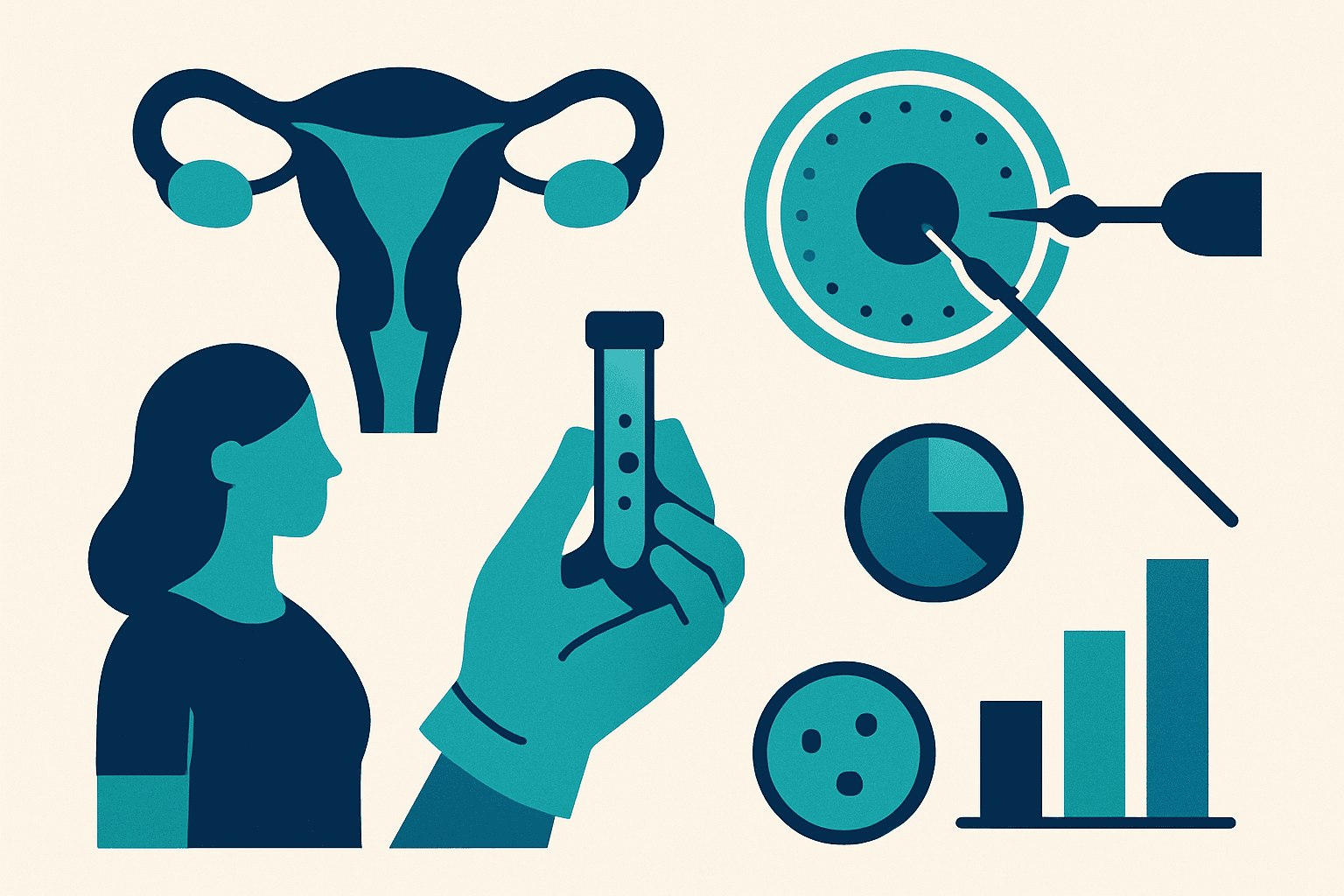
- IVF is an assisted reproductive technology in which eggs are fertilized with sperm in a laboratory before embryo transfer to the uterus.
- It may be used for many different fertility-related reasons, including tubal problems, ovulation disorders, endometriosis, male-factor infertility, and unexplained infertility.
- IVF success rates vary by age and medical factors, so one person's outcome does not predict another's.
- Treatment can involve medications, monitoring, egg retrieval, laboratory embryo development, and fresh or frozen embryo transfer.
- IVF is one option within a broader fertility care pathway that may also include diagnosis, less invasive treatments, donor gametes, genetic testing, or surrogacy.
Celebrities with ivf have helped make fertility treatment more visible by speaking about experiences that were once kept private. When well-known people describe injections, embryo transfers, pregnancy loss, waiting, or the emotional uncertainty of trying to conceive, it can reduce stigma and remind readers that infertility and assisted reproduction affect many kinds of families.
This roundup focuses only on public figures who have personally and publicly discussed their own IVF journeys in interviews, books, documentaries, or social media. Their stories are not medical templates, but they do show how openness can create more informed conversations about reproductive health, treatment limits, and the many different paths people take toward parenthood.
1. Chrissy Teigen
Chrissy Teigen has spoken openly for years about using IVF to build her family with John Legend. She has described the process publicly in interviews and online, including the physical and emotional intensity of treatment and the difficult waiting involved. Teigen has also discussed making embryo-related decisions and the pressure people can feel when outsiders comment on fertility. Her candor helped bring IVF into mainstream conversation in a way that felt personal, direct, and easy for many readers to understand.
2. Kim Kardashian
Kim Kardashian has publicly shared that she used IVF after serious pregnancy complications made another pregnancy difficult and risky. In interviews and on television, she discussed fertility treatment as part of her path to expanding her family. Her comments linked IVF to broader reproductive realities, including how prior pregnancies or medical complications can shape later family-building choices. That visibility helped frame IVF not as a niche topic, but as one part of modern reproductive medicine.
3. Kourtney Kardashian Barker
Kourtney Kardashian Barker has spoken publicly about going through IVF during her fertility journey with Travis Barker. She discussed the experience on television and in interviews, including the emotional toll of repeated treatment and the physical effects she felt from medications. Barker also later said they stepped back from IVF, which underscored that treatment paths can change over time. Her openness mattered because it showed both the hope attached to IVF and the difficulty of living through it in real time.
4. Celine Dion
Celine Dion has publicly shared that IVF was part of her path to motherhood after fertility struggles. She spoke in interviews about how she and her late husband pursued treatment and about the joy that followed the birth of her children. Dion’s disclosures were especially significant because she discussed both persistence and disappointment without glamorizing the process. Her story gave a global audience a respectful, recognizable example of assisted reproduction within a family’s private life.
5. Brooke Shields
Brooke Shields wrote and spoke publicly about infertility, miscarriage, and IVF in a detailed and widely discussed way. She described the emotional upheaval of trying to conceive, the burden of repeated treatment cycles, and the complicated mix of grief and hope that can surround fertility care. Because she shared these experiences in long-form personal reflection, her account resonated with many people who felt their own struggles were rarely described honestly. Her openness also broadened public understanding of how fertility treatment can intersect with mental health.
6. Tyra Banks
Tyra Banks has spoken publicly about a long and difficult fertility journey that included IVF. In interviews, she described the pain of unsuccessful attempts and the intense desire to become a parent, later sharing gratitude for having a child. Banks’ comments stood out because she was candid not only about treatment, but also about loss and disappointment along the way. That kind of disclosure helped counter the misconception that IVF is quick, easy, or guaranteed to work.
7. Mariah Carey
Mariah Carey has publicly discussed using IVF as part of her journey to pregnancy. She shared details in interviews after the birth of her children, including some of the medical routines and emotional strain associated with fertility treatment. By acknowledging the effort and uncertainty behind a high-profile pregnancy, Carey helped make the subject more relatable for audiences who might otherwise see only the outcome. Her comments contributed to a broader public understanding that conception can involve extensive medical support.
8. Sarah Jessica Parker
Sarah Jessica Parker has spoken publicly about IVF in the context of trying to expand her family. In interviews, she shared that she and Matthew Broderick explored fertility treatment before ultimately welcoming twins via surrogacy. Her comments were measured and respectful, but they added important visibility to the reality that IVF can be one part of a longer and more complex family-building journey. That nuance mattered because it reflected how assisted reproduction may intersect with other reproductive options.
9. Courtney Cox
Courteney Cox has publicly shared that she underwent IVF and experienced miscarriage during her fertility journey. In interviews over the years, she has described how painful and frustrating that period felt, while also speaking about the perseverance involved in continuing treatment. Her willingness to discuss both IVF and pregnancy loss gave the public a more honest picture of what some patients endure behind the scenes. It also helped normalize difficult conversations that many people had previously kept private.
10. Gabrielle Union
Gabrielle Union has written and spoken publicly about infertility and multiple failed IVF cycles before becoming a parent. In essays, interviews, and her memoir, she described years of treatment, repeated disappointment, and the emotional toll that came with trying to conceive. Her account has been widely recognized because she addressed not just the medical process, but also the isolation and self-questioning that can accompany it. Union’s openness helped many readers feel seen, especially those whose IVF journeys did not follow a simple or linear path.
What IVF is
In vitro fertilization, usually called IVF, is a form of assisted reproductive technology used when pregnancy has not happened through intercourse or when another path to conception is medically appropriate. In a typical IVF cycle, medications are used to stimulate the ovaries so multiple eggs mature at once. Those eggs are collected in a minor procedure, combined with sperm in a laboratory, and observed as embryos develop. One embryo may then be transferred to the uterus, while others may sometimes be frozen for future use.
IVF is not a single diagnosis; it is a treatment approach that may be considered for different reasons. These can include blocked fallopian tubes, ovulation disorders, severe male-factor infertility, endometriosis, diminished ovarian reserve, unexplained infertility, or the need to use donor eggs, donor sperm, or a gestational carrier. Some patients also encounter IVF in the context of fertility preservation or embryo testing. Although IVF is widely discussed, outcomes vary significantly by age, underlying health factors, embryo quality, sperm factors, uterine factors, and the specific reason treatment is being pursued.
It is also important to understand that IVF can be physically and emotionally demanding. Treatment often involves hormone injections, blood tests, ultrasound monitoring, scheduling pressures, and periods of waiting that can feel intense. Some cycles do not lead to embryo transfer, and some embryo transfers do not result in pregnancy. Public discussion often focuses on success stories, but a realistic understanding of IVF includes uncertainty, repeated cycles for some patients, and the possibility that a different family-building route may eventually be chosen.
Diagnosis and treatment landscape
Before IVF is considered, fertility specialists usually begin with an evaluation aimed at identifying possible reasons pregnancy has not occurred. This may include menstrual and ovulation history, hormone testing, ovarian reserve assessment, pelvic ultrasound, imaging of the uterus and fallopian tubes, and semen analysis. Depending on the findings, treatment may begin with simpler steps such as cycle tracking, treatment of an underlying condition, medication to induce ovulation, or intrauterine insemination. IVF is generally one option within a wider fertility care landscape rather than the automatic first step for every patient.
Modern IVF can involve several additional tools. Intracytoplasmic sperm injection, or ICSI, may be used when there are sperm-related concerns. Embryos may be frozen for later transfer, which allows treatment to be staged over time. Some patients pursue preimplantation genetic testing, often abbreviated PGT, in specific situations. Donor eggs, donor sperm, or donor embryos may also be considered, and some families use a gestational carrier. Each of these choices involves separate medical, ethical, legal, financial, and emotional considerations.
Risks and limits deserve clear discussion. Ovarian stimulation can cause side effects, and a small number of patients develop ovarian hyperstimulation syndrome. Egg retrieval is generally safe but remains a medical procedure. Multiple pregnancy risk can increase depending on how many embryos are transferred, which is why single-embryo transfer is often discussed. Success rates differ between clinics and patient groups, and they should be interpreted carefully rather than as guarantees. For many patients, fertility treatment also raises questions about mental health support, relationship stress, cost, and how long to continue.
Because IVF is both highly personal and medically complex, accurate information matters. Public stories can reduce shame and help people feel less alone, but they do not replace individualized evaluation. Fertility specialists, reproductive endocrinologists, urologists, genetic counselors, and mental health professionals may all play a role in care. The most helpful public takeaway is that infertility is a medical issue with many possible causes, and IVF is one evidence-based treatment among several pathways people may explore.
Explore Egg Freezing at Acibadem →
Frequently asked questions
What does IVF stand for?
IVF stands for in vitro fertilization. It refers to fertilization of eggs with sperm in a laboratory, followed by embryo transfer to the uterus when appropriate.
Is IVF always the first treatment for infertility?
No. Depending on age, diagnosis, and reproductive history, clinicians may first evaluate underlying causes and consider other options such as ovulation treatment, surgery for specific conditions, or intrauterine insemination.
Does IVF guarantee pregnancy?
No. IVF can improve the chance of pregnancy for some patients, but it does not guarantee success. Outcomes depend on many factors, including age, embryo quality, sperm factors, and overall reproductive health.
Can IVF be used with other reproductive options?
Yes. IVF may be combined with ICSI, embryo freezing, preimplantation genetic testing, donor eggs or sperm, donor embryos, or the use of a gestational carrier, depending on the situation.
✔ Reviewed by the Acibadem medical team
This article is general health information inspired by publicly reported news. It is not a statement about any individual’s private medical care, nor medical advice. Always consult a qualified clinician.