

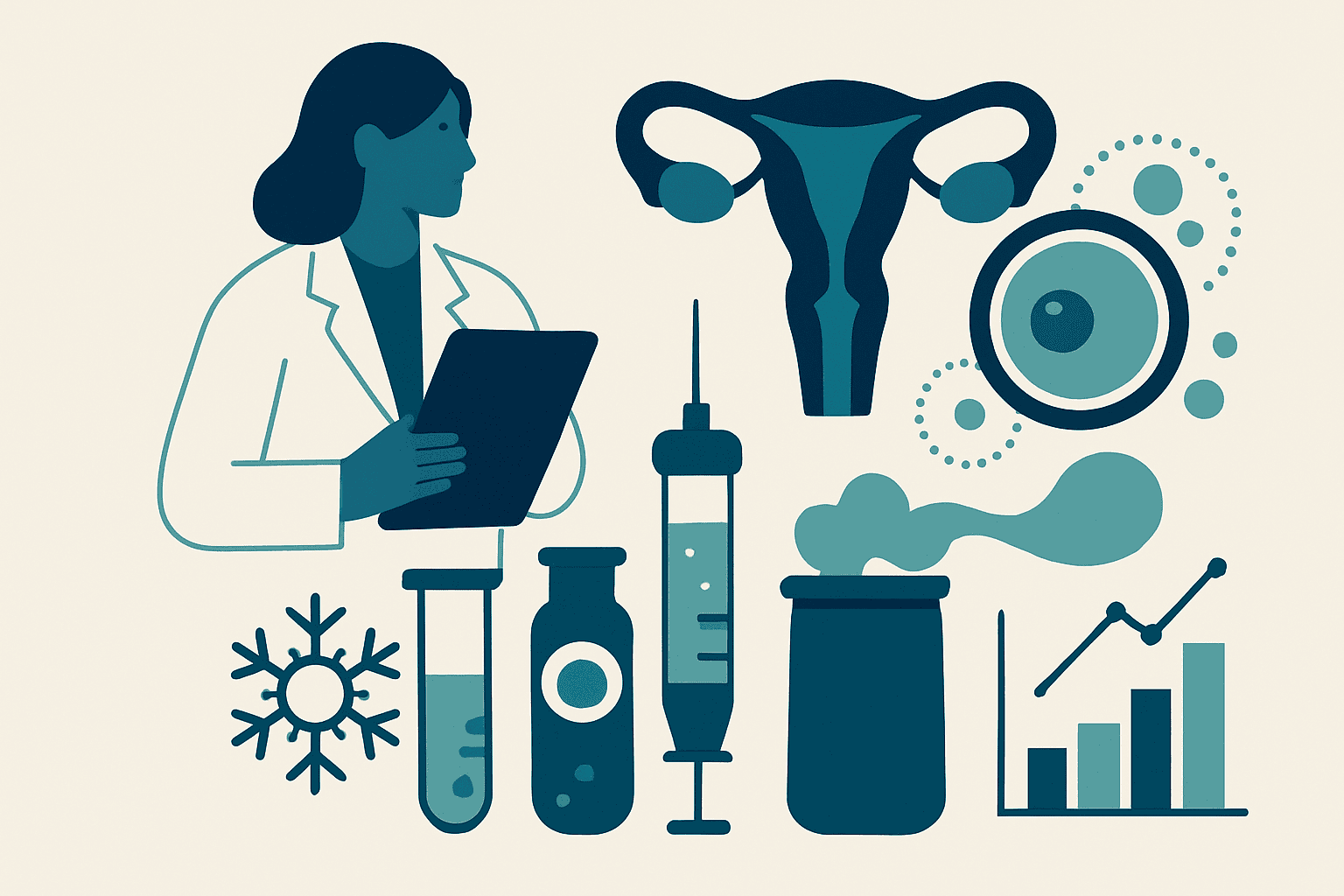
- Egg freezing preserves unfertilized eggs for possible future use but does not guarantee a future pregnancy.
- Age at the time of freezing is one of the strongest factors affecting the likelihood of later success.
- The process usually involves ovarian stimulation, monitoring, egg retrieval, laboratory freezing, and storage.
- People may consider egg freezing for personal timing or medical reasons, including conditions or treatments that may affect fertility.
- Using frozen eggs later requires additional assisted reproduction steps, including thawing, fertilization, and embryo transfer.
Celebrities with egg freezing have helped bring a once-private fertility topic into everyday conversation. In the past decade, several public figures have spoken openly about choosing egg freezing for their own lives, often to discuss timing, uncertainty, career planning, relationships, or medical concerns.
That openness matters. When well-known people describe fertility preservation in clear, personal terms, it can reduce stigma and remind readers that reproductive decision-making is rarely simple. The stories below focus only on women who have publicly discussed their own egg-freezing experiences, offering a respectful look at how visibility can expand understanding.
These accounts are not endorsements and they do not suggest that egg freezing guarantees a future pregnancy. Rather, they show how public conversation around fertility has broadened, allowing more nuanced discussions about age, ovarian reserve, family-building timelines, and the emotional side of preserving reproductive options.
1. Olivia Munn
Olivia Munn has spoken publicly about freezing her eggs in her thirties and later discussing the experience in the context of fertility planning and women’s health. She shared that she wanted to preserve options and has described the process in practical, unsensational terms. Her openness resonated because she addressed a subject many people feel pressure to keep private. By framing egg freezing as one possible tool rather than a promise, she helped make the conversation more realistic.
2. Rita Ora
Rita Ora has shared publicly that she froze her eggs in her twenties after advice from a doctor prompted her to think ahead about fertility. She has described feeling that the decision gave her peace of mind at a stage when she was focused on work and not ready for parenthood. Her comments drew attention because she discussed making the choice at a younger age than many people expect. That perspective helped broaden public understanding of fertility preservation as a proactive, individualized decision.
3. Sofia Vergara
Sofia Vergara has spoken openly about freezing embryos and eggs while discussing her reproductive plans and later legal disputes connected to stored embryos. In interviews, she has acknowledged fertility preservation as part of her own life story rather than an abstract topic. Although much public attention focused on the legal dimension, her disclosures also highlighted the practical and emotional complexity of assisted reproduction. Her case brought unusual visibility to questions of consent, storage, and future use.
4. Maria Menounos
Maria Menounos has publicly discussed freezing her eggs while navigating questions about family timing, health, and later serious medical challenges. She has spoken candidly about wanting to preserve possibilities and about how fertility decisions can intersect with other health priorities. Her comments have been notable for their honesty about uncertainty rather than certainty. That candor helped show that fertility preservation often sits within a much bigger life and health picture.
5. Kim Kardashian
Kim Kardashian has spoken publicly about freezing her eggs during her fertility journey and while sharing aspects of assisted reproduction on television and in interviews. She has discussed the topic as part of broader conversations about pregnancy complications, family-building, and reproductive planning. Because her personal life has been so visible, her comments introduced egg freezing to a very large mainstream audience. That visibility helped normalize fertility preservation as a subject people can talk about openly.
6. Kourtney Kardashian
Kourtney Kardashian has shared publicly that she froze her eggs and later reflected on the experience, including the physical and emotional aspects. She has spoken about doing so when she was encouraged to think about future fertility, and she later discussed whether she would use the eggs. Her openness mattered because it included ambivalence as well as action, which is often missing from simplified public narratives. By talking about the process without glamorizing it, she added nuance to a widely discussed topic.
7. Emma Roberts
Emma Roberts has spoken publicly about endometriosis-related fertility concerns and shared that she had frozen her eggs after learning more about her reproductive health. She connected the decision to gaining information about a condition that can affect fertility and to wanting to preserve options. Her disclosure was important because it linked egg freezing with a specific diagnosed health issue rather than only age or career timing. That helped readers see fertility preservation within the broader context of gynecologic care.
8. Rebel Wilson
Rebel Wilson has publicly discussed freezing her eggs around age 39 while reflecting on fertility, health changes, and the possibility of motherhood. She has said she wanted to keep options open and later encouraged others to think about reproductive timelines with realistic information. Her comments attracted attention because she described the decision in a frank, relatable way. That openness contributed to more mainstream awareness that fertility planning often involves both emotion and logistics.
9. Paris Hilton
Paris Hilton has spoken openly about going through IVF and freezing embryos and eggs as part of her family-building plans. She has discussed learning about the process from close friends and choosing to preserve reproductive options before trying to have children. Her public comments helped familiarize a broad audience with the language of fertility preservation and assisted reproduction. They also underscored that these decisions can be deeply personal even when made in a highly visible life.
10. Tinsley Mortimer
Tinsley Mortimer has spoken publicly for years about freezing her eggs and about the emotional significance of preserving fertility options while navigating relationships and future family hopes. She discussed the process on television and in interviews, making the topic unusually visible in lifestyle media. Her willingness to revisit the subject over time showed that egg freezing is not a single moment but often part of an evolving life plan. That longer arc gave audiences a more grounded understanding of fertility preservation.
What egg freezing is
Egg freezing, also called oocyte cryopreservation, is a fertility preservation procedure in which a person’s eggs are collected from the ovaries, frozen, and stored for possible future use. The goal is to preserve reproductive potential at a particular point in time, because both egg number and egg quality generally decline with age. Egg freezing does not create a pregnancy on its own; if the eggs are used later, they are thawed, fertilized in a laboratory, and then an embryo may be transferred to the uterus.
The process usually begins with an evaluation by a reproductive medicine team. This may include a medical history, pelvic ultrasound, and blood tests that help estimate ovarian reserve, such as anti-Müllerian hormone and follicle-stimulating hormone levels. Patients then typically use hormone medications for ovarian stimulation over about 10 to 14 days so that multiple eggs mature in one cycle. Monitoring visits track follicle growth, and when the eggs are ready, they are retrieved in a short procedure using ultrasound guidance and sedation.
Not every retrieved egg is mature enough to freeze, and not every frozen egg will later lead to an embryo or live birth. Success depends on several factors, especially age at the time of freezing and the number of mature eggs stored. For this reason, clinicians often discuss egg freezing in terms of improving future options rather than guaranteeing an outcome. Some patients freeze eggs because they are not ready to pursue pregnancy now, while others do so before medical treatments that may affect fertility, such as certain cancer therapies.
Diagnosis and treatment landscape
Egg freezing sits within the broader field of fertility preservation and assisted reproductive technology. People may consider it for personal timing, lack of a current partner, or medical reasons such as endometriosis, autoimmune disease treatment, or planned chemotherapy. The evaluation phase is important because fertility potential is individual. A person in their early thirties may have very different ovarian reserve findings from someone of the same age, and those findings can influence counseling about expected egg yield and whether more than one cycle may be considered.
Modern laboratories typically use vitrification, a rapid-freezing technique that has improved survival rates when eggs are thawed. Even so, the path from frozen egg to pregnancy has multiple steps: stimulation, retrieval, freezing, thawing, fertilization, embryo development, and embryo transfer. Attrition can occur at each stage. That is why specialists often present treatment expectations carefully and discuss probabilities rather than promises. In some cases, embryos rather than unfertilized eggs are frozen, but that option involves different legal and personal considerations because sperm is used at the time of preservation.
Physical side effects during an egg-freezing cycle can include bloating, temporary discomfort, bruising from injections, and mood changes related to hormone treatment. Rare but important risks include ovarian hyperstimulation syndrome, bleeding, infection, or complications linked to sedation. Cost and access are also major issues in many countries, because medication, retrieval, laboratory fees, and annual storage costs may not be fully covered. As public awareness has grown, so has discussion about who benefits most, what realistic success rates look like, and how to support informed decision-making without stigma.
Egg freezing is best understood as a fertility preservation option, not an insurance policy. For some people, it provides reassurance; for others, it may not be medically, financially, or personally appropriate. The most useful public conversations are the ones that treat it honestly: as a sophisticated reproductive technology with potential benefits, clear limits, and deeply individual implications.
Explore Egg Freezing at Acibadem →
Frequently asked questions
What is egg freezing?
Egg freezing is a fertility preservation procedure in which mature eggs are collected from the ovaries, frozen, and stored for potential future use in assisted reproduction.
Does egg freezing guarantee a baby later?
No. Egg freezing may preserve future reproductive options, but outcomes depend on age at freezing, number of eggs stored, laboratory factors, and later embryo development and transfer.
Why do people choose egg freezing?
People choose egg freezing for different reasons, including not being ready for pregnancy, not having a current partner, or facing medical treatments or conditions that could affect fertility.
How long does an egg-freezing cycle usually take?
A single cycle often takes a few weeks from initial testing to egg retrieval, with the ovarian stimulation portion commonly lasting about 10 to 14 days.
✔ Reviewed by the Acibadem medical team
This article is general health information inspired by publicly reported news. It is not a statement about any individual’s private medical care, nor medical advice. Always consult a qualified clinician.