Skin spots: A Complete Medical Guide for Patients

Skin spots can be flat or raised and may be lighter, darker, red, brown, or black. Common causes include sun exposure, inflammation, hormonal changes, infections, and benign skin growths.
Key Takeaways
- Skin spots can be flat or raised and may be lighter, darker, red, brown, or black.
- Common causes include sun exposure, inflammation, hormonal changes, infections, and benign skin growths.
- Warning signs include rapid change, irregular borders, bleeding, itching, pain, or a spot that does not heal.
- Doctors diagnose skin spots by examining the skin and sometimes using dermoscopy, imaging, or a biopsy.
- Treatment depends on the cause and may include observation, topical medicines, procedures, or sun-protection measures.
- Regular self-checks and daily sun protection help prevent some skin spots and support early detection.
Skin spots are areas of skin that look different in color, shape, or texture from the surrounding skin. Many are harmless changes linked to sun exposure, aging, irritation, or benign growths, but some should be assessed by a doctor to rule out infection, inflammatory disease, or skin cancer.
Overview: what skin spots usually mean
Skin spots are patches, dots, or marks that differ from the surrounding skin in color or texture. They may appear as brown spots, white spots, red spots, purple spots, or darker patches, and they can be flat, slightly raised, smooth, rough, or scaly. In many people, skin spots are harmless and reflect common changes such as sun exposure, healing after acne, normal aging, or mild irritation.
At the same time, the term “skin spots” covers many different conditions. A single dark spot may be a freckle, sun lentigo, mole, or post-inflammatory mark. A red spot may come from eczema, a small blood vessel change, or an infection. Because the causes are varied, the most helpful approach is not to assume all spots are the same, but to consider their color, timing, symptoms, and whether they change over time.
For patients, the key question is usually whether a spot is harmless or whether it needs medical attention. Most skin spots are not dangerous, but a new, changing, bleeding, or unusually shaped spot should be evaluated. Early review is especially important when there is concern for skin cancer or a persistent rash that does not improve.
Common types of skin spots
Doctors often describe skin spots by appearance and cause rather than by one broad label. Pigmented spots include freckles, melasma, age spots, and moles. These are usually brown, tan, or black because they involve melanin, the pigment that gives skin its color. Some are present from childhood, while others appear later because of sun exposure, hormones, or inflammation.
Red or pink spots can be caused by inflammation, allergy, infection, or small blood-vessel changes. Examples include acne marks, eczema patches, psoriasis plaques, cherry angiomas, and heat or contact rashes. White or pale spots may happen when pigment is reduced, as in vitiligo, post-inflammatory hypopigmentation, or some fungal infections.
Texture also matters. A flat brown sun spot behaves differently from a rough scaly patch or a pearly bump. For example, rough sun-damaged areas may be linked to precancerous change, while a waxy “stuck-on” lesion may be a harmless seborrheic keratosis. Distinguishing among these possibilities is one reason a skin examination can be valuable when the diagnosis is uncertain.
- Flat brown spots: freckles, lentigines, melasma, post-inflammatory hyperpigmentation
- Raised brown or black spots: moles, seborrheic keratoses
- Red or purple spots: inflammation, vascular spots, bruising, infection
- White spots: pigment loss, healing changes, some fungal conditions
- Scaly or crusted spots: dermatitis, psoriasis, sun damage, actinic change
Causes and risk factors

Sun exposure is one of the most common reasons skin spots develop. Ultraviolet light stimulates pigment production and can also damage skin cells over time. This may lead to freckles, sun spots, uneven skin tone, and, in some cases, precancerous or cancerous lesions. Repeated sun exposure without protection increases risk, especially in fairer skin, though people of all skin tones can be affected.
Inflammation is another frequent cause. After acne, eczema, insect bites, burns, or minor injury, the skin may heal with darker or lighter areas. Hormonal shifts can also influence pigmentation, especially in melasma, which often affects the face. Infections, including some fungal and viral conditions, may create spots that are itchy, scaly, pale, or darkened.
Age, family history, medications, and general skin type also play a role. People with many moles, a personal or family history of atypical moles, or previous intense sunburns may need closer skin monitoring. Some medicines can increase sensitivity to sunlight or trigger pigmentation changes. If a patient has persistent symptoms or concern about a suspicious lesion, specialist assessment in dermatology care can help identify the cause and guide treatment.
Symptoms and warning signs to watch for
Many skin spots cause no symptoms at all, which is why people often notice them during routine skin care or while looking in the mirror. Harmless spots usually remain fairly stable in shape and color. They may darken slightly with sun exposure or fade slowly with time, but they do not usually become painful, bleed easily, or grow rapidly.
Some features suggest that a spot should be checked. These include asymmetry, an irregular border, more than one color within the same lesion, noticeable enlargement, crusting, oozing, bleeding, or failure to heal. New itching, tenderness, or pain can also be important, especially if a spot has recently changed. A sore that keeps recurring in the same place deserves review.
Patients are often taught the ABCDE guide for pigmented lesions: asymmetry, border irregularity, color variation, diameter that seems larger than expected, and evolving appearance. This tool does not diagnose a problem by itself, but it can help people recognize when a mole or dark spot differs from others on their body. Any “ugly duckling” spot that stands out from surrounding marks is worth mentioning to a doctor.
How doctors diagnose skin spots
Diagnosis begins with a clinical history and skin examination. A doctor will ask when the spot first appeared, whether it has changed, and whether there are symptoms such as itching, bleeding, pain, or scaling. Information about sun exposure, skin type, family history, medications, recent illness, and previous rashes can also help narrow down the cause.
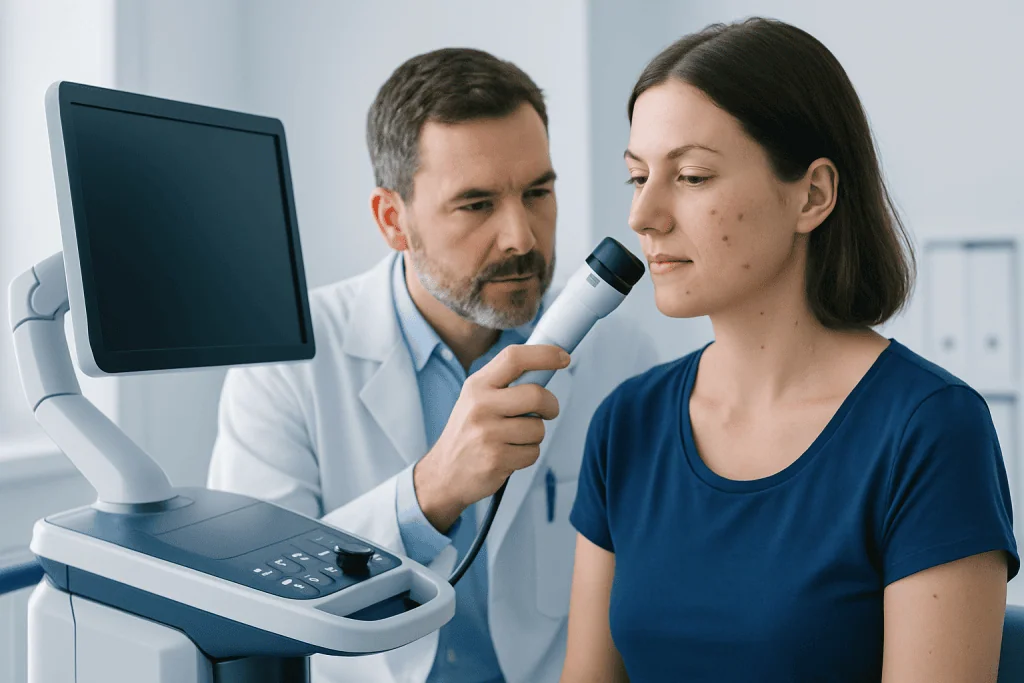
During the examination, the doctor looks at the spot’s size, border, color, symmetry, and texture, as well as its location on the body. In many cases, a handheld device called a dermatoscope is used to examine patterns below the skin surface that are not visible to the naked eye. This can improve the assessment of moles, pigmented lesions, and suspicious growths.
If the diagnosis remains unclear, further tests may be needed. These can include skin scraping for fungal infection, photographs for monitoring change over time, or a biopsy to examine a small sample of tissue under a microscope. When a lesion appears concerning, doctors may recommend prompt skin biopsy or removal to confirm whether it is benign, inflammatory, infectious, or malignant.
Treatment options for different kinds of skin spots
Treatment depends entirely on the cause. Some skin spots need no treatment at all and can simply be monitored. This is common for stable freckles, benign moles, and some age-related skin changes. When a spot causes cosmetic concern but is not medically dangerous, treatment is optional and should follow a clear diagnosis rather than guesswork.
For inflammatory or infectious causes, doctors may recommend topical therapies, antifungal treatment, or other medicines based on the underlying condition. Pigment changes related to acne, eczema, or irritation often improve gradually once inflammation is controlled, though fading can take time. Sun protection is an essential part of treatment for many pigmented spots because ultraviolet exposure can make discoloration last longer or recur.
Procedures may be used for selected lesions. Depending on the diagnosis, this can include cryotherapy, cautery, excision, laser-based treatment, or removal of suspicious moles. If the spot is potentially cancerous or confirmed as malignant, treatment is planned according to the specific diagnosis and may involve skin cancer treatment. In complex cases, multidisciplinary evaluation can be helpful; Acibadem International’s specialists in JCI-accredited hospitals diagnose and treat skin conditions for international patients.
Prevention and self-care
Not all skin spots can be prevented, but daily habits can reduce the risk of many common causes. Sun protection is especially important. Broad-spectrum sunscreen, protective clothing, hats, and seeking shade during strong sunlight can help limit new pigment spots and reduce cumulative skin damage. Tanning beds should also be avoided.
Gentle skin care supports a healthier skin barrier and may reduce inflammatory spots. This includes avoiding harsh scrubbing, treating acne early, using fragrance-free products if the skin is sensitive, and not picking at lesions. Picking increases the chance of scarring and post-inflammatory dark marks, particularly in deeper skin tones where pigment changes may be more noticeable and longer lasting.
It is also useful for patients to know their own skin. A monthly self-check in good lighting can help identify new or changing spots. Looking at the scalp, soles, nails, and back with a mirror or assistance may reveal lesions that are easy to miss. If a patient already has many moles, a clinician may advise periodic professional skin checks and, in selected cases, dermoscopic monitoring or mole removal for a lesion that appears atypical or repeatedly irritated.
When to seek medical care
Medical care is appropriate if a skin spot is new and unusual, changes quickly, has uneven color, or looks different from other spots. Review is also advisable for lesions that bleed, crust, itch persistently, become painful, or do not heal within several weeks. These features do not always mean something serious, but they do justify examination by a qualified doctor.
Patients should also seek assessment if skin spots are widespread, accompanied by fever or general illness, or appear after starting a new medication. In children, during pregnancy, or in people with weakened immune systems, a lower threshold for medical advice is sensible because some rashes and pigment changes need tailored evaluation. Anyone with a personal or family history of skin cancer should be particularly attentive to new or changing lesions.
Urgent medical review is important for rapidly expanding dark lesions, a sore that repeatedly opens and heals, or sudden widespread purple spots that do not blanch when pressed. Although many skin spots are harmless, timely diagnosis can bring reassurance and, when needed, allow earlier treatment with better outcomes.
Frequently asked questions
Are skin spots usually harmless?
Yes, many skin spots are harmless and are caused by sun exposure, aging, healed inflammation, or benign growths. However, a spot that is new, changing, bleeding, or not healing should be evaluated by a doctor.
What causes dark spots on the skin?
Dark spots often result from increased pigment production. Common causes include sun exposure, post-inflammatory hyperpigmentation after acne or eczema, hormonal changes such as melasma, and some benign moles or age spots.
How can a person tell if a skin spot might be cancerous?
Warning signs include asymmetry, irregular borders, several colors in one spot, growth over time, and bleeding or crusting. A lesion that stands out from others on the body or keeps changing should be checked by a clinician.
Do skin spots go away on their own?
Some do, especially spots related to temporary inflammation, minor irritation, or healing after a rash. Others, such as freckles, many sun spots, and some moles, may persist unless treated.
Can sunscreen help prevent skin spots?
Yes, regular use of broad-spectrum sunscreen can help prevent some pigment spots and reduce worsening of existing discoloration. Sun protection also lowers cumulative UV damage and supports skin cancer prevention.
When is a biopsy needed for a skin spot?
A biopsy may be needed when a spot has suspicious features, when the diagnosis is uncertain, or when treatment depends on confirming the exact cause. It allows a tissue sample to be examined under a microscope for a more definite diagnosis.
References
- American Academy of Dermatology
- National Health Service
- Mayo Clinic
- World Health Organization
- National Cancer Institute
This article is for general information only and is not a substitute for professional medical advice. Please consult a qualified doctor about your individual situation.
Oncology care in Turkey — second opinion and treatment plan
JCI-accredited · board-certified surgeons · reply within 24h
Add us as a Preferred Source to see more of our trusted health content across Google Search, AI Overviews and Discover.