

Anesthesia for Pediatric Surgery: What Parents Can Expect Before, During and After

Key Takeaways
- The 2-4-6 fasting rule stops clear fluids 2 hours, breast milk 4 hours, and formula or solid food 6 hours before anesthesia, counted back from the scheduled start time, not from leaving home.
- Most children are rousable within about 15 minutes of the anesthetic being switched off, but recovery-room stays of half an hour to a couple of hours are normal before discharge criteria are met.
- Emergence delirium, a brief inconsolable thrashing state on waking, affects a substantial minority of preschoolers, usually lasts 5–15 minutes, and leaves no memory.
- A chesty cough, wheeze or fever is the most common reason an operation is postponed on the day, because an irritable airway is more likely to spasm under anesthesia.
- The best human studies of a single short anesthetic in children under three, including a randomized trial of infant hernia repair, found no measurable difference in later IQ.
- Sedation uses the same medicine families and carries the same airway risks as general anesthesia, so it requires identical fasting and monitoring rather than being a lighter alternative.
Pediatric anesthesia follows a predictable pathway: a pre-operative assessment, fasting guided by the 2-4-6 rule, a brief mask or IV induction, continuous monitoring by an anesthesia team throughout the operation, and a wake-up in a recovery area that usually takes minutes to about an hour. Most children are groggy, teary or clingy for a few hours afterward. Serious complications are rare in otherwise healthy children, and each step is tailored to the child.
It is 5:40 in the morning and your six-year-old is asking why there is no cereal. You already know the answer, because the nurse explained the fasting times twice, but saying no to breakfast on a day you are already anxious feels like the first of many small tests. Somewhere in the back of your mind sits the question you typed into a search bar the night before: pediatric anesthesia, what to expect, honestly, from someone who will not just tell you everything is fine.
Here is the honest version. Anesthesia for children is one of the most carefully standardized parts of modern surgery, with its own specialists, equipment sized for small airways, and a long record of safety research. It is also strange to witness. Your child will go limp in your arms or on a trolley, and you will walk out of the room without them.
Knowing the sequence in advance does not remove the strangeness, but it does shrink it to a manageable size. That is what this guide is for.
How pediatric anesthesia actually works, step by step
Anesthesia is a controlled, reversible state in which medicines switch off awareness, memory, movement and the body’s reaction to pain. In children, it is almost always general anesthesia, meaning the child is fully unconscious, because very few children can lie perfectly still through an operation or a scan.
The person running it is an anesthesiologist, a physician who trained for several years after medical school specifically in anesthesia, often with extra pediatric training. In many hospitals a nurse anesthetist or anesthesia resident works alongside them. Their job starts long before the first medicine is given and does not end until the child is awake and comfortable.
The process has three phases. Induction is the start, when the child drifts off, either by breathing an anesthetic gas through a soft mask or through a small plastic tube in a vein (an IV). Maintenance is the middle, when the anesthesiologist keeps the child asleep with a steady supply of gas, intravenous medicine or both, adjusting it second by second against the monitors. Emergence is the end, when the medicines are turned off, breathed out or broken down by the body, and the child wakes.
Most children under general anesthesia have a breathing device placed once they are asleep. This is either an endotracheal tube, a thin tube that passes between the vocal cords into the windpipe, or a laryngeal mask, a soft cuff that sits above the voice box. The child never feels it go in and rarely remembers it coming out, although a scratchy throat afterward is common, as both the NHS and Mayo Clinic patient guidance describe.
The mechanism matters because it explains the rules. Anesthetic medicines also quiet the reflexes that protect the airway, which is why fasting is strict, and they relax the muscles of breathing, which is why someone whose only task is watching your child’s breathing stays in the room the entire time.
Who usually needs anesthesia as a child, and who is asked to wait
Children are given anesthesia for a wider range of reasons than adults. Alongside operations such as hernia repair, tonsil removal, ear tube placement or fracture fixation, it is routinely used for MRI scans in young children, for dental treatment that cannot be done awake, for some bone marrow or lumbar puncture procedures, and for radiotherapy planning. The common thread is not the size of the procedure but the need for a child to be still, pain-free and unaware.

Age alone is rarely a barrier. Newborns, including premature babies, have anesthesia when the operation cannot safely wait. What changes with age is the planning: smaller equipment, closer attention to temperature and fluid balance, and in the youngest infants, a period of overnight monitoring because immature breathing control can produce pauses in breathing after anesthesia.
Who is asked to wait? The most frequent reason for a last-minute postponement is a respiratory infection. A child with a fever, a wet cough, wheeze or a chesty cold has an irritable airway that is more likely to spasm or produce thick secretions under anesthesia. A clear runny nose with no fever is often acceptable; a cough that keeps the child awake usually is not. The anesthesiologist makes that call on the morning, which is why you will be asked, more than once, how your child has been in the past couple of weeks.
Other reasons for delay include an unexplained rash, a recent asthma flare, poorly controlled epilepsy, a new heart murmur that has not been assessed, and, for elective surgery, a child who is not yet old enough for a procedure that can reasonably wait. None of these are judgments about the child or the family. Postponing is the system working as designed.
If your child has a long-term condition such as asthma, diabetes, sleep apnea, a syndrome affecting the face or airway, or a bleeding disorder, expect the pre-operative conversation to be longer and possibly to involve the child’s specialist as well.
What is the 2-4-6 rule for anesthesia fasting in children?
Fasting before anesthesia is the rule families remember most, and the one most often misunderstood. The reason is aspiration: if a child vomits while the protective reflexes of the throat are switched off, stomach contents can enter the lungs. An empty stomach makes that far less likely.
The 2-4-6 rule is a memory aid used across anesthesia society guidelines, including the fasting guidance reflected in NHS and Mayo Clinic patient information. It means:
- 2 hours before anesthesia: stop clear fluids. Water, diluted apple juice without pulp and clear oral rehydration drinks count. Milk does not.
- 4 hours before: stop breast milk.
- 6 hours before: stop infant formula, cow’s milk, and solid food, including gum, sweets and chewing on toast crusts.
Two practical points soften what sounds severe. First, the clock runs backward from the planned anesthesia time, not from when you leave the house, so a late-morning slot often allows an early breakfast. Second, children are actively encouraged to drink clear fluids up to the cut-off. Some centers now allow clear fluids until one hour beforehand, following updated pediatric guidance, because a well-hydrated child is calmer, has easier veins to find and feels less miserable. Your own hospital’s written instructions override any general rule, including this one.
A heavy, fatty meal the evening before is also worth avoiding, since fat slows stomach emptying. And if a sibling slips the patient a cracker in the waiting room, tell the staff. The honest answer may delay the start by a couple of hours; the dishonest one carries real risk. Nobody will be cross. Operating lists are built with these moments in mind.
Pediatric anesthesia: what to expect at the pre-operative assessment
Days or sometimes weeks before surgery, you will be asked to attend a pre-operative assessment, either in person, by phone or by video. This is where most of the risk management happens, quietly, with a clipboard rather than a monitor.
The nurse or anesthesiologist will go through the child’s medical history, previous anesthetics and how they went, allergies, current medicines including inhalers and supplements, and whether anyone in the family has had an unusual reaction to anesthesia. That last question is not small talk. Rare inherited conditions, such as malignant hyperthermia, a dangerous rise in body temperature and muscle breakdown triggered by certain anesthetic medicines, run in families and change which medicines are chosen.
Expect questions about snoring, pauses in breathing during sleep and daytime sleepiness, because obstructive sleep apnea alters how much pain medicine a child tolerates afterward. Expect questions about loose teeth, since a wobbly tooth can be dislodged when the breathing device goes in. Expect a weight, because almost everything in pediatric anesthesia is calculated per kilogram.
You will also be told which regular medicines to give on the morning and which to hold, with a small sip of water allowed. Follow those instructions exactly; if you are unsure, call and ask rather than guessing. Do not stop or start anything on your own.
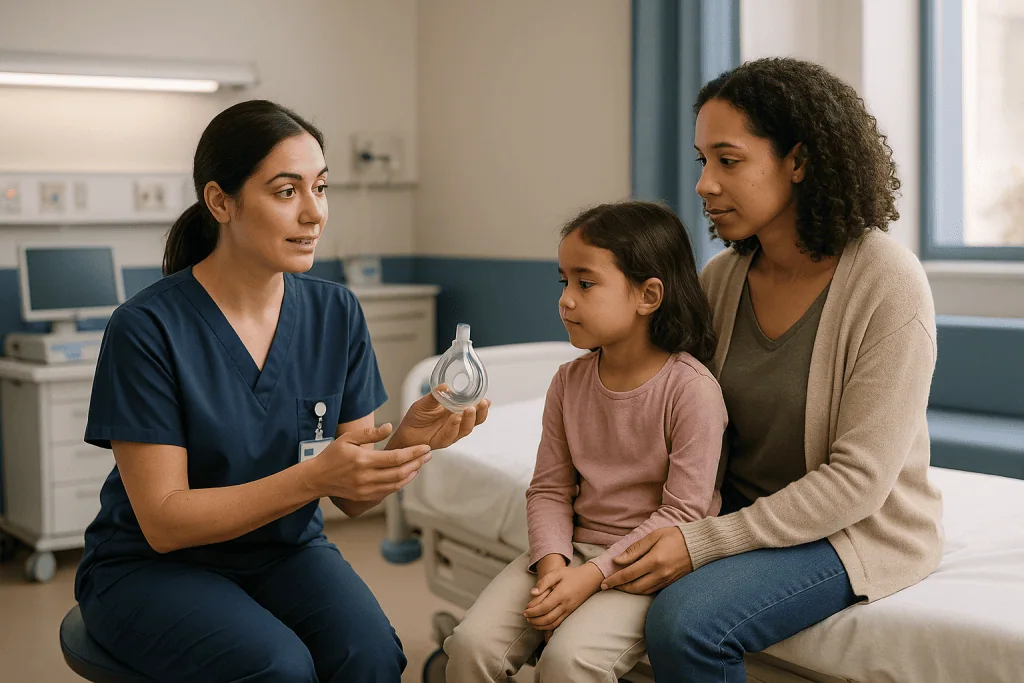
This is also the visit for practical preparation. Many hospitals run play-based sessions where a child-life specialist, a professional trained in helping children cope with medical experiences, lets the child handle a mask, try the finger clip that measures oxygen, and act out the day on a doll. The evidence for this kind of preparation is reasonably consistent: children who know roughly what will happen, in age-appropriate terms and timed close to the event, are less distressed at induction than children who are surprised by it.
Pediatric anesthesia: what to expect on the morning of surgery
Arrival is usually one to two hours before the scheduled time, as hospital guidance from the NHS and Mayo Clinic describes. Those hours fill with the same questions you answered before, asked again by different people. This repetition is deliberate; it is a safety check, not disorganization.
Your child will change into a gown or loose clothing, have temperature, pulse and oxygen level recorded, and get a wristband. A numbing cream or spray may be applied to the back of the hands so that if an IV is needed it hurts less; the cream takes a while to work, which is one more reason for the early arrival.
Then comes the part parents dread and children mostly do not: induction. For most preschool and school-age children, this happens with a mask. The anesthesiologist holds a soft mask near, then over, the nose and mouth while the child breathes a mixture of oxygen and an anesthetic gas that smells faintly sweet, sometimes flavored with a lip balm scent chosen by the child. Within about a minute of breathing the gas, the child becomes floppy and unresponsive. Many go through a brief phase of wriggling or eye-rolling on the way down. It looks alarming and is entirely normal.
Older children, teenagers and children who already have an IV are more often put to sleep through the vein, which works within seconds. Teenagers are usually asked which they prefer.
Whether a parent can be present varies by hospital and by child. One calm parent in the room reassures many children; a visibly frightened parent can make things worse, and anesthesiologists are candid about that. If you are invited in, your role is simple: a steady voice, a familiar story, a hand on the chest. A nurse will walk you out the moment your child is asleep. Expect to feel wrung out. That is also normal.
What happens while your child is asleep in the operating room
The hour or hours you spend in the waiting area are, from the anesthesiologist’s side, a period of constant small adjustments. Nobody is watching a clock and waiting for the surgeon to finish. Someone is watching your child’s physiology, breath by breath.
Standard monitoring for every child under anesthesia includes continuous measurement of heart rhythm, blood pressure, oxygen saturation (the percentage of hemoglobin carrying oxygen, measured by the clip on a finger or toe), the carbon dioxide in each exhaled breath, and body temperature. Children lose heat quickly because of their large skin area relative to body weight, so warming blankets and warmed fluids are routine.
Once the child is asleep, an IV is placed if it was not already there. Fluids run through it to replace what fasting removed. Pain-relieving medicines are given before the first incision, not after, because pain signaling is easier to prevent than to chase. Many operations below the waist in young children also include a caudal block, an injection of local anesthetic through the small opening at the base of the spine that numbs the lower body for several hours. Done while the child is asleep, it reduces the amount of general anesthetic needed and means the child often wakes with little pain at all.
Anti-nausea medicines are commonly given during the procedure for operations known to provoke vomiting, such as tonsillectomy or squint surgery. The anesthesiologist chooses these based on the child’s age, weight and the operation.
Toward the end, the anesthetic is lightened. The breathing device is removed either while the child is still deeply asleep or once protective reflexes return, a judgment based on the child’s airway and the surgery. The child is then moved, usually asleep or barely stirring, to the recovery room, where a dedicated nurse takes over and the anesthesiologist hands over every detail.
General, regional, sedation or local: a comparison of anesthesia types for children
Parents often assume anesthesia means one thing. In practice the anesthesiologist combines techniques, and it helps to know the vocabulary when the plan is explained. Regional anesthesia means numbing a region of the body with local anesthetic injected near nerves; sedation means medicines that make a child drowsy and relaxed without full unconsciousness; local anesthesia numbs only a small patch of skin or tissue.
| Type | What the child experiences | Commonly used for | Typical notes for parents |
|---|---|---|---|
| General anesthesia | Fully unconscious, no memory, breathing supported | Most operations in children of any age; MRI in young children | Full fasting rules apply; wakes in a recovery room |
| Regional block (for example caudal, spinal or nerve block) | Numbness and heaviness in one area; in children almost always combined with general anesthesia or sedation | Hernia repair, circumcision, lower-limb and some arm surgery | Numbness may last several hours after waking; the leg or arm should be protected until feeling returns |
| Sedation | Drowsy, relaxed, may doze; may remember parts | Short scans, some dental work, minor procedures | Fasting rules still usually apply; monitoring is the same as for general anesthesia |
| Local anesthesia alone | Awake, numb patch only | Stitches, small skin procedures in cooperative older children | No fasting needed; a parent usually stays throughout |
Two points in this table deserve emphasis. First, sedation is not a lighter, safer alternative that escapes the rules of general anesthesia. A sedated child can slip deeper than intended, so the monitoring, the fasting and the trained person at the head of the bed are all the same. Second, regional techniques in children are mostly an addition to general anesthesia rather than a replacement for it, because a child cannot be expected to lie still and calm while awake during an operation. The gain is less pain on waking and less opioid needed afterward.
Which combination your child receives depends on the operation, the child’s health, the surgeon’s requirements and the anesthesiologist’s judgment. It is a reasonable thing to ask about and a decision that sits with the treating team.
Is anesthesia safe for toddlers and a 4 year old? What the evidence shows
This is the question underneath all the others, so it deserves a direct answer with the uncertainty left in.
For the immediate risks, the picture is reassuring. Serious complications of anesthesia in otherwise healthy children, such as a severe allergic reaction, a dangerous airway event or cardiac arrest, are rare, and death attributable to anesthesia alone in healthy children is very rare in high-income health systems, as patient guidance from Mayo Clinic and the NHS states. The risks rise with serious underlying illness, with emergency surgery and in the youngest infants, which is exactly where the extra planning described earlier is concentrated.
The longer-term question concerns the developing brain. Studies in young animals showed that prolonged or repeated exposure to anesthetic medicines could affect developing nerve cells. On that basis the US Food and Drug Administration added a label warning in 2016 about repeated or lengthy anesthesia, meaning more than about three hours, in children under three years of age. The warning was explicitly cautious: it did not conclude that harm occurs in children, and it did not advise delaying necessary surgery.
Human evidence since then has been more reassuring than the animal work. A large randomized trial that compared general anesthesia with awake regional anesthesia for infant hernia repair, with roughly an hour of exposure, found no difference in intelligence scores at age five. A sibling-matched study comparing children who had one brief anesthetic before age three with their unexposed siblings also found no difference in later cognitive testing. What these studies cannot yet fully answer is the effect of multiple long anesthetics in very young children, which remains an area of ongoing research.
The practical conclusion drawn by pediatric anesthesia bodies is this: a single, relatively short anesthetic in a healthy toddler or four-year-old has not been shown to affect development, and the risks of delaying a needed operation are real and measurable. If your child needs several procedures, it is worth asking whether any can be combined under one anesthetic.
Child waking up from anesthesia: how long does it usually take?
Modern anesthetic gases are breathed out almost as fast as they were breathed in, and the intravenous medicines in common use are broken down quickly by the liver. That is why the wake-up is fast. Most children open their eyes within minutes of the anesthetic being switched off, often before they reach the recovery room, and are rousable, if not exactly awake, within a quarter of an hour or so.
Being rousable and being ready to go home are different things. Patient information from the NHS and Mayo Clinic describes recovery-room stays that commonly run from about half an hour to a couple of hours, depending on the operation, the medicines used and how the child is doing. Recovery nurses work to a checklist: breathing steadily without support, oxygen levels normal on room air, pain controlled, no active bleeding, temperature normal, and, for day surgery, able to drink and often to pass urine. Children who had a caudal or spinal block may be kept until some leg movement returns.
Several things make the wake-up slower. Long operations, a large dose of opioid pain medicine (given because the operation was painful, not because anything went wrong), low body temperature, and simply being very young all stretch the timeline. A child who stays sleepy for an hour or more is usually being watched for exactly these ordinary reasons, and the recovery nurse will tell you so.
You will typically be called into the recovery area once your child is stirring, so that the first face they focus on is a familiar one. Bring the comfort object. A child who wakes to the smell of a well-worn blanket settles faster than one who wakes to a stranger’s reassurance, however kind.
Children admitted overnight, including young infants and those with sleep apnea or other conditions, continue to be monitored on the ward with the same oxygen clip you saw in the morning.
How do kids act after anesthesia? Emergence delirium and other normal strangeness
Nothing in the leaflets quite prepares a parent for a child who wakes screaming, thrashing and apparently not recognizing them. This is emergence delirium, sometimes called emergence agitation: a short, dissociated state in the first minutes after waking in which the child may be inconsolable, stare without focusing, push away comfort and seem not to know where they are.
It is common, especially in preschool-age children and after the fastest-acting anesthetic gases. A review published through PubMed reports rates that vary widely between studies depending on how it is defined, from about 10% up to half or more of young children in some series. Episodes typically last 5–15 minutes and usually resolve within half an hour, after which the child is often sleepy, then themselves, with no memory of it.
It is distressing to watch and essentially harmless. The recovery nurses have seen it many times. Their advice is usually to keep lights low, voices quiet, hands gentle, and to avoid repeatedly asking the child to look at you or answer questions. If the agitation is severe or prolonged, the anesthesiologist can give a small amount of medicine to settle it, a decision made at the bedside.
Beyond that first half hour, the rest of the day has its own pattern. Expect tearfulness, clinginess and a short fuse. Expect a child who wants to be carried everywhere or who refuses to be touched. Expect an unusual nap. Some children are oddly cheerful and chatty; a few say things that make the recovery staff laugh and that the child would be mortified to hear repeated. Nausea is common, more so after some operations, and a small vomit in the car is not a crisis.
Toddlers may be wobbly on their feet for the rest of the day and should be carried or watched closely on stairs. Older children should not cycle, climb or swim until the next day at the earliest, and teenagers should not make important decisions, sign anything or use the stove, as the NHS and Mayo Clinic both advise for the 24 hours after a general anesthetic.
The first days at home: a typical recovery timeline
Most of what happens in the days after surgery belongs to the operation rather than the anesthetic, but the two are tangled together in a child’s experience, and parents want a map. The timeline below reflects typical patterns described in NHS and Mayo Clinic guidance for general anesthesia; your child’s surgical team will give instructions specific to the procedure, and those take priority.
The first evening. Sleepiness, poor appetite and an unsettled mood are the norm. Offer small sips, then light food such as toast, yogurt or soup, rather than a full meal. A child who vomits once and then keeps fluids down does not need to be seen; a child who cannot keep any fluids down does. A low-grade temperature on the first night is common after surgery. Pain relief should be given on the schedule the team wrote down, before pain builds, rather than waiting to see whether it is needed.
The next day. Most children are substantially more themselves. Appetite returns, often with a vengeance. A sore throat from the breathing device, a hoarse voice and a small bruise where the IV sat are expected and fade over two or three days. Some children have a croupy cough for a day or so.
Days two to seven. Behavior changes are the part that surprises families. A proportion of young children show new clinginess, night waking, bedwetting after being dry, tantrums or fear of being left, for days or occasionally a few weeks after surgery. These are recognized in the pediatric literature as a reaction to the whole experience rather than a drug effect, and they settle with routine, patience and no particular treatment. Keep bedtime rituals exactly as they were.
Returning to normal. Nursery or school return depends on the operation, not the anesthetic. Tell the teacher what happened; small accommodations on the first day back help.
Keeping your child comfortable: pain, nausea, sore throat and the IV
Comfort after anesthesia is partly medical and partly choreography, and parents do most of the choreography.
Pain in children is routinely underestimated, because young children do not reliably say they hurt. They go quiet, refuse to move, or become angry. Pediatric teams therefore work on scheduled pain relief for the first day or two after any operation likely to hurt, usually combining a simple analgesic with an anti-inflammatory, and reserving stronger medicines for specific situations. The exact plan, including which medicines and how often, is written down at discharge and belongs to the prescribing clinician. If what is written is not working, call rather than improvising with something from the cabinet.
Nausea and vomiting after anesthesia affect a meaningful minority of children, particularly after tonsillectomy, eye muscle surgery and ear operations, and in children with a history of motion sickness. Anti-nausea medicine is often given during the procedure. At home, slow sips, a cool room, avoiding car journeys straight after a big drink, and not forcing food all help.
A sore throat from the breathing device is best treated with cool drinks, ice pops and time; it rarely lasts more than a couple of days. Hoarseness follows the same course.
The IV site is usually covered with a small dressing that can come off the next day. A little bruising is expected. Redness spreading beyond the site, warmth or a hard tender cord along the vein are reasons to call.
Finally, comfort is also about the child feeling in control again. Let them choose the film, the pajamas and the snack. Praise specific brave things they did. Avoid telling the story of the screaming wake-up in front of them. Children rebuild their sense of safety quickly when adults behave as if the ordinary world has returned, and it has.
What people often get wrong about anesthesia in children
Some of the most persistent anxieties about pediatric anesthesia rest on ideas that the evidence does not support. Correcting them is not about dismissing fear but about aiming it accurately.
Myth: a child can wake up during the operation and feel everything. Awareness under general anesthesia is very rare, and rarer still in children, who are monitored continuously for the physical signs of lightening anesthesia. The brief wriggling at induction and the agitation at emergence are not awareness; the child does not remember either.
Myth: it is safer to ask for sedation instead. Sedation uses the same families of medicines, carries the same airway risks and requires the same monitoring. For a child who cannot reliably stay still, a planned general anesthetic is often the more controlled option. The choice belongs to the anesthesiologist.
Myth: counting backwards from ten is how you know it worked. Children are rarely asked to count. With a mask induction they drift off mid-sentence; with an IV they are asleep before the second number. The counting exists mostly in films.
Myth: a cold is just a cold. A child with a chesty cough has a measurably higher chance of airway spasm and oxygen dips under anesthesia. Postponement is caution, not inconvenience.
Myth: anesthesia lowers IQ. The animal studies that prompted regulatory warnings involved prolonged or repeated exposure. The best human studies of a single short anesthetic in young children have not found a measurable effect on later cognition. Uncertainty remains about multiple long exposures, and that is where research continues.
Myth: a child who is still asleep an hour later is in trouble. Long operations, strong pain relief and youth all extend the wake-up. The recovery nurse watching the monitor will tell you if anything is actually wrong.
Myth: being honest about the fasting slip-up will get you told off. It will get the list rearranged. The alternative is a risk nobody in the building wants.
Questions to ask your child's anesthesia care team
You will usually meet the anesthesiologist on the morning of surgery, sometimes for only a few minutes. A short written list keeps that meeting useful rather than a blur. These are questions parents regularly wish they had asked.
- Who will be giving my child’s anesthetic, and will they be present for the whole operation?
- Will my child go to sleep with a mask or through a vein, and may my child choose?
- Can I be present at induction, and can I be called to recovery as soon as my child begins to wake?
- Is a regional block, such as a caudal, part of the plan, and how long will the numbness last?
- What will you give to prevent pain and nausea before my child wakes, and what will we use at home?
- Does my child’s snoring, asthma, heart murmur or syndrome change the plan or mean an overnight stay?
- If my child develops a cold before the date, who do I call and how do you decide whether to proceed?
- What exact fasting times apply to us, given the scheduled time of the operation?
- Which of my child’s regular medicines should be given on the morning, and which held?
- What signs after we go home should make me call, and what number do I call at night?
Ask also about the practical things that no leaflet covers: whether the comfort object can go into the operating room, whether a sibling can wait with you, and where you should be when the operation ends. If your child has had a difficult experience with a previous anesthetic, say so clearly and early. Anesthesiologists adjust their approach for a child who was terrified last time, and the earlier they know, the more they can do.
There is no question on this list that an anesthesia team will find unreasonable. The decisions remain theirs; the understanding should be shared.
When to call your doctor after your child's anesthesia
Most of the first 24 hours after a general anesthetic is spent waiting for an ordinary child to re-emerge, and in the great majority of families that is exactly what happens. A small number of signs mean you should not wait. Your discharge paperwork will carry a direct number for the surgical ward or day unit; use it. If a sign is severe, call emergency services.
Seek urgent help the same day, or sooner, if your child:
- has difficulty breathing, noisy or fast breathing, flaring nostrils, the skin pulling in between the ribs, or a blue or gray tinge to the lips
- is unusually difficult to wake, floppy, or confused beyond the first few hours, or if drowsiness is getting worse rather than better
- cannot keep down any fluids for several hours, passes very little urine, or has a dry mouth and no tears
- has a temperature that is high and rising, especially with shivering, a stiff neck or a rash that does not fade when pressed
- has bleeding from the wound or mouth that soaks a dressing, or any fresh bleeding after tonsil surgery
- has pain that is not controlled by the scheduled medicine the team prescribed
- develops a spreading rash, swelling of the face or lips, or widespread hives
- has not regained feeling or movement in a limb that was numbed by a block within the time the anesthesiologist told you to expect, or the limb becomes pale, cold or severely painful
- has a croupy, barking cough that is getting worse or interferes with breathing
Call during working hours, without alarm, for a sore throat lasting more than a few days, hoarseness that is not improving, a red or hard IV site, persistent nausea, or behavior changes that are still disrupting the household after a couple of weeks.
Trust the instinct that something is not right. Parents detect subtle change in their own child before any monitor does, and the teams who look after children expect, and welcome, those calls.
Frequently asked questions
What is the 2 4 6 rule for anesthesia?
The 2-4-6 rule is a fasting memory aid: no clear fluids for 2 hours, no breast milk for 4 hours, and no formula, cow’s milk or solid food for 6 hours before anesthesia. It exists to lower the risk of stomach contents entering the lungs while protective reflexes are switched off. Some centers now allow clear fluids until one hour before. Your hospital’s written instructions always override the general rule.
Is it safe for a 4 year old to have anesthesia?
For a healthy four-year-old having a single, relatively short procedure, serious anesthesia complications are rare and large human studies have not found an effect on later learning or IQ. Regulatory warnings about brain development concern repeated or prolonged anesthesia, typically more than three hours, in children under three, and remain an area of research. The anesthesiologist weighs the specific operation and your child’s health, and the risks of delaying needed surgery count too.
How long does it usually take for a child to wake up from anesthesia?
Most children open their eyes within minutes of the anesthetic being turned off and are rousable within about a quarter of an hour, because modern anesthetic gases are breathed out quickly. Full recovery-room discharge takes longer, commonly from half an hour to a couple of hours, while nurses confirm steady breathing, controlled pain, normal temperature and the ability to drink. Long operations, strong pain relief and very young age all extend the timeline.
How do kids act after anesthesia?
Expect grogginess, tearfulness, clinginess, a short temper and sometimes an unusual nap for the rest of the day. Many preschoolers go through a few minutes of emergence delirium, screaming or thrashing without recognizing you, which settles on its own. Nausea, a sore throat and a wobbly walk are also common. Some children show clinginess, night waking or tantrums for days to a few weeks afterward; this is a reaction to the experience and resolves with routine.
Is anesthesia safe for toddlers having an MRI or dental work?
Anesthesia for scans and dental treatment in toddlers uses the same monitoring, fasting rules and trained staff as anesthesia for an operation, and in otherwise healthy children serious complications are rare. The main consideration is avoiding repeated separate anesthetics where procedures could be combined, since the unanswered research questions concern multiple or prolonged exposures in very young children. Ask the team whether anything can be done under one anesthetic.
Can I stay with my child while they go to sleep?
Many hospitals allow one calm parent to be present at induction, although policies differ and some situations, such as emergency surgery or very young infants, make it impractical. If you are invited in, your job is a steady voice and a familiar hand until your child is asleep, after which a nurse will walk you out. Anesthesiologists are honest that a visibly frightened parent can make a child more distressed, so it is fine to decline.
Why can't my child have anesthesia with a cold?
A respiratory infection makes the airway more irritable, which raises the chance of coughing, breath-holding, airway spasm and drops in oxygen during and after anesthesia. A clear runny nose without fever is often acceptable; a wet cough, wheeze or fever usually means postponing until the chest is clear. The anesthesiologist decides on the morning, which is why you are asked repeatedly about recent illness.
What is a caudal block and why is it used in children?
A caudal block is an injection of local anesthetic through the small opening at the base of the spine, given while the child is already asleep, that numbs the lower half of the body for several hours. It is commonly combined with general anesthesia for hernia repair, circumcision and lower-limb surgery. It reduces the amount of general anesthetic and opioid needed and means many children wake with little pain.
Will my child remember the operation or the breathing tube?
Almost never. General anesthesia switches off memory formation, so children do not recall the operation, the breathing device going in or coming out, or usually the episode of agitation some have on waking. What children do remember is the surroundings before and after: the waiting room, the mask, the recovery nurse. Preparing them for those parts in simple, honest language is what reduces later anxiety.
What should my child eat and do on the first day home after anesthesia?
Start with small sips of clear fluid, then light food such as toast, yogurt or soup, and let appetite guide the rest. For 24 hours children should be supervised closely, carried or watched on stairs, kept away from bikes, climbing frames and swimming, and older children should not use the stove or make important decisions. Give pain relief exactly as the team wrote it down, and call if your child cannot keep fluids down.
References
This article is for general information only and is not a substitute for professional medical advice. Please consult a qualified doctor about your individual situation.

More from the Blog

Toddler Tantrums, Talking and Potty Training: The Normal Ranges
Most toddler tantrums are a normal stage of brain development, most common between 18 months and 3 years and usually fading by age 4.…

Why Do Videos of Movement Episodes Help? Preparing for a Pediatric Movement Assessment
Videos help because movement episodes in children are brief, unpredictable and hard to describe, and a clinician rarely witnesses one in clinic. A steady,…

Grommets (Ear Tubes): What They Are, What They Do and Whether They Fall Out
Grommets, also called ear tubes or tympanostomy tubes, are tiny hollow cylinders placed through the eardrum during a short operation. They let air into…

How Long Does Kawasaki Disease Recovery Take? Fever Settling, Peeling Skin and Tired Weeks
Kawasaki disease recovery usually unfolds over weeks rather than days. When treatment is given within the first 10 days of fever, the fever typically…

Bronchiolitis in Babies: Is It Contagious, How Serious Is It, and How Is It Treated?
Bronchiolitis very rarely kills. It is a common viral chest infection in babies under two, and most cases are mild and clear on their…

How Can Parents Comfort a Child With Viral Croup? Calm Positions, Fluids and Rest
To comfort a child with croup, stay calm and hold the child upright on your lap, because crying and lying flat can tighten the…