

Ankle Replacement Recovery: From Cast to Walking Boot to Full Weight-Bearing

Key Takeaways
- Unlike a hip or knee replacement, a new ankle is usually kept in a cast or splint with no weight on the leg for the first weeks, according to MedlinePlus.
- The walking boot marks the start of staged weight-bearing, not automatic permission to walk normally, so ask exactly what your boot allows.
- Johns Hopkins describes full recovery from ankle replacement as taking up to a year, with swelling that can persist for months.
- Extra procedures done alongside the replacement, such as calf lengthening or a neighboring fusion, are a common reason one person's timeline runs longer than another's.
- Physical therapy rebuilds three things a cast takes away: ankle range of motion, calf and foot strength, and the balance sense that lets you walk on uneven ground.
- Calf pain and swelling, spreading wound redness, fever, or sudden breathlessness are red flags that need a same-day call or emergency care rather than watchful waiting.
Ankle replacement recovery time typically runs in stages: a cast or splint with no weight on the leg for the first few weeks, a walking boot with gradually increasing weight-bearing through roughly the second and third months, and steady gains in strength and swelling control for up to a year. Patient resources from MedlinePlus and Johns Hopkins describe several months before everyday walking feels normal, with the exact pace set by your surgical team.
The first thing many people notice after ankle replacement surgery is not the ankle at all. It is the ceiling. Lying with a heavy leg propped on three pillows, waiting for the nerve block to fade, the question that arrives is blunt: how long until I can just walk across the kitchen?
Ankle replacement recovery time is a genuinely different experience from a hip or knee replacement, and that catches people off guard. A new hip often carries weight within a day. A new ankle does not. The joint is small, the surrounding skin is thin, and the implant needs quiet weeks to settle into bone before it can carry a body.
This explainer follows the real sequence most patients live through: cast, boot, first full steps, and the long, slower tail of swelling and strength. Where a number appears, it is tied to a mainstream source. Where the evidence is thin, we say so.
What does ankle replacement recovery time actually look like?
Think of ankle replacement recovery time as three overlapping seasons rather than one countdown. The first season protects. The second reloads. The third rebuilds.
Protection comes first because a total ankle replacement, also called total ankle arthroplasty, involves resurfacing the two bones that meet at the ankle: the tibia, your shin bone, and the talus, the bone that sits on top of your heel. Metal components are fixed to each bone with a plastic spacer between them. Bone needs undisturbed time to grow onto or around those components, and the skin over the front of the ankle, which has a modest blood supply, needs time to knit. MedlinePlus describes a period in a cast or splint without weight on the leg during this stage, and it is measured in weeks, not days.
Reloading follows. Once the incision is sound and early imaging looks stable, the cast gives way to a removable walking boot, and weight is added in steps. This is when most people feel recovery finally begins, because they can shower more easily, start physical therapy in earnest, and see the ankle move.
Rebuilding is the longest season and the one nobody warns you about enough. Johns Hopkins notes that full recovery from ankle replacement can take up to a year. Swelling lingers, stamina returns slowly, and the ankle keeps improving long after the boot has been retired to a closet.
The honest headline: most patient guidance describes several months before walking feels ordinary and roughly a year before the ankle reaches its steady state. Your own path depends on bone quality, the condition of nearby joints, other health conditions, and how the surgery itself went. Only your treating team can turn those general ranges into a plan for you.
How ankle replacement works, in plain language
Healthy ankle cartilage is a slick, rubbery layer that lets the talus glide under the tibia thousands of times a day. Arthritis wears that layer down until bone rubs bone. Ankle replacement swaps the damaged surfaces for artificial ones so the joint can glide again.
During the operation, which is done under general or regional anesthesia, the surgeon usually opens the front of the ankle. A thin slice of worn bone is removed from the bottom of the tibia and the top of the talus. A metal plate is fixed to the tibia, a metal cap to the talus, and a polyethylene insert, a dense medical-grade plastic, sits between them as the new cartilage. MedlinePlus describes the procedure taking a few hours, after which the ankle is closed and placed in a splint or cast.
Why the wait before walking? Two reasons. First, the metal components rely on bone growing into their textured surfaces for long-term stability, a process called osseointegration, which is simply bone bonding to an implant. Early loading can shift the components before that bond forms. Second, the front-of-ankle incision crosses skin that is tight and relatively poorly supplied with blood, so surgeons protect it carefully until it heals.
Some people also need extra procedures at the same time. A tight calf muscle may be lengthened so the ankle can flex properly, a misaligned heel may be corrected, or nearby foot joints with their own arthritis may be fused. Each add-on can lengthen the protected phase, and this is one of the main reasons two patients with the same implant can have very different timelines.
Understanding the mechanics helps the waiting make sense. The cast is not caution for its own sake; it is buying the implant the time it needs to become part of you.
Who is usually offered an ankle replacement, and who is asked to wait
Ankle replacement is generally considered when ankle arthritis causes pain and limits walking despite non-surgical care. The NHS lists the usual first steps for osteoarthritis as activity adjustment, weight management where relevant, supportive footwear or braces, physiotherapy, and pain relief. Surgery enters the conversation when those measures no longer hold the line.
People commonly offered a replacement tend to share a few features. They have end-stage arthritis, often after an old fracture or from an inflammatory condition, in an ankle that is reasonably well aligned. They have good bone quality so the implant can anchor. They are motivated to keep the joint moving rather than accept the stiffness that fusion brings. Many are in later middle age or older, when high-impact demands on the joint are lower.
Others are usually asked to wait or steered toward a different option. Active infection anywhere in the body, poor circulation in the leg, significant nerve damage in the foot, severe deformity that cannot be corrected, or bone too weak to hold an implant all raise the risk that a replacement will fail or that the wound will not heal. Uncontrolled diabetes and smoking are common reasons a team pauses; both slow wound healing and bone bonding, and MedlinePlus notes that smoking in particular raises the chance of problems after surgery.
Very heavy or very high-impact work can also tip the balance toward fusion, because a fused ankle tolerates pounding better than an implant.
None of this is a checklist you can score yourself against. Surgeons weigh imaging, examination, medical history, and your goals together. If you have been asked to wait, ask what specifically needs to change, because in many cases, controlling blood sugar, stopping smoking, or treating a skin problem is what reopens the door.
The first days after surgery: cast, elevation, and pain control
You wake with the ankle wrapped in a padded splint or cast, the leg raised, and a strong instruction ringing in your ears: keep it up. Elevation is the single most useful thing you can do in the first week, because it drains swelling away from an incision that needs every bit of blood supply it can get.

Pain is real but usually well managed. Many teams use a regional nerve block, an anesthetic injected near the nerves of the leg, which keeps the ankle numb for many hours after surgery. When it wears off, the transition can be abrupt, so nurses typically start other pain medicines before the block fades. Those medicines may include anti-inflammatory drugs, which reduce the chemical signals driving swelling and pain, and short courses of stronger analgesics. Which ones, and for how long, is a decision for your prescribing clinician, and it is worth asking before discharge what the taper plan looks like.
Blood-clot prevention starts early. Immobility plus lower-limb surgery raises the risk of deep vein thrombosis, a clot in a deep leg vein. Depending on your history, your team may use compression, anticoagulant medicines that slow clotting, or both. The NHS advises getting up and moving as soon as it is safe and staying well hydrated, and these apply just as much at home.
MedlinePlus describes a short hospital stay, commonly a day or a few, before going home on crutches, a walker, or a knee scooter with strict instructions not to put weight through the operated leg. The first outpatient visit, usually around two weeks, checks the incision and often swaps the initial splint for a more permanent cast or a rigid boot.
Expect to be tired, to sleep oddly, and to lean heavily on whoever is at home. That is normal, and temporary.
Weeks two to six: from cast to walking boot
The stretch between the first wound check and the six-week mark is when many people feel stuck. The pain has eased, the drama is over, and yet the leg is still off the floor. It helps to know what is happening underneath the plaster.
Bone is bonding to the implant. Soft tissue around the joint is forming scar that will later be stretched into useful range of motion. The incision, checked at two weeks and often again around four to six weeks, is closing layer by layer. MedlinePlus describes this early period as one where the ankle is kept in a cast or splint and not walked on, and Johns Hopkins similarly describes a splint for the initial weeks followed by a boot.
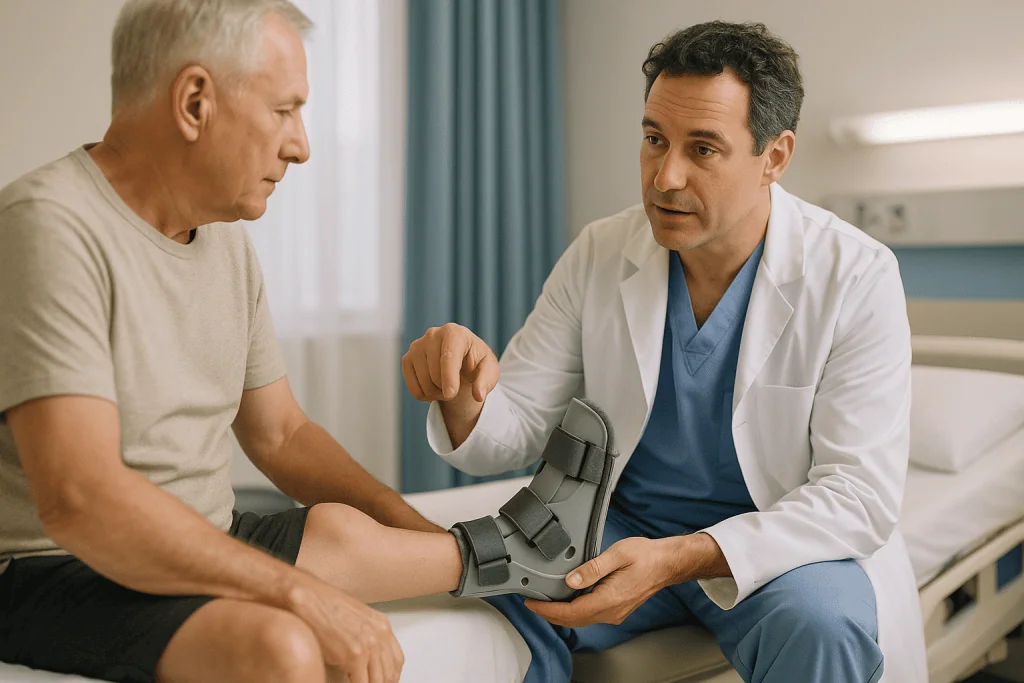
The move into a boot is a milestone, and it usually happens somewhere in this window, once the surgeon is satisfied with the wound and X-rays. A walking boot is a rigid, removable brace with a rocker sole. It lets you take it off to wash, to do gentle ankle movements if your therapist has cleared them, and to sleep more comfortably. It also lets the team start adding weight in a controlled way.
Getting into a boot does not automatically mean walking on it. Some surgeons keep patients non-weight-bearing in the boot for a further period; others begin touch-down weight, which means resting the foot on the floor for balance only. Ask exactly what your boot permits, because the same object means different things in different plans.
Practical wins in these weeks matter more than they sound. Learning to shower safely on a seat, managing stairs with crutches, and setting up a sleeping spot that keeps the leg raised all reduce the risk of the fall or wound breakdown that could set the calendar back.
When can you put weight on a new ankle? Weight bearing after ankle replacement
Weight bearing after ankle replacement is staged, and the vocabulary trips people up. Non-weight-bearing means the foot does not touch the ground while walking. Touch-down or toe-touch weight-bearing allows the foot to rest lightly for balance. Partial weight-bearing permits a set fraction of body weight, often judged by feel or by practicing on a scale. Full weight-bearing means walking normally, first in the boot and later in a shoe.
Most published patient guidance places the switch from non-weight-bearing to protected weight-bearing after the early cast period, commonly in the range of several weeks, and MedlinePlus describes not walking on the ankle until the surgeon confirms it is safe. Johns Hopkins describes a progression through a walking boot before transitioning to regular footwear. The exact week is set by wound healing, X-ray appearance, and whether any extra procedures were done alongside the replacement. A heel correction or fusion of a neighboring joint often adds weeks of protection.
The first steps are strange. The foot feels wooden, the calf is weak from disuse, and the brain has to relearn where the ankle is in space. Physical therapists call this proprioception, the sense of joint position, and it comes back with practice.
Two rules of thumb hold across most plans. Increase weight gradually rather than in one leap, and let pain and swelling guide the day: an ankle that balloons overnight after a long walk is asking for a shorter one tomorrow.
Resist the temptation to test the ankle early because it feels fine. Implants can shift before bone has bonded, and that failure is silent until it shows on an X-ray. When your surgeon says wait, the wait is doing work you cannot feel.
Ankle replacement recovery timeline at a glance
A table cannot capture every individual plan, but it can show the shape of a typical course. The ranges below reflect patient guidance from MedlinePlus and Johns Hopkins; your surgeon’s schedule takes precedence over every row.
| Stage | Typical window | What usually happens |
|---|---|---|
| Hospital and first days | Day of surgery to about one week | Splint or cast, strict elevation, nerve block fading, clot prevention, no weight on the leg |
| Early protection | Roughly weeks one to six | Wound checks, cast or boot, non-weight-bearing or touch-down only, gentle toe and knee movement |
| Reloading in a boot | Roughly weeks six to twelve | Progressive weight-bearing in a walking boot, formal physical therapy, range-of-motion work |
| Transition to shoes | Around three months onward | Boot weaned, supportive shoe, gait retraining, balance work, longer walks |
| Rebuilding | Three months to about a year | Strength, endurance, swelling control, return to low-impact activity |
Notice how the boundaries blur. A person whose incision heals slowly may sit in early protection for longer, then move quickly once cleared. Someone who had a calf lengthening may spend extra time in the boot. Someone with excellent bone and a straightforward operation may progress on the early side of each range.
Notice too what the table does not say. It makes no promise about the final result, because outcomes depend on factors no schedule can control. It also does not say when the ankle will be pain-free, because many people describe a gradual fade of surgical discomfort rather than a switch.
Use the table for orientation, not measurement. If you find yourself running behind a row, that is a question for your team, not evidence that something has gone wrong.
Physical therapy after ankle replacement: what the work involves
Physical therapy after ankle replacement starts earlier than most people expect, even if the first sessions look like nothing much. While the ankle is still in a cast, a therapist may have you wiggle toes, straighten and bend the knee, tighten the thigh, and practice safe transfers and crutch technique. These small tasks keep the rest of the leg from wasting and reduce the risk of clots and falls.
Once the boot arrives and the surgeon clears movement, the real work begins. It usually comes in three strands.
- Range of motion. The ankle needs to move up, called dorsiflexion, and down, called plantarflexion. Scar tissue fights both. Gentle, repeated movement within pain limits gradually restores the arc.
- Strength. The calf, the muscles along the shin, and the small muscles of the foot all shrink during weeks of disuse. Resistance bands, seated heel raises, and later standing exercises rebuild them.
- Balance and gait. Standing on the operated leg, weight shifting, and walking drills retrain the nervous system so the ankle responds automatically on uneven ground.
Johns Hopkins describes physical therapy as a standard part of ankle replacement recovery, continuing for weeks to months. Frequency varies; many people attend a clinic once or twice a week and do a home program daily. The home program is where progress is made.
Swelling management sits alongside all of this. Elevation, gentle compression, and pacing activity keep the joint from stiffening in a fluid-filled state. A therapist will also watch your walking pattern closely, because the limp you learned while protecting the ankle can persist long after the ankle is ready to move normally.
Therapy is uncomfortable at times, but sharp pain, a sudden increase in swelling, or wound changes are signals to stop and check with the team rather than push through.
Ankle replacement recovery time vs ankle fusion: how do the two compare?
People weighing surgery usually meet two options: replacement, which preserves motion, and fusion, medically called arthrodesis, which joins the tibia and talus into one solid bone so the joint no longer moves and therefore no longer hurts. Comparing ankle replacement recovery time with fusion recovery is one of the most searched questions in this field, and the honest answer is that both are long.
Fusion relies on bone healing across the joint, a process similar to mending a fracture. MedlinePlus describes a prolonged period of immobilization and protected weight-bearing after fusion while the bones knit. Replacement relies on bone bonding to an implant and on soft tissue settling, so its protected phase is also measured in weeks, and its rehabilitation adds range-of-motion work that fusion does not need.
The distinctive differences show up later. A fused ankle does not bend, so walking on slopes and stairs relies on neighboring foot joints, which can wear over years. A replaced ankle keeps some motion, which many people find makes walking feel more natural, but the implant has a finite life and may need revision surgery down the line. Fusion tends to be favored for younger, heavier, or more physically demanding patients and for badly deformed or unstable ankles; replacement is more often favored in older patients with good alignment and bone.
Which recovers faster in practice? Studies comparing the two exist, but timelines overlap widely and depend on the specific techniques used, so no reliable rule of thumb favors one across the board. What the evidence more consistently shows is that both procedures can reduce pain substantially for appropriately selected people, and that selection matters more than the label.
If you are choosing, ask your surgeon which option their assessment points toward for your ankle specifically, and why.
Swelling, stiffness and the long tail: months three to twelve
Around the third month, the boot comes off for good and a curious disappointment often follows. You are walking in shoes, which is wonderful, but the ankle is puffy by evening, stiff in the morning, and nowhere near the effortless joint you pictured. This is the long tail of recovery, and it is normal.
Swelling persists because the lymphatic and venous systems of the lower leg were disrupted by surgery and by weeks of immobility, and they recover slowly. Gravity does not help. Johns Hopkins notes that swelling can continue for months after ankle replacement. Compression socks, evening elevation, and breaking long periods of standing with short walks all help, and most people notice steady rather than sudden improvement.
Stiffness eases with continued therapy and daily movement. The range you have at six months is not necessarily your final range; many people keep gaining into the second half of the year. Morning stiffness that loosens with a few minutes of movement is typical of any recovering joint.
Stamina lags behind everything else. A body that spent weeks on crutches has lost general conditioning, and the first longer walks leave you surprisingly tired. This is the point where a gentle return to low-impact exercise pays off: cycling on a stationary bike, swimming once the incision is fully healed and cleared, and walking on flat ground.
Follow-up X-rays usually continue through the first year and then periodically for life, because implant problems are best caught early. Johns Hopkins describes full recovery as taking up to a year, and many surgeons frame the one-year visit as the point at which the ankle has largely become what it will be.
Hold that horizon in mind on the frustrating days.
Driving, work, stairs and sleep: everyday questions after ankle surgery
The questions that fill follow-up appointments are rarely about implants. They are about life.
Driving depends first on which ankle was replaced. If it is the right ankle in a country that drives on the right, you will not drive safely until you can bear full weight, are out of the boot, can perform an emergency stop without hesitation, and are no longer taking medicines that impair alertness. If it is the left ankle and your car is automatic, some teams clear driving earlier. Ask your surgeon for a specific answer and check with your insurer, because rules vary.
Work returns depend on the job. A desk role with a raised leg may be possible within a few weeks once pain and fatigue allow, especially remotely. Roles that involve standing, walking, ladders, or lifting usually wait until you are walking confidently in shoes, which most guidance places at several months. Ask early for a written note describing your restrictions so an employer can plan.
Stairs are manageable on crutches with practice, and a therapist will teach the technique before discharge. The everyday version is the well-worn rule: up with the good leg, down with the operated one, so the strong leg does the lifting.
Sleep is disrupted for weeks. The cast or boot is awkward, the leg must stay raised, and a nerve block wearing off at two in the morning is a rite of passage. Sleeping on your back with the leg on pillows, keeping the boot on at night if instructed, and timing pain medicine as your clinician directs all help.
Showering means keeping the incision dry until cleared, usually by sitting on a shower seat with the leg wrapped and outside the spray. Baths and pools wait until the wound is fully sealed.
Risks and complications that can slow ankle replacement recovery
Every operation carries risk, and honest guidance names them. Ankle replacement has a specific profile shaped by the joint’s anatomy.
Wound healing problems sit near the top of the list. The skin over the front of the ankle is thin, and MedlinePlus lists poor wound healing among the risks of the procedure. Slow healing can delay the move to a boot and, if the wound breaks down over the implant, can require further surgery. Smoking, diabetes, and poor circulation increase this risk, which is why surgeons often address them before operating.
Infection can be superficial, involving the skin, or deep, involving the implant. Deep infection is uncommon but serious and may require implant removal. Redness spreading from the incision, fever, and drainage are the signals teams ask you to watch for.
Blood clots in the leg veins are a known risk after lower-limb surgery. The NHS describes calf pain, swelling, warmth, and redness as features of deep vein thrombosis, and a clot that travels to the lungs, called pulmonary embolism, can cause sudden breathlessness or chest pain and is a medical emergency.
Implant-related issues include loosening, where bone fails to bond or later gives way; wear of the plastic insert over years; and fracture of the small bones on either side of the ankle during or after surgery. Nerve irritation can cause numbness or tingling on the top of the foot, which often improves but sometimes persists.
Stiffness, ongoing pain, and the eventual need for revision surgery round out the list. None of these are reasons to avoid a well-chosen operation, but they are reasons to follow the protected phase closely and to report problems early rather than hoping they resolve.
What people often get wrong about ankle replacement recovery
Myths cluster around this surgery, partly because most people’s mental model comes from a relative’s hip or knee.
Myth: you will be walking within days, like after a hip replacement. Ankles are different. MedlinePlus describes a period in a cast without walking on the leg, and it is measured in weeks. Expecting a hip-style recovery sets you up for frustration.
Myth: if the ankle feels fine, it is safe to walk on. Early implant stability depends on bone bonding you cannot feel. Comfort is not clearance; your surgeon’s X-ray is.
Myth: swelling at three months means something has gone wrong. Johns Hopkins notes swelling can persist for months. Evening swelling that settles overnight is ordinary. Swelling that arrives suddenly with pain, heat, or fever is different and needs a call.
Myth: physical therapy is optional once you are walking. The limp learned during protection, the weakened calf, and the stiff joint do not fix themselves. Therapy is where a walking ankle becomes a functional one.
Myth: a new ankle means a return to running and jumping. Implants are generally designed for walking, cycling, swimming, golf, and similar low-impact activity. High-impact sport accelerates wear and is usually discouraged. Fusion is often the choice for people whose lives demand pounding.
Myth: the implant lasts forever. Like any mechanical part, it wears. Regular follow-up X-rays exist precisely because problems are easier to manage when caught early.
Myth: recovery is finished when the boot comes off. The boot marks the end of protection, not the end of recovery. Strength, balance, and swelling keep improving for the better part of a year.
Correcting these expectations before surgery is one of the quietest predictors of a calmer recovery.
Questions to ask your care team before and after ankle replacement
A good consultation leaves you with a plan you can describe back in your own words. These questions help get there.
- Why is replacement, rather than fusion or continued non-surgical care, the option you recommend for my ankle specifically?
- Will any additional procedures be done at the same time, and how will they change my recovery timeline?
- How long do you expect me to be non-weight-bearing, and what will trigger the move to a boot?
- What does partial weight-bearing mean in your plan, and how will I know how much weight is allowed?
- Which medicines will I go home with, what does each one do, and what is the plan for stopping them?
- What clot-prevention measures will I use, and for how long?
- How should I care for the incision, and when may it get wet?
- When does physical therapy begin, how often, and will I have a home program?
- What equipment should I have ready at home: crutches, knee scooter, shower seat, raised toilet seat?
- When is it realistic for me to drive, return to my particular job, and climb stairs unaided?
- Which signs should prompt an immediate call, and which number do I use after hours?
- How often will I need follow-up X-rays in the first year and beyond?
- What activities should I avoid long term to protect the implant?
- If the implant needs revision in the future, what would that involve?
Bring someone with you, and write the answers down or ask permission to record them. Post-operative appointments are short and you will be tired; a written plan taped to the refrigerator settles a surprising number of two-in-the-morning worries. Every one of these decisions rests with your treating team, and asking well is how you become a partner in them.
When to call your doctor during ankle replacement recovery
Most of recovery is uneventful, and most worries are ordinary. A handful of signs are not, and they deserve a same-day call or, in some cases, emergency care.
Call your surgical team promptly if you notice any of the following at the incision or ankle: redness spreading outward from the wound, increasing rather than settling pain, new drainage or a wound that has opened, a foul smell, or a fever with chills. MedlinePlus lists these as signals of possible infection or wound problems after joint surgery. Also call if the cast or boot feels suddenly too tight, if toes become pale, blue, cold, or numb, or if you cannot move them, because these can indicate pressure on blood vessels or nerves.
Seek urgent assessment if you develop calf pain, swelling, warmth, or redness in either leg, especially the operated one. The NHS describes these as features of deep vein thrombosis, which needs prompt treatment.
Call emergency services immediately for sudden breathlessness, chest pain that worsens with breathing, coughing up blood, or lightheadedness and a racing heart. These can indicate a clot that has traveled to the lungs, which is life-threatening.
Other reasons to reach out, less urgently but without delay: a fall onto the operated leg, a sudden loss of the progress you had made, new grinding or instability in the ankle, persistent nausea or vomiting that stops you keeping fluids down, or side effects from medicines that concern you. Never stop or change a prescribed medicine, including a blood thinner, without speaking to the prescriber first.
When in doubt, call. Surgical teams would far rather answer a question that turns out to be nothing than meet a complication late.
Frequently asked questions
How long is the typical ankle replacement recovery timeline?
Patient guidance from MedlinePlus and Johns Hopkins describes a staged course: a cast or splint without weight-bearing for the first weeks, a walking boot with progressive weight through roughly the second and third months, and continued gains in strength and swelling for up to a year. Individual timelines vary with bone quality, added procedures, and healing, so your surgeon sets the actual schedule.
When does weight bearing after ankle replacement usually begin?
Weight-bearing is usually introduced only after the incision has healed and X-rays show the implant sitting stably, which most guidance places several weeks after surgery. It then progresses in steps from touch-down to partial to full weight in a boot. The precise week depends on your surgeon’s assessment and on whether extra procedures were performed alongside the replacement.
Is ankle replacement vs fusion recovery very different?
Both involve weeks of protected weight-bearing and months of rehabilitation, and published timelines overlap widely. Fusion waits for bone to heal across the joint; replacement waits for bone to bond to an implant and adds range-of-motion work. The bigger differences appear later: fusion removes ankle motion but tolerates heavy use, while replacement preserves motion but may need revision over time.
How long does physical therapy after ankle replacement last?
Johns Hopkins describes physical therapy as a standard part of recovery continuing for weeks to months. Early sessions focus on safe movement and keeping the rest of the leg strong; later work restores ankle range, calf strength, balance, and a normal walking pattern. Many people attend a clinic once or twice weekly and do daily exercises at home for several months.
Why is swelling still present months after ankle replacement?
Surgery and weeks of immobility disrupt the veins and lymphatic channels that drain the lower leg, and gravity works against them. Johns Hopkins notes swelling can persist for months. Evening swelling that settles overnight is typical; swelling that arrives suddenly with pain, warmth, redness, or fever is not and should prompt a call to your team the same day.
When can I drive after ankle replacement surgery?
Driving usually waits until you can bear full weight without a boot, perform an emergency stop confidently, and are no longer taking medicines that affect alertness. If the left ankle was replaced and your car is automatic, some teams clear driving earlier. Ask your surgeon for a specific answer and confirm your insurer’s requirements before getting behind the wheel.
Can I return to running after an ankle replacement?
High-impact activity such as running and jumping is generally discouraged because it accelerates wear on the implant and raises the risk of loosening. Most surgeons encourage walking, cycling, swimming, golf, and similar low-impact activities once recovery allows. People whose work or sport demands repeated pounding are often steered toward fusion instead, so discuss your goals before choosing.
What should I have ready at home before surgery?
Plan for weeks of not putting weight on one leg. Useful items include crutches or a knee scooter, a shower seat, a raised toilet seat, extra pillows for elevation, and a sleeping spot on the main floor if stairs are difficult. Arrange help with meals, laundry, and transport, and clear rugs and cables that could cause a fall.
How long will the implant last?
Implants wear over time like any mechanical part, and some eventually need revision surgery. Longevity depends on activity level, body weight, bone quality, alignment, and implant design, and reliable lifetime figures vary between studies. Regular follow-up X-rays, typically through the first year and periodically afterward, exist so that loosening or wear is detected early when options are widest.
What signs after ankle replacement mean I should seek urgent care?
Seek same-day help for spreading wound redness, new drainage, fever, a cast that feels suddenly tight, or toes that turn pale, cold, or numb. Calf pain with swelling or warmth may signal a blood clot and needs prompt assessment. Sudden breathlessness, chest pain, or coughing up blood are emergency signs of a clot in the lungs; call emergency services immediately.
References
- MedlinePlus – Ankle replacement
- NHS – Osteoarthritis
- NHS – Deep vein thrombosis (DVT)
- NIH NIAMS – Osteoarthritis
This article is for general information only and is not a substitute for professional medical advice. Please consult a qualified doctor about your individual situation.

More from the Blog

Hip Flexor Pain: Tight, Strained or Something Else, and the Exercises That Help
Hip flexor pain is soreness at the front of the hip or groin where the iliopsoas and rectus femoris muscles lift the thigh. Most…

Does the Robot Operate on Its Own? Robotic Knee Replacement Myths, Corrected
No. In robotic knee replacement, the surgeon performs the operation and the robotic arm acts as a precision tool. The surgeon plans the implant…

How a Pavlik Harness Keeps Your Baby’s Hips in Place So the Socket Can Deepen
A Pavlik harness works by holding a baby's hips bent up and gently spread apart, so the ball at the top of each thigh…

Shoulder Replacement Recovery: Timeline, Sling Life and Real Milestones
Most people wear a sling for about two to six weeks after shoulder replacement, regain everyday reach by three months, and see strength keep…

What to Ask Your Surgeon Before Hip Replacement: Approach, Implant Type and Rehab Plan
Before hip replacement, ask your surgeon which surgical approach they use and why, what implant type and bearing surface they plan (cemented or uncemented,…

First Signs of Arthritis in the Fingers, and How Arthritis Is Tested
The first signs of arthritis in the fingers are usually subtle: stiffness on waking or after gripping something, aching or tenderness in a knuckle,…