

Are Chickenpox Parties a Bad Idea? Deliberate Exposure Myths Pediatricians Correct

Key Takeaways
- Before routine vaccination, chickenpox caused about 4 million US cases, more than 10,500 hospitalizations and 100 to 150 deaths every year, according to the CDC.
- A child with chickenpox is contagious one to two days before the first spot appears, so a pox party host has usually already spread the virus at school.
- The CDC describes a typical unvaccinated case as 250 to 500 blisters with fever, while a breakthrough case in a vaccinated child is usually mild with few spots.
- Two doses of the varicella vaccine are about 90 percent effective against any chickenpox and more effective against severe disease, per CDC data.
- Vaccination within 3 to 5 days of an exposure may prevent or soften the illness in eligible children, so a quick call to the pediatrician after exposure is worthwhile.
- Wild chickenpox virus stays dormant in nerve cells and can reawaken decades later as shingles; vaccinated children carry a lower lifetime shingles risk than those naturally infected.
Chickenpox parties are not recommended by pediatric and public health bodies. Deliberately exposing a child to varicella risks a full infection with possible complications such as bacterial skin infections, pneumonia and brain inflammation, and it can spread the virus to pregnant people, newborns and immunocompromised contacts. Two doses of the varicella vaccine give reliable protection with a lower risk profile; families should discuss the right path with their child's doctor.
The text arrives on a Tuesday evening, from a mother in the preschool group chat: her son has come down with chickenpox, the spots are only just starting, and anyone who wants their child to “get it over with” is welcome to drop by on Saturday. Three thumbs-up emojis follow within minutes. Then a long pause, while a dozen parents quietly search their phones.
That pause is where this article lives. The chickenpox party myth has outlasted the disease it was built around; most American parents under 40 have never nursed a child through a full case, yet the idea that a backyard exposure is a sensible, old-fashioned shortcut to immunity still circulates with surprising confidence.
So here is the honest version, drawn from what pediatricians and public health agencies actually document: what the virus does inside a child, who gets hurt when it spreads, what the vaccine does and does not promise, and how to read the group chat with a clearer head.
Why do people have chickenpox parties?
The logic was never foolish; it was a product of its time. Until the mid-1990s there was no varicella vaccine in the United States, and almost every child caught chickenpox eventually. Illness in a young child was generally milder than in a teenager or adult, so parents reasoned that a controlled infection at age four beat an uncontrolled one at age fourteen, when they could not manage the timing around exams, work or a pregnancy in the household.
Pox parties also solved a scheduling problem. A parent who knew the exposure date could plan the two weeks of incubation, arrange childcare and keep the sick child away from a grandparent with a weak immune system. In an era without any other option, that sense of control felt like good parenting.
What changed is the alternative. Since routine varicella vaccination began, the CDC reports that chickenpox cases, hospitalizations and deaths have fallen dramatically, and most children today are protected without ever being infected. The party survives partly out of nostalgia, partly from a belief that “natural” immunity is stronger, and partly from distrust of vaccines in general.
Three motivations keep appearing in parent forums:
- A wish to avoid vaccines while still gaining immunity before adulthood.
- A belief that the infection is trivial and the vaccine is “unnecessary medicine”.
- A sense that an exposure chosen by the family is safer than one picked up at daycare.
Each of these rests on an assumption that the evidence does not support, which is what the rest of this piece works through. Understanding the reasoning matters, though, because the parents who host these gatherings are rarely careless; they are usually trying hard to protect their children with information that is 30 years out of date.
What actually happens inside a child who catches chickenpox
Chickenpox is caused by the varicella-zoster virus, a member of the herpes family that spreads through the air and through direct contact with blister fluid. A child breathes it in, it multiplies in the lining of the nose and throat, and then it travels through the bloodstream to the skin and internal organs.
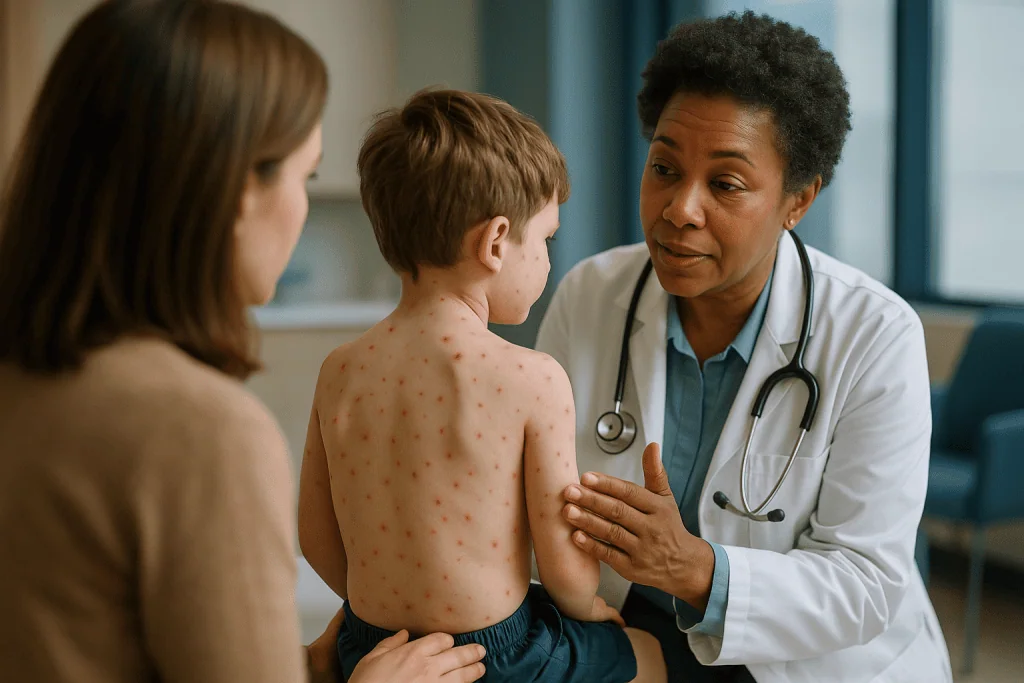
Nothing is visible during this stage. The CDC describes a typical incubation period, the gap between exposure and symptoms, of 14 to 16 days, with a full range of 10 to 21 days. During the last day or two of that window, before a single spot appears, the child is already contagious. That is the first fact a pox party quietly ignores: the host child has probably been spreading the virus at school, the grocery store and the playground for 48 hours before anyone knew.
Then comes the prodrome, a day or so of fever, tiredness, headache and poor appetite. The rash follows, starting on the chest, back and face before spreading. Each spot moves through stages: a flat red mark, a raised bump, a fluid-filled blister, and finally a crust. New crops keep arriving for several days, so a child commonly carries spots at every stage at once. The CDC notes that an unvaccinated child typically develops 250 to 500 blisters, which can appear inside the mouth, on the eyelids and in the genital area, not only on the skin you can see.
A child stays contagious until every lesion has crusted over, usually about five to seven days after the rash began. Across the whole episode, that adds up to roughly a week of infectiousness, a week or two of waiting, and a sick child who is miserable from itch, fever and sore mouth sores. The virus then retreats into nerve cells, which matters for a later section.
Is the chickenpox party myth of a "harmless childhood illness" true?
For most healthy children, chickenpox runs its course without lasting harm. That sentence is true, and it is the foundation of the chickenpox party myth. The trouble is the word “most”. Nobody can tell in advance which child will be the exception, and the exceptions are not rare enough to shrug off.
The most common complication is a bacterial infection of the skin, when scratching lets bacteria such as group A streptococcus or Staphylococcus aureus into open blisters. Usually that means a course of antibiotics and some scarring; occasionally it progresses to cellulitis, a deep soft-tissue infection, or to sepsis, a dangerous whole-body response to infection. The CDC and Mayo Clinic both list pneumonia, dehydration, bleeding problems, and inflammation of the brain (encephalitis) or of the balance center at the back of the brain (cerebellar ataxia) among recognized complications in otherwise healthy children.
There is also Reye’s syndrome, a rare but serious swelling of the liver and brain linked to aspirin use in children with viral illnesses, which is why clinicians advise against aspirin-containing products for a child with chickenpox. A parent at a pox party who reaches for a familiar family remedy may not know that.
Severity also rises with age. Adolescents and adults who catch chickenpox tend to have more blisters, higher fever and a greater chance of pneumonia, according to the CDC’s clinical overview. A deliberate exposure in childhood was meant to avoid that, but a party guest who does not actually catch it that day, which happens, walks away unprotected and older.
Pediatricians do not call chickenpox harmless because they have seen the minority of cases that end in the emergency department. Mild for most is not the same as safe for all.
How many people died of chickenpox before the vaccine?
Parents searching “how many people died of chickenpox in 1990” are usually trying to size up the real danger, and the numbers deserve a straight answer rather than a scare.
The CDC reports that in the early 1990s, before the varicella vaccine was licensed in the United States, roughly 4 million people caught chickenpox each year. More than 10,500 of them were hospitalized annually, and between 100 and 150 died. Many of those deaths were in previously healthy children and adults, not only in people with weakened immune systems.
Set beside the 4 million cases, 100 to 150 deaths looks like a tiny fraction, and it is. But public health works in totals, not fractions. A hundred funerals a year from a disease that is now preventable is not a number pediatricians were willing to keep accepting once an alternative existed.
The alternative changed the picture quickly. The CDC estimates that chickenpox vaccination in the United States now prevents more than 3.5 million cases, about 9,000 hospitalizations and around 100 deaths every year, and that deaths among children and adolescents have fallen by about 97 percent since the vaccine program began. Hospitalizations across all ages dropped sharply as well.
Two points follow from these figures. First, the risk of death from chickenpox in any one healthy child is low, which is why the pox party ever seemed reasonable. Second, the risk is not zero, and in a room of ten children at a party it is spread across every family present, including the ones who have not thought about the pregnant aunt visiting next week.
The honest summary is this: chickenpox killed a classroom’s worth of Americans every year for decades, mostly quietly, and it stopped doing so largely because of a vaccine.
Chickenpox party vs vaccine: what the comparison really looks like
Parents weighing a deliberate exposure against vaccination are usually comparing two kinds of immunity, and the comparison is fairer when it is laid out side by side rather than argued in the abstract.
| Question | Deliberate infection (pox party) | Varicella vaccine (two doses) |
|---|---|---|
| What enters the body | Wild virus at an unknown amount, from an unknown stage of illness | A weakened (attenuated) virus in a standardized preparation |
| Typical illness | Fever and 250–500 blisters over about a week (CDC) | Soreness at the site; occasionally a mild fever or a few spots (CDC) |
| Serious complications | Skin infection, pneumonia, encephalitis, sepsis; roughly 10,500 hospitalizations a year pre-vaccine (CDC) | Severe reactions rare; monitored through national safety systems (CDC) |
| Protection against any chickenpox | High after a confirmed case; no protection if the child does not catch it | About 90 percent after two doses; breakthrough cases usually mild (CDC) |
| Risk to others | Contagious before and during the rash to everyone nearby | Transmission from a vaccinated child is very rare (CDC) |
| Later shingles risk | Present, because wild virus stays dormant in nerves | Lower than after natural infection (CDC) |
| Who decides | Family, without medical oversight | Family with their pediatrician |
The table is not a sales pitch for vaccination; it is a description of trade-offs. A vaccinated child can still catch chickenpox, and the CDC is clear that a single dose protects less well than two. A child who survives the wild infection usually gains durable immunity. But one path accepts a week of real illness and a small chance of serious harm in exchange for that immunity, while the other accepts a sore arm and a small chance of a mild breakthrough case.
Which trade-off suits a particular child, especially one with eczema, asthma, a weak immune system or a sibling undergoing cancer treatment, is a conversation for the child’s own doctor.
Pox party risks nobody counts: the people around the child
The quiet flaw in the pox party plan is that it treats the infected child as a closed system. He is not. For about a week before and after that gathering, he is a small, cheerful transmitter of a virus that behaves very differently in other bodies.
Pregnancy is the first concern. A person who has never had chickenpox or the vaccine and catches it during pregnancy faces a higher risk of pneumonia themselves, and the fetus faces a small risk of congenital varicella syndrome, a pattern of scarring, limb and eye abnormalities. The CDC’s clinical overview puts that risk at roughly 1 to 2 in 100 when infection occurs in the first 20 weeks. Infection in the days just before or after delivery can cause severe, sometimes fatal, chickenpox in the newborn.
Newborns and young infants are the second group. Babies under a year are too young for the vaccine and depend on the immunity of people around them. Third are people whose immune systems are suppressed: children on chemotherapy, transplant recipients, people taking steroids or biologic medicines for arthritis or inflammatory bowel disease. In these groups the virus can spread to the lungs, liver and brain. Fourth are unvaccinated adults, including the parents at the party who assume they had it as children and may be wrong.
None of these people needs to attend the party. The host child’s older sister carries the virus to school; a guest’s father carries it to his office; the family stops for milk on the way home. Public health agencies discourage deliberate exposure not only because of the child at the center, but because communities are porous, and the people most endangered by chickenpox are precisely the ones who were never consulted.
Are chickenpox parties safe if the exposure is "controlled"? What about mailed lollipops?
Some parents argue that the problem is random exposure, not exposure itself, and that a carefully timed visit to a mildly ill child is as controlled as a medical appointment. Pediatricians push back on that for three practical reasons.
There is no control over the amount of virus. A child at a party may inhale a heavy load from a cousin who is coughing, or a trivial amount from a guest whose spots are already crusting. Higher exposure doses are associated with more severe disease, and nobody at a backyard gathering is measuring. There is also no control over what else is present. A child with open blisters may be carrying group A streptococcus on the skin; the Mayo Clinic and CDC both describe secondary bacterial infection as the most common complication, and a shared bath toy or towel can pass bacteria alongside the virus.
And there is no control over who actually gets infected. Some guests will leave uninfected and unprotected, believing they are now immune. Others will develop illness quietly and seed it into households that were never part of the decision.
The mailed-lollipop version of this idea, in which parents ship candy licked by an infected child to strangers, is worse on every count. Varicella is fragile outside the body and spreads mainly through the air, so the lollipop is unlikely to transmit chickenpox at all, while it can carry bacteria and other viruses from an unknown child’s mouth. Federal authorities have warned that mailing infectious material is unlawful. A parent who does this is accepting a stranger’s germs for a protection the package probably cannot deliver.
Controlled exposure is a reassuring phrase. In practice, the only standardized, measured exposure to varicella that medicine can offer is the vaccine.
Who is varicella vaccination usually for, and who is usually asked to wait?
Routine varicella vaccination is recommended by the CDC for healthy children as a two-dose series in early childhood, with timing on the standard schedule that pediatric practices follow. The vaccine is also recommended for older children, adolescents and adults who have no evidence of immunity, meaning no documented vaccination, no laboratory-confirmed past infection and no clinician-verified history of chickenpox or shingles. Adults who grew up elsewhere, healthcare workers, teachers, childcare staff and people planning pregnancy are often asked about their status for exactly this reason.
Because it contains a live, weakened virus, the vaccine is usually deferred or avoided for certain people, and this is where a parent’s judgment stops and a clinician’s begins:
- Infants under one year, who are generally too young for the routine series.
- People who are pregnant; vaccination is typically timed before or after pregnancy.
- People with significantly weakened immune systems from disease or treatment.
- Anyone with a moderate or severe acute illness, who may be asked to wait until recovered.
- Anyone with a prior severe allergic reaction to a vaccine component.
Some children who cannot be vaccinated themselves are the strongest argument for vaccinating everyone around them. A child on chemotherapy relies on classmates, siblings and cousins being immune. Public health agencies describe this as community protection, and it only works when deliberate exposures stay rare.
There is also a middle group: children with eczema, mild asthma or a family history of immune disorders. These are not automatic reasons to skip vaccination, but they are reasons for a conversation. A pediatrician can check records, order a blood test for immunity if the history is unclear, and advise on timing. What a pediatrician cannot do is retroactively manage an exposure a family arranged on a Saturday without telling anyone.
What the following days and weeks look like after a chickenpox exposure
Suppose the exposure has already happened, deliberately or not. The timeline matters, because there is a short window in which choices still exist.
Day 0 to day 5: the CDC’s clinical guidance notes that giving the varicella vaccine within 3 to 5 days of exposure may prevent chickenpox or make it milder in a child who has no contraindications. For people at high risk of severe disease, such as newborns, pregnant people without immunity and immunocompromised patients, clinicians may consider varicella-zoster immune globulin, a preparation of ready-made antibodies, within 10 days of exposure. Whether either applies is a decision for the treating clinician, made quickly.
Day 10 to day 21: the incubation window. The NHS and CDC describe this as the period in which symptoms can begin, most often around two weeks after contact. A child who has been exposed should be kept away from pregnant people, newborns and anyone immunocompromised during this period, since contagiousness starts before the rash.
Rash onset: the first spots usually appear on the trunk and face, with fever. New crops continue for roughly three to five days. Comfort measures focus on itch relief, short fingernails, cool baths, loose clothing and fluids; the NHS advises avoiding aspirin-containing products and discussing any medicines with a pharmacist or doctor rather than guessing.
Crusting: once every blister has scabbed over, the child is no longer contagious. The NHS puts this at about five days after the rash started for most children, and schools and daycare centers usually ask for all spots to be crusted before return.
Weeks later: scabs fall off and skin settles over two to three weeks. Some pitted scars remain where blisters were scratched or infected. The virus itself has not left; it has settled into nerve cells, dormant, which is the subject of the next section.
Shingles: why the virus from a pox party never really leaves
Chickenpox has a sequel, and it is the part of the story that the party invitation never mentions.
After the rash heals, varicella-zoster virus retreats into clusters of nerve cells near the spinal cord and brainstem, where it remains inactive, often for decades. If immunity later dips, through age, stress, illness or immunosuppressive treatment, the virus can reawaken and travel down a single nerve to the skin. The result is shingles (herpes zoster): a painful, blistering rash in a band on one side of the body, sometimes followed by nerve pain that lingers for months, a condition called postherpetic neuralgia. The CDC estimates that about one in three people in the United States will develop shingles in their lifetime, and nearly all of those cases trace back to a childhood chickenpox infection.
Shingles can also appear in children, though it is uncommon, and it is more likely in children who caught wild chickenpox early in life. The CDC reports that children vaccinated against varicella have a lower risk of shingles than children who had the natural infection, which fits the mechanism: the weakened vaccine virus also becomes dormant, but it appears to reactivate less readily.
This changes the arithmetic of a pox party. A parent choosing deliberate infection is not only accepting a week of illness now; they are depositing a live virus in their child’s nervous system that may resurface at 50 or 70. The vaccine deposits a weaker version of the same virus, and the long-term data so far favor it, though the first vaccinated generation is only now reaching middle age, and researchers continue to follow them.
Adults who had chickenpox as children can discuss shingles vaccination with their own doctor when they reach the recommended age. That, too, is a conversation worth having rather than a decision to make from a group chat.
Can you really have chickenpox two or three times?
Grandparents swear they had it twice. An online thread claims three times. These stories are common enough that they feed the chickenpox party myth in a roundabout way: if immunity from infection is unreliable, why bother with the vaccine either?
The CDC states that a second case of chickenpox after a confirmed first infection is possible but uncommon, and tends to occur in people whose immune systems are weakened. The far more frequent explanation for a “second” or “third” case is that at least one of the episodes was never chickenpox. Before laboratory testing was routine, a parent or family doctor diagnosed chickenpox by looking at spots. Several other childhood rashes can mimic it: hand, foot and mouth disease, impetigo, insect bites, allergic reactions, and a mild shingles episode on a child’s back. A toddler with itchy blisters in the pre-vaccine era was simply assumed to have chickenpox, and the memory stuck.
There is also a quieter cause of apparent repeat infection. A child who catches a very mild first case, with a handful of spots, may have been infected while still carrying some maternal antibody, or may have been vaccinated and had a breakthrough case. Both can leave immunity that is real but incomplete.
What this means for a family is that an unverified childhood history is not the same as immunity, especially for a person who is pregnant, immunocompromised or working in healthcare. A simple blood test can measure varicella antibodies, and clinicians use that result, not family folklore, to decide whether vaccination is needed. It also means that “got it three times” is not evidence that infection-based immunity fails; it is usually evidence that rashes are hard to identify by eye.
What people often get wrong: the chickenpox party myths pediatricians correct
Most of the beliefs behind pox parties contain a grain of truth that has grown into something misleading. Here are the ones pediatricians hear most, and what the evidence actually shows.
“Natural immunity is always stronger.” Immunity after a confirmed infection is durable, but so is immunity after two vaccine doses, which the CDC rates at about 90 percent protection against any chickenpox and higher against severe disease. The difference is the price paid for it.
“Chickenpox is just itchy.” The CDC documented more than 10,500 hospitalizations a year before vaccination, for pneumonia, bacterial skin infections and brain inflammation, in a population where most patients were healthy children.
“The vaccine gives kids chickenpox anyway.” A small number of vaccinated children develop a few spots or a mild breakthrough case; the CDC describes these as typically milder, with fewer lesions and little or no fever. That is not the same as the 250 to 500 blisters of wild infection.
“You can’t spread it before the spots show.” Contagiousness begins one to two days before the rash, which is why outbreaks move through classrooms before anyone knows.
“If you had it once, you can relax about pregnancy.” Only a confirmed history or a positive antibody test counts; memory of a childhood rash is often wrong.
“Shingles is a separate illness.” Shingles is the same virus reawakening years later; the childhood infection is where it was planted.
“A lollipop in the mail works like a party.” The virus is airborne and fragile; the candy mostly carries bacteria.
None of these corrections requires a parent to feel foolish. Each myth was reasonable before the evidence existed. The point is that the evidence does exist now, and it leans one way.
Questions to ask your care team about chickenpox exposure and vaccination
Whether a family is leaning toward vaccination, has already attended a gathering, or is simply unsure what their own immunity status is, a short list of questions makes the appointment more useful. Pediatricians generally welcome these; they would rather answer them than manage a complication later.
- Does my child have documented varicella vaccination, and if only one dose, when is the second usually given?
- Is there any reason my child should wait or avoid the vaccine, such as a current illness, a medication or an immune condition?
- My child was exposed on a specific day; is there still a post-exposure option, and how quickly would we need to act?
- Who in our household is pregnant, planning pregnancy, immunocompromised or under a year old, and what should we do to protect them?
- I think I had chickenpox as a child but have no record; is an antibody blood test worth doing before I travel, start a new job or become pregnant?
- If my child develops chickenpox, which comfort measures are appropriate, and which over-the-counter products should we avoid?
- What signs would mean the illness is no longer simple and we should be seen urgently?
- How long should my child stay home from school or daycare, and what does the school require?
- Does my child’s eczema, asthma or other condition change the risks on either side?
- Should the adults in the family ask about the shingles vaccine as we get older?
Bring records if they exist, including the yellow card or digital immunization printout, and be ready to describe any rash honestly, including spots inside the mouth or near the eyes. The care team’s job is to weigh the individual picture; the family’s job is to give them the whole picture.
When to call your doctor: red-flag signs during chickenpox
Most children with chickenpox can be cared for at home with rest, fluids and itch relief, and a routine call to the pediatrician is sensible at the start, both to confirm the diagnosis and to review who else in the family may be at risk. Some signs, though, mean the illness has moved beyond routine and needs prompt medical attention, by phone first or in person if the situation is clearly urgent.
Contact your doctor the same day, or seek urgent care, if your child has any of the following, drawing on red flags described by the CDC, NHS and Mayo Clinic:
- A blister or area of skin that becomes very red, warm, swollen or painful, or leaks pus, which can signal a bacterial infection.
- Fever that lasts more than four days, rises very high, or returns after it had settled.
- Difficulty breathing, fast breathing, chest pain or a persistent cough.
- Severe headache, a stiff neck, unusual drowsiness, confusion, difficulty waking, or trouble walking or keeping balance.
- Repeated vomiting, inability to keep fluids down, or signs of dehydration such as very little urine or no tears.
- Spots in or around the eye, or new vision problems.
- Bleeding into the skin, bruising, or a rash that does not fade when pressed.
- A seizure.
Call sooner, and mention chickenpox exposure specifically, if the person affected is a newborn, is pregnant, is an adult who has never had chickenpox or the vaccine, or has a weakened immune system from illness or treatment. In these groups the window for preventive treatment is short, and clinicians may want to act within days of exposure rather than wait for a rash.
Every one of these decisions, including whether an antiviral medicine is appropriate for a particular patient, belongs with the treating team. The parent’s role is to notice early and call without hesitating; nobody in pediatrics has ever been annoyed by a worried call about chickenpox.
Frequently asked questions
Why do people have chickenpox parties?
Chickenpox parties began before a vaccine existed, when nearly every child caught the virus and younger children usually had milder illness than teenagers or adults. Parents chose the timing to avoid infection later in life and to plan around work or pregnancy. Today they persist mainly among families who distrust vaccines or believe infection-based immunity is superior, although pediatric and public health bodies advise against deliberate exposure.
Are chickenpox parties safe for healthy children?
No major pediatric or public health body considers them safe. Even healthy children can develop bacterial skin infections, pneumonia, dehydration or brain inflammation from chickenpox, and there is no way to predict which child will. The exposure also cannot be controlled for virus amount or for other germs, and an infected child spreads the virus to pregnant people, infants and immunocompromised contacts in the wider community.
What are the main pox party risks compared with catching it at school?
The risks of the illness itself are the same wherever it is caught; a pox party simply guarantees the exposure and often concentrates it. A child who attends may inhale a larger amount of virus, may pick up bacteria from open blisters, and will then carry the virus home during the days before any rash appears. Catching chickenpox at school is not safer, which is the argument for vaccination rather than for either route.
Chickenpox party vs vaccine: which gives better immunity?
Both give lasting protection, but at different costs. The CDC reports that two vaccine doses prevent about 90 percent of chickenpox cases and nearly all severe cases, with breakthrough infections usually mild. Natural infection gives strong immunity but only after a full illness with hundreds of blisters, a risk of complications, and a dormant virus that can later cause shingles. Children who are vaccinated appear to have a lower shingles risk.
Can you have chickenpox three times?
True repeat infections after a confirmed case are uncommon and occur mainly in people with weakened immune systems, according to the CDC. Most stories of two or three bouts reflect misdiagnosis, because several childhood rashes, including hand, foot and mouth disease, impetigo and insect bites, look similar and were rarely lab-tested in the past. An antibody blood test can confirm whether someone is actually immune.
How many people died of chickenpox in 1990 before the vaccine?
The CDC reports that in the early 1990s, before the varicella vaccine was introduced in the United States, chickenpox caused about 100 to 150 deaths each year, alongside roughly 4 million cases and more than 10,500 hospitalizations annually. Many of those who died were previously healthy. Since routine vaccination began, deaths among children and adolescents have dropped by about 97 percent.
What are the first symptoms of chickenpox and how does the rash progress?
Chickenpox usually begins with a day or two of fever, tiredness, headache and loss of appetite, followed by an itchy rash that starts on the chest, back and face. Each spot changes from a red bump to a fluid-filled blister and then a crust, with new crops appearing over several days. Only a clinician can confirm the diagnosis, since other rashes look similar; call your doctor if you suspect it.
My child was exposed at a chickenpox party; what should I do now?
Call your pediatrician promptly. The CDC notes that vaccination within 3 to 5 days of exposure may prevent or lessen illness in eligible children, and higher-risk contacts may be offered antibody treatment within 10 days. Keep your child away from pregnant people, newborns and anyone immunocompromised for the next three weeks, since contagiousness begins before the rash. Your care team will decide what is appropriate.
How long is a child with chickenpox contagious?
A child is contagious from one to two days before the rash appears until every blister has crusted over, which the NHS says is usually about five days after the spots first appeared. Across the whole episode that is roughly a week of infectiousness. Schools and daycare centers typically require all spots to be crusted before a child returns, and the timeline can run longer in a child with many lesions.
Does getting chickenpox as a child cause shingles later?
Yes, shingles is the same varicella-zoster virus reactivating after lying dormant in nerve cells, often decades after the childhood infection. The CDC estimates about one in three people in the United States will develop shingles in their lifetime. Children vaccinated against chickenpox carry a weakened form of the virus and appear to have a lower risk of shingles than those who had wild infection.
References
- CDC: About Chickenpox
- CDC: Clinical Overview of Chickenpox (Varicella)
- NHS: Chickenpox
- MedlinePlus: Chickenpox
This article is for general information only and is not a substitute for professional medical advice. Please consult a qualified doctor about your individual situation.
Add us as a Preferred Source to see more of our trusted health content across Google Search, AI Overviews and Discover.

More from the Blog

Speech, Occupational or Physical Therapy for Developmental Delay: How the Plan Is Matched
Speech therapy, occupational therapy and physical therapy are matched to the specific area where a child's development is behind, not to the label of…

What to Expect After Whooping Cough Treatment: Lingering Cough, Fatigue and Follow-Up Visits
After whooping cough treatment, antibiotics clear the bacteria and shorten the time you can spread it, but they rarely shorten the cough itself. Coughing…

When Is It Safe to Get the Site Wet After Pediatric Plastic Surgery? Bathing and Play Return
Most children can have a brief shower or careful wash around the incision 24 to 48 hours after pediatric plastic surgery, but soaking in…

When Is Pediatric Physical Therapy Recommended? Injuries, Delays and Neuromuscular Conditions
A child is usually referred to pediatric physical therapy when movement is delayed, painful, uneven or limited: for example, missing motor milestones such as…

Which Conditions Do Pediatric Surgeons Treat? Congenital, Abdominal and Soft-Tissue Cases
Pediatric surgeons treat surgical conditions in children from before birth through the teenage years. Their work falls into three broad groups: congenital problems present…

How Is ROP Treatment Performed? Sedation, the Retinal Procedure and the Minutes It Takes
ROP laser treatment is performed while a premature baby is sedated or under general anesthesia and continuously monitored by the neonatal team, either at…