

Body Contouring Revision: When Residual Laxity or Irregularity Needs a Second Procedure

Key Takeaways
- Residual laxity after body contouring reflects lost skin elasticity rather than surgical failure, and the Mayo Clinic notes that people with major weight loss often need more than one procedure.
- Swelling after liposuction subsides over weeks but the final shape can take several months to appear, so irregularities should not be judged early.
- Scars after a tummy tuck continue fading for a year or more, which is why most surgeons defer any revision decision until at least that long has passed.
- Liposuction removes fat beneath skin and does not tighten it; loose skin after weight loss surgery is addressed by excision, not by more suction or by devices.
- Skin that has already been lifted once has a rearranged blood supply, making wound-healing problems a specific concern in revision surgery.
- One-sided calf swelling, sudden breathlessness or chest pain after surgery are warning signs of a blood clot and require emergency assessment.
Body contouring revision is a second procedure that addresses leftover skin laxity, contour irregularities, asymmetry or scar problems after an earlier tummy tuck, liposuction or post-weight-loss surgery. Surgeons usually wait until swelling has settled and weight has been stable, often a year or more, before judging whether revision is appropriate. The decision rests with the treating team after an in-person examination.
The photographs from the first consultation are still on her phone. A year after a tummy tuck that followed a 120-pound weight loss, most of what she hoped for has happened: the overhanging apron is gone, she can tie her shoes without rearranging herself first. But there is a fold of skin above the scar on the left that is not on the right, and a small pucker at each end of the incision that catches on her waistband. She is not unhappy. She is unsure whether this is simply how healing looks, or whether it is a reason to go back.
That uncertainty is the real subject of body contouring revision. It sits in the gap between what tissue can do and what a single operation can control, and it is far more ordinary than most people realize when they first notice something is not quite even.
This explainer walks through why residual laxity and irregularity happen, who is usually considered for a second procedure, and what the evidence says about timing, risk and expectations.
What is body contouring revision, and why does it happen so often after weight loss?
Body contouring is the group of surgical procedures that remove excess skin and fat and reshape the trunk, arms, thighs or buttocks. A body contouring revision is any second operation performed to improve the result of one of those procedures: tightening skin that stayed loose, smoothing an uneven surface, correcting asymmetry, or improving a scar that healed poorly.
Revision is not a verdict on the first surgeon or on the patient. Skin that has been stretched for years, whether by pregnancy, weight gain or both, loses elastin and collagen organization and does not snap back the way a younger, never-stretched envelope would. A surgeon can remove skin and tighten what remains, but cannot restore the quality of the tissue left behind. The Mayo Clinic notes that people who have lost large amounts of weight often need more than one procedure, and that results depend on the condition of the remaining skin.
Gravity, scar contraction and the slow redistribution of fluid all continue to work for many months after the drains come out. So the shape a person sees at six weeks is not the shape they will have at six months, and the shape at six months may still change by eighteen. Some of what looks like a problem early is simply unfinished healing. Some of it is genuinely residual, and that is where a measured conversation about revision begins.
Framing matters here. The most useful way to think about a second procedure is as a refinement step that was always a possibility, planned for calmly, rather than as a repair of something that went wrong.
Why does residual laxity happen even after a well-performed first procedure?
Laxity is the clinical word for skin that hangs loosely because it has lost its ability to recoil. Several mechanisms explain why it can persist after surgery.
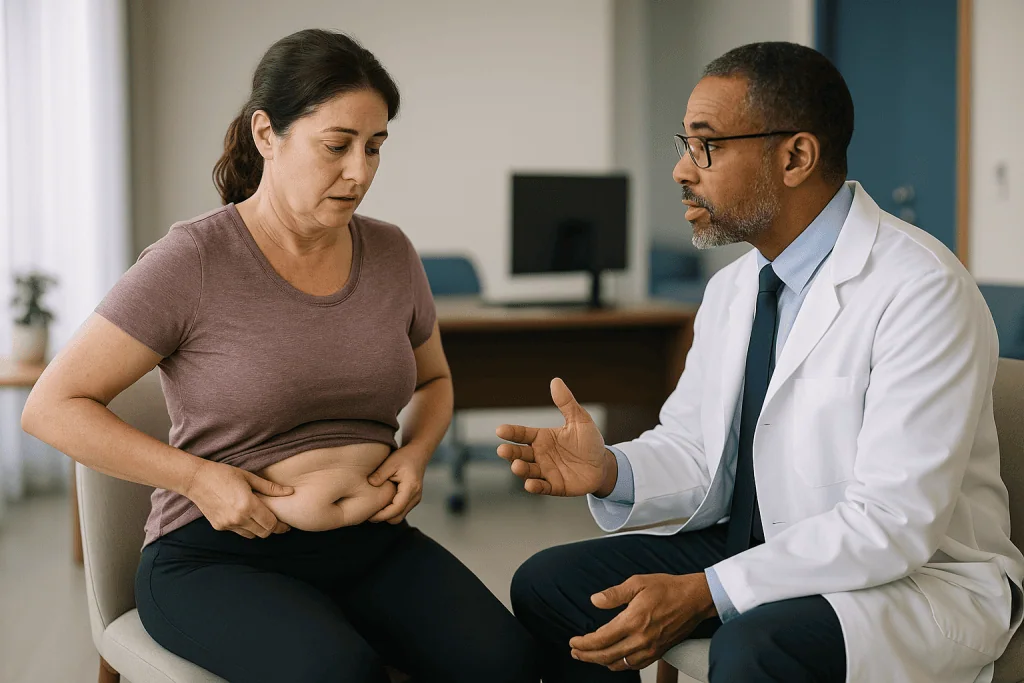
The first is tissue quality. Skin that has carried a great deal of weight shows thinned dermis and fragmented elastic fibers. When a surgeon pulls that skin tight and sutures it, the tension is held by the stitches and the deeper fascial layer at first, but over the following months the skin itself relaxes under gravity. A moderate amount of this settling is expected and is one reason surgeons aim for firm, not maximal, closure.
The second is the three-dimensional problem. An abdominoplasty, the formal term for a tummy tuck, tightens the front of the abdomen in a predominantly vertical direction. It cannot fully address looseness that wraps around the flanks and back. What was hidden by the larger abdominal apron becomes visible once that apron is gone, which is why many people after massive weight loss are advised from the outset that a circumferential approach or a staged plan may be needed.
The third is weight change. The Mayo Clinic advises that body contouring is best done once weight has been stable, because fluctuation afterward stretches or deflates the result. Even a modest regain can loosen a tightened abdomen, and further loss after surgery can create new redundancy.
The fourth is healing variability. Swelling, a collection of fluid under the skin called a seroma, or a fold at the incision end known as a dog-ear can all distort the early picture. Some resolve on their own; some leave a lasting contour change. The surgeon’s job at follow-up is to sort which is which, and that sorting takes time.
Contour irregularities after liposuction: what causes dents, ridges and asymmetry?
Liposuction removes fat through small cannulas, thin hollow tubes, passed under the skin. It reshapes by subtraction, and subtraction is unforgiving: fat that is removed cannot easily be put back in the same place.
Irregularities fall into a few recognizable patterns. A depression or dent usually reflects over-resection in one zone or a cannula pass that stayed too superficial, close to the undersurface of the skin. A ridge or wave pattern often comes from uneven passes or from skin that lacked the elasticity to redrape smoothly over a thinner fat layer. Asymmetry between the two sides may be true asymmetry or may reflect a difference in swelling that has not yet equalized.
Timing is central. The Mayo Clinic states that swelling after liposuction typically subsides over a few weeks, but that it may take several months for the treated area to look leaner and settle into its final shape. A lump felt at week three may be a firm area of healing fat tissue that softens by month four. Judging a liposuction result, or planning a liposuction revision, before that window has passed risks treating a temporary finding.
Revision options depend on the pattern. Small depressions are sometimes addressed with fat grafting, which transfers a person’s own fat from another area into the dent. Residual fullness can be treated with careful additional liposuction. Loose, crepey skin that did not redrape is a skin problem rather than a fat problem, and more suction will not help it; excision or acceptance are the realistic routes. A thorough examination, often with the person standing and bending, is how the surgeon distinguishes a fat issue from a skin issue before suggesting anything.
What qualifies you for revision surgery, and who is usually asked to wait?
There is no universal checklist, and the decision always rests with the treating team, but surgeons tend to weigh the same handful of factors.

Someone is more likely to be considered for a body contouring revision when the concern is stable and reproducible, meaning it looks the same at successive visits rather than shifting week to week; when weight has been steady; when the skin and scar have fully matured; when overall health supports another operation; and when the goal is specific and achievable with surgery. A visible fold that photographs the same way at twelve and fifteen months is a very different proposition from a vague sense that the midsection could be flatter.
People are commonly asked to wait when healing is still active, when weight is changing, when they are planning pregnancy, or when nutrition is not yet optimized. The Mayo Clinic’s guidance on body contouring after major weight loss emphasizes waiting until weight has stabilized, which for people who have had bariatric surgery often means well over a year after that operation. The same logic applies to revision: operating on a moving target produces a result that will move again.
Smoking, poorly controlled diabetes and some medications affect healing and raise the risk of wound breakdown; most surgeons will want these addressed first. Body mass index, a ratio of weight to height used as a rough screening measure, also enters the conversation because higher values are associated with more wound complications in body contouring, as the Mayo Clinic notes.
Finally, expectations are part of candidacy. A revision can improve a specific finding. It cannot deliver skin that behaves like it was never stretched, and a frank discussion of what a second procedure realistically changes is a prerequisite rather than a formality.
How long should you wait before judging body contouring results?
The impulse to judge early is understandable. The compression garment comes off, the mirror is right there, and the shape is not the shape in the surgeon’s drawings. But early appearance is a poor predictor of the final one.
Swelling follows a long curve. Much of it declines in the first weeks, yet residual fluid in the lower abdomen and flanks can persist for months, especially after combined procedures. Scars go through their own arc: red and raised for the first several months, then gradually flattening and fading, a process the Mayo Clinic describes as taking a year or longer after a tummy tuck. Firm areas under the skin, sometimes mistaken for lumps, usually soften as healing tissue remodels.
For these reasons most surgeons prefer to defer any decision about revision until roughly a year has passed, and longer when weight is still settling or when a large circumferential procedure was done. Photographs taken at each follow-up, in the same lighting and posture, are more reliable than memory and help both patient and surgeon see whether a contour is changing or has stopped changing.
What does not improve with time is also informative. A dog-ear at the incision end that is unchanged at nine months is unlikely to vanish at twelve. Skin that was loose at the thighs before surgery and was never operated on will not tighten because the abdomen was. Distinguishing the two categories, still healing versus genuinely residual, is the whole point of the waiting period.
Waiting is not passivity. It is the period during which weight stabilizes, scars mature and the real end result declares itself, so that any second procedure addresses what is truly there.
Revision tummy tuck: what a second abdominoplasty actually involves
A revision tummy tuck is tailored to the specific residual finding, which is why two people with the same label can have very different operations.
For dog-ears, the surgeon excises the small cone of excess skin at the end of the scar and extends the incision slightly so the closure lies flat. This is often a limited procedure. For a scar that sits too high or has widened, the scar can be excised and the skin re-advanced downward, usually only if enough laxity remains to allow it. For diffuse residual laxity, a section of lower abdominal skin is removed again and the remaining skin re-tightened; this is a larger operation that may approach the scale of the first.
Some revisions address the deeper layer. Diastasis recti, a separation of the two vertical abdominal muscles along the midline, is often repaired by stitching the fascia, the strong connective tissue sheet over the muscles, back toward the center. If that repair has loosened or was not fully addressed, it can be revisited, which MedlinePlus describes under abdominal wall surgery as part of what an abdominoplasty may include.
The belly button is a frequent focus. An umbilicus that sits off-center, looks stretched or has healed with a tight ring can be reshaped, and because it is a small procedure it is sometimes done on its own.
Residual laxity around the flanks and back usually calls for extending the incision around the sides rather than redoing the front, effectively converting a standard abdominoplasty into a partial or full circumferential procedure. The trade is a longer scar for a more complete contour.
Every one of these choices is made by the surgeon after examining scar quality, skin mobility and blood supply, because tissue that has already been lifted and undermined once has a different circulation than untouched skin.
Loose skin after weight loss surgery: why staged body contouring is normal, not failure
After bariatric surgery, excess skin is an expected consequence of success. The Mayo Clinic notes that people who lose a great deal of weight commonly develop loose, hanging skin that can cause rashes, hygiene problems and discomfort, and that body contouring may be considered once weight is stable.
The amount of skin involved is often too great, and the operating time too long, to address safely in a single session. Surgeons therefore plan in stages, commonly separating the abdomen and trunk from the arms and thighs, and spacing operations months apart to allow recovery and to see how the first stage settles before the next is designed. A second or third stage in this setting is part of the original plan rather than a revision of a disappointing result, though the two can overlap when the first stage also needs refinement.
Loose skin after weight loss surgery cannot be reversed by exercise, creams or skin-firming devices in any clinically meaningful way; strength training builds muscle beneath the skin but does not shrink the envelope, and there is no robust evidence that topical products tighten stretched dermis. For skin that has lost its elasticity, excision remains the evidence-supported option. The Mayo Clinic is explicit that body contouring surgery removes the excess skin and fat that remain after major weight loss, and that this is a surgical rather than lifestyle problem once elasticity is gone.
Nutrition deserves attention before any stage. Protein, iron and vitamin levels can be low after bariatric procedures, and deficiencies impair wound healing. Many teams coordinate with the bariatric program to check and correct these before a date is set. People who are still losing weight are generally asked to wait; operating during active loss means the result will loosen again as the body continues to change.
Body contouring revision scenarios at a glance
The table below summarizes common residual findings, what usually causes them and the general direction of revision. It is a map of possibilities, not a prescription; the right approach for any individual is decided by the treating surgeon after examination.
| Residual finding | Usual cause | Typical revision direction | When it is usually assessed |
|---|---|---|---|
| Dog-ear at scar end | Excess skin cone at incision edge | Small excision with slight scar extension | After scar has matured |
| Diffuse lower abdominal laxity | Poor skin elasticity, weight change | Re-excision and re-tightening of skin | Once weight stable a year or more |
| Flank and back fullness | Front-only approach in first surgery | Extension to circumferential procedure | After front has settled |
| Depression after liposuction | Over-resection or superficial passes | Fat grafting into the dent | Several months after swelling resolves |
| Residual fullness after liposuction | Under-resection or uneven passes | Targeted additional liposuction | Several months after swelling resolves |
| Widened or high scar | Tension on closure, scar biology | Scar excision and re-advancement if laxity allows | After a year or longer |
| Off-center or tight umbilicus | Healing contraction or positioning | Umbilical reshaping, often a small procedure | After healing complete |
| Persistent midline bulge | Loosened or incomplete muscle repair | Revisiting fascial repair | After imaging or examination confirms |
Two patterns are worth noticing. Most revisions are smaller than the original operation, and nearly all of them are judged only after swelling and scar maturation have run their course. The exception is diffuse laxity, which can require an operation comparable in scale to the first, which is why the preliminary conversation about expectations is so important.
What does recovery from a body contouring revision look like in the following weeks?
Recovery scales with the size of the revision. A dog-ear excision done under local anesthesia may mean a few days of a dressing and little else. A full re-excision of abdominal skin, or an extension around the flanks, follows a course closer to the original surgery.
In the first days after a larger revision, the focus is on walking early, keeping drains functioning if they were placed, and managing discomfort with the regimen set by the surgical team. Walking matters not only for comfort but for circulation; prolonged immobility is a recognized risk factor for deep vein thrombosis, a blood clot in a deep leg vein, as MedlinePlus explains. Compression garments are typically worn to limit swelling and support the new contour.
Over the first several weeks, activity is usually increased gradually, with heavy lifting and core strain restricted longer when the fascia has been re-tightened, because that repair needs time to gain strength. The Mayo Clinic advises avoiding strenuous activity for a period after a tummy tuck set by the surgeon, and similar caution applies after a revision that re-enters the same planes.
Swelling then follows the same slow decline described earlier. Scars from the revision are red and firm at first and will take many months to settle; the Mayo Clinic describes scar fading after abdominoplasty as a process of a year or more. Numbness along the incision and the lower abdomen is common and often improves slowly, though some areas may stay less sensitive.
Follow-up visits are where small problems are caught early: a fluid collection that can be drained in clinic, a wound edge that needs extra care. Attending them, and bringing questions, is the most controllable part of recovery.
How do the risks of a second procedure differ from the first?
The general risks of body contouring surgery apply again: bleeding, infection, seroma, delayed wound healing, changes in skin sensation, visible or asymmetric scarring, and the rare but serious possibility of blood clots. MedlinePlus lists these among the recognized complications of abdominal wall surgery. Several considerations are specific to revision.
Blood supply is the main one. The first operation lifted skin off its underlying tissue, dividing some of the small vessels that fed it. The skin healed by recruiting circulation from its edges and from whatever connections remained. Lifting the same skin again asks those rearranged vessels to do the work a second time, and areas at the far ends of the lifted flap, often near the midline just above the scar, are the most vulnerable to poor healing or small areas of skin loss. Surgeons account for this by limiting how far they lift and by respecting the scars already present.
Scar tissue changes the surgical field. Planes that separated easily the first time may be fused and firmer, which can lengthen the operation and alter where fluid collects afterward.
Expectations carry their own risk. A revision improves a defined problem but introduces new scars and new healing, and some findings, such as very poor skin elasticity, have limits that no second operation can overcome. People sometimes find that a small residual fold bothers them less than the thought of another recovery, and choosing not to revise is a legitimate outcome of the consultation.
Alternatives are part of the risk conversation. For minor irregularities, scar care, time and acceptance are reasonable. For skin quality concerns, there is no non-surgical option with strong evidence, and that honesty is itself protective, since it steers people away from treatments unlikely to help.
Non-surgical body contouring and the newest tummy tuck techniques: what the evidence actually shows
Searches about the newest tummy tuck procedure or about treating loose skin without surgery are among the most common in this topic, so the evidence deserves a plain statement.
Energy-based devices that deliver radiofrequency or ultrasound heat to the skin and subcutaneous tissue are marketed to tighten skin. In practice, the evidence supports modest tightening in people with mild laxity and good baseline elasticity. For skin that has been stretched by massive weight loss, these treatments do not produce changes comparable to excision, and no mainstream guideline recommends them as a substitute for surgery in that setting. They are sometimes used alongside surgery for fine-tuning, but claims of surgical-level results from devices alone are not supported.
Non-surgical fat reduction, by cooling, heat or injection, reduces small localized fat pockets. The Mayo Clinic describes liposuction as a procedure for removing fat from specific areas rather than a weight-loss method, and the same limitation applies more strongly to non-surgical fat reduction. None of these approaches tighten loose skin, and reducing fat beneath already-loose skin can make laxity more visible.
Within surgery, newer approaches tend to be refinements rather than revolutions: suture techniques that reduce the need for drains, methods of preserving lymphatic channels to lessen swelling, and incision designs that place scars lower. These are legitimate evolutions in technique, and a surgeon can explain which, if any, apply to a specific case. They do not change the underlying biology of stretched skin.
Laxity in people after bariatric surgery is a structural problem of lost elastin and excess surface area. When a treatment claims to reverse it without removing skin, the appropriate response is to ask what the published evidence shows for people with that degree of laxity, not for people with mild post-pregnancy looseness.
What people often get wrong about body contouring revision
Several beliefs recur in consultations, and most of them lead people either toward unnecessary surgery or away from reasonable help.
The first is that needing a revision means the first surgery failed. Residual laxity after a large weight loss is a property of the tissue, and the Mayo Clinic’s guidance anticipates that more than one procedure may be needed. Refinement is part of the pathway for many people.
The second is that a revision should be scheduled as soon as something looks off. Early findings change. Operating on swelling or on an immature scar risks treating a problem that would have resolved and creating a new one. Patience here is evidence-based, not evasive.
The third is that liposuction fixes loose skin. It does the opposite; removing volume beneath inelastic skin leaves more slack. Skin problems are addressed by removing skin.
The fourth is that results are permanent regardless of weight. The Mayo Clinic is clear that body contouring results are long-lasting only when weight remains stable. Fluctuation afterward is the most common reason a good result deteriorates, and no revision can protect against it.
The fifth is that scars can be erased in a revision. Scars can be repositioned, narrowed or made more symmetric, and they fade over a year or more, but a revision trades one scar for another. Anyone promised a scarless outcome is being misled.
The sixth is that creams, massage or firming devices can substitute for excision in significant laxity. For mild looseness there may be small gains; for the degree of skin excess seen after major weight loss, surgery remains the only option with consistent evidence behind it.
Correcting these ideas does not make revision less appealing. It makes the decision clearer, which is the goal.
Questions to ask your care team before agreeing to a body contouring revision
A good consultation is a two-way examination. These questions help ensure the plan matches the problem and that expectations are shared.
- Is what I am seeing still healing, or is it a residual finding that has stopped changing? What makes you confident of that?
- Is this a skin problem, a fat problem, a muscle-layer problem or a scar problem? Which part of the proposed procedure addresses which?
- What would you expect this specific finding to look like with no further surgery in another year?
- How large is the proposed revision compared with my first operation, and how does the recovery compare?
- Where will the new or extended scars be, and how will they relate to the existing ones?
- How does the blood supply of skin that has already been lifted affect the plan and the risks in my case?
- Are there non-surgical measures with evidence for my specific finding, and where does the evidence stop?
- Should I wait for anything first: weight stability, nutritional results, smoking cessation, planned pregnancy?
- What signs after surgery should prompt me to call, and how do I reach the team outside clinic hours?
- If the revision does not achieve what we hope, what are the realistic further options, if any?
Bringing dated photographs in consistent lighting helps both sides see whether a contour has been stable. It is also reasonable to ask for time to think after the consultation; a well-planned revision loses nothing by a few weeks of reflection, and the team should welcome that. Any decision to proceed, to wait or to leave things as they are belongs jointly to the patient and the treating team.
When to call your doctor
Most recovery from a body contouring revision is uneventful, but a small number of complications need prompt attention, and recognizing them early protects both health and the result. Contact the surgical team the same day, or seek urgent care, for any of the following.
Call urgently for signs of a blood clot or its spread to the lungs: new swelling, pain or warmth in one calf or thigh, sudden shortness of breath, chest pain that worsens with breathing, or coughing up blood. MedlinePlus identifies these as warning signs of deep vein thrombosis and pulmonary embolism, and they are emergencies.
Call the team promptly for signs of infection or wound problems: spreading redness around an incision, increasing rather than decreasing pain, pus or foul-smelling drainage, a fever, or any part of the incision that opens. Rapidly enlarging swelling on one side, firm and painful, can indicate bleeding under the skin (a hematoma) and should be assessed quickly. A softer, fluid-filled swelling that develops over days may be a seroma; it is less urgent but still needs the team’s evaluation rather than waiting for the next scheduled visit.
Skin that becomes dusky, purple or very pale, especially near the center of the lifted area, can signal compromised blood supply and warrants a same-day call. So do persistent nausea and vomiting that prevent fluid intake, difficulty passing urine, or confusion.
Beyond the acute period, contact the team if a contour change appears suddenly rather than gradually, if a scar thickens and becomes painful, or if a bulge develops at the midline when straining. These are not emergencies but should be examined.
The general principle is simple: changes that are rapid, one-sided, painful, or accompanied by fever or breathlessness are the ones that cannot wait. The surgical team would far rather hear about a false alarm than miss a real one.
Frequently asked questions
What qualifies you for revision surgery after body contouring?
Surgeons usually consider revision when a finding is stable across visits, weight has been steady, scars have matured, health supports another operation, and the goal is specific and achievable. People are typically asked to wait during active healing, ongoing weight change, planned pregnancy, smoking or uncorrected nutritional deficiencies. The decision is individual and rests with the treating team after examination.
How long does body contouring last for belly fat?
Results from a tummy tuck or liposuction are long-lasting when weight remains stable, according to the Mayo Clinic. Fat cells removed by liposuction do not return, but remaining cells can enlarge with weight gain, and stretched skin can loosen again. Aging and pregnancy also change the abdomen. Maintaining a steady weight is the single most important factor in how long a contour holds.
What is the newest procedure for tummy tucks?
Recent developments are refinements rather than new operations: suture techniques that can reduce the need for drains, approaches that preserve lymphatic vessels to limit swelling, and lower incision placement. None change the biology of stretched skin. A surgeon can explain which techniques apply to a specific case; novelty alone is not evidence of a better result.
How do you get rid of loose skin after weight loss surgery?
Skin that has lost its elasticity after major weight loss is removed surgically; the Mayo Clinic describes body contouring as the treatment for excess skin that remains after bariatric surgery. Exercise builds underlying muscle but does not shrink the skin envelope, and creams or devices do not produce meaningful tightening in significant laxity. Surgery is usually planned once weight has been stable for many months.
Is a revision tummy tuck a smaller operation than the first one?
Often, but not always. Correcting a dog-ear, reshaping the belly button or narrowing a scar are limited procedures. Re-excising diffuse laxity or extending the incision around the flanks can approach the scale of the original surgery. The surgeon determines the extent after examining skin mobility, scar quality and the blood supply of tissue that has already been lifted once.
When is a liposuction revision usually considered?
Generally only after swelling has fully resolved, which the Mayo Clinic notes can take several months. Depressions may be treated with fat grafting, residual fullness with targeted additional liposuction. Loose skin that did not redrape is not improved by more suction and may need excision or acceptance. Standing, bending examination helps the surgeon tell a fat problem from a skin problem.
What are realistic body contouring results after a revision?
A revision can improve a defined finding such as a fold, dent, asymmetry or scar position, but it cannot restore skin to its pre-stretched quality and it adds new scars that take a year or more to fade. Results again depend on stable weight. Many people find a modest, specific improvement worthwhile; others decide the residual finding bothers them less than another recovery.
Why do I have a bulge or fold at the end of my tummy tuck scar?
A fold at the incision end is often a dog-ear, a cone of extra skin left where the closure meets untouched tissue. Some flatten as swelling settles over months; those that persist after the scar has matured can be removed with a small excision that slightly extends the scar. Your surgeon can assess whether it is still changing or has stabilized.
Can non-surgical skin tightening replace a body contouring revision?
Not for significant laxity. Radiofrequency and ultrasound devices show modest tightening in mild looseness with good baseline elasticity, but no mainstream guideline supports them as a substitute for excision in skin stretched by major weight loss. They are sometimes used for fine-tuning alongside surgery. Ask what published evidence exists for people with your degree of laxity specifically.
What warning signs after body contouring revision need urgent care?
Seek emergency help for one-sided leg swelling or pain, sudden breathlessness, chest pain or coughing blood, which MedlinePlus lists as signs of a blood clot. Call the surgical team the same day for spreading redness, fever, pus, an opening wound, rapidly growing painful swelling, or skin turning dusky or pale. Rapid, one-sided or painful changes should never wait for a routine visit.
References
This article is for general information only and is not a substitute for professional medical advice. Please consult a qualified doctor about your individual situation.
Add us as a Preferred Source to see more of our trusted health content across Google Search, AI Overviews and Discover.

More from the Blog

Fat Transfer for International Patients: Stay Length, the Flight Home and Protecting the Graft
People having fat transfer abroad are usually asked to stay near the operating team until the main early risks have passed, often around one…

Fat Grafting Myths Corrected: Transferred Fat Is Living Tissue, Not a Filler That Wears Off
Fat grafting moves a person's own fat from one body area to another, where the fat cells that survive gain a blood supply and…

When Do Laser Liposuction Results Show? Swelling, Skin Retraction and Final Contour Timing
Laser liposuction results usually appear in stages rather than all at once. Swelling and bruising are most noticeable in the first one to two…

Can You Have Arm Liposuction Before Reaching Your Goal Weight? How Surgeons Time It
Arm liposuction can sometimes be done before you reach your goal weight, but most surgeons prefer a weight that has been stable for several…

Lifting Your Toddler After a Mommy Makeover: A Realistic Return-to-Childcare Plan
Most people are asked to avoid lifting a toddler for several weeks after a mommy makeover, because a tummy tuck tightens the abdominal wall…

Brazilian Tummy Tuck Recovery: Compression, Early Walking and Protecting the Repaired Muscles
Brazilian tummy tuck is a marketing name for abdominoplasty, often combined with liposuction, so recovery follows the same pattern as any tummy tuck. Most…