

Breast Augmentation Incision Options: Under the Fold, Around the Areola or in the Armpit

Key Takeaways
- The three mainstream breast augmentation incision options are the inframammary fold, the lower edge of the areola and a crease in the armpit, and mainstream references describe them as trade-offs rather than a ranking.
- The fold incision gives the most direct view of the pocket and fits larger pre-filled silicone implants, which is why it is often the default and the easiest route for any future revision.
- The periareolar incision passes closest to milk ducts and nipple nerves, so changes in sensation and milk supply are the risks most tied to that site, even though many people breastfeed after it.
- The transaxillary route leaves no scar on the breast itself, but the armpit scar shows with raised arms and a later implant exchange often needs a new incision elsewhere.
- Implants are not lifetime devices; both NHS and Mayo Clinic state they are likely to need replacing or removing at some point, which makes revision access a real factor in site choice.
- A lollipop lift is a vertical mastopexy that repositions tissue and the nipple without adding volume; it is a different operation from augmentation and follows different incision logic.
Breast augmentation incision options are the inframammary incision in the fold beneath the breast, the periareolar incision along the edge of the areola, and the transaxillary incision in the armpit. Each leaves a scar in a different place and offers the surgeon a different level of control. No single site is proven best; the choice depends on anatomy, implant type and the treating team's judgment.
The consultation is nearly over when she asks the question she has been saving. Not about size, not about saline or silicone, but about the scar: where exactly will it be, and will anyone see it? She has read that one approach hides it in a fold, another in the border of the areola, a third in the armpit. Each website she has visited seems certain its favorite is the right one.
That certainty is the first thing worth questioning. Breast augmentation incision options are not a ranking with a winner at the top. They are three routes to the same destination, a pocket beneath the breast tissue or the chest muscle where an implant will sit, and each route trades something for something else.
This explainer walks through what actually happens with each incision, what the evidence can and cannot tell you, how the first weeks tend to unfold, and which questions are worth asking before any decision is made with your surgical team.
What are the breast augmentation incision options, and why does placement matter?
Every implant has to enter the body through an opening, and the opening has to heal into a scar. Where that scar lives is the whole point of this discussion. Surgeons working within mainstream practice use three main breast augmentation incision options, and major medical references describe the same trio: beneath the breast, around the areola, and through the armpit (Mayo Clinic).
The inframammary incision sits in the inframammary fold, the natural crease where the lower breast meets the chest wall. The periareolar incision follows the edge of the areola, the darker ring of skin surrounding the nipple. The transaxillary incision is placed in a natural skin crease of the axilla, the medical word for the armpit, and the implant is guided down toward the breast from there.
Placement matters for reasons beyond appearance. The incision determines how directly the surgeon can see and shape the implant pocket, how close the cutting path runs to the milk ducts and nerves of the nipple, and how large an opening can be made. A pre-filled silicone gel implant needs a longer opening than an empty saline shell that is filled after placement, so implant type and incision site are decided together rather than separately (Cleveland Clinic).
There is also a practical limit built into each site. The fold can be made longer if needed; the areola can only offer as much edge as its own circumference; the armpit route is the longest tunnel of the three. Understanding those constraints makes the rest of the conversation with your care team far more concrete, and it explains why a surgeon may gently steer you toward one option even when another sounds more appealing on paper.
How breast augmentation actually works, step by step
Strip away the marketing and the operation is a sequence of fairly consistent steps. Breast augmentation is usually performed under general anesthesia, a medicine-induced sleep during which you feel nothing, though some surgeons use local anesthesia with sedation (Mayo Clinic). Before any of that, you stand while the surgeon marks the planned incision line and the boundaries of the pocket with a skin pen; gravity changes everything once you lie down, so the marks are made upright.
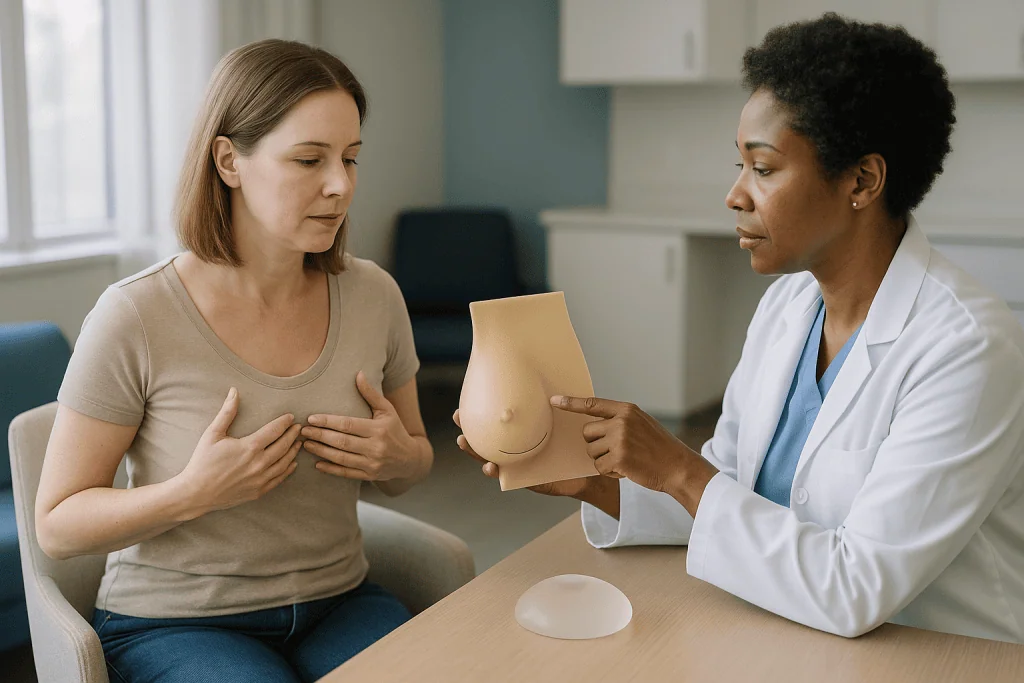
Once you are asleep, the incision is opened at the chosen site. The surgeon then creates the pocket, a space either behind the breast tissue and in front of the pectoral muscle (subglandular), or partly or fully behind the muscle (submuscular). The placement decision is separate from the incision decision, although they influence each other: reaching a submuscular pocket from the armpit, for example, is a different technical task than reaching it from the fold.
The implant is inserted next. Saline implants go in empty and are filled with sterile salt water once positioned; silicone implants arrive pre-filled with gel. Many surgeons use a funnel-shaped sterile sleeve to pass the implant through a smaller opening with less handling. The surgeon then checks symmetry, often sitting the patient up on the table, before closing the layers with stitches. Skin is closed with sutures, surgical tape or tissue adhesive, and a supportive bra or dressing is applied (Mayo Clinic).
The procedure typically takes one to two hours, and most people go home the same day (Mayo Clinic; NHS). The incision is the doorway; everything described here happens behind it, which is why the door’s location changes the surgeon’s view but not the operation’s fundamental goal.
Inframammary incision: what happens under the fold
If surgeons had to pick a default, this would be it. The inframammary incision runs along or just above the crease beneath the breast, usually a few centimeters long, placed so that the finished breast drapes over it. The appeal is directness. The surgeon is operating straight into the breast from below, with a clear line of sight to the pocket and the chest muscle, which makes precise shaping and careful control of bleeding easier than from a distant entry point.
Length is the other advantage. The fold can accommodate the longer opening a pre-filled silicone gel implant requires, including larger or more cohesive gel implants, so surgeons rarely have to compromise on implant choice to fit the incision (Cleveland Clinic). The dissection also stays away from the nipple and the ducts behind it, which is relevant for anyone thinking about future breastfeeding or worried about nipple sensation.
What does it cost you? A scar in the fold is invisible when you stand or sit, but it may be seen when lying flat, when arms are raised, or in some swimwear. In people with very little breast tissue, there may not be a well-defined fold to hide it in, and the surgeon has to predict where the new fold will form once the implant is in place. Get that prediction wrong and the scar can end up riding on the lower breast rather than tucked beneath it, a known pitfall surgeons plan around carefully.
Revision surgery, meaning any later operation to exchange, remove or reposition an implant, is also most straightforward through this site, because the existing scar can simply be reopened. Given that implants are not lifetime devices (NHS), that practical point deserves weight in the decision.
Periareolar incision: around the edge of the areola
The periareolar incision follows the lower half of the areola’s border, the line where darker pigmented skin meets lighter breast skin. That color change is what makes the scar camouflage well for many people. Healing tissue often lands somewhere between the two tones, so the eye reads it as a natural edge rather than a cut.

From this entry the surgeon tunnels down through or around the breast tissue to create the pocket. The central position gives good access to both the upper and lower breast, which some surgeons value when they also need to adjust the fold or address mild asymmetry. If a small lift of the nipple position is being considered at the same time, the same incision can sometimes serve both purposes.
The constraints are real. The incision can only be as long as roughly half the areola’s circumference, so a small areola limits the size and type of implant that can pass through without excessive force. The dissection passes close to the milk ducts and the nerve branches that supply the nipple. Mainstream references list changes in nipple or breast sensation as a recognized risk of augmentation in general (Mayo Clinic), and surgeons commonly explain that an incision at the areolar edge sits nearest those structures. Whether that translates into a measurable extra risk is addressed in its own section below, because the evidence deserves a careful answer rather than a slogan.
One practical point: the periareolar route involves cutting through breast tissue that naturally carries bacteria within the ducts, and some surgeons regard this as a theoretical factor in capsular contracture, the tightening of scar tissue around an implant. Ask your team how they weigh that in your case.
Transaxillary breast augmentation: through the armpit
Transaxillary breast augmentation moves the incision off the breast entirely. A short opening is made in a natural crease of the armpit, and the surgeon tunnels beneath the skin and down to the chest to create the pocket, usually with a long, lighted endoscope, a thin camera that projects the view onto a screen so the surgeon can see what the direct eye cannot (Cleveland Clinic).
For someone who wants no scar on the breast itself, this is the option that delivers it. The armpit scar fades into skin folds for many people and is hidden with arms at the sides. Because the dissection does not pass through breast tissue or near the nipple, the milk ducts are untouched, and some surgeons consider the approach reasonable when breastfeeding is a priority.
The compromises are mechanical. The surgeon is working at a distance through a narrow tunnel, so fine adjustments to the lower pocket and the fold are harder than through a direct inframammary opening. Pre-filled silicone implants, especially larger ones, are more difficult to pass down the tunnel, which is why this route has historically been paired more often with saline implants that are filled once in position. The scar is also exposed in sleeveless clothing and when arms are raised, so “hidden” depends on posture.
Revision is the point most often underplayed. If an implant later needs exchanging or repositioning, many surgeons prefer to make a new incision in the fold rather than work through the armpit again, meaning a second scar in a different place. A thoughtful team will raise this before you choose, not after.
Breast augmentation incision options compared: a side-by-side table
Numbers and absolutes are scarce in this area, and honest comparison tables reflect that. What the three sites genuinely differ on is access, implant compatibility, scar location and what happens if a second operation is ever needed. The table below summarizes the considerations mainstream clinical references and surgical teaching consistently describe (Mayo Clinic; Cleveland Clinic).
| Consideration | Inframammary (under the fold) | Periareolar (areola edge) | Transaxillary (armpit) |
|---|---|---|---|
| Scar location | In the crease beneath the breast | Border between areola and skin | Natural fold of the armpit |
| Surgeon’s direct view of pocket | Most direct | Good, central access | Indirect; usually endoscope-assisted |
| Fits pre-filled silicone implants | Yes, including larger sizes | Limited by areola size | Harder, often paired with saline |
| Path near milk ducts and nipple nerves | Avoids them | Passes close | Avoids them |
| Scar visible when | Lying flat, arms raised, some swimwear | Nipple exposed | Arms raised, sleeveless clothing |
| Revision through same scar | Usually straightforward | Often possible | Often needs a new incision |
| Works with lift at same time | Lift needs separate incisions | Can combine with small lift | No |
Notice what the table does not contain: a column labeled “best.” Every row is a trade. A small areola rules one option out for some implants; a desire to avoid any breast scar favors another; the realistic prospect of a future exchange operation quietly favors the fold. Your anatomy fills in the blanks, and only an in-person examination can do that accurately.
What is the best type of incision for breast augmentation?
People type this question into search engines more than any other on the topic, and the honest answer disappoints anyone hoping for a verdict. There is no incision proven superior for every patient. Clinical references describe the three sites as options with different trade-offs rather than a hierarchy (Mayo Clinic), and the choice is explicitly framed as something decided between patient and surgeon based on anatomy, implant type and personal priorities (Cleveland Clinic).
What the evidence does support is a set of if-then statements. If a pre-filled silicone gel implant is planned, particularly a larger or more cohesive one, the fold gives the room that the areola or armpit may not. If avoiding any scar on the breast is the overriding wish, the armpit is the only route that achieves it. If the areola is generous in size and its border camouflages scars well, the periareolar route becomes a realistic middle path. If a small lift is needed at the same time, the areolar edge may serve double duty.
Surgeon familiarity matters more than most patients expect. A surgeon who has performed hundreds of cases through one approach will generally produce more predictable results with that approach than with one they use occasionally. That is not a reason to accept an option you dislike, but it is a reason to ask how often your surgeon uses each site and why they are recommending the one they are.
The best incision, then, is the one that fits your tissue, your implant, your tolerance for scar location and your surgeon’s expertise, agreed after an examination. Any source that announces a universal winner is telling you about its own preferences, not about the evidence.
Does the periareolar incision affect breastfeeding and nipple sensation?
Two worries cluster around the areolar edge: will I still be able to breastfeed, and will my nipple feel the same? Both deserve precise answers rather than reassurance.
On breastfeeding, mainstream references are measured. Breast implants do not generally prevent breastfeeding, though some people have difficulty producing a full milk supply after augmentation, and surgery near the nipple is a recognized factor in that (Mayo Clinic). The mechanism is anatomical: the milk ducts converge beneath the areola to reach the nipple, so an incision at the areolar border passes closer to them than an incision in the fold or the armpit. Cutting or scarring a portion of the ducts can reduce, though usually not eliminate, the pathways milk uses to reach the surface. Many people who have had periareolar incisions go on to breastfeed; the point is that the risk is not zero and is not identical across incision sites.
On sensation, the picture is similar. Changes in nipple and breast sensation, which may be temporary or permanent and may mean numbness or heightened sensitivity, are listed among the standard risks of breast augmentation regardless of incision (Mayo Clinic; NHS). Nerve branches supplying the nipple travel through the breast tissue toward the areola, so dissection in that region puts them nearer the surgical path. Implant size also matters: a larger implant stretches nerves more, whichever doorway it entered through.
If future breastfeeding is a priority for you, say so plainly at consultation. A surgeon can factor it into the incision recommendation, and that conversation is far better had before surgery than during pregnancy years later.
Who is usually a candidate, and who is usually asked to wait
Breast augmentation is elective, which means the threshold for proceeding is set deliberately high and the reasons to pause are taken seriously. Candidates are typically adults in good general health whose breasts have finished developing, who have realistic expectations about what an implant can and cannot change, and who are seeking the operation for themselves rather than to please someone else (Mayo Clinic). In the United States, saline implants are approved for augmentation from age 18 and silicone gel implants from age 22, a distinction based on the regulatory approval process rather than on a biological difference at those ages (Cleveland Clinic).
Who is asked to wait? Anyone currently pregnant or breastfeeding, because the breasts are still changing and will change again when feeding stops. Anyone with an active infection anywhere in the body, since infection is a known complication of implant surgery and an existing one raises the odds. Anyone with an uncontrolled medical condition, such as poorly managed diabetes or a bleeding disorder, until it is stabilized with their physician. People who smoke are commonly asked to stop for a period before and after surgery, because nicotine narrows blood vessels and impairs wound healing; a poorly healing incision is the last thing anyone wants at any of the three sites.
Surgeons also screen for expectations and mental health. Body dysmorphic disorder, a condition in which a perceived flaw causes distress out of proportion to its visibility, is a recognized reason to defer cosmetic surgery and seek assessment first (NHS). Significant recent weight change or plans for pregnancy soon are reasons some teams suggest waiting, because both alter breast shape and can shift an implant’s position or the fold where a scar was hidden.
None of these are judgments. They are the ordinary checks that make elective surgery safer, and your treating team makes the final call.
What the first days and weeks after breast augmentation usually look like
The incision you chose becomes very real in the first week, because it is the part of the operation you can see. Soreness, swelling and bruising are expected, and the breasts often sit high and feel firm before softening and settling over the following weeks (Mayo Clinic). A supportive surgical bra or compression garment is usually worn to limit movement and support healing tissue.
Your team will give specific aftercare instructions, and those override anything written here. In general terms, references describe one to two weeks off work for most people, with strenuous activity, heavy lifting and anything that raises the pulse or blood pressure avoided for at least two weeks and often longer (Mayo Clinic; NHS). Driving is reasonable only when you can brake sharply without pain and are no longer taking sedating medicine, which the NHS frames as typically a week or more (NHS).
Incision care is simple but matters. Keep the area clean and dry, follow instructions about when showering is allowed, and avoid soaking in baths or pools until the wound is closed. Armpit incisions deserve particular attention, because that skin is warm, moist and moves with every reach; ask how to manage deodorant and arm movement. Stitches may dissolve on their own or be removed at a follow-up visit (NHS).
Constipation is a common, under-discussed complication of the first days, driven by opioid pain relievers, anesthesia and reduced movement. Walking gently from the first day, drinking fluids and eating fiber all help, and your team can advise on stool softener or laxative classes if needed; do not strain against a fresh chest incision. More on that question appears in the FAQs below.
Breast augmentation scars: how they mature and what genuinely helps
Every incision becomes a scar, and the scar you see at two weeks is not the scar you will live with. Early scars are typically pink or red, slightly raised and firm, because the body is laying down collagen rapidly. Over the following months the collagen remodels, the color fades toward skin tone, and the line softens and flattens. Mainstream references describe scars as fading over time without disappearing, and warn that scar appearance varies with skin type, genetics and healing (Mayo Clinic).
Some people form hypertrophic scars, which are thickened and raised but stay within the original cut, or keloids, which grow beyond the wound’s borders. Keloid tendency runs in families and is more common in darker skin tones; if you have ever formed a thick scar from a piercing, vaccination or minor cut, tell your surgeon, because it may influence which incision site is chosen and how the wound is managed afterwards.
What helps a scar heal well is less glamorous than the shelves of creams suggest. Avoiding tension on the wound, which is one reason surgeons restrict arm movement and lifting early. Protecting the scar from sun for the first year, since ultraviolet light darkens healing tissue and can leave the line permanently more visible. Not smoking. Silicone gel sheets or silicone-based gels are the topical option with the most consistent, though still modest, supporting evidence for softening and flattening scars; ask your team whether and when to start them.
Massage, vitamin E oil and many branded scar products have weaker or inconsistent evidence. They are unlikely to harm a healed wound, but expecting them to erase a scar sets you up for disappointment. A realistic goal is a fine, pale line that most people, including you, stop noticing.
What people often get wrong about breast augmentation incisions
“The armpit incision is scarless.” It is scar-free on the breast, not scar-free. The armpit scar is hidden with arms down and visible with arms up. Framing matters, and the honest version is “no scar on the breast.”
“The newest technique is automatically the best.” People ask what the newest breast augmentation technique is as though novelty equals quality. Endoscopic transaxillary placement, insertion funnels and fat grafting have each been described as innovations, and fat transfer from one body area to the breast is a genuine alternative for modest enlargement without an implant (Cleveland Clinic). None has been shown in high-quality evidence to produce better outcomes for everyone, and the three incision sites in this article have remained the mainstream options for decades precisely because they work. Newer deserves scrutiny, not a free pass.
“A lollipop lift is a type of augmentation.” A lollipop lift is the informal name for a vertical mastopexy, a breast lift using an incision around the areola plus a vertical line down to the fold, resembling a lollipop on its stick. It repositions sagging tissue and the nipple; it does not add volume. Some people have a lift and an implant at the same time, but they are separate operations with separate incision logic.
“Implants are permanent.” Both the NHS and Mayo Clinic are explicit that implants are not lifetime devices and are likely to need replacement or removal at some point, with rupture, capsular contracture and position change among the reasons (NHS; Mayo Clinic). That is why revision access through the original incision is a legitimate factor in choosing a site.
“The incision decides where the implant sits.” Incision site and pocket position (above or below the muscle) are related but separate decisions. Ask about both.
Risks worth understanding before choosing an incision
Incision choice shifts a few risks around; it does not remove them. Mainstream references list the same core complications for breast augmentation regardless of approach: infection, bleeding or a collection of blood called a hematoma, changes in nipple and breast sensation, scarring, implant rupture or leakage, implant malposition, and capsular contracture, the tightening of the scar capsule that naturally forms around any implant (Mayo Clinic; NHS). Capsular contracture can make the breast feel firm, look distorted or become painful, and may require further surgery.
Two implant-related conditions deserve plain language. Breast implant-associated anaplastic large cell lymphoma, usually shortened to BIA-ALCL, is a rare cancer of the immune system found in the scar capsule, not in the breast tissue itself, and has been linked mainly to textured-surface implants (Mayo Clinic). The term “breast implant illness” describes a cluster of systemic symptoms some people report, such as fatigue and joint pain; research into whether and how implants cause these symptoms is ongoing, and the evidence does not yet give a settled answer (Mayo Clinic). An honest explainer says so rather than dismissing or amplifying the concern.
Where does the incision come in? The periareolar route passes closest to ducts and nerves, so sensation and milk supply changes sit nearest that path. The armpit route makes later revision through the same scar harder. The fold route places the scar where fold position must be predicted correctly. Implants can also make mammograms harder to read, and additional imaging views are often needed; silicone implant guidance includes periodic imaging to check for silent rupture (Mayo Clinic). These are not reasons to avoid surgery; they are the information an informed decision is built on, and your team will put them in the context of your own health.
Questions to ask your care team about breast augmentation incision options
Consultations move quickly, and the incision discussion can get squeezed between implant catalogs and scheduling. Bringing a short list keeps it where it belongs, at the center. These questions are drawn from what patients most often wish they had asked.
- Which incision are you recommending for me, and what about my anatomy makes it the better fit than the other two?
- How often do you use each of the three sites, and which do you perform most?
- Does my implant choice (saline or silicone, size, shape) limit which incision is realistic?
- Where exactly will the scar sit when I stand, lie flat and raise my arms? Can you draw it on me?
- If I want to breastfeed in future, how does that change your recommendation?
- What is your plan for nipple sensation, and how do you discuss that risk with patients?
- If this implant needs exchanging or removing years from now, which incision would you use then, and would it be the same scar?
- Will the implant sit above or below the muscle, and why?
- I have formed thick or keloid scars before; does that alter the site you suggest?
- What does your aftercare look like for this incision, including how I should manage movement, showering and the armpit area if that is the route?
- What signs should make me call you, and how do I reach the team after hours?
- Do you take photographs for my records, and will I see a realistic range of results for this incision, not only the best ones?
A good team welcomes these questions and answers them without hurry. If any answer is vague on the “why,” particularly on why one site suits you specifically, it is reasonable to ask again or to seek a second opinion before committing. The decision is yours to make with them, and it should feel that way.
When to call your doctor after breast augmentation
Most recoveries are uneventful, and most of what you notice in the first fortnight, such as swelling, bruising, tightness and odd shooting sensations, is expected healing. A small number of signs are not, and they need a same-day call to your surgical team or emergency care rather than a wait for the next appointment (Mayo Clinic; NHS).
Call your team promptly if you notice:
- Sudden swelling or enlargement of one breast, especially with increasing pain or tightness, which may indicate bleeding into the pocket (hematoma)
- Fever, chills or feeling unwell, or redness, warmth and spreading pain around the incision, which can signal infection
- Pus, cloudy fluid, foul odor, or the incision edges opening or pulling apart
- Skin over the breast turning dark, dusky or unusually pale, or the nipple changing color
- Bleeding that soaks through a dressing or does not stop with gentle pressure
- Pain that worsens after the first few days instead of easing, or pain not controlled by what your team advised
- A visible shift in implant position, a sudden change in shape, or a new firmness or distortion weeks or months later
Seek emergency care immediately for chest pain, shortness of breath, coughing up blood, or pain, swelling and warmth in a calf, because these can indicate a blood clot in the leg or lung, a rare but serious risk after any operation. Confusion, fainting, a racing heartbeat or a rash with fever also warrant urgent assessment.
Months or years on, any new breast swelling, fluid collection, lump, persistent pain or change in shape should be examined, as should any concern that an implant may have ruptured (Mayo Clinic). You are not wasting anyone’s time; your team would far rather hear from you early than late. Every judgment about what a symptom means and what to do next belongs with them.
Frequently asked questions
What is the best type of incision for breast augmentation?
There is no single best incision; mainstream clinical references present the fold, areola and armpit sites as options with different trade-offs, chosen between patient and surgeon. The fold suits larger pre-filled silicone implants and future revisions, the areola camouflages scars at a color border, and the armpit avoids any scar on the breast. Your anatomy, implant choice, breastfeeding plans and your surgeon’s experience with each route decide which fits you.
Is the inframammary incision the most common choice?
The inframammary incision in the fold beneath the breast is widely regarded as the most frequently used site because it gives the surgeon the most direct view of the implant pocket and accommodates any implant type and size. It also allows later revision through the same scar. The scar is hidden when standing but may be seen lying flat or with arms raised, and in a very small breast the fold position must be predicted carefully.
Does a periareolar incision affect breastfeeding?
It can, though not inevitably. Implants do not generally prevent breastfeeding, but surgery near the nipple is a recognized factor in reduced milk supply because the ducts converge beneath the areola and an incision there passes close to them. Many people breastfeed after a periareolar incision, often with a reduced rather than absent supply. If breastfeeding matters to you, raise it at consultation so the incision site can reflect that.
How visible is the scar after transaxillary breast augmentation?
The transaxillary scar sits in a natural crease of the armpit, so it is hidden when your arms are at your sides and visible when you raise them or wear sleeveless clothing. Like all scars it starts red and raised before fading over months. The breast itself carries no scar, which is the route’s main appeal, but a future implant exchange may require a new incision in the fold, adding a second scar.
How do you poop after breast augmentation?
Constipation is common after surgery because opioid pain medicines, anesthesia and reduced movement all slow the bowel. Gentle walking from the first day, plenty of fluids and fiber-rich foods help, and your care team can advise whether a stool softener or laxative class is appropriate for you. Avoid straining, which stresses a fresh chest incision; a footstool to raise the knees can make passing stool easier. Tell your team if it persists beyond a few days.
What is the newest breast augmentation technique?
Techniques described as newer include endoscope-assisted armpit placement, funnel sleeves that pass implants through smaller openings, and fat grafting, which transfers your own fat to the breast for modest enlargement without an implant. None has been shown in high-quality evidence to produce better results for everyone, and the three incision sites in this article remain the mainstream options. Treat novelty as a reason to ask questions rather than a guarantee of a better outcome.
What is a lollipop breast lift, and is it the same as augmentation?
A lollipop lift is the informal name for a vertical mastopexy, a breast lift that uses an incision around the areola plus a vertical line down to the fold, resembling a lollipop on its stick. It repositions sagging tissue and the nipple but adds no volume. Breast augmentation adds volume with an implant or fat. The two can be combined in one operation when both lift and size are wanted, but they are distinct procedures.
How long do breast augmentation scars take to fade?
Scars from any incision site are typically pink or red and raised in the early weeks, then soften, flatten and fade toward skin tone over the following months, with mainstream references noting they fade over time but do not vanish. Final appearance depends on skin type, genetics and healing. Sun protection for the first year, avoiding tension on the wound, not smoking and silicone-based gels or sheets, if your team recommends them, give the best chance of a fine, pale line.
Can the incision site be used again if the implant needs replacing?
Often, yes, but it depends on the site. The inframammary fold incision is the easiest to reopen for an exchange, removal or repositioning, and periareolar incisions can frequently be reused as well. Transaxillary incisions are harder to work through a second time, so many surgeons make a new fold incision instead. Because implants are not lifetime devices, asking how a future revision would be approached is a worthwhile question before the first operation.
Does the incision decide whether the implant goes above or below the muscle?
No. Incision site and implant pocket position are related but separate decisions. A pocket above the chest muscle (subglandular) or partly or fully beneath it (submuscular) can be reached from the fold, the areola or the armpit, though access and precision differ by route. Reaching a submuscular pocket from the armpit, for example, is technically more demanding than from the fold. Ask your surgeon to explain both choices and how they fit together.
References
This article is for general information only and is not a substitute for professional medical advice. Please consult a qualified doctor about your individual situation.

More from the Blog
Can You Breastfeed After Nipple Aesthetics Procedures? Sensation, Ducts and Planning Ahead
Many people can breastfeed after nipple surgery, but how much milk they make depends on which structures the operation touched: the milk ducts running…

Can Breast Reduction Relieve Neck and Back Strain? How the Decision Is Made With Your Surgeon
Breast reduction surgery can ease neck, shoulder and upper back strain for many people whose symptoms are linked to heavy breast tissue, and major…

When Breast Reconstruction Needs a Revision: Asymmetry, Capsule Changes and Fat Grafting
Breast reconstruction revision surgery is a follow-up operation that adjusts an earlier reconstruction when problems develop: a difference in size or position between the…

How Is Discomfort Managed After Breast Reduction? Tightness, Drains and Sleeping Positions
Breast reduction pain after surgery is usually described as soreness and tightness rather than sharp pain, and it is typically most noticeable in the…
What Breasts Look Like After Prosthesis Removal: Volume, Skin and When a Lift Is Discussed
After implant removal without replacement, breasts usually look smaller and softer at first, with loose or deflated-looking skin, a lower nipple position and some…
Who Is a Candidate for Breast Fat Transfer? Donor Fat, Breast Volume Goals and Skin Quality
A good fat transfer breast augmentation candidate is a healthy adult who wants a modest increase in size or fullness, has enough spare fat…