

Can Amblyopia Be Treated in Teenagers and Adults? What Eye Doctors Consider
Key Takeaways
- Amblyopia is a brain-based problem in an eye that is usually structurally healthy, which is why treatment aims to change how the brain uses the eye rather than to repair the eye.
- In a randomized trial of 7- to 17-year-olds, 47 percent of previously untreated teenagers improved by at least two chart lines with patching and glasses versus 20 percent with glasses alone.
- Teenagers who were already treated thoroughly in childhood gained little extra from further patching in the same trial, so prior history shapes realistic expectations.
- About a quarter of older children in that trial improved with an updated glasses prescription alone, making optical correction the essential first step at any age.
- Evidence for adult amblyopia treatment comes mainly from small studies of perceptual learning and dichoptic training, which report modest, variable gains rather than a reliable standard of care.
- Strabismus surgery straightens the eyes and can improve appearance and field of view, but it does not on its own sharpen vision in the amblyopic eye.
Amblyopia can often be improved in teenagers and, to a smaller and less predictable degree, in adults. The visual brain keeps some flexibility beyond childhood, so glasses, patching, blurring drops and structured visual training may still help, especially in people never treated before. Gains are usually partial, the evidence for adults is limited, and an eye doctor must weigh benefits against risks such as double vision.
She is 34, an accountant, and she has never once seen the 3D effect at the cinema. The glasses on her nose have always felt like a formality for the right lens; the left one, she says, “just comes along for the ride.” A childhood eye patch lasted three weeks before it ended up in a drawer. Now she has read online that the brain can still learn, and she wants a straight answer: is it too late?
It is one of the most common questions that reaches an eye clinic from an adult, and the honest reply has changed over the past two decades. The old teaching was that lazy eye treatment for adults was pointless because the visual brain had “set” by age seven or eight. Research has softened that verdict without overturning it.
What follows is how eye doctors actually think through the question, what the trials show, and where the genuine uncertainty still sits.
What amblyopia actually is, and why the eye itself is usually healthy
Amblyopia, the medical name for lazy eye, is reduced vision in one eye (occasionally both) that develops because the brain and that eye did not learn to work together in early childhood. The key word is brain. In most cases the eye is structurally normal; the retina, lens and optic nerve are fine. The problem is that the visual cortex, the part of the brain that processes sight, learned to favor the clearer or straighter eye and to suppress the other.
Three triggers account for almost every case. Strabismus, a misalignment of the eyes, sends two different images to the brain, which switches one off to avoid confusion. Anisometropia, a large difference in focusing power between the eyes, means one image is always blurred. Deprivation, the least common cause, happens when something physically blocks light, such as a congenital cataract or a drooping eyelid.
The National Eye Institute estimates that about 3 in every 100 children are affected, and the NHS puts the figure at roughly 1 in 50. Because the condition usually affects one eye and the other compensates, many people reach adulthood without realizing how much weaker the amblyopic eye is until a routine test covers the good one.
Two effects matter beyond the letter chart. People with amblyopia commonly have poor stereopsis, the depth perception that comes from the brain fusing two slightly different images, which is why the cinema 3D glasses never worked for our accountant. They also have only one fully functioning eye to fall back on if disease or injury ever damages the stronger one, a point that shapes how doctors weigh the value of even modest improvement later in life.
Why doctors used to say lazy eye treatment for adults was impossible
The pessimism had a respectable scientific pedigree. Classic animal experiments in the mid-twentieth century showed that depriving one eye of clear vision during a narrow window of infancy permanently rewired the visual cortex, and that the same deprivation later in life did almost nothing. Researchers called this the critical period, and clinicians translated it into a rule of thumb: treat amblyopia before school age or accept the result.
Mainstream guidance still reflects the core truth in that rule. The NHS and Mayo Clinic both state that treatment works best when started before about age seven, because the connections between eye and brain are still forming and easily reshaped. Nobody in the field disputes that the earlier the intervention, the larger and more reliable the gain.
What changed was the idea of a hard cutoff. Neuroscientists began documenting neuroplasticity, the brain’s capacity to reorganize its connections, well into adult life, in areas from stroke recovery to language learning. Case reports appeared of adults whose amblyopic eye improved after they lost sight in the good eye, suggesting the suppressed circuitry was dormant rather than dead. Laboratory studies of perceptual learning, in which adults practiced demanding visual tasks for hours, showed measurable acuity gains in the weaker eye.
So the modern framing is a sliding scale rather than a locked door. Plasticity declines with age; it does not vanish. The practical question an eye doctor asks is no longer “Is this person too old?” but “How much realistic improvement is available, at what effort, and with what risk?” That reframing is exactly why lazy eye treatment for adults has become a legitimate clinical conversation instead of a polite refusal.
What eye doctors check first in a teenager or adult with amblyopia
Before anyone talks about patches or apps, the first appointment is about ruling things out and measuring things precisely. The most important step is confirming that the reduced vision really is amblyopia and not a disease of the eye itself that has gone unnoticed since childhood. An adult who was told at age six they had a lazy eye may never have had a dilated examination since.
A typical work-up includes a careful measurement of visual acuity, the sharpness of vision tested letter by letter, in each eye separately and with the best possible glasses prescription. Refraction, the measurement of focusing error, is repeated rather than copied from old records, because an out-of-date prescription is a common and correctable reason the weak eye underperforms.
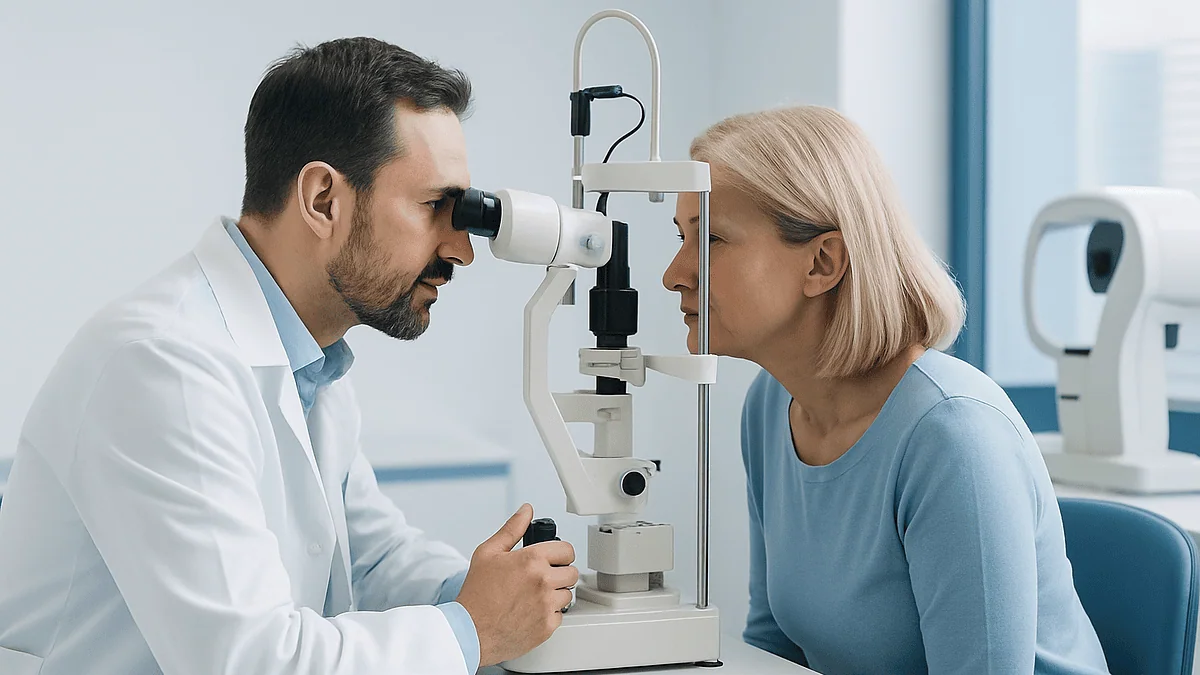
The clinician then examines eye alignment and movement, checks how the pupils react, and looks at the back of the eye after dilating drops. Optical coherence tomography, a scan that images the retina and optic nerve in cross-section, is often used to confirm the structures are healthy. The Cleveland Clinic and Mayo Clinic both describe this staged approach, moving from acuity and refraction through alignment to a full eye-health examination.
Two further questions steer the treatment discussion. Has the person been treated before, and how thoroughly? The trial evidence, discussed below, suggests prior treatment strongly influences how much room is left for gain in teenagers. And does the person have strabismus with an established pattern of suppression? Waking up the weaker eye in someone whose eyes point in different directions can, in a minority, produce double vision, so the alignment findings are not a formality. Only after these answers are in hand does the conversation about options begin.
How lazy eye treatment for adults actually works
Every form of amblyopia treatment, at any age, rests on one principle: make the brain use the weaker eye. The methods differ in how they achieve that.
The foundation is optical correction. Glasses or contact lenses give the amblyopic eye the sharpest image its optics allow, so the signal reaching the brain is worth paying attention to. In children, this step alone produces a meaningful share of the total gain, and clinicians usually wait to see what glasses achieve before adding anything else. The same logic applies to adults: an eye that has never had a properly focused image cannot be expected to improve without one.
The second layer is occlusion or penalization. Occlusion means covering the stronger eye with a patch for a set period each day. Penalization means blurring the stronger eye instead, usually with an eye drop from the anticholinergic class, such as atropine, which relaxes the focusing muscle so near objects become blurred, or with a deliberately weakened lens. Either way, the brain is pushed toward the eye it has been ignoring. Any decision about drops, how often and for how long, belongs to the prescribing clinician.
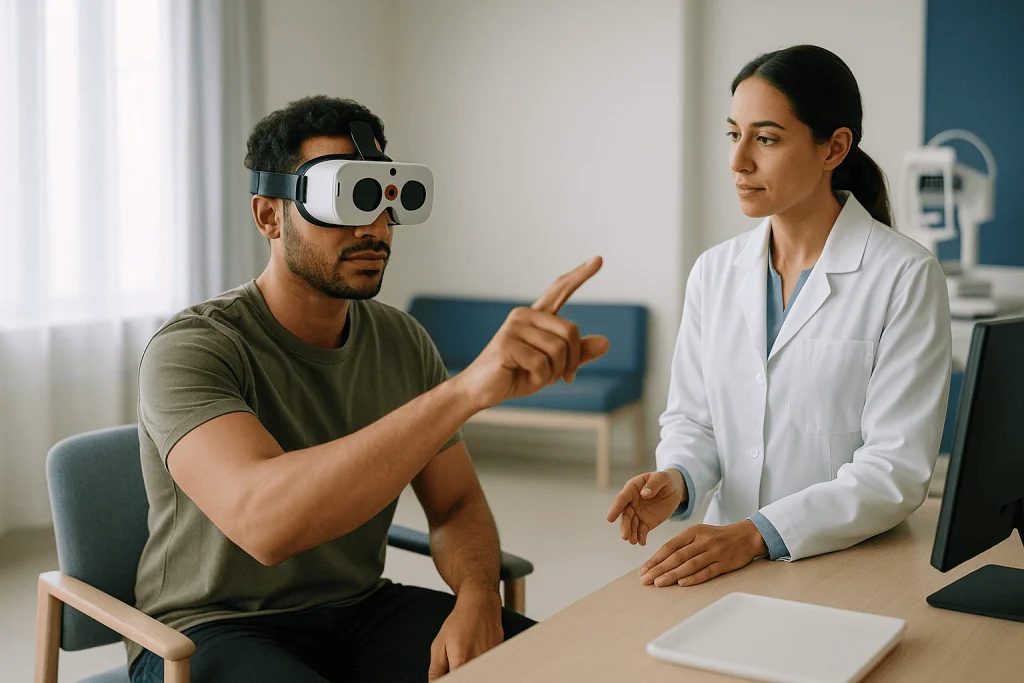
The third and newest layer is binocular training. Rather than shutting one eye out, dichoptic methods present different images to each eye at once, typically through a game or video with the strong eye’s image dimmed, and require both eyes to cooperate to complete the task. The aim is to reduce suppression directly rather than to punish the good eye. Perceptual learning, repeated practice of demanding visual discrimination tasks, works on a related idea: forcing the visual cortex to extract more from the weak eye’s signal.
In adults, these tools are the same as in children. What differs is how much the brain will yield, and how long it takes.
Lazy eye treatment for teenagers: what the trial evidence shows
The most influential evidence on older patients comes from a randomized trial run by the Pediatric Eye Disease Investigator Group, a US research network, in children aged 7 to 17. It is the study clinicians most often quote to a teenager asking whether it is too late.
More than 500 participants with amblyopia received glasses. Half were also assigned to active treatment, meaning patching plus near activities and, for the younger group, atropine drops; the other half continued with glasses alone. Success was defined as improving by at least 10 letters on the eye chart, roughly two lines.
The results split by age. Among 7- to 12-year-olds, 53 percent of the actively treated group reached that threshold compared with 25 percent of the glasses-only group. Among 13- to 17-year-olds, the picture depended on history. In teenagers who had never been treated before, 47 percent responded to active treatment versus 20 percent with glasses alone. In teenagers who had already been treated in childhood, the difference nearly disappeared: 23 percent versus 20 percent.
Two conclusions follow, and eye doctors lean on both. First, lazy eye treatment for teenagers is worthwhile, particularly for those who slipped through the net earlier; Mayo Clinic summarizes the same body of work by noting that about half of children between 7 and 17 respond to treatment. Second, a teenager who patched diligently for years as a child may already have banked most of the available gain, and further patching offers less. That does not mean nothing can be done; it means expectations should be set with the individual’s history in view.
The trial also reminds us what success looked like: two lines on a chart, not normal vision. Most treated teenagers ended with an eye that was better, and still weaker than the other.
Amblyopia treatment for adults: what the evidence shows so far
Once past the teenage years, the quality of evidence drops sharply. There is no large randomized trial of amblyopia treatment for adults comparable to the pediatric studies. What exists is a collection of small trials, laboratory studies and case series, most testing perceptual learning or dichoptic games in adults with anisometropic or strabismic amblyopia.
Taken together, these studies report that many adults gain measurable acuity in the weak eye after weeks of structured training, and that some regain a degree of stereopsis. The gains are typically modest, roughly one to two lines on the chart in the better-responding participants, and they vary widely between individuals. Some studies find that improvement persists for months after training stops; others show partial fading.
Eye doctors read this literature with three cautions. The studies are small, so a striking result in a dozen participants may not hold in a hundred. Many lack a control group receiving glasses alone, which matters because the pediatric trials show that glasses by themselves produce gains in a quarter of patients who would otherwise be credited to the training. And the tasks used in research labs are often more intensive than anything a busy adult will sustain at home.
MedlinePlus and the National Eye Institute describe the adult position in careful terms: research suggests some adults may benefit, and treatment is being studied, without claiming an established standard of care. That is the honest summary. An adult who asks about treatment should expect a candid discussion that the approach is reasonable to try in selected cases, that results cannot be predicted, and that the strongest proven step, an up-to-date glasses prescription and a full eye-health check, is also the least glamorous one.
Who is usually offered treatment, and who is usually asked to wait
Clinicians do not apply a single age threshold. They weigh a cluster of factors, and the pattern that emerges from guidelines and the trial data looks something like this.
People most likely to be offered a trial of treatment beyond childhood are those with untreated or undertreated amblyopia, since the pediatric evidence shows the biggest gap between active treatment and glasses alone in this group. Those with anisometropic amblyopia, where the eyes are aligned but one is blurred, tend to be favorable candidates because the risk of unmasking double vision is lower. Anyone whose current glasses are out of date is offered correction first, whatever else follows.
Treatment is usually deferred, or approached very cautiously, in several situations. If the eye examination reveals a structural cause of poor vision, that is treated on its own merits and the amblyopia label is revisited. If the person has a long-standing eye turn with deep suppression, the team may test carefully for the potential to develop diplopia, double vision, before pushing the weak eye forward. If the stronger eye is itself unwell, protecting it takes priority.
Life circumstances also count. Structured visual training demands regular time over weeks to months, and a patch on an adult face is a social commitment as much as a medical one. A clinician who senses that a plan cannot be sustained may reasonably suggest a smaller first step and a review.
None of these are rules that override individual judgment. The decision about whether to try, what to try and when to stop rests with the treating team, informed by the examination and by what the person actually wants from their vision.
Treatment options compared: a summary table
The options below are those a teenager or adult is likely to hear about. The evidence column reflects mainstream sources and trial data rather than marketing claims, and none of it replaces an individual assessment.
| Approach | How it works | Evidence in teens and adults | Points doctors weigh |
|---|---|---|---|
| Glasses or contact lenses | Gives the weak eye the sharpest possible image so the brain has a signal worth using | Improved about a quarter of 7- to 17-year-olds on their own in the main trial; first step at any age | Prescription must be current; effect emerges over weeks |
| Patching | Covers the strong eye for part of the day, forcing use of the weak eye | Roughly doubled response in untreated 13- to 17-year-olds; little added benefit in previously treated teens | Adherence, appearance, small risk of double vision if strabismus present |
| Blurring drops or lenses | Blurs the strong eye’s vision, usually for near tasks, instead of covering it | Studied mainly in younger children; used selectively in older patients | Prescribing clinician decides suitability; light sensitivity and near blur |
| Dichoptic or binocular games | Shows each eye a different part of a game, with the strong eye dimmed, to reduce suppression | Small trials in adults show modest gains; no benefit over glasses alone in a trial of 13- to 16-year-olds | Engagement required; evidence still developing |
| Perceptual learning | Repeated practice of demanding visual tasks to sharpen cortical processing | Laboratory studies in adults show measurable but variable acuity gains | Time-intensive; durability uncertain |
| Strabismus surgery | Repositions eye muscles to straighten the eyes | Improves alignment; does not by itself restore acuity in the amblyopic eye | Often about appearance, comfort and field of view rather than sharpness |
The table makes one point starkly: the interventions with the firmest evidence are the oldest, and the newest are the least proven. That is not a reason to dismiss the new approaches, but it is a reason to hear any confident promise about them with a raised eyebrow.
Adult amblyopia vision therapy, dichoptic games and perceptual learning: what is proven
“Vision therapy” is an umbrella term, and that is part of the difficulty. It can mean carefully designed dichoptic training studied in university laboratories, or a loosely defined program of eye exercises with no supporting trial. When a clinician discusses adult amblyopia vision therapy, it helps to separate the two.
Dichoptic training has the strongest scientific rationale. Amblyopia is fundamentally a problem of suppression, and dichoptic methods target suppression directly by rewarding the brain for combining input from both eyes. Studies in adults have reported improvements in acuity and, in some participants, the first measurable stereopsis of their lives. The Pediatric Eye Disease Investigator Group also tested a binocular tablet game against patching in 13- to 16-year-olds and found it did not outperform glasses alone in that older group, a sobering result that tempers the early enthusiasm from small studies.
Perceptual learning has a longer research history in adults. Participants practice discriminating fine visual features, such as the orientation of faint lines, for many sessions. Acuity in the amblyopic eye often improves, sometimes generalizing to tasks that were not trained. The gains are real in the studies that report them, but the studies are small, the training is intensive, and long-term follow-up is patchy.
What has not been shown is that generic eye exercises, convergence drills or unsupervised app use improve amblyopia in adults. Mainstream sources including MedlinePlus, the NHS and Mayo Clinic do not list these as established treatments. A reasonable position, and the one most eye doctors take, is that structured binocular or perceptual training is worth discussing as an investigational option for a motivated adult, ideally within a monitored program, with clear agreement in advance on how improvement will be measured and when the effort will be reviewed.
Lazy eye surgery for adults: what it can and cannot do
Adults often arrive assuming there is an operation for lazy eye. There is surgery for strabismus, the eye misalignment that causes some amblyopia, and the distinction matters enormously.
Strabismus surgery adjusts the position or tension of the small muscles that move the eye so that the two eyes point in the same direction. In adults it is usually performed under general anesthesia and is well established. Its benefits are alignment-related: a straighter appearance, an expanded field of view, relief from the effort of holding the eyes together, and, in people who retain some capacity to fuse images, improved binocular function.
What it does not do is sharpen the amblyopic eye. Acuity is a brain function, and moving the eye muscles does not change how the visual cortex processes the signal. The NHS and Mayo Clinic both describe surgery as a treatment for the eye turn rather than for the reduced vision itself. Some surgeons will suggest amblyopia treatment before or after alignment surgery, but the two address different problems.
Lazy eye surgery for adults is also sometimes misunderstood to mean laser refractive surgery. Reshaping the cornea can correct the focusing error in an amblyopic eye, just as glasses do, and may be discussed for adults who want to be free of spectacles. It corrects the optics, not the amblyopia, and an eye that saw poorly through a perfect lens will still see poorly after surgery. Surgeons weigh the special caution of operating on someone with only one good eye.
Finally, if the examination finds a physical cause such as a cataract or drooping lid, surgery for that cause can improve the image reaching the brain, and the amblyopia question is reassessed afterward. The surgical team decides which, if any, of these apply.
What the first weeks and months of treatment usually look like
Amblyopia treatment is slow by design, because the brain changes incrementally. Anyone expecting a visible difference within days will be disappointed, and clinicians say so at the outset.
The usual sequence begins with the new glasses prescription worn full-time. Vision through the weaker eye is rechecked after a period of adaptation, because acuity often continues to creep up for weeks as the brain adjusts to a sharper image. The NHS describes this optical phase as a standard first step before patching is considered.
If patching or blurring is added, it is usually for a set number of hours each day rather than all day, combined with visually demanding near tasks such as reading or detailed work while the strong eye is covered. The NHS notes that treatment commonly continues for several months, with follow-up visits to measure progress and adjust the plan. In the large trial of 7- to 17-year-olds, the main outcome was measured after about six months, which gives a realistic sense of the commitment involved.
Early sensations are worth anticipating. Wearing a patch or having the good eye blurred can feel disorienting and tiring at first, particularly for driving or screen work; adults often schedule occlusion for evenings at home. Dichoptic or perceptual training programs involve regular sessions over weeks, with progress tracked on the tasks themselves and confirmed on the eye chart at review.
The review appointments are where the real decisions happen. If acuity is climbing, treatment continues. If it has plateaued across two or three visits, the team discusses whether to intensify, switch method or stop. If double vision or discomfort appears, the plan changes promptly. Throughout, the course is set by the clinician and the person together, not by a fixed calendar.
Risks and trade-offs: double vision, regression and the strong eye
Amblyopia treatment is low-risk compared with most medical interventions, but it is not risk-free, and adults face a slightly different profile from children.
The concern that most shapes clinical caution in older patients is diplopia, seeing two images at once. In someone with strabismus, the brain has long suppressed the turned eye to avoid exactly this. If treatment strengthens that eye’s signal while the eyes remain misaligned, the suppression can lift and the two images may both reach awareness. In children the brain usually adapts; in adults it may not, and persistent double vision is disabling. This is why alignment testing and, in some cases, trial lenses to simulate the effect come before aggressive treatment.
Regression is the second trade-off. Gains achieved with patching can partially fade after treatment stops, which is why clinicians taper rather than stop abruptly in children and why follow-up continues after the active phase. In adults, the durability of gains from training programs is not well established; some studies show persistence for months, others show drift.
Occlusion of the strong eye carries its own small hazard: reverse amblyopia, where the previously good eye weakens from lack of use. This is chiefly a concern in young children whose visual systems are still developing, and much less so in adults, but it is one reason patching is monitored rather than open-ended.
Blurring drops can cause light sensitivity and near-vision blur in the treated eye for their duration of action. Skin irritation from adhesive patches is common and usually manageable.
Set against these is the risk of doing nothing. An amblyopic person lives with a single reliable eye, and any lifelong injury or disease in the strong eye has larger consequences. That asymmetry is part of why even modest improvement in the weaker eye is worth a careful conversation.
What people often get wrong about amblyopia in adults
Misunderstandings about lazy eye are stubborn, partly because the condition is invisible and partly because the old absolute rule about age lingers online. A few corrections, each grounded in the evidence above.
The eye is not lazy, and it is not diseased. The name suggests a weak muscle or a defective organ; in reality the eye is usually healthy and the brain has learned to ignore it. This matters because the goal of treatment is neural, not mechanical, and because a healthy eye examination is reassuring rather than puzzling.
Lazy eye and an eye turn are not the same thing. Strabismus is a misalignment you can see; amblyopia is reduced vision you cannot. One can exist without the other. An adult with perfectly straight eyes can have profound amblyopia from a childhood focusing difference, and an adult with a visible turn can have good vision in both eyes.
Surgery does not sharpen vision. Strabismus surgery straightens the eyes and can improve appearance and comfort; it does not by itself change how well the amblyopic eye sees.
It is not automatically too late after childhood. The trial data in 7- to 17-year-olds and the smaller adult studies show the visual brain retains some plasticity. The correct statement is that later treatment produces smaller, less predictable gains, not none.
Equally, it is not the case that any adult can restore normal vision with the right app. No mainstream source supports that claim, and the strongest trial of a binocular game in teenagers found no advantage over glasses. Anyone promising a full restoration, a guaranteed outcome or a single proprietary method is speaking beyond the evidence. The trustworthy answer is measured, individual and delivered after an examination.
Questions to ask your care team
A good consultation about amblyopia in a teenager or adult is a two-way conversation, and coming with specific questions tends to produce specific answers. These are the ones eye doctors say they are glad to be asked.
- Is my reduced vision definitely amblyopia, and has a full dilated examination ruled out any other cause in either eye?
- Is my current glasses or contact lens prescription the best possible for the weaker eye, and how long should I wear it before we judge its effect?
- Based on my history, including any childhood treatment, how much improvement do you think is realistic, and how will we measure it?
- Do I have any eye misalignment, and what is my individual risk of double vision if the weaker eye improves?
- Which approach would you suggest first, and what would make you switch or stop?
- If you recommend a training program, is it a monitored one with progress checks, and what does the evidence say about it for someone my age?
- How often will I be reviewed, and what should prompt me to contact you between visits?
- What steps should I take to protect my stronger eye over the long term?
The last question is often the most important and the least asked. Whatever happens with treatment, an adult with amblyopia benefits from regular eye examinations, protective eyewear for sports and hazardous work, and prompt attention to any change in the good eye. The care team can frame all of these in the context of the individual’s occupation, hobbies and driving.
Write the answers down or ask for a written summary. Treatment plans for amblyopia unfold over months, and the reasoning behind each decision is easier to follow when it is on paper.
When to call your doctor
Amblyopia itself is stable and painless, so a change in vision is never something to attribute to lazy eye and wait out. Contact your eye doctor promptly, or seek urgent care, if any of the following occur, whether or not you are in active treatment.
Seek urgent care for a sudden drop in vision in either eye, especially the stronger one, since that eye is your primary source of sight. The same applies to a sudden shower of new floaters, flashes of light, or a curtain or shadow spreading across part of your visual field, which can indicate a retinal tear or detachment. Sudden eye pain with redness, halos around lights and nausea needs same-day assessment. Any eye injury, chemical splash or foreign body in the stronger eye should be treated as an emergency.
Call your care team within a day or two if you develop new or persistent double vision during treatment, since this can signal that suppression is lifting in a misaligned eye and the plan may need to change. Do the same if a blurring drop causes severe light sensitivity, marked skin or eye irritation, or symptoms elsewhere in the body such as flushing, a racing heart or confusion, which are recognized effects of the anticholinergic class and warrant review by the prescriber.
Also make contact if vision in the treated eye seems to be getting worse rather than better, if a patch is causing skin breakdown, or if you are finding the plan impossible to sustain. None of these mean treatment has failed; they mean the plan needs adjusting, and the team would rather hear early.
Do not stop or change any prescribed drop on your own. Describe what is happening and let the prescribing clinician decide the next step.
Frequently asked questions
Can lazy eye be corrected in adults, or is it too late after childhood?
Adults can sometimes improve vision in an amblyopic eye, but gains are usually smaller and less predictable than in young children. The visual brain keeps some flexibility throughout life, and small studies of structured visual training in adults report measurable improvement in some participants. Mainstream sources describe adult treatment as an area of ongoing research rather than an established standard, so expectations should be set individually after a full eye examination.
What is the best lazy eye treatment for teenagers?
The best-supported approach for teenagers is an up-to-date glasses prescription followed, where appropriate, by patching or blurring of the stronger eye combined with near visual tasks. In a large randomized trial, this roughly doubled the chance of a two-line improvement in previously untreated 13- to 17-year-olds compared with glasses alone. Teenagers already treated in childhood gained less, so the eye doctor tailors the plan to that history.
Does amblyopia treatment for adults involve wearing a patch?
Patching is one option that adults may be offered, usually for a few hours a day during visually demanding near tasks, alongside corrected glasses. Alternatives include blurring the strong eye with drops or a lens, and structured binocular or perceptual training programs. Which approach, if any, is suitable depends on the examination findings, particularly eye alignment, and on what the person can realistically sustain over several months.
Is adult amblyopia vision therapy proven to work?
Some forms are supported by early evidence and others are not. Dichoptic training and perceptual learning have produced measurable gains in small adult studies, though results vary and long-term durability is uncertain. Generic eye exercises and unsupervised apps have not been shown to treat amblyopia in adults. Mainstream medical sources do not list vision therapy as an established adult treatment, so it is best discussed as an investigational option within a monitored plan.
Can lazy eye surgery for adults restore sharp vision in the weak eye?
No. Surgery for lazy eye is really surgery for strabismus, the eye misalignment that sometimes accompanies amblyopia. It repositions the eye muscles to straighten the eyes, which can improve appearance, comfort and field of view. It does not change how the brain processes the amblyopic eye’s signal, so acuity in that eye is not expected to improve from surgery alone. Any amblyopia treatment is planned separately.
How long does amblyopia treatment take in an older patient?
Treatment is measured in months rather than weeks. The NHS describes patching as typically continuing for several months with regular reviews, and the main trial in 7- to 17-year-olds assessed its primary outcome after about six months. Adults in training studies usually completed programs over several weeks with follow-up afterward. The actual duration is set by the treating team based on whether measured vision is still improving.
Why might an eye doctor be cautious about treating amblyopia in an adult with an eye turn?
Because of the risk of double vision. In someone with strabismus, the brain suppresses the turned eye to avoid seeing two images. If treatment strengthens that eye while the eyes remain misaligned, the suppression can lift and both images may become visible. Children usually adapt; adults may not, and persistent double vision can be disabling. Careful alignment testing before treatment helps the team judge this risk.
Do glasses alone improve a lazy eye in teenagers or adults?
Often they help, and they are always the first step. In the randomized trial of 7- to 17-year-olds, about 25 percent of those given only a correct glasses prescription improved by at least two chart lines over six months. The brain needs a sharp image from the weaker eye before it can learn to use it, so clinicians update the prescription and allow time for adaptation before adding other treatments.
Will improvement from lazy eye treatment last after stopping?
Not always completely. In children, part of the gain from patching can fade after treatment ends, which is why clinicians taper rather than stop abruptly and keep reviewing afterward. In adults, some training studies show gains persisting for months while others show partial drift, and long-term data are limited. Ongoing follow-up with the eye doctor is the way to detect and respond to any regression.
If I have amblyopia, how should I protect my stronger eye?
Treat the stronger eye as irreplaceable. Have regular eye examinations even when vision feels fine, wear protective eyewear for sports, DIY and hazardous work, and seek urgent care for any sudden change in that eye, such as a drop in vision, flashes, new floaters or a shadow across your sight. Your eye doctor can tailor this advice to your job, hobbies and whether you drive.
References
- NHS: Lazy eye (amblyopia)
- NIH National Eye Institute: Amblyopia (Lazy Eye)
- MedlinePlus: Amblyopia
- Cleveland Clinic: Amblyopia (Lazy Eye)
This article is for general information only and is not a substitute for professional medical advice. Please consult a qualified doctor about your individual situation.

More from the Blog

What Multifocal Lens Implants Really Deliver: Halos, Reading Light and Adaptation
Multifocal lens implants split incoming light into two or more focal points so many people read and see distance with less need for glasses…

Esotropia, Exotropia and Beyond: How Strabismus Disorders Differ and How Care Is Planned
Strabismus is a misalignment of the eyes, and the main types of strabismus are named for the direction of the turn: esotropia (inward), exotropia…
Preparing for an Eye Examination: Glasses, Old Reports, Medication Lists and a Driver
For an eye exam, bring the glasses and contact lenses you actually use, any previous prescriptions or eye reports, a complete list of your…

Laser, Injections or Vitrectomy: How Retina Specialists Match the Treatment to the Problem
Retinal treatment options fall into three main groups: laser, which seals tears or treats leaking blood vessels; injections into the eye, which block the…

Observation, Laser, Injections or Surgery: How Diabetic Retinopathy Treatment Is Chosen
Diabetic retinopathy treatment options are chosen by stage and by what is threatening sight. Early disease without swelling of the central retina is usually…

What Happens at a Contact Lens Fitting: Tear Film Checks, Trial Lenses and Wear Rules
A contact lens fitting appointment is a separate visit, or an add-on to an eye exam, in which an eye care professional measures the…