

Cardiac Ablation Recovery: The Overnight Stay and the First Two Weeks of Lighter Activity

Key Takeaways
- Cardiac ablation is a catheter procedure through a groin vein, not open surgery, which is why physical recovery is measured in days rather than weeks.
- Expect to lie flat for around four to six hours afterward and to go home the same day or after one night, according to MedlinePlus and Mayo Clinic guidance.
- Heavy lifting, straining and hard exercise are typically paused for roughly two weeks to protect the healing puncture site, while walking is encouraged from day one.
- Palpitations in the first two to three months fall within the blanking period and are not, on their own, a sign that the procedure failed.
- Anticoagulant medicines are usually continued for a period after ablation regardless of rhythm, and only the prescribing clinician decides when they change.
- Bleeding that will not stop, a growing pulsating groin lump, severe chest pain, fever with swallowing difficulty, or stroke-like symptoms need same-day or emergency care.
Cardiac ablation recovery time is short for most people: home the same day or after one overnight stay, several hours lying flat while the groin puncture seals, then a few days of tiredness. Light activity returns within about a week; heavy lifting and hard exercise are typically paused for around two weeks. The heart keeps settling for two to three months, so your care team sets the timeline.
The overnight bag is packed, and the packing list from the electrophysiology lab is oddly specific: loose trousers, slip-on shoes, nothing that needs bending to fasten. That last detail is the first clue to what cardiac ablation recovery time is really about. You will not be nursing a chest incision. You will be protecting a puncture in the crease of your groin the width of a drinking straw, and learning to trust a heart that has just been deliberately, precisely scarred.
People arrive at this procedure after months or years of an erratic rhythm: the flutter that woke them at 3 a.m., the racing pulse in a supermarket aisle, the medication that worked until it didn’t. Their questions afterward are practical. Can I climb my own stairs tonight? Why does my heart still skip when the point was to stop that? When is it safe to lift a grandchild?
What follows is the honest version of the answers, drawn from mainstream guidance rather than reassurance for its own sake.
What actually happens during a catheter ablation?
A catheter ablation is a procedure in which thin, flexible tubes called catheters are threaded through a vein, usually at the top of the leg, up into the heart. There is no chest incision and no heart-lung machine. The specialist performing it is an electrophysiologist, a cardiologist who focuses on the heart’s electrical wiring.
Once inside, the team first maps the problem. Electrodes on the catheter tips record where the abnormal signals start or where they circle. For atrial fibrillation, the most common reason people have this procedure, the culprit is usually rogue electrical activity around the four pulmonary veins, the vessels that return blood from the lungs into the left upper chamber. Reaching that chamber means passing through the thin wall between the two upper chambers, a step called a transseptal puncture.
Then comes the ablation itself. Energy is delivered through the catheter tip to create small lines of scar tissue. Radiofrequency ablation uses heat; cryoablation uses extreme cold. Scar does not conduct electricity, so the abnormal signals are walled off or the misfiring spot is silenced. According to the Mayo Clinic, the whole procedure commonly takes several hours, and most people receive either sedation or a general anesthetic so that they are comfortable and still.
Two facts about that scar shape the recovery. First, it is tiny, so the body does not need weeks to knit a wound the way it does after open surgery. Second, the lines mature over a couple of months as inflammation fades, which is why the rhythm often stays unsettled for a while afterward. Hold on to that second point; it explains half of what worries people in the first weeks.
Is cardiac ablation considered a major surgery?
Strictly speaking, it is not surgery at all. Cardiac ablation is a minimally invasive catheter procedure, in the same family as the angiogram used to look at coronary arteries. Nothing is cut open. The only wounds are one or more needle punctures in the groin, and occasionally a second small access point in the neck.

That does not make it trivial. The team is working inside a beating heart, sometimes for hours, delivering energy within millimeters of the esophagus, the nerve that drives the diaphragm, and the heart’s own natural pacemaker. Cleveland Clinic describes it as a low-risk procedure that nonetheless carries recognized serious complications, which is a fair way to hold both truths at once.
The distinction matters for recovery expectations. After open-heart surgery, the breastbone takes six to eight weeks to heal and driving is off the table for weeks. After ablation, the limiting factor is a blood vessel puncture that seals within hours and a heart that needs a gentle few days. Mayo Clinic notes that most people return to their normal activities within a few days, though strenuous exertion is held back longer.
Where the “major” label does apply is in the preparation and the decision. Blood-thinning medicines are managed around the procedure, imaging of the heart is often done beforehand, and the choice to proceed is weighed against continuing with rhythm medicines alone. Treat the recovery as light, in other words, but treat the decision as serious, and let the treating team be the ones who confirm you are a suitable candidate.
Who is usually offered ablation, and who is asked to wait?
The typical candidate has a rhythm disorder that is causing symptoms and has not been controlled well enough by medicines, or has a rhythm where ablation is known to work particularly well. The American Heart Association lists atrial fibrillation, atrial flutter, supraventricular tachycardia (a fast rhythm starting above the lower chambers), and certain ventricular arrhythmias among the conditions treated this way.
Several groups tend to be offered it earlier rather than later. People with paroxysmal atrial fibrillation, meaning episodes that come and go on their own, generally have more predictable results than those whose rhythm has been continuously abnormal for years. Younger people who would otherwise face decades of daily rhythm medicines, and people who have had side effects from those medicines, are also common referrals.
Others are asked to wait or to consider a different path. An uncontrolled thyroid, untreated sleep apnea, or a very recent stroke are often addressed first, because each can drive the rhythm problem and lower the chance of a durable result. A left atrium that has become greatly enlarged, or atrial fibrillation that has been permanent for a very long time, may push the conversation toward rate control instead. Active infection postpones almost any elective procedure, and pregnancy usually does too because of the X-ray guidance involved.
None of these are absolute rules. They are the factors an electrophysiologist weighs alongside your symptoms, your other conditions, and what you want from treatment. If you have been told to wait, it is reasonable to ask which factor is driving that and whether anything you can do would change it.
The overnight stay: the first hours after ablation
You wake up, or the sedation lifts, in a recovery area with a blood pressure cuff cycling on your arm and sticky electrodes on your chest. The first instruction is the one people find hardest: lie flat and keep the leg straight. MedlinePlus advises that this typically lasts around four to six hours, and the reason is entirely mechanical. The catheter sheath was wider than a standard IV, and the vein needs time under gentle pressure to seal itself before you bend at the hip.
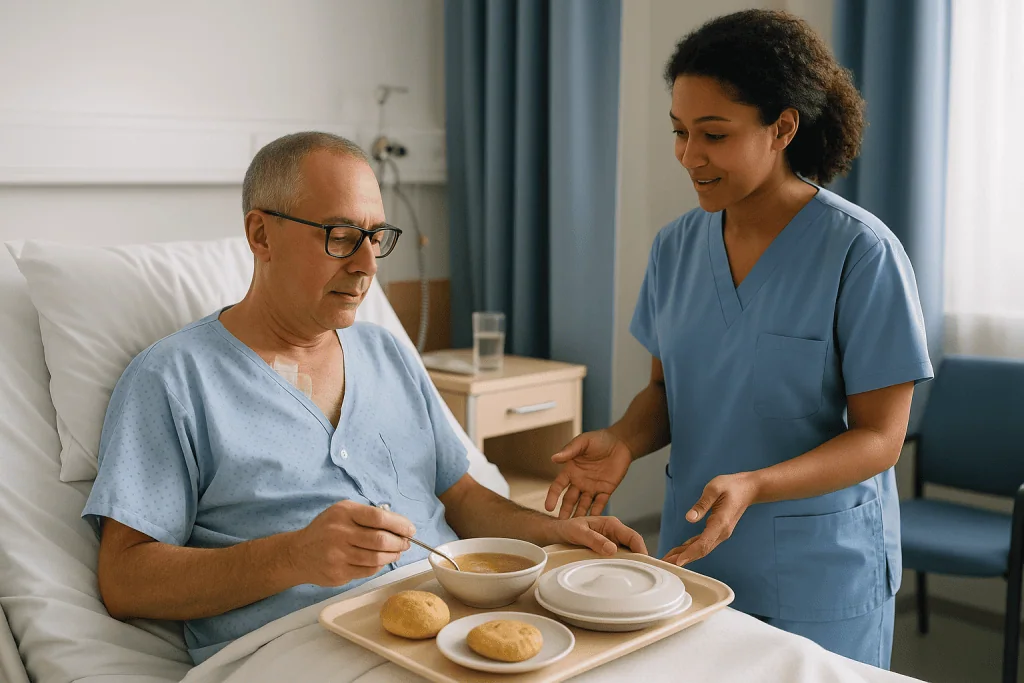
A nurse will check the groin site frequently, feel the pulse in your foot, and press on the puncture if there is any oozing. A small dressing or a closure device may already be in place. Expect the site to feel tender and bruised rather than painful.
Chest discomfort is common in these first hours and is usually a dull, sore, or pressure-like feeling that worsens with deep breaths. It reflects irritation of the heart’s outer lining where the energy was delivered. The team will ask about it repeatedly, not because it is expected to be dangerous but because a change in its character is one of the things they are watching for.
Whether you go home the same evening or the next morning depends on how long the procedure ran, whether general anesthesia was used, how the groin looks, and how stable your rhythm and blood pressure are. Mayo Clinic notes that either is normal. The one non-negotiable is a ride home: driving is not permitted after sedation, and most units want an adult with you for the first night.
Cardiac ablation recovery time at a glance
Recovery has three overlapping clocks: the puncture site, your general energy, and the heart’s electrical healing. The table below sets out typical ranges drawn from Mayo Clinic, MedlinePlus, and NHS guidance. Your team may shorten or lengthen any of these based on how your procedure went.
| Stage | Typical timing | What is usually happening |
|---|---|---|
| Lying flat after the procedure | Around 4 to 6 hours | Vein puncture sealing; frequent groin and pulse checks |
| Hospital discharge | Same day or after one night | Rhythm and blood pressure stable; groin site dry |
| Tiredness and mild chest soreness | Several days | Anesthetic clearing; inflammation of the heart lining settling |
| Return to desk work and light daily activity | Within about a week | Groin bruise fading; walking encouraged |
| Heavy lifting, running, hard exercise | Paused for roughly 1 to 2 weeks | Protecting the puncture site from pressure |
| Electrical “blanking period” | About 2 to 3 months | Scar maturing; early palpitations do not yet count as failure |
| Follow-up review | Commonly around 3 months | Rhythm assessed; medicines reviewed by the treating team |
Two patterns stand out. The physical recovery is measured in days, while the electrical recovery is measured in months, and confusing the two is the most common source of unnecessary worry. Someone who feels physically fine on day five may still have a heart that is inflamed and irritable, and someone whose rhythm is perfect on day two may still have a groin that cannot take a squat rack.
Treat the table as a map, not a contract. The team that saw your heart from the inside will know whether your procedure was quick and straightforward or long and complex, and that changes the pace.
How painful is heart ablation recovery?
Less than most people brace for, and different in kind from what they imagine. There is no incision to throb. The discomfort falls into three predictable categories, each with a different cause and a different timescale.
The groin is the first. Expect an ache and a bruise that may spread down the inner thigh and turn impressive shades of purple and yellow over a week or so. A firm, pea-sized lump under the skin is common and represents a small collection of clotted blood that the body reabsorbs. This is what Cleveland Clinic and NHS guidance describe as expected soreness rather than a complication, provided the lump does not grow, throb, or feel hot.
The chest is the second. A dull soreness or pressure that sharpens when you take a deep breath or lie flat reflects inflammation of the pericardium, the thin sac around the heart, at the ablation sites. It typically eases over a few days. A sore throat and mild difficulty swallowing can follow the breathing tube used during general anesthesia or the ultrasound probe sometimes passed into the esophagus to guide the procedure.
The third is not pain at all but fatigue, and it surprises people most. Several hours of sedation, a night of interrupted sleep, and a heart recovering from a workout it did not choose add up to a deep tiredness for a few days.
Simple over-the-counter pain relief is usually enough, but which one is safe alongside your blood-thinning medicine is a question for the prescribing clinician, not a pharmacy aisle guess. Severe, escalating, or new pain is a different matter entirely, and belongs in the red-flag section below.
Do you need bed rest after ablation? The first week of lighter activity
Bed rest, in the old-fashioned sense, is actively discouraged. Once the mandatory hours of lying flat are over, walking is one of the best things you can do. It keeps blood moving through the leg veins, which matters because lying still after a procedure raises clot risk, and it tells your nervous system that the heart can be trusted.
What the first week does call for is a lighter gear. Cleveland Clinic and Mayo Clinic guidance converge on the same picture: short walks on flat ground, stairs at a steady pace, ordinary household tasks, and plenty of rest in between. NHS guidance for atrial fibrillation treatment advises avoiding strenuous activity and heavy lifting for about two weeks so the puncture site can heal fully.
The everyday translation is this. A bag of groceries in each hand is fine. A full suitcase hoisted into a car boot is not. Pushing a vacuum is fine. Digging the garden is not. The test is whether the effort makes you hold your breath and brace your abdomen, because that spike in pressure travels straight to the healing vein.
Showers are usually allowed after the first day; baths and swimming wait until the site has closed completely, typically several days to a week, to keep it dry and free of infection. Sexual activity generally follows the same rules as other moderate exertion and is commonly fine within a week if the groin is comfortable, though it is worth asking rather than assuming.
Listen to two signals. Breathlessness beyond what the effort deserves and any throbbing or swelling at the groin are your cue to stop, sit, and reassess.
Week two: recovery after AFib ablation and the return to work, driving and exercise
By the second week most people feel physically ordinary again, and the questions shift from “what hurts” to “what am I allowed.”
Work depends on what the job asks of your body. Mayo Clinic notes that many people are back to normal routines within a few days, and a desk job or light retail work often resumes within that first week. Jobs that involve lifting, climbing, or long periods on your feet usually wait until the two-week mark, and some employers or occupational health services want written clearance. Ask for a note before you leave the hospital rather than chasing it later.
Driving has two constraints. The first is the sedation, which rules out the day of the procedure entirely. The second is the groin: an emergency stop means slamming a leg down hard, and most teams suggest waiting a few days until that movement is pain-free. Some licensing authorities have specific rules for people who have had arrhythmia treatment, particularly for commercial licenses, and those rules override general advice.
Exercise returns in steps. Brisk walking can build steadily through the second week. Running, cycling on the road, weight training, and contact sports are the activities that guidance from the NHS and Cleveland Clinic holds back for roughly two weeks, sometimes longer if the procedure was long or the groin bled. When you do restart, expect your heart rate to sit higher than usual for a given effort for a couple of months; the nerves that normally slow the heart are sometimes dampened by ablation near the pulmonary veins, and this usually settles.
Flying is generally reasonable once your team is satisfied with the groin site and your rhythm, but a long-haul flight in the first week or two carries the ordinary post-procedure clot risk. Get up hourly, drink water, and check the plan for what to do if palpitations return while you are away.
Do's and don'ts after heart ablation
Written discharge instructions vary in detail, so here is the consolidated version that most guidance from Mayo Clinic, Cleveland Clinic and MedlinePlus agrees on. Where your own sheet differs, your own sheet wins.
- Do walk every day, starting with a few minutes and building gradually.
- Do keep the puncture site clean and dry, and look at it once a day in good light.
- Do take every prescribed medicine exactly as written, including blood thinners, unless the prescribing clinician tells you otherwise.
- Do drink enough fluids; dehydration is a known trigger for palpitations and makes dizziness on standing more likely.
- Do keep your follow-up appointment even if you feel perfectly well.
- Don’t lift anything heavy, strain on the toilet, or do exercises that make you brace your abdomen for around two weeks.
- Don’t soak in a bath, hot tub or pool until the site has fully closed.
- Don’t drive on the day of the procedure, and wait until an emergency stop would not hurt.
- Don’t stop or reduce a blood thinner because you feel fine; the weeks after ablation are when the heart’s inner surface is healing and clots can form.
- Don’t assume an early recurrence of your old rhythm means the procedure failed.
One item deserves emphasis because it is where people most often go wrong: straining. Constipation is common after anesthesia and after a day of not eating, and the bearing-down that comes with it puts direct pressure on the femoral vein. A high-fiber diet, fluids and a gentle walk do most of the work; if that is not enough, ask your team what is appropriate alongside your other medicines rather than guessing.
Groin pain after cardiac ablation: caring for the puncture site
The femoral vein sits just below the skin at the top of the thigh, and it is the workhorse of this procedure. Because veins carry blood at low pressure, they seal more readily than arteries, which is why the recovery is so much gentler than it might be. Occasionally a small artery is also used, and your team will tell you if that applies to you because it changes how carefully the site is watched.
Normal healing looks like this. A small dressing comes off after a day or so. Underneath is a pinprick or a tiny incision, a bruise that can spread widely, and possibly a firm lump about the size of a pea or a grape. The area aches when you walk far or sit in a low chair. Over one to two weeks the bruise yellows and fades, the lump softens, and the ache disappears.
Abnormal healing has a different character. A lump that grows over hours rather than shrinking over days, a pulsating swelling, a leg that becomes cold, pale, numb or unusually swollen below the site, or fresh bleeding that does not stop with ten minutes of firm pressure are all reasons to seek help the same day. Cleveland Clinic and MedlinePlus both list bleeding or blood collection at the access site among the most common complications, precisely because it is the part of the procedure that meets the outside world.
If bleeding does start at home, lie down, press firmly on the spot with a clean cloth without peeking for a full ten minutes, and have someone call for advice while you do so. Do not apply a tight bandage and hope; pressure from a hand works because it is direct and can be adjusted.
Wear loose waistbands for the first week. It sounds minor, but a tight seam rubbing on the crease is the single most common avoidable irritation people report.
What is the blanking period after ablation, and why does my heart still skip?
The blanking period is the window, usually counted as the first two to three months after ablation, during which any return of the old rhythm is not yet taken as evidence that the procedure did not work. The American Heart Association and the Mayo Clinic both describe recurrences in these early weeks as common and often temporary.
The mechanism is inflammation. Fresh ablation lines are swollen and irritable, not yet the smooth, mature scar they will become. Irritable tissue misfires. Some of those misfires feel like your old atrial fibrillation; others are runs of extra beats, brief flutters, or a heart rate that sits stubbornly ten or twenty beats higher than your usual resting pace. All of these can occur in someone whose long-term result will be good.
There is also the opposite phenomenon. Some lines that appear complete during the procedure turn out to have small gaps once the swelling recedes, and the rhythm can return months later. This is why a second procedure is sometimes offered, and why the three-month review carries so much weight. What happens at that visit varies: a rhythm recording over days or weeks, a conversation about how you have felt, and a decision by the treating team about medicines.
For the person living through it, the practical advice is to keep a simple diary. Note the date, how long an episode lasted, what you were doing, and how you felt. A wearable device or a smartphone-based recording can help, but it can also generate anxiety about every irregular reading, so agree with your team in advance what they actually want to see and what they would prefer you not chase.
Medicines after ablation: what usually continues, and why
People are often surprised to leave the hospital with the same medicines they arrived with. The reasoning is sound, and understanding it helps you stick with the plan until the team changes it.
Anticoagulants, the blood-thinning medicines that reduce the risk of clots forming inside the heart, are the most important example. Ablation temporarily damages the inner lining of the left upper chamber, and damaged lining is a surface on which clots can form. Guidance summarized by the American Heart Association and the Mayo Clinic is that anticoagulation is typically continued for at least a couple of months after atrial fibrillation ablation regardless of how the rhythm looks, and beyond that according to your underlying stroke risk rather than whether the procedure worked. Whether it eventually stops is a decision the prescribing clinician makes with you; a successful ablation does not automatically end the need.
Rhythm-controlling medicines, the antiarrhythmics you may have taken for years, are frequently continued through the blanking period to keep the irritable heart quiet while the scar matures, then reviewed. Rate-controlling medicines such as beta-blockers, which slow the heart’s response to abnormal signals, follow a similar pattern.
Some people are given a short course of a medicine to protect the esophagus from acid while the tissue behind the left atrium recovers, because the ablation energy is delivered close to it. Others are asked to take something for mild inflammation of the heart lining.
None of these should be started, stopped or adjusted on your own judgment, however well you feel. If a side effect is troubling you, that is a reason to call, not a reason to skip a dose.
Risks and alternatives, in plain language
A fair account of recovery has to include what can go wrong, because knowing the shape of a complication is what lets you recognize it early. Mayo Clinic and MedlinePlus describe the following as recognized risks. Most are uncommon; a few are rare but serious.
- Bleeding, bruising or a collection of blood at the puncture site, the most common issue and usually managed with pressure.
- Damage to the blood vessel by the catheter.
- Fluid collecting around the heart (pericardial effusion) which, if it compresses the heart, is called tamponade and needs urgent drainage.
- Blood clot leading to stroke, the reason anticoagulation is handled so carefully.
- Narrowing of the pulmonary veins where scar forms.
- Damage to the heart’s natural electrical pathways, occasionally requiring a pacemaker.
- Injury to the phrenic nerve, which drives the diaphragm, causing breathlessness that usually recovers over months.
- Injury to the esophagus, very rare but serious, which is why fever, chest pain and difficulty swallowing in the weeks after the procedure are never ignored.
- Radiation exposure from X-ray guidance, kept as low as possible.
The alternatives are not lesser options so much as different trade-offs. Continuing rhythm or rate medicines avoids a procedure but accepts daily tablets and their side effects. Cardioversion, a controlled electrical shock under brief anesthesia, can restore normal rhythm quickly but does not address the underlying wiring. Surgical ablation is sometimes performed alongside other heart surgery. For a few people whose rate cannot otherwise be controlled, ablating the heart’s main junction and fitting a pacemaker is considered.
Which path fits depends on your symptoms, your heart’s structure, your stroke risk and your preferences, weighed together with the treating team. No article can rank them for you, and none should try.
What people often get wrong about cardiac ablation recovery time
Some misconceptions come up so reliably that correcting them in advance saves a good deal of worry.
“If I feel palpitations in week three, the ablation failed.” Early recurrence within the two-to-three-month blanking period is common and frequently settles, as the American Heart Association notes. Judgment about whether the procedure worked is reserved for the follow-up review, not the kitchen table.
“Recovery means resting in bed.” The opposite is closer to the truth. Beyond the initial hours of lying flat, movement protects you from clots and deconditioning. Lighter activity, not no activity, is the goal.
“The groin heals in a day, so I can go to the gym on day three.” The skin closes quickly; the vein wall underneath takes longer to become robust. NHS guidance holds strenuous activity back for around two weeks for that reason, and a second bleed at the site is far more disruptive than a fortnight of patience.
“Once my rhythm is normal I can stop the blood thinner.” Anticoagulation after ablation is continued for a period regardless of rhythm, and beyond that according to stroke risk. Only the prescribing clinician makes that call.
“A faster resting heart rate means something is wrong.” A modest, persistent rise in resting pulse for a few months is a recognized effect of ablating near nerve fibers around the pulmonary veins and usually settles.
“It is a small procedure, so the follow-up is optional.” The three-month visit is where medicines are reviewed and where the team decides whether more is needed. Skipping it leaves you on a plan designed for the healing phase, not for the long term.
Questions to ask your care team
The best time to ask most of these is before the procedure or at the moment of discharge, when the people who saw your heart from the inside are still in the room. Write down the answers; sedation is unkind to memory.
- Which vessels were used for access, and was an artery involved? This changes how closely the groin needs watching.
- Was my procedure straightforward, and does anything about it change the usual timeline for lifting, exercise or driving?
- Which of my medicines continue, for roughly how long, and who decides when they change?
- What pain relief is safe alongside my blood thinner?
- What symptoms should make me call the ward or clinic today, and which should send me straight to emergency care?
- If my old rhythm returns in the next few weeks, what exactly do you want me to do, and do you want recordings from a watch or phone?
- When is my follow-up, what will happen at it, and how will my rhythm be checked?
- Is there a number I can reach outside office hours?
- Do I need written clearance for work, and are there any rules about driving that apply to my license?
- How soon is it reasonable for me to travel, and what should I carry with me if I do?
One further question is worth asking even though it feels awkward: if this does not hold, what would the next step be? Knowing that a second procedure or a change of medicines is a normal part of the pathway, rather than a failure, changes how the first uncertain weeks feel.
When to call your doctor
Most of what you feel in the first two weeks will be ordinary healing. A small number of signs are not, and the difference is usually in the direction of travel: healing gets steadily better, complications get worse.
Call emergency services or go straight to emergency care for chest pain that is severe, crushing, or spreading to the arm, jaw or back; sudden breathlessness that stops you speaking in full sentences; sudden weakness or numbness on one side, a drooping face, slurred speech or confusion; fainting or collapse; a puncture site that bleeds and will not stop with ten minutes of firm pressure; or a rapidly growing, pulsating swelling at the groin. Mayo Clinic and MedlinePlus list fluid around the heart, stroke and major bleeding among the serious complications, and each of these announces itself in these ways.
Contact your care team the same day for a fever or chills, especially with chest pain or difficulty swallowing, in the days or weeks after the procedure; redness, warmth, increasing pain or discharge at the puncture site; a leg below the site that becomes cold, pale, numb, or noticeably more swollen than the other; palpitations that last many hours, leave you dizzy or breathless, or feel different from your usual rhythm; a resting heart rate that is unusually slow with light-headedness; or new persistent hiccups or breathlessness on one side, which can point to the nerve that drives the diaphragm.
You know your own body’s baseline better than anyone. If something feels wrong and does not fit the list, that instinct is itself a reason to pick up the phone. Calling about a false alarm costs a few minutes; missing a real one costs far more, and no team resents the call.
Frequently asked questions
What are the do's and don'ts after heart ablation?
Walk daily, keep the puncture site clean and dry, take every prescribed medicine as written, drink enough fluids, and attend follow-up. Avoid heavy lifting, straining, baths and swimming until the site has closed, and do not drive on the day of the procedure. Never stop a blood thinner because you feel well, and do not treat early palpitations as proof the procedure failed. Your discharge sheet overrides any general list.
Is cardiac ablation considered a major surgery?
No. It is a minimally invasive catheter procedure with no chest incision; the only wounds are small punctures at the top of the leg. It is still a serious intervention inside a beating heart with recognized complications, so preparation and the decision to proceed are handled carefully. Recovery, however, resembles that after an angiogram far more than that after open-heart surgery.
How painful is heart ablation recovery?
Usually mild. The main sources are a bruised, aching groin, a dull chest soreness that sharpens with deep breaths as the heart’s outer lining settles, and a sore throat if a breathing tube or esophageal probe was used. Fatigue is often more noticeable than pain. Simple pain relief is generally sufficient, but check with the prescribing clinician which options are safe alongside your blood-thinning medicine.
Do you need bed rest after ablation?
Only for the first few hours, when lying flat with a straight leg lets the vein puncture seal; MedlinePlus puts this at around four to six hours. After that, bed rest is discouraged. Short walks reduce clot risk and help energy return. The rule for the first two weeks is lighter activity, not inactivity, with strenuous effort and heavy lifting held back until the site is robust.
How long does recovery after AFib ablation usually take?
Physically, most people feel close to normal within a few days and resume routine activities within about a week, with strenuous exercise paused for roughly two weeks. Electrically, the heart keeps healing for two to three months, and rhythm is not formally judged until the follow-up review. The treating team adjusts these ranges to how your particular procedure went.
How long after ablation can I exercise?
Walking can begin the day after the procedure and build steadily. Running, cycling on the road, weight training and anything that makes you brace your abdomen are typically held back for around two weeks so the groin vein can heal, per NHS and Cleveland Clinic guidance. When you restart, a higher heart rate for a given effort is common for a couple of months and usually settles.
What is the blanking period after ablation?
It is the first two to three months after the procedure, during which the ablation lines are still inflamed and maturing into scar. Palpitations or a return of the old rhythm in this window are common and often temporary, so they are not counted as a failed procedure. The three-month follow-up is where rhythm and medicines are properly reassessed.
Is groin pain after cardiac ablation normal?
An ache, tenderness and a bruise that spreads down the thigh are expected and fade over one to two weeks. A small firm lump can also be normal. Seek same-day advice if the lump grows, pulsates, becomes hot or red, if the leg below turns cold, pale or numb, or if bleeding does not stop after ten minutes of firm pressure.
When can I drive after cardiac ablation?
Not on the day of the procedure, because of sedation or anesthesia. Most teams then suggest waiting a few days until an emergency stop, which slams the leg down hard, would not hurt the puncture site. Commercial drivers and people in some regions may face specific licensing rules after arrhythmia treatment, so confirm the exact timing with your care team.
Will I still need blood thinners after a successful ablation?
Usually for a period, yes. The heart’s inner lining is healing after ablation and can form clots, so anticoagulants are typically continued for at least a couple of months regardless of how the rhythm looks. Beyond that, the decision rests on your underlying stroke risk rather than on whether the procedure worked, and it is made by the prescribing clinician, not by how well you feel.
References
This article is for general information only and is not a substitute for professional medical advice. Please consult a qualified doctor about your individual situation.

More from the Blog

What an Echocardiogram Shows in Heart Failure: Ejection Fraction and Why It Guides Treatment
An echocardiogram in heart failure measures ejection fraction, the percentage of blood the left ventricle pumps out with each beat. A normal range on…

Who Needs Heart Bypass Surgery Rather Than a Stent? What the Heart Team Weighs
Heart bypass surgery is usually offered when coronary blockages are too extensive, too complex, or too poorly placed for stents to treat well: typically…

How to Measure Blood Pressure at Home: The Technique Most People Get Wrong
To measure blood pressure at home, use a validated automatic upper-arm monitor with a cuff sized to your arm. Sit quietly for five minutes…

Who Is a Candidate for Percutaneous PFO or ASD Closure, and Who Is Better Served by Surgery?
Percutaneous PFO closure is usually considered for adults under about 60 who have had a stroke of unclear cause that a full workup links…
What an Echocardiogram Shows in Pericardial Effusion and How It Guides Treatment
An echocardiogram shows how much fluid surrounds the heart, where it sits, and whether it is pressing on the heart chambers. Measuring the fluid…

Managing Hypertension Day to Day: Salt, Weight, Exercise and a Reading Log Your Doctor Can Use
Living with hypertension means treating blood pressure as a number you manage rather than a label you carry. Guidelines point to four everyday levers:…