

Daily Life With ALS: Assistive Devices, Nutrition and Energy Conservation Explained
Key Takeaways
- ALS damages motor neurons, not muscles themselves, so gentle activity can help muscles that still have nerve supply while exhaustive exercise only drains reserve.
- Multidisciplinary ALS clinics, seen roughly every two to three months, are associated in NINDS summaries with better quality of life and longer survival than fragmented care.
- Voice banking must happen while speech is still clear, which is why speech-language pathologists raise it at the first sign of slurring rather than later.
- People with ALS tend to burn calories faster than expected, so dietitians usually advise calorie-dense foods in five or six small meals rather than general low-fat guidance.
- A feeding tube does not prevent eating by mouth for pleasure, and placement is safer while breathing function remains relatively strong.
- Noninvasive ventilation through a mask is one of the better-evidenced supports in ALS, reported by Mayo Clinic and NINDS to improve quality of life and extend survival.
Daily life with ALS changes gradually as motor neurons weaken muscles, but much of it can be planned for and managed. Assistive devices such as braces, wheelchairs and speech aids preserve independence; a higher-calorie diet and early swallowing support help maintain weight; and energy conservation, meaning pacing, planning and positioning, spreads limited strength across the day. A multidisciplinary ALS team guides each decision as needs change.
The jar of peanut butter is where it starts for a lot of people. Not the diagnosis, which usually arrives months later after a trail of tests, but the private moment when a lid that opened yesterday will not budge today, and the hand that failed is the one you trust most. For someone newly living with amyotrophic lateral sclerosis, daily life with ALS becomes a series of these small renegotiations: with buttons, stairs, soup spoons, the phone.
What rarely gets said in the first clinic visit is that an enormous amount of practical knowledge already exists about those renegotiations. Occupational therapists, dietitians, speech-language pathologists and respiratory therapists have spent decades learning which brace saves a fall, which meal keeps weight on, and why a 20-minute rest at 2 p.m. can rescue an evening.
This explainer walks through that knowledge, grounded in guideline-level evidence rather than inspiration. It will not promise outcomes. It will tell you what tends to help, when, and why, so that the questions you bring to your own care team are sharper.
What actually happens to the body in ALS, in plain language
Amyotrophic lateral sclerosis is a disease of motor neurons, the nerve cells that carry movement commands from the brain and spinal cord to the muscles. Two sets are involved. Upper motor neurons run from the brain down the spinal cord; lower motor neurons run from the spinal cord out to the muscles themselves. ALS damages both, which is why it produces an unusual mixture of stiffness and spasticity (an upper-neuron problem) alongside wasting, weakness and twitching (lower-neuron signs). The National Institute of Neurological Disorders and Stroke describes this dual pattern as the defining feature of the condition.
The muscles are not diseased in themselves. They weaken because the signals telling them to contract are fading, the way a lamp dims when the wiring frays rather than the bulb. That distinction matters for daily life: a muscle that still has working nerve supply can be strengthened gently, while a muscle that has lost its supply cannot be exercised back, and pushing it to exhaustion only burns energy the person needs elsewhere.
Sensation, bladder and bowel control, and the senses of sight and hearing are generally spared. Most people keep their thinking clear, although Mayo Clinic notes that some develop changes in memory, decision-making or behavior, and a minority are eventually diagnosed with a related frontotemporal dementia.
Where the disease begins shapes early experience. Limb-onset ALS tends to show up as a weak grip, a foot that catches on stairs, or a stumble on flat ground. Bulbar-onset ALS, named for the brainstem region that controls the mouth and throat, begins with slurred speech or trouble swallowing. Either way, weakness spreads over time to other regions, and the practical toolkit has to grow with it.
Who the ALS multidisciplinary clinic is for, and which decisions are usually asked to wait
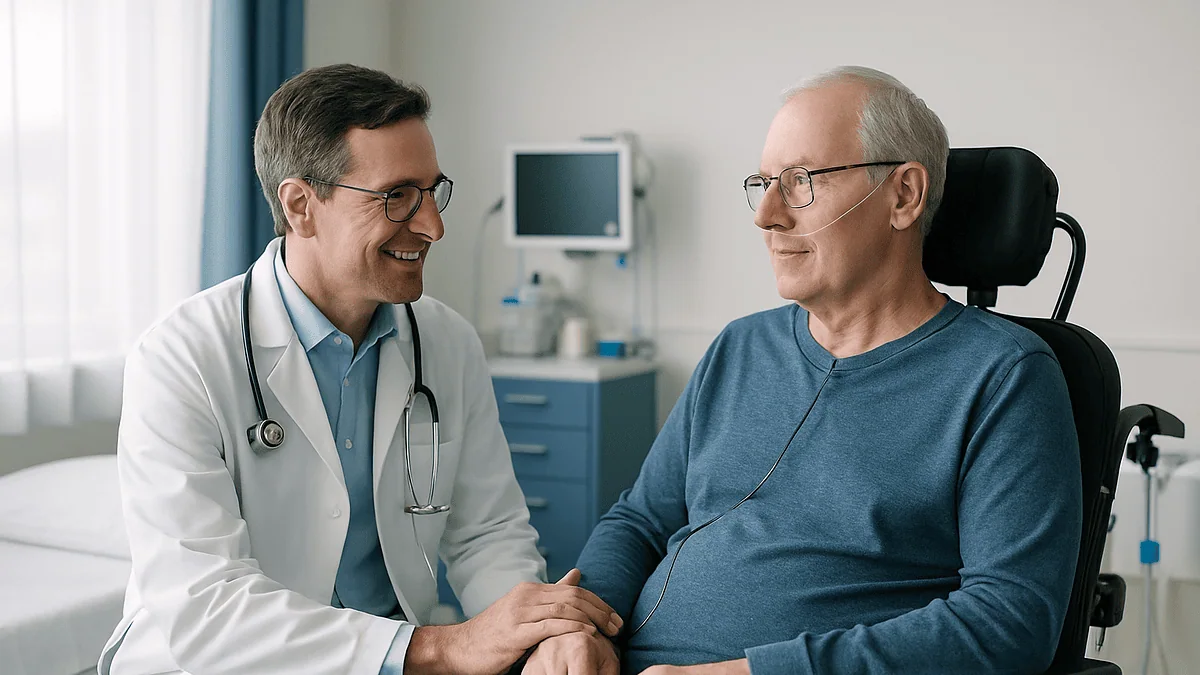
A multidisciplinary clinic is a model of care in which a neurologist, nurse, physical therapist, occupational therapist, speech-language pathologist, dietitian, respiratory therapist and social worker see a patient in a single visit, usually every two to three months, and plan together. Mayo Clinic and NINDS both describe this coordinated approach as the standard of care, and research summarized by NINDS associates it with better quality of life and longer survival than fragmented care. The clinic is for everyone with a confirmed diagnosis, from the first appointment onward, including people who feel they are managing fine. Early involvement means devices can be fitted before a fall rather than after one.
Some decisions are deliberately paced. Teams rarely order a power wheelchair at the first visit for someone still walking confidently, partly because insurance assessments require documented need, and partly because the chair has to be configured for where weakness is heading, not where it is today. A feeding tube is usually raised early as a conversation but placed later, when swallowing or weight changes make the benefit clear while breathing function still allows a safe procedure. Noninvasive ventilation, a mask-based breathing support, is typically started when breathing tests or nighttime symptoms cross thresholds the respiratory team monitors.
People are also sometimes asked to wait before committing to an expensive communication device, because a speech-language pathologist may first want to record the person’s natural voice while it is still clear, a process called voice banking that becomes impossible once speech has deteriorated.
What no one should wait for is the clinic itself. Johns Hopkins and Cleveland Clinic both emphasize that supportive care begins at diagnosis, not when symptoms become severe, and that the team’s job is to anticipate the next six months rather than react to the last two.
Which assistive devices for ALS help most, and when
Assistive devices are tools that compensate for a lost function rather than restore it, and in ALS they tend to arrive in a predictable order that follows the spread of weakness. The table below groups the most common ones by the problem they solve. It is a map, not a prescription; the fitting, timing and funding route are always worked out with the clinic’s therapists.
| Daily need | Typical devices | What it does | Usually assessed by |
|---|---|---|---|
| Foot drop, tripping | Ankle-foot orthosis (AFO), a rigid or hinged brace worn inside the shoe | Holds the foot up during the swing phase of walking | Physical therapist, orthotist |
| Unsteady walking | Cane, four-wheeled walker with seat | Widens the base of support; walker seat allows rests | Physical therapist |
| Fatigue over distance | Lightweight manual wheelchair, mobility scooter | Conserves energy for the destination rather than the journey | Occupational or physical therapist |
| Weak trunk and limbs | Power wheelchair with tilt, recline and pressure-relieving cushion | Repositions the body to protect skin and ease breathing | Seating specialist |
| Neck weakness | Soft or semi-rigid cervical collar, headrest | Supports the head, reduces neck pain and swallowing strain | Occupational therapist |
| Weak grip | Built-up utensils, universal cuffs, button hooks, key turners | Lets a weak hand hold and turn | Occupational therapist |
| Unclear speech | Amplifier, text-to-speech app, eye-gaze speech-generating device | Replaces or amplifies the voice | Speech-language pathologist |
| Weak cough | Mechanical insufflation-exsufflation device, suction unit | Clears secretions the chest can no longer expel | Respiratory therapist |
Two patterns are worth noticing. First, nearly every device on the list is about preserving energy or preventing an injury, not about appearance. Second, the people who fit them are therapists, which is why the clinic model matters so much: the right AFO fitted by an orthotist who understands progressive weakness is a different object from one bought online to fit today’s foot.
Mobility aids and home changes that prevent the fall before it happens
Falls are the injury the clinic worries about most in the early and middle stages, because a broken hip or wrist in someone with limited reserve can cost weeks of independence. The NHS guidance on motor neurone disease, the term used in the UK for the same disease family, lists physiotherapy, braces and walking aids as core early interventions precisely for this reason.

The sequence often begins with an ankle-foot orthosis. Foot drop, where the front of the foot cannot lift, causes the toe to catch on carpet edges and curbs; a brace that holds the foot at a right angle removes that catch. A cane follows when balance wavers, then a four-wheeled walker with brakes and a seat, which doubles as a resting bench on a long hallway. Physical therapists also teach safer techniques for the moments that cause the most trouble: rising from a low chair, turning in a narrow bathroom, stepping into a shower.
Home changes are cheaper and simpler than most families expect at first. Grab bars beside the toilet and inside the shower, a raised toilet seat, a shower chair, removal of loose rugs, and brighter lighting on stairs address the majority of early hazards. Later, a hospital-style bed that raises the head helps breathing and makes transfers easier, and a ceiling or portable lift lets one caregiver move a person safely. A ramp or stair lift becomes relevant once a wheelchair is in use.
Occupational therapists conduct home assessments and can advise on the order of changes so a household is not remodeling constantly. Many people find it helps to treat the home like the clinic treats the body: plan for six months ahead, and install the next change before it becomes urgent.
Communication: keeping your voice when speech changes
Speech is lost gradually in ALS, and the strategies that preserve communication work best when they begin before anyone feels they are needed. A speech-language pathologist, a clinician trained in speech, voice and swallowing, is the guide here.
The first step is often voice banking: recording a large set of phrases in your natural voice so that a synthetic version can later speak for you through a device. Cleveland Clinic and NINDS both describe this as a standard offer in ALS care. The recordings need clear articulation, which is why clinics raise the subject early in bulbar-onset disease and at the first sign of slurring in limb-onset cases.
While speech remains understandable, low-tech measures carry a surprising amount of weight. A small voice amplifier compensates for a quiet, breathy voice. Slowing down, over-articulating and speaking in shorter phrases reduce listener strain. Many people keep a dry-erase board or a letter board for noisy environments or tired evenings.
As speech becomes harder to understand, speech-generating devices take over. These range from a tablet running text-to-speech software, controlled by touch or a joystick, to eye-gaze systems that track where the eyes rest on an on-screen keyboard and speak the typed words. Eye-gaze technology is particularly important because eye movement is typically preserved late into the disease. Learning a device takes practice, which is another reason therapists push for early introduction: it is far easier to learn eye-gaze typing as a backup than as an emergency.
Communication is also about the people around the patient. Families are taught to allow extra time, not to finish sentences uninvited, and to ask yes-or-no questions when fatigue is high. Those small courtesies protect something the disease cannot touch: the person’s right to be heard.
ALS diet and nutrition: why weight is treated as a vital sign
Clinic teams weigh people with ALS at every visit, and they do so with a seriousness that surprises many patients. The reason is mechanical and metabolic at once. Chewing and swallowing take longer and tire the mouth, so meals shrink; at the same time, NINDS notes that people with ALS tend to burn calories faster than expected, and the constant low-grade effort of breathing and moving with weak muscles raises energy needs further. The result is unintended weight loss, which clinic dietitians work hard to prevent because loss of muscle mass removes the reserve a person needs for everything else.
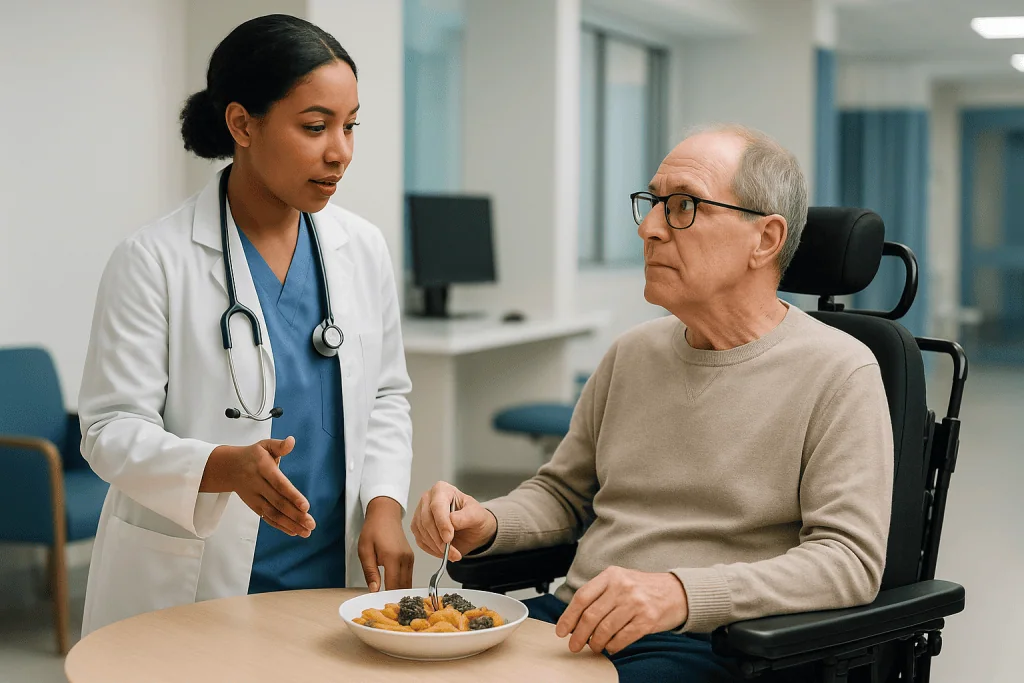
The dietary strategy is almost the opposite of general public-health advice. Calorie density is the goal. Dietitians typically recommend adding fats and proteins to foods already being eaten: full-fat dairy, nut butters, avocado, olive oil stirred into soups, cheese melted over vegetables. Small, frequent meals, five or six a day, are easier than three large ones for a person whose jaw tires. Nutritional supplement drinks can fill gaps, but the dietitian decides which and how much, based on weight trends and swallowing safety.
Texture becomes a nutrition issue as well. Soft, moist, uniform foods such as scrambled eggs, yogurt, mashed vegetables and slow-cooked meats require less chewing and are less likely to catch in the throat. Dry, crumbly or mixed-texture foods, like crackers or thin soup with chunks, are harder. Thin liquids are often the earliest challenge, and a speech-language pathologist may suggest thickening them.
Hydration and bowel regularity need attention too, because reduced mobility and lower fluid intake lead to constipation, which in turn reduces appetite. Fiber, fluids and, when the team agrees, a stool softener are the usual tools. Evidence does not support any special anti-ALS diet or supplement; what the guidance consistently supports is enough calories, safely swallowed, every day.
Swallowing changes and the feeding tube decision, without the fear
Dysphagia, the medical term for difficulty swallowing, is one of the most consequential changes in daily life with ALS because it links three concerns at once: nutrition, hydration and the risk of food or liquid entering the lungs. Coughing during meals, a wet-sounding voice after drinking, or meals that stretch past 45 minutes are the kinds of changes a speech-language pathologist will want to hear about.
The first responses are adjustments rather than interventions. Chin-tuck posture while swallowing, smaller bites, alternating solids with sips, texture changes and thickened liquids can keep eating safe for a long time. Managing saliva matters as well; weak lip and swallowing muscles mean saliva pools, and the team may discuss medicines or other measures to reduce drooling.
At some point many people and their teams consider a gastrostomy tube, usually a percutaneous endoscopic gastrostomy or PEG: a soft tube placed through the abdominal wall directly into the stomach, allowing liquid nutrition, water and medicines to bypass the mouth. Mayo Clinic describes the tube as a way to maintain weight and hydration and reduce choking risk. Two facts reshape most people’s view of it. First, having a tube does not forbid eating by mouth; many continue to enjoy favorite foods for pleasure while the tube carries the nutritional load. Second, the procedure is safer when breathing is still relatively strong, which is why teams raise it earlier than patients expect, not because things are suddenly worse but because the window for a straightforward placement is wider.
Choosing a tube, declining one, or deferring are all legitimate decisions, and the clinic’s role is to lay out risks, including infection and tube displacement, alongside the alternatives. The choice belongs to the person and their treating team.
Energy conservation techniques in ALS: the four Ps that stretch a day
Fatigue in ALS is not ordinary tiredness. It is the sum of weak muscles working harder for the same result, breathing that costs more effort, interrupted sleep, and the emotional weight of the illness. Occupational therapists approach it with a framework often called the four Ps: planning, prioritizing, pacing and positioning. None is complicated, but together they change the shape of a day.
Planning means deciding the night before what tomorrow must include and arranging it so heavy tasks are not stacked together. Showering, dressing and a medical appointment on the same morning is a recipe for an unusable afternoon. Prioritizing is harder because it asks a question most adults avoid: of the things I do, which matter enough to spend strength on? Many people conclude that letting someone else fold laundry buys an hour with a grandchild, and that trade is worth making consciously rather than by collapse.
Pacing is the rule of stopping before exhaustion. A rest taken at the first sign of heaviness restores more than one taken after the muscles have given out. Short, scheduled breaks, sitting rather than standing for tasks like brushing teeth or chopping vegetables, and splitting a long walk with the seat of a walker are all pacing in practice.
Positioning covers the body mechanics that waste energy without anyone noticing: a chair too low to rise from easily, a kitchen counter that forces a stoop, a bed without a rail to pull on. Correcting these removes dozens of small efforts a day.
Exercise still has a place. Mayo Clinic and the NHS note that gentle, low-impact activity and stretching can ease stiffness, protect joints and support mood, provided it never pushes to fatigue. The physical therapist sets the ceiling; the person decides how to spend what is beneath it.
Breathing support in daily life: what noninvasive ventilation actually does
The diaphragm and the muscles between the ribs are, in the end, muscles like any other, and ALS weakens them. Breathing difficulty is why respiratory function is checked at every clinic visit with simple tests such as forced vital capacity, the largest breath a person can blow out. Changes often show first at night: waking short of breath, morning headaches, vivid dreams, daytime sleepiness, or needing extra pillows to sleep. These are worth reporting even when daytime breathing feels normal.
Noninvasive ventilation, or NIV, is a machine that delivers pressurized air through a mask over the nose or nose and mouth, giving tired breathing muscles support without any surgery. Used first at night and later for parts of the day, it eases the work of breathing and improves sleep. Mayo Clinic and NINDS both report that NIV improves quality of life and is associated with longer survival, which is one of the stronger evidence statements in ALS care. Getting used to a mask takes patience; respiratory therapists adjust fit and settings over several visits, and most people find a configuration they can tolerate.
A weak cough is a separate problem with its own tools. When the chest cannot generate enough force to clear mucus, a mechanical insufflation-exsufflation device, often called a cough assist, pushes air in and then rapidly pulls it out to mimic a cough. Manual techniques, breath-stacking and a suction unit for the mouth round out the toolkit, all taught by the respiratory team.
Later in the disease, some people consider invasive ventilation through a tracheostomy, a surgical opening in the neck. That is a major decision with lifestyle and caregiving implications, and clinics raise it in advance so the choice is made deliberately. Whatever the path, decisions about breathing support rest with the person and their treating team.
What the medicines do, in plain language, and what they do not
No medicine currently stops ALS, and this article will not pretend otherwise. A small number of drugs are approved to slow it, and understanding their mechanisms helps set honest expectations. Any decision about starting, continuing or changing them belongs to the prescribing neurologist.
Riluzole has been in use the longest. It is thought to reduce the release of glutamate, a chemical messenger that in excess can damage motor neurons. NINDS summarizes its effect as prolonging life by a few months on average, without reversing existing weakness. Edaravone is an antioxidant believed to reduce oxidative stress, a form of chemical wear on nerve cells; trial evidence suggests it slows functional decline in some people, and the effect size is modest. For the small group whose ALS is caused by a variant in the SOD1 gene, an antisense oligonucleotide, a lab-made strand that reduces production of the faulty protein, is available. Mayo Clinic describes all three and notes that benefits are measured in slowed decline rather than improvement.
The medicines most people feel day to day are symptomatic ones. Drugs that reduce muscle cramps and spasticity, agents that dry excess saliva, medicines for the sudden laughing or crying episodes called pseudobulbar affect, and treatments for constipation, pain, anxiety and insomnia all exist and are adjusted continuously by the clinic. Their value is often larger in lived experience than the disease-modifying drugs, because they target the things that interrupt sleep, meals and conversation.
Evidence does not support stem cell injections sold outside clinical trials, high-dose vitamin regimens, or special diets as ALS treatments. Clinical trials, by contrast, are how progress happens, and NINDS maintains that participation is a reasonable option to discuss with a care team.
How fast does ALS progress? What the following months usually look like
This is the question people type into search bars at 2 a.m., and it deserves a straight answer with its uncertainty intact. NINDS reports that most people with ALS live three to five years from the first symptoms, with breathing failure the usual cause, and that roughly 10 percent live ten years or more. Those are population figures. They describe thousands of people at once and say very little about any one person, because the pace varies enormously and no test at diagnosis reliably predicts it.
What clinicians can say is how the pattern tends to unfold. Weakness usually spreads from the first region to neighboring ones: from one hand to the arm and the other hand, from one foot to the leg and the other foot. Bulbar symptoms, meaning speech and swallowing, may appear early or late. Breathing muscles are affected in nearly everyone eventually. Mayo Clinic notes that older age at onset and bulbar onset are associated with faster courses on average, while younger onset tends toward slower progression, again on average.
Practically, the first months after diagnosis are often dominated by appointments: clinic enrollment, baseline breathing tests, therapy assessments, conversations about work and driving. Many people continue working, with adaptations, for a considerable time. The middle period is when devices accumulate and the household adjusts its rhythms; this is also when advance care planning, meaning documenting your wishes about future treatments, is best done, while communication is easy.
Clinic teams track change with a functional rating scale, a questionnaire scored at each visit, and use the trend rather than any single number to anticipate the next needs. Asking your team how your own trend looks is a fair question, and the honest answer will usually include the words “on average.”
What people often get wrong about daily life with ALS
Myths cluster around any frightening diagnosis, and several of the ALS ones actively harm daily life.
The first is that harder exercise will hold the disease back. It will not; muscles without working nerve supply cannot be strengthened, and overexertion drains the reserve needed for eating and breathing. Gentle activity helps; punishing routines do not.
The second is that a wheelchair, a feeding tube or a breathing mask represents giving up. Clinic data and guidance from Mayo Clinic and NINDS point the other way: each tool preserves energy, weight or oxygen for the things a person actually wants to do. People with a feeding tube still taste birthday cake. People in a power chair still go to the park.
Third, the hunt for the longest survivor. There is no official leaderboard, and the physicist Stephen Hawking, who lived for decades after diagnosis, had an extraordinarily atypical course. The meaningful figure is NINDS’s estimate that about one in ten people live ten years or more. Comparing yourself to a famous outlier helps no one.
Fourth, that every first symptom is the same. Onset varies widely, from a weak hand to a slurred word, which is why people asking “what were my first symptoms of ALS” online rarely find a matching story.
Fifth, that twitching or weakness means ALS. Neurologists spend months ruling out conditions that mimic it, among them compression of nerves in the neck, multifocal motor neuropathy, myasthenia gravis, vitamin B12 deficiency and benign fasciculation syndrome, several of which are treatable. That is why the diagnosis takes time, and why a thorough work-up is reassurance, not delay.
Finally, that ALS always clouds the mind. Most people retain clear thinking, and the person inside is the same person, with the same opinions about how their day should go.
Questions to ask your care team
Clinic visits are long and the agenda is full, so arriving with a written list keeps your priorities from being crowded out. The questions below are ones therapists and neurologists say they wish more people asked.
- Based on my current trend, which device or adaptation would you want in place within the next three to six months, and how do we start that process now?
- How is my weight tracking, and should I be adding calories before I notice any problem with swallowing?
- Would voice banking be useful for me, and when is the right time to record?
- What do my breathing test results mean, and what nighttime symptoms should prompt a call between visits?
- Which of my daily tasks are costing me the most energy, and which would you hand off first?
- What are the risks and alternatives of a feeding tube in my case, and when would the window for a straightforward placement begin to close?
- Are there clinical trials I might be eligible for, and what would participation involve?
- What symptomatic treatments exist for the things that bother me most, whether cramps, saliva, sleep or mood?
- Who do I contact when something changes between visits, and how quickly can I expect a response?
- How can my family or caregiver be trained in safe transfers, suctioning or cough assist?
- When should we talk about advance care planning, and who on the team leads that conversation?
Bring a companion to take notes if you can, and ask the clinic whether a summary letter can be sent after each visit. Many teams also offer a nurse coordinator as a single point of contact; knowing that person’s name and number is one of the most practical pieces of equipment you will acquire.
When to call your doctor
Because ALS changes slowly, it is easy to attribute every new problem to the disease and wait for the next scheduled visit. Some changes should not wait. Contact your clinic promptly if you notice any of the following, and call emergency services for anything involving severe breathing difficulty.
- New or worsening shortness of breath, especially when lying flat, or waking at night gasping or with a headache that was not there before.
- Fever with increased cough, chest discomfort or discolored mucus, which can signal a chest infection in someone with a weak cough.
- Coughing, choking or a wet-sounding voice during meals, or a meal that now takes much longer than it did a month ago.
- Unintended weight loss noticed on your home scale or in how clothes fit.
- A fall, even without obvious injury, since it usually means a mobility aid needs adjusting.
- Redness or a sore that does not fade on the tailbone, heels or hips, an early sign of pressure injury.
- Pain, swelling or warmth in a calf, which can indicate a blood clot in a person who moves less.
- Sudden worsening of speech, drooling or swallowing over days rather than months.
- New confusion, a marked change in mood or behavior, or persistent low mood that is affecting sleep and appetite.
- Any problem with a feeding tube, ventilator or other equipment that you cannot resolve with the troubleshooting you were taught.
Caregivers should feel equally entitled to call. Exhaustion, back strain from lifting, or a sense that the home setup is no longer safe are clinical issues, and social workers on ALS teams are there to address them. The thread running through this entire article holds here too: the clinic is designed to anticipate and respond, and no change in daily life with ALS is too small to mention.
Frequently asked questions
How fast does ALS progress to death?
NINDS reports that most people live three to five years after their first symptoms, most often because the breathing muscles fail, and that about 10 percent live ten years or longer. These are averages across large groups and cannot predict any individual’s course. Older age at onset and bulbar onset tend to be associated with faster progression, while younger onset tends toward a slower course. Your clinic tracks your own trend over time, which is more informative than population figures.
Who is the longest survivor of ALS?
There is no official record or registry of the longest-living person with ALS. The physicist Stephen Hawking, who lived for decades after diagnosis, is the most widely known example, but his course was highly unusual and not a benchmark. The evidence-based reference point is the NINDS estimate that roughly one in ten people live ten or more years. Long survival is possible but uncommon, and comparing yourself to a famous outlier rarely helps with planning real daily life.
What were the first symptoms of ALS for most people?
Early signs vary widely, which is why no two first-symptom stories match. Limb-onset ALS often begins with a weak grip, tripping from foot drop, or cramps and twitching in one region. Bulbar-onset ALS begins with slurred speech or trouble swallowing. Sensation is spared, so numbness or tingling points away from ALS. Only a neurologist can sort these signs from the many conditions that resemble them, usually through examination, nerve testing and imaging over several months.
What are five reasons someone might not have ALS?
Several conditions mimic ALS and must be excluded before a diagnosis is made. Common examples include compression of the spinal cord or nerves in the neck, multifocal motor neuropathy, myasthenia gravis, vitamin B12 deficiency and benign fasciculation syndrome, in which twitching occurs without weakness or wasting. Some of these are treatable, which is exactly why neurologists take time with the work-up. Twitching or weakness alone does not indicate ALS; a specialist evaluation does.
Which assistive devices for ALS are usually needed first?
The order follows where weakness begins. Limb-onset ALS often starts with an ankle-foot orthosis for foot drop, built-up utensils or a universal cuff for a weak hand, and a cane or walker as balance changes. Bulbar-onset ALS typically begins with a voice amplifier and voice banking. Occupational and physical therapists fit each device, and clinics try to introduce them three to six months before they become essential so there is time to learn them safely.
What does an ALS diet and nutrition plan look like?
The goal is calorie density with safe swallowing. Dietitians typically advise five or six small meals a day, adding fats and proteins such as full-fat dairy, nut butters, olive oil and avocado to familiar foods, and shifting toward soft, moist textures that need less chewing. Thin liquids may be thickened if a speech-language pathologist recommends it. No special diet or supplement has been shown to slow ALS; enough calories, every day, is the evidence-based target.
What are energy conservation techniques for ALS?
Occupational therapists teach the four Ps: planning the day so heavy tasks are spread out, prioritizing activities that matter most, pacing by resting before exhaustion rather than after, and positioning the body and home to eliminate wasted effort, such as sitting to brush teeth or raising a low chair. Together these spread limited strength across the day. Gentle stretching and low-impact movement still have a place as long as they never push to fatigue.
Does getting a feeding tube mean I can never eat again?
No. A gastrostomy tube carries the nutritional and hydration load, but many people continue to eat favorite foods by mouth for pleasure when their speech-language pathologist considers it safe. Mayo Clinic describes the tube as a way to maintain weight and reduce choking risk. Teams raise it early because placement is safer while breathing is still relatively strong, not because things have suddenly worsened. Accepting, declining or deferring are all legitimate choices made with your team.
When is noninvasive ventilation usually started in ALS?
Respiratory teams monitor breathing tests such as forced vital capacity at each clinic visit and ask about nighttime symptoms like waking short of breath, morning headaches and daytime sleepiness. Noninvasive ventilation, delivered through a mask, is typically introduced when those tests or symptoms cross thresholds the team watches, often starting at night. Mayo Clinic and NINDS report it improves quality of life and is associated with longer survival. The timing decision rests with your care team.
Can people with ALS still work and drive?
Many do for a considerable period, with adaptations. Occupational therapists can assess workplace changes such as voice-recognition software, ergonomic seating or reduced hours, and driving assessments through rehabilitation services can test hand controls or other modifications. The deciding factors are safety and energy cost rather than diagnosis alone. Discussing work and driving early with the clinic team allows plans to change gradually instead of abruptly, which most people find easier to manage.
References
- Amyotrophic Lateral Sclerosis (ALS) – National Institute of Neurological Disorders and Stroke (NIH)
- Motor neurone disease – NHS
- Amyotrophic Lateral Sclerosis – MedlinePlus
This article is for general information only and is not a substitute for professional medical advice. Please consult a qualified doctor about your individual situation.

More from the Blog

Why Gamma Knife Results Take Months to Show and How Follow-Up MRI Tracks the Change
Gamma Knife radiosurgery rarely produces visible results right away. The radiation damages the DNA of target cells so they lose the ability to divide,…

Why Prompt Reporting of New Symptoms Matters in Demyelinating Disease Follow-Up
Reporting new or changed symptoms promptly in a demyelinating disease such as multiple sclerosis lets the care team decide quickly whether it is a…

Who Is a Candidate for Deep Brain Stimulation in Parkinson Disease? What the Evaluation Tests
A person is usually a candidate for deep brain stimulation (DBS) in Parkinson disease when they have confirmed idiopathic Parkinson disease, still respond clearly…

What Happens During a TMS Session: Coil Placement, Pulses and How Long You Are in the Chair
During a TMS session you sit awake in a reclining chair while a clinician positions an electromagnetic coil against your scalp, most often over…

Daily Life With a Movement Disorder: Rehabilitation, Fall Safety and Caregiver Routines
Living with a movement disorder usually means combining three things: regular rehabilitation with physical, occupational and speech therapists; a home and daily routine arranged…

Broca’s, Wernicke’s and Global Aphasia: How the Type Changes the Therapy Approach
Therapy for aphasia is matched to the pattern of language loss. In Broca's aphasia, understanding is relatively preserved, so therapy drills spoken output, often…