

Do Wisdom Teeth Always Need Removing? When Dentists Monitor Third Molars Instead

Key Takeaways
- Wisdom teeth typically emerge between about 17 and 25, long after the jaw has finished growing, which is why they so often run out of room.
- A Cochrane systematic review found the evidence insufficient to support or refute routine removal of symptom-free, disease-free impacted wisdom teeth, so monitoring is a recognized option.
- The strongest reasons for removal are repeated gum infection, decay that cannot be restored, damage or bone loss at the neighboring second molar, and cysts around an unerupted tooth.
- Each of the four third molars is assessed individually; a plan to remove one and monitor three can be entirely coherent.
- Dry socket is the most common complication after removal, usually appearing a few days later and more often in people who smoke.
- Full recovery after surgical removal typically takes up to two weeks, with swelling peaking around days two to three and most people back to routine within about a week.
No. Wisdom teeth do not always need removing. Current guidance from the NHS and a Cochrane review supports taking out third molars when they cause problems such as repeated gum infection, decay, cysts, or damage to the neighboring tooth, and monitoring healthy, symptom-free wisdom teeth with periodic exams and X-rays instead. The decision rests with your dentist or oral surgeon after examining you.
The panoramic X-ray goes up on the screen, and there they are: four pale shapes tucked behind the last molars, two of them tilted like books leaning on a shelf. You are twenty-two, nothing hurts, and you came in for a routine cleaning. Then comes the question you half expected. “Have you thought about your wisdom teeth?”
Plenty of people in that chair assume the answer has already been decided for them. A generation ago it often was, and the memory of a sibling’s swollen cheeks and blended soups still shapes what families expect. Yet the honest clinical answer to whether wisdom teeth need to be removed has shifted, quietly, toward a more selective approach.
This explainer walks through what dentists look for, why some third molars are taken out and others are simply watched, what removal and recovery actually involve, and how to have a useful conversation before anyone picks up an instrument.
Why do wisdom teeth arrive so late and run out of room?
Wisdom teeth are the third molars, the last set of chewing teeth at the very back of each side of the upper and lower jaw. Most adults develop four, though some have fewer and a minority have none at all. They are called wisdom teeth because they usually appear between roughly 17 and 25, years after the rest of the adult set has settled in, according to the NHS.
That late arrival is the root of the trouble. By the time a third molar is ready to push through, the jaw has largely finished growing and the other 28 teeth have claimed their positions. When the space behind the second molar is shorter than the tooth trying to fill it, the wisdom tooth may stall in the bone, tilt forward or sideways, or break through only partially. Dentists call a tooth that cannot fully emerge into a normal position impacted.
Not every jaw is short of space. Some third molars come through straight, meet their partner in the opposite jaw, and behave like any other molar for decades. Others never emerge at all and sit quietly under the gum, causing no symptoms, which is one reason the Mayo Clinic notes that impacted wisdom teeth are sometimes discovered only on a routine X-ray.
The everyday image that helps: think of a crowded parking lot where the last car arrives after every space is taken. It may squeeze in at an angle, block the car beside it, or idle half in and half out of the row. Which of those happens in a particular mouth depends on jaw size, the angle of the developing tooth, and plain chance. None of it is a sign that a person did anything wrong, and none of it, on its own, decides whether the tooth should come out.
Do wisdom teeth need to be removed? What the evidence actually says
The short version is that the evidence supports removing wisdom teeth that are causing disease and supports caution about removing teeth that are not. Where it stays honest is in admitting what it cannot yet tell us.

In the United Kingdom, national guidance since the early 2000s has advised against routine removal of healthy, impacted wisdom teeth that are free of symptoms and disease; the NHS summarizes this by saying wisdom teeth are usually only removed when they are causing problems or are likely to in the future. The US has no single equivalent national rule, and practice varies more widely, which is part of why people receive different advice from different dentists.
The most rigorous attempt to settle the question is a Cochrane systematic review comparing removal with retention of asymptomatic, disease-free impacted wisdom teeth. Its authors found the available trials too few and too small to say with confidence whether taking such teeth out early prevents problems later. They reported low-certainty evidence that keeping an impacted third molar may be associated with gum disease at the back of the neighboring second molar, but they concluded that the evidence was insufficient to support or refute routine preventive removal.
What this means in the chair is that two positions are both defensible. Removing a symptom-free tooth is not wrong if the dentist can point to a specific, visible risk on your X-ray. Keeping it is not reckless if it is being monitored. Where a recommendation should not land is on habit alone. A good clinician will tell you which category your tooth falls into and why, and will be comfortable saying “we can watch this” when that is what the picture shows.
How dentists decide: the exam, the X-ray, and impacted wisdom teeth types
The decision starts with two things: what the dentist can see and feel in the mouth, and what the X-ray reveals below the gum. A panoramic radiograph, the wide image that shows both jaws in a single sweep, is the usual tool because it captures the whole tooth, its roots, and the structures around it.
From the exam, the dentist notes whether the tooth has broken through, whether the gum around it is inflamed, whether food and plaque are trapping behind the second molar, and whether the tooth meets a partner in the opposite jaw. From the X-ray, they judge the angle of the tooth, how deep it sits in bone, how close its roots run to the main nerve of the lower jaw, and whether the tissue sac around an unerupted tooth has widened into a cyst, which is a fluid-filled pocket that can slowly enlarge and thin the bone.
Angle matters enough that surgeons describe it in standard terms.
| Impaction type | What it means | Why it matters |
|---|---|---|
| Vertical | Upright but blocked by bone or gum | Often erupts or stays quiet; may be monitored |
| Mesioangular | Tilted forward toward the second molar | Most common in the lower jaw; can trap food against the neighbor |
| Horizontal | Lying sideways, pressing on the second molar’s root | Higher concern for damage to the adjacent tooth |
| Distoangular | Tilted backward, away from the other teeth | Unlikely to erupt; removal from the lower jaw can be more involved |
None of these labels is a verdict by itself. A horizontal tooth buried deep in a symptom-free jaw might reasonably be watched; a vertical tooth with a chronically infected gum flap might need to go. The Mayo Clinic frames the goal simply: identify teeth that are causing pain, infection, decay, or damage, or that show a clear sign they are heading that way.
Who is usually offered removal, and who is usually asked to wait
Across mainstream guidance, the reasons a dentist or oral surgeon typically recommends removal cluster into a handful of findings. The NHS lists repeated infection of the gum around the tooth, decay in the wisdom tooth that cannot be restored, decay or gum disease in the neighboring molar caused by the wisdom tooth, cysts or other growths around it, and cases where the tooth is interfering with planned orthodontic or other dental treatment.

Removal is also commonly discussed when a tooth has erupted only partly and cannot be cleaned, even before infection strikes, because a permanent plaque trap behind the last reachable molar is a predictable problem rather than a theoretical one. And when a lower tooth sits in a position where the roots are still developing and the surgery would be simpler now than after the roots lengthen and wrap around the nerve canal, some surgeons raise the timing question early. That is a judgment call, and a reasonable one to discuss openly rather than accept or refuse on reflex.
The people usually asked to wait, or simply to keep an eye on things, are those whose third molars are fully erupted and cleanable, or fully buried and disease-free, with no cyst, no decay in the adjacent tooth, and no history of gum infection. The Cochrane review supports this watchful approach for asymptomatic, disease-free teeth precisely because the benefit of removing them has not been demonstrated.
Medical circumstances can push the decision either way. Someone about to begin treatment that suppresses the immune system, or who is being prepared for certain heart or cancer therapies, may be advised to deal with a borderline tooth beforehand to avoid an infection at a vulnerable moment. Someone with a bleeding disorder or on medicines that affect bone healing may be counseled toward monitoring unless there is a compelling reason to operate. These are exactly the situations where your dentist and your physician should be talking to each other.
Is it okay to not remove wisdom teeth? What monitoring really involves
Yes, for many people it is a legitimate choice, provided “not removing” means “monitoring” and not “forgetting.” The difference is the whole point.
Monitoring is unglamorous. It means keeping your regular dental visits, letting the hygienist and dentist look specifically at the tissue around the third molars, and having X-rays repeated at the interval your dentist judges appropriate for your situation. There is no universal schedule; the right interval depends on how the tooth sits, whether anything has changed, and your overall risk of decay and gum disease. Your dentist should be able to tell you what they are looking for on each image, in plain terms.
Between visits, your job is mostly hygiene. A wisdom tooth that has come through fully still sits at the hardest-to-reach spot in the mouth. Angling the brush from the cheek side, taking a slow extra pass at the very back, and cleaning between the second and third molars with floss or an interdental brush all matter more here than anywhere else. If you cannot get a brush onto a tooth because it is half covered by gum, tell your dentist; that single fact often changes the plan.
Monitoring also means noticing change and reporting it rather than waiting for the next appointment. Gum that becomes tender or swollen at the back of the mouth, a bad taste that does not clear, difficulty opening wide, or a new hole or sensitivity in the tooth in front are the kinds of shifts the Cleveland Clinic describes as reasons to be evaluated. They do not automatically mean surgery, but they do mean the tooth has moved from the “quiet” column and deserves a fresh look.
Choosing to monitor is not choosing the easy way out. It is choosing a different kind of commitment: to keep showing up.
Can I just let my wisdom teeth grow in? Partial eruption and pericoronitis
If a wisdom tooth has room and is heading in the right direction, letting it come through is exactly what dentists want. Many upper third molars, in particular, erupt without drama and serve as ordinary molars. The problem is not eruption itself; it is eruption that stalls halfway.
A partly erupted tooth leaves a flap of gum draped over part of its crown. Bacteria and food debris slip beneath that flap, where no toothbrush can follow. The resulting inflammation is called pericoronitis, which simply means inflammation of the gum around the crown of a tooth. The NHS identifies it as one of the most common reasons wisdom teeth are eventually taken out.
Pericoronitis tends to flare and settle. A person may have a few days of soreness and swelling at the back of the jaw, sometimes with a bad taste and difficulty biting down, followed by weeks of calm. Each episode is treated on its own merits; a dentist may clean under the flap, advise on rinsing, and, if the infection is spreading, consider a short course of antibiotics, a class of medicines that kill or slow bacteria. Whether antibiotics are needed, and which one, is the clinician’s decision based on how far the infection has extended.
The pattern that matters is repetition. One episode in a tooth that is still erupting may resolve for good once the crown finishes coming through and the flap recedes. Repeated episodes in a tooth that has stopped moving are a different story, and this is where guidance shifts from “let it grow” toward “this tooth is not going to fix itself.” Sometimes, when the tooth is otherwise well positioned, a surgeon may discuss removing the gum flap rather than the tooth, though this is used selectively.
So the fair answer to “can I just let it grow in” is: if it is genuinely growing in, yes, with your dentist watching; if it has parked halfway and keeps getting infected, the conversation changes.
Can you live your whole life without removing your wisdom teeth?
Many people do, and never think about them again. Others keep theirs for decades and then face a problem at 55 that would have been a smaller operation at 25. Both outcomes are real, and no test today reliably predicts which path an individual quiet tooth will take. That uncertainty is the heart of the Cochrane review’s conclusion.
What is known about the risks of keeping wisdom teeth long-term falls into a few categories. The first is the second molar. A forward-tilted wisdom tooth pressed against the back of the tooth in front creates a niche that traps plaque, and over years that can produce decay on a surface that is difficult to restore, or bone loss around the second molar’s root. Because the second molar is a workhorse chewing tooth, protecting it is often a stronger reason for surgery than any problem in the wisdom tooth itself.
The second is cyst formation. Every unerupted tooth develops inside a small sac of tissue. Occasionally that sac fills with fluid and expands slowly, hollowing bone as it grows. Such cysts are uncommon, usually painless until large, and are one reason dentists want periodic X-rays of buried teeth rather than assuming silence equals safety. The Mayo Clinic lists cysts and, rarely, benign tumors among the complications of impaction.
The third is the simple arithmetic of aging. Bone becomes denser, roots finish forming and sometimes curve, healing slows, and more people are on medicines that complicate surgery. A tooth that must come out late is, on average, a bigger undertaking than the same tooth removed young. That is not an argument for taking out every wisdom tooth in every twenty-year-old. It is an argument for making the decision deliberately, on the basis of your X-ray and your health, rather than letting the calendar make it for you.
Does age matter? Why timing changes the conversation
Timing sits at the center of the wisdom tooth debate because the same tooth is a different surgical problem at different ages. Understanding why helps you weigh a recommendation that might otherwise feel premature.
In the late teens, a wisdom tooth’s crown is complete but its roots are often still forming. Shorter roots mean the tooth is less anchored, the bone around it is more forgiving, and the roots have not yet grown down toward the canal that carries the main sensory nerve of the lower jaw. Surgeons sometimes describe this window as the point where removal, if it is going to be needed, tends to be technically simplest. The Mayo Clinic notes that some clinicians recommend removal in younger adults before roots and bone are fully developed, precisely to reduce the difficulty of a later procedure.
By the mid-twenties, roots have generally completed. The tooth is not “too late” to remove; it is simply a more established structure. Over subsequent decades, the trend continues: denser bone, roots that may have developed hooks or fused with bone, and healing that takes longer. Older adults also more often carry conditions and medicines that a surgeon must plan around.
Here is the tension, stated plainly. Early removal is easier, but many early removals take out teeth that would never have caused trouble. Late removal happens only when a problem has declared itself, but it is harder. The evidence does not tell us where to draw the line for a given person, and clinicians of good faith draw it in different places.
What you can do is ask your dentist to be explicit about which side of that line your teeth sit on. “These are fully buried, the sac looks normal, the neighbor is healthy, and we can watch” is a very different statement from “this one is tilted into the second molar and will be harder to remove every year we wait.” Both are legitimate. Both deserve to be said out loud.
Is wisdom teeth removal necessary for all four at once?
Not necessarily, and this is one of the most useful questions to raise, because the answer depends entirely on the individual teeth rather than on convenience.
Each third molar is assessed on its own. It is entirely possible for a person to have one lower tooth that is horizontally impacted and damaging the second molar, one upper tooth that has erupted normally and is functioning, and two others that are buried and quiet. In that mouth, a recommendation to remove one tooth and monitor three is clinically coherent. A recommendation to remove all four would need a reason for each.
That said, there are situations where clinicians reasonably suggest addressing more than one tooth in a single session. If two lower teeth both show clear problems, doing them together means one episode of anesthesia and one recovery rather than two. If an upper tooth has no partner below it after the lower one is removed, it can gradually drift downward over years, sometimes becoming a food trap or biting on the gum, and some surgeons discuss taking it out at the same time to avoid a second procedure later. Whether that reasoning applies to you is a conversation, not a rule.
The Cleveland Clinic describes wisdom tooth removal as ranging from a simple extraction of an erupted tooth to a surgical procedure involving an incision in the gum and removal of bone. Combining teeth of very different difficulty in one visit changes the length of the operation and the recovery, and it is fair to ask how each tooth on the plan is expected to behave.
A practical way to frame the question at your appointment: “For each of these four, is the recommendation remove, monitor, or leave alone, and what specifically on the X-ray drives that?” A clinician who has thought it through will welcome the question. If the answer is “we always do all four,” that is a signal to ask more.
What actually happens during wisdom tooth removal
Knowing the steps takes much of the dread out of the procedure. Wisdom tooth removal is one of the most commonly performed oral surgeries, and its choreography is well established.
Before anything else comes anesthesia. For a straightforward erupted tooth, local anesthetic alone, an injection that numbs the area while you remain fully awake, is common. For impacted teeth or for people who prefer not to be aware, the Mayo Clinic describes additional options including sedation given through a vein, which relaxes you and blurs memory of the procedure, or general anesthesia, in which you are fully unconscious. Which is appropriate depends on the complexity of the surgery, your health, and your anxiety, and is decided with the surgeon or anesthesia provider beforehand.
Once you are numb, the surgeon works in a sequence. If the tooth is under the gum, a small incision opens the tissue. If bone covers the tooth, a portion is removed to expose it. A tooth that is awkwardly angled or has spreading roots is often divided into sections so each piece can be lifted out through a smaller opening, which is less traumatic to the surrounding bone than forcing a whole tooth through. The socket is cleaned of any debris, the edges are checked, and the gum is closed, sometimes with stitches that dissolve over about a week or two, sometimes with none at all. Gauze goes over the site and you bite down to encourage a clot to form.
The NHS notes that a simple procedure may take only a few minutes while a more complicated one can take longer, sometimes beyond twenty minutes. You should feel pressure during the work but not sharp pain; if you do, say so, because more anesthetic can be given.
Afterward you will rest briefly, receive written instructions, and, if sedated, go home with someone who can drive. The surgeon will explain what to expect and what would be a reason to call, which matters more than most people realize in the first two days.
Wisdom teeth recovery time: what the following days and weeks look like
Recovery has a fairly predictable arc, though its length depends on how many teeth came out and how deeply they were buried. The NHS gives a typical range of up to two weeks for full recovery after a surgical removal, with most people back to ordinary routines well before that.
The first 24 hours are about protecting the clot. The blood clot that fills the socket is the scaffold on which healing builds, so instructions usually center on avoiding anything that could dislodge it: no vigorous rinsing, no drinking through a straw, no smoking, no poking the site with your tongue. Some oozing is expected. Numbness from local anesthetic wears off over a few hours, and soreness sets in as it does.
Days two and three are typically when swelling peaks. A cheek that looks fuller than yesterday on day two is normal; the Mayo Clinic notes swelling and bruising commonly improve after that point. Jaw stiffness can make opening wide uncomfortable. Soft, cool foods are easier, and gentle salt-water rinses often begin once the surgeon says so.
Days four through seven usually bring steady improvement. Pain should be trending down, not up. This is also the window in which a complication called dry socket most often appears, so a pain that eases and then returns sharply around day three or four is worth a call rather than waiting out.
The second week is mostly about the gum closing over. Dissolving stitches loosen and fall away. Chewing on that side gradually becomes comfortable. The socket itself fills with new bone over months, but that process happens without your involvement.
Pain management is decided by your surgeon. Over-the-counter and, when needed, prescribed pain relievers work by different mechanisms and are chosen based on your health and other medicines; follow the specific plan you were given rather than a friend’s memory of theirs. The Cleveland Clinic suggests most people feel largely themselves within about a week.
Risks and complications of wisdom tooth removal
Removal is common and generally safe, but “generally” is doing real work in that sentence. A fair decision weighs these risks against the risks of keeping the tooth, and both lists deserve equal airtime.
Dry socket, known formally as alveolar osteitis, occurs when the protective clot is lost or fails to form, leaving bone exposed in the socket. It produces a deep, throbbing ache that typically appears a few days after surgery and can radiate toward the ear, sometimes with a bad taste or smell. The NHS identifies it as the most common complication and notes it is more likely in people who smoke. It is treated in the office, usually by cleaning the socket and placing a soothing dressing, and it heals; it is miserable rather than dangerous.
Nerve injury is the complication people fear most, and honesty helps here. Lower wisdom teeth sit near two nerves: one supplies feeling to the lower lip and chin, the other to the tongue. Bruising or stretching of either during surgery can cause numbness, tingling, or altered taste. The NHS describes this as usually temporary, resolving over weeks or months, and permanent in a small minority of cases. A surgeon should tell you before the procedure how close your tooth’s roots sit to the nerve canal on the X-ray, since that proximity is the main predictor.
Infection of the socket can occur, showing as worsening pain, swelling, pus, or fever after the first few days. It is treatable, and the treatment is the clinician’s call.
Less common problems include an opening between an upper socket and the sinus, a fractured neighboring tooth or filling, and, very rarely, a fracture of the jaw itself in cases where a large tooth sits in thin bone. Sedation and general anesthesia carry their own small risks, which the anesthesia provider will review.
None of these should be a surprise on the day. Every one belongs in the pre-operative conversation, and any risk that is specific to your anatomy should be named.
What people often get wrong about wisdom teeth
Wisdom teeth attract folklore the way any rite of passage does. Sorting the myths from the evidence clears space for a better decision.
“Everyone needs them out eventually.” Many people keep healthy third molars for life. The Cochrane review found no convincing evidence that removing symptom-free, disease-free wisdom teeth prevents future problems, which is why monitoring is a recognized option rather than a compromise.
“Wisdom teeth push the front teeth crooked.” This idea is persistent, partly because lower front teeth do tend to crowd in adulthood, and the timing overlaps. Research reviewed in the same Cochrane analysis has not established that erupting third molars are the cause; adult crowding occurs in people with and without wisdom teeth. Removing third molars to prevent or treat crowding is not supported as a reason on its own.
“If it doesn’t hurt, it’s fine.” Cysts and decay on the back of the second molar are frequently painless until advanced. Silence is reassuring only when an X-ray backs it up.
“If it hurts once, it has to come out.” A single episode of gum soreness around an erupting tooth may resolve as the tooth finishes coming through. Repetition, not a one-time flare, is what usually tips the balance.
“Removal always means being put to sleep and a week off work.” An erupted upper wisdom tooth can sometimes be removed under local anesthetic in minutes with a recovery measured in a day or two. Deeply impacted lower teeth are the demanding end of the spectrum. Your experience depends on your teeth, not on someone else’s story.
“Wisdom teeth are useless leftovers.” A third molar that has erupted straight and meets a partner functions as a chewing tooth. It is only “useless” when it cannot do that job, and the Cleveland Clinic is clear that well-positioned, healthy wisdom teeth can be kept.
Questions to ask your care team before deciding
The most valuable ten minutes in this whole process is the conversation after the X-ray and before any decision. Walking in with questions turns a recommendation into a shared plan. These are the ones that tend to unlock the clearest answers.
- For each of my wisdom teeth, is your recommendation to remove, to monitor, or to leave alone, and what specifically on the X-ray supports that?
- Is there active disease now, such as decay, gum infection, or a cyst, or is this about preventing a problem you expect later?
- If we monitor, what exactly will you look for at each visit, and how often would you want to repeat X-rays?
- How close are the roots of my lower teeth to the nerve canal, and what does that mean for my personal risk of numbness?
- Is the tooth in front of the wisdom tooth healthy, and is it at risk if we wait?
- What anesthesia options are suitable for me, and what are the trade-offs of each?
- How long do you expect my recovery to take given the position of my teeth, and what would you consider a normal versus a worrying course?
- Do any of my medical conditions or medicines change either the risks of surgery or the risks of keeping the teeth?
- If I choose to wait and later change my mind, what would make the procedure more difficult by then?
- Who do I call, and when, if something feels wrong afterward?
Notice that several questions invite the answer “we can watch this.” A clinician confident in their assessment will say so when it is true. If any answer is vague, ask for the X-ray to be shown to you with the finding pointed out; the Mayo Clinic and the NHS both frame the choice as one made together, and seeing what your dentist sees is the fastest route to trusting it. A second opinion is reasonable for any elective surgery, and asking for one is not an insult.
When to call your doctor or dentist
Two sets of warning signs matter here: those that arise while you are keeping and monitoring your wisdom teeth, and those that arise after removal. In both cases the instruction is the same. Do not wait for the next scheduled appointment; call.
If you still have your wisdom teeth, seek prompt dental care for swelling at the back of the jaw or in the cheek that is increasing, pain that makes it difficult to open your mouth or swallow, a persistent foul taste or discharge from the gum, or fever alongside jaw pain. These can indicate an infection around the tooth that is spreading beyond the gum, and the Cleveland Clinic advises evaluation rather than waiting it out. Swelling that extends toward the eye, the floor of the mouth, or the neck, or any difficulty breathing, is an emergency and warrants immediate care.
After removal, the Mayo Clinic lists signs that need a same-day call to your surgeon: bleeding that does not slow with firm pressure on gauze, pain that is not eased by the medicine you were given or that worsens after initially improving, swelling that gets worse after the second or third day, fever, pus or discharge from the socket, a persistent bad taste not relieved by gentle rinsing, and numbness or loss of feeling that continues after the anesthetic should have worn off. Difficulty swallowing or breathing after surgery is an emergency.
A useful principle for the recovery week: the trajectory should be toward better. Discomfort that plateaus for a day is ordinary; discomfort that reverses direction is not, and that reversal is precisely what your surgeon wants to hear about early, when it is simplest to manage.
None of this is meant to alarm. The great majority of monitored teeth stay quiet and the great majority of removals heal uneventfully. Knowing the exceptions is what lets you relax about the rest, and it keeps every decision, before and after, in the hands of the team that has seen your X-ray and knows your history.
Frequently asked questions
How do I tell if my wisdom teeth need to be removed?
You usually cannot tell on your own, because the deciding findings sit below the gum. A dentist combines an exam with a panoramic X-ray to look for gum infection around the tooth, decay in the wisdom tooth or the molar in front, a cyst around an unerupted tooth, or an angle that is damaging the neighbor. Soreness at the back of the jaw is a reason to be examined, not a diagnosis by itself.
Is it okay to not remove wisdom teeth?
For many people, yes. Guidance summarized by the NHS and a Cochrane review supports leaving healthy, symptom-free wisdom teeth in place and monitoring them with regular exams and periodic X-rays. The key word is monitoring: the tooth stays, but it is watched for decay, gum infection, cysts, or changes in the neighboring molar. Your dentist decides the appropriate check-up interval based on how the tooth sits.
Can you keep your wisdom teeth for your whole life?
Many people do, especially when the teeth have erupted straight and can be cleaned, or are fully buried with no signs of disease. Others develop problems decades later, and surgery at that stage tends to be more involved because bone is denser and roots are fully formed. No test predicts which path an individual quiet tooth will take, which is why periodic X-rays matter even when nothing hurts.
Can I just let my wisdom teeth grow in?
If a wisdom tooth has room and is coming through in a good position, letting it erupt is exactly what dentists want. The trouble arises when a tooth stops halfway, leaving a gum flap that traps bacteria and leads to repeated pericoronitis, inflammation of the gum around the crown. One episode during eruption may settle; repeated episodes in a tooth that has stopped moving usually shift the conversation toward removal.
What are the risks of keeping wisdom teeth?
The main risks are decay or bone loss on the back of the second molar caused by a tilted wisdom tooth, recurrent gum infection around a partly erupted tooth, and, uncommonly, a cyst forming around an unerupted tooth that slowly enlarges within the bone. There is also a practical risk: if removal becomes necessary later in life, it is often a more demanding procedure than it would have been in early adulthood.
Do wisdom teeth cause crowding of the front teeth?
The evidence does not support this common belief. Lower front teeth often crowd gradually in adulthood, and the timing overlaps with wisdom tooth eruption, but studies reviewed in the Cochrane analysis have not shown that third molars are the cause; the same crowding occurs in people without wisdom teeth. Removing wisdom teeth to prevent or treat crowding is not considered a valid reason on its own.
How long is wisdom teeth recovery time?
The NHS gives a typical range of up to two weeks for full recovery after surgical removal, and most people feel largely normal within about a week. Swelling usually peaks around the second or third day and then eases. A simple extraction of an erupted upper tooth may involve only a day or two of soreness, while deeply impacted lower teeth sit at the longer end of the range.
What does an impacted wisdom tooth mean?
An impacted wisdom tooth is one that cannot fully emerge into its normal position because it is blocked by bone, gum, or the tooth in front. It may be tilted forward, lying sideways, angled backward, or upright but stuck. Impaction does not automatically mean removal is needed; many impacted teeth cause no symptoms and are discovered on routine X-rays. The dentist assesses whether the position is causing or likely to cause harm.
Does wisdom tooth removal hurt?
During the procedure you should feel pressure but not pain, because the area is fully numbed with local anesthetic, sometimes combined with sedation or general anesthesia depending on complexity and preference. Afterward, soreness and swelling are expected for several days and are managed with a plan your surgeon sets. Pain that worsens after initially improving, particularly around day three or four, can signal dry socket and should be reported.
Do all four wisdom teeth need to come out at the same time?
Not necessarily. Each tooth is judged on its own position and health, so a plan might remove one problem tooth while monitoring the others. Surgeons sometimes suggest treating more than one at a time to combine anesthesia and recovery, or to remove an upper tooth that would lose its partner and drift downward. Ask for the specific reason behind each tooth on the plan.
References
- NHS – Wisdom tooth removal
- Cleveland Clinic – Wisdom teeth removal
- PubMed – Surgical removal versus retention for the management of asymptomatic disease-free impacted wisdom teeth (Cochrane Review)
This article is for general information only and is not a substitute for professional medical advice. Please consult a qualified doctor about your individual situation.

More from the Blog
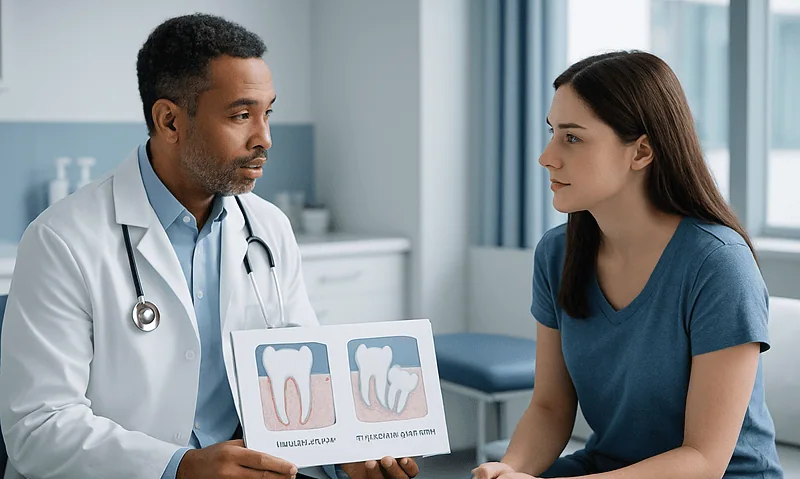
Impacted Canine vs Impacted Wisdom Tooth: Why One Is Often Saved and the Other Removed
An impacted canine is usually saved because it is a cornerstone tooth with the longest root in the mouth, guides the bite and anchors…
Do Root Canals Make You Sick? Old Myths About Treated Teeth, Corrected
No. Current evidence does not show that a properly treated root canal tooth causes cancer, heart disease, arthritis or other illnesses. The idea traces…
Do Teeth Need Straightening Before Porcelain Veneers? When Orthodontics Comes First
Not everyone needs braces before veneers, but many people benefit from straightening first. Porcelain veneers can mask mild rotations, small gaps, and uneven edges,…

Sinus Lift: Why Upper-Jaw Implants Sometimes Need It, and How It Heals
A sinus lift is a surgical procedure that adds bone between the upper jaw and the maxillary sinus so a dental implant has enough…
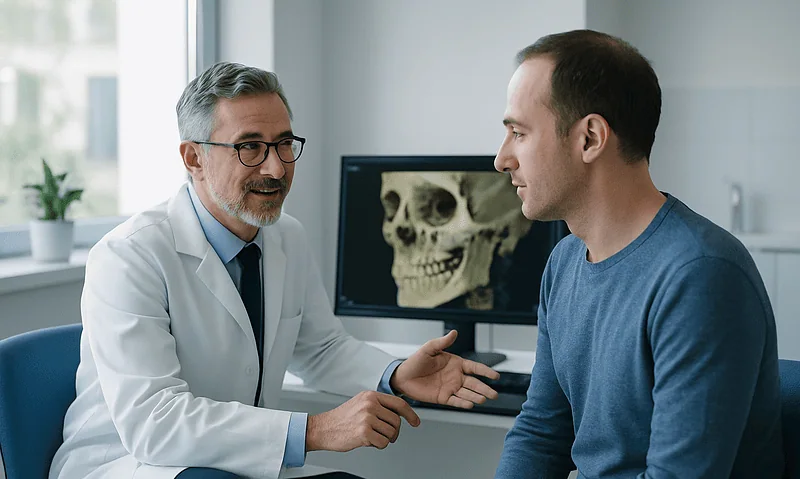
How 3D Imaging Changes Oral and Maxillofacial Surgery Planning Around Nerves and Sinuses
3D imaging in oral surgery planning, most often a cone beam CT scan, gives surgeons a layered view of the jaw so they can…

Oil Pulling: The Ancient Practice vs the Actual Evidence
Oil pulling, swishing edible oil in the mouth for 10 to 20 minutes, may modestly reduce plaque and mouth bacteria, according to a handful…