

Does Melanoma Need Treatment After Surgery? How Adjuvant Therapy Decisions Are Made

Key Takeaways
- Most melanomas are found at stage I and are managed with surgery and follow-up alone; adjuvant therapy is mainly discussed for stage III and selected higher-risk stage II disease.
- The decision rests on three pathology findings: Breslow thickness, ulceration, and whether a sentinel lymph node biopsy showed cancer cells in the nodes.
- Modern adjuvant treatment for melanoma is immunotherapy or BRAF-plus-MEK targeted therapy, typically given for about a year according to the NHS, not chemotherapy.
- Targeted therapy is an option only for the roughly half of cutaneous melanomas that carry a BRAF mutation, which the pathology lab tests for.
- Adjuvant therapy reduces the rate of recurrence in stage III trials, but whether it lengthens life in every sub-group is still being measured as trial data mature.
- Immune-related side effects such as thyroid damage can occasionally be permanent, which is why the choice is weighed individually rather than applied automatically.
Not always. Whether melanoma needs treatment after surgery depends mainly on its stage. Thin, early melanomas are usually managed with surgery and follow-up alone. For stage III disease, and some higher-risk stage II cases, specialists often discuss adjuvant therapy, usually immunotherapy or targeted therapy given for about a year, to lower the chance of recurrence. The decision weighs recurrence risk, side effects and personal priorities, and rests with the treating team.
The stitches are out, the scar is pink and fading, and the pathology report has been read twice. Then the oncologist says a sentence that lands harder than expected: “The surgery went well, and now we need to talk about what comes next.” For many people, that is the first time they realize that removing a melanoma is not always the end of the conversation.
Adjuvant therapy melanoma after surgery is one of the most searched phrases in skin cancer care, and for good reason. The question sounds simple. The honest answer is layered: some people need nothing more than careful follow-up, some are offered a year of medicine, and a sizeable group sits in a gray zone where the evidence is genuinely still maturing.
This explainer walks through how specialists reach that decision, what the different options actually do inside the body, and which parts of the picture are solid, uncertain or simply myth.
Does melanoma always need treatment after surgery?
No, and that single word matters, because many people arrive at their post-operative appointment braced for chemotherapy they may never need. Melanoma is a cancer that begins in melanocytes, the pigment-producing cells of the skin. For the majority of people, it is found while still thin and confined to the skin, and the standard treatment is a wide local excision: the surgeon removes the tumor along with a margin of healthy-looking skin around it, so that stray cells at the edge are taken too.
According to the Mayo Clinic, early-stage melanoma treated this way often needs no further therapy beyond regular skin checks. The word “often” is doing careful work there. What separates a melanoma that is finished with surgery from one that is not is the estimated chance that microscopic cells have already traveled beyond the visible tumor.
That estimate is what the whole adjuvant conversation hinges on. Adjuvant therapy is any treatment given after the main treatment, in this case surgery, to lower the risk of the cancer coming back. The Mayo Clinic’s overview of adjuvant therapy describes it plainly as treatment aimed at cancer cells that cannot be seen on scans but might remain.
So the real question is rarely “Do I need more treatment?” It is “How likely is it that something was left behind, and does the medicine on offer reduce that risk enough to justify its side effects?” Everything that follows is a way of answering those two halves honestly.
What adjuvant therapy for melanoma after surgery actually is
Picture the surgeon’s work as clearing a field. The visible tumor is gone, the margins are clean, and in many cases the nearest lymph nodes have been checked. What no scalpel or scanner can confirm is whether a handful of cells slipped into the bloodstream or lymphatic channels before the operation. Current imaging cannot detect deposits that small.
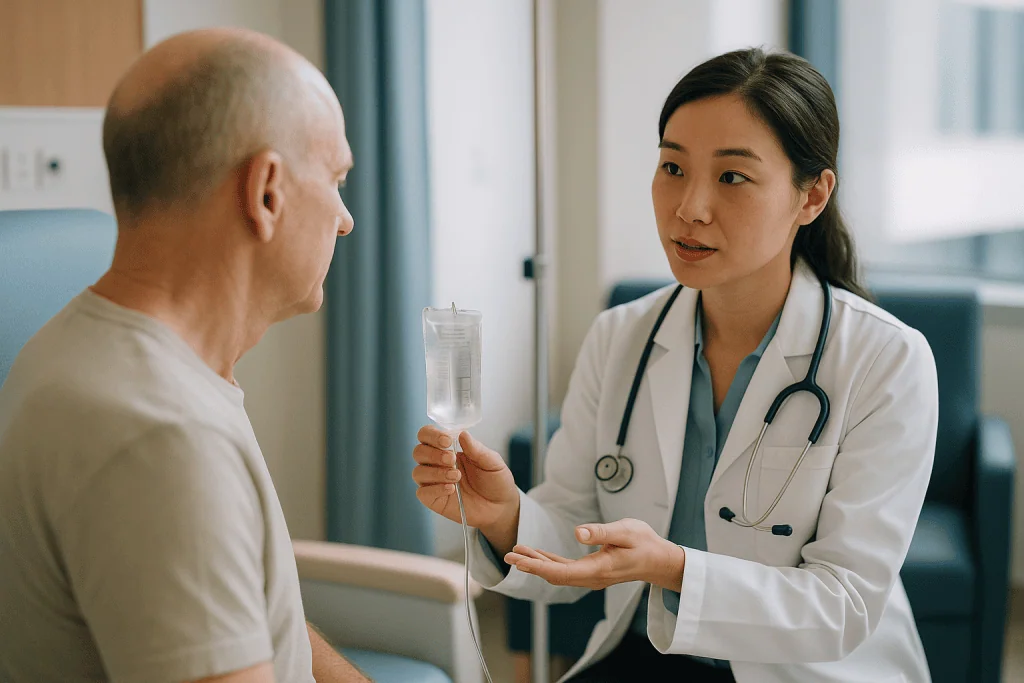
Adjuvant therapy is designed for that invisible remainder. Rather than targeting a lump, it works systemically, meaning throughout the whole body, for a defined period. In melanoma today, that nearly always means one of two approaches: immunotherapy, which trains the immune system to recognize and attack melanoma cells, or targeted therapy, which blocks a specific faulty signaling protein inside tumor cells that carry a particular mutation. The NHS notes that both are used after surgery for people whose melanoma has reached the lymph nodes.
Older forms of adjuvant treatment, including interferon and standard chemotherapy, have largely fallen out of routine use for this purpose because newer approaches showed clearer benefit in clinical trials with more manageable toxicity. If someone remembers a relative receiving a very different post-surgery regimen years ago, that history is accurate; it simply reflects an earlier era.
Two features distinguish adjuvant therapy from treatment for advanced disease. First, there is no tumor to measure, so no one can watch it shrink; benefit shows up only as fewer recurrences across a population. Second, the person receiving it is, by every available test, cancer-free. That combination is why the decision feels so different from other cancer treatment choices, and why specialists spend so long on the risk calculation before suggesting it.
How melanoma staging decides who is offered adjuvant therapy
Staging is the system that converts a pathology report into a risk estimate, and three findings carry most of the weight.
The first is Breslow thickness, the depth of the tumor in millimeters measured under the microscope from the top of the skin surface down to its deepest point. The second is ulceration, meaning the skin over the tumor has broken down, which signals a more aggressive growth pattern. The third is lymph node involvement: whether melanoma cells have reached the nearby nodes, the small filters of the immune system.
The National Cancer Institute’s treatment summary describes how these elements combine. Stage I melanomas are thin and node-negative. Stage II tumors are thicker, or ulcerated, but the nodes remain clear. Stage III means cancer has reached lymph nodes or nearby skin, and stage IV means it has spread to distant organs. Stage II and III are further split into sub-stages (A, B, C and, for stage III, D) that track rising risk.
Nodes are usually assessed with a sentinel lymph node biopsy, a procedure in which dye or a tracer identifies the first node that drains the tumor site so it can be removed and examined. The Mayo Clinic explains that this is generally considered once a melanoma exceeds a certain thickness or shows other high-risk features.
Why does this matter for the adjuvant question? Because the trials that established modern adjuvant treatment enrolled people by stage. The benefit demonstrated in stage III patients cannot simply be assumed to apply to someone with a thin stage I lesion, whose baseline risk is already low. The pathology report, more than any preference or fear, sets the frame.
Stage 3 melanoma treatment after surgery: why this group is usually offered more
If there is one group for whom the evidence is clearest, it is people with stage III disease. Once melanoma cells are confirmed in a lymph node, the probability that microscopic disease exists elsewhere rises substantially, and this is the population in which adjuvant immunotherapy and targeted therapy were tested most rigorously.

The NHS states that after surgery for stage III melanoma, immunotherapy or targeted treatment may be offered to help stop the cancer coming back, and that treatment is usually given for about a year. The NCI summary lists both approaches as standard options following surgical removal of stage III disease.
It helps to understand what “stage III” covers, because it is wide. At one end, a single node contains a microscopic cluster of cells found only because a sentinel biopsy was performed. At the other, several nodes are visibly enlarged, or there are satellite deposits of tumor in the skin between the primary site and the node basin. Risk differs across that range, and so does the strength of the case for treatment.
Most people with stage III melanoma who are reasonably fit are offered an adjuvant conversation. Whether they accept depends on their sub-stage, other medical conditions, and tolerance for a year of appointments and the possibility of lasting side effects. Specialists in the field generally regard this as a shared decision rather than an automatic prescription, and the treating team remains the only appropriate source for an individual recommendation.
One further point deserves honesty: trials showed a reduced rate of recurrence, which is the outcome adjuvant therapy is designed to influence. Whether that translates into longer life for every sub-group is still being measured as the data mature.
Stage 2 melanoma: the gray zone where many people are asked to wait
Stage II is where the conversation becomes genuinely difficult, and where a thoughtful oncologist may say, “We could treat, or we could watch closely, and both are defensible.”
These are melanomas that are thick or ulcerated but have not reached the lymph nodes. Their risk of recurrence is lower than stage III on average, yet the higher sub-stages (IIB and IIC) can carry a recurrence risk that overlaps with early stage III. That overlap is why trials of adjuvant immunotherapy were extended to this group, and why some guidelines now include it as an option for the higher-risk sub-stages. The NCI notes immunotherapy as a consideration for certain stage II melanomas after surgery.
Here is the tension. Because the baseline risk is lower, a larger number of people must be treated for each recurrence prevented. Many of those people would never have relapsed anyway, yet all are exposed to the side effects. Immune-related toxicity can, in a minority, be permanent. Weighing that trade-off is not a formula; it is a judgment that depends on how a person values a reduced relapse chance against the possibility of a lifelong thyroid condition, for example.
People most often asked to wait rather than treat include those with stage IIA or thinner disease, those with significant autoimmune conditions where immunotherapy could flare them, those with frailty or organ problems that raise the risk of complications, and anyone for whom the absolute benefit is small enough that close surveillance is the more proportionate choice. Waiting is not neglect. Structured follow-up, with the option of treatment if something returns, is a legitimate strategy supported by the same guidelines.
Immunotherapy or targeted therapy: how each option works inside the body
The two main classes of adjuvant treatment take completely different routes to the same goal.
Immunotherapy, in this setting, usually means an immune checkpoint inhibitor. Checkpoints are natural braking proteins on immune cells; melanoma exploits them to avoid being attacked. Checkpoint inhibitors release the brake so that T cells, the immune system’s search-and-destroy cells, can recognize melanoma as a threat. The Cleveland Clinic describes immunotherapy as helping the body’s own immune system fight the cancer. These medicines are given as infusions into a vein at intervals of a few weeks, and they do not depend on the tumor carrying any particular mutation.
Targeted therapy applies only to melanomas with a BRAF mutation, a change in a gene that leaves a growth-signaling switch stuck in the “on” position. Roughly half of cutaneous melanomas carry it; the pathology lab tests for it. A combination of a BRAF inhibitor and a MEK inhibitor, two oral medicines that block consecutive steps in that stuck pathway, can be used after surgery for stage III BRAF-mutant disease. The NHS lists targeted medicines as an alternative to immunotherapy in this group.
Which one a person is offered depends on mutation status first, then on practical factors: an autoimmune history pushes against immunotherapy; a preference for tablets over infusions, or specific side-effect concerns, may push toward or away from targeted therapy. Neither is “stronger” in a general sense. Head-to-head comparison in the adjuvant setting is limited, and the choice is individualized by the prescribing clinician rather than by any published ranking.
Adjuvant options compared: a summary table
The table below gathers the main pathways into one view. It is a map of the territory, not a recommendation; the right row for any individual is a decision for their oncology team.
| Pathway | Usually considered for | How it works | Typical duration | Key cautions |
|---|---|---|---|---|
| Surgery plus surveillance only | Stage I, most stage IIA, anyone for whom benefit is judged too small | Removes visible disease; regular skin and node checks catch recurrence early | Follow-up for up to 5 years (NHS) | Requires commitment to appointments and self-checks |
| Adjuvant immune checkpoint inhibitor | Stage III; selected higher-risk stage II | Releases immune brakes so T cells attack residual melanoma cells | About 1 year (NHS) | Immune-related side effects; some may be permanent; caution with autoimmune disease |
| Adjuvant BRAF plus MEK inhibitor | Stage III with confirmed BRAF mutation | Blocks the overactive growth pathway inside tumor cells | About 1 year (NHS) | Fever, fatigue, rash, eye and heart monitoring; only for BRAF-mutant tumors |
| Neoadjuvant therapy (before surgery) | Selected stage III with measurable nodes, often within trials | Same medicines given first, so response can be assessed in the removed tissue | Variable; still being defined | Evidence evolving; availability depends on local practice |
| Clinical trial | Any stage where an open study fits | Tests new combinations or shorter schedules | Per study protocol | Uncertain benefit by definition; close monitoring built in |
Two details are worth underlining. The one-year duration quoted for both adjuvant classes is a typical range reported by the NHS, not a guarantee of how long any individual will be treated; schedules can be shortened by side effects or adjusted by the team. And the surveillance row is not a lesser option. It is the standard of care for the largest number of people diagnosed with melanoma each year.
Is adjuvant therapy worth it for melanoma? What the evidence actually shows
This is the question people type into search bars late at night, and it deserves a straight answer rather than reassurance.
What the evidence shows clearly: in people with resected stage III melanoma, adjuvant immunotherapy and, for BRAF-mutant tumors, adjuvant targeted therapy reduce the likelihood of the cancer returning within the first few years compared with surgery alone. That finding has been consistent enough across major trials for the NCI and national health services to list these treatments as standard options.
What is less settled: whether that reduction in recurrence reliably translates into living longer. For some groups the overall survival data remain immature, meaning not enough time has passed for the trials to answer definitively. Part of the reason is encouraging: when melanoma does return, modern treatments for advanced disease are effective enough that some people who skipped adjuvant therapy and relapsed do well after later treatment. Whether treating everyone early or treating only those who relapse gives the better long-term result is still a live scientific question.
What is uncertain for stage II: the recurrence benefit is real but smaller in absolute terms, because fewer of these patients would have relapsed in the first place. Reasonable experts disagree about where the threshold for treatment should sit.
“Worth it,” then, depends on three things an individual can discuss with their team: their personal recurrence risk from the pathology, the size of the expected risk reduction for that stage, and how they weigh a year of treatment and its side effects against that gain. There is no universal answer, and anyone who offers one without seeing a pathology report is guessing.
Immunotherapy after melanoma surgery side effects: what is common, what is rare, what can last
Because checkpoint inhibitors work by loosening the immune system’s restraints, their side effects are mostly the immune system overshooting and attacking healthy tissue. These are called immune-related adverse events, and they are the central reason the adjuvant decision is not trivial.
The most frequent are fatigue, skin rash and itching, and changes in thyroid function, which can swing toward underactive or overactive. Diarrhea and inflammation of the bowel (colitis), inflammation of the liver (hepatitis) and inflammation of the lungs (pneumonitis) are less common but more serious, because they can escalate quickly if not recognized. Rarer still are effects on the pituitary gland, the adrenal glands, the joints, the heart and the nervous system. The Mayo Clinic notes that immunotherapy side effects reflect the immune system attacking other parts of the body and vary in severity.
Most immune-related side effects are manageable with monitoring, pauses in treatment, and in some cases steroid medicines to calm the immune reaction, as directed by the oncology team. A minority become permanent. Thyroid damage is the typical example: once the gland is injured, lifelong thyroid hormone replacement may be needed. Adrenal or pituitary damage, though rare, can also be lasting.
Targeted BRAF and MEK inhibitors carry a different profile: fever and chills, fatigue, rash, joint pain, and sometimes effects on the eyes or heart that require periodic checks. These effects are generally reversible when treatment is adjusted or stopped, which is one practical difference between the two classes.
None of this is an argument for or against treatment. It is the information a person needs in order to decide, and it is why teams schedule blood tests and symptom reviews throughout the treatment year rather than only at the end.
What the following weeks and months usually look like
For someone who proceeds with adjuvant therapy, the rhythm of the year is fairly predictable, even if the experience is personal.
Treatment usually begins once the surgical wound has healed and the final pathology, including any sentinel node result and BRAF testing, is back. That generally places the start several weeks after the operation; trials typically required enrollment within roughly three months of surgery, and clinical practice follows a similar window where possible. The exact timing is set by the team based on healing and test results.
With immunotherapy, the pattern is an infusion visit every few weeks, each preceded by blood tests to check thyroid, liver and kidney function, plus a conversation about any new symptoms. The appointment itself usually lasts a few hours including preparation and observation. With oral targeted therapy, visits are less frequent but still regular, with blood work and, for some medicines, periodic eye or heart assessments.
Both classes are typically continued for about a year, according to the NHS, unless side effects or recurrence intervene. Scans are not performed after every cycle in the adjuvant setting, because there is no tumor to measure; most teams schedule imaging at intervals or in response to symptoms, following local guidelines.
After treatment ends, surveillance continues. The NHS describes check-ups continuing for up to five years for higher-stage disease, more often in the first years and spacing out later. Many people describe the first unscheduled gap between appointments as strangely unsettling, after months of structure. That is a normal reaction, and clinical nurse specialists are used to hearing it.
For those who choose surveillance only, the calendar looks like the final paragraph above from the start: regular examinations, skin self-checks between visits, and a clear route back to the team if anything changes.
Melanoma recurrence after surgery: what it means and how it is caught
Recurrence means melanoma that reappears after a period in which no cancer could be detected. It can show up in three broad ways: locally, in or near the original scar; regionally, in the lymph nodes that drain the area or in the skin between the scar and those nodes; or at a distance, in organs such as the lungs, liver, brain or bone. Distant recurrence is what clinicians call metastatic melanoma, meaning melanoma that has spread beyond its region of origin, and it corresponds to stage IV disease. The MedlinePlus overview explains that melanoma is more likely than other common skin cancers to spread in this way, which is why follow-up is taken seriously.
Most recurrences, when they happen, occur within the first few years after surgery, which is why surveillance is concentrated in that window. Late recurrences many years out are documented but uncommon.
Catching recurrence early matters because treatment options for regional recurrence often include further surgery, and because advanced melanoma now has effective systemic treatments. Surveillance combines three layers: the person’s own skin and node self-checks between visits, clinical examination at scheduled appointments, and, for higher-risk stages, periodic imaging according to guideline schedules.
Advanced melanoma does not announce itself with one signature symptom. New lumps under the skin or in the neck, armpit or groin, a change at the scar, persistent unexplained symptoms such as weight loss, breathlessness, headaches or new bone pain are the kinds of changes teams ask to hear about promptly. These are prompts to call the clinic, not a tool for self-diagnosis; most such symptoms turn out to have ordinary explanations, and only the care team can sort one from the other.
If recurrence is confirmed, the staging process begins again, and the treatment conversation shifts from prevention to active management.
What people often get wrong about adjuvant therapy and melanoma
“If the surgeon got it all, I’m done.” Clean margins mean the visible tumor was fully removed. They cannot speak to cells that left before surgery. That gap is the entire reason adjuvant therapy exists, and it is why the pathology report, not the surgeon’s reassurance, drives the next step.
“Adjuvant therapy means chemotherapy.” For melanoma, it almost never does today. Modern post-surgical treatment is immunotherapy or targeted therapy. People who picture hair loss and weeks of nausea are usually imagining a different disease or an earlier decade.
“Taking the treatment guarantees it won’t come back.” It does not. Adjuvant therapy lowers the probability of recurrence across a group; it cannot promise an outcome for one person. Some people relapse despite treatment, and some who decline it never relapse.
“Can you have melanoma for 20 years and not know?” Melanoma that remains unchanged for two decades would be unusual. Some melanomas grow slowly over years, and some people have had a lesion they ignored for a long time, but most are detected within months to a few years of appearing. A pigmented spot that has looked identical for decades is far more likely to be a stable mole. What is true is that recurrence can, rarely, surface many years after the original surgery, which is a different phenomenon from an undetected primary.
“Stage IV means nothing can be done.” Advanced melanoma is serious, and this magazine does not publish survival figures outside quoted guidelines, but it is now a disease with several effective systemic treatments, and outcomes have changed markedly compared with the era before immunotherapy. The Johns Hopkins overview describes treatment for advanced disease in these terms.
“Immunotherapy is natural, so it’s gentle.” It uses the body’s own immune system, but the side effects can be significant and occasionally permanent. Natural is not the same as mild.
Questions to ask your care team before deciding
A good adjuvant consultation is a dialogue, and the most useful thing a patient can bring is a short list of specific questions. These tend to open the right doors.
- What is my exact stage and sub-stage, and which features of the pathology report drove that?
- Based on my stage, what is my estimated chance of recurrence without further treatment, and by roughly how much would adjuvant therapy be expected to lower it?
- Has my tumor been tested for a BRAF mutation, and how does the result change my options?
- Which treatment would you suggest for me, and why that one rather than the alternative?
- How long would treatment last, how often would I need to come in, and what monitoring is involved?
- Which side effects are most likely, which are the most serious, and which could be permanent?
- Do I have any conditions, such as autoimmune disease, that make one option riskier for me?
- If I choose surveillance instead, what would the follow-up schedule look like, and what would happen if the melanoma returned?
- Is there a clinical trial, including trials of therapy before surgery, that I would be eligible for?
- Who do I contact, including out of hours, if I develop symptoms during treatment?
- Is there any time pressure on this decision, and can I take a week to think about it?
It is reasonable to ask for the answers in writing, to bring a family member or friend to take notes, and to request a second appointment before committing. Many people also find it helpful to ask for a referral to a clinical nurse specialist, who can translate the oncologist’s framework into day-to-day practicalities.
None of these questions has a single right answer. Their purpose is to make the trade-offs visible so that the final choice reflects both the evidence and the person living with it.
When to call your doctor
Whether someone is receiving adjuvant therapy or being watched, there are changes that should go to the care team promptly rather than waiting for the next scheduled visit.
During immunotherapy or targeted therapy, contact the oncology team the same day for: diarrhea that is persistent, bloody or accompanied by abdominal pain; new breathlessness, cough or chest pain; severe or spreading rash, or blistering of the skin or mouth; yellowing of the skin or eyes, dark urine or pale stools, which can signal liver inflammation; a severe or persistent headache, especially with vision changes or unusual thirst; fever that does not settle; sudden profound fatigue, confusion or fainting; or new weakness, numbness or difficulty walking. Immune-related side effects can escalate within days, and most are far easier to manage when treated early. Teams expect these calls and would rather hear about a symptom that turns out to be nothing.
At any stage after surgery, including years later, arrange an appointment within days for: a new lump under the skin, particularly near the scar or in the neck, armpit or groin; a change in the appearance of the scar or new pigmented spots nearby; a mole anywhere that is changing in size, shape, color or texture, or that bleeds or itches persistently; unexplained weight loss, ongoing night sweats, new persistent bone pain, or seizures or neurological symptoms that have no other explanation.
Seek emergency care without delay for sudden severe breathing difficulty, chest pain, a first seizure, sudden confusion, or signs of a severe allergic reaction during or shortly after an infusion.
This list is a prompt to make contact, not a diagnostic tool. Most of these symptoms will have benign causes, and only the treating team, with examination and tests, can determine what is happening and what, if anything, needs to change.
Frequently asked questions
Is adjuvant therapy worth it for melanoma if my lymph nodes were clear?
It depends on how thick and whether ulcerated the tumor was. Node-negative stage I and IIA melanomas are generally managed with surveillance alone. For higher-risk stage IIB and IIC disease, adjuvant immunotherapy is listed as an option by the NCI, though the absolute benefit is smaller than in stage III and some specialists favor close monitoring. Your oncology team can estimate your individual recurrence risk from the pathology report.
What does stage 3 melanoma treatment after surgery usually involve?
Most people with stage III melanoma are offered a year of either immune checkpoint inhibitor immunotherapy or, if the tumor carries a BRAF mutation, combined BRAF and MEK targeted therapy, according to the NHS. Treatment typically starts once the surgical site has healed and full pathology is back, with regular blood tests and symptom reviews throughout. Surveillance continues after treatment ends.
What are the most common immunotherapy after melanoma surgery side effects?
Fatigue, skin rash, itching and changes in thyroid function are the most frequent. Less common but more serious effects include inflammation of the bowel, liver or lungs, and rare effects on the pituitary, adrenal glands, heart or nerves. Most are manageable with monitoring and treatment adjustments directed by the oncology team, but some, particularly thyroid damage, can be permanent.
How likely is melanoma recurrence after surgery?
It varies enormously by stage, from very low for thin stage I tumors to considerably higher for stage IIIC and IIID disease. The strongest predictors are Breslow thickness, ulceration and lymph node involvement. Most recurrences, when they occur, happen within the first few years, which is why NHS follow-up schedules are most intensive early. Your team can give you a stage-specific estimate rather than a general figure.
Can you have melanoma for 20 years and not know?
Rarely, and it would be unusual. Some melanomas grow slowly for years, and some people ignore a changing spot for a long time, but most are detected within months to a few years of appearing. A lesion that has looked identical for decades is far more likely to be a stable mole. Separately, recurrence of a previously treated melanoma can occasionally surface many years later, which is a different situation.
What is metastatic melanoma?
Metastatic melanoma is melanoma that has spread from the original skin site to distant parts of the body, most often the lungs, liver, brain, bones or distant skin and lymph nodes. It corresponds to stage IV disease. MedlinePlus notes melanoma is more likely to spread than other common skin cancers. It is treated with systemic therapies rather than surgery alone, and treatment has improved substantially with immunotherapy and targeted medicines.
What are the symptoms of advanced melanoma?
There is no single signature symptom, and symptoms depend on where the cancer has spread. New lumps under the skin or in the neck, armpit or groin, persistent unexplained weight loss, breathlessness, ongoing headaches, bone pain or neurological changes are the kinds of changes care teams ask to hear about. These are prompts to contact your clinic, not a self-diagnosis list; most have other explanations.
What is the survival rate for stage 4 skin cancer?
Survival figures for stage IV melanoma vary widely with the sites of spread, the tumor’s mutations, overall health and response to treatment, and published averages lag behind current therapies. For that reason this article does not quote a figure outside a named guideline. The NCI summary describes stage IV as treatable with systemic therapy, and your oncologist can discuss statistics that apply to your situation.
Can adjuvant therapy be given before surgery instead?
Yes, that approach is called neoadjuvant therapy, and it is an active area of research for stage III melanoma with measurable lymph node disease. Giving immunotherapy first allows the team to see how the tumor responded in the removed tissue. Evidence is still evolving and availability varies, so it is generally discussed within specialist centers or clinical trials rather than as routine practice.
What happens if I decide against adjuvant therapy?
You enter structured surveillance: regular skin and lymph node examinations, self-checks between visits, and for higher stages periodic imaging, with NHS follow-up continuing for up to five years. If melanoma returns, treatment options including further surgery and systemic therapy remain available. Declining adjuvant treatment is a recognized choice, and your team will respect it while keeping the door open to revisit.
References
This article is for general information only and is not a substitute for professional medical advice. Please consult a qualified doctor about your individual situation.

More from the Blog

How Hormone Therapy Is Given: Injections, Implants and Daily Tablets Compared
Hormone therapy for cancer is given in three main ways: tablets or capsules taken by mouth each day, injections given under the skin or…

SBRT vs Conventional Radiation Therapy: Fewer Visits, Tighter Margins, Different Planning
SBRT (stereotactic body radiation therapy) and conventional radiation therapy use the same type of X-ray energy, but SBRT delivers a larger share of the…

Robotic Partial Nephrectomy Step by Step: Small Incisions, the Robot and Saving the Kidney
A robotic partial nephrectomy is keyhole surgery in which a surgeon, seated at a console, controls slender instruments through several small abdominal incisions to…
What an Ovarian Cancer Tumor Board Considers Before Recommending Surgery Timing
An ovarian cancer tumor board weighs where the cancer sits on imaging, whether all visible disease can realistically be removed, the patient's fitness for…

Immunosuppressive Medicines for Graft Disease (GVHD): What Blood Tests Monitor and Why
After a donor stem cell transplant, medicines that calm the donor immune system are monitored with regular blood tests: drug levels for calcineurin inhibitors…

When Does Myelogenous Leukemia Call for a Stem Cell Transplant Rather Than Drug Therapy?
A stem cell transplant is usually considered for acute myeloid leukemia when the leukemia's genetic features, or leukemia cells that persist after chemotherapy, make…