

Elbow Surgery Recovery: Why Early Movement Matters and How Stiffness Is Prevented

Key Takeaways
- The elbow is the joint most prone to stiffening after injury or surgery, largely because its thin capsule sits within millimeters of the muscles that move it and scars in whatever position the arm rests.
- Bone at the elbow usually knits over about six to eight weeks according to the NHS, but strength and the final degrees of motion typically return over months, as the Mayo Clinic describes for arm fractures.
- Extension, the ability to fully straighten, is lost far more readily than bending, because a painful arm rests bent and the front of the capsule shortens to match.
- Short, frequent range-of-motion sessions with a sustained pause at the end of the arc outperform occasional long, forceful sessions, which cause swelling and next-day guarding.
- Tendon and ligament repairs are usually moved through a deliberately limited, brace-guided arc, while plated fractures and joint replacements can often start controlled motion earlier at the surgeon's direction.
- The CDC notes that most surgical site infections appear within about thirty days of an operation, so new redness, drainage or fever around the incision in that window should be reported the same day.
Elbow surgery recovery time varies by procedure: bone typically knits in about six to eight weeks, while regaining full strength and motion usually takes several months. Because the elbow stiffens more readily than most other joints, surgeons commonly begin gentle, protected movement within days of surgery whenever the repair is stable. Your surgeon and therapist set the exact timeline for your operation.
The sling comes off for the first time in the therapist’s office, and the arm just hangs there at an odd half-bend, as if it has forgotten what elbows are for. The person attached to it, a plate and screws now holding the broken end of the upper arm bone together, does what almost everyone does: looks at the joint, looks at the therapist, and asks whether it is really safe to move it.
It is the most common question in any elbow surgery recovery time conversation, and the honest answer surprises people. For most elbow operations, the bigger risk is not moving too soon. It is moving too late. The elbow is the joint most likely to stiffen after injury or surgery, and once it does, the lost motion is slow and sometimes difficult to win back.
This explainer walks through why that happens, what “early motion” actually means in practice, and how surgeons and therapists build a recovery around preventing stiffness rather than chasing it afterward.
What does elbow surgery recovery time actually mean?
Ask three people about their elbow surgery recovery time and you will get three different answers, because they are measuring three different things. One means the day the stitches came out. One means when the bone looked solid on the X-ray. The third means the afternoon she finally reached the top shelf without thinking about it.
Clinicians tend to split recovery into layers. Tissue healing comes first: the skin closes over a couple of weeks, and a fractured bone usually knits over roughly six to eight weeks, according to NHS guidance on broken arms. Functional recovery, strength, endurance, the confidence to lift a full kettle, runs on a longer clock, one the Mayo Clinic describes in weeks to months rather than days. Return to sport or heavy manual work sits at the far end, and for some procedures it is the surgeon’s call well beyond the point where the bone itself has healed.
Motion is the layer people forget to count, and it is the one that most often decides whether the others feel like success. A perfectly healed fracture inside an elbow that will not straighten past a right angle is, to the person living with it, an unfinished recovery. That is why the phrase “recovery time” is slightly misleading. Time alone does not restore an elbow. What happens during that time does.
So when this article gives ranges, read them as scaffolding, not the building. The bone’s schedule is fairly fixed. The joint’s schedule depends heavily on how early and how consistently it is asked to move, and that part is shared between the surgical team, the therapist and the person doing the exercises at the kitchen table.
What actually happens inside the elbow after surgery?
The elbow is a hinge, but an unusually tightly packed one. Three bones meet in a space you can cover with your palm: the humerus from above, and the radius and ulna from the forearm below. The joint is wrapped in a capsule, a thin, fibrous sleeve that seals the joint and holds its lubricating fluid, and that capsule sits only millimeters from the muscles that bend and straighten the arm.
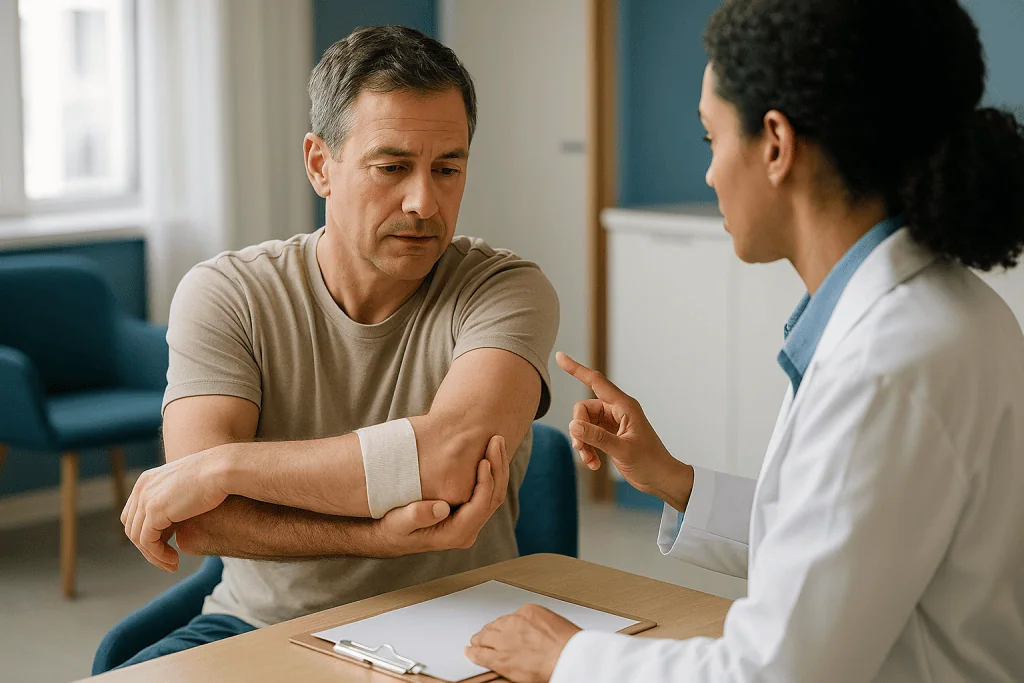
Surgery, like the injury that usually precedes it, sets off a predictable inflammatory response. Blood collects around the joint. The capsule swells and thickens. Fibrin, the sticky protein scaffolding the body lays down to begin repairs, forms in and around the joint. If the elbow is held still while this happens, that scaffold matures into scar tissue in whatever shape the arm was resting in. A capsule folded at ninety degrees for weeks becomes a capsule that resists being unfolded.
A second, less common process deserves a name. Heterotopic ossification is the growth of bone in soft tissue where bone does not belong, and the elbow is one of the places it most often appears after trauma or surgery. It acts like a physical block to motion, separate from the capsule problem. Johns Hopkins lists it among the recognized complications of elbow fractures.
Muscle guarding adds the final layer. Pain makes the brain hold the arm protectively bent, the biceps and forearm flexors shorten to match, and a joint that could technically move stays parked. None of these processes is dramatic. Each is small, quiet and cumulative, which is exactly why the response has to begin early, before they harden into something structural.
Why does early movement matter so much for the elbow?
Movement interrupts that sequence at several points at once. Gently bending and straightening the joint pumps swelling out of the capsule, keeps the developing scar aligned along the direction the joint actually travels rather than across it, and reminds the muscles that the arm is allowed to open. Cartilage, which has no blood supply of its own, depends on the squeeze-and-release of motion to move nutrients through the joint fluid. A still joint is a hungry one.
There is also a mechanical argument specific to this joint. The knee and hip sit in muscle-rich, forgiving surroundings and tolerate losing a few degrees. The elbow works close to its limits in daily life. Reaching your own face, tying a shoelace and pushing up from a chair use nearly the whole arc between straight and fully bent. Lose a slice at either end and ordinary tasks suffer almost immediately, which is why surgeons treat every degree at the elbow as valuable.
The evidence for early motion is built mostly on fracture care and joint replacement, where modern fixation is designed to be sturdy enough to tolerate movement from the start. Johns Hopkins describes physical therapy to restore motion as a standard part of recovery after surgical repair of an elbow fracture. MedlinePlus describes the same principle for elbow replacement, with a therapist guiding movement of the new joint.
None of this means “move freely.” Early motion is protected motion: a defined range, specific planes, often with the forearm supported and without any load. The therapist’s job is to find the widest safe window your particular repair allows and to enlarge it as healing permits. The surgeon’s job is to say where that window’s edges are. Yours is to use it every day.
Who is usually moved early, and who is asked to wait?
Whether your elbow starts moving in the first days or the first weeks comes down to one question the surgeon answers in the operating room: how much can this repair tolerate before it heals? The answer differs by tissue.
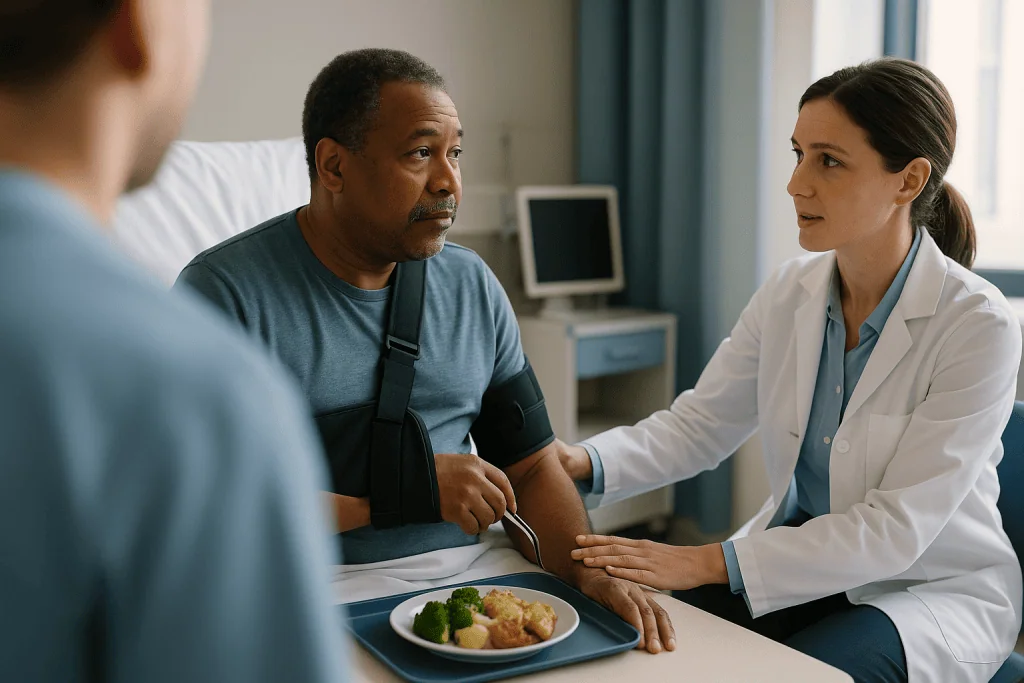
Bone held with a plate and screws, or a joint replaced with an artificial one, is generally the most tolerant. The hardware carries the load while the bone knits, so controlled motion can usually start early, at the surgeon’s direction. Procedures on the surface of the joint, arthroscopic removal of loose fragments or bone spurs, or release of a tight capsule, also tend to move quickly, because there is nothing fragile to protect and the whole point of the operation was motion.
Tendon and ligament repairs sit at the cautious end. A reattached biceps tendon or a reconstructed collateral ligament, the ligaments on the inner and outer sides that stop the joint wobbling sideways, heals by forming living tissue at the repair site, and that tissue is weakest in the early weeks. These repairs are typically braced and moved through a deliberately limited arc, with certain directions blocked until healing allows.
Some people wait longer for reasons unrelated to the repair itself. Nerve procedures, such as moving a compressed ulnar nerve at the inner elbow to a new position, may need time for the nerve to settle before full stretching. Slow-healing wounds, heavy swelling or an external fixator can all delay the start.
The point is not that one group is lucky and another unlucky. Each protocol trades protection of the repair against protection of motion, and the surgeon who saw the tissue is the only person who can weigh that trade accurately.
Elbow surgery recovery time by procedure: a comparison
The table below is a map, not a schedule. It shows how common elbow operations differ in what is being protected, and therefore in how motion is introduced. Your own protocol may look different for reasons specific to your tissue, and it always overrides anything printed here.
| Procedure | What it addresses | Usual approach to early motion | What is usually protected |
|---|---|---|---|
| Fracture fixation (plate and screws) | Broken humerus, radius or ulna at the elbow | Controlled bending and straightening once the surgeon confirms fixation is stable | Lifting and loading until healing is confirmed on X-ray |
| Arthroscopic debridement or capsular release | Loose fragments, bone spurs, established stiffness | Motion is the goal; typically begins promptly | Wound healing; heavy gripping early on |
| Tendon repair (for example, distal biceps) | Torn tendon reattached to bone | Limited, often brace-guided arc; some directions blocked at first | The repair against pull; active use of the repaired muscle |
| Collateral ligament reconstruction | Instability of the inner or outer elbow | Hinged brace with a gradually widened range | Sideways stress; throwing or heavy load for many months |
| Ulnar nerve transposition | Nerve compression at the inner elbow | Gentle motion, with full stretching delayed as the nerve settles | Pressure on the inner elbow; deep sustained bending |
| Total elbow replacement | Severe arthritis or an unreconstructable fracture | Therapist-guided motion of the new joint during recovery | A lasting lifting limit set by the surgeon |
Two patterns stand out. The more an operation relies on soft-tissue healing, the more cautious the early phase. And no common elbow operation is designed around weeks of complete stillness; even the most protective protocols use a controlled arc rather than a locked joint. The NHS describes a bone-healing window of about six to eight weeks for arm fractures, and the Mayo Clinic frames full functional recovery in weeks to months, but the motion work runs throughout both periods rather than waiting for either to end.
What do the first two weeks usually look like?
The first fortnight is less about the elbow than about everything around it. Swelling is at its peak, the wound is closing, and the arm is often in a splint or sling that holds it bent. Even so, most protocols start work almost immediately on the parts that are free.
The hand comes first. Making a full fist and spreading the fingers wide, many times through the day, pumps fluid back toward the heart and keeps the small joints of the hand from stiffening in sympathy with the elbow. Shoulder circles matter for the same reason; a shoulder left still in a sling can develop its own problems. Wrist movement is usually encouraged unless the repair involves the forearm bones.
If the surgeon has cleared the elbow itself, early motion in this phase is gentle and supported: the forearm resting on a table while the joint slides through a set arc, or the other hand guiding the movement so the operated muscles do not have to work. Forearm rotation, turning the palm up and down, is often included, because the small radial head at the outer elbow stiffens readily and rotation is easy to neglect.
Elevation is the unglamorous hero of this stage. An elbow kept above heart level whenever you are sitting or lying drains faster, hurts less and moves more freely at the next session. Cold over the dressing, if your team approves, helps for the same reason.
Wound checks fall in this window too. The CDC notes that most surgical site infections show up within about thirty days of an operation, so this is the period to know what the incision looked like yesterday and to notice if today is different.
Weeks two to six: protected motion and the fight for full extension
Once the wound is settled and the initial swelling is retreating, the real work on the joint begins. This is the window in which the developing scar is still pliable enough to be shaped, and it is where therapists concentrate their effort.
The enemy in this phase is the last bit of straightening. Elbows lose extension far more readily than they lose bending, for two reasons. The resting position of a painful arm is bent, so the front of the capsule shortens. And most of what we do with our hands happens in front of us, at mid-range, so a slight bend goes unnoticed until it is fixed. Therapists therefore spend disproportionate time on extension: sustained, gentle pressure toward straight, with the arm supported and the shoulder positioned so the biceps is relaxed.
Exercises progress along a recognizable ladder. Passive motion, where the therapist or your other hand does the work, gives way to active-assisted motion, where the operated muscles contribute with help, and finally to active motion under the arm’s own power. Load is still restricted; NHS advice after arm fractures is to avoid lifting anything heavy until the bone is confirmed healed, and the same logic applies to tendon and ligament repairs.
Bracing changes too. Hinged braces are opened a little wider at each visit. Splints may switch from holding the joint still to coaxing it toward straight overnight.
Progress is rarely linear. A good week can be followed by a stiff one after poor sleep or a missed session. Therapists measure motion in degrees at each visit precisely because the trend across weeks matters more than any single reading. If the trend stalls, the surgeon wants to know promptly, not at the next scheduled review.
From six weeks onward: strength, sport and the last few degrees
Around the point when X-rays show bone knitting, about six to eight weeks for many arm fractures, per NHS guidance, the emphasis shifts. Motion work continues, but strengthening joins it, and the person starts to be treated less like a patient with a repair and more like someone rebuilding an arm.
Strength returns in a particular order. Grip and forearm endurance come first, because they can be trained with the elbow supported. Then the muscles that bend and straighten the elbow, initially against gravity alone, later against light resistance. Pushing through the arm, a press-up, a heavy door, rising from a low chair, usually comes last, because it compresses the joint and loads any repair on the outer side.
The final degrees of motion are the slowest. Stiffness remaining at this point is less about swelling and more about matured scar, which responds only to sustained, repeated stretch over weeks. This is where static-progressive splints, devices that hold the elbow at its current limit and are tightened a notch at a time, earn their place, and where daily consistency beats intensity. A joint stretched hard once a week swells and fights back; one stretched gently several times a day tends to yield.
Return to sport or heavy manual work is a separate decision from either healing or motion. For throwing athletes after ligament reconstruction, the timeline runs well past bone-healing windows and is set by the surgeon based on the tissue, the sport and how the arm tests. The Mayo Clinic’s framing of arm fracture recovery, that regaining full strength can take months, is a useful expectation-setter for everyone.
After joint replacement the rules differ permanently. MedlinePlus notes that people with an artificial elbow are given lasting limits on lifting to protect the implant, a restriction that outlives the recovery period entirely.
Elbow range of motion exercises: what they are and how they are done
Range of motion exercises are simply movements that take a joint through its available arc, on purpose, with attention. At the elbow they fall into four families, and most protocols use all of them.
- Flexion and extension: bending the hand toward the shoulder and straightening back out, usually with the upper arm resting on a table so gravity is not fighting the movement.
- Pronation and supination: turning the palm down and up with the elbow bent to a right angle and tucked at the side, so the rotation comes from the forearm rather than the shoulder.
- Assisted motion: the unaffected hand, a stick held in both hands, or the therapist supplies the push, so the operated tendons rest while the joint travels.
- Sustained holds: the elbow is taken to its comfortable limit and held there while the muscles relax, letting the capsule adapt.
The quality that separates useful practice from wasted effort is the end-range pause. Sliding quickly through the middle of the arc, where the joint is already free, achieves little. The change happens in the last few degrees, held long enough for the tissue to accept the new position. Therapists describe the right sensation as a firm stretch, not a sharp pain, and teach people to breathe through it rather than brace against it.
Frequency is set by your therapist and depends on the repair. What is consistent across protocols is that short sessions spread through the day outperform one long session, because an overworked elbow swells and guards, and swelling undoes the gain.
Warmth beforehand, a shower, or a warm compress if the wound allows, can make tissue more compliant, and cold afterward can settle the joint. Neither replaces the movement itself, and any technique or device beyond what your team has shown you should be checked with them first.
Do splints and braces prevent elbow stiffness after surgery?
They can, but only when chosen for the right job, and the job changes over the course of recovery.
In the first days, a splint protects. It holds the repair still, keeps the wound undisturbed and often positions the elbow closer to straight than a sling would, because an elbow resting at ninety degrees is an elbow learning to prefer ninety degrees. A hinged brace, a lightweight frame with a locking joint at the elbow, takes over for tendon and ligament repairs, allowing motion within a set arc while blocking the directions that would strain the repair. The therapist widens the arc as healing allows.
Later, the purpose flips from protection to persuasion. A static-progressive splint holds the joint at the edge of its current range and is adjusted in small increments to nudge it further. A dynamic splint uses a spring or elastic to apply continuous gentle pull. Both rely on the principle that governs all stiff tissue: prolonged low load reshapes scar more effectively than brief high force. Many people wear them for extended stretches, including overnight, so that hours of sleep become hours of stretch rather than hours of settling back into a bend.
What a brace cannot do is replace movement. A joint that lives in a device and is never actively worked loses muscle and coordination even as its passive range improves. The two are partners: the brace holds ground overnight, the exercises take new ground by day.
Devices can also cause harm, pressure on the ulnar nerve at the inner elbow, skin breakdown over bony points, swelling below a strap. Numbness in the ring and little fingers while wearing a brace is a signal to loosen it and tell your team, not to persevere.
How does pain control fit into physical therapy after elbow surgery?
Pain control and motion are not rivals in elbow recovery; they are the same project. A joint that hurts is a joint the brain will not let you straighten, whatever your intentions. The aim of pain management after elbow surgery is therefore not to make the arm numb but to bring discomfort down to a level at which the exercises are possible and sleep is restorative.
The medicines involved are best described by class. Anti-inflammatory painkillers damp the chemical signals that drive swelling and pain at the surgical site. Simple analgesics act more on how pain is perceived. Stronger prescription painkillers are sometimes used briefly in the earliest days for certain operations, with the intention of tapering as swelling falls. Which combination is appropriate, in what amounts and for how long, depends on your other health conditions and the specific procedure; that is a conversation with the prescribing clinician, and this article deliberately offers no figures.
What is worth knowing is the practical rhythm. Therapists often ask people to time exercise sessions for the period when their pain relief is working best, and to plan the day’s hardest stretch accordingly. Cold applied after a session settles the joint. Elevation between sessions reduces the throbbing that comes from fluid pooling at the lowest point of the arm.
A word about pain as information. Sharp, sudden pain during an exercise, a new grinding sensation, or pain that is clearly worse at rest the next day rather than better are all signals to stop and check with your team rather than push through. The firm stretch therapists want and the something-has-given-way that surgeons worry about feel different, and part of good rehabilitation is learning to tell them apart.
Can elbow stiffness after surgery be reversed once it sets in?
Often, yes, though the effort required climbs steeply the longer the stiffness has been established, which is the whole argument for prevention.
In the early months, the answer is usually more of the same, done more consistently: a targeted stretching program, a static-progressive or dynamic splint worn for long daily periods, and attention to whatever is driving the guarding, unaddressed pain, poor sleep, fear of the joint. Many stiff elbows loosen substantially in this window without any further procedure, because the scar is still immature enough to remodel.
When motion plateaus despite genuine effort, and the remaining stiffness interferes with daily life, surgeons may discuss releasing the contracted tissue. Capsular release is an operation, done through a scope or an open incision, in which the thickened capsule is cut or partly removed so the joint can travel further. If heterotopic bone is blocking motion, it can be removed, though surgeons typically wait until it has matured, because operating on actively forming bone can provoke more of it. Hardware that impinges on movement is sometimes removed at the same time.
Two honest caveats belong here. First, a release buys the opportunity for motion, not motion itself; the weeks after it involve exactly the intensive early movement described in this article, and skipping that rehabilitation tends to return the joint to where it started. Second, not every stiff elbow is a candidate. Established arthritis, damaged cartilage or a joint that has healed out of alignment may limit what release can achieve, and the treating team weighs that before recommending anything.
The Mayo Clinic lists stiffness among the recognized complications of arm fractures and their treatment, which is why early movement is written into the operation’s plan rather than offered as an optional extra.
What people often get wrong about elbow recovery
Most of the mistakes are understandable. They come from applying common sense about healing to a joint that behaves against common sense.
“Rest it until it heals, then start moving.” This is the most damaging myth, and it is the reverse of how elbow protocols are written. The bone heals on its own schedule regardless; the capsule and scar set on theirs. Waiting for the first before addressing the second means starting the fight after the opponent has dug in.
“If it hurts, I am damaging it.” Stretching stiff tissue is uncomfortable, and the discomfort is often worst in the last few degrees, which is exactly where progress happens. Sharp or sudden pain, or pain that is worse the following day, deserves a call. Firm stretch that fades soon after the session is usually the work, not the harm.
“The sling keeps it safe.” A sling protects a wound and rests a tired arm. It also parks the elbow at a right angle for hours, exactly the position it most readily settles into. Most teams want the sling off for exercises and, for many procedures, off for good sooner than people expect.
“I will make up for missed days with a big session.” Elbows punish this. A long, hard stretch produces swelling, swelling produces guarding, and the joint is stiffer the next morning. Frequent short sessions win.
“Recovered means the X-ray looks healed.” Bone healing in six to eight weeks, as the NHS describes for arm fractures, is a milestone, not the finish. Strength and the final degrees of motion arrive over the months that follow, as the Mayo Clinic notes for arm fracture recovery generally.
“Rotation will sort itself out.” The radial head stiffens quietly. Turning a key or a door handle is where people first notice it, usually after the window in which it was easiest to prevent.
Questions to ask your care team
Good questions do more than gather facts; they tell the team what you are worried about and let them tailor the plan. These are the ones that tend to change what happens next.
- Which exact movements am I allowed to do now, which are off-limits, and for how long? Ask for it in plain language and, if possible, in writing.
- What is the goal range at my next appointment, and what happens to the plan if I am short of it?
- Is my repair the kind that tolerates early motion, or the kind that needs protection first? What was seen during the operation that shaped that decision?
- Should I wear the splint or sling for exercises, between exercises, at night, or not at all?
- How do I tell the difference between a stretch I should sit with and a pain I should stop for?
- Which symptoms mean I should call today rather than wait for the next review?
- Who do I contact if motion stalls between appointments, and how quickly can that be assessed?
- Will I have lasting restrictions on lifting, sport or repetitive work once recovered, and are they permanent?
- Does anything in my history, previous stiffness, diabetes, nerve symptoms, make me higher risk for a stiff elbow, and does that change the plan?
- How will my pain relief be adjusted as swelling settles, and who decides?
Bring the answers to your therapist, and bring the therapist’s observations back to the surgeon. Elbow recovery works best as a three-way conversation in which the person doing the exercises is treated as the most important reporter of how the joint behaves day to day. Note the numbers from each visit, degrees of bend, degrees of straight, so you can see the trend for yourself rather than relying on how the arm feels on any given morning.
When to call your doctor
Most bumps in elbow recovery are ordinary: a stiffer morning, a sore evening after a hard session, mild swelling that settles with elevation. A smaller set of signs should reach your surgical team the same day, because early treatment changes what happens next.
Call promptly for any of the following:
- Increasing redness, warmth or swelling around the incision, cloudy or foul-smelling drainage, wound edges separating, or fever or chills. The CDC notes that most surgical site infections declare themselves within about thirty days of an operation.
- New or worsening numbness or tingling, especially in the ring and little fingers, or hand weakness that was not present before, possible pressure on the ulnar nerve.
- Fingers that are pale, blue or cold, or pain that is severe and unrelieved by elevation and your prescribed pain relief, which can indicate a problem with blood flow or dangerous swelling under a tight dressing.
- A sudden pop, a sensation of the joint giving way, or a change in the arm’s shape, particularly after a fall or an unexpected load.
- Motion that is clearly going backward over several days rather than plateauing, or a joint that has suddenly locked in one position.
- Calf pain, leg swelling, chest pain or breathlessness. Blood clots are less common after arm surgery than after hip or knee procedures, but they are not impossible, and these signs are always urgent.
Seek emergency care immediately for chest pain, difficulty breathing, or a hand that is cold, white or blue and numb. For everything else on this list, use the contact route your team gave you at discharge, and do not wait for the next scheduled appointment. Every decision about what follows, a dressing change, an X-ray, a change in medicine or a further procedure, rests with the treating team, and they would far rather hear from you early than late.
Frequently asked questions
How long is elbow surgery recovery time overall?
It depends on the procedure and on which layer of recovery you mean. NHS guidance places bone healing for arm fractures at roughly six to eight weeks, while the Mayo Clinic describes full functional recovery in weeks to months. Motion is worked on throughout both periods. Tendon and ligament repairs and return to sport follow longer, surgeon-set timelines. Your own team’s schedule is the only one that applies to your elbow.
What is a typical elbow fracture recovery time after plate-and-screw fixation?
The bone itself usually knits over about six to eight weeks, per the NHS, during which heavy lifting is avoided. Controlled bending and straightening often begins much earlier, once the surgeon confirms the fixation is stable, because modern hardware is designed to tolerate protected motion. Strength and the last degrees of movement return over the following months. Johns Hopkins describes physical therapy as a standard part of recovery after these repairs.
Why does the elbow get stiff after surgery more than other joints?
Its capsule is thin, tightly packed and sits right against the muscles that move the joint, so post-surgical swelling and scar quickly tether it. A painful arm also rests bent, which shortens the front of the capsule. The elbow is prone to heterotopic ossification, bone forming in soft tissue, after trauma, which Johns Hopkins lists among fracture complications. And because daily tasks use almost its whole arc, small losses are felt immediately.
When should I start bending my elbow after surgery?
Only when your surgeon says so, but for many operations that is within days rather than weeks. Fracture fixation and joint replacement usually tolerate early controlled motion; tendon and ligament repairs are typically moved through a limited, brace-guided arc; nerve procedures may wait longer for full stretching. Hand, wrist and shoulder movement usually begins almost immediately regardless. The specific start date and range come from the team who saw your repair.
Will I be able to straighten my elbow fully again after surgery?
Many people regain most or all of their extension, but no team can promise it, and the last few degrees are the hardest to win. Full straightening is lost more readily than bending, which is why therapists focus on it early with sustained gentle stretch and, later, static-progressive splints. Established stiffness can sometimes be improved with capsular release, followed by intensive rehabilitation. Your surgeon can tell you what your particular joint allows.
Should I wear my sling all the time after elbow surgery?
Usually not, unless your team has told you to. A sling protects the wound and rests a tired arm, but it also parks the elbow at a right angle for hours, the position it most readily settles into. Most protocols want the sling off for exercises, and for many procedures off altogether sooner than people expect. Ask your team exactly when to wear it, when to remove it, and what to do at night.
Is it normal for the elbow to hurt during range of motion exercises?
A firm stretch at the end of the arc is normal and expected, particularly in the last few degrees where progress happens. What is not normal is sharp or sudden pain, a new grinding sensation, or pain that is clearly worse at rest the next day. Those are signals to stop and contact your team. Therapists teach people to breathe through the stretch rather than brace, and to use short frequent sessions to avoid swelling.
What is a static-progressive splint and will I need one?
A static-progressive splint is a device that holds the elbow at the edge of its current range and is tightened in small steps to nudge it further, often worn for long periods including overnight. It applies prolonged low load, which reshapes matured scar better than brief force. Not everyone needs one; they are typically introduced when stiffness persists after the swelling phase. Your therapist decides whether one would help your joint.
Does swelling make elbow stiffness after surgery worse?
Yes, directly. Swelling stretches and thickens the capsule, provokes protective muscle guarding and makes every stretch harder the next morning. That is why elevation above heart level, frequent hand pumping, cold applied after sessions if your team approves, and short rather than marathon exercise sessions all matter as much as the exercises themselves. Swelling that increases with redness, warmth or fever is different and should be reported promptly, as the CDC’s infection guidance advises.
Can elbow stiffness be fixed if it has already set in?
Often it can be improved, though it gets harder the longer it has been established. Early on, a consistent stretching program and splinting are usually tried first, and many joints loosen without further surgery. If motion plateaus and daily life is affected, surgeons may discuss capsular release or removal of heterotopic bone or impinging hardware. Any release must be followed by intensive early movement, and candidacy depends on the state of the cartilage and alignment.
References
This article is for general information only and is not a substitute for professional medical advice. Please consult a qualified doctor about your individual situation.

More from the Blog

When Can You Return to Sport After ACL Reconstruction? Why Tests Decide, Not the Calendar
Return to sport after ACL reconstruction is usually decided by passing objective tests rather than by reaching a date. Most rehabilitation guidance points to…
Why Surgeons Ask You to Stop Smoking Before Rotator Cuff Repair: Tendon Healing Explained
Surgeons ask patients to stop smoking before rotator cuff surgery because nicotine narrows small blood vessels and carbon monoxide displaces oxygen, starving the repaired…
Flying Home After Cruciate Ligament Surgery: Clot Precautions, Bracing and Timing
Most people can fly after ACL surgery once the surgical team has confirmed that swelling is settling, the wound is healing and clot risk…
How Arthroscopy Works: The Camera, the Portals and What Surgeons Can Fix Through Keyholes
Arthroscopy works by passing a pencil-width tube with a light and a video camera into a joint through an incision a few millimetres long,…

Soft Tissue Injury Healing Stages: Why Sprains, Strains and Bruises Heal at Different Rates
Soft tissue injury healing time depends on what was damaged and how well it is supplied with blood. Bruises usually fade within about two…
What Happens Years After Meniscus Surgery? Cartilage Wear and Realistic Expectations
Years after meniscus surgery, the knee's future depends mainly on how much meniscus tissue was removed and how healthy the cartilage was beforehand. Partial…