

Flying Home After Cruciate Ligament Surgery: Clot Precautions, Bracing and Timing

Key Takeaways
- Clot risk and graft risk run on different clocks: the CDC notes most travel-related clots surface within about two weeks of a trip, while the graft's biological strength dip is commonly described in the second and third months.
- The CDC puts long-distance travel over roughly four hours at about two to four times baseline clot risk, and recent surgery adds to that, which is why long-haul flights are treated more cautiously than short ones in the first weeks.
- No major guideline sets a fixed number of weeks before flying after ACL reconstruction; many surgical teams use the first post-operative review, often around two weeks, as a checkpoint before long flights.
- Ankle pumps and periodic aisle walks are the core in-flight clot measures endorsed by the CDC and NHS; compression stockings are an adjunct for people at raised risk, not a replacement for movement.
- A hinged knee brace, if your team issued one, protects against sudden uncontrolled twists in crowded aisles rather than against ordinary bending, and its hinge settings for travel should be confirmed with the team.
- A fresh plaster cast can tighten as cabin pressure changes and is a recognized aviation concern; a hinged brace after ACL reconstruction does not carry this problem.
Most people can fly after ACL surgery once the surgical team has confirmed that swelling is settling, the wound is healing and clot risk has been addressed, which is often after the first follow-up visit rather than in the first days. Long flights carry more clot risk than short ones, so timing, in-flight movement, hydration, any prescribed clot prevention and a brace plan should all be agreed with the treating team.
The knee is wrapped, the crutches are propped against the hotel bed, and the boarding pass on the phone says the flight home leaves in four days. That is the moment the question stops being theoretical. The surgeon said the operation went well. Nobody said much about a cramped seat, a cabin at altitude and a leg that cannot yet bend past a right angle.
Flying after ACL surgery is one of the most searched questions in sports orthopedics, and one of the least honestly answered. The internet offers a confident number of weeks; the truth is that two separate clocks are running. One is the blood-clot clock, which peaks early and fades over weeks. The other is the graft clock, which runs slowly and quietly for months.
This explainer walks through both, using what the mainstream evidence actually shows, so that the conversation with your treating team is a sharper one.
Why flying after ACL surgery is really two separate questions
Ask a surgeon whether you can fly and you will often get a question back: how far, and how soon? That is not evasion. The knee and the bloodstream recover on different schedules, and a flight tests both.
The first concern is venous thromboembolism, the medical term for a blood clot that forms in a deep leg vein (deep vein thrombosis, or DVT) and may break off and travel to the lungs (pulmonary embolism). Surgery on a leg, the pause in normal walking afterward and the swelling around the joint all slow the flow of blood in the calf veins. Sitting still for hours in a narrow seat slows it further. The CDC’s travel health guidance puts long-distance travel of more than about four hours at roughly two to four times the baseline clot risk for the general population, and lists recent surgery among the factors that raise it further.
The second concern is the graft itself. After a reconstruction, the new ligament is held in place by fixation devices while it slowly knits into bone. A jolt from a service cart, a twist while shuffling down the aisle, or a fall on a wet jet bridge can undo weeks of careful protection. The graft is not fragile in the sense of shattering, but it has no reflexes yet, and neither does the surrounding muscle.
There is a third, quieter issue that rarely makes it into forum posts: swelling. A knee that has just been operated on tends to puff up when the leg hangs down for hours, and a swollen, stiff knee is harder to rehabilitate in the first days at home. None of these three factors makes flying impossible. Each one changes what a sensible plan looks like, and that plan belongs to the treating team, not to a search result.
What ACL reconstruction actually does inside the knee
The anterior cruciate ligament is a short, tough band of tissue running diagonally through the center of the knee, and its job is to stop the shin bone from sliding forward and rotating too far under the thigh bone. When it tears, usually in a pivot or an awkward landing, it does not heal back together on its own the way a bone does, because it sits bathed in joint fluid rather than in a blood-rich bed.
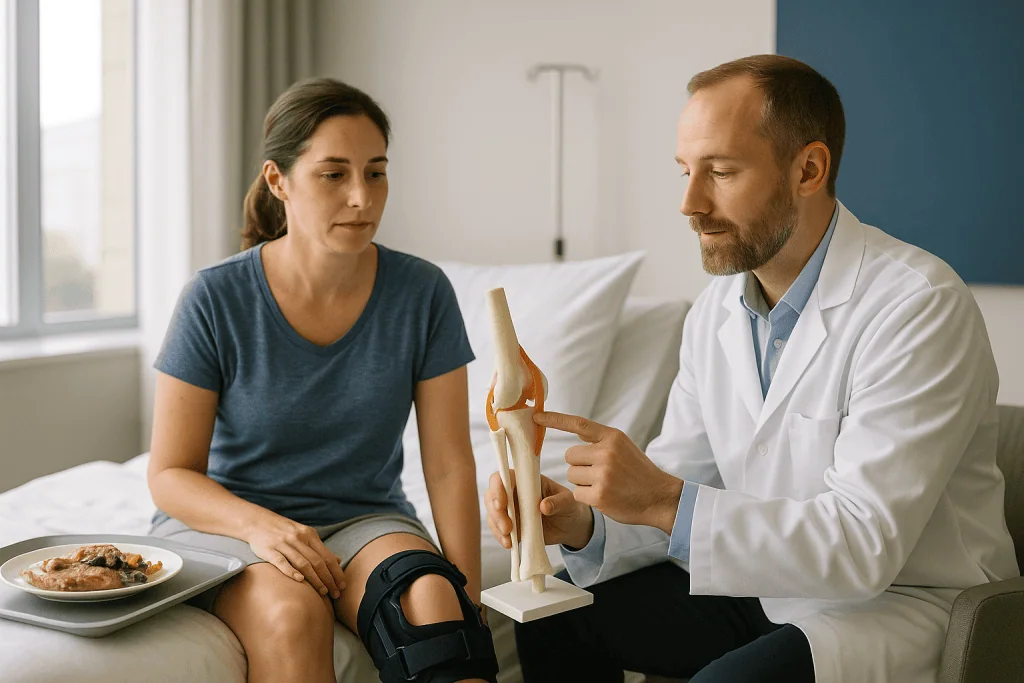
Reconstruction replaces the torn ligament rather than stitching it. According to Mayo Clinic and MedlinePlus descriptions of the procedure, the surgeon typically takes a strip of tendon, most often from the patient’s own hamstring or kneecap tendon (an autograft), or occasionally from donor tissue (an allograft), drills small tunnels in the thigh and shin bones, threads the graft through and secures it with screws, buttons or staples. Most of the work is done arthroscopically, meaning through small incisions with a camera and thin instruments.
Two details matter for a traveler. First, the fixation hardware provides the early strength while the graft is essentially a passenger. Second, the graft has to be re-supplied with blood and slowly remodeled into something ligament-like, a process orthopedic surgeons call ligamentization, and it takes many months. Mayo Clinic and the NHS both frame return to pivoting sport as a matter of many months, commonly somewhere between six and twelve, with rehabilitation doing most of the heavy lifting.
Meniscus repairs are often done at the same time, since the shock-absorbing cartilage pads frequently tear alongside the ligament. A repaired meniscus changes the rules: weight-bearing and bending are usually restricted more tightly, and that affects how a person sits, stands and moves through an airport. If you had a repair as well as a reconstruction, your travel plan needs to reflect both.
How long after ACL surgery can you fly again?
There is no single number in any major guideline, and anyone who gives you one without asking about your flight length, your clot history and your surgical details is guessing. What the evidence supports is a set of principles that most surgical teams turn into an individual recommendation.
The clot risk is front-loaded. The CDC’s travel guidance notes that most travel-associated clots become apparent within about two weeks of the journey, and that the risk from recent surgery is highest in the weeks immediately afterward before tapering. Combining a fresh operation with a long flight stacks two peaks on top of each other. That is the core reason many teams prefer a short domestic hop over an intercontinental leg in the first fortnight, and why some ask patients to wait until the first post-operative review, often around two weeks in the schedules described by the NHS and MedlinePlus, before any long-haul travel.
Short flights are treated differently from long ones for a physiological reason, not an arbitrary one: the risk rises with the duration of immobility. A ninety-minute flight with an aisle seat and a walk to the lavatory is a very different exposure from twelve hours in a middle seat overnight.
The graft does not need weeks of rest before a flight; it needs protection from twisting and falls, which is a matter of bracing, crutches and how you move rather than the calendar. Swelling, on the other hand, does improve with time, so a knee that is a week further along is simply easier to manage in a seat.
Put those threads together and the honest answer is: sooner for short flights in a low-risk person with the team’s blessing, later for long-haul in anyone with extra clot risk, and always after the wound has been checked. The final call sits with the surgeon who knows what was done inside your knee.
Is it safe to fly 2 weeks after surgery? What the clot evidence shows
Two weeks is the number most often typed into a search bar, and it is not a random one. It lines up with the first surgical review in many pathways, with the point at which the incision is usually closed and with the tail end of the highest-risk period for clots that the CDC describes.
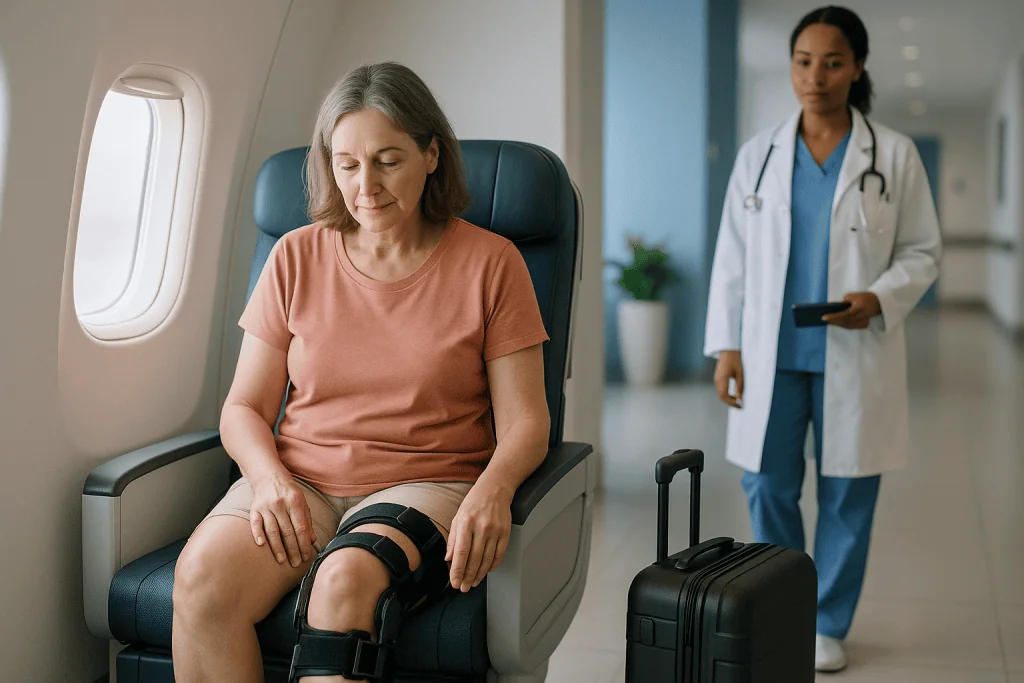
Consider what the bloodstream is doing. Virchow’s triad, the classic explanation of why clots form, names three contributors: sluggish blood flow, injury to the vessel wall and a blood chemistry tilted toward clotting. Knee surgery delivers all three at once. Flow slows because the calf muscles that normally pump blood upward are resting; the vessels near the operated area have been disturbed; and the body’s healing response temporarily raises clotting factors. The NHS deep vein thrombosis guidance lists recent surgery, reduced mobility and long journeys among the leading risk factors, and at two weeks all three may still be in play.
Against that, two weeks of gradual weight-bearing and physiotherapy have usually restored some of the calf pump, and the acute inflammatory surge has calmed. For a person with no additional risk factors, that is often enough for a surgeon to feel comfortable about a medium-length flight, provided in-flight movement and hydration are taken seriously.
Extra factors change the picture. Prior clots, a known clotting disorder, hormonal contraception or hormone therapy, obesity, smoking, pregnancy, active cancer and age are all named by the CDC and NHS as multipliers. Someone with two or three of these at two weeks post-op is in a different category from a fit twenty-year-old, and the treating team may recommend delaying or adding protection.
What the evidence does not support is the idea that two weeks is a magic threshold after which a flight becomes risk-free. Clot risk after leg surgery declines over weeks, not overnight, and travel itself stays a modest risk for anyone.
Why is the ACL graft weakest at 6 weeks?
This question circulates on rehabilitation forums with an air of settled fact, and the underlying biology is real, but the precise timing deserves a more careful answer than a single week number.
On the operating table, a freshly harvested tendon graft is strong, often stronger than the native ligament it replaces. Then something counterintuitive happens. Cut off from its original blood supply, the graft’s cells die back over the first weeks. The tissue is then reinvaded by new blood vessels and cells, which gradually remodel the collagen into a structure that looks and behaves more like a ligament. During that transition, laboratory and animal studies summarized in the orthopedic literature indexed on PubMed show that the graft’s mechanical strength dips before it climbs again.
The trough is commonly quoted as falling somewhere in the second and third months after surgery, which is where the six-week figure comes from. The important honesty here is that the sharpest data come from animal models, and human grafts vary with graft type, fixation method and individual biology. Nobody can tell you the exact day your graft is at its weakest, and no imaging test in routine use measures graft strength directly.
What protects the knee in that window is not rest but control: a strong, well-coordinated quadriceps and hamstring group, gradual loading that the rehabilitation program prescribes, and the avoidance of pivoting, cutting and sudden deceleration. Fixation hardware carries the load early on; by six to twelve weeks the biological healing at the tunnel walls is taking over, and it does not appreciate a twisting fall.
For a traveler, the practical translation is simple. A flight at six weeks is usually well past the highest clot-risk period, but it is squarely within the period when a stumble in an aisle or a rushed transfer between terminals matters most to the graft. Crutches, a brace if the team has recommended one and unhurried movement are the tools.
Who is usually cleared to fly, and who is usually asked to wait
Surgeons rarely think in terms of a blanket ban. They think in terms of stacked risk, and a few patterns recur across sports medicine practice and the CDC’s travel guidance.
People commonly cleared for shorter flights relatively early tend to share a profile: an uncomplicated arthroscopic reconstruction without a meniscus repair, a wound that is dry and closed at review, swelling that is clearly receding, no personal or family history of clots, no smoking, no hormonal medication, a healthy weight and the ability to stand and take steps on crutches without dizziness. Their teams may still want to see them once before the trip and may still suggest compression and a movement routine on board.
People more often asked to wait, or to fly only with additional precautions, include those who have had a previous DVT or pulmonary embolism, those with a diagnosed clotting disorder, those taking estrogen-containing medication, people who are pregnant or recently postpartum, anyone with active cancer, older adults, people living with obesity and those who had a more extensive procedure such as combined ligament repairs or a meniscus repair that restricts weight-bearing. The NHS deep vein thrombosis pages list most of these as recognized risk factors.
A separate group is asked to wait for reasons unrelated to clots: a wound that is leaking or red, a fever, a knee that is unexpectedly hot and tight, or a patient who cannot yet manage stairs or a long walk on crutches. An airport concourse can involve half a mile of walking, and a person who cannot manage that safely is at risk of a fall regardless of the calendar.
Where you sit on this spectrum is a clinical judgment. The most useful thing a patient can do is lay out the flight details and personal history plainly so the team can weigh them.
Flying with an ACL tear before surgery: can I fly after an ACL injury?
Plenty of people tear a ligament far from home, on a ski slope or a holiday soccer pitch, and need to fly back before anyone has operated. The considerations differ from the post-surgical ones, and in some respects they are gentler.
Without an incision, the clot risk from the injury itself is lower than after surgery, but it is not zero. Trauma to the leg, a swollen joint and days of limping or immobility all appear on the NHS and CDC lists of clot risk factors. If the knee has been placed in a rigid splint or cast, that raises the immobility component, and a plaster cast applied within the last day or two carries an additional aviation concern: air trapped in the plaster and swelling of the limb can tighten the cast as cabin pressure changes. Many airlines and clinicians ask for a fresh cast to be split or for a short wait for that reason. A hinged brace does not have this problem.
The bigger practical issue with a freshly torn ACL is instability. The knee may give way without warning, particularly on uneven ground, stairs and the small step down onto a jet bridge. Crutches, a brace if one has been fitted and a request for assistance through the terminal reduce the chance of a second injury to the cartilage or meniscus while the ligament is already loose.
Timing matters less than many people fear. An isolated ACL tear is not usually treated as a same-week emergency; Mayo Clinic notes that surgery is often delayed until swelling has settled and range of motion has returned, because operating on a stiff, inflamed knee makes recovery harder. That means there is usually time to get home, see a specialist and plan properly rather than rushing into anything.
The exceptions are a locked knee that will not straighten, a dislocated kneecap or joint, numbness or a cold foot, all of which need assessment before travel.
Flying after knee surgery: blood clot precautions that actually help
Advice about in-flight clot prevention tends to be either vague or oversold. The measures below are the ones that public health and clinical bodies actually stand behind, along with what the evidence says about each.
Movement is the foundation. The CDC’s travel guidance and the NHS both recommend getting up and walking the aisle when it is safe to do so and doing calf exercises in the seat when it is not. The mechanism is straightforward: contracting the calf squeezes blood upward through the deep veins, doing the job that walking normally does. Ankle pumps, pressing the toes down and then pulling them up, can be done every twenty to thirty minutes even with the knee straight in a brace, and they are usually part of the post-operative exercise sheet anyway.
Hydration supports flow. Dehydration thickens blood slightly and encourages people to stay seated to avoid the lavatory. Water is the sensible choice; alcohol and heavy sedation are discouraged by the CDC for travelers at raised risk because both reduce movement and alcohol adds to fluid loss.
Graduated compression stockings are named by both the CDC and the NHS as an option for travelers at increased clot risk, with the caveat that they should be properly fitted and are not a substitute for movement. Whether to wear one on the operated leg, over a dressing, is a question for the team, since a poorly fitted stocking can rub a wound.
Medicine is the piece that requires the most care in a general article. Some surgeons prescribe a short course of an anticoagulant, a blood-thinning medicine that reduces the blood’s tendency to form clots, for patients they consider at higher risk after lower-limb surgery. Whether that applies to you, and whether it should extend through a flight, is a decision for the prescriber. Starting, stopping or stretching any such prescription for travel without that conversation is exactly the kind of improvisation that gets people into trouble.
Should you wear a knee brace on the plane after ACL surgery?
Bracing after ACL reconstruction is a point on which surgeons genuinely differ, and that is worth knowing before the internet tells you there is one right answer.
Some teams fit a hinged brace, a rigid frame with adjustable hinges at the knee that can be locked straight or limited to a set range of bending, for the first weeks after surgery. Others, particularly after an isolated reconstruction with strong fixation, use no brace at all and rely on the quadriceps and controlled rehabilitation. Both approaches are mainstream, and the choice usually reflects what was done inside the knee, whether a meniscus was repaired and the surgeon’s training. If your team did not issue a brace, a flight is not a reason to buy one; a poorly fitted brace can press on a swelling calf and create the very compression pattern you want to avoid.
If you have been given a brace, there are sensible reasons to wear it in transit. A crowded aisle, a slippery lavatory floor and the shuffle into a window seat are exactly the uncontrolled environments where a twist is most likely. The brace is not there to stop you bending; it is there to stop you bending suddenly in a direction you did not choose. Ask the team what setting the hinges should be on for the journey, since a brace locked fully straight makes seating awkward and may increase the temptation to sit sideways.
A brace has a downside on a long flight: it can hide swelling and make it harder to do ankle pumps if it extends low on the calf. A practical compromise many teams suggest is to loosen or briefly remove it once seated on a longer flight, provided the leg can be kept straight and protected, and to refit it before standing. Confirm that plan with the team rather than deciding in row 32.
Security screening handles braces routinely, and it is reasonable to tell the officer before the scanner that you have a post-surgical brace and crutches.
A flying timeline after ACL surgery: what changes week by week
The table below is a summary of how the two clocks tend to run, drawn from the recovery descriptions on the NHS, Mayo Clinic and MedlinePlus pages and the CDC’s clot guidance. It describes typical patterns, not permissions. Your own timeline may run faster or slower, and the treating team’s view overrides any row here.
| Time since surgery | Knee and wound (typical) | Clot considerations | How teams often view flying |
|---|---|---|---|
| First few days | Maximal swelling and pain; dressings in place; crutches essential | Highest-risk period begins; calf pump barely working | Usually discouraged except unavoidable short hops, and only with the team’s explicit plan |
| Around 1 to 2 weeks | Wound usually closed and checked; bending improving; swelling easing | Still elevated; risk from surgery plus travel overlap | Short and medium flights often considered after review; long-haul more cautiously, with precautions |
| Around 2 to 6 weeks | Walking with less support; rehabilitation building strength | Declining but still above baseline, especially with extra risk factors | Long-haul more commonly acceptable with movement, hydration and any prescribed prevention |
| Around 6 to 12 weeks | Near-normal walking; graft in its biological remodeling trough | Approaching baseline for most; travel itself remains a modest risk | Flying rarely the issue; falls, twists and rushed transfers are the concern |
| Beyond 3 months | Progressive strengthening; sport-specific work; no pivoting yet | Baseline travel risk applies | Standard traveler precautions; graft protection continues through rehabilitation |
Notice what the table does not say. It does not name a week when everything becomes safe, because the two risks trade places rather than disappearing together. The early weeks belong to the bloodstream; the middle months belong to the graft. A person reading only clot advice may relax exactly when the knee needs the most care, and a person fixated on the graft may sit rigidly still on a long flight in the first fortnight, which is the wrong instinct for their veins.
What the first weeks after ACL surgery usually look like
Knowing the shape of the early recovery makes travel planning less abstract, because it shows what a person will realistically be able to do at an airport on a given day.
Most reconstructions are day-case or single-night procedures, according to the NHS and MedlinePlus. People go home on crutches with a bulky dressing, exercises to straighten the knee and activate the thigh muscle, and instructions to keep the leg elevated much of the time. The first three to five days are about swelling and pain control, and about not falling. Elevation matters here, and a plane seat is the opposite of elevation: the leg hangs, fluid pools, and the knee stiffens. That is the practical reason early flights are uncomfortable even when they are medically permitted.
By the first review, typically around two weeks in the pathways the NHS describes, the wound is inspected, any stitches or clips are removed and the physiotherapist checks that the knee can fully straighten and bend to roughly a right angle or beyond. Full extension is the milestone therapists care about most in this phase, because a knee that heals slightly bent is hard to fix later. On a long flight, keeping the knee straight and doing quadriceps squeezes protects that milestone.
Between two and six weeks, crutches are usually phased out as the quadriceps wakes up and the gait normalizes. Stationary cycling and gentle strength work begin. Sitting for prolonged periods becomes easier but still leaves the knee stiff on standing, so the first few steps after a flight should be deliberate.
From six weeks onward, the program shifts toward strength, balance and, much later, controlled running. The NHS and Mayo Clinic both describe return to pivoting sport as commonly taking somewhere between six and twelve months, guided by strength and function tests rather than the calendar. Travel during this phase is mostly a matter of not missing rehabilitation sessions, which is why booking physiotherapy at home before the flight is often more valuable than any in-flight tactic.
Getting through the airport on crutches: seats, security and luggage
The flight itself is often the easiest part of the day. The distances, queues and time pressure of a large airport are where a newly operated knee is most exposed, and a little logistics goes a long way.
Assistance is worth requesting. Airlines and airports offer mobility help, ranging from a wheelchair through the terminal to a buggy between gates, and using it is not a sign of weakness; it is a way of preserving the leg for the moments when you genuinely need to walk. A person who arrives at the gate exhausted and sweating on crutches is more likely to stumble boarding than one who has been wheeled and is fresh.
Seat choice is a clot-prevention measure as much as a comfort one. An aisle seat allows standing and walking without negotiating with neighbors, and the CDC’s travel guidance singles out an aisle seat as a helpful choice for people at raised clot risk precisely because it removes the friction that keeps people sitting. A bulkhead or extra-legroom row lets the operated leg stay straight, though bulkhead rows sometimes cannot accommodate crutches or a brace during takeoff, so ask when checking in. Exit rows are typically unavailable to anyone with a mobility limitation, and that is a safety rule rather than an insult.
Luggage is where people hurt themselves. Lifting a case into an overhead bin means standing on one leg on a moving aircraft while twisting; delegate it, or check the bag. Rolling a heavy case through a terminal on crutches is nearly impossible and tempts people to abandon the crutches early. Pack light, ship what you can, and keep medication, the brace paperwork and a copy of the operative note in a small bag that stays with you.
Finally, build slack into connections. A tight transfer converts a calm walk into a rushed one, and rushing is the single most avoidable hazard for a knee in the graft-remodeling window.
What people often get wrong about flying after ACL surgery
Several confident claims circulate widely enough to deserve direct correction, with the evidence attached.
Myth one: there is an official number of weeks. There is not. No major guideline body sets a fixed waiting period for flying after ACL reconstruction. What exists is guidance on clot risk after surgery and during long travel, from bodies such as the CDC and the NHS, and surgeons translate that into individual advice. Anyone quoting a universal figure is repeating a heuristic, not a rule.
Myth two: sitting completely still protects the graft. Sitting still is the worst thing for the veins and does nothing useful for the graft, which is protected by fixation hardware early on and by muscle control later. Ankle pumps and periodic walks do not stress a reconstructed ligament; sudden twists and falls do.
Myth three: a short flight is risk-free. Duration matters, and short flights carry less clot risk, but the airport walk, the boarding scramble and the fall hazard are the same length regardless of flight time. The knee does not know how long the flight is.
Myth four: compression stockings alone are enough. Both the CDC and the NHS describe stockings as an adjunct for people at raised risk, not a substitute for moving and staying hydrated. A stocking on a motionless leg is a modest help at best.
Myth five: if the surgeon prescribed a blood thinner, the flight is covered and nothing else is needed. Anticoagulants reduce clot risk; they do not eliminate it, and they do nothing about falls, swelling or stiffness. The other measures still apply, and any adjustment to the prescription for travel is the prescriber’s call.
Myth six: the graft is at full strength once the wound has healed. Skin heals in weeks; the graft remodels over months, with a strength dip in the second and third months. A closed incision is a green light for many things, but not for pivoting sports or complacency on stairs.
Questions to ask your care team before you book the flight
The most useful pre-travel appointment is the one where the patient arrives with specifics. A surgeon can give a far better answer to a real itinerary than to a hypothetical. Bring the flight length, any connections, the number of days since surgery on the travel date and your personal and family history of clots, then work through the following.
- Given exactly what was done in my knee, including any meniscus work, is there anything about my case that makes flying riskier than average?
- What is the shortest interval after surgery you would be comfortable with for a flight of this length, and what would change your answer?
- Do I have any personal risk factors for clots that should push me to wait longer or take extra precautions?
- Are you prescribing any clot-prevention medicine, and if so, how does the flight fit with the course you have planned? I would like to know what to do if a dose falls during travel, without changing anything on my own.
- Should I wear compression stockings, on one leg or both, and how do they fit around my dressing or brace?
- If I have a brace, what hinge settings should I use for walking through the airport and for sitting on the plane, and is it acceptable to loosen it while seated?
- Which in-flight exercises from my rehabilitation sheet are safe to do in the seat?
- Which warning signs should make me seek care at the destination rather than waiting for my next appointment with you?
- Who do I contact if something happens during the journey, and what documents should I carry about the operation and hardware?
- Can you help me arrange physiotherapy and a follow-up review near home so there is no gap in rehabilitation?
Write the answers down. Post-operative appointments are short and pain medication can blur recall, and the answers to the last three questions are the ones you will need when you are tired and far from the clinic.
When to call your doctor: red flags during and after the journey
Most people who fly after ACL surgery have an uncomfortable but uneventful trip. A small number develop problems that need prompt attention, and the value of knowing the warning signs is that they are easy to dismiss as ordinary post-operative soreness or travel fatigue. If any of the following appear, contact the surgical team or seek urgent care rather than waiting to see whether they settle.
Signs that may point to a deep vein thrombosis, as described by the NHS and Johns Hopkins, include new or worsening pain or tenderness in the calf or thigh, particularly on one side; swelling of the whole leg rather than just around the knee; skin that feels warm or looks red or darker than the other leg; and veins that appear more prominent than usual. After knee surgery some swelling is expected, so the tell-tale features are a change in pattern, a calf that is tight and sore to squeeze, or one leg noticeably larger than the other.
Signs that may point to a pulmonary embolism are an emergency and warrant calling emergency services wherever you are: sudden shortness of breath, chest pain that is sharp or worse on breathing in, coughing up blood, a racing heartbeat, lightheadedness or fainting.
Signs of a wound or joint problem include fever or chills, spreading redness or warmth around the incision, pus or persistent leaking from the wound, a knee that becomes suddenly much more swollen, hot and painful, or an inability to bear weight where you previously could.
Signs that the graft or fixation may have been disturbed include a fall or twist followed by a pop, new giving-way, a knee that suddenly will not straighten or bend as far as it did the day before, or a rapid new effusion of fluid in the joint.
Numbness, tingling, a pale or cold foot, or calf pain that intensifies inside a brace or stocking also needs same-day assessment. When in doubt, the treating team would far rather hear from you about a false alarm than not hear about a real one.
Frequently asked questions
How long after ACL surgery can you fly?
There is no fixed guideline interval; the decision rests with the surgical team and depends on flight length, wound healing and your personal clot risk. Many teams prefer that the first post-operative review, often around two weeks, has taken place before long-haul travel, because the CDC identifies the weeks right after surgery and long journeys as overlapping clot-risk periods. Shorter flights in low-risk people are sometimes permitted earlier with precautions.
Can I fly after an ACL injury before I have had surgery?
Usually yes, once the knee has been assessed and there is no locked joint, dislocation, fracture or circulation problem. Clot risk from the injury and reduced mobility is real but lower than after surgery, and Mayo Clinic notes that ACL reconstruction is often deliberately delayed until swelling settles, so there is normally time to travel home and plan. A fresh plaster cast is the one item that may need splitting or a short wait before flying.
Is it safe to fly 2 weeks after ACL surgery?
For many people with an uncomplicated reconstruction and no extra clot risk factors, a medium-length flight at two weeks is often considered acceptable by their surgeon, with movement, hydration and any prescribed prevention. Clot risk after leg surgery declines gradually rather than switching off, and the NHS lists recent surgery, reduced mobility and long journeys as compounding factors, so anyone with prior clots, hormonal medication or a meniscus repair should expect a more cautious plan.
Why is the ACL graft weakest at 6 weeks?
After surgery the transplanted tendon loses its original blood supply, its cells die back and the tissue is slowly reinvaded and remodeled into ligament-like tissue. Orthopedic studies, largely from animal models, show graft strength dipping during that transition before recovering, commonly described in the second and third months. The exact timing in humans varies, which is why rehabilitation programs avoid pivoting and cutting movements for many months rather than trusting a single week.
Does flying after knee surgery cause blood clots?
Flying does not directly cause clots, but prolonged sitting slows blood flow in the calf veins, and after knee surgery that flow is already reduced while the body’s clotting response is heightened. The CDC estimates that long-distance travel roughly doubles to quadruples clot risk for travelers in general, and recent surgery is a recognized additional risk factor. Regular calf movement, hydration and, where prescribed, clot-prevention medicine are the standard countermeasures.
Should I wear a knee brace on the plane after ACL surgery?
Wear one only if your surgical team issued it; not all reconstructions are braced, and an unprescribed brace can compress a swelling calf. If you have a hinged brace, it mainly protects against sudden twists in aisles and on stairs, so most teams favor wearing it while moving and may permit loosening it once seated on a long flight. Ask about the hinge settings for the journey before you travel.
Do compression stockings help when flying after ACL surgery?
They can help as an addition to movement for people at increased clot risk, which is how both the CDC and the NHS describe them, but they are not a stand-alone protection. Fit matters, and a stocking over a fresh dressing or under a brace can rub, so ask the team which leg, which type and whether it is appropriate for your wound before the flight.
Can I take my crutches on a plane after knee surgery?
Yes, crutches are treated as mobility aids by airlines and are carried without counting toward cabin baggage. Cabin crew will usually stow them during takeoff and landing and return them at the gate. Requesting airport assistance in advance removes most of the long terminal walks, which is where a post-surgical knee is most exposed to fatigue and falls.
How should I sit on a long flight after ACL surgery?
Choose an aisle seat so you can stand and walk without disturbing anyone, keep the operated leg as straight as the space allows, and do ankle pumps and thigh squeezes every twenty to thirty minutes as most rehabilitation sheets already suggest. Avoid crossing the legs or tucking the operated leg sideways, drink water rather than alcohol, and stand slowly after landing because the knee will be stiff.
What if I fall or twist my knee while traveling after ACL surgery?
A stumble without pain, giving-way or new swelling is usually not serious, but a pop, sudden instability, a rapid increase in joint fluid or a knee that will no longer straighten or bend as it did needs same-day assessment. Contact the surgical team, describe exactly what happened, and do not resume the rehabilitation exercises until they have advised you, since fixation and graft healing are still in progress for months.
References
This article is for general information only and is not a substitute for professional medical advice. Please consult a qualified doctor about your individual situation.

More from the Blog
Why Surgeons Ask You to Stop Smoking Before Rotator Cuff Repair: Tendon Healing Explained
Surgeons ask patients to stop smoking before rotator cuff surgery because nicotine narrows small blood vessels and carbon monoxide displaces oxygen, starving the repaired…
How Arthroscopy Works: The Camera, the Portals and What Surgeons Can Fix Through Keyholes
Arthroscopy works by passing a pencil-width tube with a light and a video camera into a joint through an incision a few millimetres long,…

Soft Tissue Injury Healing Stages: Why Sprains, Strains and Bruises Heal at Different Rates
Soft tissue injury healing time depends on what was damaged and how well it is supplied with blood. Bruises usually fade within about two…
What Happens Years After Meniscus Surgery? Cartilage Wear and Realistic Expectations
Years after meniscus surgery, the knee's future depends mainly on how much meniscus tissue was removed and how healthy the cartilage was beforehand. Partial…

Does a Sprain or Strain Need an MRI? When Imaging Adds to a Soft Tissue Injury Exam
Most sprains and strains do not need an MRI. Clinicians usually diagnose them by asking how the injury happened and examining the joint or…

Does Bursitis Come Back? Why Flares Recur and What Long-Term Results Usually Look Like
Yes, bursitis can come back. Most flares settle within a few weeks with rest, ice and reduced pressure on the area, but recurrence is…