

Gait Training and Gait Analysis: Relearning to Walk, Properly
Key Takeaways
- In a healthy stride, the stance phase occupies about 60% of the gait cycle and the swing phase about 40%, asymmetry between sides is often the first abnormality a therapist spots.
- Usual walking speed below roughly 0.8 meters per second is linked in research to frailty and higher fall risk, while about 1.0 m/s or faster generally supports independent community walking.
- A cane belongs in the hand opposite the weaker leg, with the handle at your wrist crease so your elbow bends about 15–20 degrees.
- CDC data show more than 14 million U.S. adults aged 65 and older report a fall each year, and structured gait, strength, and balance training is one of the best-supported ways to reduce that risk.
- Large stroke-rehabilitation trials found progressive overground and home-based walking programs matched high-tech treadmill-and-harness training: the dose and progression of practice, not the machine, drives results.
- An improvement of about 0.1 meters per second in usual gait speed is treated in rehabilitation research as a clinically meaningful change, tiny on a stopwatch, substantial in daily life.
Gait training is supervised, task-specific physical therapy that rebuilds a safe, efficient walking pattern after injury, surgery, stroke, or a neurological condition. Gait analysis is the assessment behind it, observing step length, timing, symmetry, and balance to find what has gone wrong. Programs combine repeated walking practice, strength and balance exercises, and sometimes treadmills or walking aids; research shows frequent, progressively challenging practice improves walking speed and confidence for many people.
Watch someone six weeks out from a knee replacement walk down a hospital corridor and you’ll notice something odd: they’re concentrating. Hard. The thing the rest of us do while reading a phone, swing a leg, catch our weight, roll off the toes, repeat, has become a math problem solved one step at a time.
That’s the strange truth about walking. It’s so automatic that we forget it’s a skill, learned over roughly a year of toddler falls and refined over decades. When a stroke, a fracture, a hip replacement, or a condition like Parkinson’s disrupts the pattern, the skill doesn’t simply snap back. It has to be practiced again, deliberately, correctly, and thousands of steps at a time.
That practice has a name, a method, and a surprisingly deep evidence base. It also has more myths attached to it than almost any other corner of rehabilitation, starting with the biggest one: that you can fix a broken walking pattern by ‘just walking more.’
What Is Gait Training, Exactly?
Gait training is the physical therapy discipline devoted to one task: restoring a walking pattern that is safe, symmetrical, and efficient. Not walking in generalyour walking, with its specific breakdown, whether that’s a leg that swings out in a half-circle, a foot that catches on the carpet, or steps that have quietly shrunk to half their old length.
The ‘training’ part is literal. Motor learning research is clear that the nervous system relearns movement the same way it learned it the first time: through high volumes of repetition with feedback. A therapist’s job is to make sure the repetitions are the right ones. Practicing a flawed pattern hundreds of times a day doesn’t fix it; it engraves it deeper. That’s why gait training pairs walking practice with targeted strength work (the muscles that failed), balance work (the reactions that failed), and cueing (the timing that failed).
Walking is a bigger physical demand than it looks. Each stride requires you to balance your entire body weight on one leg while the other is airborne, biomechanists sometimes describe gait as a controlled fall, caught roughly a hundred times a minute at normal cadence. When any link in that chain weakens, the body improvises a workaround. Gait training exists to replace the workaround with the real thing, or, when full recovery isn’t possible, to make the workaround as safe and energy-efficient as it can be.
Gait Analysis: What a Therapist Sees That You Don't
Before anyone trains your gait, someone has to read it. That’s gait analysis, and most of it happens with trained eyes rather than technology.
Therapists break each stride into a cycle. The stance phase, when your foot is on the ground, takes up about 60% of the cycle; the swing phase, when it’s in the air, takes about 40%. For a brief window, around a fifth of the cycle at comfortable speeds, both feet are down at once. Healthy walking keeps these proportions nearly identical on both sides. Injury and neurological disease almost never do. A person protecting a painful hip spends less time standing on it; a person with weakness after stroke may struggle to swing the affected leg through cleanly.
So a clinician watches for specifics: step length and whether it matches side to side, cadence, how wide apart the feet land, whether the foot clears the floor or scuffs, whether the pelvis drops when one leg bears weight, what the arms and trunk are doing to compensate. Each detail points somewhere. A dropped pelvis suggests weak hip stabilizers. A leg swung outward in an arc suggests trouble bending the knee or lifting the foot. Toes that catch suggest weakness in the muscles that pull the foot up.
The analysis matters because it turns ‘walk better’ into a checklist: which joint, which muscle group, which phase of the cycle. Training without it is guesswork.
Who Actually Needs Gait Training?
The candidates are broader than most people assume. The classic referrals are neurological: stroke, Parkinson’s disease, multiple sclerosis, spinal cord injury, cerebral palsy in children. In these conditions the walking pattern itself is disrupted at the level of the brain or nerves, and retraining leans heavily on repetition and neuroplasticity: the nervous system’s documented ability to reorganize around damage.
Orthopedic patients form the second big group: hip and knee replacements, ankle and hip fractures, ligament reconstructions, people learning to walk with a prosthetic limb. Here the nervous system is usually intact, but months of pain and protection have taught the body a limp, and the limp tends to outlast the injury unless it’s actively untrained.
The third group is the one most often missed: older adults whose walking has changed gradually. Shorter steps, a wider stance, slower speed, a hand that reaches for furniture: these shifts often get filed under ‘normal aging,’ yet many are trainable. The stakes are real. According to the CDC, more than 14 million U.S. adults aged 65 and older report falling each year, and falls are the leading cause of injury in that age group. Gait, strength, and balance training is among the best-supported interventions for reducing that risk: the NHS and CDC both recommend it explicitly in their falls-prevention guidance.
If walking has become slower, scarier, or more tiring than it was a year ago, that’s a referral-worthy change, not a life sentence.
What Are the 7 Kinds of Gait?
Search results love this question, and it comes from a real clinical tradition: medical training commonly groups abnormal walking patterns into seven recognizable types. Recognizing them is useful, not for self-diagnosis, but for understanding what your clinician means and why the training plan looks the way it does.
| Gait pattern | What it looks like | Often associated with |
|---|---|---|
| Antalgic | A limp, shortened time standing on one painful side | Arthritis, injury, any painful leg condition |
| Ataxic | Wide-based, unsteady, irregular steps, like walking on a boat | Cerebellar conditions, some nerve disorders |
| Hemiplegic | One stiff leg swung outward in a half-circle | Stroke affecting one side of the body |
| Parkinsonian | Small shuffling steps, stooped posture, reduced arm swing | Parkinson’s disease and related conditions |
| Steppage | Knee lifted high so a dropped foot can clear the floor | Foot drop from nerve injury or weakness |
| Waddling (myopathic) | Trunk sways side to side; pelvis drops with each step | Weak hip muscles, some muscle disorders |
| Spastic (scissoring) | Stiff legs that cross toward the midline with each step | Cerebral palsy, some spinal cord conditions |
Two honest caveats. Real patients rarely fit one box cleanly: a person after stroke may show hemiplegic and antalgic features at once. And the pattern identifies the problem’s signature, not automatically its cause; the same limp can come from a hip, a knee, or a nerve. That’s what the fuller evaluation is for.
What Happens During a Gait Analysis Appointment?
Less machinery than you might expect, and more walking back and forth.
A typical first visit starts with history: what changed, when, any falls or near-falls, pain, footwear, and which daily tasks have become hard. Then you walk, usually a hallway of 10 meters or so, several passes, while the therapist watches from the front, back, and side. You may be asked to walk faster, turn, step over a line, or walk while counting backward, because divided attention often exposes problems that a careful, concentrating walk hides.
Standardized tests usually follow. Common ones include a timed short-distance walk to measure gait speed, the Timed Up and Go (rise from a chair, walk about three meters, turn, return, sit, commonly completed in under 12 seconds by adults at low fall risk), and balance batteries that test standing with feet together, in tandem, or on one leg.
Technology has a role in complex cases. Video lets you and the therapist review your own stride frame by frame, often a revelation, since most people have never actually seen themselves walk. Instrumented walkways and pressure sensors quantify step length and timing; full motion-capture labs exist for surgical planning in conditions like cerebral palsy. But for most people, skilled observation plus a stopwatch answers the essential questions: where the pattern breaks down, and how far current performance sits from safe.
Gait Speed: The Most Underrated Number in Your Chart
If one number from this article is worth memorizing, it’s this one. Researchers have called usual walking speed the ‘sixth vital sign,’ because it predicts so much from such a simple test: mark off four meters, walk at your normal pace, divide distance by time.
Healthy adults typically walk at roughly 1.2 to 1.4 meters per second. Research consistently links speeds below about 1.0 m/s with mobility limitations, and speeds below roughly 0.8 m/s with frailty, higher fall risk, and greater likelihood of hospitalization. The thresholds aren’t arbitrary: they map onto real life. Pedestrian crossing signals in many cities are timed around walking speeds of roughly 1.2 m/s; walk much slower than that and the built environment itself starts working against you.
Why does one number carry so much information? Because comfortable walking speed is a composite output of nearly everything: leg strength, joint mobility, balance reactions, cardiovascular fitness, vision, confidence, even mood. When any input declines, speed quietly absorbs the loss.
The encouraging flip side: speed responds to training, and small changes count. An improvement of about 0.1 m/s, barely perceptible on a stopwatch, is widely treated in rehabilitation research as a meaningful change, associated with better function and outcomes. Gait training programs measure speed at the start and track it deliberately, which is one way to tell a structured program from generic exercise: it should know your number, and it should be moving.
What Are Examples of Gait Training Exercises?
Good gait exercises aren’t exotic. They isolate one demand of walking, load it, and then feed it back into full strides. A representative menu:
- Sit-to-stands. Rising from a chair without hands trains the thigh and hip strength that controls the stance phase: the 60% of the cycle where most stumbles begin.
- Weight shifts. Standing at a counter, shifting fully onto one leg and holding. Deceptively simple; it rebuilds the single-leg stability every step requires.
- Marching in place. Exaggerated knee lifts train hip flexors and foot clearance: the antidote to scuffing toes.
- Heel-to-toe (tandem) walking. Walking a line as if on a tightrope narrows your base and challenges balance reactions directly. Mayo Clinic includes versions of this in its core balance-exercise guidance.
- Step-overs. Stepping over small obstacles, a rolled towel works, trains the deliberate clearance that prevents trips.
- Side-stepping and backward walking. Life demands more than forward motion; these train the hip stabilizers and the less-rehearsed directions where falls often happen.
- Heel walks and toe walks. Short bouts strengthen the muscles that control how the foot meets and leaves the floor.
- Stair practice. Up with the stronger leg first, down with the weaker: a sequencing rule therapists teach early because stairs are where mistakes cost most.
The unifying principle: specificity. Squats on a machine build strength, but the nervous system relearns walking best by practicing tasks that look, feel, and time like walking.
How to Do Gait Training at Home: Without Falling
Home practice is where progress actually accrues; two or three clinic sessions a week can’t supply the repetition volume the nervous system needs. But home is also where most falls happen, so setup matters more than ambition.
Start with the environment. Pick one straight, well-lit path, a hallway or the length of a kitchen counter, and clear it completely: rugs, cords, pet bowls. Wear firm, closed shoes, not socks or backless slippers. Keep a sturdy support within arm’s reach for balance work, and if your steadiness is genuinely in question, practice when someone else is home.
Then follow a simple progression: supported before unsupported, stationary before moving, forward before sideways or backward. A reasonable early sequence is weight shifts holding the counter, then marching in place with fingertip support, then short hallway walks focusing on one cue at a time, ‘heel first,’ ‘longer step,’ ‘stand tall.’ One cue per walk; the brain can’t juggle five. Several short bouts of five to ten minutes beat one exhausting session, because fatigue degrades form, and degraded form is exactly what you’re trying not to practice.
Stop and reassess if you feel dizzy, develop chest pain or unusual breathlessness, or find yourself grabbing for support more than occasionally. And a candid word: if a therapist has given you a home program, that program outranks anything in a magazine, this article included. It was built from your gait analysis; generic lists weren’t.
Treadmills, Parallel Bars, and Body-Weight Support: What the Evidence Says
Rehabilitation gyms are full of equipment, and it’s fair to ask what each piece actually buys you.
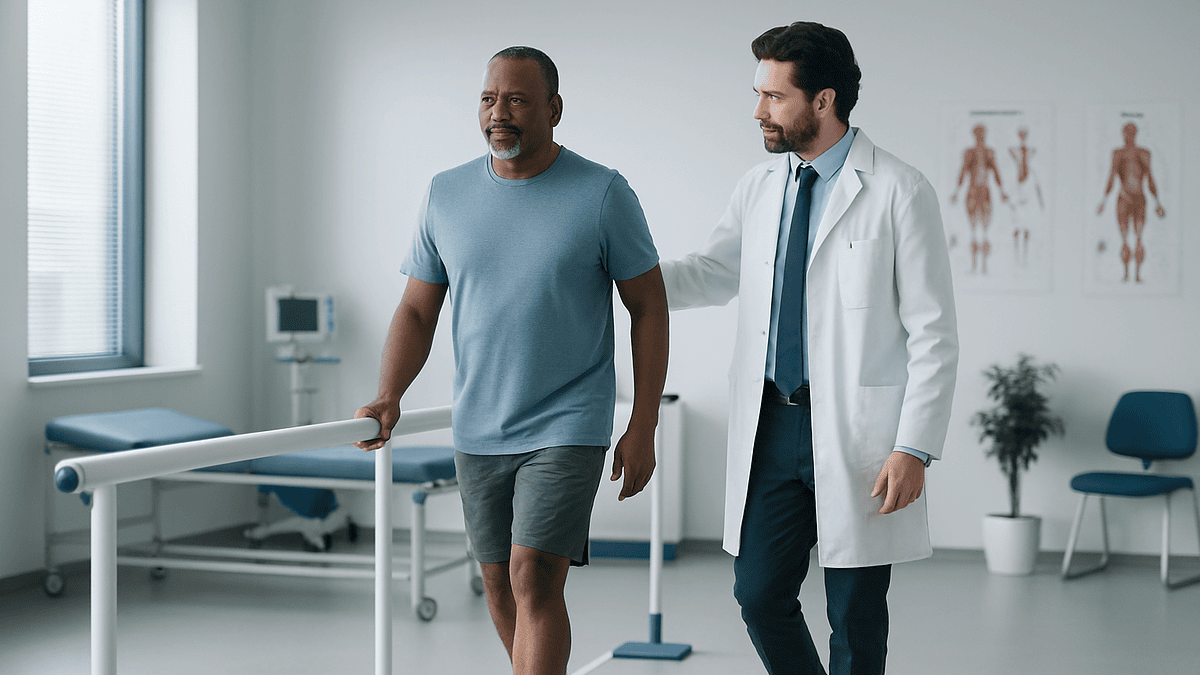
Parallel bars are the honest workhorse. Early after a stroke, surgery, or amputation, they let you load the legs and rehearse stepping with both hands on rails, practice that simply couldn’t happen safely in open space yet.
Treadmills add two things: an enforced rhythm, which helps people whose stepping has become hesitant or asymmetrical, and repetition density, far more steps per minute of therapy than stop-and-start hallway walking. For some neurological conditions, the external pacing itself seems to help retime the stride.
Body-weight-supported systems suspend part of your weight in a harness over a treadmill, letting people practice stepping before their strength and balance could otherwise allow it. The concept is elegant. The evidence, though, delivered rehabilitation’s most useful humbling: large randomized trials in stroke recovery found that structured, progressively challenging home and overground walking programs produced outcomes comparable to sophisticated treadmill-and-harness protocols. The machine wasn’t the active ingredient. The dose and progression of practice was.
That finding should shape how you judge any program, high-tech or not. Ask how many steps or minutes of actual walking practice each session contains, and how difficulty will increase week to week. A therapist with a hallway, a stopwatch, and a plan for progression is running an evidence-based program. A gleaming machine used twice a week without progression is not.
Canes and Walkers: Why the Fit Matters More Than the Gear
A walking aid is a piece of prescribed equipment, and using one that’s mis-sized or mis-handled can create nearly as many problems as it solves. Yet most canes are bought off a pharmacy rack and never adjusted.
The fit rules are specific. Stand tall in your usual shoes with arms relaxed: the top of a cane or walker handle should reach the crease of your wrist, which puts your elbow at a slight bend of roughly 15 to 20 degrees when you grip it. A handle set too high hikes the shoulder; too low, and you stoop, trading a leg problem for a back one.
Placement is the part people get backward. A cane belongs in the hand opposite the weaker or painful leg, and it moves forward together with that weaker leg. This mirrors the body’s natural arm-leg reciprocal pattern and shares load across the stride; a cane on the same side forces an awkward lean that distorts gait further.
Walkers have their own sequencing, aid forward first, weaker leg, then stronger leg, and their own maintenance needs: worn rubber tips and sticky wheels are genuine fall hazards. So is the well-meaning habit of carrying the walker up off the floor while hurrying.
One myth deserves direct handling: that using an aid ‘creates dependence.’ The evidence points the other way. A properly fitted aid typically lets people walk farther, faster, and more often, and activity, not avoidance, is what preserves walking ability.
How Long Does Gait Training Take to Work?
The honest answer has three tiers, because the timeline depends on why your gait changed.
After orthopedic surgery, a hip or knee replacement, a healed fracture, meaningful gait improvement typically unfolds over weeks to a few months. The tissue heals on its own schedule; the training’s job is to make sure the limp doesn’t outlive the injury, which it will if left alone.
After a neurological event like a stroke, the horizon is longer. Recovery tends to be fastest in the first three to six months, when the brain’s reorganization is most active, but research has repeatedly documented gains well beyond that window in people who keep training. ‘Plateau’ often describes a drop in practice intensity more than a biological limit.
For progressive conditions such as Parkinson’s disease, ‘work’ means something different: maintaining speed, step length, and safety over time, and adapting strategies as the condition evolves. That’s not a lesser goal, preserved independence is the entire point.
Across all three tiers, the strongest predictor within your control is practice volume. Motor learning studies suggest the nervous system needs repetitions in the hundreds and thousands, not dozens, and clinic time alone rarely supplies that. This is why therapists are so insistent about home programs, and why progress should be measured, not felt: gait speed, walking distance, or a timed test rechecked every few weeks. Feelings fluctuate daily. A stopwatch doesn’t.
How Much Does Gait Training Cost?
An honest question that deserves a non-evasive answer, with the caveat that costs vary enormously by country, setting, and coverage.
In the United States, gait training is billed as physical therapy. With commercial insurance, patients commonly pay a per-visit copay in the range of tens of dollars, subject to deductibles and annual visit limits. Paying entirely out of pocket, outpatient sessions commonly run from under a hundred to a few hundred dollars each, with hospital-based clinics generally at the higher end and evaluations costing more than follow-ups. Medicare Part B covers medically necessary outpatient therapy, with the patient responsible for coinsurance after the deductible. In countries with public health systems such as the UK’s NHS, physiotherapy referred through usual channels typically carries no direct charge, though waits vary.
Three ways to get more value regardless of system:
- Ask for a home program early. Since practice volume drives results, a well-taught home program converts a handful of paid sessions into months of productive training.
- Check community options. Evidence-based group fall-prevention and balance programs, the kind the CDC and local health agencies promote, are often free or low-cost for older adults.
- Clarify the plan up front. A reasonable clinic can tell you the expected number of visits, the goals, and how progress will be measured. Open-ended therapy without measurable targets serves budgets poorly and recovery worse.
What’s rarely worth the money: unproven gadgets promising to fix gait passively. The active ingredient in every credible study is practice.
Gait Training Myths That Slow People Down
Some beliefs about walking recovery are harmless. These four actively cost people function.
‘Just walk more and it’ll sort itself out.’ Volume without correction rehearses the compensation. A limp practiced for 5,000 steps a day is a very well-learned limp. Walking more is often part of the answer, but only after the pattern being repeated is worth repeating.
‘Push through the pain.’ Pain is not neutral background noise during gait work; it actively reshapes the stride. The antalgic gait, the limp, is the body’s automatic pain-avoidance program, and it runs whether you want it to or not. Training through significant pain often means training the limp. Discomfort from effort is expected; sharp or worsening pain is information for your clinician.
‘I’m too old for this to help.’ The evidence says otherwise, repeatedly. Strength and balance are trainable across the lifespan, and falls-prevention research in adults well into their 80s and 90s shows measurable improvements from structured exercise. The NIH’s National Institute on Aging makes exactly this point in its falls guidance: age changes the starting point, not the trainability.
‘Once I stop therapy, I’m done.’ Walking ability behaves like fitness: it responds to use and erodes with disuse. The people who keep their gains are the ones who convert their program into a habit: a daily walk with intention, balance work while the coffee brews, stairs taken deliberately. The formal training ends; the practice shouldn’t.
When to See a Doctor About Your Walking
Most gait changes build gradually and warrant a routine appointment. A few demand faster action.
Call emergency services immediately if walking difficulty appears suddenly, especially with weakness or numbness on one side of the body, a drooping face, slurred speech, sudden severe headache, or trouble with vision. These are hallmark stroke warning signs, and minutes genuinely matter. Sudden inability to walk after a fall, or any fall involving a blow to the head, particularly for people who take medicines that affect bleeding, also belongs in urgent care, not a wait-and-see file.
Book a prompt appointment if you notice: walking that has become noticeably worse over weeks or months; new stumbling, tripping, or foot-dragging; numbness or tingling in the feet; more than one fall or near-fall in the past year; new dizziness or lightheadedness when walking; or a change in walking that arrives alongside memory problems or new bladder symptoms: a combination clinicians specifically want to evaluate, because some of its causes respond well to treatment when found early.
And a lower bar than most people set for themselves: if you’ve started avoiding walks, stairs, or outings because you no longer trust your legs, that fear is itself a medical finding worth reporting. Activity avoidance accelerates the very decline it’s trying to prevent. MedlinePlus lists a wide range of causes for walking abnormalities, many mundane, many treatable, and the only way to sort yours out is an evaluation, not a guess.
Frequently asked questions
How do you do gait training at home?
Set up a clear, well-lit walking path, wear firm closed shoes, and keep sturdy support within reach. Start with weight shifts and marching in place at a counter, then progress to short hallway walks focusing on one cue at a time, such as landing heel-first or taking longer steps. Practice in several short five-to-ten-minute bouts rather than one tiring session. If a physical therapist has prescribed you a home program, follow that: it was built from your specific gait analysis.
What are examples of gait training?
Common examples include sit-to-stands, standing weight shifts, marching in place, heel-to-toe (tandem) walking, stepping over small obstacles, side-stepping, backward walking, heel and toe walks, and supervised stair practice. Clinics may add treadmill walking, parallel-bar work, or harness-supported stepping for people early in recovery. The common thread is task specificity: each exercise isolates one demand of walking, strength, clearance, balance, or timing, and then feeds it back into full strides.
What are the 7 kinds of gait?
Medical training commonly describes seven abnormal gait patterns: antalgic (a pain-driven limp), ataxic (wide-based and unsteady), hemiplegic (one stiff leg swung outward, often after stroke), parkinsonian (small shuffling steps with stooped posture), steppage (high knee lift to clear a dropped foot), waddling or myopathic (trunk sway from weak hip muscles), and spastic or scissoring (stiff legs crossing toward the midline). Real patients often show mixed features, which is why a professional evaluation matters.
How much does gait training cost?
It varies widely by country, setting, and insurance. In the U.S., gait training is billed as physical therapy: insured patients commonly pay a per-visit copay, while self-pay sessions typically range from under a hundred to a few hundred dollars, with hospital-based clinics usually costlier. Medicare Part B covers medically necessary outpatient therapy with coinsurance. Community fall-prevention classes are often free or low-cost, and a well-taught home program stretches the value of every paid visit.
How long does gait training take to show results?
It depends on the cause. After orthopedic surgery, meaningful gait improvement typically unfolds over weeks to a few months. After stroke, gains are usually fastest in the first three to six months, though research documents continued improvement later in people who keep practicing. For progressive conditions, success means maintaining speed and safety over time. Across all groups, practice volume is the strongest controllable factor, so home practice between sessions substantially shapes the timeline.
Can you relearn to walk after a stroke?
Many people can, at least partially, and research supports this. The brain reorganizes around damaged areas through neuroplasticity, which is driven by high-repetition, task-specific practice, exactly what gait training provides. Recovery is typically fastest in the first months but can continue well beyond with sustained training. Outcomes vary with the stroke’s location and severity, so no one can promise a specific result; a rehabilitation team can give a realistic individual outlook.
Is treadmill gait training better than walking practice on the ground?
Not clearly. Large randomized trials in stroke rehabilitation found that structured, progressively challenging overground and home-based walking programs achieved outcomes comparable to treadmill training with body-weight support. Treadmills do offer advantages, enforced rhythm and more steps per session, that suit some people well. The evidence suggests the decisive factors are practice dose, progression, and supervision quality rather than the equipment itself.
What is a normal walking speed?
Healthy adults typically walk at about 1.2 to 1.4 meters per second at a comfortable pace. Research links usual speeds below roughly 1.0 m/s with mobility limitations, and below about 0.8 m/s with frailty and higher fall risk. Clinicians often measure this with a simple timed four-meter walk. Because comfortable speed reflects strength, balance, fitness, and confidence all at once, it’s sometimes called the ‘sixth vital sign.’
Do I need a doctor's referral for gait training?
Often not for an initial evaluation, but it depends on where you live and how you’re insured. Most U.S. states allow some form of direct access to physical therapy, though insurers may still require a physician’s referral for coverage, and Medicare has its own plan-of-care rules. In the UK, physiotherapy is usually accessed through a GP or self-referral schemes. Check with your insurer or health service before booking to avoid surprise costs.
What is the difference between gait training and regular physical therapy?
Gait training is a specialty within physical therapy, not a separate profession. General physical therapy addresses strength, mobility, and function across many problems; gait training focuses those tools specifically on the walking pattern, using gait analysis to identify where the stride breaks down, then targeting that phase with task-specific walking practice, strengthening, balance work, and cueing. Occupational therapists may also contribute, particularly around safe walking during daily tasks at home.
References
- MedlinePlus: Walking Abnormalities
- NHS: Falls: Prevention
- NIH National Institute on Aging: Falls and Fractures in Older Adults
This article is for general information only and is not a substitute for professional medical advice. Please consult a qualified doctor about your individual situation.

More from the Blog

What Is Physiotherapy? What Physiotherapists Actually Do, Session by Session
Physiotherapy (called physical therapy in the United States) is a regulated health profession that restores movement, strength, and everyday function after injury, surgery, or…

When Does a Sports Injury Need Supervised Rehabilitation Rather Than Rest Alone?
A sports injury usually needs supervised rehabilitation rather than rest alone when pain, swelling or weakness has not clearly improved after about two weeks…

What to Bring to Your First Therapeutic Exercise Session: Reports, Restrictions and Shoes
For a first therapeutic exercise session, bring any imaging or surgical reports, a written list of your current medicines and health conditions, and any…

Bobath Neurodevelopmental Treatment Between Sessions: The Daily Home Program and Positioning
A Bobath home program is the between-session part of neurodevelopmental treatment: positioning, handling and short bouts of task practice that a therapist designs for…

Dry Needling: What It Is, What It Helps, What the Evidence Says
Dry needling is a technique in which a trained clinician inserts thin, solid filament needles into tight, tender bands of muscle called trigger points,…
What a Rehabilitation Robot Actually Does: Guided Repetition for Legs, Arms and Balance
A rehabilitation robot is a motorized, sensor-equipped device that supports a person's leg, arm or trunk while they practice walking, reaching or balancing. It…