

Glare, Dryness and Ghosting After Astigmatism Correction: Normal Healing or a Call to Make?

Key Takeaways
- Glare, halos, dryness and ghosting after astigmatism correction share one root: a reshaped cornea with a disrupted tear film and temporarily cut nerves.
- Mayo Clinic guidance places typical post-LASIK glare and halos at a few days to a few weeks, and dryness at up to about six months while nerves regrow.
- Ghosting that comes and goes with blinking usually reflects dry surface; ghosting that is constant in all conditions is more likely residual astigmatism.
- Cover one eye at a time: a shadow image that persists in a single eye is ghosting from the cornea or lens, not double vision from eye misalignment.
- After LASIK the flap is held by suction and surface cells rather than stitches, so eye rubbing in the early weeks can displace it.
- A symptom that is slowly improving is behaving as expected; one that reverses direction, or arrives suddenly with pain or redness, warrants a same-day call.
Glare, halos, dry eyes and faint ghost images are among the most common astigmatism surgery side effects, and in most people they fade as the cornea heals: glare and halos often settle over days to weeks, dryness over several months. Sudden pain, a sharp drop in vision, increasing redness or discharge are not part of normal healing and need a same-day call to your eye team.
Three nights after her procedure, a reader wrote to us from a parked car. She had pulled over because the oncoming headlights had grown feathery tails, the street signs had faint twins, and her eyes felt like they had been sanded. Was this what the consent form meant by “temporary visual disturbances”, or was something going wrong?
It is the question almost everyone asks in the first week, and it deserves a more honest answer than “give it time”. Astigmatism surgery side effects follow fairly predictable patterns, because they come from predictable causes: a reshaped cornea, a disrupted tear film and nerves that need months to regrow. Knowing which pattern you are looking at is the difference between a good night’s sleep and a call you should not postpone.
This explainer walks through what the surgery does, why these three symptoms cluster together, what the typical weeks look like, and the specific signs that should send you back to your treating team without waiting for the scheduled follow-up.
What astigmatism correction actually does to your eye
Astigmatism is a focusing error caused by a cornea (the clear front window of the eye) or lens that is curved more steeply in one direction than the other, a little like the back of a spoon rather than a ball. Light entering the eye lands as a smear rather than a point, so edges blur at every distance. MedlinePlus notes that most people have some degree of it and that glasses or contact lenses correct it well; surgery is one option among several.
Every surgical approach works on the same principle: make the eye’s optics symmetrical again. Laser procedures such as LASIK (laser-assisted in situ keratomileusis, where a thin hinged flap is lifted and the tissue beneath is reshaped) and PRK (photorefractive keratectomy, where the surface skin layer is removed and the cornea reshaped directly) remove a precise, lopsided sliver of tissue so the steep axis flattens to match the flat one. SMILE (small incision lenticule extraction, where a disc of tissue is drawn out through a keyhole opening) does the same with no flap. Lens-based correction, usually a toric intraocular lens placed during cataract surgery (a lens with built-in cylinder, rotated to a specific axis), corrects astigmatism inside the eye rather than on its surface.
Each of these interventions changes the surface or the internal optics in a way the brain has never seen before, and each disturbs the cornea’s dense web of sensory nerves to a different degree. Those two facts, a new optical surface and a temporarily numbed, drier front window, explain almost everything you will feel in the following weeks. They also explain why side effects are not a sign that something was done wrong; they are the expected cost of altering tissue that was, until the procedure, perfectly healthy.
Astigmatism surgery side effects: why glare, dryness and ghosting arrive together
Patients tend to describe these three complaints as separate problems. Physiologically they are siblings. The Mayo Clinic lists dry eyes, glare, halos and double vision among the most frequent effects after LASIK, and the mechanisms overlap in ways that are worth understanding.

Start with the tear film, the three-layered liquid coating that keeps the cornea optically smooth. Surgery cuts or ablates corneal nerves, and those nerves normally tell the eye how often to blink and how much tear to produce. With the signal reduced, the surface dries in patches. A patchy tear film is an irregular lens: it scatters light, which the brain reads as glare, and it can double up an edge, which you experience as a ghost.
Now add the reshaped cornea itself. In the early weeks the treated zone has a slightly uneven boundary while the surface cells (the epithelium) remodel and the deeper tissue settles. Any irregularity at the edge of the pupil becomes obvious in dim light, when the pupil opens wide enough to reach it. That is why a headlight at night produces starbursts that are invisible at noon.
Residual or induced astigmatism, meaning a small amount of uncorrected cylinder left over or newly created during healing, is the third contributor and the one most likely to produce true ghosting rather than haze. It usually shrinks as swelling resolves, which is why surgeons are reluctant to measure a final prescription until the eye has stopped changing.
Seen this way, a dry, glary, ghosting eye in week two is not three complications. It is one healing cornea described three ways, and treating the dryness often improves the other two.
Why do I see halos after astigmatism surgery at night?
Halos are rings of light around bright sources; starbursts are the spiky version; glare is the general sense that lights are too bright or washed out. All three are grouped by the Mayo Clinic under the early visual disturbances that commonly follow laser vision correction and that typically ease over days to weeks.
The physics is straightforward. In daylight your pupil is small, so you look through the center of the treated zone, where the new curve is most regular. After dark the pupil dilates, and light now passes through the transition zone at the edge of the treatment, plus any area of surface swelling. Light bending unevenly at those edges is what paints a halo around a streetlamp.
Two things usually shrink the effect. The first is simple tissue settling: the margin between treated and untreated cornea smooths as cells migrate across it, which is why night symptoms tend to improve week by week rather than hour by hour. The second is neuro-adaptation, the brain’s gradual learning to filter a new optical pattern, the same process that lets people adjust to a new glasses prescription that felt “wrong” on day one.
A smaller group of people notice halos that persist. Larger pupils, higher starting prescriptions and residual astigmatism make this more likely, which is why pupil size and prescription stability feature in the assessment before surgery. Persistent halos are not dangerous in themselves, but they are worth reporting, because the treating team can distinguish an optical cause (which may be addressed later) from a dry-surface cause (which is managed differently).
What you should not see is a sudden new halo weeks after the eye had been clear, especially with redness or ache; that pattern belongs in the red-flag section below.
Dry eyes after laser eye surgery: the nerve story nobody explains at the consult
Dryness is the side effect people underestimate most, partly because it sounds trivial. It is not. The cornea is one of the most densely innervated tissues in the body, and those nerves do two jobs: they sense discomfort, and they drive the reflex that keeps the surface wet. Laser surgery interrupts a large share of them, more so with a flap than with surface or keyhole techniques.
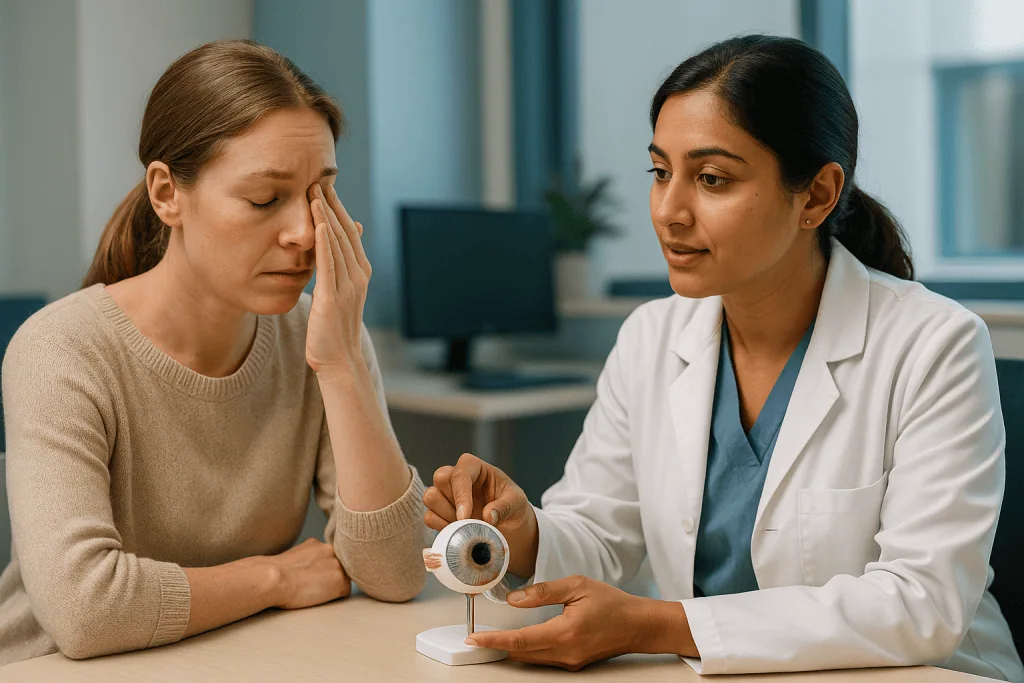
The consequence is a surface that does not know it is dry. People often report less tearing and less blinking in the early weeks, then a gritty, burning or fluctuating-vision feeling by the afternoon. The Mayo Clinic describes LASIK-related dryness as typically lasting for the first six months or so, with nerves regrowing slowly over that period; the NHS similarly lists dry eyes as a common effect that can persist for months.
Several factors shape how rough this phase is. Pre-existing dry eye, long screen hours, air conditioning, contact-lens intolerance before surgery, certain medicines that reduce tear production, and conditions such as autoimmune disease all raise the odds of a longer course. Women around menopause and people over 50 are more prone to dry eye in general, according to Mayo Clinic guidance, and surgery can unmask a problem that was mild beforehand.
Why does this matter for glare and ghosting? Because a dry tear film is an optical defect. When the surface breaks up between blinks, vision smears, then clears with the next blink. If your ghosting comes and goes blink to blink, dryness is the likely culprit and the easiest to address. If it is constant in all conditions, the cause is more likely a residual refractive error, which is a question for your follow-up measurements rather than for a bottle of drops.
Ghosting after LASIK and other procedures: shadow images and residual astigmatism
Ghosting is a faint second copy of an edge, offset slightly from the real one. Patients describe text with a shadow, a moon with a dim partner, or a traffic light that seems to have a twin. Unlike true double vision from eye misalignment, ghosting persists when you cover one eye, which is a useful home observation to share with your team (cover each eye in turn and note whether the shadow stays).
Three causes account for most cases. Residual astigmatism is the first: healing rarely lands exactly on target, and a small leftover cylinder, or a slight rotation of the correction axis, creates a smear in one direction. It often reduces as the cornea settles, and the Mayo Clinic notes that vision can fluctuate for a few months before stabilizing. The second is a poor tear film, covered above, which produces ghosting that varies with blinking. The third, less common, is a surface or flap irregularity: a wrinkle in the LASIK flap, epithelial cells growing beneath it, or uneven surface healing after PRK. These are detectable at the slit lamp (the microscope used in eye clinics) and are the reason early follow-up visits are not optional.
For toric lens patients, ghosting that appears after an initially clear result can signal that the lens has rotated away from its intended axis. Because the correction is angle-dependent, even a modest rotation reduces its effect. This is a mechanical issue the surgeon can assess and, where appropriate, address; it is not something that resolves with waiting.
The practical point: ghosting in week one or two is expected. Ghosting that is worsening, that appeared after a clear interval, or that is confined to one eye with new discomfort is information your surgeon wants promptly.
Who is usually offered astigmatism correction, and who is asked to wait
Suitability is decided by the treating team after a detailed examination, but the broad principles are consistent across guidance from the NHS, Mayo Clinic and Cleveland Clinic. Candidates are typically adults whose prescription has been stable for at least a year, whose corneas are thick and regular enough to spare tissue safely, whose eyes are otherwise healthy, and whose expectations match what the procedure can deliver.
Several groups are commonly asked to wait or to consider alternatives rather than being refused outright:
- People under their early twenties, because the prescription may still be changing.
- Anyone pregnant or breastfeeding, since hormones can temporarily shift the cornea and the refraction.
- People with significant dry eye, because surgery usually makes it worse before it gets better.
- Those with thin or irregular corneas, keratoconus (a progressive bulging of the cornea), or a family history of it, because removing tissue can weaken the structure.
- People with uncontrolled diabetes, autoimmune disease, or on medicines that slow healing.
- Those with very large pupils or very high prescriptions, where night symptoms are more likely.
Age plays a role in a different way for lens-based options. Someone in their sixties developing cataract may be a better fit for a toric intraocular lens than for a laser, because the surgery addresses both problems in a single step. Conversely, a laser enthusiast in their late forties should hear about the near-vision changes of middle age before deciding, since a cornea corrected for distance does not stop the need for reading glasses.
None of these are judgments about the person. They are statements about tissue and timing, and a “not now” from an assessment is often the most protective advice a patient receives.
LASIK, PRK, SMILE and toric lens: how side-effect patterns differ
The underlying symptoms are shared, but their timing and intensity vary with technique, chiefly because each disturbs the corneal surface and nerves to a different depth. The table summarizes typical patterns described in mainstream guidance; it is a map, not a promise, and individual courses differ.
| Approach | Early discomfort | Dryness tendency | Glare/halo pattern | Ghosting notes |
|---|---|---|---|---|
| LASIK (flap) | Mild, usually hours to a day | Highest; nerves cut by flap, months to recover | Common early, settles over weeks | Flap wrinkle or residual error; early review |
| PRK / surface laser | Moderate for several days while surface regrows | Moderate | Can last longer; surface haze possible | Slower settling; vision clears over weeks |
| SMILE (keyhole) | Mild | Generally lower than LASIK | Similar early pattern | Limited range for high astigmatism |
| Toric intraocular lens | Mild; as for cataract surgery | Lower; small incision | Lens-design related, may persist | Lens rotation can cause late ghosting |
Two features deserve emphasis. PRK trades a slower, sorer first week for a cornea with no flap, which is why it is often chosen for thinner corneas or for people in contact sports; the NHS notes that surface techniques take longer to recover from than LASIK. SMILE offers a smaller incision and a reputation for less dryness, but its ability to treat higher degrees of astigmatism is more limited, so the “best” option is genuinely patient-specific.
For lens-based correction, glare and halos may relate as much to the lens design (particularly multifocal types) as to healing, and they can be long-lasting rather than transient. That distinction is worth raising before surgery, because it changes what “normal” looks like afterward.
What the first days and weeks after astigmatism surgery usually look like
Healing follows a rough sequence, and knowing it reduces the 3 a.m. worry. The ranges below come from Mayo Clinic, Cleveland Clinic and NHS patient guidance; your own team’s instructions take precedence over any general timeline.
The first 24 hours. Expect watering, light sensitivity, a scratchy or burning feeling and blurry vision. Cleveland Clinic guidance describes vision beginning to clear within a day or two after LASIK, while surface procedures stay blurry longer. Sleeping with eye shields protects a fresh flap from an accidental rub.
Days two to seven. Vision sharpens but swings, often clearer in the morning and hazier in the dry late afternoon. Glare and halos at night are at their most noticeable. After PRK, the surface layer regrows under a bandage contact lens during this week, and discomfort can be more marked. Drops prescribed by the surgeon, typically an antibiotic class to prevent infection and an anti-inflammatory class to calm healing, are used exactly as instructed; this explainer does not cover schedules, which belong to the prescribing clinician.
Weeks two to six. Halos recede for most people as the treated zone smooths. Dryness often persists and may feel worse than week one as the initial numbness fades and sensation returns. Ghosting from mild residual error commonly lessens.
Months two to six. The Mayo Clinic notes that vision can fluctuate for a few months and that dryness commonly lasts up to about six months as nerves regrow. This is the window in which a stable measurement can finally be taken.
Across all stages, the rule of thumb is direction: a symptom that is slowly improving, however annoying, is behaving as expected. A symptom that reverses direction is the one to report.
How long do astigmatism surgery side effects last? What the evidence actually shows
People want a number, and honest sources give ranges rather than dates. Here is what mainstream guidance supports, with the caveat that individual healing varies with technique, starting prescription and the health of the eye surface.
Glare, halos and starbursts. The Mayo Clinic describes these as commonly lasting from a few days to a few weeks after LASIK, with night driving sometimes difficult during that period. Longer persistence is more likely with large pupils and high corrections.
Dry eyes. Mayo Clinic guidance places typical LASIK-related dryness in the first six months or so, with corneal nerve recovery continuing beyond that in some people. The NHS also lists months-long dryness as a common effect. A minority report ongoing symptoms past a year, usually those with dry eye before surgery.
Ghosting and fluctuating sharpness. These track the refractive settling period, which the Mayo Clinic describes as a few months. Ghosting from dryness improves as the surface stabilizes; ghosting from residual astigmatism either shrinks with settling or becomes a candidate for an enhancement procedure once measurements are stable.
Enhancements. If a meaningful residual error remains after the eye stabilizes, a second laser treatment is sometimes discussed. Mayo Clinic guidance notes this is considered only after vision has stopped changing, and that not everyone is eligible because of corneal thickness.
What the evidence does not support is any promise of a specific percentage of people who will be symptom-free by a given week. Studies vary in how they measure “dry” or “halo”, and the honest statement is directional: most symptoms improve substantially within months, a few people need longer, and persistent problems are manageable through follow-up rather than something to tolerate silently.
What people often get wrong about astigmatism surgery side effects
Myths around this topic are stubborn, and several of them lead people either to panic or to ignore a problem. These are the ones that come up most often in reader questions.
“If my eyes don’t feel dry, they aren’t dry.” They may be. Reduced nerve sensation after surgery means the usual gritty warning is muted. Fluctuating or hazy vision that clears with a blink is often the first clue. Lubricating drops, preservative-free when used frequently, are reasonable to use as your team advises even without the sensation of dryness.
“Ghosting means the surgery failed.” Early ghosting usually reflects a tear film in disarray or a cornea still settling. The measurement that matters is taken after stabilization, not in week one.
“Halos are permanent.” For most laser patients they fade over weeks, as described above. The exception is lens-based correction with certain lens designs, where halos can be a lasting feature; that should be part of the pre-surgery conversation.
“Rubbing my eyes just this once is fine.” After LASIK, the flap is held by suction and surface cell growth, not stitches. Rubbing in the early weeks risks displacing it. Shields at night and a strict no-rub rule exist for a reason.
“Astigmatism can’t come back.” Regression, a partial drift back toward the original prescription, can occur, particularly after larger corrections and with surface techniques. It is monitored and sometimes addressed with an enhancement.
“More drops are always better.” Prescribed drops have a purpose and a schedule set by the surgeon; adding, stopping or doubling them without advice can hinder healing or raise pressure inside the eye. The decision belongs to the prescribing clinician.
Managing dryness, glare and ghosting safely while you heal
Most of what helps in the healing phase is low-tech, and none of it should replace the instructions you were given. The aim is to protect the surface, keep it wet, and avoid tempting the brain to interpret every flicker as a disaster.
Surface and tears. Lubricating drops are the backbone, used as your team recommends; preservative-free single-use forms are generally preferred for frequent use because preservatives can irritate a healing surface. A humidifier in dry rooms, taking screen breaks to restore normal blinking (people blink far less when reading), and directing fans or car vents away from the face all reduce evaporation. For stubborn dryness, clinicians may discuss punctal plugs (tiny inserts that slow tear drainage) or prescription anti-inflammatory drops that target the inflammation driving dry eye; whether these are appropriate is the prescribing clinician’s call.
Light and night driving. Sunglasses outdoors ease photophobia. Many people avoid night driving for the first couple of weeks while halos are strongest; this is a safety judgment to make honestly rather than a rule. Keeping the windscreen clean and dashboard lights dim reduces scatter.
Protecting the eye. No swimming, hot tubs or eye makeup for the period your team specifies; no rubbing; shields at night as instructed. After PRK, the bandage contact lens stays in place until the surgeon removes it.
Expectations. Writing a one-line note each evening (“halos: smaller than Monday”) sounds trivial but turns anxiety into data you can share at follow-up. It also catches reversals early.
What this section does not include is any over-the-counter remedy marketed for “faster healing”. Mainstream guidance does not support supplements or devices for post-surgical corneal recovery, and anything placed on or near the eye without the surgeon’s knowledge carries its own risk.
When side effects become complications: infection, flap problems, ectasia and regression
Serious complications after astigmatism correction are uncommon, but they share a defining feature: they do not follow the slow-improvement curve of normal healing. Recognizing the departure matters more than memorizing names, though the names help you understand what your team is checking for.
Infection. Rare, and most likely in the first week while the surface is open. It typically produces increasing pain, redness, discharge and a drop in vision rather than a plateau.
Flap complications (LASIK). A displaced or wrinkled flap, cells growing beneath it (epithelial ingrowth), or an inflammatory reaction under the flap known as diffuse lamellar keratitis (a sterile, non-infectious inflammation sometimes called “sands of the Sahara” for its appearance) can each cause new ghosting, haze or discomfort in the early days. All are assessed at the slit lamp and managed by the surgeon.
Surface haze (PRK). A cloudiness in the healing layer that can blur vision for weeks to months; it is monitored and usually treated with the anti-inflammatory drops already prescribed.
Ectasia. A progressive thinning and bulging of the cornea after laser treatment, which the Mayo Clinic flags as a risk especially for thin or irregular corneas. It can appear months or years later as steadily worsening, increasingly astigmatic vision. This is why pre-operative corneal mapping is so exacting, and why a new, slowly increasing blur long after surgery should be examined rather than attributed to age.
Regression and under- or over-correction. Not emergencies, but reasons to keep follow-up appointments. The options, from glasses for specific tasks to an enhancement, are decided once the measurements are stable.
Alternatives always remain available. Glasses, soft toric contact lenses, and rigid or scleral lenses for irregular surfaces are mainstream, reversible ways to manage astigmatism, before or after surgery. No one is locked out of clear vision because a procedure did not fully deliver.
Questions to ask your care team before and after astigmatism correction
A good consultation welcomes specifics. These questions turn a generic conversation into one about your eyes, and the answers belong in your notes so you can compare them with what you actually experience.
Before surgery:
- How much astigmatism do I have, and is it regular? Which technique suits my corneal thickness and pupil size, and why?
- Do I already have signs of dry eye on testing, and would you advise treating that first?
- What degree of glare and halo is typical for my prescription, and how long do you usually see it last in people like me?
- Will my reading vision change, and how will that interact with my age over the next decade?
- What is your policy on enhancement if residual astigmatism remains, and what would make me ineligible?
After surgery:
- Which of my current symptoms are you expecting at this stage, and which would you want to hear about immediately?
- Is my ghosting coming from the surface or from a residual prescription, and how will we tell?
- When will my measurements be stable enough to judge the result?
- Which drops are for healing and which are for comfort, and how will we decide when to stop each? (The schedule itself is set by the prescribing clinician.)
- What activities are off-limits, and for how long?
- How do I reach someone after hours if something changes suddenly?
One question is worth asking in both settings: “What would make you think my eye is not healing as expected?” The answer tells you exactly what your surgeon is watching for, and it is far more useful than a general reassurance.
When to call your doctor: red-flag signs after astigmatism surgery
Normal healing is slow, fluctuating and annoying. It is not sudden, worsening or painful. Contact your eye team the same day, or seek urgent eye care if you cannot reach them, for any of the following:
- Pain that is increasing rather than easing, or severe pain at any point after the first day or two.
- A sudden drop in vision, or vision that was improving and then clearly worsens.
- Increasing redness, discharge, or a feeling that something is in the eye that does not settle.
- New or marked light sensitivity appearing after an initial improvement.
- Any trauma to the eye, including a hard rub or a knock, within the early weeks after LASIK.
- A new shadow or curtain in part of your vision, or a shower of new floaters with flashes.
- Ghosting or blur that appears suddenly in one eye after a period of clear vision, which in toric lens patients can signal lens rotation.
Slowly improving glare, halos, dryness and faint ghosting in the first weeks do not need an emergency call, but they do need to be documented at scheduled follow-ups. Dryness or ghosting that is unchanged or worse at the three-month point, or any gradual decline in sharpness months to years later, should be examined rather than tolerated, because conditions such as ectasia or regression are far easier to manage early.
Every judgment about what your symptoms mean, whether to adjust drops, and whether an enhancement or another approach is appropriate rests with your treating team. This article is a guide to the questions, not a substitute for the examination that answers them.
Frequently asked questions
Are lasik astigmatism side effects different from side effects for nearsightedness alone?
They overlap heavily, but astigmatism correction removes tissue unevenly, so night-time glare and ghosting from any leftover cylinder tend to be more noticeable early on. Dryness, light sensitivity and fluctuating vision are shared with all laser corrections. Higher degrees of astigmatism and larger pupils make persistent halos somewhat more likely, which is why these are measured during the suitability assessment.
How long does ghosting after lasik usually last?
Ghosting from a dry or settling surface commonly improves over the first weeks, while ghosting from a small residual prescription may take a few months to shrink as the cornea stabilizes, in line with Mayo Clinic guidance on fluctuating vision. If it is unchanged at your three-month review, your team can measure whether a residual error explains it and discuss options.
Why are my dry eyes after laser eye surgery worse in week three than in week one?
Because sensation is returning. In the first days, cut corneal nerves blunt the feeling of dryness even though the surface is dry; as they begin to regrow, you start to notice it. This is expected and usually continues to improve over the following months. Report it if it is accompanied by pain, redness or a drop in vision rather than just grittiness.
Do halos after astigmatism surgery mean the treatment was off-center?
Usually not. Early halos come from light passing through the edge of the treated zone when the pupil dilates at night, and from a patchy tear film scattering light. Both improve as healing smooths the cornea. A truly decentered treatment is uncommon and would be identified on corneal mapping at follow-up, where your surgeon can discuss what, if anything, it means for you.
Can I drive at night with glare and halos?
Only if you can see clearly and safely, which is an honest judgment rather than a rule. Many people avoid night driving for a couple of weeks while halos are strongest. Your surgeon will confirm when your vision meets the legal standard for driving in daylight; night comfort often lags behind that point and improves with healing.
Is it normal for vision to change during the day after astigmatism correction?
Yes, in the early months. Vision is often clearest in the morning and hazier by evening because the tear film thins with screen use and dry air. Mayo Clinic guidance notes fluctuation for a few months after LASIK. A steady pattern of blink-to-clear blur points to dryness; a steady, time-independent blur is more likely refractive and worth measuring.
What is residual astigmatism and can it be treated?
Residual astigmatism is the small amount of cylinder left after surgery because healing rarely lands exactly on target. It often decreases as swelling resolves. If a meaningful amount remains once measurements are stable, options include glasses for specific tasks, contact lenses, or an enhancement laser treatment where corneal thickness allows. The treating team decides based on your measurements.
Could ghosting after a toric lens mean the lens has moved?
It can. A toric intraocular lens corrects astigmatism only when aligned to a specific axis, so rotation reduces its effect and can produce new ghosting, sometimes after a period of clear vision. This is assessed by examination and measurement, and it is a mechanical issue rather than one that resolves by waiting, so it should be reported promptly.
Are supplements or special drops proven to speed corneal healing?
Mainstream guidance does not support any supplement or over-the-counter product for faster healing after refractive surgery. What is supported is protecting the surface, using the drops prescribed by your surgeon as directed, and keeping the eye well lubricated with preservative-free drops where frequent use is advised. Anything added without the surgeon’s knowledge carries risk to a healing eye.
When should persistent dryness or glare be reassessed rather than waited out?
Raise it at every scheduled visit, and ask for reassessment if symptoms are unchanged or worse at the three-month point, if they interfere with daily tasks, or if they appear or worsen suddenly. Persistent dryness has specific management options a clinician can discuss, and persistent glare may relate to a measurable residual error. Neither should be endured in silence.
References
This article is for general information only and is not a substitute for professional medical advice. Please consult a qualified doctor about your individual situation.

More from the Blog

How Patching and Glasses Retrain a Lazy Eye: What Amblyopia Treatment Actually Does
Patching treats a lazy eye by covering the stronger eye for a set number of hours each day, which forces the brain to use…

Choosing an Intraocular Lens: Questions to Bring to Your Ophthalmologist
Choosing an intraocular lens means weighing how you use your eyes each day against the trade-offs of each lens design. Monofocal lenses give one…

Do Children Outgrow Strabismus? Misconceptions That Delay Treatment
Most children do not outgrow true strabismus, a condition in which the two eyes point in different directions. Brief eye wandering in newborns that…

Which Symptoms After Vitrectomy Need a Same-Day Call: Pain, Pressure and a Curtain Over Vision
After a vitrectomy, call your eye surgeon the same day for worsening eye pain, a hard or pressured feeling in the eye with headache…

Who Gets an Intraocular Lens Outside Cataract Surgery? Refractive Lens Exchange Explained
Outside cataract surgery, an intraocular lens is usually considered for adults, typically over about 50, whose natural lens still focuses poorly because of presbyopia…
Dry Eyes and Night Glare After Myopia Laser Surgery: What Usually Fades and What to Report
After myopia laser surgery, dry eyes and night glare are the most common side effects. Both usually ease as the cornea heals: dryness tends…