

How a Tumor Board Shapes Your Cancer Treatment Plan and What to Ask After It Meets
Key Takeaways
- A tumor board is a recurring meeting where medical, surgical and radiation oncologists, a pathologist and a radiologist review one patient's case together and issue a recommendation, not a decision.
- A systematic review found that multidisciplinary discussion changed diagnosis or treatment decisions in roughly 4 to 45 percent of cases, depending on cancer type.
- A study across 138 medical centers found little association between simply having a tumor board and survival, suggesting the quality of the meeting matters more than its existence.
- Patients rarely attend the meeting, so the priorities you tell your doctor beforehand are the main way your voice enters the room.
- A tumor board and an outside second opinion are different processes; a board reconciles several specialties within one institution, while a second opinion adds independent eyes from outside it.
- Cases are often held back until pathology, staging scans and biomarker tests are complete, so being asked to wait usually reflects an incomplete file rather than a worrying prognosis.
A tumor board is a scheduled meeting where specialists from several fields, typically medical, surgical and radiation oncologists, a pathologist and a radiologist, review one patient's cancer together and agree on a recommended plan. The board advises; it does not decide for you. Your treating oncologist brings the recommendation back, explains the reasoning and alternatives, and the final choice rests with you and your care team.
The oncologist has just finished explaining the biopsy result when she adds, almost in passing, “We’ll bring your case to the tumor board later this week.” The words land in a strange place. A board? Who sits on it? Does it mean things are worse than she is letting on, or is this simply what happens to everyone?
People ask what is a tumor board far more often than clinicians realize, usually in the car on the way home, or at two in the morning. The honest answer is reassuring in a quiet, unglamorous way: it is a meeting. A group of specialists who rarely share a hallway sit in one room, look at the same scans and slides, and argue, politely, about what would be best for one person.
What follows explains who is in that room, what they weigh, what the research says about whether it changes anything, and, most practically, what to ask when your doctor calls afterward.
What is a tumor board, in plain language?
Strip away the intimidating name and a tumor board is a case conference. The National Cancer Institute defines tumor board review as a treatment-planning approach in which a number of doctors who are experts in different specialties review and discuss a patient’s medical condition and treatment options. Nothing in that definition involves a verdict. The board produces a recommendation, written into your record, that your own oncologist then discusses with you.
The value comes from the mix of people. Cancer care is split into three broad treatment disciplines: medicine (drug therapies such as chemotherapy, hormone therapy and immunotherapy), surgery, and radiation. Each specialist sees the same disease through a different lens. A surgeon may see a tumor that can be removed; a radiation oncologist may see one that sits too close to a nerve to operate safely; a medical oncologist may see a reason to shrink it first. Left to separate appointments, those views can arrive weeks apart and sometimes contradict one another. Around one table, they collide in real time.
The word you will hear attached to all this is multidisciplinary, which simply means several medical specialties working on one problem together. Many hospitals run disease-specific boards, one for breast cancer, another for lung, another for gastrointestinal tumors, while smaller centers often hold a single general board. Some boards also link to outside specialists by video, so a rare tumor can be reviewed by someone who has seen more of them.
What a tumor board is not matters just as much. It is not a hearing you must attend, not a sign your case is unusually grave, and not a substitute for your relationship with the doctor who examines you. Think of it as the moment your care team widens the circle before committing to a direction.
What happens at a tumor board meeting, step by step?
Most meetings follow a rhythm that would look familiar to anyone who has sat through a well-run project review. The treating physician, or a resident working with them, presents the case in a few sentences: age, relevant medical history, how the cancer was found, what the biopsy showed. Identifying details are limited to what the room needs.

The radiologist, a doctor who specializes in reading scans, then brings the images up on a large screen and walks the room through them. Where exactly is the tumor? Has it touched a blood vessel? Are the lymph nodes enlarged? Next comes the pathologist, the doctor who examines tissue under a microscope. Slides from the biopsy appear, and the pathologist confirms the cancer type, its grade (how abnormal the cells look) and any laboratory markers that could steer drug choices.
Only then does the discussion open up. The group settles the stage, a standardized description of how far the cancer has spread, and moves to options. A surgeon might say the tumor is removable but would need a larger operation than hoped. The radiation oncologist may propose an alternative. The medical oncologist raises whether a clinical trial, a research study testing a new approach, is open and suitable. Someone asks about the patient’s other health conditions and what the patient has said they want.
Each case may receive only a few minutes, which surprises people. The brevity reflects preparation, not indifference: the presenting doctor has usually gathered everything in advance so the room can go straight to the decision points. A coordinator or nurse records the consensus recommendation, and the board moves to the next name on the list. Your doctor leaves with a plan to bring back to you.
Who sits around the table, and why each seat matters
The core of any board is the three treatment specialties. A medical oncologist manages drug-based therapy and often coordinates overall care. A surgical oncologist judges whether and how a tumor can be removed. A radiation oncologist plans treatment with high-energy beams aimed at a tumor. Two diagnostic specialists anchor the discussion: the radiologist interpreting imaging and the pathologist interpreting tissue. Without those two, the rest of the room is guessing.
Beyond that core, the cast varies by hospital and cancer type, and the extra seats often shape the plan as much as the headline recommendation.
- A nurse navigator or oncology nurse tracks the practical side: which tests are pending, how the patient is coping, what has already been promised.
- A palliative care clinician, a specialist in relieving symptoms and supporting quality of life at any stage of illness, may flag pain, nausea or fatigue that should be addressed regardless of the cancer plan.
- A genetic counselor speaks up when a tumor’s features suggest an inherited risk that could matter for relatives.
- A clinical trial coordinator knows which studies are enrolling and what their entry rules are.
- A social worker or psychologist may raise transportation, work or caregiving barriers that could make one option realistic and another impractical.
- Residents and fellows, doctors in training, present cases and learn how experienced clinicians reason.
Notice who is usually absent: you. Patients rarely attend tumor boards, largely because the meeting is a technical working session rather than a consultation. Your presence in the room comes through your doctor, who is expected to carry your priorities into the discussion. That is why the conversations you have before the board, about what matters to you and what you fear, are far from small talk.
Who usually gets a tumor board review, and who is usually asked to wait?
Practice differs between hospitals, and no universal rule dictates which cases go to a board. Some programs review every newly diagnosed patient with a particular cancer. Others reserve the meeting for cases where a decision is genuinely contested. Common reasons a case is brought forward include a new diagnosis with more than one reasonable path, a tumor sitting on the border between operable and inoperable, a rare cancer, a recurrence after earlier treatment, a scan that could be read two ways, or simple disagreement between two of your doctors.
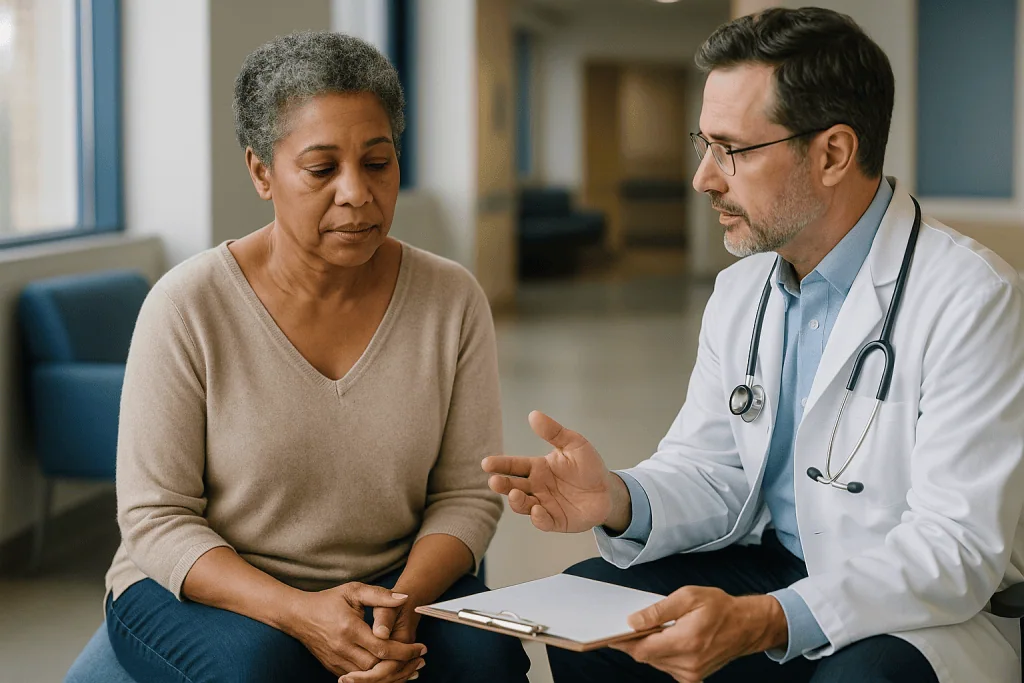
Being asked to wait usually says more about the file than about you. A board can only work with complete information, and cases are often held back until the pieces arrive. Pathology may still be finalizing the tissue diagnosis. Staging scans, the imaging that shows how far a cancer has spread, may not have been done yet. Biomarker testing, laboratory analysis of a tumor’s proteins or genes that can indicate which drugs are likely to work, frequently takes longer than the biopsy itself. Presenting a half-finished case risks a recommendation that has to be revised a week later, which helps no one.
Straightforward situations may also bypass the board altogether. An early-stage cancer with a single well-established treatment pathway is often managed according to a written protocol, with the board notified rather than consulted. That is not a lesser standard of care; it reflects that the evidence already points clearly in one direction.
Timing has a second dimension. Some cancers move slowly enough that waiting for the next scheduled meeting carries little risk, while others prompt an urgent call among specialists outside the regular meeting. If you are unsure which category you are in, ask directly. “Is anything about my timeline changed by waiting for the board?” is a fair and answerable question.
How often do tumor boards meet, and how long does a review take?
Most established boards run on a fixed weekly or every-other-week schedule, often early in the morning before clinics open, because that is the only hour when a surgeon, a radiologist and a pathologist can all be free. Large centers may run several boards a week, each devoted to one organ system. Smaller hospitals typically hold a single general conference. Your care team can tell you exactly when yours meets, and it is reasonable to ask.
The review of an individual case is brief, measured in minutes rather than hours. What consumes time is everything upstream: gathering outside records, obtaining prior imaging for comparison, waiting for a specialized pathology stain, or requesting a second read of a scan. A case can be scheduled for one meeting and slip to the next because a single result is outstanding.
Several factors stretch or shorten the wait between diagnosis and discussion:
- Whether the biopsy was done at the same institution or must be re-reviewed by the board’s own pathologist.
- Whether molecular or genetic tumor testing has been ordered, since those assays are run in batches and can take longer than routine pathology.
- Whether staging is complete, including any scan the board is likely to request anyway.
- The urgency the treating physician assigns, which can move a case up or trigger an informal same-day discussion.
After the meeting, a written summary is usually entered into the record within a short time, and the treating doctor reaches out to the patient, sometimes the same day, sometimes at the next scheduled visit. If you have not heard anything after the meeting date you were given, calling the clinic is entirely appropriate. Delays are usually administrative rather than clinical, but you should not have to guess.
What the board actually weighs: scans, slides, stage and you
Four kinds of information do most of the work in the room. The first is imaging, which shows the tumor’s size, location and relationship to nearby structures, and whether it appears in lymph nodes or other organs. The second is pathology, which establishes what kind of cancer it is, how aggressive the cells look, and any laboratory markers on the tumor. The third is stage, and the fourth, easily overlooked in a technical meeting, is the patient as a whole person.
Stage deserves a plain explanation because it anchors nearly every treatment decision. Staging is the process of describing how much cancer is in the body and where it is. Many solid tumors use the TNM system, which the National Cancer Institute describes as combining three pieces of information: T for the size and extent of the main tumor, N for whether nearby lymph nodes are involved, and M for whether the cancer has spread, or metastasized, to distant parts of the body. Those letters are combined into an overall stage, usually expressed as stage 0 through stage IV. Guidelines for most cancers are organized by stage, so settling it is often the board’s first task.
Then comes the part no scan captures. Does the patient have heart or lung disease that would make a long operation risky? How well are they functioning day to day, a measure clinicians call performance status? Are they caring for someone at home? Have they said they would rather avoid surgery, or that a clinical trial appeals to them? A recommendation that ignores those facts is technically correct and practically useless.
This is why the conversation with your doctor before the meeting shapes the outcome after it. Tell them what you value. The board can only weigh what it has been told.
Does a tumor board change treatment decisions? What the evidence shows
It is tempting to assume more doctors in a room automatically produce better results. The research is more nuanced, and worth reading honestly.
A systematic review published in Cancer Treatment Reviews examined studies of multidisciplinary team meetings across a range of cancers. It found that discussion at these meetings led to a change in diagnostic reports or treatment decisions in roughly 4 to 45 percent of cases, depending on the cancer type and the study. That is a wide range, but even its lower end means a meaningful minority of people leave the board with a different plan from the one they would otherwise have received. Changes most often involved stage, the interpretation of imaging or pathology, and whether a particular therapy was offered.
Whether those changes translate into longer survival is less settled. A study in the Journal of the National Cancer Institute analyzed care across 138 medical centers within one national health system and found little association between the mere presence of a tumor board and several measures of care quality or survival. The authors suggested that what happens inside the meeting, how thoroughly cases are prepared, whether the right specialists attend, whether recommendations are actually carried out, matters more than whether a meeting exists on the calendar.
Put those findings together and a fair summary emerges. A tumor board reliably improves the consistency of diagnosis and staging, reduces the chance that an option is overlooked, and catches disagreement early. The evidence that it lengthens life is mixed and probably depends on how well the board functions. Neither finding should alarm you. A board is a quality process, not a treatment, and the question to ask is not “will this meeting save me?” but “did this meeting give my doctors a clearer picture?”
Is a tumor board the same as a second opinion?
People often use the phrases interchangeably, and the confusion is understandable, because both involve additional doctors looking at your case. The mechanics, however, are different, and the difference affects what each can offer you.
A second opinion is a consultation you initiate. You, or your doctor, send records to another physician, often at a different institution, who reviews them independently and gives you a direct assessment. You usually meet that doctor. A tumor board is something your care team initiates within its own institution, and it produces a group recommendation delivered through your existing doctor. You typically do not meet the board.
| Feature | Tumor board | Second opinion |
|---|---|---|
| Who starts it | Your treating team | Usually you, sometimes your doctor |
| Who reviews | Several specialties at once, within one institution | One physician, often at another institution |
| Do you attend? | Rarely | Yes, in person or by video |
| Output | Consensus recommendation entered in your record | Independent written or verbal assessment to you |
| Main strength | Multiple viewpoints reconciled in real time | Fresh eyes from outside the original team |
| Main limit | Members may share institutional habits | Single perspective; may lack full imaging or slides |
Neither replaces the other. A board can be unanimous and still reflect the shared assumptions of colleagues who trained together. An outside second opinion can catch that, but a single consultant may not have a pathologist and radiologist beside them. Many people, especially with rare or high-stakes diagnoses, benefit from both, and asking your oncologist “would a second opinion make sense here?” is a normal question that good clinicians expect. If you do seek one, ask that the outside doctor receive the actual images and slides, not just the reports.
Is a tumor board recommendation binding? Where the decision really sits
No. This is the single most important thing to understand about what is a tumor board and what it is not. The board advises. It does not prescribe, schedule or consent you to anything. Legal and ethical responsibility for your care stays with the treating physician, and the right to accept or decline any treatment stays with you.
In practice, the recommendation carries real weight because it represents the considered view of several specialists. Most of the time, the treating doctor agrees with it and presents it to the patient as the plan they would suggest. But departures happen for legitimate reasons. New information may surface after the meeting, such as a biomarker result or a change in your health. You may express a preference the board did not know about. Your doctor may know something about your circumstances that shifts the balance. When the treating physician deviates from the recommendation, the reasoning is usually documented, and the case can return to the board for a second discussion.
The board’s recommendation also is not always singular. Sometimes the record reads, in effect, “Option A or Option B are both reasonable; the choice depends on the patient’s priorities.” That is not indecision. It is the board recognizing that the evidence supports more than one path and that the deciding factor is you.
Ask to see or hear the recommendation in the board’s own words, and ask whether the room was unanimous. If two specialists disagreed, that disagreement is information you deserve. It may mean the decision is genuinely close, in which case your values are the tiebreaker, or it may mean one option carries a risk the other specialist weighted more heavily. Either way, the final decision rests with you and your treating team, together.
What is a molecular tumor board, and how is it different?
Some hospitals run a second kind of meeting alongside the traditional board. A molecular tumor board reviews the results of genomic testing, laboratory analysis of the genetic changes inside a tumor, and considers whether any of those changes point toward a targeted drug or a clinical trial.
The background is straightforward. Cancers develop when cells accumulate changes in their DNA, and some of those changes drive the cancer’s growth. Certain drug classes, often called targeted therapies, are designed to block specific altered proteins produced by those changes. Immunotherapy drugs, which work by helping the immune system recognize cancer cells, are sometimes chosen based on tumor markers as well. When a tumor is sequenced, the report can list dozens of alterations, most of which have unclear significance. Interpreting that list is a specialized skill, so the molecular board typically includes clinicians with expertise in cancer genetics, along with medical oncologists and sometimes bioinformaticians who analyze large datasets.
Several points are worth keeping in perspective. Not every cancer benefits from broad genomic testing; for some, standard pathology already identifies the markers that matter. Finding an alteration does not guarantee that a matching drug exists, is approved for your cancer type, or will work in your case. Recommendations from molecular boards often involve clinical trials precisely because the evidence for many gene-drug pairings is still being gathered. And the timeline is longer, since sequencing takes more laboratory time than routine stains.
If your case goes to a molecular board, reasonable questions include which alterations were found, whether any are considered actionable, what the evidence level is for the suggested approach, and whether that evidence comes from your cancer type or is borrowed from another. Your treating oncologist should be able to explain the recommendation in those terms, and the decision, as always, remains a shared one.
What the days and weeks after the board usually look like
The meeting ends and the real sequence begins, most of it invisible to you. The recommendation is entered into your record. Your treating doctor reviews it, adds their own judgment, and reaches out, either by phone, through a patient portal message, or at a visit that has already been scheduled. That conversation is where the plan becomes yours: they explain the reasoning, lay out alternatives, describe expected side effects and answer questions.
From there, the path depends on what was recommended, but a few patterns recur.
- Additional tests. Boards frequently request one more scan, a repeat biopsy, or a laboratory panel before treatment starts. This can feel like backsliding; it is usually the board closing a gap it noticed.
- New referrals. If surgery or radiation was recommended and you have not yet met that specialist, an appointment is arranged. Expect a fresh consultation where the specialist examines you and confirms the board’s view fits what they see in person.
- Trial screening. When a clinical trial was mentioned, a coordinator typically contacts you to check eligibility, which involves its own tests and a detailed consent process.
- Supportive planning. Nutrition, physical therapy, symptom management and counseling referrals often start in parallel so that treatment begins on the steadiest footing possible.
- Scheduling. Surgery dates, radiation planning sessions or infusion appointments are booked, usually with a pre-treatment education visit.
How quickly this unfolds varies with the cancer, the institution and your own availability, and it is fair to ask what a realistic timeline looks like for you. Between the board and the first treatment, you should know two things clearly: who your point of contact is, and what symptoms should prompt a call rather than a wait. If either is unclear, ask before you leave the clinic.
Can I attend a multidisciplinary tumor board meeting, and how is my voice heard?
In most institutions, patients do not attend. The meeting is a technical working session, cases are reviewed quickly, and the language is dense with abbreviations that would be alienating rather than empowering. A small number of programs have experimented with patient-attended conferences or with inviting a patient to join for their own case, and some offer a summary meeting afterward with several specialists present. If attending matters to you, ask; the answer may be no, but the request is legitimate.
Your influence on the discussion runs through two channels. The first is your treating physician, who presents your case and is expected to convey your priorities. The second is the record itself, which includes notes from your visits. Both channels work better when you have been explicit. Consider telling your doctor, in plain words, before the meeting:
- What you most want to preserve, such as the ability to keep working, swallow normally, or avoid a stoma.
- What you most want to avoid, whether that is a long hospital stay, a particular side effect, or months of travel to appointments.
- Whether you are open to a clinical trial.
- How much information you want, and whether you prefer to hear options ranked or presented side by side.
- Who else you want involved in decisions, and whether they can join the follow-up conversation.
Afterward, ask for the recommendation in writing or in a portal message so you can read it without the pressure of a ticking appointment clock. Many people find it helpful to bring a companion to the post-board visit to take notes. If the plan has several branches, ask your doctor to draw them out; a rough sketch on paper often makes a complex recommendation clearer than any spoken explanation.
What people often get wrong about tumor boards
Misunderstandings about this process are common and mostly harmless, but a few can cause real distress or lead people to make decisions on false premises.
“My case went to the board, so it must be bad.” Not so. Some hospitals review every new patient with a given cancer as routine quality practice. Others send cases precisely because there are several good options, not because there are none.
“The board decides my treatment.” The board recommends. Your treating doctor and you decide. Recommendations can be declined, modified or sent back for reconsideration.
“If the board agreed, the answer is certain.” Consensus among colleagues reduces error but does not eliminate it. Boards work from the information in front of them, and members can share institutional habits. That is one reason an outside second opinion still has a place.
“The board is a guarantee of a good outcome.” Research shows boards change management in a meaningful minority of cases and improve diagnostic consistency; the evidence that they lengthen survival is mixed. A board is a process for better decisions, not a treatment in itself.
“Only large academic centers have them.” Boards exist in community hospitals too, sometimes linked by video to distant specialists. Size of institution does not determine whether one is available.
“Strangers will be discussing my private details.” Everyone present is bound by the same confidentiality rules as your own doctor, and identifying details are limited to what the discussion requires.
“If nothing changed after the board, the meeting was pointless.” Confirmation has value. Knowing that a surgeon, a radiation oncologist and a pathologist each looked at your case and reached the same conclusion as your oncologist is a different kind of reassurance from one doctor’s opinion, even when the plan is identical.
Questions to ask your care team after the tumor board meets
The conversation after the board is where most of the value is either captured or lost. Arrive with questions written down; the following are the ones clinicians most often wish patients had asked.
- What exactly did the board recommend, and can I have it in writing?
- Was the recommendation unanimous? If not, where did opinions differ and why?
- What is the goal of this plan: to remove the cancer, to control it, to relieve symptoms, or some combination?
- What stage was agreed, and did the board change the stage or diagnosis from what I was first told?
- What alternatives were discussed, and why were they set aside?
- Which specialists do I still need to meet, and in what order?
- Were any additional tests requested before treatment starts, and what are they for?
- Was a clinical trial considered? If so, what would participating involve, and if not, why not?
- What are the main risks and expected side effects of the recommended approach, and how will they be managed?
- How will we know whether the treatment is working, and when will that be assessed?
- What is a realistic timeline from today to the first treatment, and does waiting carry any risk in my case?
- Would a second opinion outside this institution be reasonable, and can you help arrange it?
- Who is my single point of contact if I have questions or symptoms before treatment begins?
You do not need to ask all of these at once. Some people prefer a short first conversation and a longer follow-up after the recommendation has sunk in. Tell your doctor which pace suits you. And if an answer is uncertain, a good clinician will say so; “the evidence does not clearly favor one option” is not evasion but the truth about many decisions in cancer care, and it is your cue to bring your own values to the table.
When to call your doctor
The period between diagnosis, the board meeting and the start of treatment can stretch over days or weeks, and during that time you are not on hold. Cancer and its complications do not wait for a calendar, so know in advance who to call and when. Your clinic should give you a number that reaches someone around the clock; if it has not, ask.
Contact your care team the same day, or seek emergency care, if you notice any of the following:
- A fever, especially if you have recently received chemotherapy or your team has warned you about low white blood cell counts, since infection can escalate quickly when immunity is reduced.
- New or worsening shortness of breath, chest pain, or a fast or irregular heartbeat.
- Sudden weakness or numbness on one side, difficulty speaking, facial drooping or a severe sudden headache.
- New confusion, extreme drowsiness or a marked change in alertness.
- Bleeding that does not stop, coughing or vomiting blood, or black stools.
- Pain that is severe, escalating or no longer controlled by what you have been advised to use.
- Persistent vomiting, an inability to keep fluids down, or signs of dehydration such as very little urine.
- Swelling, warmth or pain in one leg, which can signal a blood clot, a known risk in people with cancer.
- New back pain with leg weakness, numbness or loss of bladder or bowel control.
- Inability to swallow, or a sudden change in the appearance of a tumor you can see or feel.
Call during clinic hours, without waiting for your next appointment, if symptoms are milder but new or unexplained, if you have not heard the board’s recommendation by the date you were given, if you have decided you want a second opinion, or if you have changed your mind about a preference you shared. None of these is a bother. They are the system working as intended. Every decision about your treatment, including whether to pause, proceed or reconsider, stays with you and your treating team.
Frequently asked questions
What happens at a tumor board if the doctors disagree?
Disagreement is recorded, not hidden. The board may list two reasonable options and note that the choice depends on the patient’s priorities, or it may request more information and revisit the case. Your treating doctor should tell you where opinions differed and why. Genuine disagreement often signals a close decision in which your own values become the deciding factor, so ask about it directly.
How often do tumor boards meet at most hospitals?
Many established boards meet weekly or every other week, often early in the morning when surgeons, radiologists and pathologists can all attend. Large centers may run several disease-specific boards each week; smaller hospitals often hold one general conference. Your care team can tell you the exact schedule and whether your case is on the next agenda or waiting for a test result.
Can I request a tumor board review myself?
You can ask, and many oncologists will bring a case forward on request, particularly when the diagnosis is rare, the options are unclear, or you have doubts. Boards are usually convened by the treating team, so the request goes through your doctor. If the answer is no, ask why; sometimes the case has already been reviewed informally or follows a well-established protocol.
Is a tumor board second opinion a substitute for going elsewhere?
Not entirely. A tumor board gives you several specialists’ views, but they work in one institution and may share habits and assumptions. An outside second opinion adds independence but usually comes from a single physician. Many people with complex diagnoses benefit from both. If you seek an outside view, ask that the actual scans and pathology slides be sent, not just the written reports.
Does going to a tumor board mean my cancer is advanced?
No. Some hospitals review every new patient with a particular cancer as routine practice, and many cases are brought to the board because there are several good options rather than none. Advanced cancers are discussed, but so are early ones with contested treatment choices. Ask your doctor why your case is being presented; the answer is usually about complexity of decision, not severity.
Will I get a copy of the tumor board recommendation?
In most systems the recommendation is entered into your medical record and can be shared with you on request, either printed or through a patient portal. Ask for it in the board’s own words, along with your doctor’s explanation. Reading the recommendation without the time pressure of an appointment helps many people formulate better questions for the follow-up conversation.
What is a multidisciplinary tumor board meeting compared with a regular oncology visit?
A regular visit is a one-to-one consultation where your doctor examines you and discusses your care. A multidisciplinary tumor board meeting is a group session, usually without the patient present, where several specialties review the case together and agree on a recommendation. The two work in sequence: the board shapes the plan, and the visit is where your doctor explains it and you decide.
How long after a tumor board will I hear from my doctor?
Often the same day or within the next scheduled contact, though this varies by institution. The recommendation is documented after the meeting and your treating physician then reaches out by phone, portal message or at a planned visit. If you were given a meeting date and have heard nothing afterward, call the clinic; delays are usually administrative and a prompt is entirely appropriate.
Can a tumor board change my diagnosis or stage?
Yes, and this is one of its documented benefits. Because the board’s pathologist and radiologist review the original slides and images, they sometimes reinterpret them, which can shift the cancer type, grade or stage. A systematic review found changes to diagnostic reports or treatment decisions in a meaningful minority of cases. Always ask whether the board confirmed or altered what you were first told.
Do clinical trials get discussed at tumor boards?
Frequently. Many boards include a research coordinator who knows which studies are enrolling and their eligibility criteria, and molecular tumor boards in particular often point toward trials because evidence for newer gene-targeted approaches is still developing. If a trial is mentioned, you will typically be contacted for screening, which involves its own tests and a detailed consent process before any decision is made.
This article is for general information only and is not a substitute for professional medical advice. Please consult a qualified doctor about your individual situation.

More from the Blog

Targeted Therapy for Chronic Myeloid Leukemia: How Daily Treatment and Monitoring Work
Targeted therapy for chronic myeloid leukemia uses daily oral tyrosine kinase inhibitors (TKIs) that block BCR-ABL1, the abnormal enzyme driving the disease. Treatment is…
Why a Dental Assessment Comes Before Head Cancer Radiotherapy and What It Involves
A dental assessment before head and neck radiotherapy is a specialist check of the teeth, gums and jaw carried out before treatment starts. Radiation…

What Happens After TURBT? How Pathology Results and Follow-Up Cystoscopy Guide the Next Steps
After TURBT, the removed tissue goes to a pathologist, whose report on stage, grade and the presence of bladder muscle in the sample decides…
Bone Marrow Transplant in Older Adults: Reduced-Intensity Conditioning and What Age Changes
Older adults can and do receive bone marrow transplants; fitness, organ function and the specific blood cancer matter more than a birthday. Reduced-intensity conditioning…

Who May Be a Candidate for HIPEC? Peritoneal Spread, Imaging and the Surgical Evaluation
People considered for HIPEC usually have cancer confined to the lining of the abdomen, a primary tumor type where the approach is supported by…

Your First Chemotherapy Infusion Day: Check-In, Blood Work, Pre-Medication and the Infusion
On a first chemotherapy infusion day, most people check in, have weight and vital signs recorded, give a blood sample, and wait for results…