

How DIEP Flap Breast Reconstruction Works: Abdominal Tissue, Microsurgery and Operating Time

Key Takeaways
- DIEP stands for deep inferior epigastric perforator, the single small blood vessel that keeps the transferred abdominal tissue alive after it is moved to the chest.
- Unlike TRAM flaps, a DIEP flap leaves the rectus abdominis muscle in place, which is why abdominal bulge and hernia are less common and core strength is better preserved.
- The flap's artery and vein are reconnected to chest vessels, usually the internal mammary vessels, under a microscope with sutures finer than a human hair.
- Published patient resources place a typical DIEP operation at around six to eight hours, with bilateral reconstructions often taking longer.
- Nurses check the flap's color, warmth and Doppler signal frequently, often hourly at first, because vessel problems that occur almost always appear within the first few days.
- Most people stay in hospital around three to five days, reach broad recovery at roughly six to eight weeks, and later have at least one shorter refinement operation.
DIEP flap breast reconstruction rebuilds a breast using skin and fat from the lower abdomen while leaving the abdominal muscle in place. Surgeons trace a small perforating blood vessel through the muscle, move the tissue to the chest, and reconnect its artery and vein to chest vessels under a microscope. The operation typically takes about six to eight hours, followed by several days in hospital and roughly six to eight weeks of recovery.
The consultation ends with a drawing. A surgeon sketches a lower belly, an oval of skin and fat, a thin red line that is supposed to be a blood vessel, and an arrow pointing up to the chest. You nod, take the paper home, and realize on the drive that you still have no clear picture of what will happen while you are asleep for most of a working day.
That gap is common, and it matters, because a DIEP flap is not a quick procedure that can be summarized in a sentence. Understanding diep flap surgery how it works, down to the one vessel everything depends on, makes the long operating time, the hourly checks afterwards and the staged follow-up operations feel less like mystery and more like logic.
This explainer walks through the anatomy, the microsurgery, the clock and the weeks that follow, with the evidence stated plainly and every decision left where it belongs: with you and your treating team.
What is a DIEP flap reconstruction, in plain language?
A DIEP flap reconstruction rebuilds a breast using your own skin and fat taken from the lower abdomen, the area between the navel and the pubic bone. The letters stand for deep inferior epigastric perforator, which is the name of the blood vessel the surgeon preserves to keep that tissue alive once it has been moved to the chest. A perforator is a small branch that “perforates” through muscle to reach the fat and skin above it.
The defining feature, according to the Cleveland Clinic and Mayo Clinic descriptions of the technique, is what is left behind. The rectus abdominis, the long vertical “six-pack” muscle on each side of the belly, stays in place. Earlier abdominal flap methods took part or all of that muscle along with the tissue. A DIEP flap takes the skin, the fat and the vessel, and nothing structural.
Two consequences follow. First, the abdominal donor site heals in a way that resembles a tummy tuck, with a long low scar from hip to hip and a repositioned navel, because the lower abdominal skin has been removed and the upper skin pulled down to close the gap. Second, the new breast is made of living tissue that is warm, soft and changes with your body: it gains and loses weight with you and ages with you, something an implant cannot do.
The trade-off is complexity. Because the tissue is completely detached from the abdomen, its blood supply has to be rebuilt from scratch at the chest. That reconnection, performed on vessels narrower than a drinking straw, is the microsurgery in the title and the reason the operation is measured in hours rather than minutes. Everything else in this article flows from that one fact.
DIEP flap surgery: how it works, step by step
Picture the operation as four acts, often performed by two surgical teams working at once so that the chest and the abdomen are prepared in parallel.
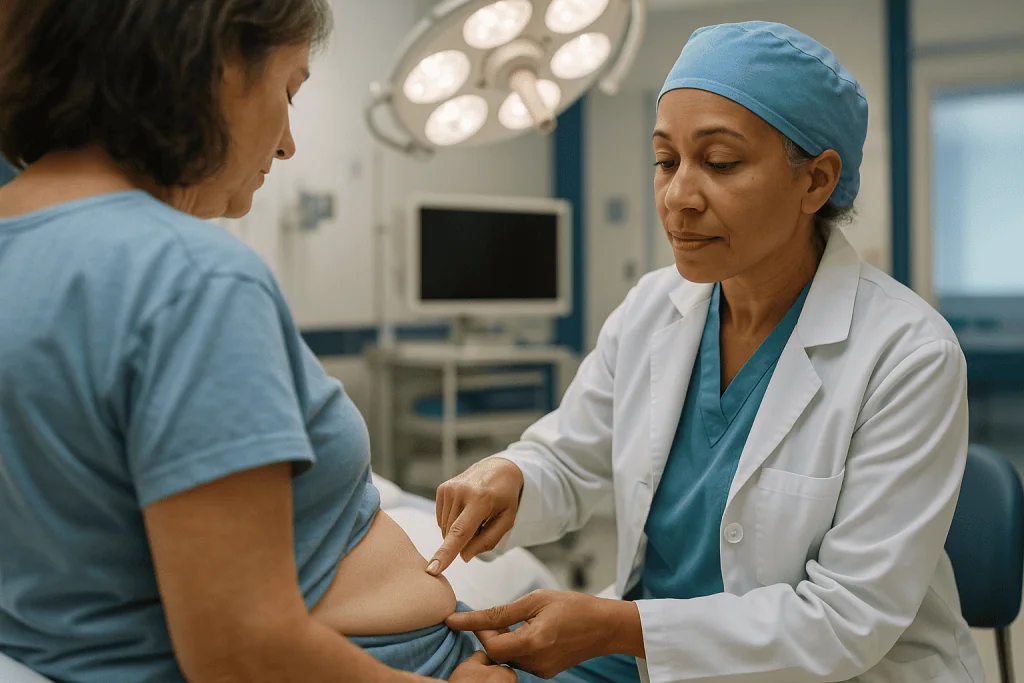
Act one is the mastectomy itself, if reconstruction is immediate, or the opening of the old mastectomy scar if it is delayed. The chest team also exposes the recipient vessels, most often the internal mammary artery and vein that run beneath the ribs beside the breastbone. A small piece of rib cartilage is sometimes removed to reach them.
Act two is the dissection on the abdomen. The surgeon lifts the oval of lower abdominal skin and fat and looks for the perforators coming up through the rectus muscle. Each candidate vessel is assessed for size and pulse, and the best one or two are chosen. The muscle fibers are then gently separated, not cut, so that the perforator can be followed down to its parent vessel, the deep inferior epigastric artery and vein, which lie beneath the muscle. This is slow, careful work and is the longest part of the day.
Act three is the transfer. The vessels are clipped, the flap is lifted free, and its weight and shape are checked. On the chest, the flap’s artery and vein are joined to the recipient vessels under an operating microscope with sutures finer than a human hair. Once the clamps come off, the tissue should flush pink within moments.
Act four is shaping and closing. The flap is trimmed, folded and sutured into a breast mound, often with a patch of abdominal skin left visible if chest skin was removed. The abdomen is closed in layers, the navel is brought out through a new opening, and drains are placed on both sites. Mayo Clinic’s overview of flap reconstruction describes this same sequence.
What is flap surgery, and how does DIEP differ from TRAM and other flaps?
Flap surgery is any operation that moves a block of living tissue, with its own blood supply, from one part of the body to another. The term comes from older techniques where the tissue stayed attached at one edge, like a flap of an envelope. Modern breast flaps come in two broad families.
A pedicled flap stays connected to its original blood vessels and is tunneled under the skin to the chest. The classic example is the pedicled TRAM, which stands for transverse rectus abdominis myocutaneous flap: lower abdominal skin and fat carried on a strip of rectus muscle that remains attached at the top. A free flap, by contrast, is fully detached and reconnected by microsurgery. A free TRAM still takes a portion of muscle; a DIEP takes none; a muscle-sparing TRAM sits in between.
Why does the muscle matter? MedlinePlus notes that taking rectus muscle can weaken the abdominal wall, which raises the risk of a bulge or hernia and may make sit-up-type movements harder. Preserving the muscle is the main reason DIEP has become the most commonly discussed abdominal option. The cost is a more demanding dissection, because the perforator must be teased out of the muscle instead of being lifted with it.
The abdomen is not the only donor site. The latissimus dorsi flap uses back muscle and skin, usually with an implant beneath it. Gluteal flaps take tissue from the buttock, and thigh flaps such as the TUG or PAP use the inner or back of the thigh. These are generally considered when the abdomen lacks enough tissue or has been used before. The NHS guide to breast reconstruction lists the main donor sites and notes that choice depends on body shape, previous surgery and personal preference, worked out with the surgical team.
How long does DIEP flap surgery take, and why does it take so long?
Published patient resources from the Cleveland Clinic and Johns Hopkins put a typical DIEP flap at around six to eight hours of operating time, and a bilateral reconstruction, meaning both breasts in one sitting, can run longer. Mayo Clinic describes flap reconstruction simply as a longer and more complex operation than implant placement. These are ranges, not promises, and your own team will give you an estimate based on your anatomy and whether the mastectomy happens the same day.

Where does the time go? Three places, roughly.
- The perforator dissection. Following one small vessel through muscle without injuring it cannot be rushed. Surgeons describe it as the step that sets the pace for everything else.
- The microvascular anastomosis, which is the technical term for sewing one blood vessel to another. Each join involves several stitches placed under magnification, and the artery and vein are done separately. A coupling device is sometimes used for the vein.
- Shaping and closing two surgical sites. Closing the abdomen is itself the equivalent of an abdominoplasty.
Several things shorten or lengthen the day. Pre-operative imaging of the abdominal vessels, often with a CT angiogram, lets surgeons plan which perforator to use before the first incision. Two teams working simultaneously reduce total time. Scar tissue from earlier surgery, unusual vessel anatomy, or a vessel that needs to be redone after the clamps come off can add time.
For the person waiting outside, the practical message is to expect a long day and to plan for it: a comfortable place to wait, phone updates arranged with the ward, and no assumptions if the first few hours pass without news. Length alone is not a sign that anything has gone wrong.
Who is DIEP flap surgery usually for, and who is usually asked to wait?
DIEP is considered for people who have had or are planning a mastectomy and want reconstruction with their own tissue rather than an implant. Mayo Clinic and the NHS highlight several situations where a tissue flap is often discussed first: when radiotherapy has been given or is planned, because irradiated skin tolerates implants less well; when a previous implant reconstruction has failed or become uncomfortable; and when someone simply prefers a result that is living tissue.
Anatomy is the first filter. There has to be enough lower abdominal skin and fat to build a breast of the size wanted. People who are very lean may be offered a different donor site or an implant. People who have had an abdominoplasty, or certain abdominal operations that may have divided the deep inferior epigastric vessels, are usually not candidates for a DIEP, because the vessel is no longer reliably available. Previous cesarean or appendix scars are often workable, but the team will want to check with imaging.
Overall health is the second filter, and this is where “asked to wait” comes in. A six-to-eight-hour anesthetic and a two-site operation place real demands on the heart, lungs and circulation. Smoking is the most frequently cited reason for postponement: the NHS warns that smoking impairs wound healing, and nicotine narrows exactly the kind of small vessels the flap depends on. Teams commonly ask for a period of complete abstinence before and after surgery, with the length set by the surgeon. Poorly controlled diabetes, a high body mass index, clotting disorders and conditions that make long anesthesia risky may also prompt a pause, further tests, or a recommendation for a less demanding option.
Cancer treatment timing sits above all of this. If chemotherapy or radiotherapy is planned, the oncology and surgical teams decide together whether to reconstruct now or later.
Is DIEP better than implants? DIEP flap vs implants, side by side
There is no single answer, and anyone who gives you one without asking about your body, your treatment plan and your priorities is skipping the hard part. The honest framing is that each approach trades one set of advantages for another. The table draws on descriptions from Mayo Clinic, the Cleveland Clinic and the NHS.
| Factor | DIEP flap | Implant reconstruction |
|---|---|---|
| Material | Your own skin and fat | Silicone or saline device, often after a tissue expander |
| Operating time | Typically about 6–8 hours | Typically a few hours |
| Hospital stay | Usually several days | Usually shorter |
| Scars | Chest plus a hip-to-hip abdominal scar | Chest only |
| Feel and ageing | Soft, warm, changes with body weight and age | Firmer; does not change with weight |
| Radiotherapy | Generally tolerates radiation better | Higher rates of capsular contracture after radiation |
| Long-term maintenance | Usually none once healed | Devices may need replacement over the years |
| Main early risk | Flap blood-supply problems, abdominal wound issues | Infection, expander problems, implant exposure |
A few points deserve emphasis. Capsular contracture, which is the hardening of scar tissue around an implant, is the main reason surgeons steer away from implants in a radiated chest. Implants are not lifetime devices and most people will face at least one further operation over the decades. On the other side, DIEP is a bigger operation with a second scar and a longer recovery, and it is not available to everyone.
Some people end up with a combination: a flap plus a small implant for volume, or an implant on one side and a flap on the other. The right choice is the one that fits your anatomy, your cancer treatment and how you weigh a longer recovery against a longer-lasting result, decided with your team.
Immediate or delayed reconstruction, and what a Goldilocks mastectomy is
Timing is a separate decision from technique. Immediate reconstruction means the DIEP flap is placed during the same anesthetic as the mastectomy. Delayed reconstruction means the mastectomy is completed first, and the flap is built months or years later through the old scar. A third pattern, sometimes called delayed-immediate, places a temporary tissue expander at the mastectomy so that the skin envelope is preserved while treatment finishes, with the flap following afterwards.
The NHS and Mayo Clinic describe the usual reasoning. Immediate reconstruction preserves more of the breast skin, avoids a period with no breast mound, and means one recovery rather than two. Delayed reconstruction is often chosen when radiotherapy is planned, because radiation can shrink and tighten a freshly transferred flap, or when the person needs time to recover from cancer treatment or to decide. Neither option has been shown to interfere with cancer surveillance when planned properly, and your oncologist’s view carries weight here.
A Goldilocks mastectomy is a different idea that often comes up in the same conversation. In this technique the surgeon removes the breast tissue but keeps the lower breast skin and the fat beneath it, then folds that remaining tissue into a small breast mound, as in a breast lift pattern. It is “not too much, not too little”: it offers a modest natural-tissue shape without a flap from elsewhere or an implant. It suits people with larger, lower-sitting breasts who are comfortable with a smaller final size, and it can later be enhanced with fat grafting. It is not a DIEP flap, and it is not suitable for small breasts, but it belongs on the list of options a team may discuss.
Whatever the timing, the sequence is set jointly by breast surgeons, plastic surgeons and oncologists, and it can change if pathology results after the mastectomy alter the treatment plan.
The first days after surgery: flap checks, drains and the first walk
The first 24 to 72 hours are about one thing: confirming that blood is flowing into and out of the flap. Problems with the tiny vessel joins, when they occur, show up early, and catching them quickly is what allows a return to theatre to fix them. For this reason, the Cleveland Clinic and Johns Hopkins describe close monitoring on a specialist ward or high-dependency unit, often hourly at first.
What does a flap check involve? A nurse looks at the color of the skin patch (healthy tissue is pink; pale suggests poor arterial inflow, dusky purple suggests venous congestion), feels its warmth, presses it gently to see how fast color returns, and listens to the blood flow with a handheld Doppler, a small ultrasound device that makes a whooshing sound over a working vessel. Some units also use a small implanted Doppler probe or a skin sensor that tracks oxygen levels continuously.
Expect to be kept warm, because cold narrows blood vessels. Expect to be asked to avoid caffeine and nicotine for the same reason. You will have drains, usually two in the abdomen and one or two at the chest, collecting fluid that would otherwise pool under the skin; they typically stay for a week or two and are removed when output falls. A bed positioned with the hips slightly bent takes tension off the abdominal closure, which is why you may feel you are walking stooped at first.
Getting up matters. Early walking, usually from the first or second day with help, reduces the risk of blood clots and chest infection. Compression stockings and, where the team prescribes it, a short course of a blood-thinning injection are standard clot-prevention measures. Most people stay in hospital around three to five days according to the Cleveland Clinic, with the exact length decided by how the flap, the wounds and your mobility look.
DIEP flap recovery time, week by week
Recovery is a two-site process: the chest and the abdomen heal on slightly different schedules, and most people say the abdomen is the more demanding of the two. The Cleveland Clinic and Mayo Clinic place full recovery at roughly six to eight weeks, with the caveat that fatigue often lingers longer and that everyone’s timeline is their own.
In the first two weeks at home, the focus is on wounds, drains and gentle movement. Walking around the house several times a day is encouraged; lifting, stretching upward and anything that tenses the abdomen is not. Standing fully upright returns gradually as the abdominal skin relaxes. Showering is usually allowed once the team confirms the dressings and drain sites can be managed. Numbness across the lower abdomen and the reconstructed breast is normal and may be permanent in places, because small skin nerves are divided during surgery.
Weeks three to six bring a steady widening of activity. Many people return to desk-based work somewhere in this window, drive again once they can brake sharply without pain and are off strong pain medicines, and begin light exercise such as longer walks. Lifting restrictions, often described as nothing heavier than a light bag, commonly continue to around six weeks to protect the abdominal closure.
Beyond six to eight weeks, most routine activities resume, including core exercise introduced gradually with the team’s agreement. Swelling in the flap and the abdomen continues to settle for months, scars stay pink and firm for up to a year before fading, and the final shape of the breast is not judged until that settling is complete. This is also the period when the team begins to talk about whether a second-stage operation would be useful, which is the subject of the next section.
DIEP flap stage 2 and stage 3: revisions, fat grafting and the nipple
The first operation builds a breast mound. It rarely builds a finished breast, and understanding this in advance avoids disappointment. Johns Hopkins and the Cleveland Clinic both describe reconstruction as a staged process, with later procedures that are usually shorter, often performed as day cases, and timed several months after the first surgery once swelling has settled and the flap’s blood supply is well established.
Stage 2 is the refinement operation. Typical elements include reshaping the flap, reducing or lifting it to match the other side, revising the abdominal scar or the “dog ears” of skin at its ends, and fat grafting. Fat grafting, also called lipofilling, means taking fat by liposuction from the thighs, flanks or abdomen, purifying it and injecting it in small amounts to fill hollows in the upper breast or soften the edge between flap and chest. Some grafted fat is reabsorbed, so the step is sometimes repeated. If only one breast was reconstructed, a lift, reduction or augmentation of the natural breast may be offered at this stage for symmetry.
Stage 3, where wanted, is nipple and areola reconstruction. A nipple can be made from local skin folded into a small projection, or from a graft, and the areola is usually added by tattooing a few months later once the nipple has healed. Many people instead choose a three-dimensional tattoo alone, which creates the illusion of projection without surgery, and some choose no nipple reconstruction at all. Each is a legitimate choice.
None of these stages is compulsory. Some people are content with the result of the first operation and stop there. The timing and content of each later stage are decided jointly, and insurers and health systems treat them as part of the original reconstruction rather than as cosmetic extras.
Risks and complications, stated plainly
Every operation of this size carries risk, and a good team will go through the list without euphemism. MedlinePlus, Mayo Clinic and the NHS describe the main categories below.
Flap-related problems come first because they are specific to this technique. Total flap loss, where the blood supply fails and the tissue cannot be saved, is uncommon in experienced microsurgical units but not zero; when it happens, it usually declares itself in the first few days, and a return to theatre to re-explore the vessels is the standard response. Partial flap loss and fat necrosis, where an area of fat inside the flap loses its blood supply and becomes a firm lump, are more common and often need no treatment beyond reassurance, though a firm area may need imaging to distinguish it from anything else.
Abdominal donor-site problems include delayed wound healing along the long scar, especially in the middle where tension is highest; fluid collections called seromas; and, less often than with TRAM flaps, a bulge or hernia. Numbness of the lower abdomen is expected rather than a complication.
General surgical risks are the same as for any long anesthetic: bleeding, infection, blood clots in the legs or lungs, chest infection and reactions to anesthesia. Long operations raise clot risk, which is why early walking and clot-prevention measures are taken seriously.
Finally, there are the risks of not being satisfied with shape or symmetry, and the certainty of scars. Reconstruction cannot restore the sensation of the original breast, although some teams attempt nerve reconnection and some feeling may return over time. Your surgeon can tell you how these risks apply in your case and what their own unit’s experience has been; ask directly.
What people often get wrong about DIEP flap surgery
The myths around this operation tend to come from well-meaning friends and from older information about TRAM flaps. Here are the ones that cause the most confusion.
“It is a free tummy tuck.” The abdominal result does resemble an abdominoplasty, but the goal of the dissection is a healthy vessel, not a sculpted waist, and the closure is designed around the flap’s needs. People with very little abdominal fat will not get a flatter stomach in any meaningful sense, and may not be candidates at all.
“The new breast will have feeling like before.” Mayo Clinic is clear that reconstructed breasts generally have little or no sensation, because the nerves to the skin are divided at mastectomy. Some sensation may return over months or years, and nerve-reconnection techniques are being studied, but the evidence does not support promising normal feeling.
“You will not be able to sit up or exercise properly afterwards.” This was a real concern with flaps that removed muscle. Because DIEP spares the rectus muscle, core strength is far better preserved, though the abdominal wall still needs weeks of protection while the layers heal.
“Once it is done, it is done.” Most people have at least one further, smaller operation to refine shape, and some have two or three. One-stage perfection is the exception.
“A flap hides cancer recurrence.” Recurrences after mastectomy most often occur in the skin or chest wall, which remain examinable, and routine follow-up continues as planned. Reconstruction does not change surveillance.
“Longer surgery means something went wrong.” A six-to-eight-hour operation is normal for this procedure, as the Cleveland Clinic and Johns Hopkins note. Waiting families should expect a long day.
Questions to ask your care team
The most useful consultation is the one where you leave knowing how the general picture applies to you specifically. These questions, drawn from what people most often wish they had asked, are a starting point.
- Based on my imaging and examination, am I a good candidate for a DIEP, or would a different flap or an implant suit my body better, and why?
- Will the reconstruction be immediate or delayed, and how does my planned chemotherapy or radiotherapy affect that timing?
- How many of these operations does the unit perform each year, and what is its own rate of flap loss and return to theatre?
- Roughly how long do you expect my operation to take, and will two teams be working at once?
- Where exactly will my scars be, and can you show me photographs of typical results at six months and at two years?
- What will the breast and the abdomen feel like afterwards, including numbness, and is nerve reconnection something you offer?
- How long should I expect to stay in hospital, and what support will I need at home in the first two weeks?
- When can I return to work, drive, lift my children and exercise, and what are the specific restrictions on the abdomen?
- What second- or third-stage procedures do you anticipate for me, and when would they usually happen?
- If I smoke, have diabetes or take medicines that affect clotting, what do you need me to do before surgery, and who manages that?
- What happens if the flap fails: what is the back-up plan, and who would I speak to?
- Who do I call, at any hour, if I am worried about the flap or a wound after I go home?
Write the answers down or bring someone who will. A second consultation to go over them is reasonable for an operation of this scale.
When to call your doctor
After discharge you are the first line of flap monitoring, and your team will want to hear from you early rather than late. Johns Hopkins and the Cleveland Clinic advise contacting the surgical team the same day, or going to emergency care if you cannot reach them, for any of the following.
Signs of a flap blood-supply problem: the skin patch on the reconstructed breast turning pale, mottled, blue or dark purple; the flap becoming noticeably cooler or colder than the surrounding skin; sudden swelling, tightness or firmness of the breast; or new bleeding or a rapidly enlarging bruise. These can indicate a blocked artery or vein and are time-critical.
Signs of infection or wound breakdown: fever or chills; spreading redness, heat or increasing pain around any incision or drain site; pus or foul-smelling fluid; or an incision edge that opens, particularly along the middle of the abdominal scar.
Signs of a blood clot: pain, swelling or warmth in one calf; sudden shortness of breath; chest pain that worsens on breathing; or coughing up blood. Any breathing symptom of this kind warrants emergency services immediately.
Other reasons to call: a drain that suddenly stops draining or whose output turns bright red; vomiting that stops you keeping fluids down; calf or abdominal pain that is escalating rather than easing; or anything that worries you and does not fit the pattern you were told to expect.
Do not wait for a scheduled appointment to raise these. A phone call that turns out to be unnecessary costs nothing; a delay with a struggling flap can cost the reconstruction. Keep the ward’s direct number where you can find it, including at night.
Frequently asked questions
What is a DIEP flap reconstruction?
A DIEP flap reconstruction rebuilds a breast using skin and fat from the lower abdomen, carried on a small perforating blood vessel and reconnected by microsurgery to vessels in the chest. The abdominal muscle is left intact, which distinguishes it from the older TRAM flap. The donor site is closed much like a tummy tuck, leaving a long low scar.
What is flap surgery?
Flap surgery moves a block of living tissue, together with the blood vessels that feed it, from one part of the body to another. A pedicled flap stays attached to its original vessels and is tunneled into place; a free flap, such as the DIEP, is fully detached and its vessels are sewn to new ones under a microscope.
How long does DIEP flap surgery take?
Patient resources from the Cleveland Clinic and Johns Hopkins describe a typical DIEP flap taking about six to eight hours, and longer when both breasts are reconstructed or when the mastectomy is performed in the same session. Most of that time is spent dissecting the perforator vessel and performing the microvascular joins. Your own surgeon will give an estimate based on your anatomy.
Is DIEP better than implants?
Neither is better in every case. A DIEP flap gives a soft, living result that ages with you and tolerates radiotherapy well, but requires a longer operation, a second scar and a longer recovery. Implants involve shorter surgery and no abdominal scar but may harden after radiation and usually need replacement over time. The right choice depends on your body, your treatment plan and your priorities.
What is a Goldilocks mastectomy?
A Goldilocks mastectomy removes the breast tissue but keeps the lower breast skin and underlying fat, folding it into a small breast mound in a breast-lift pattern. It avoids both an implant and a flap from elsewhere, which is why it is described as neither too much nor too little. It suits larger, lower-sitting breasts and people happy with a smaller final size.
What is the DIEP flap recovery time?
Most people are in hospital for around three to five days and reach broad recovery at roughly six to eight weeks, according to Mayo Clinic and Cleveland Clinic resources. Walking starts within a day or two, desk work often resumes between weeks three and six, and lifting restrictions protect the abdomen for about six weeks. Swelling and scars continue to settle for up to a year.
What happens at DIEP flap stage 2?
Stage 2 is a shorter refinement operation, usually several months after the first, that reshapes the flap, improves symmetry with the other breast, revises scars and often adds fat grafting to fill hollows. It is frequently a day-case procedure. Nipple reconstruction or tattooing, sometimes called stage 3, may follow. None of these later stages is compulsory.
Will the reconstructed breast have feeling?
Usually very little at first, and often permanently reduced, because the skin nerves are divided during mastectomy. Some sensation may return gradually over months or years, and some surgeons attempt to reconnect a nerve within the flap, but evidence does not support promising normal feeling. Numbness across the lower abdomen is also expected.
Why is the flap checked so often after surgery?
Because the reconnected vessels are only a few millimeters wide, a clot or kink can cut off blood flow, and this almost always shows up within the first few days. Frequent checks of color, warmth, capillary refill and Doppler signal allow a problem to be caught early and corrected in theatre, which is the best chance of saving the flap.
Who is usually not a candidate for a DIEP flap?
People who have had an abdominoplasty or surgery that divided the deep inferior epigastric vessels, those with too little abdominal tissue to build the breast wanted, and current smokers are commonly steered to other options or asked to wait. Significant heart, lung or clotting problems that make a long anesthetic unsafe may also rule it out. The surgical team makes this assessment.
This article is for general information only and is not a substitute for professional medical advice. Please consult a qualified doctor about your individual situation.

More from the Blog
Combined Procedures in Breast Aesthetics: When a Lift and Implants Happen in One Operation
A combined breast lift and augmentation, also called augmentation mastopexy, reshapes and raises sagging breast tissue while placing an implant for volume, all under…

Reading a Breast Aesthetics Surgical Plan: Measurements, Options and Questions to Raise
A breast aesthetics surgical plan usually lists your chest and breast measurements, the surgeon's proposed technique, and the alternatives that were considered. Reading it…

Preparing for Breast Augmentation: Imaging, Medication Review and the Final Sizing Visit
Preparing for breast augmentation usually involves three steps spread over several weeks: a baseline breast imaging review if you are of screening age or…

How Long Do Breast Implants Last? Lifespan, Monitoring and When Replacement Is Discussed
Breast implants are not lifetime devices, but they do not expire on a fixed schedule. Many last 10 to 20 years or more, and…

When Is Gynaecomastia Treatment Considered? Watchful Waiting, Causes Checked and Surgery
Gynecomastia treatment is usually considered only after three things have happened: a doctor has confirmed the swelling is glandular breast tissue rather than fat,…

Questions to Ask Before Breast Reconstruction: Stages, Symmetry Surgery and Nipple Options
Before breast reconstruction, ask your plastic surgeon which technique suits your body and cancer treatment (implant or your own tissue), whether reconstruction should happen…