

Questions to Ask Before Breast Reconstruction: Stages, Symmetry Surgery and Nipple Options

Key Takeaways
- The most consequential reconstructive decisions, including whether skin or nipple can be preserved and where incisions go, are made during the mastectomy, so a plastic surgeon should be consulted before that date is set.
- Reconstruction is typically a two- or three-stage process: building the mound, refining and matching the other breast, and, if wanted, creating a nipple months later once the shape has settled.
- Radiation stiffens skin and raises the risk of capsular contracture around implants, which is why many teams delay definitive reconstruction or favor your own tissue when radiation is likely.
- Implants are not lifetime devices and often need later replacement or adjustment, while flaps require a longer first operation and a donor-site scar but age with the body.
- A reconstructed breast has little or no sensation because the nerves are removed with the breast tissue, and a reconstructed nipple made from skin tends to flatten over time.
- The National Cancer Institute reports no evidence that reconstruction causes cancer to return or hides it, and delayed reconstruction remains possible years after mastectomy.
Before breast reconstruction, ask your plastic surgeon which technique suits your body and cancer treatment (implant or your own tissue), whether reconstruction should happen at the mastectomy or later, how many operations the full plan involves, what happens to the other breast for symmetry, and what your nipple options are. Ask, too, how radiation would change the plan, which complications matter most for you, and what recovery realistically looks like.
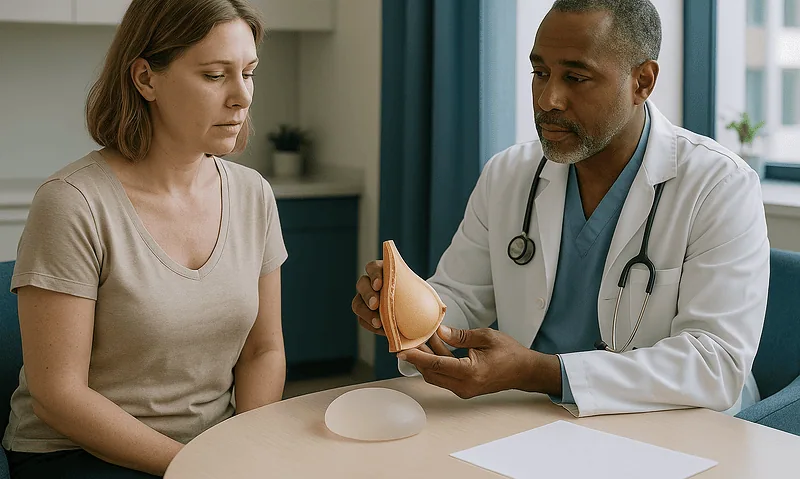
The pathology report is still in the folder on the kitchen table when the second appointment gets booked, this time with a plastic surgeon. Most people arrive at that visit with a phone full of half-finished notes and a single worry that sits above the rest: I do not know what I do not know. That is the honest starting point for anyone searching for the right questions to ask a plastic surgeon about breast reconstruction.
The consultation itself often runs shorter than the drive to get there. Diagrams appear, words like flap and expander go by quickly, and a decision that will shape how you feel in your own skin for decades gets sketched in twenty minutes. The good news is that the field has settled into a handful of clear choices, each with known trade-offs.
This explainer walks through those choices in plain language, so the diagrams make sense before you see them and the questions you ask are the ones that change the plan.
Why the questions to ask a plastic surgeon about breast reconstruction begin before the mastectomy
Reconstruction is often described as something that happens after cancer surgery. In practice, the most consequential reconstructive decisions are made during the mastectomy itself, which is why the National Cancer Institute advises meeting a plastic surgeon before that operation is scheduled rather than afterward.
A mastectomy is the removal of the breast tissue. A skin-sparing mastectomy keeps most of the breast skin as an envelope for the new breast; a nipple-sparing mastectomy also keeps the nipple and areola, the darker ring of skin around it. Whether either approach is safe depends on where the tumor sits and how close it comes to the skin and nipple, judgments the breast surgeon and plastic surgeon make together. Once the skin is gone, that option is gone with it.
The placement and length of the incision matter as well. A scar planned with later reconstruction in mind can sit where an implant or flap will hide it, while a scar planned only to remove cancer may cross the very area a surgeon later needs to shape. The same is true for lymph node surgery, drains and even the direction of skin tension.
So the first question is not about implants or tissue at all. It is a scheduling question: has a plastic surgeon been part of the plan before the mastectomy date was set? If the answer is no, asking for that meeting is reasonable and, in most centers, expected. The NCI is clear that reconstruction has not been shown to affect the return of cancer or the ability to detect it, so asking does not compromise the cancer treatment; it simply coordinates it.
How breast reconstruction actually works: mound, expander and flap explained
Every reconstruction has the same first goal: rebuild the breast mound, the volume and shape you see under clothing. Surgeons reach that goal in two broad ways, and most of the vocabulary you will hear belongs to one or the other.
Implant-based reconstruction usually starts with a tissue expander, a deflatable silicone shell placed under or in front of the chest muscle at the time of mastectomy. Over a series of clinic visits, the surgeon adds saline through a small port, gradually stretching the skin the way a slow-growing pregnancy stretches an abdomen. When the pocket reaches the intended size, a second operation swaps the expander for a permanent silicone or saline implant. Some patients with enough healthy skin skip the expander and receive the implant directly, an approach called direct-to-implant. A sheet of processed collagen called acellular dermal matrix is often used as an internal sling to support the lower edge of the pocket.
Autologous reconstruction, from the Greek for self, uses your own tissue. A flap is a block of skin and fat, sometimes with muscle, moved from another part of the body along with the blood vessels that keep it alive. In a pedicled flap the tissue stays connected to its original vessels and is tunneled to the chest. In a free flap the vessels are cut and reconnected to chest vessels under a microscope, work measured in millimeters. The DIEP flap takes lower abdominal skin and fat while sparing the muscle; the TRAM flap takes some of that muscle; the latissimus dorsi flap borrows from the upper back.
Fat grafting, in which fat removed by liposuction is injected in small amounts to smooth contours, often finishes either type. Mayo Clinic describes it as a refining step, not a way to build a whole breast.
Immediate vs delayed breast reconstruction: which timing fits your treatment plan
Timing is the second question that shapes everything downstream. The NCI describes three patterns, and each exists for a reason rather than as a fallback.
Immediate reconstruction happens during the same anesthesia as the mastectomy. You wake with a mound in place, the skin envelope is fresh and unscarred, and you avoid the experience of a flat chest. The trade-off is a longer first operation and a plan made before all pathology results are in.
Delayed reconstruction takes place months or years later, after cancer treatment is complete. Skin has healed and sometimes tightened, so an expander is more often needed, but the cancer picture is settled and you have had time to decide what you want. Delayed reconstruction remains possible long after mastectomy; there is no biological deadline.
Delayed-immediate reconstruction is the hybrid. An expander is placed at the mastectomy to preserve the skin envelope, but the final reconstruction waits until the team knows whether radiation is needed. If it is, the expander can be deflated during treatment and the definitive surgery follows once the tissue has recovered.
The factors that push a team toward one pattern are fairly consistent: the likelihood of radiation, whether chemotherapy is planned before or after surgery, the extent of disease, other medical conditions, and, not least, how much decision-making you can absorb in the weeks after a diagnosis. Some people want everything done at once; others want the cancer surgery over with and reconstruction as a separate chapter.
Neither instinct is wrong. The useful question to ask is which timing your surgeons recommend for you and what specifically would change their advice.
Implants or your own tissue? A side-by-side comparison
Most people eventually face the implant-versus-flap choice, and the two paths differ in ways that matter differently to different lives. The table below summarizes what the NCI, MedlinePlus and Mayo Clinic describe; it is a starting point for a conversation, not a scorecard.
| Consideration | Implant-based | Your own tissue (flap) |
|---|---|---|
| First operation | Shorter; expander or implant placed | Longer, especially for free flaps requiring microsurgery |
| Number of planned stages | Often two, plus optional nipple and revision steps | Often one main operation, plus optional refinement |
| Scars | Chest only | Chest plus donor site (abdomen, back, thigh or buttock) |
| How it changes over time | Stays the same size while the body changes; implants are not lifetime devices and may need replacement | Ages with you, gains and loses weight with you |
| After radiation | Higher risk of capsular contracture and other complications | Generally tolerates radiated tissue better |
| Feel and warmth | Firmer, cooler to the touch | Softer, closer to natural breast tissue |
| Who may be steered away | People with heavily radiated or thin skin | People who smoke, have limited donor tissue or conditions affecting small blood vessels |
A few points deserve emphasis. Mayo Clinic notes that implants can rupture, ripple or develop a tight scar capsule, and that many people eventually need further surgery to replace or adjust them. Flap surgery moves that risk to the front end: a bigger operation, a second scar and a small chance the flap loses its blood supply, but a result that tends to need less maintenance.
The NCI gives a similar recovery window for both, with most people returning to usual activities within roughly 6 to 8 weeks, though flap recovery involves the donor site as well. Ask your surgeon which of these trade-offs weighs heaviest for your anatomy and your treatment plan.
Who is usually offered reconstruction now, and who is usually asked to wait
Almost anyone who has a mastectomy can be considered for reconstruction, but the timing and technique offered vary with health and treatment. Being asked to wait is rarely a judgment about you; it is usually a judgment about blood supply and healing.
Nicotine narrows small blood vessels, and reconstruction depends on those vessels to keep skin edges, flaps and expander pockets alive. Surgeons commonly ask people who smoke or vape to stop for a period before and after surgery, and some will not perform flap surgery until that has happened. Uncontrolled diabetes impairs wound healing in a similar way. Higher body weight is associated with more wound and flap complications, so some teams recommend implants, delayed surgery or a different flap rather than a large abdominal flap.
Planned radiation is the most common medical reason to delay. Radiated skin loses elasticity and blood flow, which is why the delayed-immediate approach exists. Inflammatory breast cancer, which involves the skin itself, is usually reconstructed later for the same reason. People with very advanced disease may be advised to focus on treatment first, with reconstruction revisited when the picture is clearer.
Age alone is not a barrier. Fitness for anesthesia and the length of the operation matter more than the number on a birth certificate, and older adults undergo both implant and flap reconstruction.
Then there is readiness that has nothing to do with medicine. Some people simply do not want another decision in the weeks after diagnosis, and choosing to postpone is a legitimate clinical choice. The NHS describes reconstruction as something that can be offered at the time of mastectomy or at any point afterward.
Whatever your situation, the decision about eligibility and timing rests with your treating team, who can weigh your cancer plan against your healing risk in a way no general article can.
Breast reconstruction stages: how many operations should I expect?
The phrase most people wish they had heard earlier is this: reconstruction is a process, not a procedure. Understanding the stages in advance keeps the second and third operations from feeling like something went wrong.
Stage one builds the mound. For implant-based reconstruction this usually means placing an expander at the mastectomy, followed by expansion visits over the following weeks and months. For flap reconstruction it means the flap surgery itself, which produces most of the final shape in a single operation.
Stage two refines it. In an implant pathway, this is the exchange operation, when the expander is replaced by the permanent implant. In either pathway, this is often when the surgeon adjusts the shape, uses fat grafting to fill hollows near the collarbone or armpit, revises scars, and performs any symmetry surgery on the opposite breast. The NCI notes that the second stage typically follows once the tissue has healed and, where relevant, once radiation is complete.
Stage three addresses the nipple, if you want one. Nipple reconstruction is usually deferred until the mound has settled into its final position, which the NCI describes as several months after the previous operation, because a nipple placed on a breast that is still changing may end up off-center. Tattooing of the areola usually follows once the reconstructed nipple has healed.
Not every stage is required. Some people stop after the mound, satisfied with the shape under clothing. Others choose tattooing without a raised nipple. A useful set of questions: how many operations does the complete plan involve for someone like me, which of them are optional, how long is each typical recovery, and what happens if I decide to stop partway through?
How radiation therapy changes the reconstruction plan
Radiation is the variable that most often turns a straightforward plan into a conditional one, and the reason is biological rather than surgical. Radiation damages the small blood vessels and collagen in skin and fat. Treated tissue becomes tighter, thinner and slower to heal, changes that continue to evolve for months after the last session.
For implants, that creates a specific problem. Every implant develops a capsule, a thin layer of scar tissue the body builds around any foreign object. In radiated tissue that capsule is more likely to thicken and tighten, a condition called capsular contracture that can make the breast feel hard, look distorted or become painful. Mayo Clinic and the NCI both describe radiation as raising the risk of implant complications, including contracture, infection and the need for further surgery.
Flaps tolerate radiation differently because they bring their own blood supply and un-radiated skin to the chest. Many surgeons therefore prefer autologous reconstruction for people who have had or will need radiation, or they place an expander first and delay the flap until radiation is finished and the tissue has recovered.
The complication is that the need for radiation is not always known before the mastectomy. Lymph node findings and final tumor measurements sometimes change the recommendation. This is why the delayed-immediate approach exists and why it is worth asking the breast surgeon and radiation oncologist directly: how likely am I to need radiation, and when will you know for certain?
Then ask the plastic surgeon what changes in each scenario. A team that has thought through both branches, radiation and no radiation, before your first operation will have a plan rather than a reaction if the pathology report shifts.
Symmetry surgery after mastectomy: what happens to the other breast
A reconstructed breast is built to a design; the natural breast on the other side follows its own history of pregnancies, gravity and weight. Getting the two to match under a swimsuit or fitted top often requires surgery on the breast that never had cancer, and this surprises many people.
The options mirror cosmetic breast surgery. A breast reduction removes tissue so the natural side matches a smaller reconstruction. A mastopexy, or lift, repositions a breast that sits lower than the new mound without changing its size. An augmentation places a small implant to match a larger reconstruction. Fat grafting can adjust small differences on either side.
Timing usually falls at the second stage, once the reconstructed side has settled and the surgeon can see what needs matching. Some people prefer to wait longer, particularly if the natural breast is still under surveillance. Ask whether symmetry surgery is included in your plan, which procedure your surgeon anticipates, and how it will affect future mammograms on that side.
In the United States, the NCI notes that a federal law, the Women’s Health and Cancer Rights Act, requires most group health plans that cover mastectomy to also cover reconstruction, including surgery on the opposite breast for symmetry, prostheses and treatment of complications. Coverage details still belong in a conversation with your plan, not with a magazine.
Symmetry also includes the choice of no reconstruction at all. An aesthetic flat closure is a mastectomy finished with attention to contour, so the chest is smooth rather than left with excess skin folds. If you are leaning toward flat, ask whether the surgeon will perform a deliberate flat closure and whether removing the other breast is a separate decision with its own risks, which it is.
Nipple reconstruction options: sparing, rebuilding, tattooing or none
The nipple is the detail that makes a reconstruction read as a breast rather than a mound, and it is also the part people are least likely to be told about in advance. There are four broad paths.
Nipple-sparing mastectomy keeps your own nipple and areola. Whether it is safe depends on the tumor’s distance from the nipple, the size and droop of the breast, and whether the blood supply to the preserved skin is likely to survive. The retained nipple usually loses most of its sensation and its ability to become erect, and the NCI notes that the tissue behind it is checked for cancer cells at surgery. Ask the breast surgeon whether you are a candidate and what would rule it out.
Nipple reconstruction builds a new nipple from small flaps of skin on the reconstructed breast, folded and stitched into a raised shape. Because the new nipple is made of skin without the underlying structure, it tends to flatten over time, sometimes considerably. Some surgeons graft skin or tissue from the other nipple or elsewhere to help it hold its projection.
Tattooing creates the areola’s color and, in three-dimensional technique, uses shading to give the illusion of a raised nipple on a flat surface. Tattooing can follow a reconstructed nipple or stand alone, and many people choose it precisely because it avoids another operation.
No nipple is also a choice. Some prefer a clean mound; others use adhesive prosthetic nipples for particular clothes.
Questions worth asking: is my nipple likely to be preservable, how does a reconstructed nipple change over the years, who performs the tattooing and how it is maintained, and can I decide about the nipple later without limiting any other option? The answer to the last question is usually yes.
What the first days and weeks after breast reconstruction usually look like
Recovery differs by technique, but certain features are nearly universal, and knowing them in advance removes much of the alarm.
You will almost certainly go home with drains: thin tubes leaving the chest and, after a flap, the donor site, emptying fluid into small bulbs that you record and empty at home. MedlinePlus describes drains staying in place for one to two weeks or until output falls to a low daily volume. Nurses teach the routine before discharge; it is fiddly for the first day and second nature by the third.
Hospital stays are shorter for implant-based surgery and longer for flaps, because free flaps are watched closely in the first days. Staff check the flap’s color, warmth and pulse with a handheld Doppler around the clock, listening for the whoosh of blood flow. That vigilance can feel intense, but it exists because a threatened flap caught early can usually be rescued in the operating room.
Movement is encouraged early, walking within a day, while lifting and reaching overhead are restricted for weeks. After an abdominal flap you will walk slightly bent at first, and a supportive garment eases the donor site. Expander fills begin once the incisions are sound and produce a tight, stretched feeling for a day or two after each visit.
Numbness across the chest is expected and often permanent. Some sensation may return over months at the edges, but the NCI is explicit that a reconstructed breast will not feel the way the original did.
The NCI places return to most usual activities around 6 to 8 weeks. Emotional recovery follows its own timeline. Seeing the new shape for the first time, in a mirror rather than a diagram, is a moment worth preparing for, and worth mentioning to your team if it lands harder than expected.
Risks worth naming out loud before you sign the consent form
Consent forms list complications in small type. A good consultation says them aloud, in order of what actually matters, and explains what the team does when they happen.
Early wound problems are the most common: infection, a collection of fluid called a seroma, a collection of blood called a hematoma, and skin edges that heal slowly or open. Mastectomy skin with a poor blood supply can partially die, a problem called skin necrosis that may need trimming. An infected expander or implant sometimes has to be removed and replaced months later, a setback that adds a stage rather than ending the reconstruction.
Flap-specific risks center on blood supply. Partial or complete flap loss occurs when the reconnected vessels clot; Mayo Clinic describes it as uncommon but serious, requiring urgent surgery and sometimes a different reconstruction. Fat within a flap can harden into lumps called fat necrosis, which are benign but can mimic cancer on examination. Abdominal flaps carry a risk of weakness or bulge at the donor site, higher when muscle is taken.
Implant-specific risks accumulate over years: rupture, visible rippling, shifting position and capsular contracture. Mayo Clinic notes that implants are not designed to last a lifetime. The NCI also describes breast implant-associated anaplastic large cell lymphoma, a rare cancer of the immune system found in the scar capsule and linked mainly to textured-surface implants; it usually presents as late swelling or a lump and is treatable when found early. Some people report a cluster of systemic symptoms sometimes called breast implant illness; the evidence for a direct cause remains uncertain, and that is exactly how a surgeon should describe it.
Ask which of these complications your surgeon sees most often, what the plan is if a flap fails or an implant becomes infected, and how you will be monitored in the years ahead.
What people often get wrong about breast reconstruction
Much of the frustration people describe afterward traces back to a handful of assumptions that were never corrected. Here are the ones worth dismantling before your consultation.
It will feel like my breast did. It will look like a breast and it may feel soft to someone else’s touch, but the nerves that carried sensation were removed with the tissue. The NCI states plainly that a reconstructed breast has little or no sensation, and surgeons who attempt nerve reconnection describe partial return at best.
It is one operation. As covered above, the norm is two or three stages, and implants often need further surgery years later.
Reconstruction hides a recurrence. The NCI reports no evidence that reconstruction causes cancer to return or delays its detection. Surveillance does change: routine mammograms are generally not performed on a reconstructed breast without native tissue, so your team will explain what follow-up you need and why any new lump should be reported.
I have to decide now or lose the chance. Delayed reconstruction is available years after mastectomy. What may be lost by waiting is the skin envelope, which changes the technique, not the possibility.
Choosing flat means giving up. An aesthetic flat closure is a deliberate surgical outcome with its own technique, and increasing numbers of people choose it for comfort, simplicity or personal preference.
A bigger or more complex operation is a better one. The best technique is the one matched to your tissue, your treatment plan and your tolerance for recovery and maintenance. A surgeon who offers only one method for everyone is worth asking about that.
Cosmetic augmentation experience translates directly. Reconstruction after mastectomy deals with thin, sometimes radiated skin and no breast tissue beneath it, a different problem from adding volume to a healthy breast.
Questions to ask your care team, sorted by who is best placed to answer
People often ask what questions to put to a surgeon before a mastectomy and what to ask a plastic surgeon separately. The most efficient approach is to aim each question at the person who owns that decision, then ask the team how they communicate with one another.
For the breast surgeon, the cancer specialist who performs the mastectomy:
- Is a skin-sparing or nipple-sparing mastectomy safe for me, and what would rule it out?
- Have you and the plastic surgeon planned the incisions together?
- How likely am I to need radiation, and when will we know?
- If I want to go flat, will you perform an aesthetic flat closure?
For the plastic surgeon:
- Which techniques am I a candidate for, and which do you recommend for my anatomy and treatment plan?
- Should reconstruction be immediate, delayed or delayed-immediate in my case, and why?
- How many operations does the complete plan involve, and which are optional?
- What happens to my other breast for symmetry, and when?
- What are my nipple options, and can I decide later?
- How would radiation change your plan?
- Which complications do you see most often, and what is the plan if a flap fails or an implant becomes infected?
- How will my reconstruction change over ten or twenty years, and what maintenance should I expect?
- May I see photographs of results in people with a body shape and treatment history similar to mine?
For the medical and radiation oncologists:
- Does the reconstruction timing affect when chemotherapy or radiation can begin?
- What follow-up imaging will I need afterward?
Bring someone to take notes, ask for written material, and ask whether a second reconstructive opinion is welcome. Mainstream guidance treats that as routine, and a team confident in its plan will say so.
When to call your doctor after breast reconstruction
Most recovery is uneventful, and most worries turn out to be ordinary bruising, tightness or drain fluid changing color from red to straw. A short list of signs, however, should prompt a same-day call to the surgical team rather than a wait for the next appointment.
Call promptly if you notice spreading redness or warmth around an incision, a fever, drainage that becomes thick, cloudy or foul-smelling, or an incision that opens. Sudden swelling or a rapidly enlarging, tense, painful area on the chest or donor site can signal bleeding. After a flap, any change in the flap’s color to pale, dusky, blue or purple, or a flap that turns cool or firm compared with the surrounding skin, is treated as an emergency because blood supply may be compromised; teams usually give a direct number for exactly this.
Pain that escalates instead of easing, or pain out of proportion to what you were told to expect, deserves a call. So does a drain that stops draining suddenly while the area around it swells.
Certain symptoms warrant emergency services rather than the clinic. Chest pain, sudden shortness of breath, coughing up blood, or a swollen, painful calf can indicate a blood clot traveling to the lungs, a recognized risk after long operations, and are reasons to call 911.
In the months and years that follow, report any new lump, hardening, swelling or change in shape of a reconstructed breast, and any late fluid collection around an implant. These are usually benign, but the NCI notes that late swelling is the typical presentation of implant-associated lymphoma, so it should always be assessed rather than watched.
Your surgical team decides what each of these signs means for you. The job on your side is simply to notice early and call.
Frequently asked questions
What questions should I ask my surgeon before a mastectomy?
Ask whether a skin-sparing or nipple-sparing mastectomy is safe in your case, whether a plastic surgeon has been consulted before the operation is scheduled, how likely radiation is and when you will know, and whether the incisions have been planned with reconstruction in mind. If you are considering no reconstruction, ask whether the surgeon will perform an aesthetic flat closure with attention to contour.
What are some good questions to ask a plastic surgeon about breast reconstruction?
Ask which techniques you are a candidate for and why one is recommended, whether timing should be immediate or delayed, how many operations the full plan involves, what symmetry surgery the other breast may need, what your nipple options are, how radiation would change the plan, which complications the surgeon sees most often, and how the result is expected to change over ten to twenty years.
Is immediate or delayed breast reconstruction better?
Neither is better in general; each fits different situations. Immediate reconstruction preserves the skin envelope and avoids a period without a breast but requires a longer first operation. Delayed reconstruction lets cancer treatment finish first and gives time to decide. A delayed-immediate approach places an expander at mastectomy and postpones the final reconstruction until radiation decisions are settled. Your treating team weighs these against your cancer plan.
How many breast reconstruction stages are there usually?
Most reconstructions involve two or three stages. The first builds the breast mound with an expander, implant or flap. The second refines shape, exchanges an expander for an implant if used, and often includes symmetry surgery on the other breast. A third, optional stage creates a nipple, typically several months after the mound has settled, with tattooing afterward. Some people choose to stop after any stage.
What nipple reconstruction options exist if my nipple cannot be saved?
You can have a nipple rebuilt from small skin flaps on the reconstructed breast, sometimes reinforced with a graft to help it keep its projection, followed by tattooing of the areola. You can choose three-dimensional tattooing alone, which creates the appearance of a nipple on a flat surface without surgery. You can also use adhesive prosthetic nipples or decide on no nipple at all, and this decision can usually be made later.
Is symmetry surgery after mastectomy part of breast reconstruction?
Yes, in clinical terms it is considered part of the reconstructive process. Matching the natural breast may involve a reduction, a lift or a small implant, usually performed at the second stage. In the United States, the National Cancer Institute notes that federal law requires most group health plans covering mastectomy to also cover reconstruction and procedures on the other breast for symmetry; specific coverage should be confirmed with your plan.
Will my reconstructed breast have feeling?
Usually very little. The nerves that carried sensation are removed with the breast tissue, so a reconstructed breast typically feels numb to you even though it may feel soft to touch. Some sensation may return at the edges over months, and some surgeons attempt nerve reconnection during flap surgery, but the National Cancer Institute advises expecting a breast that looks natural rather than one that feels the way the original did.
Do I still need mammograms after breast reconstruction?
Routine mammograms are generally not performed on a reconstructed breast that contains no natural breast tissue, though the natural breast on the other side continues its usual screening. Your team will explain the surveillance you need, which typically relies on clinical examination and imaging when a concern arises. Any new lump, swelling or change in a reconstructed breast should be reported rather than assumed to be scar tissue.
Can I have breast reconstruction years after my mastectomy?
Yes. Delayed reconstruction has no biological deadline and is performed years after mastectomy. What changes with time is the skin: a healed, flat chest has less skin to work with, so an expander or a flap that brings its own skin is more often needed. The decision depends on your current health, any radiation you received and your goals, all of which your treating team assesses.
Are the questions the same as before cosmetic breast augmentation?
Some overlap, such as questions about implant type, scars and long-term maintenance, but reconstruction is a different problem. After mastectomy there is no breast tissue under the skin, the skin may be thin or radiated, and the plan must coordinate with cancer treatment. Ask specifically about the surgeon’s experience with post-mastectomy reconstruction, how radiation is handled, and how the team plans staged surgery and symmetry.
References
- MedlinePlus: Breast reconstruction – implants
- MedlinePlus: Breast reconstruction – natural tissue
- NHS: Mastectomy
This article is for general information only and is not a substitute for professional medical advice. Please consult a qualified doctor about your individual situation.

More from the Blog
Combined Procedures in Breast Aesthetics: When a Lift and Implants Happen in One Operation
A combined breast lift and augmentation, also called augmentation mastopexy, reshapes and raises sagging breast tissue while placing an implant for volume, all under…

Reading a Breast Aesthetics Surgical Plan: Measurements, Options and Questions to Raise
A breast aesthetics surgical plan usually lists your chest and breast measurements, the surgeon's proposed technique, and the alternatives that were considered. Reading it…

Preparing for Breast Augmentation: Imaging, Medication Review and the Final Sizing Visit
Preparing for breast augmentation usually involves three steps spread over several weeks: a baseline breast imaging review if you are of screening age or…

How Long Do Breast Implants Last? Lifespan, Monitoring and When Replacement Is Discussed
Breast implants are not lifetime devices, but they do not expire on a fixed schedule. Many last 10 to 20 years or more, and…

How DIEP Flap Breast Reconstruction Works: Abdominal Tissue, Microsurgery and Operating Time
DIEP flap breast reconstruction rebuilds a breast using skin and fat from the lower abdomen while leaving the abdominal muscle in place. Surgeons trace…

When Is Gynaecomastia Treatment Considered? Watchful Waiting, Causes Checked and Surgery
Gynecomastia treatment is usually considered only after three things have happened: a doctor has confirmed the swelling is glandular breast tissue rather than fat,…