

Combined Procedures in Breast Aesthetics: When a Lift and Implants Happen in One Operation
Key Takeaways
- Augmentation mastopexy combines two opposing goals in one operation: a lift removes skin and tightens, while an implant stretches skin and adds weight.
- Combined procedures carry a higher revision rate than a lift or augmentation performed alone, which is why some surgeons prefer to stage them months apart.
- The junction where anchor-pattern incisions meet under the breast has the poorest blood supply and is the most common site of delayed wound healing in combined surgery.
- Mayo Clinic gives an average implant lifespan of about ten years, so combined surgery in early adulthood implies at least one further operation later in life.
- Implants can obscure breast tissue on mammograms, so imaging centers use additional views and must be told about implants when the appointment is booked.
- Pregnancy, breastfeeding and further weight loss can reverse a lift, which is why surgeons usually ask people to finish their families and reach a stable weight first.
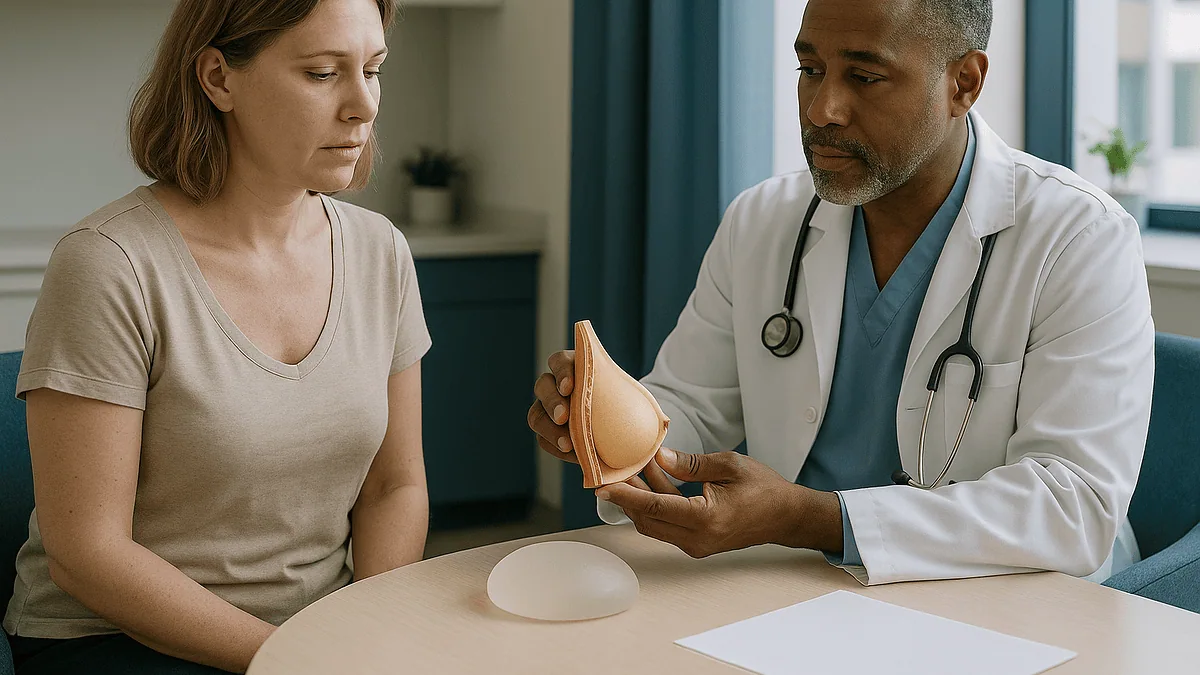
A combined breast lift and augmentation, also called augmentation mastopexy, reshapes and raises sagging breast tissue while placing an implant for volume, all under one anesthetic. Surgeons sometimes recommend it for people who have both lost fullness and developed drooping. It carries a higher revision rate than either procedure alone, so the choice between one operation and two staged operations should be made individually with the treating surgical team.
She had rehearsed the question in the parking lot. Two pregnancies and a long stretch of breastfeeding had left her breasts, in her words, emptier and lower than she remembered. The surgeon sketched two options on a notepad: a lift alone, or implants alone. She interrupted. Couldn’t he just do both at once?
That question sits at the heart of combined breast lift and augmentation surgery, a single operation that tries to solve two different problems at the same time. It is one of the most debated procedures in aesthetic breast surgery, not because it is exotic, but because the two halves pull in opposite directions. A lift tightens and removes skin. An implant stretches skin and adds weight.
This explainer walks through what actually happens in the operating room, who tends to be offered the one-stage approach, why some surgeons prefer two separate operations, what the recovery weeks look like, and what the evidence honestly shows about risk. Every decision, as always, belongs with the treating team.
What does combined breast lift and augmentation surgery actually involve?
Start with the two procedures on their own. A breast lift, known medically as mastopexy, removes excess skin and repositions the nipple higher on the chest wall so the breast sits where it used to. Breast augmentation places an implant behind the breast tissue or behind the chest muscle to add volume. Combined breast lift and augmentation surgery does both through the same incisions, during the same anesthetic, on the same day.
Inside the operating room the sequence matters. Most surgeons create the pocket for the implant first, because the implant changes the shape the skin will need to drape over. The implant, or a temporary sizer, goes in. Only then does the surgeon mark and cut the skin pattern for the lift, tailoring it around the new volume rather than guessing in advance. The nipple and areola, still attached to their blood supply through a bridge of tissue, are moved upward. Excess skin is trimmed, and the breast is closed in layers.
The incision pattern depends on how much lifting is needed. A small lift may use a cut around the areola only. A moderate lift adds a vertical line down to the fold under the breast, often described as a lollipop. A larger lift adds a horizontal cut along that fold, creating an anchor shape. According to Mayo Clinic, the extent of skin removal and the position of the nipple are the main things that determine which pattern is chosen.
The operation is done under general anesthesia, meaning you are fully asleep. NHS guidance for breast enlargement alone gives a typical operating time of 60 to 90 minutes; adding the lift extends that, and combined cases routinely take longer than either procedure would separately. Drains are sometimes placed to collect fluid, and a supportive surgical bra is fitted before you wake.
Why do a lift and implants at the same time when they pull in opposite directions?
Here is the tension that every surgeon weighs. A mastopexy works by removing skin and tightening what remains. An implant does the reverse: it adds weight and volume that the skin envelope has to accommodate. Tighten too much and the closure is under strain, which risks poor wound healing. Tighten too little and the lift disappears within months as the implant settles.

So why combine them at all? Because the two problems often arrive together. After pregnancy, breastfeeding, significant weight loss or simply years of gravity, many people notice both a loss of fullness in the upper breast and a downward drift of the nipple. The medical word for that drooping is ptosis. A lift alone restores position but can leave the upper breast looking flat. An implant alone restores volume but can leave the nipple pointing downward, sometimes even accentuating the sag by adding weight.
Doing both in one sitting has practical appeal. One anesthetic instead of two. One recovery period instead of two. One set of scars that the surgeon can plan around a known implant volume, rather than lifting first and hoping the skin later stretches evenly over an implant.
The counterargument is precision. When a surgeon lifts first and augments months later, each step can be judged on its own settled result. Swelling has resolved, the skin has found its final position, and the implant size can be chosen against reality rather than prediction. This is why the choice between one stage and two stages, covered below, is genuinely individual. Neither approach is right for everyone, and Mayo Clinic notes plainly that breast lift results are not permanent and that adding an implant is an option some people consider alongside or after a lift, not a default.
Who is usually offered breast lift with implants, and who is asked to wait?
Surgeons tend to consider a breast lift with implants when three things line up: the nipple sits at or below the fold under the breast, the upper breast has lost volume that the person wants restored, and overall health supports a longer operation. That combination is common after childbearing and after major weight loss, when the skin envelope has grown larger than the tissue inside it.
Equally important is who is asked to wait, and why.
- People planning further pregnancy or breastfeeding are usually advised to postpone. Mayo Clinic notes that pregnancy and breastfeeding can stretch the breasts again and reverse the result of a lift.
- People still actively losing weight are often asked to reach a stable weight first, because further loss deflates the breast and undoes the tailoring.
- People who smoke are asked to stop well before surgery. Nicotine narrows small blood vessels, and the nipple’s survival after a lift depends on a fragile blood supply through a narrow bridge of tissue. NHS guidance on cosmetic breast surgery is explicit that smoking increases the risk of complications.
- People with uncontrolled diabetes, bleeding disorders or certain autoimmune conditions may need optimization or a different plan.
- People with a strong family history of breast cancer or an abnormal recent screening result are typically referred for that to be fully evaluated first.
Age itself is not a bar, but skin quality is. Thin, stretched skin with little elasticity holds a lift less well and tolerates implant weight less well, so a surgeon may recommend a smaller implant, a lift alone, or staging.
Finally, realistic expectations matter as much as anatomy. The goal of this operation is improvement in shape and position, not a return to a specific age or a match to someone else’s photograph. A surgeon who slows the conversation down at this stage is doing their job.
One stage vs two stage breast lift: how surgeons decide, and what the alternatives are
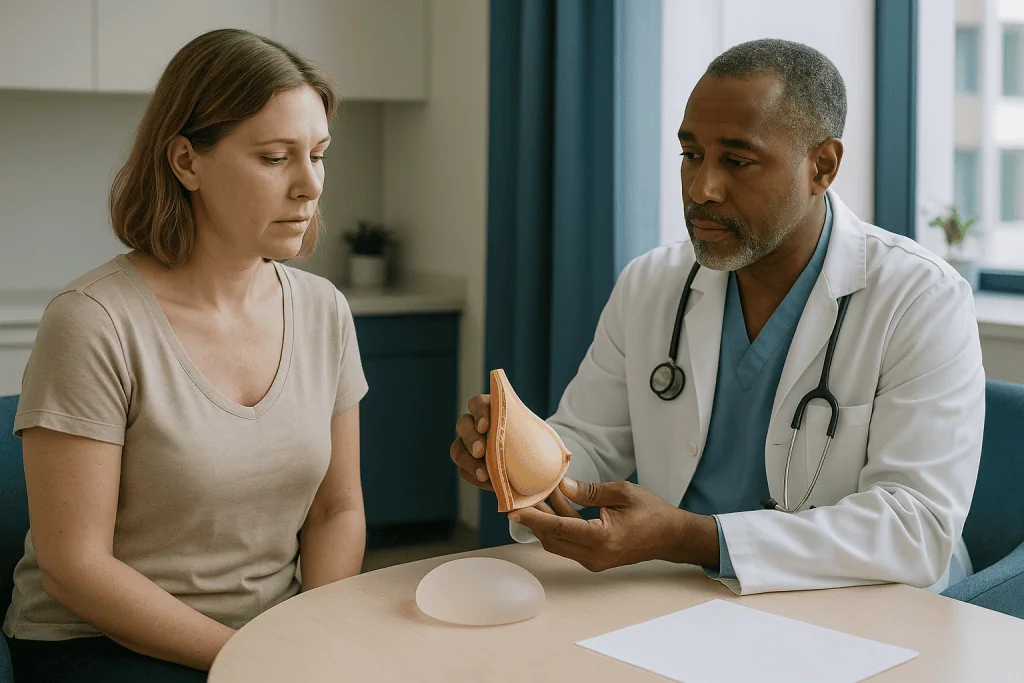
The single most consequential decision after choosing surgery at all is whether to do everything at once or to stage it. The table below lays out how the options typically compare, along with the alternatives that a thorough consultation should also cover.
| Option | What it addresses | Typical trade-offs |
|---|---|---|
| Combined lift and implants, one stage | Position and volume together | One anesthetic and one recovery; higher revision rate than either procedure alone; skin tension and implant weight must be balanced in one sitting |
| Lift first, implants later (two stage) | Position first, then volume once settled | Two operations and two recoveries; implant size chosen against a settled result; more months of waiting |
| Lift alone | Position and shape, no added volume | No implant-related risks or future replacement; upper breast may remain flatter than wished |
| Implants alone | Volume only | Shorter operation, fewer scars; does not correct a low nipple and may worsen sag over time if ptosis already exists |
| Fat transfer | Modest volume using your own fat | No implant; volume gain is modest and partly unpredictable because some transferred fat does not survive; no lifting effect |
| No surgery | Acceptance, supportive garments | No surgical risk; no change in shape or position |
Surgeons who favor one stage point to convenience and to the ability to shape skin around the actual implant. Those who favor two stages point to the higher rate of revision reported for combined procedures, especially when large lifts meet large implants. The degree of ptosis, the size of implant wanted, skin quality and the person’s tolerance for a second operation all feed into the decision.
What the evidence does not support is a blanket rule. Neither approach has been shown to be right for everyone, and any surgeon who says otherwise is giving you an opinion, not a finding. Ask which approach your surgeon uses most often and why they think it fits your anatomy.
What happens on the day of surgery?
The morning usually starts with photographs and markings. Standing, not lying down, the surgeon draws the planned incision lines, the new nipple position and the boundaries of the implant pocket on the skin with a marker. Gravity changes everything once you lie flat, so these upright marks become the map for the whole operation.
An anesthesiologist reviews your history, confirms you have followed fasting instructions, and places an intravenous line. General anesthesia is standard for combined breast lift and augmentation surgery because of the length of the procedure and the extent of tissue work. You will be asleep throughout and will not remember the operation.
While you are under, several safety steps run in the background. Compression devices on the calves squeeze rhythmically to keep blood moving and reduce the risk of a clot forming in the leg veins, known as deep vein thrombosis. Antibiotics are typically given before the first incision. The surgical team confirms implant type and size against the plan.
Afterward you wake in a recovery area wearing a surgical bra and, in some cases, with small drainage tubes exiting near the fold under each breast. Expect tightness across the chest and a feeling of pressure rather than sharp pain in the first hours. Nausea from anesthesia is common and is treated as it arises.
Where you sleep that night varies. NHS guidance describes breast enlargement alone as often a same-day discharge, while a breast lift more commonly involves at least one night in hospital. Combined cases sit somewhere in between and depend on how the operation went, how well pain and nausea are controlled, and whether drains are in place. You will need someone to drive you home and ideally to stay with you for the first night or two. The team will send you home with written instructions on wound care, when to shower, and which symptoms require a call.
What does augmentation mastopexy recovery look like in the first six weeks?
Recovery unfolds in overlapping phases rather than tidy steps, but a rough timeline helps set expectations. Every range below is a typical pattern drawn from NHS and Mayo Clinic guidance for breast surgery, not a promise for any individual.
Days one to three. Swelling, bruising and tightness dominate. Prescribed pain relief and anti-nausea medicine are used as directed by the surgical team. Drains, if placed, are usually removed within the first several days once output falls. Short walks around the home are encouraged from day one because movement is the simplest protection against clots. Sleeping on your back, propped up, is easier and protects the incisions.
Week one to two. Most people can return to a desk job in this window, in line with NHS guidance that gives one to two weeks off work for breast enlargement, with lift patients often needing the longer end. Lifting anything heavy, including toddlers and grocery bags, is generally off limits. Driving usually resumes when you can brake sharply without pain and are no longer taking sedating pain medicine.
Weeks two to six. Swelling begins to settle and the breasts, which often look high and firm at first, start to soften and drop into a more natural position. Incision lines are red and may feel firm to the touch. NHS guidance advises avoiding strenuous exercise and heavy lifting for around six weeks after breast surgery. Light cardio is often cleared earlier, but chest and upper body strength work waits.
Beyond six weeks. Final shape takes months, not weeks, and Mayo Clinic notes that scars from a breast lift continue to fade over one to two years. Nipple sensation may take just as long to settle. Follow-up appointments are scheduled to check healing and are the right place to raise anything that looks or feels different from what you were told to expect.
What risks come specifically from combining a lift with implants?
Every operation carries the general risks of anesthesia, bleeding, infection and clots. Combining two procedures adds a set of problems that come from the interaction between them, and honesty about these is what separates a good consultation from a sales pitch.
The first is wound healing at the point where incision lines meet. In an anchor-pattern lift, three lines converge at the fold under the breast. That junction has the poorest blood supply and the highest skin tension, and an implant sitting behind it adds outward pressure. Small areas of delayed healing or wound separation at this spot are a recognized complication of combined surgery.
The second is compromise to nipple blood supply. During a lift the nipple stays attached through a pedicle, a bridge of tissue carrying its blood vessels. Stretching that pedicle over an implant, especially a large one, can reduce flow. In rare cases partial or complete loss of nipple tissue can occur. Smoking raises this risk substantially, which is why surgeons are firm about it.
The third is asymmetry and the need for revision. Because skin removal, nipple position and implant volume are all being judged at once, small miscalculations show up months later as unevenness, a nipple that sits too high, or a lift that has stretched out over the implant. Published series and clinical reviews consistently report a higher revision rate for combined procedures than for lift or augmentation alone, though the exact figure varies widely between studies and surgical techniques.
Implant-related risks apply as well. Capsular contracture, in which the scar tissue that naturally forms around an implant tightens and hardens, can distort shape and cause discomfort. Implant rupture, rotation of shaped implants, and rippling visible through thin tissue are all described by Mayo Clinic as recognized complications of augmentation. A rare lymphoma associated with textured implants, known as BIA-ALCL, is discussed in a later section because it deserves its own explanation.
Which implant and placement decisions matter most in a combined operation?
Implant conversations tend to fixate on size. In a combined operation, three other decisions often matter more for the long-term result, and none of them has a single right answer.
Fill material. Implants are filled with either sterile saline or silicone gel. Mayo Clinic describes the practical difference: a saline implant that ruptures deflates visibly as the body absorbs the salt water, while a silicone rupture may be silent and detectable only on imaging. Silicone is generally described as feeling more like natural breast tissue. Both types are used in combined surgery, and the choice is a shared decision rather than a medical necessity in most cases.
Placement. An implant can sit under the breast tissue but on top of the chest muscle, called subglandular, or partly or fully behind the muscle, called submuscular. Behind the muscle there is more soft tissue covering the implant, which can reduce visible edges and may make mammograms somewhat easier to read. In front of the muscle the implant moves more naturally with the breast and avoids the animation that can occur when the chest muscle contracts. In a lift, where tissue is being tightened, the placement also affects how the implant and the lifted tissue settle relative to each other.
Surface and shape. Implants come with smooth or textured shells and in round or anatomical teardrop shapes. Textured surfaces were developed to reduce capsular contracture and rotation, but they are the type linked to the rare lymphoma discussed later. Shaped implants can rotate, which is a specific complication smooth round implants do not have.
Size sits last for a reason. In combined surgery a larger implant means more skin tension, more weight pulling on the lift and a higher chance the result stretches out. Many surgeons steer toward moderate volumes precisely to protect the lift. Sizers tried under the surgical bra during consultation help, but the final decision is a negotiation between what you want and what your tissue can hold.
What happens to scars, nipple sensation and breastfeeding?
Three questions come up in almost every consultation, and the answers deserve plain language.
Scars. A combined operation leaves the scars of a lift, not the small hidden incision of augmentation alone. Depending on the pattern, that means a ring around the areola, possibly a vertical line to the fold, and possibly a horizontal line in the fold. Mayo Clinic notes that these scars are permanent but usually fade and soften over one to two years. They are generally placed where a bra or swimwear covers them. People with a personal or family history of thick, raised scars, called keloids or hypertrophic scars, should raise this before surgery because it changes how the surgeon plans and manages incisions.
Nipple sensation. The nerves supplying the nipple travel through the tissue that is cut and moved during a lift, and an implant pocket disturbs them further. Temporary numbness or, less commonly, heightened sensitivity is expected. Mayo Clinic lists changes in nipple and breast sensation as a recognized complication of both augmentation and lift, and while sensation often returns over months, some people experience permanent change. Anyone for whom nipple sensation is central to their wellbeing should say so explicitly.
Breastfeeding. Milk ducts run from the glandular tissue to the nipple, and a lift that moves the nipple can divide some of them. Implants placed behind the muscle disturb the ducts less than those placed in front. Both Mayo Clinic and NHS guidance note that breastfeeding after these procedures is possible for many people but cannot be guaranteed, and that milk supply may be reduced. Because pregnancy and breastfeeding can also reverse the result of a lift, most surgeons recommend completing your family first. If that is not your plan, the conversation about which techniques best preserve duct and nerve pathways should happen before, not after, surgery.
How long do results last, and will another operation be needed?
Two separate clocks run after combined surgery, and it helps to keep them apart.
The first is the lift. Mayo Clinic is direct on this point: breast lift results are not permanent. Skin continues to age and lose elasticity, gravity continues to act, and weight change or pregnancy can stretch the tissue again. A lifted breast will, over years, gradually descend. Adding an implant introduces extra weight on that tightened skin, which is one reason surgeons often favor moderate implant volumes in combined cases. How quickly the lift relaxes depends heavily on skin quality, implant weight and life events, none of which can be forecast precisely.
The second clock is the implant. Mayo Clinic states that breast implants are not guaranteed to last a lifetime and gives an average lifespan of about ten years, with rupture risk rising the longer an implant is in place. NHS guidance likewise tells people that implants will likely need replacing at some point. That means anyone having combined surgery in their thirties should expect at least one further operation in their lifetime, whether to replace or remove an implant, to address capsular contracture, or to tighten skin that has relaxed.
Neither clock is a reason to avoid surgery; they are simply part of the informed decision. What they argue against is the idea of a single, final procedure. A more useful mental model is a long relationship with your surgical team, with periodic check-ins, imaging as advised, and a willingness to act if something changes.
Follow-up is also where problems are caught early. A breast that becomes firmer, higher, or differently shaped than its partner months or years later may be signaling capsular contracture or a rupture. These are not emergencies in the way infection is, but they are reasons for an appointment rather than a wait-and-see approach.
Do implants change breast cancer screening and follow-up imaging?
Yes, in two ways, and both should be understood before surgery rather than discovered at a first mammogram afterward.
The first concerns routine breast cancer screening. Mayo Clinic notes that implants can make mammograms harder to interpret because the implant can obscure part of the breast tissue. Radiologists compensate with additional views, using a technique that gently pushes the implant back against the chest wall so more tissue can be imaged. Tell the imaging center about your implants when booking so the appointment is scheduled with those extra views. Implants placed behind the muscle generally interfere less with mammography than those placed in front. Screening does not stop because of implants, and it should follow the same schedule your doctor recommends for anyone of your age and risk profile.
The second concerns the implant itself. Silicone implants can rupture without any change you would notice, a so-called silent rupture. Mayo Clinic explains that imaging, either MRI or ultrasound, is the way such ruptures are detected, and that periodic surveillance imaging is recommended for people with silicone implants. How often depends on the implant, the time since surgery and your surgeon’s protocol; ask for a written plan.
A third topic sits alongside these. Breast implant-associated anaplastic large cell lymphoma, shortened to BIA-ALCL, is a rare cancer of the immune system that develops in the scar capsule around an implant, not in the breast tissue itself. Mayo Clinic describes it as rare and as linked mainly to textured-surface implants. It typically presents years after surgery as swelling from fluid around the implant, or occasionally a lump. It is generally treated by removing the implant and its capsule. The absolute risk is low, but it is a reason that any new, persistent swelling around an implant, even many years later, warrants prompt evaluation rather than reassurance from a search engine.
What people often get wrong about combined breast lift and augmentation surgery
Misunderstandings cluster around a few themes, and correcting them changes the conversation you will have with a surgeon.
“An implant alone will lift my breasts.” It will not, at least not for true ptosis. An implant adds volume and can give an illusion of fullness, but it does not move the nipple. If the nipple already sits at or below the fold, an implant alone often makes the breast look larger and lower. Mayo Clinic frames the lift and the augmentation as addressing different problems for exactly this reason.
“One operation is always better than two.” It is more convenient, and for many people it is the right call. It is not universally safer. Combined procedures carry a higher revision rate than either component alone, and for large lifts with large implants some surgeons believe staging gives a more reliable result. Convenience is a legitimate factor; it is not a clinical trump card.
“Bigger implants make a better lift.” The opposite is closer to true. More weight on tightened skin accelerates the descent the lift was meant to correct. Surgeons who recommend a smaller implant in a combined case are usually protecting the lift, not being conservative for its own sake.
“Scars will be invisible.” A lift leaves permanent scars. They fade over one to two years, per Mayo Clinic, and sit in areas covered by clothing, but they do not vanish.
“Once it’s done, it’s done.” Implants have a finite lifespan, and lifts relax with time. Planning for a future operation is realism, not pessimism.
“Implants cause breast cancer.” Large population studies have not shown that breast implants increase the risk of breast cancer. The rare lymphoma BIA-ALCL is a distinct condition of the implant capsule and is discussed above. What implants do change is how screening is performed.
Questions to ask your care team before agreeing to surgery
A consultation works best as an interview in both directions. Bring these questions, and pay as much attention to how they are answered as to what is said.
- Based on my anatomy, do you recommend one stage or two, and what specifically about my skin, nipple position or implant size drives that?
- How often do you perform combined breast lift and augmentation surgery compared with each procedure alone, and what is your own revision rate for it?
- Which incision pattern are you planning, and can you show me where each scar will sit on my body?
- What implant fill, surface, shape and placement are you suggesting, and what would change your mind on each?
- What is the largest implant you would be comfortable placing in my case, and why is that the ceiling?
- How will this affect my nipple sensation and my ability to breastfeed if I later choose to?
- What is the plan for imaging surveillance of the implants, and how will my routine breast cancer screening change?
- What happens if a wound does not heal well at the junction of the incisions, and how is that managed?
- What are the exact signs that should make me call you, and who answers that call at night or on a weekend?
- What would you expect this to look like in ten years, and what further surgery might I need?
Two further points are worth raising even if they feel awkward. Ask whether the surgeon holds board certification in plastic surgery and whether the facility where the operation takes place is accredited for the level of anesthesia planned. Ask, too, for a written summary of the plan, including implant details, so you have a record for future clinicians. A team that welcomes these questions is a team you can work with over the years an implant will be part of your life.
When to call your doctor after a combined breast lift and augmentation
Most recovery days are uneventful: tightness, bruising, fatigue and impatience. A small number of symptoms signal problems that need a same-day call or an emergency visit, and knowing them in advance removes the guesswork.
Call your surgical team the same day if you notice one breast becoming markedly more swollen, tight or painful than the other, especially within the first days. This can indicate a hematoma, a collection of blood under the skin that may need to be drained. Call if the skin around an incision becomes increasingly red, hot or hard, if there is pus or a foul smell from a wound, or if you develop a fever. These are the signs of infection, and an infection around an implant is treated urgently because it can be difficult to clear while the implant remains.
Call promptly if a nipple or the skin around it turns pale, dusky, purple or very dark, or feels cold compared with the other side. This may indicate compromised blood supply and is time-sensitive. Call if an incision opens, if fluid leaks persistently from a wound, or if a drain stops working or its output suddenly changes.
Seek emergency care immediately, without waiting for a callback, if you develop chest pain, sudden shortness of breath, coughing up blood, or a swollen, painful calf. These can signal a blood clot that has traveled to the lungs, a recognized and serious complication after any surgery under general anesthesia. Severe bleeding that soaks dressings, or confusion and fainting, also warrant emergency services.
In the months and years after surgery, book a non-urgent appointment for a breast that becomes firmer or changes shape, for new lumps, or for persistent swelling around an implant. These may point to capsular contracture, rupture or, rarely, BIA-ALCL. Your team would rather see you for a false alarm than miss something treatable. Every one of these situations is a decision for the treating clinicians, not for the internet.
Frequently asked questions
Can you get a lift and implants at the same time?
Yes, a lift and implants can be performed in a single operation known as augmentation mastopexy. Surgeons offer it when someone has both a low nipple position and lost upper breast volume. Whether one stage is right for you depends on the degree of sag, the implant size you want and your skin quality, and some surgeons recommend two separate operations for larger corrections.
What is the difference between one stage vs two stage breast lift with implants?
One stage means the lift and the implant placement happen during the same operation. Two stage means the lift is done first and the implant is added months later once swelling has settled and the skin has found its final position. One stage means a single recovery; two stage allows implant size to be chosen against a settled result and is sometimes preferred for large lifts.
How long is augmentation mastopexy recovery?
Most people return to desk work within one to two weeks and avoid strenuous exercise and heavy lifting for around six weeks, in line with NHS guidance for breast surgery. Swelling settles over several months, and scars continue to fade over one to two years according to Mayo Clinic. Final shape and nipple sensation can take months to stabilize, so patience is part of the plan.
Is breast lift with implants riskier than either procedure alone?
Combined surgery carries all the risks of each procedure plus problems from their interaction, including wound healing issues where incisions meet, strain on the nipple’s blood supply, and a higher revision rate for asymmetry or a lift that stretches over the implant. Published rates vary widely between studies and techniques, so ask your surgeon about their own experience with the combined operation.
Will an implant alone lift sagging breasts?
No, an implant adds volume but does not move the nipple. If the nipple already sits at or below the fold under the breast, an implant alone often makes the breast look larger and lower rather than lifted. Restoring nipple position requires a mastopexy, which is why surgeons assess how far the breast has descended before recommending implants on their own.
What scars does a combined breast lift and augmentation leave?
The scars are those of the lift, not the small incision of augmentation alone. Depending on how much lifting is needed, they include a ring around the areola, sometimes a vertical line to the breast fold, and sometimes a horizontal line along the fold. Mayo Clinic notes these scars are permanent but usually fade over one to two years and sit where clothing covers them.
Can I breastfeed after a lift with implants?
Many people can, but it cannot be guaranteed and supply may be reduced. A lift moves the nipple and can divide some milk ducts, and implants placed in front of the muscle disturb ducts more than those placed behind it. Because pregnancy and breastfeeding can also reverse a lift, most surgeons suggest completing your family first; if that is not your plan, discuss duct-preserving techniques beforehand.
How long do implants last after combined surgery?
Mayo Clinic states that implants are not guaranteed to last a lifetime and gives an average lifespan of about ten years, with rupture risk rising over time. NHS guidance likewise tells people that implants will likely need replacing at some point. The lift itself also relaxes gradually with aging, gravity and weight change, so a further operation at some stage is a realistic expectation.
Do breast implants affect mammograms?
Yes. Implants can obscure part of the breast tissue, so radiologists take additional views that push the implant back to image more tissue, according to Mayo Clinic. Screening continues on the same schedule your doctor recommends for your age and risk. Tell the imaging center about your implants when booking, and ask your surgeon for a separate plan for imaging the implants themselves.
What are warning signs after a combined breast lift and augmentation?
Same-day calls are warranted for one breast becoming much more swollen or painful than the other, spreading redness or heat around incisions, pus, fever, an opening wound, or a nipple turning pale or dark. Chest pain, sudden breathlessness or a swollen painful calf are emergencies because they can signal a blood clot. Later firmness, shape change or swelling around an implant needs a non-urgent appointment.
References
This article is for general information only and is not a substitute for professional medical advice. Please consult a qualified doctor about your individual situation.

More from the Blog

Reading a Breast Aesthetics Surgical Plan: Measurements, Options and Questions to Raise
A breast aesthetics surgical plan usually lists your chest and breast measurements, the surgeon's proposed technique, and the alternatives that were considered. Reading it…

Preparing for Breast Augmentation: Imaging, Medication Review and the Final Sizing Visit
Preparing for breast augmentation usually involves three steps spread over several weeks: a baseline breast imaging review if you are of screening age or…

How Long Do Breast Implants Last? Lifespan, Monitoring and When Replacement Is Discussed
Breast implants are not lifetime devices, but they do not expire on a fixed schedule. Many last 10 to 20 years or more, and…

How DIEP Flap Breast Reconstruction Works: Abdominal Tissue, Microsurgery and Operating Time
DIEP flap breast reconstruction rebuilds a breast using skin and fat from the lower abdomen while leaving the abdominal muscle in place. Surgeons trace…

When Is Gynaecomastia Treatment Considered? Watchful Waiting, Causes Checked and Surgery
Gynecomastia treatment is usually considered only after three things have happened: a doctor has confirmed the swelling is glandular breast tissue rather than fat,…

Questions to Ask Before Breast Reconstruction: Stages, Symmetry Surgery and Nipple Options
Before breast reconstruction, ask your plastic surgeon which technique suits your body and cancer treatment (implant or your own tissue), whether reconstruction should happen…