

How Doctors Assess a Febrile Seizure: Finding the Fever Source and When Tests Are Added

Key Takeaways
- A febrile seizure is diagnosed from the history and examination, not from any laboratory test, and the first job is finding the infection behind the fever.
- The simple-versus-complex split (whole body, under 15 minutes, once in 24 hours) determines whether routine tests are skipped or individually considered.
- For a simple febrile seizure in a well, immunized child, guidelines advise against routine blood tests, EEG, and CT or MRI because results do not change care.
- A lumbar puncture is performed when meningitis signs are present and considered in under-immunized infants aged 6 to 12 months or children recently on antibiotics.
- An EEG recorded soon after a febrile seizure is often mildly abnormal yet does not predict recurrence or epilepsy, which is why it is reserved for complex cases.
- About one in three children will have another febrile seizure, usually within one to two years, and simple febrile seizures are not linked to brain damage.
Doctors assess a febrile seizure mainly by taking a careful history and examining the child to find the fever's cause. For a simple febrile seizure in a well-appearing child, guidelines advise against routine blood tests, EEG, or brain imaging. Lumbar puncture is considered only when meningitis signs, incomplete immunization, recent antibiotics, or a complex or prolonged seizure raise concern.
The call usually comes in the voice of someone who has just watched the longest ninety seconds of their life. A toddler, warm with a cold since breakfast, went stiff on the living-room rug, jerked, then slept. Now the family is in a curtained bay, and the question is not really “what was that?” but “what are you going to do to find out?”
Here is the part that surprises many parents: the answer to “which febrile seizure evaluation tests are needed?” is often “very few, and sometimes none.” The most useful instrument in the room is a clinician’s hands and eyes, working through a methodical search for the fever’s source. Tests get added in specific, well-defined situations, not as a reflex.
This explainer walks through that pathway: what the examination is really looking for, which children are examined and sent home, which are asked to stay, and why a spinal tap, a brain-wave recording, or a scan is sometimes on the table and more often is not.
What happens during febrile seizure evaluation tests in the emergency department?
The sequence is quieter than most families expect. First comes a rapid check that the child is breathing comfortably, has a steady pulse, and is waking up. Most children are drowsy for a while after a seizure, a state clinicians call the postictal period, and the team watches the direction of travel: is the child becoming more alert minute by minute, or not?
Then the history begins, and it is the single most valuable test on offer. The clinician wants to know how long the shaking lasted, whether it involved the whole body or one side, whether it happened once or more than once, and how long before the child seemed like themselves again. They ask about the fever: when it started, how high, and what other symptoms came with it, from runny nose to earache to vomiting. They ask about immunizations, recent antibiotics, family history of febrile seizures or epilepsy, and whether anything about the child’s development has worried anyone.
The examination follows. A full top-to-toe check looks for the source of the fever (ears, throat, chest, skin, abdomen, and in younger children the urine) and for anything that does not belong in an ordinary viral illness, such as a stiff neck, a bulging soft spot on the skull, an unusual rash, or weakness on one side.
Only after that does the question of tests arise. The guiding principle from both US and UK sources is that a febrile seizure is a clinical diagnosis, made by recognizing a familiar pattern, rather than a laboratory one. The Mayo Clinic describes the diagnostic goal plainly: confirm the seizure fits the febrile pattern, and identify the infection behind the fever.
Simple vs complex febrile seizure: why this one distinction drives the whole workup
Almost every decision that follows hinges on a two-word label. A febrile seizure is a convulsion triggered by fever in a child without a brain infection or prior epilepsy, and it is sorted into one of two categories.
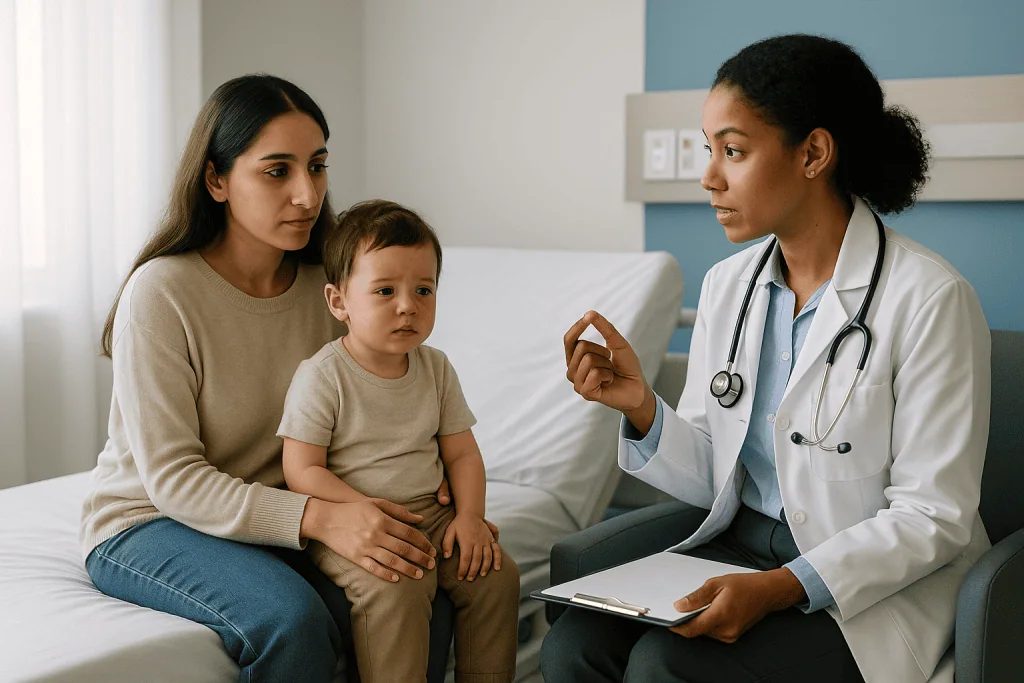
A simple febrile seizure involves the whole body, lasts less than 15 minutes, and does not recur within 24 hours. A complex febrile seizure breaks at least one of those three rules: it is focal (affecting one side or one part of the body), lasts 15 minutes or longer, or happens more than once in the same 24-hour illness. Those definitions are used consistently by the National Institute of Neurological Disorders and Stroke and the Mayo Clinic.
| Feature | Simple febrile seizure | Complex febrile seizure |
|---|---|---|
| Pattern | Whole body | Focal, or whole body |
| Duration | Under 15 minutes | 15 minutes or longer |
| Recurrence in 24 hours | None | One or more repeats |
| Typical share | Large majority | Minority |
| Usual testing | Fever-source search only | Individualized; more tests considered |
Why does this matter so much? Because the research base for “no routine tests” was built on children with simple febrile seizures who were otherwise well. The reassuring numbers, such as a low chance of later epilepsy and no evidence of brain injury, belong to that group. Once a seizure is complex, the clinician cannot lean on those studies in the same way and has to reason case by case.
Parents are often the only witnesses, which is why the history questions are so detailed. If you are unsure whether one side moved more than the other, say so. “I don’t know” is more useful than a guess, and clinicians plan around uncertainty all the time.
Who is usually examined and sent home, and who is asked to wait
The child most likely to be discharged after an examination alone looks something like this: between about six months and five years old, up to date on immunizations, back to normal alertness within an hour or so, with a simple seizure and an obvious viral cause for the fever such as a cold, a sore throat, or an ear infection. The NHS notes that most febrile seizures are harmless and that children usually recover fully, and this profile matches the group in which that holds true.
Several features move a child into the “please stay a while” column. Age is one. Children under about 12 months are harder to assess for meningitis because the classic signs, stiff neck and the inability to tolerate light, are often absent or unreliable in infants; the soft spot on the skull and general irritability carry more weight, and the threshold for further tests is lower. Age at the other end matters too: a first febrile seizure after five years, or any seizure in a child younger than six months, prompts a broader search for other explanations.
Timing is another. A child who is still very sleepy, confused, or not interacting an hour after the event, or who seems to be slipping rather than improving, is observed longer, and further tests become more likely with each passing minute of no improvement.
Then there is the fever itself. If the examination finds no source, or if the child has been on antibiotics in recent days (which can blunt the usual signs of a serious bacterial infection), the clinician has less to reassure them and more reason to look harder.
None of this is a verdict. A longer stay is usually a period of watching, and watching is itself a diagnostic tool.
Finding the fever source: why the physical examination comes before any test
Think of the fever as the clue and the seizure as the alarm. The alarm has already gone off; the useful work is in tracing the clue. Fevers in young children overwhelmingly come from common viral infections, and the MedlinePlus encyclopedia lists ordinary childhood infections such as colds, flu, ear infections, and roseola among typical triggers.

So the clinician looks where those infections live. An otoscope in each ear checks for a red, bulging eardrum. A tongue depressor and light reveal a sore throat or swollen tonsils. A stethoscope on the chest listens for the crackles of pneumonia or the wheeze of a viral chest infection. The skin is scanned for the fine rash of a viral illness, the sandpaper feel of scarlet fever, or, most importantly, the purple pinpoint spots that do not fade under pressure and can signal a bloodstream infection.
Younger children get an extra step: the urine. Urinary tract infections are a common hidden fever source in infants and toddlers who cannot say where it hurts, and a urine sample is one of the few tests many clinicians will collect even when everything else looks straightforward. It is not really a seizure test at all; it is a fever test that happens to be relevant.
The neurological part of the exam runs alongside. Does the child move all four limbs equally? Do they fix their gaze on a parent and follow a toy? Is the neck supple when gently flexed? In a baby, is the fontanelle, the soft diamond on the top of the head, flat rather than tense?
When this search ends with a clear, benign source and a child who is perking up, the testing conversation is often over. When it ends with nothing found, the conversation continues.
Which febrile seizure evaluation tests are used to diagnose it?
Here is the honest answer to one of the most-searched questions on this topic: there is no test that diagnoses a febrile seizure. The diagnosis is made by matching the story and the examination to a well-recognized pattern, then ruling out the conditions that can imitate it. Tests exist to do the ruling out, and they are ordered only when something in the story or exam raises the odds of an imitator.
The imitators the clinician has in mind are a short list. Meningitis, an infection of the membranes around the brain and spinal cord, and encephalitis, an infection of the brain tissue itself, are the ones that cannot be missed. Low blood sugar or a severe salt imbalance can cause seizures in a feverish, vomiting child who has stopped drinking. A first unprovoked epileptic seizure can happen to coincide with a fever. Rarely, a head injury or a structural problem in the brain declares itself during an illness.
Each of those has a different test, which is why there is no single “seizure panel.” Meningitis is diagnosed by examining spinal fluid. Blood sugar is checked with a fingerprick. Salt levels need a blood sample. Epilepsy is investigated, if at all, with an electroencephalogram (EEG), a painless recording of the brain’s electrical activity through scalp sensors. Structural problems need imaging.
The Cleveland Clinic summarizes the mainstream position: a provider diagnoses a febrile seizure based on the child’s history and a physical examination, and may order tests to find the source of the fever or to rule out other causes. The word “may” is doing real work in that sentence. For a simple febrile seizure in a child who looks well, the expected number of tests is close to zero.
What labs should be ordered for a seizure workup, and when the answer is none
Parents sometimes feel short-changed when no blood is drawn. It can look like the team is not taking the event seriously. The opposite is usually true: skipping routine bloodwork in a simple febrile seizure reflects decades of evidence that those results almost never change what happens next.
The American Academy of Pediatrics guideline on simple febrile seizures in children between six months and five years states that routine blood tests, including electrolytes (the body’s salts such as sodium), calcium, glucose, and a complete blood count, should not be performed solely to find the cause of the seizure. The reasoning is simple. In a child who is awake, drinking, and recovering, abnormal results are rare, and when they occur they are usually explained by the illness rather than being the reason for the seizure.
That said, “not routine” is not “never.” A blood sugar check is quick and reasonable in a child who is still drowsy, who has been vomiting, or who has not eaten for a long stretch. Electrolytes are considered when there is a history of heavy diarrhea, poor fluid intake, or signs of dehydration, because a very low sodium can itself trigger seizures. A blood count or blood culture may be drawn as part of the fever workup in an infant whose source cannot be found, which again is a fever decision rather than a seizure decision.
If labs are taken, the timelines are predictable. A fingerprick glucose reads in under a minute. Electrolytes and a blood count typically return within an hour or two in most emergency settings. A blood culture, which looks for bacteria growing in the bloodstream, takes one to two days to give a meaningful result and is one reason some infants are kept under observation or asked to return.
Ask what any proposed blood test is meant to answer. A good team can tell you in a sentence.
Lumbar puncture for a febrile seizure: when a spinal tap is considered
Few words in a pediatric emergency department land harder than “spinal tap.” A lumbar puncture is a procedure in which a thin needle is placed between the bones of the lower back to collect a small sample of cerebrospinal fluid, the clear liquid that cushions the brain and spinal cord. The sample is examined for white cells, bacteria, protein, and sugar, which together can confirm or exclude meningitis within hours.
The guidance on when to do it has become more targeted over time. The Mayo Clinic and the American Academy of Pediatrics describe the same decision points:
- A lumbar puncture should be performed when the child has signs or symptoms suggesting meningitis: a stiff neck, a bulging fontanelle, persistent irritability or lethargy, a non-fading rash, or an abnormal neurological examination.
- It is an option in infants between six and twelve months who have not received their immunizations against Haemophilus influenzae type b and pneumococcus, or whose immunization status cannot be confirmed, because those two bacteria were historically the leading causes of meningitis in this age group.
- It is an option when the child has been treated with antibiotics in the preceding days, since antibiotics can partially treat meningitis and hide its usual signs.
Outside those situations, in a well-appearing, immunized child with a simple febrile seizure, a lumbar puncture is not recommended, because the chance of meningitis without any of those features is very low.
Complex seizures, especially prolonged or focal ones, do not carry an automatic rule; clinicians weigh them individually, and a lumbar puncture is more likely to be discussed.
The procedure itself takes around fifteen to thirty minutes including positioning. Children are held curled on their side or sitting, local numbing is used, and a parent can often stay. Headache and local soreness are the common aftereffects; serious complications are rare. The decision, including whether to wait and observe instead, sits with the treating team.
Febrile seizure EEG: why a brain-wave test is usually not ordered
An electroencephalogram records the brain’s electrical rhythms through small sensors glued to the scalp. It is painless, takes roughly 20 to 60 minutes, and is the test families most often expect after any seizure. For a simple febrile seizure, it is almost never useful.
The reason is a mismatch between what the test can show and what the clinician needs to know. An EEG recorded in the days after a febrile seizure is frequently a little abnormal, with slowing or irregular patterns, simply because the brain has just been through a fever and a convulsion. Those findings do not predict whether the child will have another febrile seizure, and they do not predict future epilepsy with any reliability. The American Academy of Pediatrics guideline therefore recommends against EEG in a neurologically healthy child with a simple febrile seizure, and the NINDS notes that most children do not require it.
An EEG may be requested in different circumstances. If a seizure was focal, lasted a long time, or recurred repeatedly in one illness, a pediatric neurologist may want a recording to look for a specific pattern that would change the diagnosis. If the child already had developmental concerns or an abnormal neurological examination, the same applies. If a seizure happened without a clear fever, the question becomes whether this was an unprovoked seizure, and an EEG is a standard part of that separate pathway.
When an EEG is arranged, it is usually done as an outpatient appointment in the following weeks rather than during the emergency visit, because a recording taken immediately after a seizure is harder to interpret. Families are sometimes asked to keep the child a little sleep-deprived beforehand, since drowsiness brings out patterns that are hidden when wide awake. The clinic will explain the preparation; it varies by center and by the child’s age.
Brain imaging after a febrile seizure: when CT or MRI enters the picture
A scan feels like certainty, and that is precisely why it is worth understanding how rarely it adds anything here. A computed tomography (CT) scan uses X-rays to build cross-sectional pictures of the brain in a few minutes; magnetic resonance imaging (MRI) uses magnetic fields, takes longer, and shows soft tissue in finer detail without radiation.
For a simple febrile seizure, neither is recommended. The American Academy of Pediatrics guideline is explicit that neuroimaging should not be performed routinely, and the Mayo Clinic describes imaging as reserved for situations such as an unusually large head, an abnormal neurological examination, or signs of raised pressure inside the skull. The logic is twofold. Structural brain problems are extraordinarily unlikely to announce themselves for the first time as a brief, generalized seizure during an ordinary fever in a developmentally normal child. And CT carries a radiation exposure that matters more in small children, while MRI typically requires sedation at this age; both carry costs in time and risk that are not justified by the tiny chance of finding something.
Imaging moves up the list in a narrower set of cases. A focal seizure, especially with weakness on one side afterward, raises the question of a localized cause. A seizure that will not stop, or a child who remains unresponsive well beyond the expected postictal period, needs an explanation. A history of head injury, a known neurological condition, or a bulging fontanelle changes the calculation. In those cases a CT is often the first study because it is fast and available around the clock, with an MRI arranged later if more detail is needed.
If no scan is done, it is not because the team ran out of options. It is because the evidence says the picture would almost certainly be normal, and a normal picture would not have changed the plan.
What are the American Academy of Pediatrics guidelines for evaluating febrile seizures?
Searches for this question are common, and the short version is reassuringly consistent. The American Academy of Pediatrics published a clinical practice guideline on the neurodiagnostic evaluation of a child with a simple febrile seizure, covering neurologically healthy children between six months and five years. It is the backbone of practice in the United States, and its recommendations are echoed by the NINDS, the Mayo Clinic, and the Cleveland Clinic.
| Question | Guideline position for a simple febrile seizure | Strength of evidence |
|---|---|---|
| Lumbar puncture if meningeal signs present | Should be performed | Strong recommendation |
| Lumbar puncture, age 6–12 months, under-immunized or unknown status | An option; clinician judgment | Option |
| Lumbar puncture if recently on antibiotics | An option; clinician judgment | Option |
| EEG | Should not be performed | Strong recommendation |
| Routine blood tests (electrolytes, glucose, blood count) | Should not be performed to find the seizure cause | Strong recommendation |
| Neuroimaging (CT or MRI) | Should not be performed | Strong recommendation |
Two things are easy to miss when reading the table. First, every recommendation applies to simple febrile seizures only. The guideline deliberately does not cover complex seizures, children under six months, or children with pre-existing neurological conditions, and in those groups the evaluation is individualized rather than templated.
Second, “should not be performed” does not mean “may never be performed.” The guideline directs clinicians away from reflexive testing; it does not forbid a test when the examination finds a specific reason for one. A team that orders a blood sugar in a drowsy, vomiting toddler is not breaking the guideline. A team that orders an EEG and a scan on every child with a brief febrile convulsion is practicing outside it.
If you want to understand a team’s reasoning, ask which of these boxes your child fits. The answer usually explains the whole plan.
How the febrile seizure workup changes when the seizure was complex or prolonged
Most of this article has described restraint. This section is about the children for whom restraint gives way to a more active search, and why.
A seizure lasting 15 minutes or longer, a seizure that affected one side, or two or more seizures in the same illness each tell the clinician that the usual reassurance does not fully apply. The NINDS notes that complex features are associated with a somewhat higher chance of later epilepsy than simple seizures, though the absolute risk remains low for most children, and a very prolonged febrile seizure, described as febrile status epilepticus when it continues for 30 minutes or more, is the scenario where the evaluation widens most.
In practice, a complex febrile seizure does several things to the plan. The observation period lengthens, often to several hours, so the team can confirm the child returns fully to baseline. The threshold for a lumbar puncture drops, particularly if the child is young, still drowsy, or has no obvious fever source. Blood glucose and electrolytes are more likely to be checked, since a prolonged seizure can itself disturb them. If there was focal weakness, imaging is discussed. An outpatient EEG and a follow-up with a pediatric neurologist are commonly arranged, not because epilepsy is expected, but because a specialist can watch the pattern over time.
A prolonged seizure that is still happening on arrival triggers a different sequence altogether. Stopping the seizure comes first, with medicines from the benzodiazepine class that calm overactive brain signaling; those are given by the emergency team according to their protocols, and the diagnostic work follows once the child is stable. Families are not asked to make decisions in that moment, and should not feel they have missed one.
What has not changed is the destination. Even after a complex febrile seizure, most children are found to have an ordinary infection and recover completely. The wider workup is a way of earning that conclusion rather than assuming it.
What the following days and weeks usually look like after a febrile seizure
Discharge is rarely the end of the story, but the next chapter is usually undramatic. Here is the typical shape of it.
The first 24 hours are about the infection, not the seizure. The child is often tired and clingy, which is partly the illness and partly the aftermath of the convulsion. Fever may continue for a few days depending on the cause; the NHS advises comfort measures, fluids, and watching for signs the child is getting worse. Fever-reducing medicines may make the child more comfortable, but they are not given to prevent another seizure, because the evidence shows they do not reliably do so; whether and how to use them is a conversation for your child’s clinician.
Within the same illness, a repeat seizure is possible and is one reason the discharge advice emphasizes knowing what to do: lie the child on their side, time the event, do not put anything in the mouth, and call emergency services if it passes five minutes.
Over the following weeks, most families have one follow-up contact with their child’s regular clinician. For a simple febrile seizure, that visit is usually a check-in and a chance to ask questions; no further tests are expected. For a complex seizure, this is when an outpatient EEG or a neurology appointment typically falls, often within a few weeks of the event.
Over the following years, the main question is recurrence. The NINDS reports that roughly one in three children who have a febrile seizure will have at least one more, most often within one to two years of the first, and that the chance is higher in children who were younger at the first seizure or who have a family history. The great majority stop having them by school age as the brain matures.
What people often get wrong about febrile seizure testing
Myths cluster around frightening events, and febrile seizures have collected a full set. A few deserve direct correction.
“The rule of 3 tells you what’s dangerous.” There is no “rule of 3” in any major guideline on febrile seizures. The phrase circulates online with shifting meanings. The actual thresholds that clinicians use are different numbers: 15 minutes separates simple from complex, 24 hours defines recurrence within one illness, 30 minutes marks febrile status epilepticus, and 5 minutes is when the NHS says to call emergency services during an ongoing seizure. The one place a “3” genuinely appears is in the recurrence figure of about one in three.
“A higher fever means a more serious seizure.” The height of the temperature does not predict whether a seizure will be simple or complex, nor how a child will do afterward. Seizures often strike as the temperature is rising, sometimes before anyone has noticed a fever at all, as the MedlinePlus encyclopedia notes.
“No tests means they missed something.” Restraint here is the evidence-based choice. Guidelines steer away from routine blood tests, EEG, and imaging because they do not change outcomes in simple febrile seizures.
“The seizure damaged my child’s brain.” The NINDS states that simple febrile seizures do not cause brain damage, intellectual disability, or learning problems, and that most children who have them grow up with no neurological consequences.
“This means epilepsy.” The risk is modestly raised compared with children who never had a febrile seizure, but remains low for most, and higher chiefly in those with complex seizures, pre-existing developmental differences, or a family history of epilepsy.
“Giving fever medicine on schedule will prevent the next one.” Studies have not shown that scheduled fever reducers prevent febrile seizures. They are for comfort, and the decision on using them belongs with the child’s clinician.
Questions to ask your care team before you leave
The curtained bay is a hard place to think clearly. These questions, in roughly the order they tend to matter, can anchor the conversation.
- Was this a simple or a complex febrile seizure, and which features led you to that call?
- What do you think caused the fever, and how confident are you in that source?
- Were any tests done? If so, what were they meant to rule out, and when will results be back?
- If no tests were done, which guideline criteria did my child meet that made them unnecessary?
- Is there anything you are still watching for during the observation period, and what would change the plan?
- If my child has another seizure during this illness, what exactly should I do, and when should I call emergency services rather than our regular clinician?
- Should my child see a pediatrician or a neurologist for follow-up, and in what time frame?
- Is an outpatient EEG or any imaging planned, and if so, what question is it answering?
- Are there signs in the next few days that should bring us straight back?
- Does anything about my child’s age, immunization record, development, or family history change their risk of recurrence or of later seizure disorders?
Two habits make these conversations more productive. Write down the answers, or ask for them to be included in the discharge paperwork, because memory under stress is unreliable. And ask the team to repeat anything that was explained while you were still shaking; experienced clinicians expect that request and are rarely offended by it.
Notice what is not on the list: questions about which medicines to give at home for prevention. That is because, for most febrile seizures, there is no preventive regimen to discuss, and in the uncommon situations where one is considered, it is a decision for the child’s own clinician with full knowledge of the history, never a general recommendation.
When to call your doctor: red-flag signs after a febrile seizure
Most children who have a febrile seizure are home, recovering from a cold, within hours. A small number need urgent reassessment, and the signs are worth knowing by heart.
Call emergency services immediately if a seizure lasts longer than five minutes, if the child has trouble breathing or turns blue, if a second seizure begins before the child has fully recovered from the first, if there was any injury during the seizure, or if the child does not begin waking up and responding within a short time after the shaking stops. The NHS also advises emergency assessment for a first febrile seizure, because the pattern needs to be confirmed by a clinician before anyone can call it typical.
Seek same-day medical review, or return to the emergency department, if in the hours and days afterward your child develops a stiff neck, a bulging soft spot on the head, a rash that does not fade when a glass is pressed against it, repeated vomiting, unusual drowsiness or difficulty waking, persistent inconsolable crying, weakness or clumsiness on one side, or if the fever climbs and the child looks generally much more unwell than they did when discharged. A child under six months with any fever and a seizure should be seen urgently regardless of other signs.
Contact your child’s regular clinician within a day or two if the fever lasts longer than expected for the diagnosed infection, if you are unsure whether what you saw was a seizure, if the child seems not quite themselves after the illness has passed, or simply if the discharge instructions are unclear. No question about a seizing child is too small for that call.
Every decision about further testing, observation, or follow-up rests with the team examining your child. This article explains the usual reasoning; it cannot replace a clinician who has the child in front of them.
Frequently asked questions
What tests are used to diagnose febrile seizures?
None directly; a febrile seizure is a clinical diagnosis made from the description of the event and a physical examination. Tests are added only to rule out other causes or to find the fever’s source. A urine test is common in young children, blood tests are reserved for specific concerns such as vomiting or dehydration, and lumbar puncture, EEG, or imaging are considered only when the seizure was complex or the examination is abnormal.
What labs should be ordered for a febrile seizure workup?
For a simple febrile seizure in a well-appearing child, guidelines state that routine electrolytes, glucose, calcium, and blood counts should not be ordered to find the seizure’s cause. A fingerprick glucose is reasonable in a drowsy or vomiting child, electrolytes are checked when there is dehydration or heavy diarrhea, and blood cultures may form part of the fever evaluation in an infant with no obvious source. The treating team decides case by case.
What are the American Academy of Pediatrics guidelines for evaluating febrile seizures?
The guideline covers neurologically healthy children aged six months to five years with a simple febrile seizure. It recommends lumbar puncture when meningitis signs are present, makes it an option for under-immunized infants aged 6 to 12 months or children recently on antibiotics, and recommends against routine EEG, blood tests, and brain imaging. Complex seizures fall outside its scope and are evaluated individually.
What is the rule of 3 for seizures?
No major guideline uses a “rule of 3” for febrile seizures; the phrase circulates informally with inconsistent meanings. The numbers clinicians actually rely on are 15 minutes to separate simple from complex seizures, 24 hours to define recurrence within one illness, 30 minutes for febrile status epilepticus, and 5 minutes as the point to call emergency services during an ongoing seizure. The genuine “three” is the roughly one-in-three recurrence rate.
When is a lumbar puncture needed after a febrile seizure?
A lumbar puncture is recommended when a child shows signs suggesting meningitis, such as a stiff neck, bulging fontanelle, persistent lethargy, a non-fading rash, or an abnormal neurological examination. It is an option, not a requirement, for infants aged 6 to 12 months who are under-immunized against Hib and pneumococcus, and for children treated with antibiotics in the preceding days. Prolonged or focal seizures lower the threshold further.
Does my child need an EEG after a febrile seizure?
Usually not. An EEG is not recommended after a simple febrile seizure in a neurologically healthy child, because recordings taken soon after the event are often mildly abnormal without predicting recurrence or epilepsy. An outpatient EEG may be arranged in the following weeks if the seizure was focal, prolonged, or repeated, if the child has developmental concerns, or if there is doubt about whether a fever was present at all.
What is the difference between a simple vs complex febrile seizure?
A simple febrile seizure affects the whole body, lasts under 15 minutes, and does not recur within 24 hours. A complex febrile seizure breaks at least one of those rules by being focal, lasting 15 minutes or longer, or happening more than once in the same illness. The distinction matters because the evidence supporting minimal testing and reassuring long-term outcomes applies specifically to simple seizures.
Will a CT or MRI scan be done after a febrile seizure?
Not for a simple febrile seizure; guidelines recommend against routine neuroimaging because structural causes are extremely unlikely and a normal scan would not change care. Imaging is considered when a seizure was focal, when weakness persists on one side, when the child remains unresponsive longer than expected, or when there is a head injury, a bulging fontanelle, or a known neurological condition. CT is faster; MRI shows more detail.
How long will my child be observed in the emergency department?
It varies with the child, but the pattern is consistent: observation continues until the child is clearly back to normal alertness and a fever source is found or reasonably excluded. For a simple seizure with a clear viral cause, that may be an hour or two. Complex seizures, infants under 12 months, children still drowsy, or those awaiting culture results are typically watched for several hours or overnight.
Can giving fever medicine prevent another febrile seizure?
Studies have not shown that scheduled fever-reducing medicine prevents febrile seizures, which often begin as the temperature is rising rather than at its peak. These medicines may help a child feel more comfortable during an illness, and whether to use them is a decision for your child’s clinician. Preventive seizure medicines are rarely considered and only in specific circumstances assessed by the treating team.
References
- Febrile Seizures, National Institute of Neurological Disorders and Stroke (NIH)
- Febrile seizures, NHS
- Febrile seizures, MedlinePlus Medical Encyclopedia
- Febrile Seizures, Cleveland Clinic
This article is for general information only and is not a substitute for professional medical advice. Please consult a qualified doctor about your individual situation.

More from the Blog

When Do Babies Sleep Through the Night? Expectations vs Reality
Most babies can sleep a five- to six-hour stretch somewhere between 3 and 6 months of age, but true 8- to 12-hour nights often…

A Child’s Cough: Croup, Bronchiolitis or Whooping Cough: How Parents Can Tell
Croup produces a barking, seal-like cough with a harsh noise on breathing in, mostly in toddlers and worst at night. Bronchiolitis, mainly in babies…

Why Is Kawasaki Disease Harder to Spot in Babies Under One? Subtle Signs and Closer Monitoring
Kawasaki disease is harder to spot in babies under one because infants often develop fewer of the classic signs, such as rash, red eyes,…

Preparing Your Child for Congenital Correction Surgery: Consultations, Imaging and Feeding
Preparing a child for congenital heart surgery usually means a series of pre-operative consultations, imaging such as echocardiography and sometimes cardiac MRI or catheterization,…

Toddler Constipation: Causes, Foods and When to See a Doctor
Toddler constipation usually means hard, painful or infrequent stools, often with straining, leg-crossing or stool withholding, and it is most often functional rather than…

After Newborn Jaundice Treatment: Frequent Feeds, Rechecks and What Parents Watch For
After phototherapy for newborn jaundice, most babies go home once bilirubin has fallen to a level considered safe for their age, with a repeat…