

How Endometriosis Is Tested and Diagnosed: Scans, Laparoscopy and What to Expect
Key Takeaways
- Endometriosis affects about 10 percent of women and girls of reproductive age worldwide, roughly 190 million people, according to the WHO.
- A normal ultrasound does not rule out endometriosis, because superficial deposits on the pelvic lining are too small and flat for scans to detect.
- CA-125 blood tests are not recommended for diagnosing endometriosis, since the marker is raised in many unrelated conditions and often normal when disease is present.
- Laparoscopy, a keyhole operation under general anesthetic, is the only way to confirm the diagnosis with certainty, and surgeons often treat visible disease during the same procedure.
- The stage of endometriosis (I to IV) describes how much disease is visible, not how severe the pain is, so minimal disease can still cause debilitating symptoms.
- Symptoms can begin with the very first period, yet diagnosis most commonly lands between about 25 and 40, which is why a cycle-by-cycle symptom diary speeds up the process.
Endometriosis is diagnosed through a combination of your symptom history, a pelvic examination, and imaging, usually a transvaginal ultrasound and sometimes an MRI. Scans can show ovarian cysts and deep disease but can miss smaller patches, so a normal scan does not rule it out. The only way to confirm it with certainty is laparoscopy, a keyhole operation in which a surgeon looks inside the pelvis and may take a tissue sample. No blood, saliva or home test is currently recommended for diagnosis.
She kept a calendar for two years before anyone asked to see it. Red dots for the days she could not stand upright, blue for the ones she called in sick, a small star for the appointment where she was told, kindly, that some people simply have heavy periods. When a gynecologist finally spread the pages across the desk, the pattern was obvious in about thirty seconds.
That gap, between a person knowing something is wrong and a clinician confirming what it is, sits at the center of the endometriosis story. The condition affects roughly 10 percent of women and girls of reproductive age worldwide, about 190 million people, yet it hides from most of the tools medicine relies on. Blood tests come back normal. Scans often look clean. The tissue itself can be a few millimeters across.
So the honest answer to how endometriosis is tested is not a single test at all. It is a sequence, and knowing that sequence in advance changes how the appointments go.
Why there is no single test for endometriosis
Most conditions announce themselves in a fluid or a picture. Diabetes shows up in blood sugar, a fracture on an X-ray. Endometriosis does neither reliably, and understanding why saves a great deal of frustration later.
The disease consists of tissue similar to the lining of the uterus growing where it should not: on the ovaries, the outer surface of the uterus, the ligaments that hold the pelvic organs in place, the bowel, occasionally the bladder. That tissue responds to the monthly hormonal cycle, thickening and bleeding with nowhere for the blood to go. The result is inflammation, scarring and, over time, adhesions that can bind organs together.
Here is the diagnostic problem. Many of these deposits are flat, superficial patches a few millimeters wide, sitting on the peritoneum, the thin membrane lining the pelvis. Ultrasound waves pass straight over them. Nothing they release into the bloodstream is specific enough to measure. Only the larger forms of the disease, ovarian cysts called endometriomas and deep nodules that infiltrate tissue, are big enough to appear on a scan.
Mayo Clinic and the NHS both describe the same consequence: imaging can support a diagnosis, but a surgeon looking directly at the pelvic lining during laparoscopy remains the way to be certain. That single fact explains why the path to a diagnosis can stretch across years, and why guidance in the UK and elsewhere now encourages clinicians to act on strong suspicion rather than wait for surgical proof.
What are the warning signs of endometriosis?
Pain is the headline, but the pattern of the pain matters more than its volume. The NHS lists the classic picture as period pain severe enough to stop normal activities, pelvic pain that flares around menstruation, pain during or after sex, and pain when passing urine or opening the bowels, particularly during a period. Heavy bleeding and difficulty becoming pregnant round out the list.
Two features distinguish this from ordinary cramps. First, timing: symptoms often begin a day or two before bleeding starts and outlast it. Second, spread: pain that radiates to the lower back or down the legs, or a bloated, tender abdomen that some people describe as feeling bruised from the inside.
Bowel and bladder symptoms deserve special mention because they send so many people to the wrong specialist first. Cyclical constipation, diarrhea, or pain on emptying the bowel is easily labeled irritable bowel syndrome. Cleveland Clinic notes that endometriosis on or near the bowel is a recognized cause of exactly these complaints.
Fatigue, nausea and low mood ride alongside chronic pain and are common, though they are not specific to endometriosis. The one thing the evidence is clear on is that severity does not predict how much disease is present. Someone with a handful of small deposits may be bedridden two days a month, while extensive disease can produce almost nothing until it affects fertility. If your pain routinely interferes with work, school or relationships, that alone justifies an appointment.
What are the 5 D's of endometriosis?
Medical students learn it as a mnemonic, and patients increasingly encounter it online. The five D’s are the Greek-rooted words for the pains that cluster in endometriosis: dysmenorrhea (painful periods), dyspareunia (pain during sex, often deep rather than at the entrance), dyschezia (pain on passing stool), dysuria (pain on passing urine), and a fifth that varies by teacher, most often dull chronic pelvic pain between periods or, in some versions, difficulty conceiving.
It is a useful memory aid, not a diagnostic test. Nobody is scored out of five and told they pass or fail. What the list does well is push the conversation beyond periods. A clinician who asks only about menstrual pain will miss the person whose worst symptom is bowel pain, and the mnemonic prompts the full set of questions.
Where it falls short is in everything it leaves out. Heavy bleeding, fatigue, bloating and pain with exercise are all common and appear in none of the D’s. The mnemonic also says nothing about timing, which is the single most informative clue: pain that tracks the cycle, worsening around menstruation, points more strongly to endometriosis than the same pain scattered randomly through the month.
If you find the list helpful, use it as a prompt when you prepare for an appointment. Note which of the five apply, when they happen, and how long they last. That turns a mnemonic into evidence a clinician can act on.
What age does endometriosis usually start?
Earlier than most people assume. The World Health Organization notes that symptoms can begin with the first period, and the NHS describes it as a condition that affects people of childbearing age, from puberty to menopause. Teenagers are not too young to have it.
Diagnosis is another matter. Cleveland Clinic reports that endometriosis is most commonly identified in people between roughly 25 and 40, which means a long stretch of adolescence and early adulthood often passes with symptoms attributed to something else. Painful periods are so widespread that both patients and clinicians can normalize them, and a fifteen-year-old who misses school every month may be told that periods hurt and to expect improvement with age.
The condition also behaves differently across the lifespan. In younger people it may present mainly as severe menstrual pain. In the late twenties and thirties, difficulty conceiving often prompts the investigation that finally names it. After menopause, when the hormonal cycle stops, symptoms usually settle, though scar tissue from years of inflammation can continue to cause pain, and the disease can occasionally persist or recur.
Family history shifts the odds. Mayo Clinic lists having a mother, sister or daughter with endometriosis among the factors that raise risk, alongside starting periods early, short cycles, and never having given birth. None of these cause the condition or prove you have it, but they are worth mentioning at an appointment because they influence how quickly a clinician should move toward imaging or referral.
Can I test myself for endometriosis at home?
No home kit, app or questionnaire can diagnose endometriosis, and none is recommended by any major health authority. Anything sold with that promise is ahead of the evidence. What you can do at home is far more useful than a kit: you can generate the record that makes a clinical diagnosis faster.
Start with a symptom diary across at least two or three cycles. Note the first and last day of bleeding, how heavy it is, and every day of pain with a rough score out of ten. Record where the pain sits, whether it changes with a full bladder or bowel movement, and whether sex is painful. Add the practical fallout: days missed from work or school, over-the-counter pain relief that did or did not help, nights disturbed. The NHS specifically suggests keeping this kind of log before seeing a GP.
The diary does two jobs. It shows whether symptoms follow the cycle, which is the single most suggestive pattern, and it protects you from the very human tendency to downplay pain once it has passed. Numbers on a page are harder to wave away than a memory.
What to avoid: reading a normal home pregnancy test or urine strip as reassurance about endometriosis, since neither has anything to do with it, and interpreting the absence of pain in one cycle as proof the problem has gone. Symptoms fluctuate. Bring the whole record, not the best month.
What happens at the first appointment
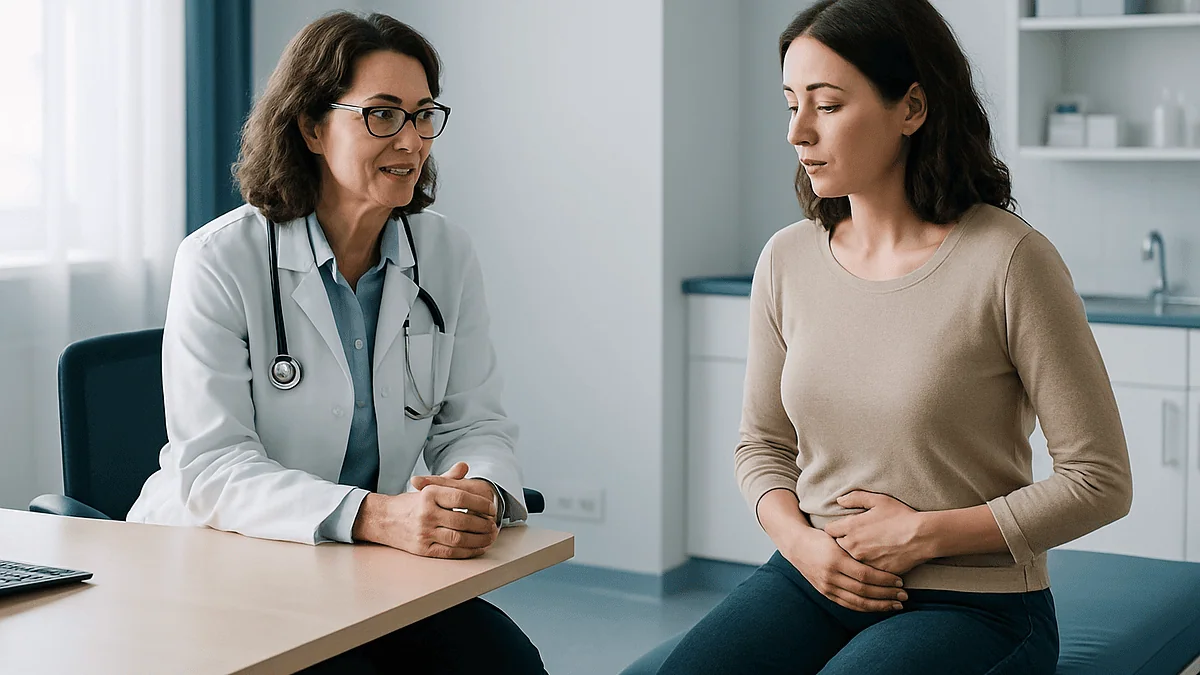
The first consultation is mostly conversation, and it is the most powerful diagnostic tool available. Expect detailed questions about your periods, pain, bowel and bladder habits, sexual health, contraception, past pregnancies and family history. A good clinician will want specifics: how many days, how much bleeding, what makes it better or worse.
A pelvic examination usually follows. Mayo Clinic describes the clinician feeling for cysts on the ovaries, nodules behind the uterus, tenderness, or a uterus that is fixed rather than mobile, which can suggest adhesions. The exam is not comfortable for many people and can be especially painful when endometriosis is present. You are entitled to ask for it to stop at any point, to have a chaperone, or to defer it. An examination is often normal even when the disease is present, so a clean exam does not close the question.
Depending on where you live and your symptoms, the clinician may arrange an ultrasound directly, offer a trial of hormonal treatment while investigations proceed, or refer you to a gynecologist. In the UK, NICE guidance supports referral when symptoms are severe, persistent or recurrent, or when initial management has not helped.
Come prepared. Bring the diary, a list of medicines and supplements, and two or three questions written down. If you have ever been told your pain is normal and you disagree, say so plainly. Diagnostic delay in this condition is well documented, and a clear account of impact on daily life is the most effective counter to it.
Is there a blood test for endometriosis?
Not one that works well enough to use. The marker most often mentioned is CA-125, a protein that can be raised in endometriosis. It is also raised in menstruation, fibroids, pelvic infection, pregnancy and a range of unrelated conditions, and it is frequently normal in people with confirmed disease. NICE guidance is explicit that CA-125 should not be used to diagnose endometriosis, and a normal result should not be taken as reassurance.
Headlines about new tests appear regularly. Research groups have reported blood panels measuring small RNA molecules, saliva tests, and analysis of fluid from the uterus. Some early studies describe encouraging accuracy. The honest summary of where the evidence stands is this: none of these tests has been validated in large, independent, real-world populations, none appears in current NHS, NICE or WHO guidance, and none is used in routine care. A promising result in a research cohort is a long way from a test you can rely on when the answer changes what happens to your body.
Genetic testing sits in the same category. Endometriosis clusters in families and many gene variants have been associated with it, but each contributes a tiny fraction of risk. No genetic test can tell an individual whether they have the condition.
Blood tests do have a place, just not that one. A full blood count can pick up anemia from heavy bleeding, and other tests help exclude infection or pregnancy. Ask what each test is for. If the answer is that it will diagnose endometriosis, ask which guideline supports it.
Scans for endometriosis: what ultrasound and MRI can and can't see
Imaging is usually the second step, and its main job is to look for the forms of the disease big enough to show up. A transvaginal ultrasound, where a slim probe is placed in the vagina, gives the clearest view of the ovaries and the space behind the uterus. An abdominal ultrasound is offered if the transvaginal approach is not appropriate.
Ultrasound detects endometriomas, the fluid-filled ovarian cysts nicknamed chocolate cysts for their dark contents, with good reliability. In experienced hands it can also pick up deep nodules on the bowel or bladder and signs that organs are stuck together. What it cannot do is see the superficial peritoneal patches that make up much of the disease. The NHS is direct on this point: a normal scan does not rule out endometriosis.
MRI is not routine but is valuable when deep disease is suspected, when a surgeon needs to map the bowel, bladder or ureters before an operation, or when ultrasound is inconclusive. Mayo Clinic describes it as giving a detailed picture of the location and size of deposits that helps in surgical planning.
| Test | What it can show | What it often misses | Typical role |
|---|---|---|---|
| Pelvic exam | Tenderness, nodules, fixed uterus | Small deposits; often normal | First appointment |
| Transvaginal ultrasound | Endometriomas, some deep nodules, adhesion signs | Superficial peritoneal disease | Usual first scan |
| MRI | Deep disease, bowel and bladder involvement | Superficial disease | Complex cases, surgical planning |
| Laparoscopy | Direct view of all visible disease; biopsy | Microscopic disease | Confirmation and treatment |
One practical tip: scan quality depends heavily on who performs it. If a scan is reported as normal but symptoms persist, asking for a repeat with a gynecology-focused sonographer is a reasonable request.
Laparoscopy: what to expect before, during and after
Laparoscopy is keyhole surgery, and it remains the only way to confirm endometriosis with certainty. It is carried out under general anesthetic, so you will be asleep. The surgeon makes a small cut near the navel, inflates the abdomen gently with carbon dioxide to create space, and inserts a thin camera. One or two further small cuts allow instruments to be passed in.
The camera lets the surgeon inspect the ovaries, the uterus, the ligaments, the bowel surface and the peritoneum for deposits, which can appear as dark spots, clear blisters, white scar-like patches or red lesions. Where anything suspicious is seen, a small sample can be removed for the laboratory to confirm the tissue type. Increasingly, surgeons treat what they find in the same operation, cutting out or destroying deposits, so the diagnostic procedure and the first treatment often happen together. Whether that is planned in your case is a conversation to have with the surgical team beforehand.
The NHS notes that most people go home the same day. Expect soreness at the incision sites, a bloated feeling and sometimes shoulder-tip pain from the residual gas, which settles over a few days. Recovery time depends on how much was done; a look-and-biopsy is quicker to recover from than extensive excision.
Risks are those of any surgery under anesthetic, described by the NHS as infection, bleeding, and rare injury to nearby organs such as the bowel or bladder. Your team will explain these in the context of your own health. The alternative, treating on suspicion without surgery, is a legitimate option, and the choice between them belongs to you and your treating clinicians.
What the surgeon looks for: types, stages and biopsy
Once inside, the surgeon is describing three things: what kind of endometriosis is present, where it is, and how extensive it is. The terminology on the operation report can be baffling, so here is a plain guide.
Clinicians commonly group the disease into three types. Superficial peritoneal endometriosis consists of flat deposits on the pelvic lining. Ovarian endometriomas are cysts within or on the ovary. Deep endometriosis describes nodules that have infiltrated more than a few millimeters into tissue, most often behind the uterus, on the bowel, or on the bladder. Many people have more than one type.
Extent is often recorded using a staging system from I (minimal) to IV (severe), based on the number, size and depth of deposits and the presence of adhesions. Cleveland Clinic and Mayo Clinic both make a point that trips up many patients: stage describes how much disease is visible, not how much pain you have or how you will respond to treatment. Stage I can be agonizing. Stage IV can be silent.
Biopsy, sending a sample to the laboratory, confirms the diagnosis at a microscopic level and helps exclude the rare cases where something else is mimicking the appearance. Not every surgeon biopsies every lesion; experienced eyes recognize the typical patterns, and current guidance accepts a visual diagnosis in many circumstances.
Ask for a copy of the operation notes and photographs if they were taken. They are your record, and they become important if symptoms return or if you see a different team in future.
Can endometriosis be diagnosed without surgery?
Increasingly, yes, with an important qualification. Because laparoscopy is an operation with real, if small, risks, and because waiting for it can mean years of untreated pain, guidance has shifted toward what clinicians call a clinical or working diagnosis. If your symptom pattern is typical and imaging shows endometriomas or deep disease, many gynecologists will now diagnose endometriosis without surgery and begin treatment.
NICE guidance supports this pragmatism. It recommends offering hormonal treatment on the basis of suspected endometriosis, and it states that laparoscopy should still be considered if symptoms persist even when ultrasound is normal. In other words, a normal scan should never be the end of the road, and a positive scan does not oblige anyone to have an operation.
The qualification is that a non-surgical diagnosis is a probability, not a certainty. Superficial disease cannot be seen on any scan, so a person with typical symptoms and normal imaging is left with a suspected diagnosis. For some, that is enough: the treatment for suspected and confirmed superficial endometriosis is often the same, so confirming it changes little. For others, certainty matters, particularly when fertility is a concern, when symptoms have not responded to treatment, or when the surgeon needs to know exactly what is there in order to remove it.
Hormonal treatments work by suppressing the cycle that drives the tissue to grow and bleed. If pain improves substantially over a few months, that response supports the diagnosis, though it does not prove it, since other conditions also respond to cycle suppression. The decision on which route to take rests with you and your treating team.
Conditions that mimic endometriosis, and how they are told apart
Part of testing for endometriosis is ruling out the conditions that wear the same disguise. Several are common, and more than one can be present at once.
Adenomyosis is the closest cousin: the same kind of tissue, but growing into the muscular wall of the uterus rather than outside it. It causes heavy, painful periods and a tender, enlarged uterus. Ultrasound and MRI can often suggest it, and it frequently coexists with endometriosis.
Irritable bowel syndrome shares bloating, cramping and altered bowel habit. The distinguishing question is whether symptoms track the menstrual cycle; IBS generally does not, though hormones can influence it. Many people carry an IBS label for years before the cyclical pattern is recognized.
Pelvic inflammatory disease, an infection of the reproductive organs, causes pelvic pain, pain during sex and sometimes fever or unusual discharge. Swabs and blood tests can identify infection, which is why sexual health screening is often part of the workup.
Fibroids are benign muscle growths in the uterus that cause heavy bleeding and pressure and are readily seen on ultrasound. Ovarian cysts of other kinds can also cause pain and appear on scans; their appearance helps distinguish them from endometriomas.
Interstitial cystitis, a chronic bladder pain condition, and musculoskeletal pelvic floor pain complete the usual list. None of these exclude endometriosis, and clinicians increasingly recognize that chronic pelvic pain often has more than one contributor. If treatment for one diagnosis leaves you no better, that is a reason to revisit the others rather than to conclude the pain is unexplained.
When to see a doctor about possible endometriosis
The simplest rule: if pelvic or period pain is regularly stopping you from doing what you would otherwise do, book an appointment. Pain that keeps you home from work or school, that needs more than occasional over-the-counter relief, or that makes sex something you avoid is not a normal part of menstruation, whatever you may have been told.
Other reasons to seek an assessment rather than wait include periods heavy enough to soak through protection hourly or to cause symptoms of anemia such as breathlessness and exhaustion, pain when passing urine or stool that follows your cycle, and difficulty conceiving after a year of trying, or six months if you are over 35, as MedlinePlus and Mayo Clinic advise.
Seek urgent care the same day if pelvic pain is sudden and severe, if you have a fever alongside pelvic pain, if you are vomiting and cannot keep fluids down, if you faint or feel faint with heavy bleeding, or if you are pregnant or could be pregnant and develop sharp one-sided pain. These signs can indicate a twisted or ruptured ovarian cyst, a serious infection or an ectopic pregnancy, none of which should wait for a routine appointment.
Once you are in the system, keep pushing if the answers do not fit the symptoms. Ask what the working diagnosis is, what would change it, and what the next step is if the current plan does not help. You are allowed to request a second opinion or a referral to a gynecologist with a specialist interest in pelvic pain. The evidence on diagnostic delay in endometriosis is consistent across countries, and the people who shorten it are usually the ones who kept asking.
Frequently asked questions
How is endometriosis tested?
It is tested in stages rather than with a single test. A clinician takes a detailed symptom history and performs a pelvic examination, then usually arranges a transvaginal ultrasound to look for ovarian cysts or deep disease. MRI may follow in complex cases. If suspicion remains, or if treatment is planned, a laparoscopy lets a surgeon look inside the pelvis directly and take a tissue sample. That surgical view is the only way to confirm the diagnosis definitively.
Can I test myself for endometriosis at home?
No. There is no home kit, app or questionnaire that can diagnose endometriosis, and none is endorsed by any major health authority. What you can do at home is keep a detailed symptom diary over two or three cycles, recording pain scores, bleeding, bowel and bladder symptoms, and days lost to pain. That record is genuinely useful because it shows whether symptoms follow your cycle, which is the pattern clinicians look for.
What are the 5 D's of endometriosis?
The 5 D’s are a memory aid for the pains that cluster in endometriosis: dysmenorrhea (painful periods), dyspareunia (pain during sex), dyschezia (pain passing stool), dysuria (pain passing urine), and either dull chronic pelvic pain or difficulty conceiving, depending on who teaches it. It is not a diagnostic score. Its value is prompting a fuller conversation than periods alone, but it leaves out common symptoms such as heavy bleeding, fatigue and bloating.
What age does endometriosis usually start?
Symptoms can start with the first period, and teenagers can have the condition. Diagnosis, however, most commonly occurs between roughly 25 and 40, according to Cleveland Clinic, because painful periods in younger people are so often assumed to be normal. Symptoms generally ease after menopause when the hormonal cycle stops, though scar tissue from years of inflammation can continue to cause pain in some people.
Is there a blood test for endometriosis?
Not a reliable one. The marker CA-125 can be raised in endometriosis but is also raised by menstruation, fibroids, infection and pregnancy, and is often normal when the disease is present, so NICE guidance advises against using it for diagnosis. Newer blood, saliva and genetic tests are at the research stage and are not part of routine care anywhere. Blood tests are still useful for checking anemia and excluding infection or pregnancy.
Can an ultrasound detect endometriosis?
Sometimes. A transvaginal ultrasound reliably detects endometriomas, the cysts that form on the ovaries, and an experienced sonographer can often identify deep nodules and signs of organs being stuck together. It cannot see superficial deposits on the pelvic lining, which make up much of the disease. A normal ultrasound therefore does not rule endometriosis out, and persistent symptoms after a clear scan still justify further investigation.
What is a laparoscopy for endometriosis like?
It is keyhole surgery under general anesthetic. The surgeon makes a small cut near the navel, inflates the abdomen with gas, and inserts a camera to inspect the pelvic organs, taking tissue samples and often removing deposits in the same operation. Most people go home the same day. Expect soreness at the incisions, bloating and sometimes shoulder-tip pain from the gas for a few days. Risks include infection, bleeding and rare injury to nearby organs.
Can endometriosis be diagnosed without surgery?
Increasingly yes, as a working diagnosis. If symptoms are typical and a scan shows endometriomas or deep disease, many clinicians will diagnose endometriosis and begin hormonal treatment without laparoscopy, an approach supported by NICE guidance. The limitation is that superficial disease is invisible on scans, so a non-surgical diagnosis remains a probability rather than a certainty. Laparoscopy is still considered when symptoms persist, fertility is a concern, or surgical treatment is planned.
What are the warning signs of endometriosis?
The main signs are period pain severe enough to disrupt normal life, pelvic pain that flares around menstruation, pain during or after sex, pain when passing urine or stool especially during a period, heavy bleeding, and difficulty conceiving. Fatigue, bloating and nausea are common companions. The strongest clue is timing: symptoms that follow the menstrual cycle point more toward endometriosis than the same symptoms occurring at random.
Does the stage of endometriosis tell me how bad my symptoms will be?
No. Stages I to IV describe how much disease a surgeon can see, based on the number, size and depth of deposits and the presence of adhesions. They do not measure pain and do not predict how you will respond to treatment. Someone with stage I disease can be incapacitated every month, while stage IV disease can go unnoticed until it affects fertility. Both Cleveland Clinic and Mayo Clinic make this point explicitly.
References
- Cleveland Clinic – Endometriosis
- World Health Organization – Endometriosis fact sheet
- MedlinePlus – Endometriosis
This article is for general information only and is not a substitute for professional medical advice. Please consult a qualified doctor about your individual situation.

More from the Blog

Prolapse Treatment in Older Women: How Health, Activity and Goals Guide the Options
Prolapse treatment in older women is chosen by weighing three things together: how much the prolapse bothers daily life, the woman's overall health and…

Who Is a Candidate for Robotic Hysterectomy? Fibroids, Endometriosis and Uterus Size
Robotic hysterectomy candidates are usually people with a benign condition such as fibroids, endometriosis, adenomyosis or heavy bleeding that has not settled with other…

Hysterectomy Recovery Week by Week: Walking, Wound Care and the Six-Week Lifting Rule
Most people can walk short distances the day after a hysterectomy, manage light household tasks within two to three weeks, and feel close to…

How Is the Hysterectomy Approach Chosen? Abdominal, Vaginal, Laparoscopic or Robotic
Surgeons choose the hysterectomy approach by weighing the size and mobility of the uterus, the reason for surgery, previous abdominal operations, body weight, pelvic…

What to Expect After Ovarian Cyst Removal: Pathology Results, Follow-Up and Cycle Changes
After ovarian cyst removal, the cyst wall is sent to a laboratory, and the pathology report usually confirms a benign type such as a…
Ovarian Cysts During Pregnancy: How They Are Monitored and When Treatment Is Considered
An ovarian cyst found during pregnancy is usually a simple, fluid-filled cyst that goes away on its own and is followed with repeat ultrasound…