

How Often Should You Have an Eye Exam? The Schedule by Age and Risk
Key Takeaways
- Mainstream guidance sets age 40 as the baseline comprehensive eye exam, then every two to four years to 54, every one to three years to 64, and every one to two years from 65.
- The strongest childhood evidence supports at least one vision screening between ages 3 and 5, when treatment for amblyopia is most effective and the condition affects up to 3 in 100 children.
- People with diabetes are advised to have a dilated eye exam every year because randomized trials show treating retinopathy in time sharply reduces severe vision loss.
- About 3 million Americans have glaucoma and roughly half do not know it, which is why a family history, or being African American or Hispanic and over 40, shortens the interval to every one to two years.
- Contact lens wearers and people with high nearsightedness are generally seen yearly because corneal infection and retinal tears develop without early symptoms visible in a mirror.
- Dilating drops widen the pupils for four to six hours and are what turns a glasses check into a health check; a phone acuity test cannot examine the optic nerve or retina.
Healthy adults without symptoms or risk factors are generally advised to have a baseline comprehensive eye exam at age 40, then one every two to four years until 54, every one to three years from 55 to 64, and every one to two years after 65. People with diabetes, contact lenses, or a family history of glaucoma usually need yearly exams, and children need at least one vision screening between ages 3 and 5.
Every September, the same small drama plays out in school hallways: a child squints at a chart taped to the wall, a nurse marks a box, and a note goes home saying “refer for eye exam.” Search interest in the phrase spikes right along with it. This year the surge has an extra push. A short video making the rounds on social platforms claims a two-minute phone test is “just as good” as a visit to an eye doctor, and the comments are a tangle of confident, contradictory advice.
As of September 2026, the mainstream guidance has not changed in the way the clip implies. What has changed is how clearly the major review bodies now state where the evidence is strong, where it is thin, and where the recommended intervals rest on expert judgment rather than trials.
That honesty is useful. It means the question of how often you need an eye exam can be answered properly: by age, by risk, and with a frank note about what each number is actually based on.
Why "how often should you have an eye exam" has no single answer
Two very different things hide behind the words “eye exam.” A vision screening is a quick check, often just a letter chart, that sorts people into “probably fine” and “needs a closer look.” A comprehensive eye exam is a medical evaluation of how well you see and how healthy the eye itself is, inside and out. The schedules in this article refer to the second kind unless stated otherwise.
Who performs it matters less than many people assume. An optometrist is a doctor of optometry who provides primary eye care, including exams and prescriptions for glasses and contact lenses. An ophthalmologist is a physician who has completed medical school and surgical training in eye disease. Both can carry out a full comprehensive exam; the ophthalmologist is the one you are referred to when disease needs treatment or surgery.
The interval itself hinges on three things. Age comes first, because the common threats to sight change decade by decade: lazy eye in early childhood, nearsightedness through the school years, presbyopia (the age-related loss of close-up focus) in the forties, then cataract, glaucoma, and macular degeneration later on. Risk comes second: diabetes, a strong family history, a high prescription, or daily contact lens wear all pull the interval shorter. Symptoms come third and override everything else. A schedule is for eyes that feel fine.
If there is one opinion worth holding firmly, it is this: the exact number of years between visits matters far less than two milestones people routinely skip. One is a proper check in early childhood, when treatment for a weak eye still works well. The other is a baseline exam around 40, when silent diseases start to appear and are easiest to manage.
What changed recently
The viral claim that sparked this month’s search surge is not tied to any new trial or approval. The genuinely recent shifts are quieter, and they come from guideline reviewers rather than product launches.
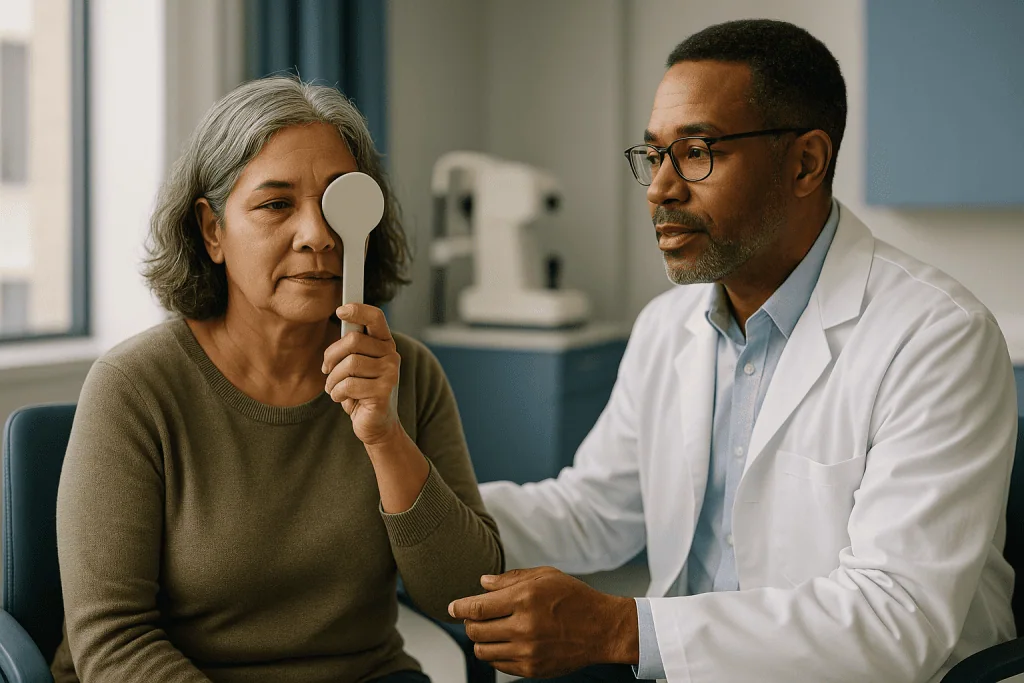
In 2022 the US Preventive Services Task Force, an independent panel that grades preventive care, issued three eye-related statements within a few months of each other. In May 2022 it concluded that evidence was insufficient to recommend for or against routine glaucoma screening in adults without symptoms, and, separately, that evidence was also insufficient for routine visual acuity screening in adults 65 and older in primary care. In September 2022 it reaffirmed a positive recommendation: at least one vision screening for children aged 3 to 5 to detect amblyopia, the condition commonly called lazy eye, in which one eye fails to develop normal sight.
Those “insufficient” verdicts are frequently misread online as “adults don’t need eye exams.” They mean something narrower: no large trial has yet proved that screening everyone in a doctor’s waiting room improves outcomes. The National Eye Institute, part of the NIH, continues to advise a dilated eye exam for everyone over 60 at least every one to two years, and earlier for people at higher risk, precisely because glaucoma and diabetic eye disease can progress without symptoms.
Two other trends frame the moment. The CDC’s current diabetes guidance keeps a yearly dilated exam as standard for people with diabetes, since diabetic retinopathy remains a leading cause of new blindness in working-age adults. And the NHS reiterates its long-standing two-year interval for adults, with a routine vision screen for children at school entry around age 4 to 5. None of that has moved toward a phone app.
What the evidence actually says, graded honestly
Eye exam schedules are a patchwork of different evidence strengths, and it helps to know which square you are standing on.
Strong, trial-based evidence exists for treating what exams find. Randomized trials show that patching or atropine treatment for amblyopia improves sight in young children, with the biggest gains before about age 7. Large randomized trials in diabetic retinopathy established that timely laser treatment, and later injections into the eye, cut the risk of severe vision loss substantially. Randomized trials in glaucoma showed that lowering eye pressure slows damage to the optic nerve. Because these conditions are silent early on, detection only happens if someone looks. That is the logical backbone of screening intervals for children and for people with diabetes.
Moderate, observational evidence supports the age-based adult schedule. Population studies show that glaucoma, cataract, and age-related macular degeneration (a disease of the central retina and the leading cause of vision loss after 50) climb steeply with each decade. About 3 million Americans have glaucoma, and roughly half do not know it. The intervals recommended at 40, 55, and 65 are set so that a slow disease is unlikely to do irreversible harm between visits.
Expert opinion fills the rest. The specific gap of “two to four years” versus “one to three years” has not been tested head-to-head in a trial, and no body claims it has. The same is true for the exact interval for contact lens wearers, though the reasoning, a higher risk of corneal infection, is well documented.
Where evidence is weakest is broad screening of symptom-free adults in general medical settings, which is why the task force verdicts read as “insufficient.” That is a statement about missing trials, not proof that exams are useless.
Eye exam schedule by age: the summary table
The table below pulls together the mainstream recommendations for people who have no symptoms. Read the right-hand column carefully: a single risk factor moves you onto the shorter schedule, and your eye doctor may shorten it further based on what they see.

| Age | No risk factors | With risk factors or existing eye disease |
|---|---|---|
| Newborn to 12 months | Red reflex and eye check at well-baby visits; a fuller assessment between 6 and 12 months if concerns arise | Earlier specialist referral for prematurity, family history of childhood eye disease, or abnormal findings |
| 3 to 5 years | At least one vision screening (strongest childhood evidence) | Comprehensive exam and follow-up as directed |
| 6 to 18 years | Screening every 1 to 2 years through school or pediatric care; exam if screening fails | Yearly exam for glasses or contact lens wearers, or as prescribed |
| 20 to 39 years | At least one full exam in the 20s and two in the 30s | Every 1 to 2 years, yearly with diabetes or contact lenses |
| 40 to 54 years | Baseline exam at 40, then every 2 to 4 years | Every 1 to 2 years, yearly with diabetes |
| 55 to 64 years | Every 1 to 3 years | Every 1 to 2 years, yearly with diabetes |
| 65 and older | Every 1 to 2 years, dilated | Yearly or more often as directed |
Risk factors that shift you rightward include diabetes, high blood pressure, a family history of glaucoma or macular degeneration, African American or Hispanic heritage after 40 (linked to higher glaucoma rates), a strong nearsighted or farsighted prescription, previous eye injury or surgery, and long-term use of medicines known to affect the eye, which your prescriber will flag.
The NHS version is simpler: adults every two years, sooner if advised, with children screened at school entry. The two systems differ in packaging, not in substance.
When should a child have their first eye exam?
A baby’s first eye check happens before anyone thinks of it as an eye exam. In the newborn period a pediatrician shines a light into each eye to look for the red reflex, the healthy orange-red glow from the back of the eye, which can reveal cataract or, rarely, a tumor. This continues at well-child visits through infancy.
Between 6 and 12 months, many pediatricians and eye doctors look more closely at how the eyes align and track. Strabismus, in which the eyes point in different directions, is easier to correct the earlier it is found. If a parent notices a persistent turn after about 4 months of age, that alone justifies a visit.
The 3-to-5 window is where the evidence is firmest. Amblyopia affects up to 3 in 100 children and is the leading cause of vision loss in one eye among the young. The brain quietly favors the stronger eye, and the weaker one never learns to see sharply. A child cannot tell you this is happening; both eyes open, the world looks normal. Screening in preschool catches it while treatment is most effective, which is why the US Preventive Services Task Force gives this recommendation its positive grade and the NHS runs a school-entry screen at 4 to 5.
After that, screening every year or two through school is standard, with a comprehensive exam whenever a screen is failed. Nearsightedness, or myopia, typically appears and progresses between ages 6 and 14, and the National Eye Institute notes it is becoming more common. Watch for the everyday signs: sitting close to screens, holding books near the face, headaches after reading, or a teacher’s comment that a child copies from a neighbor rather than the board.
Adults in their 20s and 30s: is every few years really enough?
Young adults with healthy eyes and no symptoms are on the longest interval of anyone, and it is worth saying why rather than just stating the number. Between 20 and 39 the serious sight-threatening diseases are uncommon, prescriptions tend to stabilize once growth stops, and screening trials in this group do not exist. Mainstream professional guidance therefore suggests at least one comprehensive exam in your 20s and two in your 30s, which for many people works out to roughly every five years.
That comfortable schedule collapses the moment a risk factor appears. Type 1 diabetes calls for a dilated exam within five years of diagnosis and yearly after that; type 2 calls for one at diagnosis. Daily contact lens wear moves most people to an annual visit because the lens sits on the cornea, the clear front window of the eye, and raises the risk of infection and low-oxygen changes that only a doctor can see. A parent or sibling with glaucoma, or a prescription strong enough that you cannot function without glasses, also argues for more frequent checks.
Symptoms are the other trigger, and this decade has its own pattern. Digital eye strain, the tired, dry, blurry feeling after long screen sessions, is common and usually harmless, but it is also the reason many adults in their 30s discover mild uncorrected astigmatism, an imperfectly curved cornea that blurs vision at all distances. A headache that arrives every afternoon at the desk is a reasonable reason to book, whatever the calendar says.
Pregnancy deserves a note. Hormonal changes can temporarily shift a prescription, and pre-existing diabetic eye disease can worsen during pregnancy, which is why people with diabetes are advised to have an exam early in pregnancy rather than waiting for the yearly slot.
Turning 40: why a baseline eye exam matters even with perfect vision
Forty is the age most guidelines single out, and the reason is not the reading glasses, although those arrive too. It is the beginning of a stretch when the eye’s most damaging diseases start without a single symptom.
Consider glaucoma, a group of conditions in which pressure or poor blood flow damages the optic nerve that carries images to the brain. The most common form is painless and takes peripheral vision first, so the center of the picture stays sharp until late. A baseline exam at 40 records your eye pressure, the appearance of your optic nerves, and the thickness of the retinal nerve layer. Ten years later, a change from that baseline is far more telling than any single reading.
Presbyopia is the other 40s arrival, and it explains why so many people first sit in the exam chair at this age. The lens inside the eye stiffens and loses its ability to focus close up, so menus drift farther from the face. It is normal, correctable, and often the excuse that gets someone their overdue baseline.
From 55 to 64 the recommended gap narrows to every one to three years as cataract, a clouding of the lens, becomes common and early macular degeneration begins to show as tiny deposits under the retina. Cataract is slow and highly treatable; the point of checking is to time care and to make sure it is not masking something else.
At 65 and older the National Eye Institute’s advice is a dilated exam every one to two years, yearly for anyone with a diagnosed condition. Falls, medication side effects, and driving safety all connect back to how well older adults see, which makes this the decade where a missed exam carries the most everyday consequence.
Diabetes and high blood pressure: how often should you have a dilated eye exam?
Diabetes rewrites the schedule more than any other single condition, and it is the area where the evidence for regular checks is strongest.
High blood sugar damages the tiny vessels of the retina, the light-sensing layer at the back of the eye. In diabetic retinopathy those vessels leak, close off, or sprout fragile new growth that bleeds. For years this produces no symptoms. By the time vision blurs, damage is often advanced. Landmark randomized trials showed that treating retinopathy at the right stage, with laser or with medicines injected into the eye, sharply reduces the risk of severe vision loss. That is why the CDC, the American Diabetes Association, and the National Eye Institute all endorse a dilated eye exam at least once a year for people with diabetes.
The timing of the first exam differs by type. With type 2 diabetes, the retina may already have been exposed to high sugar for years before diagnosis, so the first dilated exam is advised at diagnosis. With type 1, the first is recommended within five years of diagnosis, since retinopathy rarely appears earlier. After a normal result, some clinicians extend the interval to two years for people with excellent control, a decision that belongs to the treating team rather than to a general rule.
High blood pressure damages retinal vessels through a different route, causing narrowing and, in severe cases, swelling and hemorrhage. A routine exam can pick these changes up, and an eye doctor is sometimes the first to suspect untreated hypertension. There is no universal separate schedule for blood pressure alone, but it counts as a risk factor that moves an adult toward the shorter interval.
Both conditions share a practical message: the eye is the one place where a clinician can watch small blood vessels directly, which turns a dilated eye exam into a window on the rest of the body.
Family history of glaucoma and other risks that shorten the interval
Glaucoma runs in families, and this is the risk factor people most often fail to mention because nobody asked. Having a parent or sibling with the disease raises your own risk several-fold. The National Eye Institute lists additional groups at higher risk: everyone over 60, African Americans over 40, and Hispanic and Latino adults over 40, who develop the condition earlier and more often. People with diabetes, high nearsightedness, or a history of steroid use or eye injury are also on the list.
For anyone in these groups, mainstream guidance is a dilated eye exam every one to two years starting at 40 rather than the longer general-population gap, with the exact interval set by the examining doctor. The reasoning rests on strong trial evidence that lowering eye pressure slows optic nerve damage, paired with the observation that damage already done does not come back.
Age-related macular degeneration also clusters in families and is linked to smoking. A first-degree relative with the condition is a reason to keep to the shorter end of the age-based schedule after 50.
Medicines are a quieter risk factor. Certain long-term treatments, for example some drugs used for autoimmune conditions, can affect the retina, and prescribers arrange scheduled eye monitoring as part of that treatment. If you take a medicine and have been told it needs eye checks, that schedule overrides the age-based one. Never adjust or stop such a medicine because of something you read; raise the question with the clinician who prescribes it.
Previous eye surgery or a significant eye injury, even decades ago, also earns a spot in the higher-risk column. Scarring and pressure changes can appear late, and only an exam will reveal them.
Contact lenses, strong prescriptions and other reasons for yearly eye exams
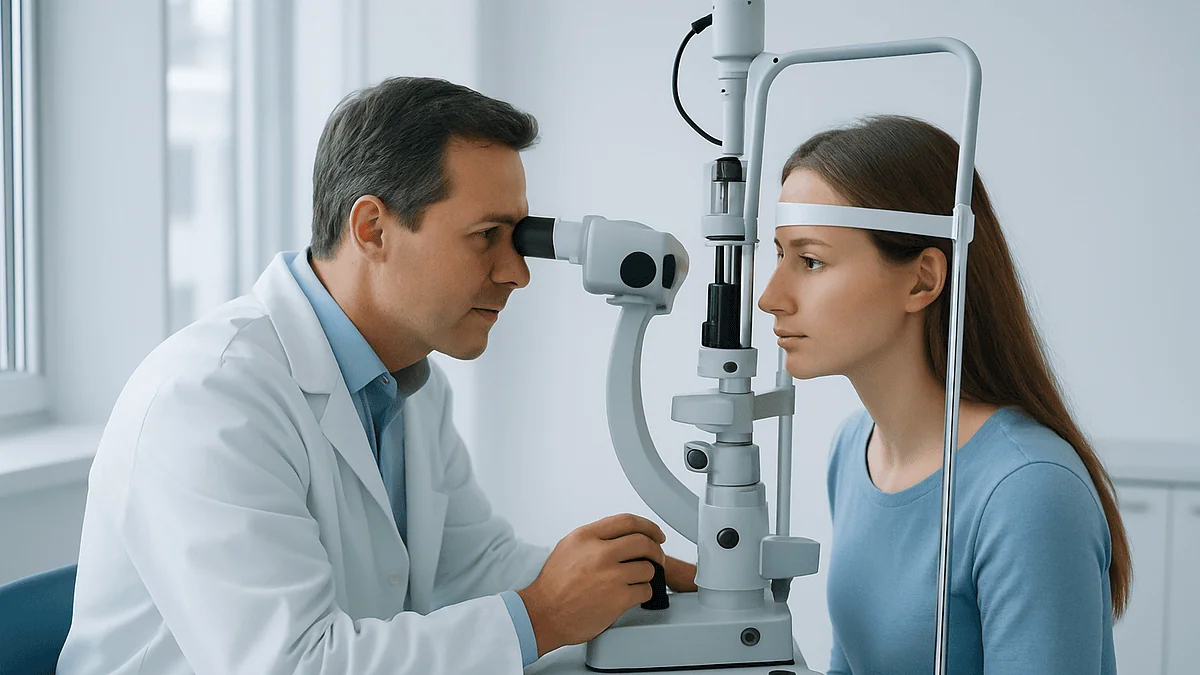
Contact lens wearers are advised to see their eye doctor every year, and the reason has little to do with the prescription. A lens rests on the cornea, which has no blood vessels of its own and draws oxygen from the air. Overwear, sleeping in lenses not designed for it, and poor hygiene raise the risk of microbial keratitis, an infection of the cornea that can scar and permanently reduce vision. Early signs are subtle: new blood vessels creeping toward the center, small dry patches, or lenses that no longer fit a slightly changed surface. None of these are visible in a mirror. All of them show up under a slit lamp, the bright, magnified microscope used to inspect the front of the eye.
A yearly visit also keeps the lens prescription and fit current, which in most jurisdictions is required to renew it. That is not a bureaucratic detail; an ill-fitting lens is an infection risk.
High nearsightedness, generally a prescription around minus 6 or stronger, stretches the eyeball and thins the retina, raising the lifetime risk of retinal tears and detachment, glaucoma, and early cataract. People in this group are usually asked to attend yearly and to learn the warning signs of a detaching retina, covered later in this article.
Other groups on an annual schedule include anyone with a diagnosed eye disease under observation, people with a history of eye surgery including refractive laser procedures, and those with conditions such as thyroid eye disease or autoimmune disorders that can inflame the eye. Occupations matter too: welders, laboratory workers, and anyone with regular exposure to eye hazards benefit from a documented baseline in case of injury.
The underlying logic across all these groups is the same. When the chance of something going wrong is higher, the cost of a long gap between looks rises with it.
What is included in an eye exam? The parts most people never notice
A comprehensive eye exam feels like a string of small games: read this, follow that, which is clearer, one or two? Behind each game is a specific measurement.
It opens with history. Symptoms, medications, family history, and general health tell the examiner where to look hardest. Then comes visual acuity, the letter chart. “20/20” means you read at 20 feet what a person with normal vision reads at 20 feet; 20/40 means you need to stand at 20 feet to read what they can read from 40.
Refraction follows. This is the process of finding the lens power that brings light to a sharp focus on the retina, using the phoropter, the mask-like instrument that flips lenses in front of each eye. It produces the glasses prescription.
The examiner then checks eye movement and alignment, pupil reactions to light, and peripheral vision, sometimes with a simple hand test and sometimes with an automated field machine that flashes faint lights while you stare at a center point.
Tonometry measures pressure inside the eye, either with a gentle puff of air or a small probe that briefly touches the numbed cornea. High pressure is a leading risk factor for glaucoma, though the disease can occur at normal readings.
The slit lamp exam inspects the eyelids, cornea, iris, and lens under magnification. With dilating drops added, the examiner can see through the widened pupil to the retina, its blood vessels, the macula at its center, and the optic nerve head. Many practices add photographs of the retina and optical coherence tomography (OCT), a scan that maps the retinal layers in cross-section to a fraction of a millimeter, which is especially useful for tracking glaucoma and macular disease over time.
Each element has a job, which is why skipping the dilated portion turns a comprehensive exam into something closer to a glasses fitting.
What to expect at an eye exam, and the best time of day to book
Plan on 45 to 90 minutes for a full exam, longer if dilation and imaging are included. Bring your current glasses and contact lenses, a list of medications, and any notes about symptoms. If you wear contacts, ask when booking whether to leave them out beforehand; soft lenses are often removed for a few hours and rigid lenses for longer so the cornea returns to its natural shape before measurements.
The dilating drops take 15 to 30 minutes to work and leave the pupils wide for four to six hours, sometimes longer in light-colored eyes. During that time near vision is blurry and bright light is uncomfortable. Sunglasses help, and driving is not recommended until the blur settles, so arranging a ride or a walkable appointment is sensible. Ask ahead whether dilation is planned so you can organize your day. Some clinics use wide-field retinal photography that reduces the need for drops in low-risk patients, but the dilated view remains the standard for a first exam and for anyone at higher risk.
On timing, there is no medically superior hour. What the evidence-minded answer comes down to is consistency: your prescription is most stable when you are rested, well hydrated, and not fresh off a long screen session, because eye strain and dryness can temporarily blur measurements. A morning or early afternoon slot on a day without hours of close work beforehand gives the most representative reading. People with dry eye often see better earlier in the day; people with certain corneal conditions may see better later. If you notice such a pattern, mention it.
Children do best when they are not tired or hungry, which usually means avoiding late afternoon. For adults with diabetes, book so that the exam does not clash with the timing of other appointments where blurred vision after dilation would be a problem.
Common myths: vision screening vs eye exam, online tests and 20/20 vision
The viral claims of the moment share a single error: they treat sharpness of sight as the same thing as eye health. It is not.
Myth: a phone or online test replaces an eye exam. App-based tests can estimate visual acuity and, in some cases, a rough refraction. Studies comparing them with clinic refraction show reasonable agreement for simple prescriptions in young adults, but they cannot measure eye pressure, examine the optic nerve, or look at the retina. They are screening tools at best, and they miss exactly the diseases that cause irreversible loss.
Myth: 20/20 vision means healthy eyes. Early glaucoma, diabetic retinopathy, and even a small retinal tear can coexist with perfect chart performance. Central sharpness is the last thing many diseases take.
Myth: the school or DMV screening counts. Vision screening vs eye exam is the distinction most people never learn. A screen checks one function; an exam checks the organ. Passing a screen is reassuring but does not reset your comprehensive exam clock.
Myth: eye exams are only for people who need glasses. The entire adult schedule exists for people who see fine and feel fine.
Myth: if your eyes don’t hurt, nothing is wrong. Of the common sight-threatening diseases, only acute angle-closure glaucoma and some infections are painful. The rest are silent.
Myth: dilation is optional fluff. Dilation is what turns a glasses check into a health check. It can be replaced by imaging in some low-risk follow-ups, but the decision is the examiner’s, based on your risk.
Where the online tests have a legitimate place is in extending care between visits for stable, low-risk adults, and in areas with few eye doctors. Used as a substitute rather than a supplement, they invite the very outcome the exam schedule exists to prevent.
When to see a doctor: red-flag eye symptoms that override the schedule
Every interval in this article assumes eyes that feel and work normally. Certain symptoms mean the schedule no longer applies and the right timing is now.
Seek emergency care the same day for any of the following:
- Sudden loss of vision in one or both eyes, even if it recovers within minutes. A brief blackout can signal a blocked blood vessel and is treated as a medical emergency in the same way as a transient stroke.
- A sudden shower of new floaters, flashes of light like lightning at the edge of vision, or a dark curtain or shadow moving across your field of view. These are classic warnings of a retinal tear or detachment, and prompt treatment protects sight.
- Severe eye pain with redness, a hazy cornea, halos around lights, headache, and nausea. This pattern suggests acute angle-closure glaucoma, in which pressure rises rapidly.
- Eye injury, a chemical splash, or a foreign body that will not rinse out.
- Sudden double vision, a drooping eyelid, or a pupil that has changed size, especially with headache or weakness elsewhere.
Book an urgent, non-emergency appointment for a red, painful eye in a contact lens wearer, light sensitivity that does not settle, a sudden distortion in which straight lines look wavy, new blurring in someone with diabetes, or persistent discharge with vision changes.
In children, arrange an assessment for an eye that turns in or out after about 4 months of age, a white rather than red reflex in flash photographs, constant tearing, an unusually large or cloudy eye, or a child who consistently tilts the head or covers one eye.
Any decision about treatment, including whether to start, change, or stop an eye medicine, belongs to the clinician who examines you. Describe what you noticed and when it began; the details of timing and which eye help more than most people expect.
Frequently asked questions
What is the best time for an eye exam?
There is no medically superior hour, but measurements are most reliable when you are rested and have not spent hours on close work or screens beforehand. Late morning or early afternoon suits most adults. If you have dry eye, earlier in the day often gives clearer results. Children cooperate best when not tired or hungry, so avoid late afternoon. Because dilation blurs near vision for several hours, pick a slot that lets you avoid driving afterward.
What is the cheapest place to get an eye exam?
This article does not compare prices or providers, and the honest answer is that cost varies widely by region, insurance, and whether the visit includes dilation and imaging. What matters medically is that the exam is comprehensive and performed by a licensed optometrist or ophthalmologist, not just a vision screening. Check what your medical and vision coverage includes, and ask when booking exactly which tests are part of the visit so you are comparing like with like.
What is included in an eye exam and how long does it take?
A comprehensive eye exam typically includes a health history, a visual acuity chart, refraction to determine any prescription, eye movement and pupil checks, peripheral vision testing, tonometry to measure eye pressure, a slit lamp inspection of the front of the eye, and a dilated view of the retina and optic nerve, often with photographs or an OCT scan. Expect 45 to 90 minutes, longer when dilation and imaging are included.
What is the right dilated eye exam frequency if I have diabetes?
Once a year is the standard recommendation from the CDC and the National Eye Institute for people with diabetes. With type 2 diabetes the first dilated exam is advised at diagnosis; with type 1 it is advised within five years of diagnosis. After one or more normal results, some clinicians extend the interval to two years for people with excellent blood sugar control, but that decision belongs to your treating team, not a general rule.
Can I drive after an eye exam with dilation?
Driving is not recommended until your vision clears, which usually takes four to six hours and sometimes longer in light-colored eyes. Dilated pupils blur near vision and make bright light uncomfortable, so bring sunglasses and arrange a ride or a walkable route. If you must drive yourself, ask when booking whether dilation is planned; in some low-risk follow-ups retinal photography can be used instead, at the examiner’s discretion.
Do I need dilation at every eye exam?
Not always, but the dilated view is the standard for a first comprehensive exam and for anyone with diabetes, a family history of glaucoma, high nearsightedness, or symptoms. Widening the pupil lets the examiner see the retina, macula, and optic nerve directly. For stable, low-risk adults, some practices alternate with wide-field retinal imaging. The choice rests with the examining doctor based on your risk profile and what previous exams showed.
Does 20/20 vision mean I can skip an eye exam?
No. 20/20 measures central sharpness only, and the diseases that cause irreversible vision loss, including glaucoma, diabetic retinopathy, and early macular degeneration, typically leave central vision untouched until late. Roughly half of the estimated 3 million Americans with glaucoma do not know they have it. A comprehensive eye exam checks the health of the eye itself, which is why the adult schedule applies to people who see and feel perfectly fine.
How often should you update your glasses prescription?
Most adults find their prescription stable enough that the age-based exam schedule keeps it current, roughly every one to two years after 40. Children and teenagers change faster, so yearly checks are usual while eyes are still growing. Book sooner if you notice new blur, headaches after reading, or squinting at road signs. A prescription that is more than a year or two old may also be considered expired for ordering new lenses, depending on local rules.
When should a child have their first proper eye exam?
Pediatricians check the eyes at newborn and well-child visits, including the red reflex test. A closer assessment of alignment and tracking is common between 6 and 12 months. The strongest evidence supports at least one vision screening between ages 3 and 5 to catch amblyopia while treatment works best. Earlier referral is warranted for an eye that turns in or out after about 4 months, a white pupil in photographs, or a family history of childhood eye disease.
Is an online vision test as good as an in-person eye exam?
It is not a substitute. Online and app-based tests can estimate visual acuity and sometimes a rough refraction, with reasonable agreement to clinic measurements in young adults with simple prescriptions. They cannot measure eye pressure, examine the optic nerve, or view the retina, so they miss the silent diseases the exam schedule exists to detect. Used between visits by stable, low-risk adults they can be a helpful supplement, never a replacement.
References
- MedlinePlus – Standard ophthalmic exam
- NIH National Eye Institute – Get a Dilated Eye Exam
- NIH National Eye Institute – Glaucoma
- CDC – Diabetes and Vision Loss
This article is for general information only and is not a substitute for professional medical advice. Please consult a qualified doctor about your individual situation.

More from the Blog

OTC Hearing Aids and AirPods as Hearing Aids: What Changed and Who Benefits
OTC hearing aids are FDA-regulated devices that adults 18 and older can buy and fit themselves for perceived mild to moderate hearing loss, a…

Cavities in Adults: Why They Still Happen and Whether Early Decay Can Reverse
Cavities still happen in adults because bacteria in plaque turn sugars into acid, and when acid attacks outnumber saliva's repair cycles, enamel loses mineral…

Mouth Ulcers: Why They Recur and When They Need a Doctor
Mouth ulcers, often called canker sores, are shallow breaks in the lining of the mouth that usually heal on their own within one to…

Mouthwash: Does It Help or Harm the Oral Microbiome?
Mouthwash can help or disturb the oral microbiome depending on its active ingredient. Fluoride rinses strengthen enamel without killing bacteria and have the strongest…

Eye Vitamins and Lutein: What the AREDS Trials Actually Showed
The AREDS trials showed that a specific antioxidant and zinc formula modestly slows progression in people who already have intermediate age-related macular degeneration, and…
Electric Toothbrushes, Water Flossers and Floss: What Dental Trials Show
Randomized trials pooled in a Cochrane review found that electric toothbrushes remove modestly more plaque and reduce gum inflammation slightly more than manual brushes,…