

How Periodontal Disease Develops Below the Gumline and Why SRP Deep Cleaning Is Planned
Key Takeaways
- About 47 percent of US adults aged 30 and older have some form of periodontal disease, and roughly 70 percent of those 65 and older, according to CDC data.
- Gingivitis is inflammation limited to the gum and is usually fully reversible; periodontitis involves loss of ligament and bone that does not regrow on its own.
- Healthy gum pockets measure about 1–3 millimeters; deeper, bleeding pockets alongside bone loss on X-rays are what prompt a plan for scaling and root planing.
- SRP cleans below the gumline and smooths root surfaces so gum can reattach; it removes the cause of inflammation but cannot rebuild lost bone.
- Tenderness and cold sensitivity after SRP typically ease over days to weeks, and a remeasurement visit several weeks later determines the next step.
- Smoking and diabetes are among the strongest modifiable risk factors, and daily mechanical plaque removal has stronger evidence than any home remedy.
Periodontal disease begins when bacterial plaque collects along the gumline, inflames the gums (gingivitis) and, if it persists, spreads below the gum to destroy the fibers and bone holding teeth. Scaling and root planing (SRP) is a deep cleaning planned when measured gum pockets show that routine brushing and polishing can no longer reach the bacteria; the treating dental team decides whether and how it is done.
The hygienist calls out numbers while a thin probe slips gently along each tooth: three, three, four, five, six. Most people have heard the low numbers for years without paying attention. The fives and sixes are new, and so is the phrase that follows them: “We’d like to plan a deep cleaning.” Nothing hurts. The gums bled a little on flossing, sure, but everyone’s gums bleed sometimes, don’t they?
That quiet moment in the chair is how many adults first meet periodontal disease. It is a condition that does most of its work out of sight, beneath a gum edge that can look perfectly pink from the mirror. Having periodontal disease explained properly, in plain terms and grounded in evidence rather than fear, changes how those probe numbers land.
This article walks through what actually happens below the gumline, why the measurements matter, what scaling and root planing involves, and which decisions belong with you and your dental team rather than with a search engine.
Periodontal disease explained: what is really changing below the gumline?
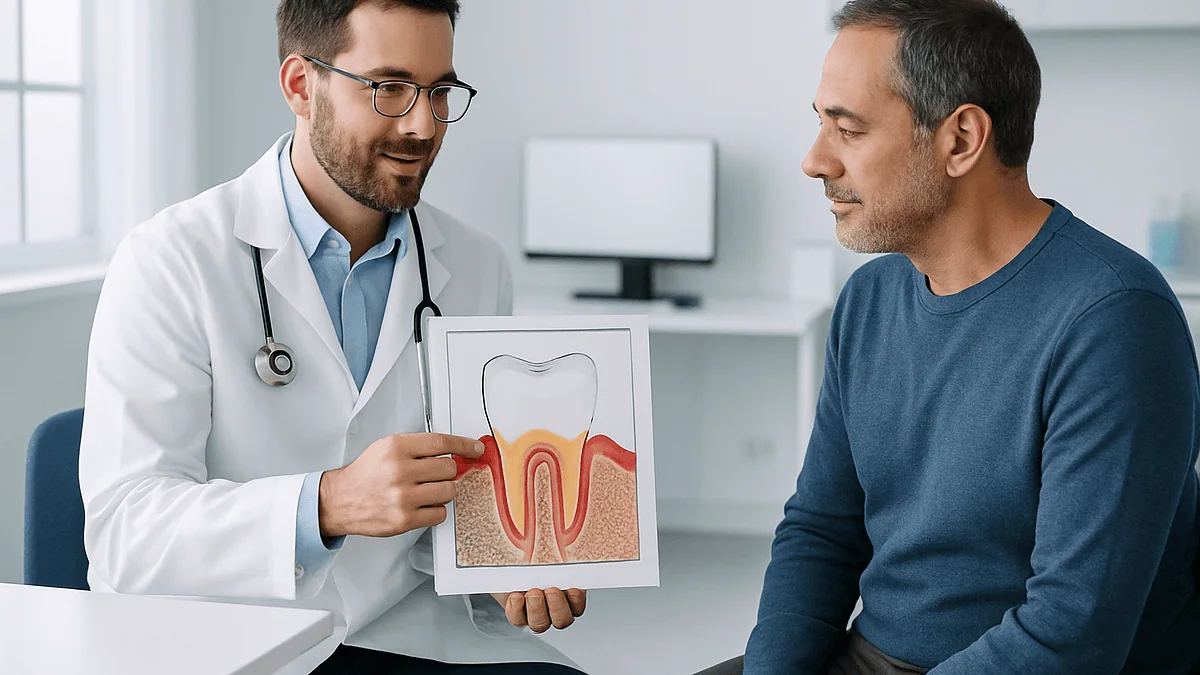
Start with the anatomy, because the whole story depends on it. A tooth is not glued into the jaw. It hangs in a socket, suspended by thousands of tiny collagen fibers (the periodontal ligament) that run from root to bone. The gum, or gingiva, drapes over the top like a cuff, sealing against the tooth just below the visible edge. In a healthy mouth that cuff forms a shallow groove, typically 1–3 millimeters deep, according to Mayo Clinic.
Periodontal disease is what happens when that seal fails. “Peri” means around; “odont” means tooth. The disease affects everything around the tooth: gum, ligament and bone. It does not attack the enamel itself, which is why a person can have strong, cavity-free teeth and still be losing the ground they stand on.
The trigger is plaque, a sticky film of bacteria that forms on teeth within hours of cleaning. Left in place, plaque hardens into tartar (also called calculus), a rough mineral crust that brushing cannot remove and that gives fresh bacteria a foothold. The body’s response to these bacteria, not the bacteria alone, does the damage. Immune cells flood the area, blood vessels dilate and the tissue swells. Over months and years, the inflammation begins dissolving the very fibers and bone it is meant to protect.
Scale matters here. The Centers for Disease Control and Prevention (CDC) reports that about 47 percent of adults aged 30 and older in the United States have some form of periodontal disease, rising to roughly 70 percent of adults aged 65 and older. That makes it one of the most common chronic conditions in the country, and one of the least discussed. Most of those people have no idea, because the early phase is nearly silent.
Gingivitis vs periodontitis: where does the line actually sit?
People use “gum disease” as one word, but dentistry draws a firm line through the middle of it, and the line is about what has been lost.
Gingivitis is inflammation confined to the gum tissue. The gums may look redder or puffier than usual and bleed when brushed, yet the ligament and bone underneath remain intact. According to the NHS, gingivitis is common and, with thorough daily cleaning and a professional clean, the gums usually settle back to health. Nothing structural has been destroyed, so nothing structural needs to regrow.
Periodontitis is the next chapter. Here the inflammation has moved below the gum’s attachment to the tooth, and bone and ligament have begun to break down. The gum peels away from the root, creating a periodontal pocket: a deepened space between tooth and gum where bacteria live undisturbed. Mayo Clinic notes that bone lost to periodontitis does not grow back on its own. Treatment aims to stop further loss and keep what remains, which is a different goal from the full reversal possible in gingivitis.
Why does one become the other? Not always, and not on a fixed schedule. Some people carry gingivitis for decades without progression. Others move to periodontitis within a few years. Genetics, smoking, diabetes, stress and the particular mix of bacteria in a given mouth all shift the odds, as Cleveland Clinic and the National Institute of Dental and Craniofacial Research (NIDCR) describe.
The practical point for anyone reading probe numbers: gingivitis is a warning you can fully answer; periodontitis is a diagnosis you manage for life. Knowing which one is being discussed is the first question worth asking.
What are the stages of gum disease?
Dentists stage periodontitis much as physicians stage other chronic conditions: by how much has been lost and how fast it is moving. Staging helps the team plan, and it helps you understand where a deep cleaning fits.
The earliest stage is gingivitis, already described. Once bone loss appears, periodontitis is graded from mild through advanced. Mayo Clinic and Cleveland Clinic describe the progression in broadly similar terms, though the exact labels vary.
- Mild (early) periodontitis: pockets deepen slightly beyond the healthy range, and X-rays show small amounts of bone loss around some teeth. Gums may bleed and feel tender, or feel entirely normal.
- Moderate periodontitis: pockets deepen further, bone loss is visible on more teeth, and gums may begin to recede, exposing root surfaces that feel sensitive to cold.
- Advanced (severe) periodontitis: substantial bone loss, teeth may loosen or drift, gaps open between teeth, and chewing can feel different. Pus may collect in pockets, and persistent bad breath is common.
Two features shape the stage beyond depth alone. One is the pattern: bone loss across most of the mouth points to a generalized problem; loss around one or two teeth may reflect a local trap such as a rough filling edge. The other is speed, judged by comparing today’s X-rays and measurements against earlier records. A person whose numbers have held steady for five years is in a different situation from someone whose pockets deepened by two millimeters in one.
Stage also determines which treatment is even on the table. Gingivitis and early periodontitis are usually addressed with improved home care and professional cleaning. Moderate disease is the classic territory for scaling and root planing. Advanced disease may still start with SRP, then move to surgical options if pockets do not respond, as Mayo Clinic outlines.
How does plaque turn into a pocket, and who is most at risk?
Picture the gum cuff as a turtleneck around each tooth. Plaque gathers at the collar. If it stays, the bacterial community changes character: the oxygen-loving species on the surface give way to species that thrive in the low-oxygen crevice beneath. These anaerobic bacteria release toxins that irritate the gum lining.
The body answers with inflammation. That response is meant to be short and sharp, but with plaque never fully removed, it becomes chronic. Enzymes released by immune cells, intended to clear damaged tissue and bacteria, begin degrading collagen in the ligament. Bone-resorbing cells are activated. The gum loses its attachment and slides down the root. Each millimeter of depth makes the pocket harder for a toothbrush to reach and easier for tartar to accumulate, which feeds more inflammation. The loop closes on itself.
This is why periodontitis is described as an inflammatory disease triggered by bacteria rather than simply an infection. It also explains why individual risk varies so widely. The same plaque produces a mild response in one person and a destructive one in another.
Several factors tilt the balance. Smoking is one of the strongest, according to the CDC and NHS; it impairs blood flow to the gums, dampens the warning sign of bleeding and blunts healing. Diabetes raises risk substantially, and the relationship runs both ways, with gum inflammation making blood sugar harder to control, as NIDCR notes. Hormonal changes in pregnancy, certain medications that dry the mouth or thicken gum tissue, poor nutrition, stress and a family history of early tooth loss all matter. Age itself is a factor mainly because the damage accumulates over time.
None of these makes periodontitis inevitable. They do make regular measurement more valuable, because the disease is easier to hold at an early stage than to claw back from a late one.
How is periodontal disease diagnosed and measured?
Diagnosis rests on three things: what the gums look like, what a probe measures, and what X-rays show. Together they tell a story that no single test can.
The visual check comes first. Redness, swelling, a shiny surface where the gum should look stippled like an orange peel, and bleeding on gentle touch all signal inflammation. Recession, where roots show, hints at past attachment loss.
The probe is the instrument that produces those called-out numbers. A periodontal probe is a slim, blunt-tipped ruler marked in millimeters. It is slid gently into the crevice between gum and tooth at six points around each tooth, and the depth is recorded. According to Cleveland Clinic and Mayo Clinic, healthy pockets measure about 1–3 millimeters; deeper readings, especially those that bleed, suggest the gum has detached. The hygienist also notes whether the gum bleeds on probing, whether pus appears, and whether teeth move when pressed.
Dental X-rays complete the picture by showing what the probe cannot: the height and density of bone between and around the roots. Comparing today’s images with older ones reveals whether loss is stable or progressing. This is a strong argument for staying with one dental record over time; the trend is more informative than any single visit.
The results are charted, and that chart drives every subsequent decision. Pockets in the healthy range with no bone loss point to prevention. Pockets of moderate depth with early bone loss are where SRP is most often planned. Deep pockets with significant bone loss may prompt referral to a periodontist, a dentist with additional training in treating gum and bone conditions.
You are entitled to see the chart and ask what each number means for your teeth. A good team will walk you through it.
What is scaling and root planing, and what actually happens during SRP?
Scaling and root planing sounds industrial, but the idea is simple: clean below the gumline where the brush cannot go, and leave the root surface smooth enough that the gum can heal against it.
Scaling removes plaque and hardened tartar from the tooth surface, both above the gum and down inside the pocket. Root planing then smooths the exposed root. Roots that have been coated in tartar develop microscopic roughness and absorb bacterial toxins; smoothing them removes that contaminated layer and gives the gum a clean surface to reattach to, as Cleveland Clinic explains.
The work is done with two kinds of instruments. Ultrasonic scalers vibrate at high frequency and spray water, breaking tartar loose and flushing the pocket. Hand scalers and curettes, fine hooked steel instruments, are used to feel along the root for remaining deposits and to finish the surface. Most clinicians use both.
Because instruments are working beneath the gum, the area is usually numbed with a local anesthetic, a medicine injected near the teeth to block sensation temporarily. Whether numbing is needed, and how much, depends on pocket depth and personal sensitivity; that is a conversation with your clinician.
SRP is often divided across visits, cleaning one quadrant or one half of the mouth at a time so that numbing and treatment time stay manageable. Cleveland Clinic notes that a full mouth may take more than one appointment. Some clinicians place an antimicrobial agent into deep pockets afterward; whether that adds benefit for a given patient is a clinical judgment, and the evidence is mixed rather than settled.
The procedure does not regrow lost bone. Its aim is to remove the cause of inflammation so the tissue can calm, pockets can shrink as swelling resolves and further destruction slows or stops.
Who is SRP usually planned for, and who is usually asked to wait?
Deep cleaning is planned on evidence, not habit. The core criterion is that measured pockets have deepened to a point where routine cleaning cannot reach the bottom, and X-rays or probing confirm attachment loss. Mayo Clinic describes SRP as a first-line, nonsurgical treatment for periodontitis, meaning it is the usual starting point once the disease has moved below the gum.
Typical candidates include people with moderate pocket depths across several teeth, those with bleeding on probing that has not resolved with improved home care, and people with early bone loss on X-rays. SRP is also commonly planned before any gum surgery, because clinicians want to see how much improvement nonsurgical treatment produces first.
Who waits, or is redirected? Someone with gingivitis and healthy pocket depths generally does not need SRP; a standard professional clean and better brushing address the problem. At the other end, teeth with very deep pockets, advanced bone loss or significant looseness may be beyond what SRP alone can achieve, and the team may discuss surgical access, regenerative procedures or extraction as part of a broader plan.
Medical circumstances shape timing too. People taking blood-thinning medicines, those with certain heart conditions, people with poorly controlled diabetes, and those undergoing cancer treatment may need coordination between dentist and physician before instrumentation below the gum. This is not a refusal; it is sequencing. Pregnancy does not rule out periodontal treatment, and the NHS notes that gum inflammation is common in pregnancy, but the team will time care thoughtfully.
The other person asked to wait is the one who has not yet been able to establish daily plaque control. SRP removes deposits, but new plaque returns within hours; without home care to match, pockets refill. Many teams review technique and reassess before committing to deep cleaning.
Routine cleaning, deep cleaning and gum surgery: how the options compare
Patients often hear “cleaning” and assume all cleanings are the same appointment with a longer name. They are not. The table below summarizes the three tiers of professional periodontal care as described by Mayo Clinic and Cleveland Clinic, so the differences are clear before you sit down to discuss a plan.
| Treatment | Where it works | Typically planned when | Main goal | Usual setting |
|---|---|---|---|---|
| Routine professional cleaning (prophylaxis) | Above the gumline and just inside a healthy crevice | Gums healthy or gingivitis only; pockets in the healthy range | Remove plaque and tartar, polish, prevent disease | Regular dental visit, usually no numbing |
| Scaling and root planing (SRP) | Below the gumline, along the root inside the pocket | Periodontitis with deepened pockets and early to moderate bone loss | Remove bacterial deposits, smooth roots, allow gum to reattach and pockets to shrink | Dental office, often with local anesthetic, sometimes across several visits |
| Periodontal surgery (flap, regenerative, grafting) | Deep pockets and bone defects under direct view | Pockets remain deep after SRP; advanced bone loss; specific defects | Gain access to clean thoroughly, reshape or rebuild bone and gum where possible | Periodontist, local anesthetic with or without sedation |
Two things stand out. First, the tiers are usually sequential. Surgery is not an alternative to SRP; it is what may follow if SRP does not achieve enough. Second, none of the tiers is a one-time event. Cleveland Clinic and Mayo Clinic both describe periodontal maintenance, a schedule of professional cleanings more frequent than the standard twice a year, as the long-term follow-up after SRP. The exact interval is set by the team based on how the gums respond.
Alternatives exist at every level, including watchful monitoring with intensified home care for borderline cases, and extraction with replacement for teeth that cannot be saved. Each carries trade-offs your team should lay out in neutral terms.
What do the days and weeks after scaling and root planing usually look like?
The first evening is mostly about the anesthetic wearing off. Once sensation returns, the gums typically feel tender and may look a little redder than before, because the instruments have disturbed inflamed tissue. Cleveland Clinic describes soreness and sensitivity that usually settles over a few days to a week; timelines vary, and your team will give guidance specific to you.
Bleeding on brushing is common for the first day or two and should taper quickly. Teeth often feel sensitive to cold, particularly where tartar removal has exposed root surfaces that were previously covered. That sensitivity commonly eases over weeks as the tooth surface adapts, though it can persist in some people. Some notice that teeth feel “looser” or that food catches in new spaces; usually this reflects the removal of bulky tartar that had been filling gaps, not new damage.
Home care matters most during this window. Gentle but thorough brushing along the gumline, cleaning between teeth daily, and any rinse or care the team recommends all help the gum heal against a clean root. Smoking during healing slows recovery and is one reason clinicians raise the topic before treatment.
Most teams schedule a reassessment several weeks after SRP, once inflammation has settled enough to remeasure. Mayo Clinic describes this re-evaluation as the point where the team decides whether pockets have shrunk sufficiently, whether isolated sites need further attention, or whether referral for surgical treatment is warranted.
What follows is maintenance. Rather than a return to twice-yearly visits, people who have had periodontitis are typically seen more often for cleaning and remeasurement, because the disease can reactivate quietly. Think of SRP as resetting the clock, not stopping it. How well the reset holds depends heavily on what happens at home between visits.
Can you live a long life with gum disease? What the evidence shows about the whole body
Yes. Periodontal disease is a chronic condition of the mouth, not a fatal illness, and tens of millions of adults live with some degree of it. The honest question is not whether you can live long with it, but what it may be quietly doing along the way, both to your teeth and possibly beyond.
Within the mouth the consequences are clear. Untreated periodontitis is a leading cause of tooth loss in adults, as NIDCR and the CDC note, and tooth loss affects nutrition, speech and confidence in ways people feel daily.
Beyond the mouth the picture is more nuanced, and it deserves careful language. Large observational studies have found that people with periodontitis have higher rates of cardiovascular disease, and the association is consistent enough that Harvard Health and the American Heart Association have both examined it. What has not been shown is that gum disease causes heart disease, or that treating gums prevents heart attacks. Shared risk factors such as smoking, diabetes and inflammation could explain much of the overlap. The reasonable reading is that inflamed gums are a marker of, and possibly a small contributor to, systemic inflammation, not a proven cause of cardiac events.
The diabetes relationship rests on stronger footing. NIDCR describes a two-way link in which periodontitis makes blood sugar harder to control and diabetes worsens gum health. Treating gum inflammation has been associated with modest improvements in glycemic control in some studies, though effects vary between trials.
Associations have also been reported with respiratory infections and adverse pregnancy outcomes; evidence quality is mixed. The practical takeaway: caring for your gums is worthwhile on its own terms, and it fits sensibly into managing heart health and diabetes, without overpromising what it delivers.
Do home remedies for gum disease work? Separating evidence from folklore
Search for home remedies for periodontal disease and you will find oil pulling, salt rinses, turmeric paste, hydrogen peroxide, tea tree oil and green tea, each presented as a fix. A closer look sorts these into three groups: things that genuinely help, things that are harmless but unproven, and things that carry risk.
What helps is unglamorous. Mechanical plaque removal is the intervention with the strongest evidence in periodontal care, according to the NHS and NIDCR: brushing twice daily with a fluoride toothpaste, angled so the bristles reach the gumline, and cleaning between teeth every day with floss or interdental brushes. Stopping smoking is the single most powerful change a smoker can make for their gums. Controlling blood sugar, if you have diabetes, supports gum healing.
Salt water rinses are soothing and low risk, and may briefly reduce surface bacteria, but they do not reach into pockets or remove tartar. Oil pulling has been studied in small trials with mixed results; it is not harmful when used alongside brushing, but there is no reliable evidence that it treats periodontitis. Herbal pastes and essential oils fall into the same category: pleasant for some, unproven for the disease itself.
Where caution is warranted: undiluted hydrogen peroxide, abrasive baking soda scrubs and acidic rinses can irritate or erode tissue and enamel. Rinses sold as antiseptic mouthwash reduce plaque bacteria on surfaces and may be recommended by a clinician for a defined period, but they do not substitute for cleaning between teeth and cannot remove hardened deposits.
The key limit of every home approach is the same: once tartar has formed below the gum, only professional instruments can remove it. Home care keeps new plaque off; it does not undo what has already calcified. That is the boundary where SRP is planned.
What people often get wrong about periodontal disease
Some misunderstandings are so common they deserve direct correction.
“My gums bleed because I brush too hard.” Occasionally true, but bleeding on gentle brushing or flossing is more often a sign of inflammation, according to the NHS. Healthy gums do not bleed from ordinary cleaning. Backing off is usually the wrong response; the plaque that caused the bleeding stays put.
“It doesn’t hurt, so it can’t be serious.” Periodontitis is largely painless until late. Bone loss itself has no nerve signal. Waiting for pain means waiting for advanced disease.
“Deep cleaning is just an expensive regular cleaning.” They address different anatomy. A routine clean works above the gumline; SRP works inside pockets along the root. Recommending SRP for healthy gums would be inappropriate, and skipping it for deep pockets leaves the cause of the disease in place.
“Once I’ve had SRP, I’m done.” Periodontitis is managed, not erased. Bone that has been lost stays lost, and the bacteria return within hours of any cleaning. Maintenance visits and daily home care are what hold the result.
“Gum disease is only about the mouth.” The links to diabetes are well documented, and associations with heart disease are real even if causation is unproven. Treat the mouth as part of the body.
“It’s inherited, so nothing I do matters.” Genetics shifts susceptibility, but plaque control and smoking status still dominate outcomes in most people, as Cleveland Clinic notes.
“Mouthwash replaces flossing.” Rinses cannot disrupt the plaque wedged between teeth. Mechanical cleaning remains essential.
“Losing teeth is just part of aging.” Age raises prevalence because damage accumulates, but healthy gums at 80 are entirely achievable with steady care.
Questions to ask your care team before agreeing to a deep cleaning
A deep cleaning plan is a conversation, not a verdict. Arriving with specific questions helps you understand the reasoning and take an active role in the decision, which stays with you and your treating team.
- Which teeth have pockets deeper than the healthy range, and how deep are they? May I see the chart?
- Do my X-rays show bone loss, and how does it compare with earlier images?
- Is this gingivitis or periodontitis, and what stage would you call it?
- Why SRP rather than a standard cleaning with improved home care and a recheck in a few months?
- How many visits do you expect, and will I be numbed?
- What sensitivity or soreness should I expect afterward, and for how long in your experience?
- When will you remeasure, and what result would you consider a good response?
- What happens if some pockets do not improve? Would you refer me to a periodontist?
- How often would you want to see me for maintenance afterward, and why that interval?
- Are any of my medicines or health conditions relevant to timing or bleeding?
- What specifically should I change in my home routine, and can you show me the technique?
- If I smoke, how does that change your expectations, and what support is available?
- What are the alternatives, including monitoring, and what are the trade-offs of each?
Notice what these questions share: they ask for evidence and reasoning rather than reassurance. A team that welcomes them, shows you the numbers and explains the plan in terms you can follow is giving you the information you need. If any answer feels vague, it is reasonable to ask for a second opinion before proceeding. Periodontal disease moves slowly enough that a few weeks of reflection rarely changes the outcome, and confidence in the plan improves the odds you will follow through on the maintenance it requires.
When to call your doctor or dentist: red-flag signs
Most periodontal disease unfolds slowly, and routine visits catch it. A few situations warrant a same-day call rather than waiting for the next scheduled appointment.
Contact your dentist promptly if you notice:
- Gum swelling with pus, a bad taste or a pimple-like bump on the gum, which may indicate a periodontal abscess (a pocket of infection) that needs drainage or treatment.
- A tooth that has suddenly become loose or shifted position, or a change in how your teeth meet when you bite.
- Persistent pain in the gums or jaw that is not explained by a recent procedure.
- Bleeding that continues for more than a few hours after scaling and root planing, or heavy bleeding at any time, particularly if you take blood-thinning medicines.
- Fever, facial swelling or difficulty swallowing alongside gum symptoms. Facial swelling that spreads toward the eye or neck, or any trouble breathing or swallowing, is an emergency; seek urgent medical care rather than waiting for a dental appointment, as MedlinePlus advises for spreading dental infections.
Book a routine appointment sooner than planned if: your gums bleed regularly on brushing or flossing, your gums have pulled back so teeth look longer, you have persistent bad breath that brushing does not resolve, or you have been told you have diabetes and have not had a periodontal check recently. Pregnant people with bleeding or swollen gums should mention it to both dentist and maternity team.
None of these signs is a diagnosis. Each is a reason for someone with instruments and X-rays to look. The decision about what happens next, from monitoring to SRP to referral, sits with the treating team who can see your mouth and your records. Your job is simply not to wait for pain, because in periodontal disease pain is usually the last sign to arrive, not the first.
Frequently asked questions
Can you live a long life with gum disease?
Yes. Periodontal disease is a chronic mouth condition, not a life-threatening illness, and millions of adults live with it for decades. Untreated, it is a leading cause of tooth loss, and it is linked to harder blood sugar control in diabetes and associated with cardiovascular disease, though causation there is unproven. Managing it protects your teeth and fits sensibly into overall health care.
What is the difference between gingivitis and periodontitis?
Gingivitis is inflammation confined to the gum tissue, with no loss of the fibers or bone holding the tooth; it is usually reversible with thorough cleaning. Periodontitis means inflammation has spread below the gum attachment and destroyed some ligament and bone, creating deepened pockets. That lost bone does not regrow by itself, so periodontitis is managed long term rather than reversed.
What is aggressive periodontitis?
Aggressive periodontitis is an older term for periodontitis that progresses unusually fast, often in younger, otherwise healthy people, sometimes with a strong family pattern. Current classification folds it into periodontitis graded by rate of progression rather than using a separate name. Rapid bone loss at a young age is a reason for early specialist assessment and closer maintenance, decided by the treating team.
What are some home remedies for periodontal disease, and do they work?
The remedies with real evidence are the plain ones: brushing twice daily at the gumline, cleaning between teeth every day, stopping smoking and controlling blood sugar. Salt water rinses are soothing but do not reach pockets. Oil pulling and herbal pastes are unproven for periodontitis. No home method removes hardened tartar below the gum; that requires professional instruments.
What are the stages of gum disease?
Gum disease begins as gingivitis, inflammation without bone loss. Periodontitis follows if inflammation spreads below the gum, and is usually described as mild, moderate or advanced based on pocket depth, bone loss on X-rays, gum recession and tooth looseness. Speed of progression compared with earlier records also shapes the stage and guides which treatment the team proposes.
Does scaling and root planing hurt?
The procedure itself is usually done under local anesthetic, so most people feel pressure and vibration rather than pain. Afterward, gums commonly feel tender and teeth sensitive to cold for a few days to a week, according to Cleveland Clinic, easing as the tissue settles. Your clinician will discuss comfort options and what to expect based on your pocket depths.
How long does scaling and root planing recovery take?
Soreness and mild bleeding typically settle within days, while cold sensitivity on exposed roots may take weeks to ease and occasionally persists. Most teams remeasure pockets several weeks after treatment, once inflammation has calmed, to judge the response. Exact timelines vary with disease severity and home care, so your team’s guidance takes priority over general ranges.
Is gum disease reversible?
Gingivitis is reversible; with thorough daily cleaning and professional care the gums generally return to health. Periodontitis is not fully reversible, because bone and ligament that have been destroyed do not regrow on their own. Treatment such as SRP aims to stop further loss and let gums reattach to clean roots, and some surgical procedures can rebuild limited bone in specific defects.
Why do my gums bleed when I floss but not hurt?
Bleeding on gentle flossing is most often a sign of gum inflammation from plaque along the gumline, according to the NHS. Inflamed tissue is fragile and bleeds easily, yet periodontal disease is largely painless until advanced because bone loss itself produces no pain. Painless bleeding is a reason for a dental check, not a reason to floss less.
How often do you need cleanings after a deep cleaning?
People treated for periodontitis are usually placed on periodontal maintenance, a cleaning and remeasurement schedule more frequent than the standard twice a year, because the disease can reactivate quietly. The interval is set by the treating team based on how your pockets respond, your home care and risk factors such as smoking or diabetes, and it may change over time.
References
- CDC: About Periodontal (Gum) Disease
- NHS: Gum Disease
- NIH National Institute of Dental and Craniofacial Research: Periodontal (Gum) Disease
This article is for general information only and is not a substitute for professional medical advice. Please consult a qualified doctor about your individual situation.

More from the Blog

Before Clear Aligners Start: Digital Scans, Cavities to Treat and the Aligner Plan
Before starting clear aligners, an orthodontist or dentist usually completes a full dental exam, X-rays, photographs and a digital scan of both jaws. Any…

Canker Sore vs Cold Sore: How to Tell Them Apart in Ten Seconds
Location is the fastest clue. Canker sores are shallow, round ulcers with a white or yellow center that form inside the mouth, on the…
Is a Dental Spa Right for Anxious Patients? Comfort Care Without Cutting Corners
A dental spa can suit many anxious patients when the comfort features sit on top of standard clinical care rather than replacing it. Warm…
Simple vs Surgical Tooth Extraction: How the Two Procedures and Recoveries Differ
A simple extraction removes a tooth that is fully visible above the gum, using an elevator and forceps, and usually heals within days. A…

Root Canal Recovery: What the First Days Feel Like and When to Check In
Most people recover from a root canal within a few days. Mild soreness or tenderness when biting typically peaks in the first 24 to…
Simple vs Surgical Wisdom Teeth Removal: How the Approach Depends on the Tooth’s Position
A simple wisdom tooth extraction is used when the tooth has fully erupted and can be loosened and lifted out with hand instruments. A…