

How Soon Can You Fly Home After a Forehead Lift? Stitch Removal and Follow-Up Abroad

Key Takeaways
- Stitches or clips after a forehead lift are usually removed within 7 to 10 days, and that visit is the natural fit-to-fly checkpoint most surgeons use.
- The serious travel hazard is a leg-vein clot, not the forehead: journeys over about four hours carry two to four times the baseline risk and recent surgery adds to it.
- Aircraft cabins are pressurized to roughly 6,000 to 8,000 feet with humidity near 10 to 20 percent, which makes facial swelling and dry eyes more noticeable but does not loosen a lift.
- Swelling often peaks on days two to four and drains into the eyelids, so bruising around the eyes is expected even when every incision is hidden in the hair.
- A combined forehead lift and facelift follows the facelift timetable, typically 2 to 4 weeks to ordinary activity, because the larger raw surface carries more early bleeding risk.
- Follow-up at home should be arranged in writing before the operation, with the type and number of closures recorded, since many travel insurance policies exclude elective surgery complications.
Most surgeons ask people not to fly home until after the first follow-up visit, which usually coincides with stitch or clip removal around 7 to 10 days after a forehead lift, and some prefer longer. The main concerns are blood clots on flights over four hours, swelling under cabin pressure, and being far from the surgeon if a problem appears. Your treating team sets the date.
The return ticket is open-ended, the hotel room is booked for ten nights, and the person in the mirror has a forehead that looks like it lost a mild argument with a door. That is the real situation behind the question of flying after forehead lift surgery: not a theoretical one about airlines, but a practical one about a bruised, numb brow, a row of tiny clips hidden in the hair, and a surgeon who may be on a different continent by next week.
People in that position tend to want a number. The honest answer is a range, and the range depends on the type of lift, the length of the flight, the person’s clot risk, and whether anyone at home is prepared to look at the incisions. None of those are mysteries. Each one can be reasoned through with ordinary surgical and travel-medicine evidence.
What follows is that reasoning, laid out so you can have a sharper conversation with the team that actually operated and who, in the end, decides the date.
What a forehead lift actually involves, in plain language
A forehead lift, also called a brow lift, is an operation that raises the eyebrows and softens horizontal forehead lines by repositioning the skin and the soft tissue underneath it. The eyebrows drift lower with age because the tissue that anchors them loosens; the lift re-tightens that anchoring and removes or redistributes a strip of excess skin.
There are several ways to do it, and the method matters for travel. In an endoscopic brow lift, the surgeon works through a few short incisions behind the hairline using a thin camera (an endoscope) and lifts the tissue onto small fixation points. In a coronal lift, a single longer incision runs across the top of the scalp from ear to ear, and the whole forehead is lifted as a unit. A hairline or trichophytic lift places the incision along the front edge of the hair. A temporal lift addresses only the outer brow. Mayo Clinic describes these variants and notes that the choice depends on the position of the hairline, the amount of skin to be moved, and the person’s goals.
Underneath, the operation disturbs small vessels and the nerves that supply forehead sensation, which is why bruising, swelling and a patch of numbness on the scalp are expected rather than alarming. Most procedures are done under general anesthesia or sedation with local anesthetic, and many people go home the same day or after one night, according to NHS guidance on facial cosmetic surgery.
The point for a traveler is this: a short endoscopic procedure with three small closures and a full coronal incision are not the same recovery, even though both are called a forehead lift. When you ask about flying after forehead lift surgery, the first thing your surgeon will want to know is which one you had.
Flying after forehead lift surgery: why there is no single safe date
Search results promise a number. Some say seven days, some say ten, one popular headline insists a month. The scatter is not carelessness; it reflects three different clocks running at once.
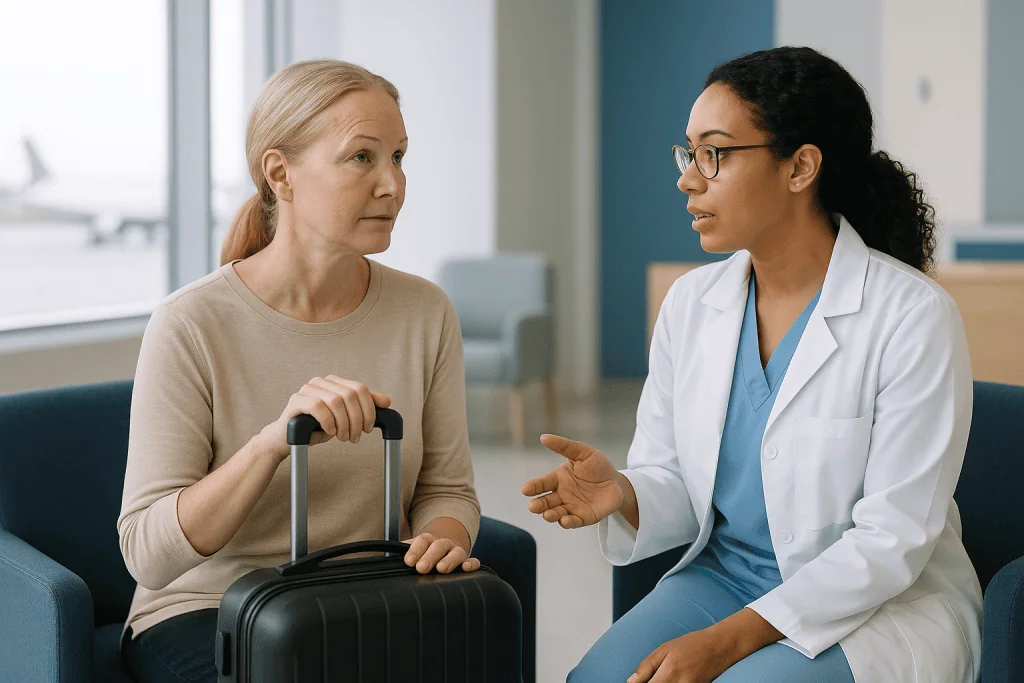
The first clock is wound healing. Incisions need their stitches or clips out, and the skin edge needs to be sealed well enough that cabin dryness and a backpack strap will not disturb it. Mayo Clinic notes that sutures or clips after a brow lift are usually removed within 7 to 10 days, and that incisions take about that long to seal at the surface.
The second clock is swelling. The forehead and eyelids swell for days and the swelling slowly drains downward, so the puffiest point often comes two or three days after surgery, not on day one. Mayo Clinic says swelling may persist for several weeks after a brow lift. A flight does not reverse healing, but reduced cabin pressure and the dry air can make swelling feel worse and can make a fresh bruise more uncomfortable.
The third clock is clot risk, which has nothing to do with the forehead and everything to do with your legs. The CDC’s travel-medicine guidance treats recent surgery as a risk factor for deep vein thrombosis (a clot in a deep leg vein) and notes that long journeys of more than about four hours roughly double to quadruple the baseline risk. A forehead lift is a lighter operation than abdominal surgery, but it still involves anesthesia, immobility and tissue injury.
Any sensible answer about flying after forehead lift surgery has to satisfy all three clocks. That is why the most common instruction from surgeons is a timing rule, stay until the first follow-up, rather than a calendar rule. The follow-up visit is where the wound is checked, closures come out, and the person who operated judges whether a cabin is a reasonable place to spend the next several hours.
Who is usually cleared to travel sooner, and who is usually asked to wait
Surgeons do not apply one rule to everyone, and it helps to know which side of the line you are likely to fall on.
People who tend to be cleared at or shortly after the first follow-up usually share a few features. They had a limited endoscopic or temporal lift with small closures. Their swelling is settling on schedule. They have no history of clots, do not smoke, are not taking hormone-containing medicines, and have a flight under four hours. They also have someone to meet them at the other end and a clinician at home willing to look at the incisions if needed.
People who are commonly asked to wait longer include anyone who had a coronal lift with a long scalp incision, anyone whose forehead lift was combined with eyelid surgery or a facelift, and anyone with a prior deep vein thrombosis, a known clotting disorder, recent cancer treatment, or a body weight that places them in a higher clot-risk group. The CDC’s deep vein thrombosis chapter lists these among the factors that compound the travel risk. Long-haul routes with a connection, where the total seated time is far above four hours, push the same way.
Age alone is not a reason to delay. Pregnancy is, because it raises clot risk independently. Anyone taking an anticoagulant, the class of medicines that slows clotting, needs the prescriber and the surgeon to agree on a plan, since those drugs affect both bleeding under the forehead flap and clot prevention in the legs. This article does not suggest changing anything; that decision belongs to the clinicians who know the specific drug and the specific operation.
Finally, some people are simply not ready. A bruise that is still spreading, a headache that is not easing, or a numb patch that has turned painful are all reasons a careful surgeon will ask for a few more days before signing a fit-to-fly letter.
Brow lift recovery time: what the first days and weeks usually look like
Day one is mostly about the dressing. Many surgeons wrap the head in a light bandage, sometimes with a small drain, to limit swelling and collect any fluid. The forehead feels tight and heavy, and the scalp behind the incisions is numb. Mayo Clinic describes elevating the head, applying cool compresses, and avoiding bending or heavy lifting during this period.

Days two and three are usually the puffiest and the most colorful. Swelling drifts down from the forehead into the upper eyelids and can make the eyes look narrower; bruising can appear around the eyes even when the incisions are all behind the hairline, because blood tracks downward under the skin. This is expected, not a complication, though it surprises people who assumed the forehead would stay the focus.
By the end of the first week the dressing is typically gone, hair washing is usually allowed with gentle technique, and the forehead starts to look more like a forehead. Mayo Clinic notes that stitches or clips come out within 7 to 10 days and that many people feel comfortable in public, with makeup if desired, at around 10 to 14 days.
Weeks two through four bring itching along the incisions as nerves recover, patches of numbness that slowly shrink, and residual swelling that is more noticeable in the morning. NHS guidance on facial lifting procedures gives 2 to 4 weeks as the typical window to resume ordinary daily activity, with strenuous exercise held back for several weeks. Scalp sensation can take months to fully return.
Brow lift recovery time therefore has two meanings. The short version, roughly 10 to 14 days to be socially presentable, is what travel planning usually revolves around. The long version, several weeks to months for swelling, sensation and the final brow position to settle, is what the follow-up schedule revolves around. Both matter when deciding where you want to be when each milestone arrives.
Stitch removal after brow lift: timing and why it anchors the travel date
Scalp incisions are usually closed with surgical clips (small metal staples that hold the skin edges together) or with stitches, sometimes both. Clips are popular behind the hairline because they are quick and spare the hair follicles; stitches are more common along a hairline incision where a fine scar matters.
Both kinds need to come out. Mayo Clinic puts the usual window at 7 to 10 days. Removal is quick and typically uncomfortable rather than painful, and it is done in the clinic by the surgeon or a nurse. If dissolvable stitches were used in deeper layers, they are left to break down on their own over weeks.
Stitch removal after brow lift surgery matters for travel in three ways. It is the moment the surface of the wound is inspected closely, so early problems such as a small opening, a collection of fluid, or redness suggesting infection are caught by the person best placed to deal with them. It also sets the point at which the skin edge is sealed well enough to tolerate dry cabin air, pillow friction and the occasional careless hand. And it is the natural fit-to-fly checkpoint: a surgeon who has just removed your clips has all the information needed to say yes or not yet.
Some people are tempted to leave early and have the clips removed at home. It is possible, and the MedlinePlus patient instructions on caring for a closed surgical wound describe the ordinary checks a clinician makes, but it shifts responsibility to someone who did not see the wound on day one and who may not know where every closure sits in the hair. If early departure is unavoidable, that arrangement needs to be made in writing before you leave, with the type of closure, the number of sites and the planned removal date clearly recorded.
Flying after forehead lift surgery and blood clots: the risk that matters most
If one thing in this article deserves the most attention, it is this: the serious hazard of flying after forehead lift surgery is not in the forehead. It is a clot forming in a leg vein during hours of sitting, and that clot breaking loose and traveling to the lungs, an event called a pulmonary embolism.
The CDC’s travel-medicine guidance on deep vein thrombosis is clear on the mechanics. Prolonged sitting slows blood flow in the calf veins; dehydration thickens the blood slightly; the cramped position compresses the veins behind the knee. Journeys over about four hours carry two to four times the baseline clot risk, and the risk climbs with duration and with the number of personal risk factors. Recent surgery sits on that list because anesthesia, reduced mobility and tissue injury all tilt the clotting balance.
A forehead lift is a relatively short, superficial operation, so its contribution is smaller than that of a hip replacement or an abdominal procedure. It is not zero, and it stacks on top of whatever risk you already carry. Someone with a prior clot, a known clotting disorder, an estrogen-containing medicine, obesity, or a recent long illness has more reason to wait than a healthy person with none of these.
The prevention basics are the same ones the CDC gives every long-haul traveler, and they cost nothing. Choose an aisle seat so you can get up without climbing over anyone. Walk the cabin every hour or so when the seatbelt sign allows. Flex your ankles and tighten your calf muscles while seated. Drink water through the flight and go easy on alcohol, which dehydrates. Avoid crossing your legs for long stretches, and do not wedge luggage under the seat where it blocks your feet.
Properly fitted knee-length compression stockings are recommended by the CDC for travelers at elevated risk. Whether you need a medicine that slows clotting, the class known as anticoagulants, for a specific flight is a decision for your surgeon and your regular physician together, based on your personal risk profile rather than on anything a magazine can say.
Does flying affect eye pressure or swelling after a forehead lift?
This question arrives in two forms, and they deserve separate answers.
The first is about the eyes themselves. Intraocular pressure (the fluid pressure inside the eyeball) is not meaningfully changed by ordinary airline travel in a healthy eye. Commercial cabins are pressurized to the equivalent of roughly 6,000 to 8,000 feet, according to the CDC’s air travel chapter. That is a real drop in pressure compared with sea level, but it is a drop that happens to every traveler on every flight, and the eye handles it. The exception that eye surgeons worry about is a gas bubble placed inside the eye during certain retinal operations, which expands at altitude. A forehead lift puts nothing inside the eye, so that concern does not apply.
The second form of the question is the one that actually matters after a brow lift: does cabin pressure make facial swelling worse? Lower cabin pressure allows tissue fluid to shift slightly, and cabin humidity of around 10 to 20 percent, again per the CDC, dries the skin and the eyes. People often describe their face as puffier after a long flight even without surgery. After a forehead lift, where the eyelids are already carrying drained swelling from above, that effect is more noticeable. It is a comfort issue, not a safety issue, in the ordinary case.
Where it can become a safety issue is bleeding. Fresh surgical sites have small vessels that are still sealing, and a sharp change in pressure in the first day or two, combined with straining to lift a bag into an overhead locker, is a plausible way to encourage a hematoma, a collection of blood under the forehead flap. This is one of the reasons surgeons are reluctant to clear anyone to fly in the first few days, and why some prefer the incisions to be checked and closures removed first.
Dry eyes deserve a mention. Upper-face surgery can temporarily reduce how fully the eyelids close, and dry cabin air aggravates that. Lubricating drops, used as your surgeon advises, and a window seat away from the air vent are low-effort ways to stay comfortable.
When can I fly after a facelift, and is a forehead lift different?
Many people reading about forehead lifts had, or are considering, a facelift at the same sitting, and the two are often lumped together online. They share the same travel logic but differ in scale.
A facelift involves longer incisions around the ears, more lifting of deeper tissue, and a greater raw surface under the skin. NHS guidance gives a recovery of 2 to 4 weeks for daily life and notes that bruising and swelling can take longer to fully fade. Because the raw surface is larger, the bleeding and hematoma risk in the first days is a bigger concern, and most surgeons apply the same stay-until-follow-up rule but with a firmer hand.
A forehead lift on its own, especially an endoscopic one, is lighter. The incisions are shorter and hidden in the scalp, and the swelling, while visible, is more contained. That is why some surgeons are comfortable with earlier departure after an isolated brow lift than after a full facelift, while others apply one rule to all facial surgery for simplicity.
When the two are done together, the heavier procedure sets the timetable. Combined surgery also lengthens the anesthetic, which slightly increases the clot consideration already discussed, and increases the total swelling that a cabin environment will aggravate.
So when someone asks when can I fly after a facelift, the honest answer is the same shape as the forehead-lift answer, after the first follow-up and stitch removal, typically in the second week, but the surgeon’s appetite for an early flight is usually lower. If you had both, plan your trip length around the facelift, not the brow.
Typical milestones after a forehead lift and what each means for travel
Timelines in prose are easy to misremember. The table below gathers the typical ranges from the cited sources alongside the practical travel implication of each. Every figure is a typical range, not a promise, and your own team may set different limits.
| Milestone | Typical timing | What it means for flying | Source |
|---|---|---|---|
| Head dressing and any drain removed | First 1–3 days | Too early for a flight; bleeding risk and swelling are at their peak | Mayo Clinic |
| Peak swelling and bruising, often around the eyes | Days 2–4 | Cabin dryness and pressure make this period uncomfortable; most surgeons say wait | Mayo Clinic |
| Stitches or clips removed | 7–10 days | The usual fit-to-fly checkpoint; wound inspected, early problems caught | Mayo Clinic |
| Comfortable in public, makeup allowed | 10–14 days | Many short-haul flights are cleared around here if healing is on track | Mayo Clinic |
| Return to ordinary daily activity | 2–4 weeks | Long-haul travel is more commonly cleared in this window | NHS |
| Elevated clot risk after surgery | Several weeks | Apply full in-flight clot prevention measures whenever you fly in this period | CDC Yellow Book |
| Residual swelling, numbness and scar settling | Weeks to months | No travel barrier, but follow-up should be arranged wherever you live | Mayo Clinic |
Two things stand out from the table. The dates that govern comfort, the swelling and bruising rows, resolve faster than the row that governs safety, the clot window. That mismatch is why someone can look nearly normal and still be asked to walk the aisle every hour and wear compression stockings on the way home.
The other point is that the fit-to-fly checkpoint and the follow-up checkpoint are the same appointment. Booking a return flight that lands before that visit is the single most common planning error people make, and it is entirely avoidable.
Arranging follow-up abroad and at home before you leave
Surgery is a series of appointments, not an event. The operation is one of them; the dressing check, the closure removal, the six-week review and the longer-term scar check are the others. When the surgeon is in one country and the patient’s sofa is in another, those later appointments need a plan, and the plan should exist before the first incision.
NHS guidance on cosmetic surgery abroad sets out the questions worth settling in advance. Who will see you if a problem arises after you get home? Will the operating surgeon be reachable by phone or video, and in which hours? What written documentation will you take with you: the operation note, the type and number of closures, the implants or fixation devices used if any, the medicines given, and a contact for the surgical team? Does your travel insurance cover complications of an elective procedure, since many standard policies exclude them?
On the home side, it is worth telling your regular physician before you travel that you are having a forehead lift elsewhere. A clinician who has been warned is far more useful than one who meets a scalp incision for the first time at an unscheduled appointment. Ask whether they are willing to inspect the wound, remove clips if needed, and manage ordinary issues such as a minor infection, and ask what they would prefer to refer on.
Photographs help. A dated set of pictures of the incisions at the time of closure removal gives any clinician at home a baseline to compare against. Keep them with the written notes in a format you can email.
Plan the first week at home as a continuation of recovery rather than a return to normal. No one should be collecting children from school with a fresh scalp incision and a time-zone headache on the morning after a long flight. Build in a quiet day or two on either side of the journey.
Packing and in-flight practicalities after forehead surgery
Small details make a surprising difference to how the journey feels.
Luggage first. Lifting a bag into an overhead locker raises pressure in the head and strains the brow at exactly the moment you least want it; Mayo Clinic advises against bending and heavy lifting in the early weeks. Travel with a bag that fits under the seat or that someone else can lift, and do not be shy about asking cabin crew for help.
Head protection next. The forehead and scalp will be numb in patches for weeks, which means you can bump or sunburn them without feeling it. A soft, loose hat protects the incisions from sun and from the seat in front, and it spares you the glances. Avoid anything tight that sits across the incision line.
Seating matters. An aisle seat makes it easier to walk every hour for clot prevention, as the CDC advises; a seat away from the air vent reduces drying of the eyes and skin. If you can manage only one of these, the aisle is the safer choice. A neck pillow helps you keep the head elevated when dozing, which Mayo Clinic recommends for swelling control in the first weeks.
Pack lubricating eye drops, if your surgeon has suggested them, a small bottle of water that you refill, and any prescribed medicines in their original packaging with the prescription, in your hand luggage rather than in the hold. If you were prescribed an anticoagulant or any other medicine for the flight, carry the written instructions from the prescriber; this article deliberately gives none.
At security, scalp clips occasionally trigger a detector. A short letter from the surgeon confirming recent surgery and the presence of clips removes the awkwardness. The same letter is what airlines mean when they ask for a fit-to-fly note, and most carriers want one for anyone traveling within a couple of weeks of an operation.
What people often get wrong about flying after forehead lift surgery
Myths cluster around this topic because so many people are making the same decision with the same incomplete information. A few deserve a direct correction.
The first myth is that a month is the universal minimum. It is not a figure in any cited guideline for facial surgery. The 7 to 10 day closure-removal window from Mayo Clinic and the 2 to 4 week recovery window from the NHS are the ranges with evidence behind them; a month is sometimes a surgeon’s personal preference for long-haul routes or combined procedures, and that is a legitimate instruction to follow, but it is not a law of healing.
The second myth runs the other way: that because the forehead looks fine, the flight is safe. The CDC’s clot guidance makes clear that the leg-vein risk after any surgery outlasts the visible recovery. Looking presentable at day ten does not change what happens in the calf veins at hour six of a flight.
The third is that cabin pressure will burst the stitches or pull the lift loose. Fixation after a forehead lift is held by sutures or small devices on bone and by the healing of tissue onto its new position, not by air pressure. Nothing in a pressurized cabin at the equivalent of 6,000 to 8,000 feet undoes that. The genuine pressure-related concern is early bleeding, which is why the first few days matter, not the stitches themselves.
The fourth is that the airline decides. Airlines ask for a fit-to-fly letter and may refuse boarding without one, but they do not assess your wound. The judgment is the surgeon’s.
The last and most costly myth is that follow-up can be sorted out later. By the time it is needed, later has usually arrived with a problem attached. Arrange it before the operation, not after the flight.
Is a forehead lift the hardest plastic surgery to recover from?
People searching this question often expect a ranking. There is no evidence-based league table of recovery difficulty, and the honest answer is that it depends on what you mean by hard.
If hard means physically demanding, a forehead lift is near the gentler end of aesthetic surgery. There is no abdominal wall to protect, no drains lasting a week, and no restriction on walking from the first day. Mayo Clinic frames the main early demands as keeping the head elevated, avoiding strenuous activity for a few weeks, and protecting the incisions. Operations on the trunk, such as abdominoplasty, carry longer restrictions and a higher clot risk by comparison.
If hard means visible, the picture changes. Facial surgery is difficult to hide. Bruising that drains into the eyelids, a hairline that is briefly shaved or thinned, and a forehead that looks startled for a week or two all happen where everyone can see them. For someone whose work or social life depends on their face, that visibility is a real recovery burden that a body procedure does not impose.
If hard means sensation, scalp surgery has a particular signature. Numbness, tingling, and later itching along the top of the head are common and can last months as the small sensory nerves regrow. Some people find this more unsettling than pain. It is expected, and it usually improves, but it is worth knowing about in advance so it does not read as something going wrong.
What makes any recovery harder is distance. A straightforward brow lift with the surgeon down the road is easy. The same operation with the surgeon a continent away and no plan for follow-up is harder, not because the surgery changed, but because the safety net did. That, more than the procedure itself, is the variable within your control.
Questions to ask your care team before you book the flight home
A ten-minute conversation before surgery saves most of the anxiety afterward. These are the questions worth bringing, phrased so the answers are specific rather than reassuring.
- Which type of forehead lift am I having, and how does that affect when you would be comfortable with me flying?
- On which day do you expect to remove the clips or stitches, and will you give a fit-to-fly letter at that visit if healing is on track?
- Given my flight length, my medical history and any medicines I take, do you consider me at ordinary or elevated clot risk, and what precautions do you want me to take on the journey?
- Should I wear compression stockings, and if so, who will fit them?
- What signs in the first week would make you want to delay my departure?
- How will you be reachable after I leave, by which route, and in which hours?
- What written documentation will I take home, and will it include the type and number of closures and anything placed under the skin?
- Who do you recommend I see at home for follow-up, and have you communicated with them?
- If a complication occurs after I return, what is the plan: do I come back, or is a clinician at home expected to manage it?
- When can I resume exercise, swimming, hair coloring and sun exposure, and are any of those different from your usual advice because I am traveling?
Write the answers down or ask for them in writing. Memory in the days after anesthesia is less reliable than people expect, and a one-page summary from the surgeon is the most useful thing you can hand to a clinician at home. If any answer is vague, ask again. A team that operates on international patients regularly will have precise answers to all of these, and precision in the clinic is a fair proxy for precision in the operating room.
When to call your doctor: red-flag signs after a forehead lift
Most recoveries are uneventful. The purpose of this section is to make sure the uncommon ones are recognized early, whether you are still near the surgeon or already home.
Contact the surgical team, or emergency services if the surgeon is unreachable, for any of the following in the days after surgery: swelling on one side of the forehead that is growing, tense or increasingly painful, which can signal a hematoma (a collection of blood under the skin flap) that may need draining; bleeding from an incision that soaks through a dressing; a fever, spreading redness, warmth or a bad-smelling discharge from an incision, which suggest infection; an incision that has opened; or a sudden change in vision, severe eye pain, or an eyelid that will not close. Mayo Clinic and the NHS list these among the recognized complications of brow and facial lifting procedures.
Treat the following as emergencies at any point in the weeks after surgery, including during or after a flight: pain, swelling or warmth in one calf; sudden shortness of breath; chest pain that is worse on breathing in; coughing up blood; a racing heartbeat; or fainting. These are the warning signs of deep vein thrombosis and pulmonary embolism described by the CDC, and they call for immediate medical attention wherever you are, not a message to a surgeon in another time zone.
Less urgent but still worth a call: numbness that is spreading rather than shrinking after the first weeks, a brow that looks noticeably uneven once swelling has settled, hair loss along an incision that is not recovering, or a scar that is thickening and raised. None of these are emergencies, and all are easier to manage with early review.
If you are at home and unsure whether something is a problem, the right first call is to a local clinician who can see you, with a message to the operating team in parallel. Every decision about treatment, including whether you should return to the surgeon, rests with the clinicians who assess you.
Frequently asked questions
When can I fly after a facelift or forehead lift?
Most surgeons ask you to stay until the first follow-up visit, which usually coincides with stitch or clip removal 7 to 10 days after surgery, and some prefer longer for long-haul routes or combined procedures. The final decision depends on your type of lift, your clot risk and how healing is progressing, and it rests with the treating team rather than the airline or a general rule.
Does flying affect eye pressure after a brow lift?
Ordinary airline travel does not meaningfully change the fluid pressure inside a healthy eye, and a forehead lift places nothing inside the eye that could expand at altitude. What people actually notice is facial swelling and dryness, because cabins are pressurized to the equivalent of 6,000 to 8,000 feet with very low humidity. That is a comfort issue, and lubricating drops used as advised usually help.
How long does it take to recover from a forehead lift?
Typical ranges from Mayo Clinic and the NHS are 7 to 10 days for closure removal, 10 to 14 days to feel presentable in public, and 2 to 4 weeks to return to ordinary daily activity, with strenuous exercise held back for several weeks. Residual swelling, scalp numbness and the final settling of the brow position can take months, which is why follow-up continues well after the flight home.
What is the hardest plastic surgery to recover from?
There is no evidence-based ranking. A forehead lift is physically gentler than trunk procedures such as abdominoplasty, which carry longer restrictions and a higher clot risk, but facial surgery is harder to hide and scalp numbness can be unsettling for months. The factor that most often makes any recovery harder is distance from the surgeon without a follow-up plan, which is the part a patient can control.
What is the brow lift recovery time before I look normal?
Mayo Clinic describes most people feeling comfortable in public, with makeup if desired, at around 10 to 14 days, after the peak of swelling and bruising in the first few days has passed and closures have been removed. Looking normal and being fully healed are different things; swelling can persist for several weeks and sensation along the scalp returns gradually over months.
How is stitch removal after brow lift surgery done, and can it be done at home?
Clips or stitches in the scalp are removed in clinic, usually within 7 to 10 days, in a quick procedure that is more uncomfortable than painful. It can be done by a clinician at home, but that clinician needs to know the type and number of closures and where each sits in the hair, so the arrangement should be made in writing with the surgeon before you leave rather than improvised afterward.
What are the clot prevention basics for a flight after surgery?
The CDC advises an aisle seat, walking the cabin every hour or so, flexing the ankles and calves while seated, drinking water, limiting alcohol, keeping the space under the seat clear for your feet, and properly fitted compression stockings for travelers at elevated risk. Whether you need a clot-preventing medicine for a specific journey is a decision for your surgeon and regular physician together.
Will cabin pressure pull the forehead lift loose or burst the stitches?
No. A forehead lift is held by sutures or small fixation devices and by tissue healing in its new position, none of which respond to the modest pressure change in a cabin. The genuine pressure-related concern is bleeding under the skin in the first day or two, when small vessels are still sealing, which is one reason surgeons prefer closures removed and the wound checked before any flight.
Do I need a fit-to-fly letter after a forehead lift?
Most airlines ask for one from anyone traveling within a couple of weeks of an operation, and some cabin crew will refuse boarding without it. The letter comes from the surgeon, usually at the closure-removal visit, and confirms you are safe to travel; it also helps at security if scalp clips trigger a detector. The airline relies on it but does not assess the wound itself.
What should I arrange at home before having a forehead lift elsewhere?
NHS guidance on surgery abroad suggests telling your regular physician in advance, confirming they are willing to inspect incisions and manage minor problems, checking whether your travel insurance covers complications of elective surgery, and taking home the operation note, closure details, medicines given and a contact route to the surgeon. Dated photographs of the incisions at closure removal give any local clinician a useful baseline.
References
This article is for general information only and is not a substitute for professional medical advice. Please consult a qualified doctor about your individual situation.
Add us as a Preferred Source to see more of our trusted health content across Google Search, AI Overviews and Discover.

More from the Blog
Can Ears Move Back After Otoplasty? Cartilage Memory, Sutures and How Long Results Last
Ears can partially move back after otoplasty, but complete return to the original shape is uncommon when the cartilage has healed around its new…

Sun, Silicone Sheets and Tension: Caring for a Scar in the Year After Scar Revision Surgery
Scar care after revision surgery centers on three habits for roughly a year: protecting the new scar from sun with clothing and broad-spectrum sunscreen,…

Why the Neck Ages Differently: Platysma Bands, Jowls and How a Neck Lift Addresses Each
Platysma bands are vertical cords that appear when the edges of the thin platysma muscle in the neck separate and tighten with age; jowls…

Reading a Brow Lift Treatment Plan: Questions to Ask About Technique, Scars and Fixation
A brow lift treatment plan should spell out the technique (endoscopic, coronal, hairline, temporal, direct or through an upper-eyelid incision), where each incision and…
Who Is a Candidate for Non-Surgical Facial Rejuvenation? Age, Skin Type and Expectations
A candidate for non-surgical facial rejuvenation is usually a healthy adult with early to moderate signs of aging, such as expression lines, mild volume…

Soft Diet and Oral Hygiene After Genioplasty: Caring for the Incision Inside the Mouth
After genioplasty the incision usually sits inside the lower lip, so aftercare centers on a liquid-to-soft diet for several weeks, gentle brushing that steers…