

Hysterectomy Myths: Does It Always Bring On Menopause, and Is Recovery Always Long?

Key Takeaways
- Menopause follows a hysterectomy immediately only when both ovaries are removed; if they are kept, they continue making hormones, though the NHS notes menopause may arrive somewhat earlier than average.
- The NHS puts full recovery after an abdominal hysterectomy at about 6–8 weeks, while Mayo Clinic estimates roughly 3–4 weeks after a vaginal operation, so the surgical route matters more than the word hysterectomy itself.
- Routine removal of healthy ovaries in people years from natural menopause is no longer default practice, because long-term observational data link early ovary loss to higher heart disease risk.
- After a total hysterectomy for benign reasons with no history of abnormal cervical cells, routine cervical screening usually stops; after a subtotal hysterectomy the cervix remains and screening continues.
- Injury to the bladder, ureters or bowel is uncommon but is the complication surgeons monitor most closely, and increasing abdominal pain, fever or urinary changes after surgery warrant a same-day call.
- Removing the uterus does not remove the structures responsible for orgasm, and many people report that sex improves once heavy bleeding and pelvic pain are gone.
A hysterectomy does not always bring on menopause. Menopause follows immediately only when both ovaries are removed during the same operation; if the ovaries are kept, they continue producing hormones, although menopause may arrive somewhat earlier than it otherwise would. Recovery is not always long either: the NHS describes roughly 6–8 weeks after an abdominal operation and often less after vaginal or keyhole surgery, with the surgical team setting the pace.
The leaflet has been folded and unfolded so many times the crease is going soft. She is fifty-one, her fibroids have made every period a logistics operation for a decade, and her gynecologist has just said the word out loud: hysterectomy. What she hears, though, is her aunt’s voice from years ago. Instant menopause. Months on the sofa. Never the same again.
Almost everyone facing this decision carries a version of that voice. Hysterectomy myths travel through families the way recipes do, handed down with total confidence and rarely checked against the original. Some of them were half true a generation ago, when nearly every operation meant a long abdominal incision and ovaries were removed almost as a matter of routine.
The surgery has changed. The evidence has grown. This explainer walks through what actually happens, what the ovaries have to do with menopause, how long healing typically takes, and which fears deserve a calm second look.
Why hysterectomy myths outlast the evidence
A hysterectomy is an operation to remove the uterus, the muscular organ where a pregnancy grows. That single sentence already dismantles the first misunderstanding, because in everyday conversation the word is used as if it also meant removing the ovaries, the cervix and everything in between. It does not. Surgeons describe several distinct procedures under one umbrella term, and which one a person has shapes almost every question that follows.
A total hysterectomy removes the uterus and the cervix, the narrow neck at the bottom of the uterus. A subtotal or supracervical hysterectomy removes the upper part of the uterus and leaves the cervix in place. A radical hysterectomy, used mainly for certain cancers, removes the uterus, cervix, the upper vagina and surrounding tissue. Any of these can be done with or without removing the ovaries and fallopian tubes, and that last detail is the hinge on which the menopause question turns.
Why do the myths persist? Partly because the operation is so common. Cleveland Clinic notes it is the second most frequently performed surgery for women in the United States after cesarean delivery, so most people know someone who has had one and inherit that person’s story as if it were the whole picture. Partly because older practice really did differ: routine ovary removal was more common, incisions were larger, and hospital stays were longer. And partly because the uterus carries meaning far beyond anatomy, so fear fills the gaps that plain information should occupy.
The rest of this article treats each inherited story as a claim to test rather than a truth to accept. Where the evidence is solid, it says so. Where it is thin or mixed, it says that too.
What actually happens during a hysterectomy
Under general anesthesia, or occasionally a regional anesthetic that numbs the lower body, the surgeon reaches the uterus by one of three routes. The choice depends on the reason for surgery, the size of the uterus, previous operations, and the surgeon’s training.
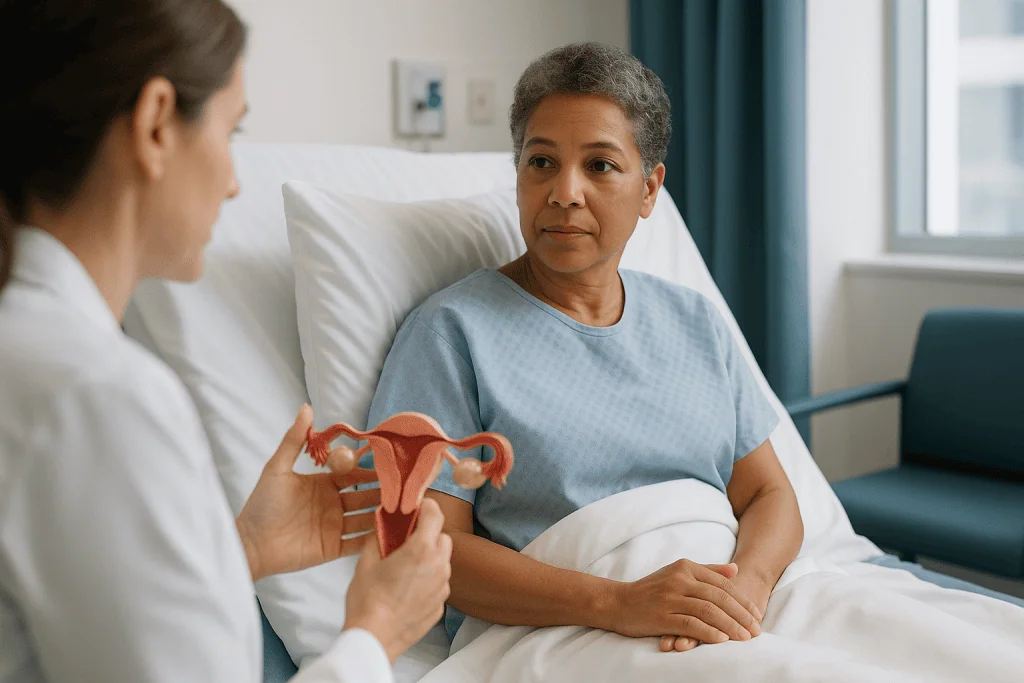
An abdominal hysterectomy uses a cut in the lower abdomen, either horizontal along the bikini line or vertical from below the navel. Mayo Clinic describes this as the approach often chosen when the uterus is very enlarged, when cancer is suspected, or when the pelvis needs to be inspected widely. A vaginal hysterectomy removes the uterus through the vagina with no external incision at all. A laparoscopic hysterectomy, sometimes called keyhole surgery, uses a few small cuts and a thin camera, with the uterus freed from its attachments inside and removed through the vagina or a slightly enlarged incision. Robot-assisted surgery is a form of laparoscopy in which the surgeon controls the instruments from a console.
Inside, the steps are broadly similar whatever the route. The surgeon seals and divides the blood vessels feeding the uterus, detaches the ligaments that hold it in the pelvis, separates it from the bladder in front and the bowel behind, and then removes it. If the ovaries and tubes are coming out too, they are detached from their own blood supply. The top of the vagina is stitched closed, forming what is called the vaginal cuff.
According to the NHS, the operation usually takes around an hour, though complex cases run longer. Afterward, a catheter drains the bladder for a while and a drip supplies fluids. Most people are helped to sit up and take a few steps the same day or the next morning, which matters more than it sounds: early movement is one of the simplest ways to lower the risk of blood clots.
Does hysterectomy cause menopause? Only if the ovaries go too
Menopause is the point at which the ovaries stop releasing eggs and producing most of the body’s estrogen. The uterus plays no part in that hormone production. It responds to hormones; it does not make them. So removing the uterus alone does not switch off the hormonal cycle, even though periods stop because there is no longer a lining to shed.
This is the distinction the NHS draws clearly: if both ovaries are removed during a hysterectomy, menopause begins immediately, whatever the person’s age. If the ovaries are left in place, they keep working, and the person will go through natural menopause at roughly the time they otherwise would have. The word roughly earns its place. The NHS also notes that people who keep their ovaries may experience menopause somewhat earlier than average, possibly within about five years of the operation in some cases. The proposed explanation is that surgery can slightly disturb the blood supply to the ovaries, though the mechanism is not fully settled.
Several things make this myth stubborn. Periods stop, and for many people the end of periods has always meant menopause. A person may already have been in perimenopause, the years of fluctuating hormones before the final period, and mistakes the timing for cause and effect. And some people do have their ovaries removed for good clinical reasons and then, understandably, describe the whole experience as the hysterectomy causing menopause.
The practical question, then, is not whether a hysterectomy causes menopause but whether your particular operation includes an oophorectomy, the medical term for removing an ovary. Ask directly. Ask why or why not. The answer should reflect your age, your reason for surgery, your family history and your own preferences, and it is one of the most consequential lines on the consent form.
What surgical menopause means when both ovaries are removed
When both ovaries come out before natural menopause, the hormonal change is abrupt rather than gradual. Natural menopause typically unfolds over several years; surgical menopause happens overnight. Mayo Clinic and the NHS both describe the usual consequences: hot flashes, night sweats, vaginal dryness, sleep disruption and changes in mood, often arriving within days of surgery and sometimes more intensely than in a natural transition.

The longer-term picture is where the evidence deserves careful reading. Estrogen protects bone density, so earlier loss of estrogen is associated with a higher lifetime risk of osteoporosis, a condition in which bones become fragile. Observational research, including analyses from the long-running Nurses’ Health Study published through PubMed, has linked ovary removal before natural menopause with higher rates of coronary heart disease and overall mortality compared with keeping the ovaries, particularly in those who did not take estrogen afterward. Observational studies cannot prove cause, and the people who had their ovaries removed may have differed in other ways, but the pattern has been consistent enough to change practice.
That shift shows up in current guidance. Routine removal of healthy ovaries at hysterectomy in younger people is no longer the default. It is usually reserved for situations where the ovaries themselves are diseased, where there is a strong inherited risk of ovarian cancer, or where a hormone-sensitive condition such as severe endometriosis makes retaining them counterproductive. Removing the fallopian tubes while keeping the ovaries is increasingly discussed as a separate option, since research suggests many ovarian cancers begin in the tubes.
For those who do need both ovaries removed before natural menopause, menopausal hormone therapy, a class of medicines that replace the estrogen the ovaries no longer make, is a standard topic of discussion. Whether it suits an individual depends on their history, particularly any hormone-sensitive cancer, and that judgment belongs with the prescribing clinician.
Who is usually offered a hysterectomy, and who is asked to wait
Hysterectomy is a treatment, not a diagnosis, and the conditions that lead to it vary widely in urgency. MedlinePlus and the NHS list the common reasons: heavy or painful periods that have not responded to other treatment, fibroids (non-cancerous growths in the uterine muscle), endometriosis (tissue similar to the uterine lining growing outside the uterus), adenomyosis (that tissue growing into the uterine wall), uterine prolapse (the uterus slipping down into the vagina), chronic pelvic pain, and cancers of the uterus, cervix, ovaries or fallopian tubes.
For cancer, the operation is often central to treatment and the discussion moves quickly. For benign conditions, which account for the large majority of hysterectomies, the conversation is usually slower and deliberately so. Guideline bodies in the United Kingdom and United States frame hysterectomy for heavy bleeding or fibroids as an option to consider after, or alongside, less invasive treatments, and only when the person has completed or decided against childbearing.
Who is typically asked to wait, or steered toward alternatives first? Someone who may want a future pregnancy, because the operation ends fertility permanently. Someone whose symptoms have not yet been explored with imaging or a biopsy, because a hysterectomy performed for the wrong diagnosis does not fix the problem. Someone whose bleeding might respond to hormonal treatment, a progestogen-releasing intrauterine device, or a procedure such as endometrial ablation, which destroys the uterine lining. Someone with a medical condition, such as poorly controlled diabetes or a recent clot, that raises surgical risk until it is stabilized.
None of this means hysterectomy is a last resort to be dreaded. For many people it is the treatment that finally ends years of anemia and disrupted life. It means the decision should follow a proper diagnosis and a real conversation about alternatives, with the person’s own goals at the center.
Why do doctors discourage hysterectomy for some conditions?
Search that question and you will find two very different frustrations behind it: people who feel their symptoms were dismissed for years, and people who feel they were pushed toward surgery too fast. Both experiences are real, and both come from the same clinical tension.
Doctors are trained to prefer the least invasive treatment that solves the problem, because every operation carries risk and hysterectomy cannot be undone. For heavy menstrual bleeding without an underlying cancer, the evidence supports trying medical options first. Tranexamic acid, a medicine that helps blood clot at the bleeding surface, hormonal treatments that thin the lining, or a hormone-releasing coil can reduce bleeding substantially for many people, with the NHS listing these ahead of surgery in its treatment pathway. Fibroids can sometimes be removed individually in a procedure called myomectomy, which preserves the uterus, or shrunk by blocking their blood supply through uterine artery embolization.
There is also a fertility dimension. A clinician who hesitates when a younger person requests a hysterectomy is usually not doubting that person’s judgment. They are obliged to make sure the permanence has been fully understood and that reversible options have been genuinely explored, because regret about lost fertility is one of the outcomes they cannot repair.
Where discouragement tips into dismissal is a legitimate grievance. Pain that has been investigated and treated without success, bleeding that causes anemia despite medication, or prolapse that limits daily life are all recognized indications for surgery, and guidance is clear that the person’s quality of life counts. If you feel unheard, asking for the specific reasons surgery is not yet recommended, and what would need to change for it to be considered, turns a closed door into a documented plan. A second opinion within the same specialty is a reasonable request, not a confrontation.
Is hysterectomy high risk? What the complication picture really shows
Hysterectomy is major surgery, and it is also one of the most extensively studied and routinely performed operations in gynecology. Both statements are true at once, which is why the risk question needs more than a yes or no.
The NHS groups the recognized complications into a small number of categories. General anesthetic carries its own small risks, greater in people who are older or have heart or lung disease. Bleeding during or after the operation occasionally requires a transfusion. Infection can develop in the wound, the vaginal cuff, the bladder or the pelvis. Blood clots in the legs or lungs are a risk after any pelvic surgery, which is why compression stockings, blood-thinning injections and early walking are standard. Damage to nearby structures, principally the bladder, ureters (the tubes carrying urine from the kidneys) and bowel, is uncommon but is the injury surgeons watch for most carefully, and it may need a further procedure to repair.
Mayo Clinic adds that the approach influences the profile. Vaginal and laparoscopic operations are associated with fewer wound problems, less blood loss and shorter hospital stays than abdominal surgery, though laparoscopy has its own small risk of injury from the instruments used to enter the abdomen. Abdominal surgery remains the right choice for some people despite that, because a very large uterus or suspected cancer changes the calculation.
What the evidence does not support is the label of a uniquely dangerous operation. Serious complications are the exception rather than the rule in otherwise healthy people, and death is rare. The honest framing is that risk is individual. Age, body weight, smoking, diabetes, previous abdominal surgery and the reason for the operation all move the needle, and the pre-operative assessment exists precisely to estimate where your own risk sits and to reduce what can be reduced beforehand.
Hysterectomy recovery time: is it always long?
The image of months on the sofa comes from an era when nearly every hysterectomy involved a long abdominal incision. Recovery is still real work, but the range is far wider than the myth allows, and the surgical route is the biggest single factor.
The NHS gives the clearest published ranges. A hospital stay is typically 1–5 days depending on the approach and how quickly you are eating, walking and passing urine without a catheter. Full recovery after an abdominal hysterectomy takes about 6–8 weeks, while vaginal and laparoscopic operations are often shorter. Mayo Clinic describes a hospital stay of around 1–2 days after abdominal surgery, with most people resuming normal activity in roughly six weeks, and estimates full recovery from a vaginal hysterectomy at about 3–4 weeks. These are typical ranges, not promises, and your own team will adjust them to your health and the complexity of your operation.
| Approach | How the uterus is reached | Typical hospital stay | Typical time to full recovery | Often chosen when |
|---|---|---|---|---|
| Abdominal | Incision in the lower abdomen | About 1–5 days (NHS); 1–2 days (Mayo Clinic) | About 6–8 weeks (NHS) | Uterus is very large, cancer is suspected, or wide inspection is needed |
| Vaginal | Through the vagina, no external cut | Often 1–2 days | About 3–4 weeks (Mayo Clinic) | Prolapse, or a uterus of normal or modestly enlarged size |
| Laparoscopic or robot-assisted | Several small abdominal incisions and a camera | Often same day to 2 days | Shorter than abdominal, commonly a few weeks (NHS) | Benign conditions where keyhole access is feasible |
Two caveats keep the table honest. Full recovery means the point at which you can lift, exercise and work without restriction; feeling well enough to walk, cook and read arrives much sooner for most people. And whether the ovaries were removed adds a hormonal recovery that runs on its own, separate timeline, which the table cannot capture.
What the first days and weeks usually look like
The first day is mostly about the basics: managing pain, sipping fluids, getting the catheter out, and taking those first cautious steps with a nurse alongside. Pain is treated with a combination of medicines chosen by the anesthetic and surgical team, tapered as comfort improves, and the plan for continuing them at home is explained before discharge. Trapped wind is a frequent and surprising source of discomfort after pelvic surgery, and walking is one of the most effective remedies.
Vaginal bleeding or brownish discharge in the first weeks is expected, according to the NHS, as the stitches at the top of the vagina heal. It should be lighter than a period and gradually fade. Bowel habits are often sluggish for a few days, partly from anesthesia and pain relief, and fluids, fiber and gentle movement usually settle them.
By the end of the first week most people are moving around the house comfortably, climbing stairs slowly, and starting short walks outside. Fatigue is the symptom that catches people off guard: the body is diverting energy to healing, and an ordinary afternoon can feel like a full day. Rest when tired, but keep moving; both halves of that sentence matter.
Weeks two to four bring steady gains. Light housework returns. Driving is usually possible once you can sit comfortably with a seat belt, twist to check mirrors and perform an emergency stop without hesitation, which the NHS suggests checking with your insurer as well as your surgeon. Heavy lifting, vigorous exercise and anything that puts sustained strain on the pelvic floor wait until the team clears them, commonly around the six-week mark after abdominal surgery. Sexual intercourse is generally deferred until the vaginal cuff has healed and any discharge has stopped, which Mayo Clinic and the NHS place at roughly six weeks, though the go-ahead should come from your follow-up check rather than the calendar.
What does no one tell you about a hysterectomy?
The consent form covers bleeding and infection. The conversations that happen afterward, among people who have been through it, cover different territory, and much of it is well documented in the medical sources even if it rarely makes the leaflet.
Emotions can be complicated even when the surgery was wanted. The NHS notes that some people feel a sense of loss after hysterectomy, related to fertility, to femininity, or simply to the end of a chapter, and that this can coexist with real relief. Sudden hormonal change from ovary removal can intensify low mood or anxiety. Naming this in advance makes it easier to recognize and to ask for support rather than wondering what is wrong with you.
Sex is a common worry and a place where myths run in both directions. Removing the uterus does not remove the clitoris, the vaginal walls or the nerves that produce orgasm. Many people report that sex improves once pain and heavy bleeding are gone. A minority notice changes, particularly if the ovaries were removed and vaginal dryness follows, or if they were accustomed to uterine contractions during orgasm. Lubricants and, where appropriate, vaginal estrogen prescribed by a clinician address the dryness; the rest is usually a matter of time and communication.
Bladder and bowel function can shift subtly. The uterus sits between the two, and its removal can slightly change how the bladder fills and empties. Pelvic floor exercises, ideally taught by a physiotherapist, support recovery and remain useful for life.
Weight is not directly changed by removing the uterus, which weighs only a few ounces unless enlarged by fibroids. Reduced activity during recovery and, after ovary removal, hormonal shifts can affect appetite and metabolism, so gentle return to movement is as much a long-term plan as a short-term one.
Does a hysterectomy shorten your life?
People searching for the average lifespan after a total hysterectomy are asking a fair question, and the fairest answer is that removing the uterus by itself has not been shown to shorten life. The uterus has no known role in longevity once childbearing is done. Where the evidence does raise a flag is, once again, the ovaries.
The Nurses’ Health Study, a large observational cohort followed for decades and reported through PubMed, compared people who had both ovaries removed at hysterectomy with those who kept them. Those who had their ovaries removed before natural menopause showed higher long-term rates of coronary heart disease and death from all causes, while having, as expected, lower rates of ovarian and breast cancer. The net effect leaned toward harm from routine removal in people without a raised cancer risk, especially among those who did not use estrogen afterward.
Three cautions apply. First, observational data can show association but not prove cause; people who had their ovaries removed may have differed in health or lifestyle from those who did not. Second, the effect was concentrated in those who lost their ovaries young; removal around or after natural menopause showed a much smaller or no difference. Third, for people at high inherited risk of ovarian cancer, or with disease in the ovaries, the calculation is entirely different and removal may be protective.
What this means for a person facing surgery is not a prognosis but a set of priorities. If your ovaries are healthy and you are years from menopause, the burden of proof for removing them sits with the reasons to do so. If they are coming out, a plan for bone health, cardiovascular risk and the option of hormone replacement belongs in the same conversation as the surgery itself. That plan is built with your treating team, not from a search result.
What people often get wrong about hysterectomy myths
Some of the most persistent hysterectomy myths deserve a direct correction rather than a nuanced discussion, so here are the ones clinicians hear most often, with what the evidence actually shows.
- Myth: every hysterectomy means instant menopause. Only removal of both ovaries triggers immediate menopause; keeping them preserves hormone production, though menopause may arrive somewhat earlier than average (NHS).
- Myth: you will still need cervical screening no matter what. After a total hysterectomy for benign reasons, with the cervix removed and no history of abnormal cells, routine cervical screening usually stops. After a subtotal hysterectomy the cervix remains and screening continues. Your team confirms which applies.
- Myth: your organs will drop into the empty space. The bowel and bladder occupy the pelvis around the uterus already; they shift slightly, and the body adjusts. Prolapse after hysterectomy is possible but relates to pelvic floor support, not a void.
- Myth: a hysterectomy ends your sex life. The nerves and structures responsible for arousal and orgasm are not removed. Many people report improved sex once pain and bleeding resolve.
- Myth: it is a quick fix for any pelvic pain. Pain from endometriosis outside the uterus, from bladder conditions or from the pelvic muscles can persist after surgery. A clear diagnosis before the operation is what predicts relief.
- Myth: recovery always takes months. Vaginal and keyhole approaches are commonly measured in weeks (Mayo Clinic, NHS), and even abdominal surgery is usually in the 6–8 week range rather than months.
One correction cuts the other way. The reassurance that it is just a routine operation can understate the reality that it is major surgery with permanent consequences. Both dismissing it and dreading it get in the way of the calm, specific questions that actually protect you.
Questions to ask your care team
The most useful appointments are the ones where you leave with your own uncertainties answered rather than a general briefing. Bring a list. Bring someone to take notes if you can. These questions are drawn from the concerns that most often surface after surgery, when it is harder to act on the answers.
Start with the diagnosis and alternatives. What exactly is the condition being treated, and how confident is the team in that diagnosis? Which non-surgical or uterus-preserving options have been considered, and why is hysterectomy the recommendation now? What is likely to happen if I wait?
Then ask about the operation itself. Which type of hysterectomy is planned: total, subtotal or radical? Which route, and why that one for me? Will my ovaries be removed, one or both, and what is the reasoning? Will my fallopian tubes be removed if the ovaries stay? Will my cervix be removed, and does that change my screening afterward?
Move to recovery and follow-up. How long is the expected hospital stay for this approach? What is the typical timeline for walking, driving, work and exercise in my case? What support will I have for pain at home, and who do I call if something worries me? When is my follow-up appointment, and what will be checked?
Finish with the long view. If my ovaries are being removed, what is the plan for menopausal symptoms, bone health and heart health? Is hormone therapy an option for me, and if not, why? Are there pelvic floor exercises or physiotherapy I should start before or after surgery?
There are no naive questions here. A team that welcomes them is showing you how the relationship will work when you need it most.
When to call your doctor
Most recoveries follow a steady, slightly boring upward curve, and boring is exactly what you want. A small set of signs should prompt a same-day call to your surgical team or, where noted, emergency care, because they can indicate infection, bleeding, a clot or injury to a nearby organ that is far easier to treat early.
Contact your team the same day if you notice: a fever with chills; vaginal bleeding that is heavier than a light period, is bright red, contains clots or soaks a pad in an hour; discharge that becomes foul smelling or green; increasing rather than decreasing pain in the abdomen or pelvis, especially with a swollen or tender belly; redness, spreading warmth, pus or separation at an incision; burning on urination, cloudy or bloody urine, or difficulty passing urine; persistent vomiting or an inability to keep fluids down; no bowel movement for several days despite laxatives, or a bowel movement leaking from the vagina; or new, painful swelling in one calf or thigh.
Seek emergency care immediately, without waiting for a callback, if you experience sudden shortness of breath, chest pain, coughing up blood, fainting, or a racing heartbeat. These can signal a pulmonary embolism, a blood clot that has traveled to the lungs, which is a recognized complication of pelvic surgery and a genuine emergency according to the NHS and Mayo Clinic.
Low mood that deepens rather than lifts over the weeks, or thoughts of harming yourself, are also reasons to call. They are recognized after major surgery and after abrupt hormonal change, and they are treatable.
None of this list is meant for self-diagnosis, and the absence of a symptom here does not mean you should ignore something that feels wrong. The people who did your operation would rather hear from you ten times about nothing than miss the one call that mattered. Every decision about your care, before and after surgery, remains with them.
Frequently asked questions
Does hysterectomy cause menopause if I keep my ovaries?
Not immediately. If both ovaries remain, they keep producing estrogen and releasing eggs, so you will not enter menopause because of the operation itself, even though periods stop. The NHS notes that some people who keep their ovaries reach natural menopause a little earlier than they otherwise would, possibly within about five years of surgery, but this is a shift in timing rather than an abrupt change, and many notice no difference at all.
What is the typical hysterectomy recovery time?
It depends on the approach. The NHS describes full recovery after an abdominal hysterectomy as about 6–8 weeks, with vaginal and laparoscopic operations often shorter. Mayo Clinic estimates roughly 3–4 weeks for a vaginal hysterectomy and about six weeks for an abdominal one. Hospital stays typically run 1–5 days. These are typical ranges, not guarantees; your own health, the complexity of the surgery and your team’s advice set the actual pace.
Is hysterectomy high risk surgery?
It is major surgery with recognized risks, but it is also one of the most common and extensively studied operations in gynecology, and serious complications are the exception in otherwise healthy people. Recognized risks include bleeding, infection, blood clots, anesthetic reactions and, uncommonly, injury to the bladder, ureters or bowel. Individual risk depends on age, weight, smoking, other medical conditions and the surgical route, which is why pre-operative assessment exists.
Why do doctors discourage hysterectomy for heavy periods?
Because the operation is permanent and less invasive treatments often work. For heavy menstrual bleeding without cancer, guidance in the United Kingdom and United States favors trying medicines, a hormone-releasing intrauterine device, or procedures such as endometrial ablation first. Clinicians also want to be sure fertility questions are settled. If your symptoms persist despite those options and affect daily life, hysterectomy remains a recognized treatment, and asking what would change the recommendation is entirely reasonable.
What does no one tell you about a hysterectomy?
Fatigue often lasts longer than pain, trapped wind can be surprisingly uncomfortable in the first days, and light vaginal discharge continues for weeks while the top of the vagina heals. Emotions can be mixed even when the surgery was wanted. Bladder habits may shift slightly, and pelvic floor exercises help. If the ovaries are removed, menopausal symptoms can start within days. Knowing these in advance makes them far less alarming.
What is the average lifespan of a woman who has had a total hysterectomy?
Removing the uterus alone has not been shown to shorten life. The question that affects long-term health is whether the ovaries were also removed before natural menopause. Large observational studies, including the Nurses’ Health Study reported through PubMed, associate early ovary removal with higher long-term heart disease and mortality rates, though such studies cannot prove cause. For those who need ovary removal, planning for bone and heart health with the treating team is the priority.
What are the long-term side effects of a hysterectomy?
For most people who keep their ovaries, long-term effects are limited to the end of periods and fertility, with a possible modest shift toward earlier menopause. Some report subtle changes in bladder function or an increased risk of pelvic organ prolapse over many years. When both ovaries are removed before natural menopause, longer-term considerations include bone density loss and cardiovascular risk, which is why hormone therapy and monitoring are discussed with the prescribing clinician.
Will I still need cervical screening after a hysterectomy?
Usually not after a total hysterectomy performed for a benign condition, provided the cervix was removed and you have no history of abnormal cervical cells or cervical cancer. After a subtotal hysterectomy the cervix stays in place, so screening continues on the normal schedule. If the operation was for cervical precancer or cancer, follow-up testing of the vaginal cuff may still be recommended. Your surgical team will confirm which pathway applies to you.
Can I have a hysterectomy and keep my cervix?
Yes. A subtotal or supracervical hysterectomy removes the upper part of the uterus and leaves the cervix in place. Some people choose it hoping to preserve pelvic support or sexual sensation, though the evidence for a meaningful difference is mixed. Keeping the cervix means cervical screening continues and a small amount of cyclical spotting is possible if lining tissue remains. It is not suitable when cancer or precancer of the cervix is present.
How soon after a hysterectomy can I have sex?
Most surgical teams advise waiting until the top of the vagina has healed and any bleeding or discharge has stopped, which the NHS and Mayo Clinic place at roughly six weeks. The actual go-ahead should come from your follow-up check rather than the calendar. Vaginal dryness is more likely if the ovaries were removed; lubricants and, where appropriate, clinician-prescribed vaginal estrogen can help. Many people report that sex is more comfortable once pain and heavy bleeding are gone.
References
This article is for general information only and is not a substitute for professional medical advice. Please consult a qualified doctor about your individual situation.

More from the Blog

How Often You Need a Smear Test (UK, EU and US Intervals)
In the UK, cervical screening (a smear test) is offered every five years between ages 25 and 64, with earlier recall if HPV is…

Myomectomy vs Hysterectomy for Fibroids: How Pregnancy Plans Shape the Choice
Myomectomy removes fibroids while keeping the uterus, so it is usually the surgical option for people who may want a future pregnancy, though fibroids…

Fibroid Surgery Recovery: Bleeding Checks, Early Walking and Lifting Limits Week by Week
Fibroid surgery recovery time depends mainly on the route the surgeon used. Hysteroscopic removal through the cervix usually needs a few days; laparoscopic or…

Smear Tests During Pregnancy: Are They Safe, and When Should You Have One?
Yes, a smear test (Pap smear) can be done safely at any stage of pregnancy. The sample is taken from the surface of the…

Normal Period Cycle Length: What Counts as Regular (It’s a Range)
A normal menstrual cycle typically ranges from 21 to 35 days in adults, counted from the first day of one period to the first…

Transvaginal Ultrasound: What It Shows and Whether It Hurts
A transvaginal ultrasound shows the uterus, its inner lining (the endometrium), the cervix, both ovaries and the space around them in close detail, using…