

Impacted Canine vs Impacted Wisdom Tooth: Why One Is Often Saved and the Other Removed
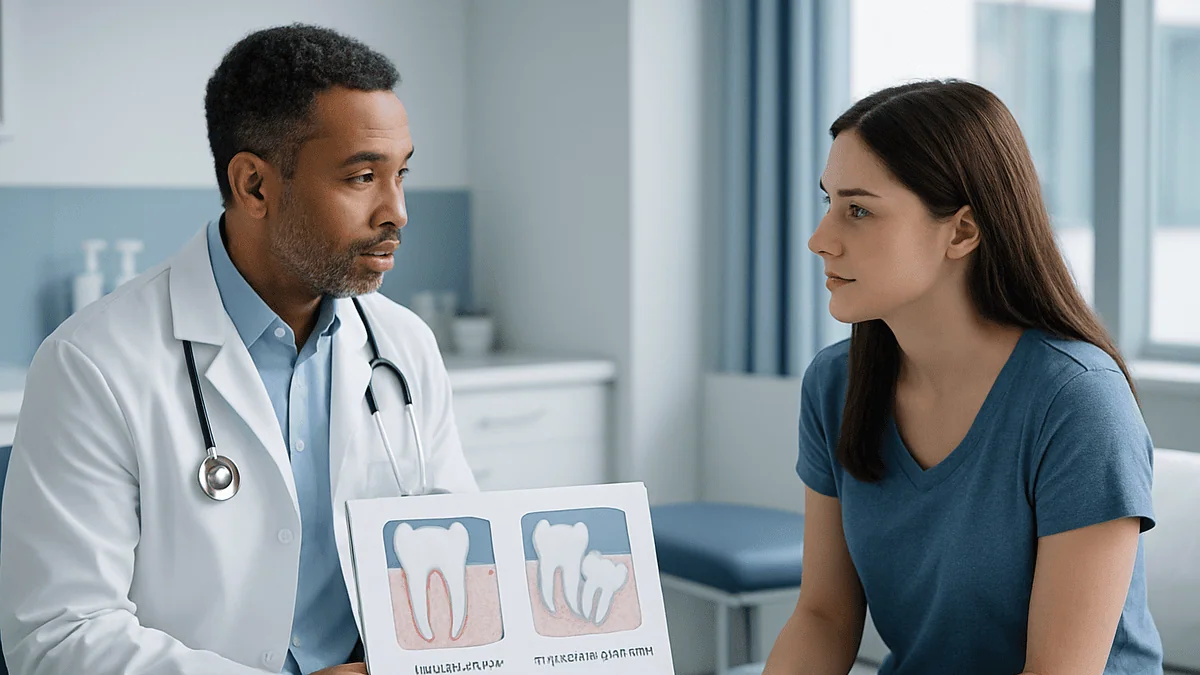
Key Takeaways
- The upper canine has the longest root of any tooth and guides the bite, which is why dentists usually try to guide an impacted canine into place rather than remove it.
- Wisdom teeth typically erupt between ages 17 and 25 into a jaw that has already finished growing, so an impacted one cannot be moved into position; the only choices are to leave it or remove it.
- The NHS states that wisdom teeth should not be removed unless they are causing problems, and a Cochrane review found insufficient evidence that removing healthy, symptom-free ones does more good than harm.
- Removing an impacted wisdom tooth usually requires an incision, some bone removal and sectioning the tooth, which is why it is a longer procedure than taking out an erupted one.
- Dry socket typically declares itself three to five days after an extraction with sharply worsening pain and a bad taste, and it needs a visit rather than waiting it out.
- A baby canine still firmly in place in a teenager is one of the commonest signs that the permanent canine has gone astray and should prompt an X-ray.
An impacted canine is usually saved because it is a cornerstone tooth with the longest root in the mouth, guides the bite and anchors the corner of the smile, and it can often be uncovered and guided into place with braces. An impacted wisdom tooth is usually removed only when it causes problems, because it sits where it cannot be cleaned or reliably moved, and most people function well without it.
Two X-rays sit side by side on the same screen. On the left, a 12-year-old’s panoramic film shows an upper canine lying almost sideways in the roof of her mouth, nowhere near the gap it should have filled a year ago. On the right, her 19-year-old brother’s lower wisdom tooth leans hard into the molar in front of it, half buried in bone. Same family, same word on both reports: impacted. Two very different plans.
She is booked for braces and a small surgery to uncover the tooth so it can be pulled gently into line over the next couple of years. He is booked to have his tooth taken out. To a parent in the waiting room, that looks arbitrary, even backwards. Why fight for one stuck tooth and give up on the other?
The impacted canine vs wisdom tooth question comes up in dental chairs every day, and the answer is not about which surgeon you see or how brave you are. It is about anatomy, timing and what the evidence says each tooth is worth.
Impacted canine vs wisdom tooth: what 'impacted' actually means
A tooth is called impacted when it fails to come through the gum into its normal position by the time it should, because something is blocking its path or because it is heading in the wrong direction. That something can be bone, thick gum tissue, another tooth, or simply a jaw with no room left. MedlinePlus notes that wisdom teeth are the most commonly impacted teeth, followed by the upper canines.
The two teeth could hardly be more different. A canine is the pointed tooth at the corner of the smile, third from the middle, sometimes called the eye tooth. It is typically the last of the front teeth to arrive, in early adolescence, and it has the longest root of any tooth in the mouth. A wisdom tooth, or third molar, is the flat grinding tooth at the very back of each corner of the jaw. The Mayo Clinic puts its usual arrival between ages 17 and 25, long after the rest of the adult set is in place.
Position matters as much as timing. The canine sits in a highly visible, mechanically important spot and has a neighbor on either side that depends on it. The wisdom tooth sits at the far edge of the dental arch, often with no opposing tooth to chew against and no neighbor behind it.
So when a dentist compares an impacted canine vs wisdom tooth, the underlying question is not “how stuck is it?” It is “what would this tooth do for the patient if it were in place, and what does it risk if it stays where it is?” The rest of this article works through both halves of that question.
What actually happens when a tooth becomes impacted
Every permanent tooth forms deep in the jaw and then travels toward the surface along a path guided partly by the roots of the teeth already there. The upper canine has the longest trip of any tooth. It starts high in the upper jaw, near the floor of the nose, and normally slides down along the root of the lateral incisor, the small front tooth beside it, until it emerges at the corner of the arch.
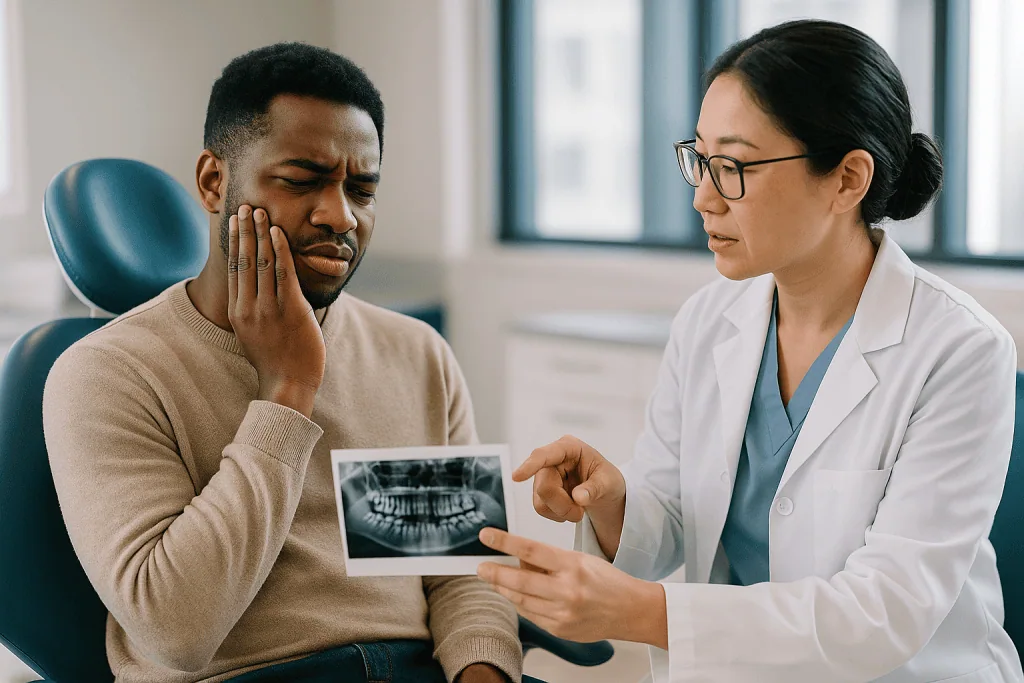
If that guide rail is missing or unreliable, the canine can lose its way. Cleveland Clinic lists crowding, a lateral incisor that is small or absent, a baby canine that refuses to fall out, and extra teeth or growths in the path as common reasons. Many displaced canines end up lying against the palate, the roof of the mouth, where they sit quietly for years while the baby canine hangs on well past its time.
Wisdom teeth get stuck for a different reason. They erupt last, into a jaw that has usually finished growing. If the space behind the second molar is shorter than the tooth trying to fill it, the wisdom tooth tilts, and the Mayo Clinic describes it emerging at an angle toward the next tooth, angled toward the back of the mouth, lying horizontally, or upright but trapped in bone. Many break partway through the gum and stop. That partial opening leaves a flap of soft tissue over the crown where food and bacteria collect but a toothbrush cannot reach.
Both teeth are “impacted,” but one has wandered off a route it could still complete, and the other has arrived at a destination that no longer exists.
Does an impacted canine need to be removed, or can it be saved?
Most of the time the aim is to save it, and the reasons are mechanical before they are cosmetic. Canines carry the side-to-side forces of chewing and guide the lower jaw as it slides, which protects the flatter back teeth from being ground down. Their long roots make them the most stable anchors in the mouth, which is why orthodontists and prosthetic dentists treat them as cornerstones. Take one away and the neighbors have to shoulder loads they were not designed for.
Then there is the corner of the smile. The canine supports the lip and marks the transition from front teeth to back teeth. Replacing it convincingly is genuinely difficult: an implant cannot be placed until jaw growth is complete, a bridge sacrifices healthy enamel on the teeth beside the gap, and moving a premolar forward to stand in for the canine changes the shape of the smile and the bite.
Leaving a displaced canine where it lies is not a neutral choice either. MedlinePlus and Cleveland Clinic both note that an impacted tooth can press on the roots of neighboring teeth and, less commonly, develop a fluid-filled sac called a dentigerous cyst around its crown. Palatally displaced canines sit right against the roots of the incisors, so root damage is a specific worry that dentists monitor on X-rays.
Removal does happen. If the tooth is fused to the bone, badly positioned, already causing root damage that cannot be halted, or found in an adult whose growth is long over, the treating team may judge that guiding it into place is not realistic. Even then, the conversation usually starts from “how do we keep this tooth?” rather than “how do we take it out?”
How impacted canine treatment works: exposure and orthodontic traction
Saving a canine is a partnership between an orthodontist, who moves teeth, and an oral surgeon or periodontist, who uncovers them. It begins with imaging. A panoramic radiograph, the wide X-ray that shows both jaws in one sweep, usually reveals the problem. Many teams add a cone-beam CT, a low-dose three-dimensional scan, to see exactly where the crown sits relative to the incisor roots and whether any of those roots have already been affected.

The first active step is usually braces. Space has to exist before the canine can be brought into it, so the orthodontist opens a gap in the arch over several months. Only then is the tooth exposed. In an open exposure, the surgeon removes a small window of gum and, if needed, bone over the crown and leaves it uncovered so it can erupt or be pulled. In a closed exposure, the surgeon lifts the gum, bonds a tiny bracket with a fine gold chain to the crown, and stitches the gum back over it with the chain emerging into the mouth.
From there the orthodontist applies light, steady force through that chain, tightened at each visit, coaxing the tooth along a path it should have taken on its own. This is slow by design. Bone remodels at its own pace, and Cleveland Clinic’s commonly quoted range for a full course of braces is one to three years; a displaced canine tends to sit toward the longer end.
Risks are real and are discussed beforehand. The tooth may prove to be ankylosed, meaning fused to bone, and refuse to move. The gum around a pulled-through canine can end up thinner or higher than its neighbor. Adjacent roots can be bruised in surgery. Whether the odds justify the attempt is a judgment for the treating team, based on the patient’s age, the tooth’s angle and how far it has to travel.
Why the impacted wisdom tooth is usually removed instead
Nobody bonds a gold chain to a wisdom tooth and pulls it into line. There is no line to pull it into. The tooth is stuck because the jaw ran out of room, and no amount of orthodontic force creates bone that is not there. The choice is therefore between leaving it and taking it out.
What tips the decision toward removal is trouble, not the mere fact of impaction. The Mayo Clinic lists the problems an impacted wisdom tooth can cause: pain, food and debris trapped behind it, infection or gum disease, decay in a partially erupted tooth, damage to the neighboring molar or the bone around it, cyst formation around the crown, and interference with orthodontic treatment. The NHS is explicit that removal is recommended when a wisdom tooth is causing problems or is likely to cause them, not simply because it exists.
The most common trigger is pericoronitis, an infection of the gum flap over a partly erupted tooth. It flares, settles, and flares again, because the flap cannot be cleaned and cannot heal while the tooth sits half in and half out. Decay on the back of the second molar is the other classic finding, hidden where floss cannot reach.
Here the contrast with the canine is sharpest. Losing a wisdom tooth does not change the smile, and most people chew perfectly well with 28 teeth. There is no partner tooth to protect and no root damage to fear from its absence. When a wisdom tooth has become a liability, removing it trades a recurring problem for a one-off procedure, and that trade usually makes sense to both patient and team.
Why do experts now say not to remove impacted wisdom teeth that are not causing problems?
A generation ago, having all four wisdom teeth out in your late teens was almost a rite of passage, symptomatic or not. The thinking has shifted, and the shift is grounded in evidence rather than fashion.
The NHS, following national guidance, states that wisdom teeth should not be removed unless they are causing problems, because surgery carries its own risks and there is no proven benefit to taking out a healthy, symptom-free tooth. A Cochrane systematic review indexed in PubMed examined trials comparing removal of asymptomatic, disease-free wisdom teeth with retention and monitoring, and concluded there was insufficient high-quality evidence to determine whether prophylactic removal does more good than harm. Insufficient evidence is not the same as evidence of harm, but it does mean the burden of proof sits on surgery, not on waiting.
Those surgical risks are not trivial. The NHS describes numbness of the lip, tongue or chin from nerve irritation, usually temporary but occasionally permanent, along with infection, dry socket and bleeding. Subjecting a healthy tooth to those risks needs a reason.
The nuance that often gets lost is the difference between “asymptomatic” and “disease-free.” A wisdom tooth can be silently rotting the back of the molar in front of it or harboring a cyst without hurting. Monitoring means periodic examination and X-rays, not ignoring the tooth. Retention is an active decision with follow-up attached.
So the modern position is neither “take them all out” nor “leave them all in.” It is: remove the ones causing or clearly threatening problems, keep an eye on the rest, and let each decision rest with the dentist or surgeon who can see the films.
Impacted canine vs wisdom tooth: side-by-side comparison
Laid out together, the two situations explain themselves. Every row below reflects the general pattern described by MedlinePlus, the Mayo Clinic, Cleveland Clinic and the NHS; individual cases can and do differ, and the treating team weighs each tooth on its own merits.
| Question | Impacted canine | Impacted wisdom tooth |
|---|---|---|
| Usual age when noticed | Late childhood or early teens, when the baby canine lingers | Late teens to mid-twenties, at the usual eruption window (Mayo Clinic: 17–25) |
| Why it gets stuck | Loses its guide path; crowding; small or missing lateral incisor; retained baby tooth | Jaw has finished growing and has no room; tooth tilts or stays in bone |
| Where it ends up | Often in the palate, near incisor roots | Behind the second molar, often partly through the gum |
| Job the tooth does | Guides the bite, anchors the arch, shapes the smile | Extra grinding surface, often with no opposing tooth |
| Can it be moved into place? | Frequently, with exposure and braces | Practically never; no space to move it into |
| Main risk if left alone | Resorption of neighboring roots; cyst; permanent gap | Pericoronitis; decay in tooth or neighbor; cyst |
| Usual plan | Save and guide; remove only if not feasible | Remove if causing problems; monitor if healthy and quiet |
| Typical timeline | Months to a few years of orthodontics | A single procedure; NHS: up to 2 weeks to recover |
One row deserves a second look: “Can it be moved into place?” That single difference drives almost everything else. A tooth that can still reach its destination is worth the long road. A tooth whose destination no longer exists is judged purely on whether it is safe to leave. Everything about the impacted canine vs wisdom tooth debate flows from that.
Who is usually offered treatment, and who is usually asked to wait?
For canines, timing is everything, and early is better. Dentists check for the developing canine by feeling the gum above the baby tooth around ages 10 to 11; if the bulge is missing or the baby canine is still firm well into the early teens, an X-ray follows. Cleveland Clinic notes that in some children, simply removing the stubborn baby canine at the right moment gives the permanent tooth a chance to correct its own course, sparing the child surgery altogether. That window closes as the jaw matures.
Teenagers with a confirmed displaced canine are the classic candidates for exposure and traction. Adults are a harder call. Bone becomes denser, the tooth is more likely to be fused in place, and the years of braces that a 13-year-old can absorb may not fit an adult’s life. Adults with a long-retained baby canine that is still functioning are sometimes advised to keep it and monitor the impacted tooth rather than embark on treatment.
For wisdom teeth, the pattern is reversed: people are offered removal because of what has already happened. Repeated pericoronitis, decay that cannot be filled, damage to the second molar or a cyst on imaging are the usual reasons. Someone whose wisdom tooth is fully in bone, symptom-free and not threatening its neighbor is generally asked to wait and be reviewed.
Some people are asked to wait for other reasons. Non-urgent oral surgery is often deferred during pregnancy. People taking medicines that affect blood clotting or bone turnover need their prescriber and surgeon to coordinate before any extraction, and nobody should stop or change such a medicine on their own. Active infection may need to settle before surgery. Each of these calls belongs to the treating team, who can see the whole picture.
How to tell if a wisdom tooth is impacted or just coming in
Honest answer first: you cannot tell for certain by looking or feeling. Only an X-ray shows the angle of the tooth, how much of it is in bone and whether it is on a collision course with the molar in front. What you can notice is the pattern over time, and that pattern is worth describing to your dentist.
A wisdom tooth that is simply erupting behaves like every other tooth did in childhood. The gum feels tender and a little swollen for a week or two, a hard edge appears, and over the following weeks more of the crown shows, upright and roughly level with the molar beside it. The soreness fades as the tooth clears the gum and the flap shrinks back.
An impacted tooth tends to stall. A corner of the crown appears and then nothing more happens for months. The gum flap stays, and the same patch flares up again and again, particularly after meals when food packs underneath it. The tooth may be visibly tilted, and people sometimes bite their cheek on it or notice a bad taste from the area. The Mayo Clinic points out that many impacted wisdom teeth cause no symptoms at all, which is exactly why they are so often discovered on a routine film.
None of this is a checklist for diagnosing yourself. Gum tenderness at the back of the mouth has other causes, and an eruption that looks normal from the front can be angled from the side. If the back of your jaw has been sore on and off for more than a few weeks, or a partly visible tooth has not progressed, ask for an examination. A single panoramic X-ray settles the question and turns guesswork into a plan.
Is it easier to remove an impacted or an erupted wisdom tooth?
Erupted, almost every time. A fully erupted wisdom tooth with a straightforward root can often be removed with forceps in a few minutes under local anesthetic, much like any other extraction. The NHS notes that a wisdom tooth removal can take anywhere from a few minutes to 20 minutes or longer, and that longer end belongs to the impacted ones.
Removing an impacted tooth is surgery in the fuller sense. The Mayo Clinic describes the steps: an incision in the gum to expose the tooth and bone, removal of bone that blocks access, dividing the tooth into sections so each piece can come out through a smaller opening, cleaning the socket, and usually stitches. The NHS adds that a small cut in the gum and removal of a little bone may be needed, and that the tooth may be cut into pieces to make it easier to remove.
Position drives difficulty more than anything else. Lower wisdom teeth sit close to the inferior alveolar nerve, the nerve that supplies feeling to the lower lip and chin, and to the lingual nerve serving the tongue; the deeper and more horizontal the tooth, the closer the work. Upper wisdom teeth can sit against the floor of the sinus. Both are reasons surgeons order detailed imaging before deciding how to proceed and whether local anesthetic, sedation or a general anesthetic suits the case.
The same logic applies to canines that are being removed rather than saved. A palatally displaced canine is deep in bone beside the incisor roots, and taking it out is a surgical procedure of comparable complexity. “Stuck” is harder than “visible” whichever tooth it is, and that added difficulty is part of why healthy, quiet impacted teeth are not routinely removed just in case.
What the days and weeks after treatment usually look like
After a wisdom tooth removal, the NHS says it can take up to two weeks to recover fully. Swelling and bruising of the cheek are usually at their worst in the first two to three days and then ease. Jaw stiffness, some difficulty opening wide and a dull ache are expected in that window; dissolvable stitches typically disappear within about a week to ten days. Your surgeon or dentist will advise on pain relief; that advice, not a general article, is the one to follow.
The socket heals from the inside out. A blood clot forms in the first hours and acts as a scaffold, which is why the NHS advises against rinsing, spitting hard or smoking on the first day and suggests gentle warm salt-water rinses only from the day after. Losing that clot leads to dry socket, an exposed-bone condition that the Mayo Clinic describes as throbbing pain typically starting three to five days after the extraction, often with a bad taste or smell. It is treatable, but it needs a visit.
Canine exposure follows a different rhythm. The mouth is sore for several days, and with an open exposure there is a small healing window in the gum to keep clean. Once the tissue settles, the orthodontic phase begins: appointments spaced weeks apart, each adding a little tension to the chain, with the tooth moving fractions of a millimeter between visits. Braces are typically in place for one to three years overall, per Cleveland Clinic’s general range, and a displaced canine tends to lengthen a course rather than shorten it.
Both paths share a truth worth saying plainly: the surgery is the short part. For the wisdom tooth, the two weeks after matter most. For the canine, the following two years do.
What people often get wrong about impacted canines and wisdom teeth
“Wisdom teeth push the front teeth out of line.” This is the most durable myth in dentistry, and the evidence for it is weak. Lower front teeth drift and crowd with age whether or not wisdom teeth are present, and removing wisdom teeth has not been shown to prevent it. Neither the NHS nor the Mayo Clinic lists preventing crowding as a reason for removal.
“Everyone should have them out young, before the roots form.” Roots do finish forming in the early twenties and surgery in older adults can be more involved, but that is a factor in planning, not a reason to remove healthy teeth. National guidance summarized by the NHS is that quiet, problem-free wisdom teeth should be left alone and reviewed.
“If it doesn’t hurt, it’s fine.” Pain is a poor guide. A wisdom tooth can hollow out the molar in front of it silently, and a displaced canine can shorten the roots of an incisor without a twinge. This is why monitoring includes X-rays, not just a question about symptoms.
“An impacted canine can always be pulled into place.” In children and teenagers, often. In adults, the tooth may be fused to bone, and even a perfectly performed exposure cannot move an ankylosed tooth. Age and position set the odds, and the team will say so honestly.
“My baby canine is still there at 16, so nothing is wrong.” A retained baby canine in a teenager is one of the commonest signs that the permanent canine has gone astray. It deserves an X-ray, not reassurance.
“Removal is the safe option.” Removal is a procedure with its own risks: nerve numbness, dry socket, infection, bleeding. Sometimes it is clearly the right call. It is never automatically the cautious one.
Questions to ask your care team
Good decisions about impacted teeth come from good conversations, and the most useful questions are specific. Bring the list; write the answers down.
- Exactly where is the tooth, and can I see it on the X-ray or scan? Ask the team to point out the neighboring roots and any nerve or sinus nearby.
- Is this tooth causing damage now, or is the concern about what it might do later? The answer separates urgent treatment from watchful waiting.
- For a canine: is it realistic to bring this tooth into place, and what makes you think so? How much of that judgment rests on my age and the tooth’s angle?
- For a canine: what happens if the tooth does not move once exposed? What would the fallback plan be?
- For a wisdom tooth: if we leave it, how often would you want to review it and with what kind of imaging?
- For a wisdom tooth: how close is it to the nerve, and what does that mean for the risk of numbness in my case?
- What type of anesthesia do you recommend, and why is that the right fit for this procedure?
- How long should I plan to be off work or school, and what limits on eating and exercise should I expect in the first days?
- Which of my current medicines or health conditions affect the timing or safety of surgery, and who will coordinate with my prescriber?
- What signs after the procedure should make me call you the same day?
You are not obliged to decide in the chair. A displaced canine has usually been in place for years, and a quiet wisdom tooth is not an emergency. Taking a week to think, or asking for a second opinion within your care network, is a normal part of the process and something experienced clinicians expect.
When to call your doctor
Most recovery after tooth surgery is uneventful, and most impacted teeth under observation stay quiet. A few signs, though, should prompt a same-day call to your dentist, surgeon or doctor, or a visit to emergency care if the practice is closed.
Swelling that spreads toward the eye, down the neck or under the jaw, or that makes swallowing or opening the mouth difficult, needs urgent assessment; a spreading dental infection can compromise the airway. Any difficulty breathing is an emergency, full stop. A fever with facial swelling points the same way.
Bleeding that soaks through gauze and does not slow after 20 to 30 minutes of firm, continuous pressure should be reported the same day. So should pain that eases for a few days and then sharply worsens around day three to five, especially with a foul taste or visible bone in the socket, which is the typical pattern of dry socket described by the Mayo Clinic.
Numbness or tingling of the lip, chin or tongue that persists beyond the expected wearing-off of the anesthetic should be mentioned to your surgeon promptly, even if it is mild, so it can be documented and followed.
For people watching an impacted tooth rather than recovering from surgery, the red flags are new or worsening pain at the back of the jaw, repeated gum flare-ups in the same spot, a bad taste that keeps returning, a front tooth becoming loose or changing position, or any swelling of the gum or palate. None of these prove that something serious is happening, but all of them warrant an examination and, usually, an X-ray. The treating team decides what comes next; your job is to make the call early rather than late.
Frequently asked questions
Does an impacted canine need to be removed?
Usually not, if it can be guided into place. Canines are cornerstone teeth with the longest roots in the mouth, so the standard approach in children and teenagers is to open space with braces, surgically expose the tooth and pull it into line over months. Removal is considered when the tooth is fused to bone, badly positioned, damaging neighboring roots, or found in an adult for whom traction is unrealistic. The treating team makes that call on imaging.
What is the main difference in an impacted canine vs wisdom tooth decision?
Whether the tooth still has somewhere useful to go. A displaced canine has a waiting gap and an important job, so it is worth years of orthodontics to bring it home. An impacted wisdom tooth is stuck because the jaw has no room, cannot be moved, and does little that the other 28 teeth do not already do, so it is judged only on whether it is safe to leave in place.
How can I tell if my wisdom tooth is impacted or just coming in?
You cannot know for certain without an X-ray. A normally erupting wisdom tooth appears upright and keeps emerging over weeks as gum tenderness fades. An impacted tooth tends to stall partway, stays tilted, and the same gum flap flares repeatedly after meals. The Mayo Clinic notes many impacted wisdom teeth cause no symptoms at all, so a dental exam and panoramic film are the reliable way to settle it.
Why do experts now say not to remove impacted wisdom teeth?
Because surgery has real risks and the benefit of removing a healthy, symptom-free tooth is unproven. The NHS states wisdom teeth should only be removed when they cause or are likely to cause problems, and a Cochrane systematic review found insufficient high-quality evidence to support or refute preventive removal. The modern approach is to remove problem teeth and monitor quiet ones with periodic checks and X-rays.
Is it easier to remove an impacted or an erupted wisdom tooth?
Erupted teeth are easier. A fully erupted wisdom tooth can often be removed with forceps in minutes under local anesthetic. An impacted tooth needs a gum incision, sometimes bone removal and sectioning of the tooth, and the NHS notes such procedures can run 20 minutes or longer. Deep lower teeth near the nerve that supplies the lip and chin are the most demanding cases.
What does impacted canine treatment involve for a teenager?
Typically three stages. Braces first open a space in the arch, which can take months. A surgeon then exposes the crown and either leaves it uncovered or bonds a small bracket with a chain and closes the gum over it. The orthodontist then applies gentle force at each visit until the tooth reaches its place. Cleveland Clinic’s general range for braces is one to three years, and displaced canines tend toward the longer end.
What are the symptoms of an impacted wisdom tooth that should prompt a dental visit?
Recurring soreness, swelling or a bad taste at the back of the jaw, a partly visible tooth that has not progressed for months, pain on biting the cheek in that area, or stiffness opening the mouth. The Mayo Clinic lists pain, swollen or bleeding gums, jaw pain and bad breath among possible signs. Many impacted teeth are silent, so these are reasons for an examination rather than a way to diagnose yourself.
Can an adult still have an impacted canine pulled into place?
Sometimes, but the odds are lower than in a teenager. Adult bone is denser and the tooth is more likely to be ankylosed, meaning fused to the bone, in which case no orthodontic force will move it. Adults are also weighing years of braces against their daily lives. Some are advised to keep a functioning baby canine and monitor the impacted tooth instead. The decision rests with the orthodontist and surgeon after imaging.
How long does recovery take after impacted wisdom tooth removal?
The NHS says it can take up to two weeks to recover fully. Swelling and bruising usually peak within two to three days and then ease, jaw stiffness settles over the following week, and dissolvable stitches disappear in roughly a week to ten days. Worsening pain three to five days afterward, especially with a bad taste, suggests dry socket and warrants a call to your surgeon.
Will leaving an impacted canine alone cause problems?
It can, which is why it is monitored rather than ignored. MedlinePlus and Cleveland Clinic note that an impacted tooth may press on and damage the roots of neighboring teeth or develop a cyst around its crown. Palatally displaced canines sit beside the incisor roots, making root resorption a particular concern. Periodic X-rays let the team spot change early and revisit the decision if the picture shifts.
References
This article is for general information only and is not a substitute for professional medical advice. Please consult a qualified doctor about your individual situation.

More from the Blog
Do Root Canals Make You Sick? Old Myths About Treated Teeth, Corrected
No. Current evidence does not show that a properly treated root canal tooth causes cancer, heart disease, arthritis or other illnesses. The idea traces…
Do Teeth Need Straightening Before Porcelain Veneers? When Orthodontics Comes First
Not everyone needs braces before veneers, but many people benefit from straightening first. Porcelain veneers can mask mild rotations, small gaps, and uneven edges,…
Sinus Lift: Why Upper-Jaw Implants Sometimes Need It, and How It Heals
A sinus lift is a surgical procedure that adds bone between the upper jaw and the maxillary sinus so a dental implant has enough…
How 3D Imaging Changes Oral and Maxillofacial Surgery Planning Around Nerves and Sinuses
3D imaging in oral surgery planning, most often a cone beam CT scan, gives surgeons a layered view of the jaw so they can…

Oil Pulling: The Ancient Practice vs the Actual Evidence
Oil pulling, swishing edible oil in the mouth for 10 to 20 minutes, may modestly reduce plaque and mouth bacteria, according to a handful…

How Laminate Veneers Are Placed: Impressions, Minimal Preparation and Bonding the Shells
A laminate veneers procedure usually unfolds over two or three dental visits spread across a few weeks. The dentist first assesses the teeth and…