

Is Masseter Botox Right for Teeth Grinding? Who Tends to Benefit and Who Should Wait
Key Takeaways
- Botulinum toxin in the masseter reduces the force of clenching rather than stopping grinding episodes, which is why trials report less pain and lower bite intensity but not an end to bruxism.
- Mayo Clinic places botulinum toxin injections among options for severe bruxism that has not improved with other treatments, not as a first step ahead of a night guard.
- Sleep bruxism is associated with obstructive sleep apnea, so unexplained snoring, witnessed breathing pauses or heavy daytime sleepiness usually prompt a sleep assessment before elective injections.
- Effects typically begin within one to three days and last about three months or longer according to Mayo Clinic, with muscle strength returning gradually rather than all at once.
- Pregnancy, breastfeeding and neuromuscular conditions such as myasthenia gravis are among the disclosures MedlinePlus lists as essential before any botulinum toxin injection.
- Difficulty swallowing, breathing or speaking, or generalized weakness after injections, are recognized warning signs of toxin spread and require immediate medical attention.
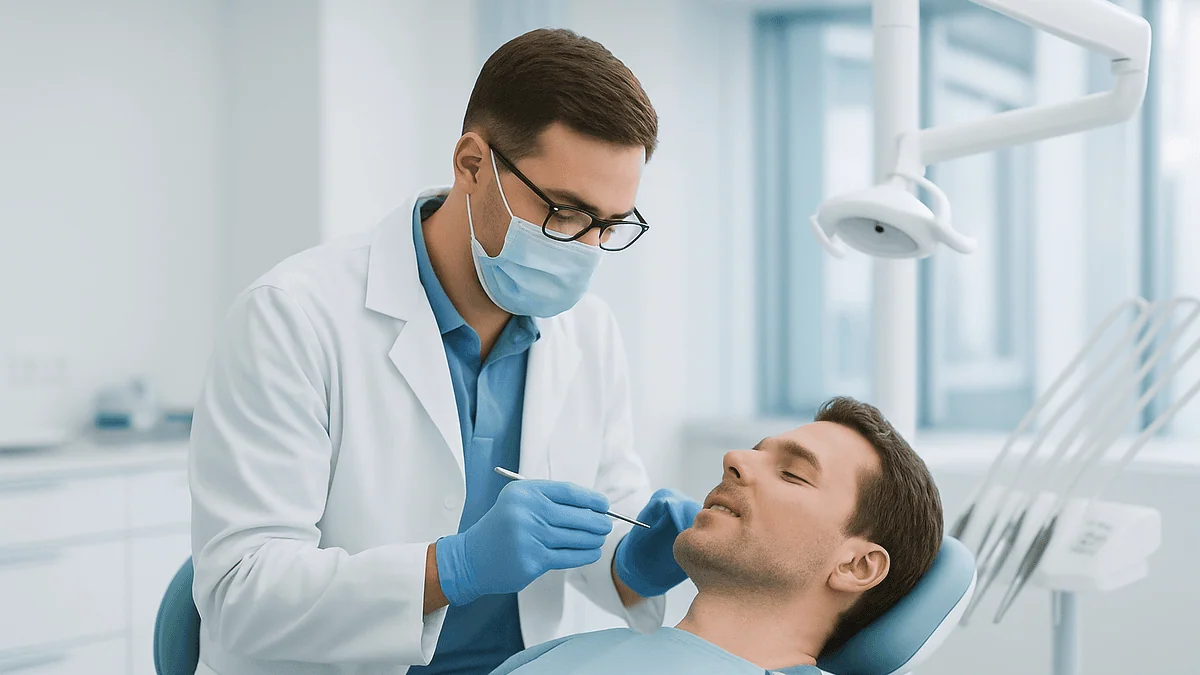
Masseter Botox, meaning botulinum toxin injected into the main chewing muscle, is generally considered for adults whose grinding or clenching causes jaw pain, muscle bulk or tooth damage that has not eased with a night guard, stress management and sleep measures. People with untreated sleep apnea, certain neuromuscular conditions, pregnancy or purely cosmetic goals are usually asked to wait. The evidence is promising but limited, and the decision rests with a dentist or physician.
The dentist tips the mirror so you can see it: a flat, glassy edge on a molar that used to have peaks. You have been waking with a jaw that feels like it ran a marathon overnight, and a dull ache that creeps toward the temples by mid-morning. Then a friend mentions she had her jaw muscles injected and ‘never clenches anymore.’
Search results on masseter Botox for teeth grinding candidates are crowded with confident promises and slim on honest detail. Most pages are written to sell an appointment. Very few explain what the injections can and cannot do, who is usually a sensible candidate, and why a good clinician sometimes says ‘not yet.’
This explainer is the conversation you would want before booking: how the treatment works, what the research really shows, the people who tend to do well, the people who are usually asked to wait, and the questions worth bringing to the person holding the syringe.
How masseter Botox for teeth grinding actually works
Place your fingers just in front of your earlobes and clench. The muscle that bulges under your fingertips is the masseter, the thick, fan-shaped chewing muscle that closes the jaw and delivers most of your bite force. Bruxism is the medical term for grinding or clenching the teeth, whether during sleep or while awake, and the masseter does most of the work.
Botulinum toxin is a purified protein that blocks the chemical signal a nerve uses to tell a muscle fiber to contract. Injected into the masseter, it does not paralyze the jaw. It dampens the force the muscle can generate, so a clench that used to arrive at full strength arrives at a fraction of it. You can still chew, talk and yawn. What changes is the ceiling, not the floor.
The word Botox is a brand name for one botulinum toxin type A product, and it has drifted into everyday speech the way ‘Band-Aid’ did. Several botulinum toxin products exist. This article uses the generic term because the mechanism, not the label, is what matters to a reader deciding whether to explore it.
One more definition that comes up constantly: off-label. Botulinum toxin is approved for a range of conditions, including chronic migraine and certain muscle spasm disorders, but bruxism is not among the approved uses. Off-label prescribing is legal and common in medicine when a clinician judges it appropriate, yet it means the evidence base is thinner and insurers treat it differently.
The effect is not immediate. Mayo Clinic notes that botulinum toxin injections usually begin working one to three days after treatment, and the change builds over the following days rather than switching on all at once. Nerve endings gradually form new connections, so the muscle regains its full strength over months, which is why any benefit is temporary by design.
Does Botox for bruxism actually work? What the evidence shows
Here is where honesty matters most. Mayo Clinic lists botulinum toxin injections among options that may help people with severe bruxism that has not responded to other treatments. That framing is deliberate: a fallback for difficult cases, not a first move.
Small randomized trials have compared botulinum toxin with saline injections in people with sleep bruxism. Several found reduced jaw pain and lower peak clenching force measured by electromyography, the technique of recording electrical activity in a muscle through skin sensors. What those trials generally did not show is that the grinding episodes themselves stop. People still clench in their sleep; they clench with a weaker muscle. Whether that distinction matters depends on what is causing harm. If the harm is muscle pain and fractured fillings, a weaker clench may be exactly the point. If the goal is ‘no more grinding,’ the evidence does not support that expectation.
The studies are also small, short and inconsistent in how they measure success. Some track pain scores, others muscle activity, others self-report. Follow-up rarely extends beyond a few months. That is why no major guideline body names botulinum toxin as standard treatment for bruxism, and why the NHS guidance on teeth grinding centers on mouth guards, sleep habits and stress management rather than injections.
A fair summary in evidence-grading language: low to moderate certainty that botulinum toxin reduces bruxism-related muscle pain and bite intensity over a period of weeks to months; insufficient evidence on long-term safety, tooth wear prevention, or benefit compared with a well-fitted night guard.
That is not nothing. For a person who has tried the conventional route and is still waking in pain, it is a reasonable option to discuss. It is simply not the near-guaranteed fix that many search results imply.
Masseter Botox for teeth grinding candidates: who tends to benefit
Ask clinicians who work with bruxism which patients tend to do well, and a recognizable profile emerges. It is not about age or face shape. It is about where the problem lives.
The first feature is muscle-centered symptoms. Aching or tired jaws on waking, tenderness when the masseter is pressed, tension headaches that start near the temples, and a visible or palpable bulk at the angle of the jaw all point to a muscle working too hard. Botulinum toxin acts on muscle, so a muscle-driven problem is the logical match. Pain that lives in the joint itself, with clicking, locking or limited opening, is a different story, covered below.
The second feature is a genuine trial of conservative care. Mayo Clinic and the NHS both place mouth guards or splints, stress management, good sleep habits and treatment of any underlying sleep disorder ahead of injections. A person who has worn a professionally fitted guard for several months, worked on the habits that feed daytime clenching and still has damage or pain is the kind of person for whom the risk-benefit balance may tilt toward trying more.
Third, the stakes matter. Someone who keeps cracking crowns, whose dentist is running out of enamel to work with, or who cannot tolerate a guard because of gagging or a strong bite that destroys it, has a concrete reason to reduce force at the source.
Fourth, and easy to overlook: realistic expectations. The people who describe the treatment as worthwhile tend to be those who understood beforehand that it dampens rather than stops, that it fades, and that a guard may still be recommended alongside it.
Finally, sleep apnea has been considered and either ruled out or treated. Why that matters deserves its own section.
Who should not get masseter Botox, or should usually wait
A careful clinician spends as much time ruling people out as ruling them in. Some reasons are absolute; most are ‘not yet.’

Pregnancy and breastfeeding sit near the top. MedlinePlus advises telling your prescriber if you are pregnant, planning pregnancy or nursing before receiving botulinum toxin, because safety data in these groups is limited. Elective, off-label injections are usually deferred.
Neuromuscular conditions such as myasthenia gravis, Lambert-Eaton syndrome or motor neuron disease change how the body responds to a drug that weakens muscle, and MedlinePlus lists them among conditions that must be disclosed. These are typically reasons to decline rather than delay.
A known allergy to botulinum toxin or its ingredients, an active skin infection over the jaw, or a bleeding tendency also call for caution. So do certain medicines that can amplify muscle weakness; your team will review your list, which is one reason a complete medication history is not a formality.
Then come the ‘wait’ group. Anyone with loud snoring, witnessed breathing pauses or heavy daytime sleepiness who has not been assessed for obstructive sleep apnea is usually asked to have that evaluation first. Teenagers whose jaws are still developing are generally steered toward guards and behavioral approaches. People whose main complaint is joint clicking or locking may need a temporomandibular joint assessment before anyone assumes the muscle is the culprit.
Two softer categories deserve mention. Someone who has never tried a night guard is usually offered one first, because it is reversible and protects teeth directly. And a person whose real goal is a slimmer lower face, with grinding as the stated reason, deserves a straightforward cosmetic consultation rather than a functional label. Neither is a judgment; both are about matching the tool to the actual problem.
Why a sleep apnea check often comes before the injections
Obstructive sleep apnea is a condition in which the upper airway repeatedly narrows or closes during sleep, causing brief drops in oxygen and repeated partial awakenings. Mayo Clinic and Cleveland Clinic both note an association between sleep bruxism and sleep apnea. The link is not fully understood, but one leading idea is that clenching is part of the body’s arousal response, a reflex that helps reopen the airway as the person surfaces from deep sleep.
If that is what is happening, weakening the masseter addresses the symptom while leaving the trigger untouched. Worse, it could quiet a warning sign. Untreated sleep apnea carries its own consequences for blood pressure, heart rhythm and daytime alertness, which is why many dentists and physicians want it screened before any elective treatment that changes jaw function.
What screening looks like is usually a conversation and, where indicated, a sleep study. Your team may ask about snoring, whether a partner has noticed pauses in breathing, morning headaches, dry mouth on waking and how alert you feel during the day. Depending on the answers, a home sleep test or an overnight study in a sleep lab may follow. Polysomnography is the formal name for that overnight study, which records breathing, oxygen levels, brain activity and muscle movement at once.
Treating sleep apnea, most commonly with a positive airway pressure device or a specially designed oral appliance, sometimes reduces the grinding on its own. When it does, injections may become unnecessary. When it does not, the treating team can move forward knowing they are not masking something more important.
None of this means every grinder has sleep apnea. It means the question should be asked, and a clinic that skips it is skipping a step that mainstream guidance treats as essential.
What actually happens at a masseter Botox appointment
The visit is shorter than most people expect, and the assessment is longer than the injections.
A dentist, oral surgeon, dermatologist or physician trained in the procedure will begin by asking about your grinding history: when it started, whether it is worse in sleep or during the day, what you have already tried, and how it affects your teeth, sleep and daily life. They will examine your teeth for wear patterns, look at the joint’s range of motion and listen for clicking, and ask you to clench while they press along the jawline to feel the masseter’s size and tender spots.
Photographs are common, both to track muscle bulk over time and to document facial symmetry before anything is injected. You will be asked to confirm your medication list, allergies and health conditions, and to sign consent that spells out the off-label nature of the treatment, the expected temporary effect and the possible side effects.
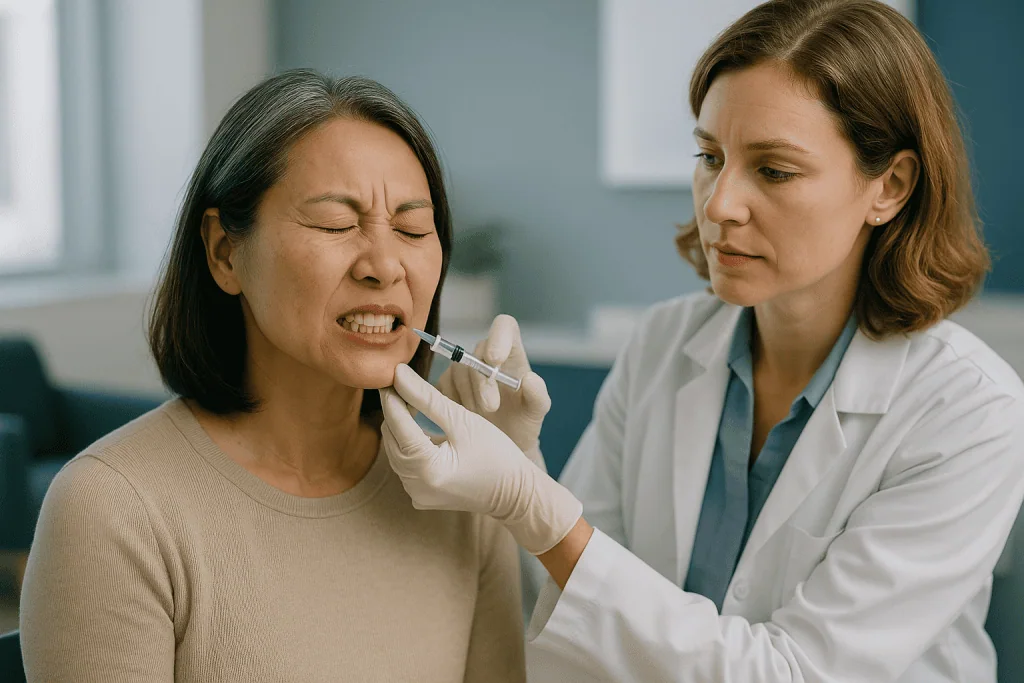
The injections themselves take a few minutes. The clinician marks the thickest part of the muscle, usually while you clench, and places a small number of injections through a very fine needle into the belly of the masseter, staying away from the front edge where muscles that lift the corner of the mouth sit. Most people describe a brief sting and a pressure sensation. Numbing cream or ice is sometimes offered but often unnecessary.
Afterward you can generally go about your day. Typical instructions include avoiding vigorous rubbing or massage of the area for the rest of the day, skipping strenuous exercise and facial treatments for a short period, and staying upright for a few hours. These are precautions against spreading the product beyond the target muscle, and the specific advice should come from the person who treated you.
How long does masseter Botox last, and what the weeks after usually look like
Nothing dramatic happens on day one, and some people wonder whether anything was done. That is normal.
According to Mayo Clinic, botulinum toxin injections usually begin working within one to three days. In the masseter, the first sign is often subtle: the jaw feels less tight on waking, or chewing a bagel takes noticeably more effort than it did last week. Over the following days the effect continues to develop, and many clinicians schedule a review a few weeks in to assess symmetry and decide whether any adjustment is appropriate. That review is a clinical decision, not something to arrange on your own.
A common early experience is chewing fatigue with tough or fibrous foods. Steak, crusty bread and chewy candy can feel like work for a while. Soft diets are not required, but many people naturally shift toward easier textures in the first week or two.
Mayo Clinic notes that the effect of botulinum toxin generally lasts about three months or longer depending on what is being treated. In the masseter, the muscle strength returns gradually as nerve endings regenerate, so clenching force creeps back rather than snapping back. Some people notice their symptoms return around that window; others find the relief stretches further, especially if they have also addressed sleep and stress.
Whether to repeat, and when, sits with the treating team. Some clinicians prefer to wait until symptoms clearly return before re-treating; others plan intervals based on how the muscle behaves. Repeated cycles over time can lead to visible slimming of the lower face as the muscle shrinks from reduced use, which some people welcome and others do not. That conversation belongs before the first appointment, not after the third.
Masseter Botox side effects: what is common and what is rare
Most side effects are local, mild and short-lived. A few are uncommon but serious enough that everyone should know them.
The predictable ones come from the needle: pinpoint bruising, tenderness at the injection sites and occasional mild swelling that settles within days. Headache and a vague flu-like feeling in the first day or two are also reported with botulinum toxin generally, according to MedlinePlus.
The next group comes from the mechanism itself. Weakness in chewing is the intended effect, but it can feel more pronounced than expected. If product spreads forward into the muscles that pull the corner of the mouth, a person may notice an uneven or lopsided smile that lasts until the effect fades. Over-treatment or asymmetric placement can produce hollowing over the cheeks or a visibly different jaw contour on one side. Experienced injectors reduce these risks by mapping the muscle carefully, but no one can eliminate them.
Some people report changes in how their bite feels or difficulty with very hard foods for a period. Temporary changes in speech clarity have been described but are unusual with masseter treatment.
The rare, serious category is what the product labeling calls distant spread of toxin effect. Botulinum toxin can, uncommonly, affect muscles beyond the injection site, producing generalized weakness, double or blurred vision, drooping eyelids, hoarseness, difficulty swallowing or trouble breathing. MedlinePlus and Mayo Clinic both flag these as symptoms requiring immediate medical attention. Swallowing and breathing problems can be life-threatening. The risk is considered higher in people with underlying neuromuscular disease, which is why disclosure matters so much.
Finally, allergic reactions can occur, ranging from itching and rash to, very rarely, anaphylaxis. Any sudden swelling of the face or throat, wheezing or faintness after an injection is an emergency.
How masseter Botox compares with a night guard and other bruxism treatments
Bruxism has no single treatment because it has no single cause. Seeing the options side by side helps clarify where injections fit.
| Approach | What it does | Strength of evidence | Typical role |
|---|---|---|---|
| Custom night guard or occlusal splint | Physical barrier that protects enamel and spreads bite force; does not stop clenching | Widely recommended by NHS and Mayo Clinic for protecting teeth | Usually first step for sleep bruxism |
| Stress management, relaxation, CBT | Targets the tension and habits that drive daytime clenching | Recommended by NHS; benefit varies by individual | Foundation for awake bruxism |
| Sleep hygiene and treating sleep disorders | Addresses arousals that may trigger grinding, including sleep apnea | Supported by association data; essential when apnea present | Screening step before elective treatment |
| Botulinum toxin to masseter | Reduces muscle force and bulk for a period of months | Small trials show less pain and force; low to moderate certainty; off-label | Considered when conservative care has not helped |
| Short-term medicines (muscle relaxants, sleep aids) | Temporarily reduce muscle tension or improve sleep | Limited evidence; Mayo Clinic describes as short-term options | Occasional, clinician-directed use |
| Dental correction of bite or restoration | Repairs damaged teeth; corrects severe misalignment where relevant | Restores function; unclear effect on grinding itself | Managing consequences rather than cause |
Two things stand out. Nothing on this list has strong, long-term evidence that it stops grinding, which is why honest clinicians talk about managing bruxism rather than eliminating it. And the approaches are not competitors. A person may wear a guard to protect teeth, treat sleep apnea to reduce arousals, work on daytime habits and, if pain persists, add botulinum toxin to lower the force. The injections replace none of the other layers; they sit on top of them.
Is masseter Botox good for people who grind their teeth mainly during the day?
Grinding is not one behavior. Sleep bruxism happens without awareness during sleep and is classified as a sleep-related movement disorder. Awake bruxism is mostly clenching rather than grinding, often tied to concentration, stress or habit: the tightened jaw during a difficult email, the set molars in traffic. Many people have both, and the distinction shapes what helps.
For sleep bruxism, the appeal of botulinum toxin is that behavior change is nearly impossible when you are unconscious. A guard protects the teeth; injections reduce the force the guard has to absorb. That pairing is where most of the research has focused.
Awake bruxism responds to something injections cannot supply: awareness. The NHS guidance emphasizes stress reduction and relaxation, and clinicians often teach cue-based habit reversal, such as checking whether the teeth are touching every time a phone notification arrives, then letting the jaw hang slightly with lips together. Cognitive behavioral approaches, which help people notice and change automatic patterns, have a place here too.
Can injections help daytime clenchers? Possibly, by making the clench less forceful and therefore less damaging, and some people find that a weaker muscle is easier to notice and relax. But if the habit remains unaddressed, the force returns as the effect wears off, and the underlying driver is untouched. Clinicians generally want daytime clenchers to work on the behavioral side first or alongside, not instead.
There is also a practical reason to sort this out. A person who mainly clenches during the day may find the chewing weakness more disruptive than someone whose problem is confined to sleep, because they are eating, talking and working through the very hours the muscle feels different. Knowing your pattern helps your team set expectations that match your life.
Jaw slimming, facial change and the functional-cosmetic overlap
It is impossible to discuss masseter injections honestly without acknowledging that many people seek them to narrow the lower face. Reducing masseter activity over repeated cycles leads to a reduction in muscle bulk, and a smaller masseter changes the jawline’s contour. For someone treating bruxism, that change is a side effect, wanted or not. For someone seeking a cosmetic result, it is the goal.
The overlap creates two problems. The first is labeling. A treatment sought for appearance but recorded as functional muddles medical records and insurance conversations, and it can lead to a dosing philosophy aimed at visible slimming rather than symptom relief. The second is expectation. A person who wants pain relief but not a changed face needs to say so, because the treating team can adjust the approach with that priority in mind, and because muscle bulk that is lost over repeated treatments does not return quickly once treatment stops.
Conversely, someone who wants facial change and also happens to clench should not feel they need a medical alibi. Cosmetic use of botulinum toxin in the masseter is a legitimate consultation in its own right, with its own risk discussion, and framing it honestly leads to better care.
There is a body-neutral point buried here too. A broad, strong jaw is not a defect, and a masseter that has grown from years of clenching is simply a muscle that has been exercised. Whether to change how it looks is a personal choice, not a health necessity. Whether to reduce the damage it does to teeth is a medical question. The two can coexist in one person, but they deserve separate, clear-eyed conversations.
Will insurance pay for masseter Botox for teeth grinding?
This is one of the most searched questions on the topic, and the honest answer is: it depends, and often not. This article does not discuss prices, and the amount of product used is a clinical decision made by the injecting clinician, so figures you see online about how many units someone ‘needs’ are not a reliable guide to your own care.
Because bruxism is not an approved indication for botulinum toxin, most insurers classify the treatment as off-label. Some medical plans cover off-label uses when a clinician documents medical necessity, meaning a clear record of the diagnosis, the damage or pain it causes, and the conservative treatments already tried without adequate benefit. Others exclude it outright or consider it cosmetic regardless of the reason. Dental plans rarely cover injectable treatments at all, though they may cover the guard, the examination and the repair of damaged teeth.
Coverage decisions also vary with who provides the treatment. A neurologist or oral surgeon billing a medical plan for a documented pain condition may face a different pathway than a dermatology or aesthetic practice, which typically operates outside insurance entirely.
Practical steps, none of which commit you to anything: ask your plan directly whether botulinum toxin for bruxism or myofascial jaw pain is covered and what documentation they require; ask the treating clinician’s office what they have seen with your insurer; and request that your dental and medical records reflect the functional history accurately, including guards tried and dental damage found.
Whatever the answer, it should not change the clinical logic. A treatment that is not right for you does not become right because a plan covers it, and one that is appropriate does not become inappropriate because it is paid for privately. Coverage is a logistics question. Candidacy is a medical one.
What people often get wrong about masseter Botox for bruxism
Some of the most common beliefs about this treatment are the opposite of what the evidence shows.
‘It stops grinding.’ The trials that exist mostly show reduced force and pain, not the disappearance of grinding episodes. People continue to clench in their sleep with a weaker muscle. For many that is enough; for someone expecting silence, it is a disappointment.
‘It is permanent, or it wears off in a few weeks.’ Both are wrong. Mayo Clinic describes the effect as lasting about three months or longer, with strength returning gradually. It is a repeating treatment, not a one-time fix and not a fleeting one.
‘It treats TMJ.’ The temporomandibular joint is the hinge in front of each ear; TMJ disorder covers a range of problems, some in the joint itself and some in the muscles around it. Botulinum toxin acts on muscle. Joint problems such as disc displacement or arthritis are not addressed by weakening the masseter, and assuming otherwise can delay proper assessment.
‘You can throw away the night guard.’ Injections do not protect enamel. A guard does. Most clinicians recommend keeping it, particularly for people with existing tooth wear.
‘More is better.’ Greater weakening brings more chewing difficulty, more facial change and a higher chance of spread to neighboring muscles. The aim is enough reduction to ease symptoms, not the maximum the muscle can tolerate. That balance is the clinician’s call.
‘It fixes sleep apnea.’ It does not touch the airway. If grinding is a response to disturbed breathing, treating the breathing is the priority.
‘You will not be able to chew.’ Chewing continues; very hard foods take more effort for a while. Complete inability to chew would signal over-treatment or spread and should be reported.
Questions to ask your care team before deciding
A good consultation should leave you with fewer questions, not a shorter list of doubts. Bringing these along helps you judge the quality of the answers as much as the content.
- Based on my examination, is my problem mainly in the muscle, the joint or both, and how did you decide?
- Have I been screened for sleep apnea, and if not, should that happen first?
- Which conservative steps have I genuinely tried, and for how long? Is there one worth completing before injections?
- What specific improvement would tell us this worked for me: less morning pain, fewer broken restorations, a smaller muscle? How will we measure it?
- What is your experience with this particular use, and what side effects have your patients reported?
- How will you protect against an uneven smile or asymmetry, and what happens if it occurs?
- Do I keep wearing my night guard, and does it need to be refitted as the muscle changes?
- How will we decide whether and when to repeat, and what happens to the muscle over years of repeated treatment?
- Are there any medicines or conditions on my record that change the risk for me?
- What signs after the appointment should make me call you the same day, and how do I reach you?
Notice that none of these questions ask for a guarantee. The most trustworthy answers will include phrases like ‘in my experience,’ ‘the evidence suggests’ and ‘we will reassess.’ A clinician who welcomes the sleep apnea question, volunteers the off-label status without being asked, and talks about the guard as a partner rather than a relic is showing the kind of judgment the procedure depends on. The final decision, including whether to proceed at all, belongs to you and that clinician together.
What repeated treatment over years may mean for the jaw
Because the effect fades, people who find relief often return for repeated cycles. That raises a fair question: what happens to a muscle and the bone beneath it after years of being kept quiet?
The muscle answer is reasonably clear. Reduced activity leads to reduced bulk, the same principle that shrinks a leg after weeks in a cast. With repeated masseter treatment the lower face may narrow, and some people report that their jaw feels less powerful even between treatments. Whether this is welcome depends entirely on the person, which is why the cosmetic conversation belongs at the start.
The bone answer is less settled. Bone responds to the forces placed on it, and animal studies have raised the possibility that prolonged reduction in masseter force could reduce bone density at the angle of the jaw. Human data is limited, mostly small imaging studies with short follow-up, and no mainstream guideline currently advises against repeated treatment on this basis. The honest statement is that long-term skeletal effects in people are not well characterized, and this uncertainty is a reasonable thing to raise with your team, particularly if you are younger or have risk factors for low bone density.
A third consideration is compensation. When one chewing muscle is weakened, others, notably the temporalis at the side of the head, may work harder. Some people notice new temple tension after masseter treatment. Reporting this allows the team to adjust.
What this adds up to is not a reason to avoid repeated treatment but a reason to keep it under review. Continued dental checks to monitor wear, periodic reassessment of whether the guard still fits, attention to sleep and stress, and a willingness to pause if the underlying drivers improve are all part of using the treatment well rather than indefinitely by default.
When to call your doctor after masseter Botox
Most people have an uneventful few days. A small number of symptoms should never be waited out.
Seek emergency care immediately if you develop difficulty swallowing, trouble breathing, a hoarse or lost voice, or generalized muscle weakness at any point in the days or weeks after injections. MedlinePlus and Mayo Clinic identify these as possible signs of botulinum toxin spreading beyond the treated area, and swallowing or breathing problems can become life-threatening. The same urgency applies to sudden facial or throat swelling, hives with wheezing or lightheadedness, which may indicate a serious allergic reaction.
Call your treating clinician promptly, the same day where possible, if you notice double or blurred vision, drooping of an eyelid, slurred speech, a markedly uneven smile, or new difficulty chewing so pronounced that you cannot manage soft foods. These are not always emergencies, but they signal that the product has affected muscles it was not meant to reach, and your team will want to assess you.
Contact them within a day or two for spreading redness, warmth or increasing pain at an injection site, a fever, or swelling that worsens rather than settles, all of which can point to infection.
Unrelated to the injections but important for anyone with bruxism: a jaw that locks open or closed, sudden severe joint pain, or a tooth that cracks or chips warrants a dental or medical appointment rather than a wait-and-see approach.
Finally, if you are ever unsure whether something is normal, that uncertainty is itself a reason to call. The clinician who treated you knows what they placed and where, and a brief conversation costs nothing but a few minutes. Every decision about what to do next, including whether to continue or stop treatment, rests with that team.
Frequently asked questions
Is Botox for bruxism good for people who grind their teeth?
It can help some people, particularly those with jaw muscle pain or bulk from grinding who have not improved with a night guard and conservative measures. Small trials show reduced pain and clenching force, but not an end to grinding itself, and the evidence is graded low to moderate. Major guidance treats it as an option for difficult cases rather than a routine first choice, and the decision belongs to a dentist or physician after examination.
Who should not get masseter Botox?
People who are pregnant or breastfeeding, those with neuromuscular conditions such as myasthenia gravis or motor neuron disease, anyone with a known allergy to botulinum toxin, and people with an active infection over the jaw are usually not treated. Others are asked to wait: anyone with unassessed sleep apnea symptoms, teenagers whose jaws are still developing, and people who have not yet tried a fitted night guard or whose pain appears to come from the joint rather than the muscle.
How long does masseter Botox last for teeth grinding?
Mayo Clinic notes that botulinum toxin injections usually begin working within one to three days and that the effect generally lasts about three months or longer depending on the condition treated. In the masseter, strength returns gradually as nerve endings regenerate, so clenching force creeps back rather than returning suddenly. Whether and when to repeat is a decision for the treating team based on how symptoms and the muscle respond.
What are the most common masseter Botox side effects?
Bruising, tenderness and mild swelling at the injection sites are the most frequent, along with occasional headache or a brief flu-like feeling. Chewing weakness with tough foods is expected for a period. Less common effects include an uneven smile if product reaches nearby muscles, cheek hollowing or asymmetry. Rarely, botulinum toxin can spread and cause swallowing, breathing, vision or speech problems, which require immediate medical care.
Will insurance pay for masseter Botox for teeth grinding?
Coverage varies and is often declined, because bruxism is not an approved use of botulinum toxin and many plans classify it as off-label or cosmetic. Some medical plans cover it when a clinician documents medical necessity, including dental damage and conservative treatments already tried. Dental plans rarely cover injectables. Asking your insurer and the treating office directly, and keeping records that accurately reflect your functional history, is the practical route.
How many units of masseter Botox do you need, and what does it cost?
This article does not give unit counts or prices. The amount injected is a clinical decision that depends on muscle size, symptoms, goals and the product used, and figures quoted online for other people are not a reliable guide to your own treatment. The treating clinician will discuss their approach, and any cost questions belong with their office and your insurer rather than with a general health explainer.
Does masseter Botox stop teeth grinding completely?
No. The available trials show that it reduces the force of clenching and the muscle pain that comes with it, but grinding episodes during sleep generally continue with a weaker muscle. For many people that reduction is enough to protect teeth and ease pain. Anyone expecting the grinding to disappear entirely is likely to be disappointed, which is why clinicians talk about managing bruxism rather than eliminating it.
Do I still need a night guard after masseter Botox?
Usually yes. Botulinum toxin weakens the muscle but does not shield enamel, while a guard physically protects the teeth and spreads bite force. Most clinicians recommend keeping the guard, especially where tooth wear or damaged restorations already exist. As the masseter changes over repeated treatments, the guard may need refitting, so mention it at dental checks. Your dentist will advise on what is appropriate for your bite.
Will masseter Botox help TMJ pain?
It may help when the pain comes from the chewing muscles, because botulinum toxin acts on muscle. It does not address problems inside the temporomandibular joint itself, such as disc displacement or arthritis, and joint clicking, locking or limited opening usually calls for a separate assessment before assuming the muscle is responsible. Distinguishing muscle pain from joint pain is one of the main jobs of the initial examination.
Why does my dentist want a sleep apnea test before masseter Botox?
Because sleep bruxism is associated with obstructive sleep apnea, and grinding may be part of the body’s response to disturbed breathing. Weakening the masseter in that situation eases a symptom while leaving an important condition untreated and possibly quieter. Treating sleep apnea sometimes reduces grinding on its own. Screening first ensures that any injections are addressing the actual problem rather than masking a warning sign.
References
- MedlinePlus: OnabotulinumtoxinA injection
- NHS: Teeth grinding (bruxism)
- Cleveland Clinic: Bruxism (teeth grinding)
This article is for general information only and is not a substitute for professional medical advice. Please consult a qualified doctor about your individual situation.

More from the Blog
Vascular Lesion Laser Recovery: Cool Compresses, Bruising and the Crusts You Must Not Pick
After vascular laser treatment, expect redness, swelling and sometimes a deep purple bruise-like mark called purpura that typically fades over one to two weeks.…

Who Is a Candidate for LASIK? Corneal Thickness, Stable Prescription and Eye Pressure
A typical LASIK candidate is an adult whose glasses or contact lens prescription has stayed stable for at least a year, whose cornea is…

Plexr Recovery Day by Day: The Grid of Crusts, Swelling and When Makeup Can Return
Plexr recovery usually follows a predictable arc: a grid of tiny brown carbon crusts forms within hours, swelling peaks around the second or third…

How to Choose Among Non-Surgical Cosmetic Procedures: Matching Concern to Treatment
Choosing among non-surgical cosmetic procedures starts with naming the specific concern rather than the treatment. Lines that appear with expression usually point toward botulinum…

Preparing for Cryoablation: Fasting, Blood Thinner Adjustments and the Anesthesia Review
Preparing for cryoablation usually involves three steps set by your treating team: fasting for a defined window before sedation or anesthesia, a planned review…

Laser, Injections or Minor Surgery for Scars: Comparing the Main Treatment Routes
No single scar treatment suits every scar. Lasers reshape scar texture, color and surface by delivering controlled heat or light; corticosteroid injections soften and…