

Life After LASEK: Sunglasses, Screens and Why Surface Healing Deserves Extra Patience

Key Takeaways
- LASEK lifts and replaces the cornea's thin outer skin rather than cutting a deeper flap, which is why early recovery is slower and more uncomfortable than after LASIK.
- Sunglasses after LASEK do two separate jobs: easing early light sensitivity, and limiting ultraviolet exposure during the months when the healing stroma can develop haze.
- Only lenses labelled UV400 or 100 percent UVA/UVB protection count; a dark lens without UV filtering can let more ultraviolet in by widening the pupil.
- Screens do not harm the regenerating cornea, but they roughly halve blink rate, so short sessions and deliberate blinking address the real cause of post-operative dryness.
- The NHS describes up to a week for vision to become reasonably clear after surface procedures, and Mayo Clinic describes two to three months before laser-treated vision typically stabilizes.
- Pain that returns after improving, a sudden fall in vision or increasing redness with discharge are red flags that warrant a same-day call to the surgical team.
After LASEK surgery, sun protection means wearing UV-blocking, preferably wraparound, sunglasses outdoors from the first day, keeping them on through the weeks when the corneal surface is still regrowing and settling, and avoiding bright direct sun and reflected glare. Surgeons advise this because the new surface layer is fragile, light sensitivity is normal early on, and ultraviolet exposure is linked to corneal haze.
The first thing many people notice when they step out of the laser suite is not sharper vision. It is the car park. Daylight that seemed ordinary an hour earlier now feels like someone turned the brightness all the way up, and the paper sunglasses handed over at the door suddenly matter more than any brochure.
That moment captures why after LASEK surgery sun protection sits near the top of every discharge sheet. LASEK works on the very front of the eye, and the thin skin of the cornea has to grow back and knit itself down before the view through it becomes stable. Those days and weeks ask for a different kind of patience than most people expect from a procedure that took minutes.
This explainer walks through what the surface is doing while you wait, what the sunglasses and screen advice is actually for, and which signs deserve a phone call rather than another day of waiting.
What actually happens during LASEK, in plain language
LASEK stands for laser epithelial keratomileusis. The cornea is the clear dome at the front of the eye, and its outermost layer, the epithelium, is a sheet of cells only a few cells thick, roughly the thickness of a strand of hair. Beneath it sits the stroma, the thick structural layer that gives the cornea its shape and does most of the focusing.
In LASEK the surgeon loosens that epithelial sheet with a dilute alcohol solution, folds it gently to one side like lifting a corner of wallpaper, and then reshapes the exposed stroma with an excimer laser, a cold ultraviolet laser that removes microscopic amounts of tissue with each pulse. The folded epithelium is then laid back in place and a bandage contact lens, a soft lens with no prescription, is placed on top to protect it while it reattaches. The NHS describes LASEK and its close cousin PRK as surface procedures, distinct from LASIK, which cuts a thicker flap that includes part of the stroma.
The reshaping itself is quick. The laser stage typically lasts under a minute per eye, and the whole appointment is usually measured in minutes rather than hours. Numbing drops keep the eye comfortable during the procedure, so most people describe pressure or a sense of brightness rather than pain.
What the laser changes is the curvature of the cornea. A cornea that is too steep for the length of the eye focuses light in front of the retina, which is short-sightedness; one that is too flat focuses behind it. Flattening or steepening the front surface by a few microns shifts the focal point back toward where it belongs. The optics are settled on the day. The healing is not, and that is where the rest of this article lives.
LASEK vs LASIK healing: why the surface route takes longer
People often arrive at LASEK having first read about LASIK, and the difference between them explains almost everything about the recovery advice. LASIK creates a hinged flap through the epithelium and the upper stroma, reshapes the tissue beneath, then lays the flap back. The surface skin of the eye is largely undisturbed, so comfort and clear vision usually return within a day or two, according to Mayo Clinic.
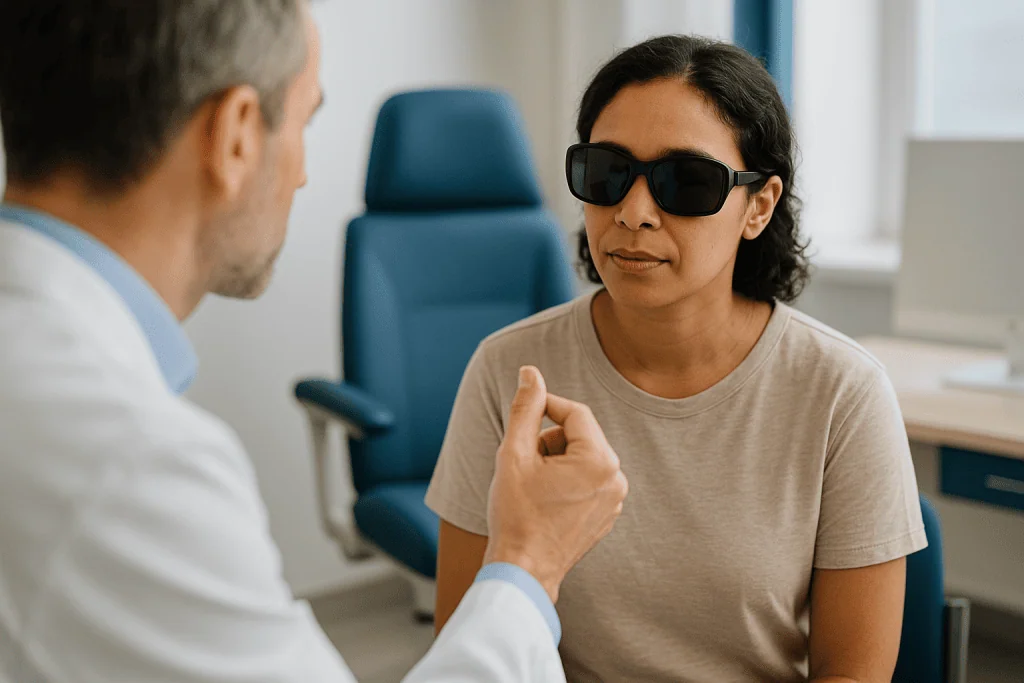
LASEK and PRK remove or move the epithelium itself. The eye then has to regrow or reattach that entire layer across the treated zone, which is why the NHS notes that vision after LASEK or PRK can take longer to settle and that discomfort is more common in the first few days. Nothing is faulty when this happens; it is simply the price of not cutting a deeper flap.
| Feature | LASIK | LASEK / PRK |
|---|---|---|
| Layer disturbed | Flap through epithelium and upper stroma | Epithelium only; stroma reshaped directly |
| Typical early comfort | Mild irritation, usually brief | Gritty, watery, light-sensitive for several days |
| Bandage contact lens | Not usually needed | Commonly worn for several days |
| Vision in the first week | Often functional quickly | Blurry, fluctuating while the surface regrows |
| Flap-related risks | Flap displacement possible after impact | No flap to dislodge |
| Who it may suit | Adequate corneal thickness | Thinner corneas, contact-sport players, some dry eye cases |
The trade is slower early healing for the absence of a flap. That is why surface procedures are often discussed for people with thinner corneas or careers where an eye could take a knock. Which route suits a given eye is a measurement question for the surgeon, not a preference to be chosen from a menu.
Who LASEK is usually for, and who is usually asked to wait
Laser refractive surgery treats refractive error, the umbrella term for short sight, long sight and astigmatism, where the eye’s shape stops light from focusing cleanly on the retina. The National Eye Institute describes these as the most common vision problems worldwide, and glasses or contact lenses correct them for most people without any surgery at all. Laser treatment is one option among several, never a requirement.
Surgeons typically consider surface procedures for adults whose prescription has been stable for a sustained period, whose corneas are healthy but perhaps too thin to spare tissue for a LASIK flap, and whose lifestyle makes a flap undesirable. The NHS lists general eligibility points: being over a minimum age, having a stable prescription, and having no eye disease that would complicate healing.
Several groups are commonly asked to wait or to consider alternatives:
- People under their early twenties, because prescriptions often still shift
- Anyone whose glasses prescription has changed meaningfully in the past year or so
- People who are pregnant or breastfeeding, since hormonal changes can alter corneal shape and tear film
- Those with significant dry eye, as surface surgery can worsen it for a time
- People with keratoconus or other thinning disorders of the cornea
- Anyone with uncontrolled diabetes, active autoimmune disease or a history of poor wound healing
Being asked to wait is a clinical judgement, not a verdict. A prescription that drifts for another year, or dry eye that improves with treatment, can change the picture. The assessment itself, which maps the cornea’s thickness and curvature point by point, is the step that decides whether LASEK, another procedure or simply new glasses is the sensible path. The treating team holds that decision, and a good consultation will explain the reasoning rather than just the answer.
After LASEK surgery sun protection: why the first weeks matter most
Two separate reasons sit behind the sunglasses advice, and they operate on different timescales.
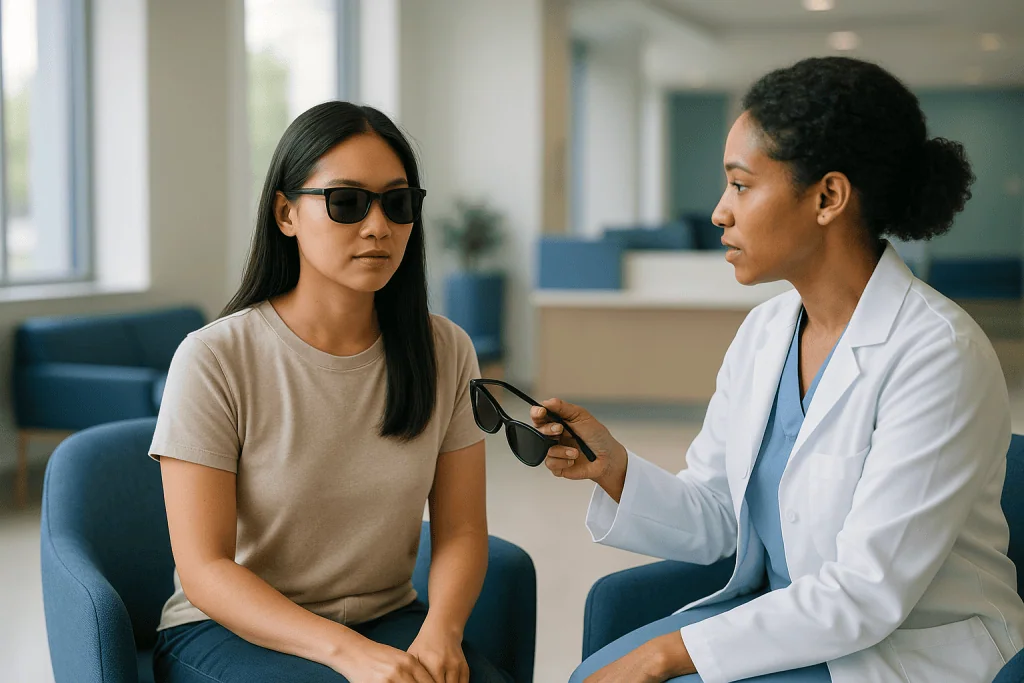
The immediate reason is comfort. A cornea without its full epithelium is, in effect, a large graze on the most nerve-dense surface in the body. Light scatters across the irregular new surface, and the exposed nerve endings register ordinary daylight as painfully bright. This photophobia, the medical word for light sensitivity, is expected in the first days and usually eases as the sheet of cells closes over, which the NHS describes as happening over the first several days to a week.
The longer reason concerns haze. Corneal haze is a faint cloudiness in the stroma that can develop as the eye lays down repair tissue after surface ablation. Ultraviolet light is a known driver of inflammation and cell changes in the cornea, and it is the same wavelength band the excimer laser uses, so an eye that has just been treated is thought to be more vulnerable to UV-related disturbance of the healing response. Surgeons therefore commonly advise diligent UV protection for the weeks and months after surface procedures, longer than they might after LASIK.
How strong is this evidence? Honest answer: the link between post-operative UV exposure and haze rests largely on laboratory work, case reports and observational studies rather than large randomized trials. That is enough for mainstream practice to recommend sunglasses as a low-cost, low-risk precaution, but not enough to quote a precise risk figure, and you should be wary of anyone who does.
Practically, the WHO advises sun protection whenever the UV index reaches 3 or higher, and the CDC notes that UV is strongest between roughly 10 a.m. and 4 p.m. Snow, water and pale concrete reflect UV upward, which is why a brim alone is not enough on a beach or ski slope.
Which sunglasses after LASEK actually help, and what the labels mean
Dark lenses and UV-blocking lenses are not the same thing, and the distinction matters more than usual for a healing cornea. Tint controls how much visible light reaches the eye, which helps with photophobia. UV blocking is a separate property of the lens material or coating, and a very dark lens with poor UV filtering can be worse than none, because the pupil widens behind it and lets more UV through.
Look for lenses labelled UV400 or described as blocking 99 to 100 percent of UVA and UVB. UV400 means the lens absorbs ultraviolet wavelengths up to 400 nanometers, which covers the full UVA and UVB range. The CDC’s sun safety guidance recommends exactly this standard for everyday eye protection, and after surface surgery there is no reason to accept less.
Fit matters nearly as much as the filter. Wraparound frames, or frames with wide arms that sit close to the face, reduce the light that sneaks in from the sides and from reflections below. Early on, when photophobia is at its peak, many people find even indoor lighting uncomfortable and keep a lightly tinted pair on at home. Nothing is wrong with that.
A few points people ask about:
- Polarized lenses cut reflected glare from roads and water, which is pleasant, but polarization is not UV protection; check for both.
- Photochromic lenses that darken outdoors are convenient, though many darken less inside a car because windscreens already filter UV.
- Your existing prescription sunglasses may no longer suit your new vision; plain UV400 lenses are fine while things settle.
- A wide-brimmed hat adds shade over the top of the frame.
If you drive, remember that very dark lenses are unsuitable at dusk and illegal for night driving in many places. Ask your team when driving is appropriate at all, since blurred and fluctuating vision in the first week or two usually rules it out.
Screen time after LASEK: what the evidence says, and what it does not
Few questions come up more often than when the phone or laptop can come back out, and the answer is less dramatic than the folklore suggests. Screens do not emit meaningful ultraviolet light and do not damage the regenerating cornea. What they do is change blinking.
Normal blink rate roughly halves during concentrated screen work, and each blink spreads a fresh layer of tears across the surface. The National Eye Institute describes dry eye as a condition where the eye does not make enough tears or the tears evaporate too quickly, and prolonged screen focus is a recognized aggravating factor. After LASEK, the corneal nerves that trigger blinking and tear production have been disturbed, so the surface is already prone to drying. Add long unblinking stretches and the gritty, blurry, burning feeling tends to flare.
So the realistic advice is not a ban but a dose and pattern:
- In the first few days, vision is often too blurry for screens to be comfortable anyway; audio, podcasts and rest are easier.
- Once the bandage lens is out and reading is possible, keep sessions short and build up as comfort allows.
- Follow the widely taught 20-20-20 habit: every 20 minutes, look at something about 20 feet away for 20 seconds, and blink deliberately.
- Enlarge text and turn down brightness; squinting at small type increases strain and reduces blinking.
- Keep any lubricating drops your team has recommended within reach for screen sessions.
Blue-light filters are heavily marketed for this period. Current evidence does not show they protect the cornea or speed healing; they may make a screen feel softer to some people, which is a comfort preference rather than a medical benefit. Spending less unbroken time staring, rather than changing the colour of what you stare at, is what the mechanism supports.
LASEK recovery time, day by day: the first week
Timelines vary from person to person, and the ranges below describe what the NHS and Mayo Clinic report as typical for surface procedures rather than a schedule anyone can promise. Your own team’s instructions override anything written here.
Day of surgery. Numbing drops wear off within hours, and most people then feel a stinging, gritty sensation with watering and strong light sensitivity. Vision is usually hazy. Sleeping is genuinely useful because closed lids protect the surface and allow it to begin reattaching. Protective shields are commonly worn at night so the eye is not rubbed.
Days one to three. This stretch is often the least comfortable. The epithelium is migrating across the treated zone, the bandage lens is in place, and the eye may feel like it has sand in it. Many people keep sunglasses on indoors, avoid screens entirely and take the pain relief their team has discussed. Clinics generally see patients within these first days to check that the surface is closing.
Days four to seven. As the sheet of cells seals over, pain usually drops sharply. The NHS notes that it can take up to a week for vision after LASEK or PRK to become reasonably clear, so blur during this phase is expected. The bandage lens is typically removed at a review appointment once the surface has covered; this should only ever be done by the clinical team.
Through this whole week, the same small rules recur: no rubbing, no water in the eye, sunglasses outdoors, drops exactly as instructed. The eye is doing careful cellular construction work, and most of what you are asked to do is simply to avoid knocking the scaffolding.
Weeks two to twelve: fluctuation, haze and when vision settles
Once the surface has healed over, a quieter phase begins that catches many people off guard. The eye looks normal, the pain is gone, and yet the vision wanders. Mornings may be clearer than evenings, or the reverse; one eye may lag the other; small print may swim in and out of focus. Mayo Clinic describes a period of two to three months before vision typically stabilizes after laser refractive surgery, and surface procedures sit at the longer end of that spectrum because the epithelium continues to remodel and smooth itself for weeks after it has closed.
Fluctuation has three main sources. The regrown epithelium is initially slightly uneven and thickens or thins in response to tear film and eyelid pressure. Dry spots on the surface scatter light and blur vision until a blink refreshes them. And the stroma is undergoing a low-grade repair response that can produce the faint haze discussed earlier.
That haze, where it occurs, often appears some weeks after surgery rather than immediately, which is one reason sunglasses advice extends well past the point where the eye feels fine. Clinicians grade haze at the slit lamp, the microscope used in eye examinations, and most of what they see at this stage is mild and fades over subsequent months. More marked haze that affects vision is uncommon and is managed by the surgeon, sometimes with anti-inflammatory drops over a longer course.
Patience here is not passive. Keeping review appointments lets the team track the pattern rather than a single snapshot. Noting when vision is better or worse during the day gives useful clues about dryness. And resisting the urge to judge the result at week three, when the cornea has not finished, spares a great deal of needless worry.
Dry eye after surface laser: the mechanism and how it is usually managed
Dryness is the most frequently reported complaint after any laser refractive procedure, and understanding why makes it easier to tolerate. The cornea is laced with fine nerve endings that do two jobs: they warn of injury, and they signal the tear glands and eyelids to keep the surface wet. Reshaping the stroma cuts across some of those nerves, and removing the epithelium disturbs the rest. The feedback loop that normally keeps the eye lubricated runs quietly for a while.
Mayo Clinic notes that dry eye symptoms after laser surgery commonly persist for weeks and can last for around six months or longer while nerves regenerate. For surface procedures the early irritation is often more noticeable, though some surgeons select LASEK partly because it disturbs fewer deep nerves than a LASIK flap. The evidence on whether that translates into less long-term dryness is mixed, so it is better described as a reasonable rationale than a proven advantage.
Management usually layers simple measures:
- Preservative-free lubricating drops, used as often as the team suggests, since preservatives can irritate a healing surface
- Deliberate, full blinks during reading and screen work
- Avoiding direct airflow from fans, car vents and air conditioning
- A humidifier in dry indoor environments, especially overnight
- Shortening screen sessions during the first weeks
For persistent dryness, clinicians may discuss options such as temporary punctal plugs, tiny inserts that slow tear drainage, or prescription anti-inflammatory drops. Those are decisions for the prescribing clinician based on examination, not something to source independently. Most people find the sensation fades as the months pass; those whose dryness does not improve should say so clearly at follow-up rather than assuming it is simply part of the deal.
Light sensitivity, glare and halos: what is normal and what is not
Three visual phenomena cluster in the early months and are easily confused. Photophobia is discomfort in bright light and is driven by the irritated corneal surface; it is strongest in the first days and improves as the epithelium heals. Glare is the sense of scattered light spilling from bright sources, such as oncoming headlights blooming across the windscreen. Halos are rings around lights, most noticeable at night when the pupil widens.
Glare and halos arise because the newly reshaped cornea is not yet perfectly smooth, and because at night the pupil may dilate beyond the zone the laser treated, so light passing through the edge is focused slightly differently. Mayo Clinic lists these as common temporary effects of laser eye surgery that usually diminish over weeks to months; the NHS mentions the same and notes they persist in a small minority.
Several things help while the eye settles. Sunglasses in daylight reduce the squint-and-strain cycle. Night driving is best deferred until the team confirms vision meets the legal standard and the person feels confident. Dimming screens and using warmer lighting indoors reduces discomfort without affecting healing one way or the other.
What would not be normal is sensitivity that worsens after it had been improving, particularly if the eye also turns red, waters heavily or begins to hurt again. That pattern suggests a new problem, such as a loose patch of epithelium, infection or a marked inflammatory reaction, rather than ordinary healing, and belongs in the red-flag section below. The distinguishing feature of expected light sensitivity is that its direction of travel is steadily, if slowly, toward better.
Drops, bandage lenses and shields: what each one is doing
The small bag of items handed over after LASEK can feel like a chemistry set, so it helps to know what each is for. None of this replaces your own instruction sheet, and the choice and duration of any drop belongs to the prescribing clinician.
Antibiotic eye drops are commonly used in the first days. A cornea without its epithelium has lost its main barrier against bacteria, and the drops reduce the chance of infection while that barrier is rebuilt. They are usually stopped once the surface has closed.
Corticosteroid eye drops damp down the inflammatory response in the stroma. After surface procedures they are often continued for longer than after LASIK, tapering over weeks, because the repair reaction that produces haze unfolds over that period. Steroid drops can raise pressure inside the eye in some people, which is one reason pressure checks are part of follow-up and why the schedule should never be shortened or extended without the team’s say-so.
Lubricating drops support the tear film while the nerves recover, as discussed above. Preservative-free versions are commonly preferred for frequent use.
The bandage contact lens holds the loosened epithelium in position and shields exposed nerves, which is why comfort often dips briefly when it is removed. It is taken out at a review once the surface has knitted, never at home.
Night shields prevent the sleeping reflex of rubbing the eyes, which could lift the new cells before they have anchored.
If a drop stings sharply, a bottle runs out early, or you are unsure of the order to use them, the clinic is the right call. Guessing with a healing cornea is rarely worth the saved phone call.
Everyday life after LASEK: washing, makeup, exercise and swimming
Most restrictions after LASEK come down to a single principle: keep the surface clean, unrubbed and out of water until the epithelium has sealed and strengthened. The precise timings below are the kinds of ranges the NHS and Mayo Clinic describe for laser eye surgery generally; your team may adjust them for your eye.
Showering and hair washing are usually fine from the next day as long as water and soap are kept out of the eyes. Tipping the head back and keeping the eyes closed is enough for most people. Face washing with a clean cloth around, not over, the eyes is a common compromise in the first week.
Eye makeup is typically paused for about a week or more because particles and old applicators can carry bacteria onto an unprotected surface, and removing makeup involves rubbing. Replacing mascara and liners that were in use before surgery is a sensible low-cost precaution.
Exercise that does not involve sweat running into the eyes, impact or dust can usually resume within days. Contact sports, racket sports and anything with a ball near the face are generally deferred for several weeks, since a blow to a healing cornea is the scenario surface procedures were partly chosen to avoid, and protective eyewear is advised when they do resume.
Swimming, hot tubs and saunas carry a higher infection risk because of microorganisms in water and are commonly off the list for a few weeks; the NHS advises avoiding them until the clinic confirms the surface has fully healed.
Dusty or smoky environments, including gardening and DIY, are worth avoiding early, and gardening gloves do not protect the eye from a stray finger.
Through all of it, the sunglasses go on at the door, every time.
Does after LASEK surgery sun protection ever stop mattering?
The honest answer has two layers. The procedure-specific caution eases; the general case for protecting your eyes from ultraviolet light does not.
The heightened concern about haze is tied to the active healing window. Once the stroma’s repair response has quietened, generally within the months during which surgeons also taper anti-inflammatory drops, the laser-treated eye is not thought to be more UV-vulnerable than anyone else’s. Clinicians vary in how long they advise strict shading, with many suggesting diligence for several months after surface procedures, and your own team’s advice should be the one you follow. There is no evidence that a reshaped cornea needs lifelong special treatment beyond what every eye deserves.
What every eye deserves is where the second layer comes in. The WHO identifies cumulative UV exposure as a contributor to cataract, the clouding of the eye’s natural lens, and to several conditions of the eye surface, including pterygium, a wedge of tissue that can grow across the cornea. The WHO also notes that UV reaches the eye from reflection off water, sand and snow, not just from the sky, which is why a hat alone is insufficient in those settings. The CDC’s sun safety guidance includes UV-blocking sunglasses alongside sunscreen and shade as a year-round habit, not a summer one.
So the practical sequence looks like this. For the first weeks, sunglasses whenever you are outdoors in daylight, no exceptions, and in bright indoor light if that helps. For the following months, the same habit continued because the stroma is still remodelling. After that, UV400 sunglasses outdoors as a lifelong norm, exactly as you would hope to do regardless of whether you had ever sat under a laser. Surgery changed your cornea’s shape. It did not change the physics of sunlight.
What people often get wrong about LASEK recovery
Recovery folklore travels faster than evidence, and a few recurring misunderstandings cause real distress or real harm.
“If it hurts on day two, something has gone wrong.” Day two is typically the most uncomfortable point after surface procedures precisely because the epithelium is mid-migration. Pain that follows the expected arc of worse-then-better is the normal course. Pain that returns after improving, or that is severe and escalating, is the pattern to report.
“Dark sunglasses are UV sunglasses.” Tint and UV filtering are independent. Only lenses labelled UV400 or 100 percent UVA/UVB protection meet the standard, and a dark untreated lens can let more UV in by dilating the pupil.
“Screens damage the healing eye.” Screens dry the eye by suppressing blinking; they do not emit damaging light. Shorter sessions and frequent blinking address the actual mechanism.
“Blurry vision at week three means the surgery failed.” Mayo Clinic describes a stabilization period of two to three months, and surface procedures sit at the longer end. Judging the outcome early is judging an unfinished process.
“I feel fine, so I can stop the drops.” Steroid drops after LASEK are often tapered over weeks to control a haze response that is invisible to the patient. Stopping or extending them is a decision for the prescribing clinician.
“Rubbing gently is harmless once the lens is out.” The new epithelium takes time to anchor firmly to the layer beneath. Rubbing can shear it, which is why night shields and the no-rub rule outlast the bandage lens.
“Laser surgery means never needing glasses again.” It treats the prescription present at the time. The lens inside the eye still stiffens with age, so reading glasses in later life remain common, and the NHS lists this plainly among its expectations.
Questions to ask your care team before and after LASEK
Good questions get better answers, and the ones below tend to surface the information that discharge sheets compress. Take them to the consultation and the follow-ups, and write the answers down while they are fresh.
Before surgery:
- Why are you recommending LASEK for my eyes rather than LASIK or another option, and what did my corneal measurements show?
- What is my realistic range of outcomes given my prescription, and what would make a second treatment or glasses still likely?
- How long do you expect my vision to fluctuate, and when would you consider it settled?
- What is your approach to preventing and treating haze, and how long would I typically use anti-inflammatory drops?
- What are the alternatives if I decide not to go ahead?
In the first days:
- Which symptoms do you expect, and which ones should prompt a same-day call?
- When will the bandage lens be removed, and what should I feel afterward?
- Exactly how should I use each drop, and in what order?
- When may I drive, and how will that be assessed?
At follow-up:
- How does my surface look under the microscope, and is there any haze?
- Is my eye pressure normal on the steroid drops?
- How long do you want me to continue strict sun protection, and why?
- If dryness persists, what are the next management steps you would consider?
- When will my prescription be stable enough to judge the result?
None of these questions is a challenge to the team’s expertise. They are how a shared decision actually gets shared.
When to call your doctor after LASEK: red-flag signs
Most of the sensations after LASEK are uncomfortable but expected, and the earlier sections describe them. A smaller set of signs points to a problem that needs the clinic rather than another day of patience. Mayo Clinic and the NHS both advise contacting the surgical team promptly for any of the following:
- Severe pain, or pain that returns and worsens after it had been improving
- A sudden drop in vision, or vision that is clearly getting worse rather than fluctuating
- Increasing redness, especially with thick or coloured discharge
- Light sensitivity that intensifies after it had begun to settle
- A sensation that the bandage lens has moved, fallen out or is scratching
- Any blow to the eye, however minor it seems
- A feeling of something stuck in the eye that does not ease with blinking
- Nausea or a dull ache behind the eye, which can accompany raised eye pressure
Infection of a cornea without its epithelial barrier can progress quickly, so these symptoms justify a same-day call, and an out-of-hours or emergency eye service if the clinic is closed. Do not remove or reinsert the bandage lens yourself, do not stop or change any drop on your own, and do not wait to see whether the morning brings improvement.
It is also worth calling for the less dramatic worries: a drop that has run out, uncertainty about the order of medicines, or vision that simply feels different from what you were told to expect. Clinics expect these calls, and a brief conversation is a small price against the alternative. Whatever the outcome of that call, the plan that follows sits with the treating team, who can see the surface and you cannot.
Frequently asked questions
How long after LASEK do I need to wear sunglasses?
Wear UV-blocking sunglasses whenever you are outdoors in daylight from the first day, and continue through the weeks and months your surgeon specifies, commonly spanning the period they also taper anti-inflammatory drops. The early weeks matter most because light sensitivity peaks and the stroma is actively healing. After that, UV400 sunglasses outdoors are a sensible lifelong habit for every eye, as the WHO and CDC both advise.
What are the precautions after laser eye surgery like LASEK?
The core precautions are: no rubbing, no water or soap in the eye, no swimming or hot tubs until cleared, no eye makeup for about a week or more, protective shields at night, sunglasses outdoors, and drops exactly as prescribed. Contact sports and dusty environments are typically deferred for several weeks. Your own team’s instruction sheet takes priority over any general list.
What is the typical LASEK recovery time?
Surface healing is staged. The NHS describes the epithelium closing and vision becoming reasonably clear over the first several days to a week, while Mayo Clinic describes two to three months before laser-treated vision typically stabilizes, with surface procedures often at the longer end. Dryness can persist for around six months as corneal nerves recover. These are typical ranges, not promises, and individual eyes vary.
Is screen time after LASEK harmful?
Screens do not damage the healing cornea; they dry it by reducing blinking. In the first few days vision is usually too blurry for screens anyway. Afterward, short sessions, enlarged text, lower brightness, deliberate blinks and the 20-20-20 habit let you return gradually. Blue-light filters have not been shown to aid healing, so the practical lever is how long you stare, not the screen colour.
How does LASEK vs LASIK healing differ?
LASIK preserves the surface skin of the eye under a hinged flap, so comfort and clear vision usually return within a day or two. LASEK removes or moves that surface layer, so the eye must regrow it, bringing several days of grittiness, light sensitivity and blur. In exchange there is no flap to dislodge, which is why surface procedures are often considered for thinner corneas or contact-sport players.
What is corneal haze after LASEK?
Corneal haze is a faint cloudiness in the stroma caused by the repair response after surface ablation. It often appears some weeks after surgery and is usually mild and fades over months. Ultraviolet exposure is thought to aggravate the response, which is one reason sunglasses advice extends well past the point the eye feels normal. Marked haze is uncommon and is managed by the surgeon.
Why do my eyes feel so dry after surface laser surgery?
Reshaping the cornea and removing the epithelium disturbs the fine nerves that signal the tear glands and eyelids to keep the surface wet, so the lubrication loop runs quietly for a while. The National Eye Institute describes dry eye as insufficient or rapidly evaporating tears, and Mayo Clinic notes symptoms can last around six months after laser surgery. Lubricating drops, humidified air and blinking habits are the usual first steps.
Can I stop my eye drops once my eye feels fine?
No. Steroid drops after LASEK are usually tapered over weeks to control a haze response you cannot feel, and stopping early or extending them without supervision can affect healing or eye pressure. Antibiotic drops are typically stopped once the surface closes, again on the team’s instruction. Any change to a prescribed drop is a decision for the prescribing clinician, so ask rather than guess.
When can I drive after LASEK?
Only when your surgeon confirms your vision meets the legal standard and you feel confident, which for surface procedures is often not within the first week or two because of blur and fluctuation. Night driving may take longer because glare and halos are common early on. Very dark sunglasses are unsuitable for dusk driving, so plan daylight journeys first and check with the clinic before each step.
Will I ever need glasses again after LASEK?
Possibly. Laser surgery treats the prescription present at the time, and the NHS notes that many people still need reading glasses later in life because the eye’s internal lens stiffens with age, a process the cornea’s shape cannot prevent. A small proportion also need an enhancement or glasses for residual error. Your surgeon can give a realistic range for your own eyes once measurements are reviewed.
References
- NHS: Laser eye surgery and lens surgery
- MedlinePlus: Laser Eye Surgery
- National Eye Institute (NIH): Dry Eye
- CDC: Sun Safety
This article is for general information only and is not a substitute for professional medical advice. Please consult a qualified doctor about your individual situation.

More from the Blog

Robotic vs Conventional Eye Surgery: Where Computer Assistance Helps and Where It Does Not
Robotic and laser-assisted eye surgery hand certain cutting and measuring steps to a computer-guided device, while the surgeon still plans and completes the operation.…
What to Expect From an Intraocular Lens: Distance, Near and the Glasses You May Still Need
An intraocular lens replaces the eye's natural lens, usually after cataract removal, and is set to focus at a chosen distance. Most people see…

Straight Lines Suddenly Look Wavy: Why Macular Degeneration Patients Get Same-Week Reviews
Sudden distortion in macular degeneration, where straight lines bend or ripple over hours to days, can signal that the dry form has converted to…
What Happens During a Retinal Injection Appointment: Numbing, the Injection and Aftercare
During a retinal injection appointment, your vision and eye pressure are checked, the eye is numbed with anesthetic drops or gel, the surface is…
How ReLEx SMILE Reshapes the Cornea Through a Keyhole Incision
SMILE eye surgery works by using a femtosecond laser to cut a thin, lens-shaped disc of tissue, called a lenticule, inside the cornea, then…

What Ultrasound and OCT Show Before Retina Surgery and How the Images Shape the Plan
Before retina surgery, two imaging tests do most of the work. Optical coherence tomography (OCT) gives a cross-section of the retina, showing whether the…