

Managing Discomfort After PRK: Prescribed Drops, Dark Glasses and Why the Bandage Lens Helps

Key Takeaways
- PRK removes the cornea's surface layer on purpose, and the first days of burning and grit reflect exposed corneal nerves while that layer regrows.
- The surface typically closes within about three to five days, and the sharpest discomfort usually eases as it does, according to patient guidance from MedlinePlus and Mayo Clinic.
- The bandage contact lens shields the healing surface from blinking friction and should never be removed at home; if it falls out, call the clinic rather than reinserting it.
- Antibiotic drops guard the open surface, steroid drops control inflammation and haze risk on a taper set by the surgeon, and short-course NSAID drops are time-limited because prolonged use can slow healing.
- UV-blocking dark glasses do double duty, easing reflex light sensitivity and reducing the ultraviolet exposure linked with corneal haze during early recovery.
- A dip in vision around the time the lens comes out is expected as the uneven new epithelium smooths, with vision settling over weeks to months rather than days.
Pain after PRK is usually most noticeable in the first two to four days, while the cornea's surface layer regrows under a protective bandage contact lens. Most people describe burning, grittiness, tearing and strong light sensitivity rather than sharp pain. Prescribed drops, dark glasses, rest and cool compresses help manage it, and the discomfort typically eases steadily within the first week as the surface heals.
The ride home is the first clue. Sunlight through the car window feels like a flashbulb, the eyes stream, and the numbing drops from the procedure room are quietly wearing off. By evening, many people who have just had photorefractive keratectomy are sitting in a dim room with cold compresses, wondering whether this is normal. For most, it is.
Searches for “prk pain first days” spike for a reason: the surface-based laser procedure removes the cornea’s outer skin on purpose, and that skin has to grow back before the eye feels like itself again. The waiting is uncomfortable, but it is also predictable, and knowing the shape of it changes how it feels.
This explainer walks through what is actually happening on the eye, what the prescribed drops and the soft bandage lens are doing, why dark glasses are more than a style choice, and which signs mean you should stop guessing and call your surgeon’s team.
What is photorefractive keratectomy (PRK) and what actually happens during it?
Photorefractive keratectomy, usually shortened to PRK, is a laser procedure that reshapes the cornea, the clear dome at the front of the eye, so that light focuses more precisely on the retina. It treats refractive errors, which are focusing problems such as nearsightedness, farsightedness and astigmatism, as described by the National Eye Institute.
The step that sets PRK apart happens before the laser is used at all. The cornea is covered by a thin living layer called the epithelium, roughly five to seven cells thick, which acts as the eye’s skin. In PRK the surgeon removes a disc of this layer from the center of the cornea, either with a diluted alcohol solution, a soft brush or the laser itself. An excimer laser, a cool ultraviolet laser that removes tissue a fraction of a micrometer at a time, then sculpts the exposed corneal bed to the planned shape.
The whole sequence takes a few minutes per eye. Numbing drops keep the procedure itself comfortable. Afterward, a soft contact lens with no prescription, called a bandage contact lens, is placed over the treated surface, and the first prescribed drops go in.
Everything that follows in the next days flows from that one choice to remove the epithelium rather than lift a flap. The reshaping is done; the eye now has an open surface the size of a small coin that needs to close. Understanding that makes the early discomfort feel less like something going wrong and more like a wound doing what wounds do.
PRK pain first days: why a healing cornea hurts the way it does
The cornea is one of the most densely innervated tissues in the body. Its nerve endings sit just beneath, and within, the epithelium. Remove that layer and the endings are exposed to air, blinking, tears and light with no cover. That is the simplest explanation for why the first days after PRK can be hard, and why the sensation is so often described as sand, grit, burning or a scratched eye rather than a deep ache.
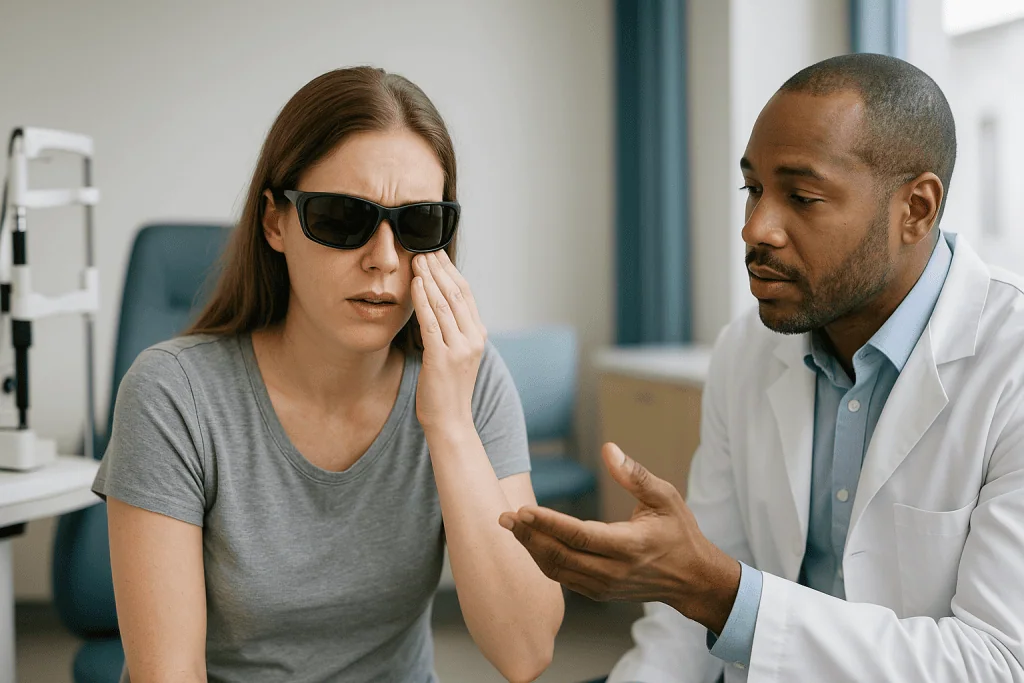
Several things happen at once in the first 24–72 hours. Cells at the edge of the treated zone begin to migrate inward to close the gap. Inflammation arrives to clear debris and support repair, and that inflammation releases chemical messengers that lower the threshold of the exposed nerves, so ordinary stimuli register as pain. Tear production rises, which is why eyes water. The eyelid, which normally glides over a smooth surface thousands of times a day, now slides across a raw one.
Light sensitivity, called photophobia, has its own mechanism. The irritated cornea and the inflamed front of the eye trigger a reflex that makes the iris and ciliary muscle spasm, and a brightly lit room can feel almost intolerable. Mayo Clinic and MedlinePlus both list light sensitivity, tearing, blurred vision and discomfort as expected in this period.
Discomfort is often worst on day two or three, when the healing edges are meeting in the middle. People are sometimes surprised that day one felt manageable and day two did not. The lens, the drops and the dark glasses are each aimed at one of these mechanisms, which is why your surgeon prescribes them as a set rather than a menu.
How long does PRK pain last? What the evidence actually shows
The honest answer is that it varies, but the range is narrower than internet forums suggest. The epithelium typically closes within about three to five days in most descriptions of PRK recovery, including MedlinePlus’s overview of laser eye surgery, and the sharp, gritty phase of discomfort tends to settle as that surface closes. Milder irritation, dryness and fluctuating vision can continue for weeks.
A useful way to think about it is in three overlapping phases:
- Acute phase, roughly days one to four: the surface is open or nearly closed. Burning, tearing, grit and strong light sensitivity dominate. This is the window the bandage lens and prescribed drops are built for.
- Early healing, roughly days four to ten: the lens usually comes out once the surface has closed. Discomfort drops noticeably, but the new epithelium is thin and uneven, so vision is blurry and eyes feel dry and tired.
- Remodeling, weeks to months: the new surface smooths and thickens, and vision gradually sharpens. NHS guidance notes that it can take several weeks to months for vision to settle fully after surface procedures.
Individual factors shift these ranges. A larger treatment zone means a larger area to close. Dry eye, certain medicines, smoking and some medical conditions can slow surface healing. Some people are simply more sensitive to corneal pain; there is no weakness in that.
What the evidence does not support is the idea that pain lasting into a second week is routine. By then the surface should be closed, and persistent or worsening pain belongs with your surgeon, not with a search bar.
How the PRK bandage contact lens helps, and why you should never remove it yourself
The bandage contact lens is a soft, high-oxygen lens with no corrective power. Its job is mechanical and biological at the same time, and it is one of the main reasons modern PRK recovery is more tolerable than it was decades ago.

Mechanically, it acts as a shield. Every blink drags the eyelid across the cornea, and with the epithelium gone that movement irritates exposed nerves and can disturb the fragile sheet of new cells creeping in from the edges. The lens takes the friction instead. It also keeps the surface wet, because a thin tear film spread under a lens evaporates more slowly than one exposed to air.
Biologically, a stable, moist, protected environment lets epithelial cells migrate across the bed and attach without being scraped off. Think of the lens as the clear film a nurse places over a skin graze: it does not heal the wound, but it lets the wound heal itself without constant interruption.
The lens stays in until your surgeon confirms the surface has closed, typically at a check in the first week. Mayo Clinic describes a similar follow-up pattern after laser eye surgery. Two rules matter:
- Do not take the lens out yourself, even if it feels loose or scratchy. Pulling it off can lift new cells and reopen the surface.
- If it falls out on its own, do not put it back. Call the clinic the same day; they will advise whether to come in.
A bandage lens is still a contact lens, which carries a small risk of infection while the surface is open. That is why antibiotic drops are prescribed alongside it, and why hand hygiene around the eye matters so much in the first week.
Prescribed drops after PRK: what each class is doing
Most people go home with several bottles and a written schedule. The schedule belongs to your surgeon; this section explains the logic, not the timing. Never add, skip or stop a drop without asking the prescribing team.
Antibiotic drops lower the risk of bacterial infection while the epithelium is open and a contact lens is on the eye. They are usually continued until the surface has closed and the lens is removed, as described in Cleveland Clinic’s and Mayo Clinic’s patient guidance on laser eye surgery.
Corticosteroid drops dampen inflammation. In PRK they do two things: they ease the inflammatory contribution to pain in the first days, and over the following weeks they help reduce the risk of corneal haze, a cloudiness that can develop as the cornea remodels. Steroid drops are typically tapered over weeks, and the taper schedule is a medical decision because stopping too early or continuing too long each carries its own risks.
Nonsteroidal anti-inflammatory (NSAID) drops are sometimes prescribed for a short period in the first days. They work by blocking prostaglandins, chemical messengers that sensitize nerve endings, and studies summarized in NIH-indexed literature describe meaningful reductions in early PRK discomfort. They are time-limited for a reason: prolonged use has been associated with delayed healing, so the surgeon’s stop date matters.
Preservative-free lubricating drops are the workhorse. They keep the healing surface wet, reduce friction and relieve dryness that can last weeks or months.
Some surgeons also prescribe an oral pain reliever. Which one, how much and for how long is their decision based on your health history, and it is not something to improvise from a medicine cabinet.
Why dark glasses matter after PRK
Sunglasses are usually handed over before you leave, and it is tempting to treat them as optional. They are not, at least for the first several days, for three overlapping reasons.
The first is comfort. Photophobia after PRK is real and physiological. The irritated cornea and inflamed front chamber trigger reflex spasm of the muscles inside the eye, so bright light produces an ache that is different from simple glare. Dark lenses lower the input and let those muscles rest. Many people find that even indoor lighting feels harsh on days one to three, and that wraparound styles help more than flat ones because light leaks in from the sides.
The second is protection. The eyes water heavily, the surface is raw, and wind, dust and dry air all aggravate it. Glasses form a barrier against airborne grit and reduce tear evaporation. On the first night some surgeons also provide plastic eye shields for sleep, so an unconscious hand cannot rub the lens off.
The third reason is longer term. Ultraviolet exposure in the weeks after surface laser procedures has been linked with corneal haze in the ophthalmic literature, which is why patient guidance from sources such as the NHS recommends UV-blocking eyewear outdoors during early recovery. A healing cornea is more vulnerable to UV than a settled one.
Practical details help more than rules. Keep a pair by the door and one by the bed. Choose lenses labelled as blocking UVA and UVB. Dim screens and lamps indoors rather than squinting. And accept that for a few days the most restorative thing you can do for your eyes is close them.
Comfort measures at home: rest, cool compresses and the screen question
Beyond the prescriptions, a handful of simple measures shape how the first days feel.
Rest with the eyes closed. Blinking is the main source of friction on the healing surface, even with a lens in place. Napping, listening to audiobooks or podcasts and simply sitting in a dim room with closed eyes are not laziness; they are treatment. Many people describe day two as the day they wished they had cleared their calendar.
Cool compresses over closed lids. A clean cloth cooled in the refrigerator, placed gently over closed eyes for a few minutes, can take the edge off burning and lid swelling. Keep it cool rather than icy, keep it clean, and never press.
Lubricate as directed. Preservative-free drops ease the gritty feeling and help the lens stay comfortable. Keep hands washed, avoid touching the tip to the eye, and keep the bottle cool if the box advises it.
Screens and reading. Screen time does not damage the cornea, but concentrating on text lowers the blink rate and dries the surface, and bright displays aggravate photophobia. Short sessions at low brightness, with frequent breaks, are a reasonable compromise once the worst of the light sensitivity passes, usually after the first few days.
Environment. A humidifier, avoiding fans blowing on the face, and steering clear of smoke, dust and swimming pools all protect the surface. Showers are fine; direct water pressure on the eye is not.
None of these replaces the prescribed drops. They work alongside them, and they cost nothing but patience.
PRK recovery timeline: what the first days and weeks usually look like
Timelines are typical ranges, not promises, and your surgeon’s instructions override any table. With that said, most people find the following shape familiar. The ranges reflect patient guidance from MedlinePlus, Mayo Clinic and the NHS.
| Stage | Typical window | What is usually happening | What people commonly notice |
|---|---|---|---|
| Procedure day | Day 0 | Epithelium removed, laser treatment, bandage lens placed | Numb at first; burning, tearing and blur as drops wear off |
| Acute healing | Days 1–4 | Epithelial cells migrate across the treated zone | Peak discomfort, strong light sensitivity, poor vision |
| Surface closure | Around days 3–7 | Surface confirmed closed; lens removed at a check | Sharp relief in grit and pain; vision still hazy |
| Early remodeling | Weeks 1–4 | New epithelium thickens and smooths | Fluctuating clarity, dryness, glare at night |
| Settling | Weeks 4–12 and beyond | Cornea stabilizes; steroid taper typically completes | Progressively steadier vision; residual dryness in some |
Two points deserve emphasis. First, vision after PRK often gets slightly worse around the time the lens comes out, because the fresh epithelium is uneven. People who do not expect this worry; people who do simply wait. Second, the two eyes may heal at different speeds, which is normal and unrelated to the final outcome.
Driving is usually off the table until the surgeon confirms vision meets legal standards, which is frequently a week or more for PRK rather than the day or two sometimes quoted for flap-based procedures. Work that involves reading can usually resume in stages as comfort allows.
Who PRK is usually for, and who is usually asked to wait
Surface laser treatment is not chosen at random. Surgeons tend to suggest PRK over flap-based LASIK in particular situations, and the same evaluation identifies people who should hold off.
PRK is often favored when the cornea is relatively thin, because no tissue is set aside for a flap, or when there is an irregular surface or mild epithelial fragility where lifting a flap would be unwise. It is also commonly suggested for people whose work or sport carries a real risk of a blow to the eye, since there is no flap that could be displaced. People with moderate dry eye are sometimes steered toward PRK as well, although dry eye is a factor the surgeon weighs case by case.
Those usually asked to wait, or to consider other options, include:
- People whose glasses prescription is still changing; Mayo Clinic notes that a stable prescription is a standard requirement before laser vision correction.
- People who are pregnant or breastfeeding, because hormonal shifts alter refraction and corneal hydration.
- People with active eye disease, uncontrolled dry eye, or conditions such as keratoconus, a progressive thinning and bulging of the cornea.
- People with systemic conditions that impair healing, or those taking medicines known to slow epithelial recovery.
- People with unrealistic expectations, which the consultation is designed to surface honestly.
None of these is a judgment. The pre-operative examination, including corneal mapping and thickness measurement, exists to match the right eye to the right procedure, and sometimes to no procedure at all. The decision sits with the surgeon and the person in the chair, together, after that examination.
PRK vs LASIK: is PRK better, and why does PRK hurt more at first?
“Is PRK better than LASIK?” is one of the most searched questions on this topic, and the only honest answer is: better for whom, and measured how?
Both procedures use the same excimer laser to reshape the same corneal tissue. The difference is access. LASIK creates a thin hinged flap in the cornea, lifts it, treats the tissue underneath and lays the flap back down. PRK removes the surface layer instead and treats the exposed bed. Because the flap in LASIK keeps most of the epithelium and its nerve cover intact, early discomfort is usually mild and vision clears within a day or two. Because PRK leaves an open surface, early discomfort is greater and visual recovery is slower.
Patient-facing summaries from Mayo Clinic, Cleveland Clinic and the NHS describe the long-term visual results of the two approaches as broadly comparable for suitable candidates, which is why the choice usually turns on anatomy and lifestyle rather than on which one is “stronger.”
Where PRK tends to be preferred:
- Thinner corneas, where sparing tissue matters.
- Contact sports or occupations with eye-impact risk, since there is no flap.
- Some surface irregularities where a flap is undesirable.
Where LASIK tends to be preferred:
- When fast visual recovery is a priority.
- When early discomfort is a particular concern.
Flap-related complications are unique to LASIK; corneal haze is more associated with PRK. Both carry risks of dry eye, glare, under- or over-correction and the need for enhancement. People sometimes ask what to expect two weeks after LASIK; typically clearer vision and less dryness than two weeks after PRK, which is precisely the trade-off being made. Neither is better in the abstract.
How long to avoid rubbing your eyes after PRK, and other things to steer clear of
“How long to not rub eyes after PRK” is a practical question with a layered answer. In the first week, while the lens is in and the surface is closing, rubbing is genuinely risky: it can dislodge the lens and tear the sheet of new cells. After the surface has closed, the new epithelium remains loosely attached for weeks, so firm rubbing can still cause a painful erosion. Most surgeons advise avoiding rubbing entirely for several weeks and treating the eyes gently for longer; your own team’s timeline is the one to follow.
Rubbing is also a habit worth breaking regardless, because it is associated with corneal warping over time. If itching drives the urge, that is something to mention at follow-up rather than something to fix with knuckles.
Other things usually restricted in early recovery, with typical reasoning:
- Eye makeup for roughly the first week or two, because particles and applicators can introduce bacteria to a surface that is still immature.
- Swimming, hot tubs and open water for several weeks, since standing water carries organisms that a compromised surface cannot defend against; this mirrors standard contact lens hygiene guidance.
- Dusty, smoky or windy environments while the surface is fragile.
- Heavy exercise in the first days, mainly because sweat and the temptation to wipe the eyes both raise risk; walking is fine.
- Driving until the surgeon confirms vision meets the legal standard.
- Tap water in the eye, including rinsing a lens that has fallen out; use the clinic’s advice instead.
Sleep deserves a mention. Side-sleepers and people who sleep with a hand near the face benefit from the shields provided for the first nights. It is a small inconvenience against a surface that is doing careful work in the dark.
What people often get wrong about PRK pain and recovery
Forums and video diaries have made PRK recovery more visible, and some of what circulates is misleading.
“PRK is unbearably painful.” For most people it is uncomfortable rather than agonizing, and the worst of it lasts days, not weeks. Severe or escalating pain is not the norm and should prompt a call.
“If the lens feels scratchy, take it out.” A slightly gritty lens in the first days is common and usually reflects the surface beneath it, not the lens. Removing it early is one of the easiest ways to set healing back.
“Numbing drops from the clinic can be used at home.” Topical anesthetic drops are not sent home after PRK because repeated use damages the epithelium and can delay or prevent healing. If you have a bottle from any source, do not use it.
“More steroid drops mean less haze, so I’ll keep going.” The taper exists because long steroid exposure raises eye pressure and infection risk. Stopping early also carries risk. Both directions are decisions for the prescriber.
“My vision got worse at day five, so the surgery failed.” A dip when the lens comes out is expected as the uneven new surface smooths. Outcomes are judged over weeks and months.
“Natural remedies will speed healing.” There is no reliable evidence that supplements, herbal washes or eye exercises hasten epithelial closure. Some home preparations are unsterile and dangerous on an open surface.
“PRK is the old, worse version of LASIK.” It is the older procedure, but current guidance treats it as a deliberate choice with specific advantages, not a fallback.
Honest expectations shorten the hard days more than any myth ever has.
Questions to ask your care team
Recovery goes more smoothly when the questions are asked before the drops wear off. Bring this list to the pre-operative visit or the first follow-up, and write the answers down; the first days are not a time to rely on memory.
- Why is PRK the right choice for my eyes rather than another procedure, and what did my corneal measurements show?
- What level of discomfort do you consider normal in the first days, and what level would you want to hear about the same day?
- Exactly which drops am I using, in what order, and what is the taper plan for the steroid?
- Is there an oral pain reliever you want me to use, and are there any over-the-counter medicines I should avoid with my health history?
- When will the bandage lens come out, and what should I do if it falls out at home or overnight?
- When can I drive, return to work, use screens, exercise, wear makeup and swim?
- How long should I keep wearing UV-blocking glasses outdoors?
- How will I reach the on-call team after hours, and what information will you want from me?
- What symptoms would make you think about infection, haze or a healing problem?
- If my prescription does not land where we planned, what are the options, and how long do you wait before deciding?
- Do any of my regular medicines or conditions change the healing timeline?
A good care team welcomes these questions. If anything in the answers conflicts with what you read here or elsewhere, the team’s instructions win, because they are the ones who have measured your cornea and watched it heal.
When to call your doctor
Expected recovery is uncomfortable but steadily improving. Anything that breaks that pattern deserves a same-day call to the surgeon’s office or the after-hours line they gave you. Do not wait for the next scheduled visit if you notice:
- Pain that is getting worse rather than better after day three or four, or pain that returns after it had settled.
- A sudden drop in vision, a new dark patch, or vision that was improving and then clouds.
- Increasing redness, especially with thick or colored discharge, or a white or gray spot on the cornea; these can signal infection, which Cleveland Clinic and Mayo Clinic list among the rare but serious complications of laser eye surgery.
- The bandage lens falling out or feeling badly displaced, particularly if the eye becomes much more painful afterward.
- Severe light sensitivity that worsens after the first few days rather than easing.
- Nausea or a deep aching pain in or around the eye, which can accompany raised eye pressure.
- Any injury to the eye, including an accidental rub or poke, during the first weeks.
- Fever or feeling generally unwell alongside eye symptoms.
In the longer term, haze, glare or vision that stops improving after the first weeks are also reasons to be seen, though these are usually assessed at planned follow-up rather than as emergencies.
If you cannot reach your surgeon’s team and symptoms are severe, an urgent eye service or emergency department can examine the eye and contact the surgeon. Surface infections after laser treatment are uncommon, but they progress quickly on an open cornea, and early treatment protects sight. Nobody on a surgical team minds a call that turns out to be nothing. Every decision about what happens next rests with them, informed by what you tell them.
Frequently asked questions
What is photorefractive keratectomy (PRK)?
PRK is a laser procedure that reshapes the cornea to correct nearsightedness, farsightedness or astigmatism. The surgeon removes the cornea’s thin outer layer, the epithelium, then uses an excimer laser to sculpt the tissue underneath. A soft bandage contact lens protects the surface while the epithelium regrows over the following days. Unlike LASIK, no flap is created, which is why early discomfort is greater but structural concerns about a flap do not apply.
How long does PRK pain last?
The most intense discomfort usually lasts two to four days, while the epithelium is closing beneath the bandage lens. Patient guidance from MedlinePlus describes surface healing within roughly three to five days, and the gritty, burning sensation typically eases as that happens. Milder dryness, irritation and fluctuating vision can continue for weeks. Pain that worsens after day three or four, or returns after settling, should be reported to the surgeon the same day.
How long to not rub eyes after PRK?
Avoid rubbing entirely while the bandage lens is in and for several weeks afterward, following your surgeon’s specific timeline. In the first week rubbing can dislodge the lens and tear the new cell layer. Even after the surface closes, the fresh epithelium stays loosely attached for weeks and can be scraped off by a firm rub. Use the eye shields provided for sleep, and report persistent itching at follow-up rather than treating it with your hands.
Is PRK better than LASIK?
Neither is better in the abstract; they suit different eyes. Mayo Clinic and Cleveland Clinic describe comparable long-term visual results for suitable candidates. PRK is often preferred for thinner corneas, surface irregularities or high-impact activities because it creates no flap. LASIK offers faster visual recovery and milder early discomfort. PRK carries more haze risk; LASIK carries flap-related risks. Your corneal measurements and lifestyle, reviewed with your surgeon, determine which fits.
What should I expect 2 weeks after LASIK surgery compared with PRK?
Two weeks after LASIK most people have fairly clear, stable vision with some dryness, because the flap preserved most of the surface. Two weeks after PRK the surface has closed but the new epithelium is still smoothing, so vision may fluctuate and dryness and night glare are common. That slower path is the expected trade-off of a surface procedure, not a sign of a problem, and follow-up visits track the progress.
What does the PRK bandage contact lens do, and can I take it out myself?
The bandage lens is a plain soft lens with no prescription that shields the healing cornea from blinking friction, keeps it moist and gives new cells a stable surface to grow across. It should stay in until the surgeon removes it, usually at a check within the first week. Never remove it yourself, even if it feels scratchy. If it falls out, do not reinsert it; call the clinic for instructions that day.
Why do I need dark glasses after PRK?
Light sensitivity after PRK is a reflex response from the irritated cornea and inflamed front of the eye, and dark lenses reduce the input that triggers it. Glasses also shield the raw surface from wind and dust and slow tear evaporation. UV-blocking lenses matter for a further reason: ultraviolet exposure during early healing has been linked with corneal haze, so patient guidance such as the NHS recommends UV protection outdoors during recovery.
Can I use over-the-counter pain relievers or leftover numbing drops after PRK?
Ask your surgeon before taking any over-the-counter pain reliever, since the right choice depends on your health history and the drops already prescribed. Numbing (anesthetic) eye drops should never be used at home after PRK; repeated use damages the epithelium and can prevent the surface from healing, which is why clinics do not send them home. The prescribed drops and any oral medicine your team recommends are the plan to follow.
What is corneal haze after PRK, and how is it managed?
Corneal haze is a cloudiness in the front of the cornea that can develop as the tissue remodels after surface laser treatment. It is more associated with PRK than with LASIK and with larger corrections. Steroid drops on a tapered schedule and UV protection during early recovery are the standard measures used to reduce the risk. Most haze is mild and fades over months; persistent haze affecting vision is assessed and managed by the surgeon.
What is the typical PRK recovery timeline for returning to work and driving?
Many people take several days to a week away from screen-heavy work, because reading lowers blink rate and bright displays aggravate light sensitivity in the acute phase. Driving must wait until the surgeon confirms vision meets the legal standard, which is often a week or more after PRK and sometimes longer, since vision fluctuates as the new surface smooths. Physically demanding or dusty work usually needs clearance at the first follow-up visit.
References
- MedlinePlus: Laser eye surgery
- Cleveland Clinic: LASIK eye surgery
- NHS: Laser eye surgery and lens surgery
- National Eye Institute (NIH): Refractive errors
This article is for general information only and is not a substitute for professional medical advice. Please consult a qualified doctor about your individual situation.

More from the Blog
What an OCT Scan Shows in Macular Degeneration: Fluid, Drusen and the Case for Treatment
An OCT scan in macular degeneration shows a cross-section of the macula so your eye doctor can see drusen (deposits under the retina that…

Before Chalazion Surgery: Medication Checks, Bleeding History and the Ride Home
Preparing for chalazion surgery is mostly about information rather than fasting or special equipment. Before the procedure, tell your eye care team every medicine…

When Does Corneal Disease Move From Drops to Surgery? How Specialists Weigh the Two Paths
Corneal disease usually moves from drops to surgery when the problem becomes structural rather than active: an infection that has healed but left a…

What Happens During an Ophthalmic Laser Session: Drops, the Lens on Your Eye and the Flashes
During an ophthalmic laser session you sit at a slit-lamp style machine while the eye is numbed with anesthetic drops and, for retinal work,…

How Glaucoma Damages the Optic Nerve Silently and Why Treatment Aims at Eye Pressure
Glaucoma damages the optic nerve by slowly killing the retinal nerve fibers that carry images from the eye to the brain, usually without pain…

Caring for Someone After Eye Surgery: Drop Schedules, Shields and the First Night Back
Caring for someone after eye surgery mostly means keeping to the written drop schedule without touching the eye, making sure the protective shield goes…