

Metal Braces for Adults: Old Fillings, Gum Health and What Changes After Teenage Years

Key Takeaways
- Teeth move through the periodontal ligament, not the bone itself, which is why a root-canal-treated tooth can be moved but a fused dental implant cannot.
- Nearly half of adults aged 30 and older show signs of periodontal disease according to the NIH's dental institute, so gum stability is checked before any bracket is bonded.
- The NHS puts typical orthodontic treatment at 18 to 24 months and Cleveland Clinic at roughly one to three years; complexity, not age alone, predicts where a case falls.
- Brackets bond less reliably to old amalgam, composite or porcelain than to enamel, so molars with large restorations may get a full metal band instead.
- Adults are more prone to black triangles between straightened front teeth because receded gum papillae may not fill the new spaces, a cosmetic issue best discussed before treatment.
- Retainers are a long-term commitment, often indefinitely at night, because teeth at any age drift back toward their original positions once active treatment ends.
Metal braces work for adults because teeth can move at any age as long as the surrounding bone and gums are healthy. Adults differ from teenagers in three ways: jaw growth has finished, bone remodels more slowly, and past dental work (fillings, crowns, implants or gum disease) shapes the plan. Treatment often runs around 18 to 24 months, and an orthodontist decides suitability after a dental and gum assessment.
She is 52, sitting in a dental chair for a routine cleaning, when the hygienist mentions that the lower front teeth have drifted enough to trap plaque no matter how carefully she flosses. On the drive home she catches her reflection in the rear-view mirror and sees the same crowding her mother had. The question arrives almost sheepishly: is it strange to want metal braces for adults at this stage of life?
It is not strange, and it is not rare. Orthodontic practices now routinely treat people in their forties, fifties and sixties, many of whom were told as children that braces were a luxury. What has changed is not the biology of tooth movement but the mouth it happens in. An adult arrives with a lifetime of dental history: a silver filling from college, a crown on a molar, perhaps a gum pocket that never quite healed.
This explainer walks through what those differences mean in practice, what the evidence supports, and which decisions belong with the treating team.
How metal braces for adults actually move teeth
A tooth is not cemented into the jaw. It sits in a socket of bone, held by a thin, elastic sling of fibers called the periodontal ligament, the living cushion between root and bone. Braces work by pressing on that cushion. On the side where the ligament is squeezed, the body sends in cells that dissolve a sliver of bone. On the stretched side, other cells lay down new bone. The tooth glides into the space that opens ahead of it, and the socket rebuilds behind it. Cleveland Clinic describes this as a slow remodeling process rather than a mechanical push, which is why gentle, continuous force does the work and hard yanks do not.
The hardware is simpler than it looks. A bracket is a small stainless-steel square bonded to each tooth with dental adhesive. A thin archwire runs through the brackets and carries the shape the teeth are being asked to adopt. Tiny elastic or wire ties, called ligatures, hold the wire in its slot. Some modern brackets use a built-in clip instead. Molars sometimes get a metal band that wraps the whole tooth, a useful option when the enamel is covered by old restorations.
At each adjustment visit the orthodontist, a dentist with several extra years of specialist training in tooth and jaw alignment, swaps or bends the wire so the pressure never quite lets up. The teeth answer over days and weeks, not minutes. That is the whole trick: a modest, steady force that the periodontal ligament can convert into bone change without damaging the root.
Nothing in that sequence depends on age. What depends on age is how quickly the bone responds, how resilient the gums are, and what else is already in the mouth. Those are the three themes that run through the rest of this article.
What changes after the teenage years
Teenagers have an unfair advantage: their jaws are still growing. An orthodontist treating a 13-year-old can harness that growth to guide a lower jaw forward or widen an upper arch. By the early twenties the growth plates have closed, so an adult’s skeletal proportions are fixed. Teeth can still be moved within the bone, but the bone itself cannot be steered. When a bite problem is truly skeletal, the adult choices narrow to camouflaging it with tooth movement or combining braces with jaw surgery, a decision that sits firmly with the orthodontist and surgeon.

The second change is in the bone. Adult jawbone is denser and turns over more slowly than adolescent bone, so the very first phase of movement, when the periodontal ligament is being recruited, tends to take longer. Many clinicians describe adult treatment as slower to start and then comparable in pace, though the evidence on overall duration is mixed and depends heavily on the complexity of the case.
The third change is wear and tear. Decades of chewing leave adults with flatter cusps, chipped edges, teeth that have tilted into old extraction gaps, and gums that have receded a little from the enamel line. None of these rule out braces. Each of them, though, adds a line to the planning checklist.
There is one advantage that runs the other way. Adults generally brush better, keep appointments, and wear elastics as instructed. Compliance is not a footnote in orthodontics; missed visits and broken brackets are among the commonest reasons treatment overruns. A motivated 50-year-old with stable gums can be an easier patient to treat well than a distracted 14-year-old, and honest orthodontists will say so.
Who metal braces are usually for, and who is usually asked to wait
The clinical term for teeth that do not meet properly is malocclusion, meaning a bad bite. MedlinePlus groups it into crowding, spacing, overbite, underbite and crossbite, and notes that most people have at least some degree of it. Adults tend to seek braces for one of four reasons. The first is crowding that makes cleaning difficult and feeds gum inflammation. The second is a bite that is grinding down enamel or straining the jaw joints. The third is a tilted molar that needs to be uprighted before a dentist can place a bridge or implant next to it. The fourth is simply appearance, which is a legitimate reason and needs no apology.
Metal brackets are usually offered when the movements are complex, when precise control of root position matters, or when a person prefers a fixed appliance that cannot be forgotten in a lunch bag. They are also the default where several teeth carry crowns or large fillings that make clear aligners hard to seat.
Who is asked to wait? Anyone with active gum disease, untreated cavities or a tooth that needs a root canal. Braces on an inflamed foundation accelerate bone loss rather than fix alignment, so orthodontists routinely send patients back to their general dentist or periodontist first. People with uncontrolled diabetes may be asked to stabilize blood sugar because it impairs gum healing. Smokers are counseled that tobacco slows the very bone remodeling braces rely on.
Medicines matter too. One class of bone drugs, the bisphosphonates used for osteoporosis, slows bone turnover and can make teeth move sluggishly or unpredictably; the orthodontist will want to know about them and will coordinate with the prescribing physician. Nobody should stop or change such a medicine on their own account because of braces.
Old fillings, crowns and root canals: what happens to earlier dental work
Bracket adhesive is designed to grip etched enamel. Adults, however, often present a molar whose chewing surface is mostly filling. An amalgam filling is the silver-gray metal type; a composite is the tooth-colored resin type. Both can be bonded to, but neither holds a bracket as reliably as clean enamel. Orthodontists respond in three ways: they roughen the restoration surface and use a metal primer, they choose a molar band that encircles the tooth rather than sticking to one face, or they move the bracket to a spot where enamel still exists. A bracket that keeps popping off an old filling is an annoyance, not a danger, but each failure adds a visit.
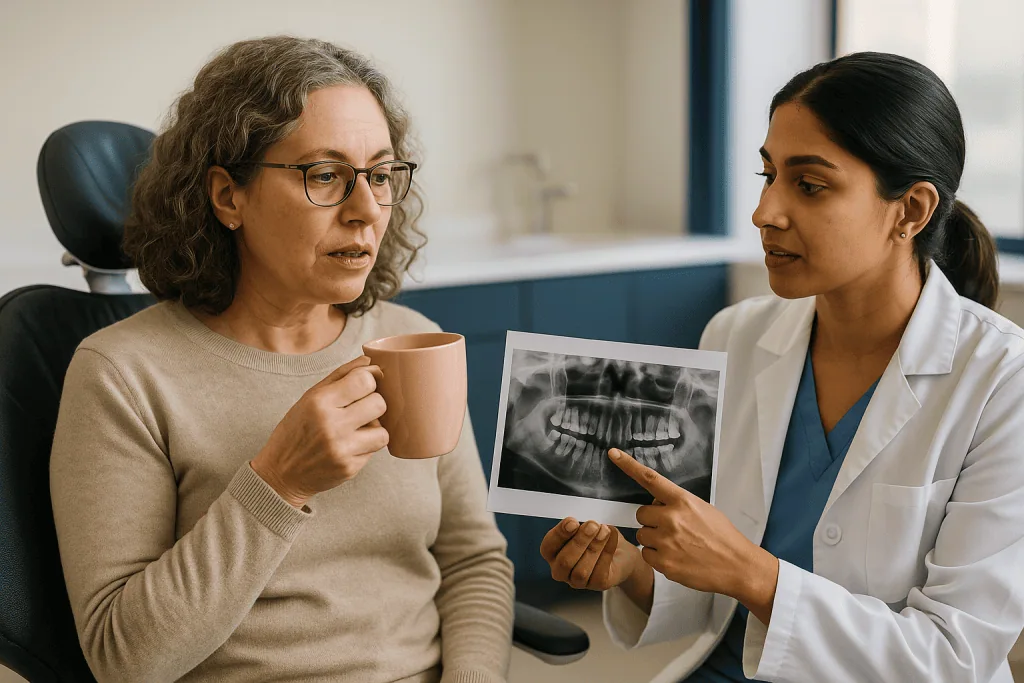
Crowns and veneers raise a different worry. Porcelain is glassy; bonding to it requires a special etchant, and removing the bracket at the end can chip the glaze. Most crowns survive braces without incident, yet a patient should hear in advance that a crown may need repolishing or, occasionally, replacement afterward. Bridges are a particular problem because the linked teeth cannot move independently; the orthodontist may plan around them or suggest the bridge be sectioned and remade later.
Root-canal-treated teeth surprise many people by moving normally. The nerve inside the tooth is gone, but the periodontal ligament that does the moving lies outside the root and is untouched by the procedure. What the orthodontist checks is the root itself: a tooth with a large post inside it or a hairline crack is more fragile under sustained force.
The practical upshot is a longer first appointment. Expect a full set of X-rays, a review of every restoration, and sometimes a request that a worn filling be replaced before brackets go on so that it does not fail mid-treatment.
Dental implants and missing teeth: why some teeth simply won't move
An implant is a titanium post fused directly to the jawbone. That fusion is exactly what makes it strong for chewing, and exactly what makes it immovable for orthodontics. Remember that braces work through the periodontal ligament; an implant has none. Push on it and nothing happens, or worse, the surrounding bone is stressed. An implant placed in a crowded arch therefore acts as a fixed post that every other tooth must be arranged around.
This has a sequencing consequence that adults rarely hear about until they ask. When someone is planning both an implant and braces, orthodontists almost always want the braces first, so the neighboring teeth are positioned before the post is fixed. Cleverly, the immovable implant can even be used as an anchor to pull other teeth against, turning a limitation into a tool. If the implant already exists, the treatment plan is drawn around it, and some ideal movements may be traded for achievable ones.
Missing teeth without implants present the opposite challenge. A gap left by an extraction years ago tends to collapse: the tooth behind tips forward, the one above drifts down into the space. Uprighting that tilted molar is one of the commonest reasons a general dentist refers an adult for braces, because a bridge or implant cannot be placed against a leaning neighbor. The orthodontist may also decide to close the gap entirely by pulling teeth together, sparing the person a replacement tooth altogether. Whether closing or opening a space is wiser depends on the bite, the bone available and what the restorative dentist needs, which is why the two clinicians typically confer before a single bracket is bonded.
The message for anyone with a busy dental history is simple: bring every record, and expect the plan to be a joint one.
Gum health first: why periodontal stability comes before brackets
Gingivitis is the reversible early stage of gum disease, where the gums bleed and swell. Periodontitis is the later stage, in which the infection eats into the bone and ligament holding the tooth. According to the NIH’s National Institute of Dental and Craniofacial Research, nearly half of adults aged 30 and older show signs of periodontal disease, and the proportion rises with age. That single statistic explains why the adult braces consultation begins with a gum probe rather than a smile assessment.
The reason is mechanical as much as biological. Braces move teeth by asking bone to dissolve on one side and rebuild on the other. In a healthy mouth the two processes balance. In an inflamed mouth, the dissolving half of the equation is already running ahead, and orthodontic force can tip a tooth with reduced bone support toward loosening. Mayo Clinic notes that periodontitis, left untreated, destroys the bone that supports teeth; adding braces to that picture without first stabilizing it is not something any guideline endorses.
Stabilizing usually means a deep cleaning below the gum line, sometimes called scaling and root planing, followed by a reassessment several weeks later to confirm the pockets have shallowed and the bleeding has stopped. Only then does the orthodontist proceed. Throughout treatment, many adults are seen by a hygienist more often than usual, because brackets and wires create dozens of new plaque traps.
A reassuring counterpoint deserves equal weight. For people whose gum trouble is driven by crowding, well-planned braces can improve access for cleaning once the teeth are aligned. That is a plausible benefit, not a promise, and it depends entirely on the gums being calm before, during and after the appliance is worn. Treated periodontitis is not a barrier; untreated periodontitis is.
Black triangles, recession and other gum changes adults should know about
Ask an orthodontist what surprises adult patients most and the answer is often a shape rather than a sensation. When crowded, overlapping front teeth are straightened, the little pink point of gum that used to fill the space between them, called the papilla, may not stretch to fill the new, wider gap. What remains is a small dark space near the gum line, informally known as a black triangle. Teenagers rarely get them because their papillae are plump and their bone level high. Adults, whose gums have receded a millimeter or two over the years, get them more often.
Black triangles are cosmetic rather than harmful, but they can trap food and they can disappoint someone who expected a flawless line. Orthodontists manage them in several ways: by reshaping the contact points between teeth so they touch lower down, by tilting roots slightly to bring the crowns closer, or by having the dentist add a sliver of bonding after treatment. Which option, if any, suits a particular mouth is a planning conversation worth having before treatment begins, not after.
Gum recession is the second concern. Moving a tooth outward through thin bone can leave the root partly exposed, especially on the lower front teeth. Careful planning keeps roots within the bony envelope, and some adults are referred to a periodontist beforehand to assess or thicken thin gum tissue. Recession that already exists does not forbid braces, but it changes how far and in which direction a tooth can safely travel.
Both issues share a lesson. Adult orthodontics is as much about the soft tissue frame as about the teeth inside it, and the best plans are drawn with the gums in view from the start.
Clear braces vs metal braces for adults: a neutral comparison
Most adults weigh three options: traditional stainless-steel brackets, ceramic brackets that are tooth-colored but otherwise similar, and removable clear aligner trays. The NHS lists all three among the appliances in general use and is careful to note that the right choice depends on the problem being corrected, not on fashion. The table below summarizes the trade-offs in neutral terms; individual cases vary, and the treating team decides which is appropriate.
| Feature | Metal brackets | Ceramic brackets | Clear aligners |
|---|---|---|---|
| Visibility | Most visible | Less visible; ties can stain | Least visible when worn |
| Range of movements | Widest, including complex root and bite corrections | Similar to metal, brackets slightly bulkier and more brittle | Best for mild to moderate crowding and spacing; limits on some rotations and bite changes |
| Dependence on wearer | Fixed; works around the clock | Fixed; works around the clock | Requires trays worn most of the day; results track wear time |
| Bonding to old restorations | Bands and primers available | Harder to bond and remove from porcelain | No bonding; trays fit over crowns, but attachments may be needed |
| Cleaning | Brackets trap plaque; extra tools needed | Same as metal | Trays removed for brushing and flossing |
| Breakage and repairs | Robust; loose brackets occasionally | More prone to chipping | Lost or cracked trays need replacing |
The pattern is clear enough. Metal wins on versatility and durability, ceramic trades a little of that for discretion, and aligners trade movement range for the freedom to remove them. For adults with multiple crowns, a deep bite or teeth to be uprighted, the orthodontist will often favor fixed appliances for control. For a straightforward relapse of front-tooth crowding, aligners may be perfectly adequate. Neither is inherently superior; suitability is a clinical judgment.
How long do adult braces take, and why the answer varies
The most-searched question about metal braces for adults has an honest but unsatisfying answer: it depends on what is being moved and how far. The NHS states that orthodontic treatment usually takes between 18 and 24 months, while Cleveland Clinic frames the typical span as roughly one to three years. Both ranges are for people of all ages; there is no separate adult clock in the guidance, though clinicians widely observe that adult cases start more slowly because denser bone takes longer to respond.
Several factors stretch or shorten that window. Complexity comes first: closing a molar-sized gap or correcting a deep bite takes longer than aligning six front teeth. Extractions, when needed to make room, add months. Gum stability adds time at the front end, because periodontal treatment must be completed before brackets go on. Missed appointments and repeatedly broken brackets are the commonest self-inflicted delays, since each interruption pauses the continuous force the ligament needs.
Adults sometimes ask for a limited or compromise plan: straighten the visible front teeth, leave the bite largely as it is, and finish in well under a year. Orthodontists can and do offer this when the bite is functionally acceptable, but they will explain what is being left uncorrected and why it may not be wise for someone with heavy wear or jaw joint symptoms.
Whatever the active phase lasts, the retention phase lasts longer. A retainer is a thin custom appliance, removable or bonded behind the teeth, that holds the new positions while the bone and ligament firm up. The NHS advises that retainers are needed long term, often indefinitely at night, because teeth of any age drift back toward their old positions without one. Anyone counting the months to freedom should count the retainer in.
What the first days and weeks with metal braces usually feel like
Fitting day is long and undramatic. The teeth are cleaned and dried, a mild etching gel roughens the enamel for a few seconds, and each bracket is positioned and set with a curing light. The wire is threaded in last. There is no drilling and no injection, and most people leave feeling mainly that their lips are suddenly far too big for their face.
The ache begins that evening. Both the NHS and Cleveland Clinic describe soreness and pressure for a few days after the braces are fitted and after each adjustment, easing as the ligament settles into its new load. Chewing feels odd; biting into an apple is briefly out of the question. Soft foods, cool drinks and an over-the-counter pain reliever chosen with a pharmacist or dentist’s advice are the usual comfort measures. The inner cheeks and lips take a week or two to toughen against the brackets; orthodontic wax pressed over a rough spot buys time while they do.
Speech changes little with metal braces, which sit on the front of the teeth away from the tongue. Adults who work in speaking roles often notice more self-consciousness than actual lisping, and that fades within days.
By the end of the first month the routine has formed. Brushing takes longer, a water flosser or threader joins the bathroom shelf, and the first adjustment visit is booked. Adjustments recur at intervals of several weeks throughout treatment; each brings a day or two of renewed tenderness, milder than the first. Loose brackets, poking wires and lost ligatures are the ordinary nuisances of this phase, and practices expect a few unscheduled calls. What nobody should tolerate quietly is the set of warning signs covered in the final section.
What are the downsides of using metal braces? Risks in plain language
Every treatment worth having carries costs measured in something other than money, and braces are no exception. Listing them plainly is part of informed consent, not a reason for alarm.
The most visible risk is to the enamel. Plaque that lingers around a bracket dissolves minerals from the surface beneath, leaving chalky white spot lesions, permanent patches of demineralized enamel, once the bracket comes off. They are entirely preventable with thorough cleaning and fluoride toothpaste, and entirely common in people who brush casually. Cavities follow the same logic.
The gums react to the same plaque. Swollen, bleeding gingiva during treatment is frequent and reversible; unchecked, it can progress toward the bone loss described earlier. Adults with a history of periodontitis are watched most closely.
Less visible is root resorption, the shortening of root tips that occurs when the body dissolves a little root along with the bone during movement. Minor shortening is common and clinically silent; significant shortening is uncommon and more likely with long treatment, heavy forces or roots that were already short. Orthodontists check for it on X-rays partway through and adjust forces if needed. The evidence does not allow a precise adult-specific figure, so honest counseling describes it as a recognized, usually minor risk rather than a probability.
Then come the everyday downsides: soreness after adjustments, food restrictions, longer cleaning, occasional emergency visits for a loose bracket, and a period of feeling conspicuous. Jaw joint symptoms may flare as the bite changes, and existing crowns may need attention afterward.
Finally, relapse. Teeth drift back without a retainer, and a person who stops wearing one may lose much of what was gained. That is less a risk of braces than a fact about teeth, but it belongs on the list.
Daily life with metal braces: cleaning, eating and getting through the workday
The two habits that decide how an adult’s braces turn out are unglamorous: what goes into the mouth and how well it comes out. Cleveland Clinic advises brushing after every meal and flossing daily during treatment, and the reason is not fussiness. A bracket has four corners, a wire has two edges, and every one of them is a ledge where plaque sits undisturbed against enamel that will be exposed again at the end.
Technique changes more than frequency. The brush is angled above and below the wire so its bristles sweep the gum line, where adult inflammation starts. Interdental brushes, the tiny bottle-brush kind, slip under the wire to clean between brackets. Floss threaders or a water flosser handle the spaces the wire blocks. Fluoride toothpaste is standard; some dentists suggest a fluoride mouth rinse for people prone to white spots, a decision left to them.
Food rules exist to protect the appliance rather than the teeth. Hard foods such as nuts, ice and crusty bread can shear a bracket off; sticky ones such as caramel and chewing gum can bend a wire or pull a band. Cutting apples and corn off the cob rather than biting into them becomes second nature. Sugary drinks sipped through the day are the quiet enemy, bathing bracket edges in acid.
Working life adjusts less than people fear. Metal braces do not interfere with speaking on the phone or presenting, and colleagues tend to comment once and then forget. A small kit in a desk drawer, containing a travel brush, wax, interdental brushes and a mirror, covers the lunchtime clean and the occasional poking wire. Sports need a mouthguard fitted over the brackets, and wind and brass players may need a few weeks to relearn their embouchure. None of it is dramatic; all of it is daily.
What people often get wrong about braces for adults over 40
The first myth is the age ceiling. There is none. The NHS states plainly that orthodontic treatment can be carried out at any age, provided the teeth and gums are healthy; a 55-year-old with stable gums is a candidate, and a 25-year-old with untreated periodontitis is not. Age is a poor proxy for the things that actually matter, which are bone support, gum health and dental history.
The second myth is that adult treatment is inevitably twice as long. Adult bone does respond more slowly at first, but the published typical ranges are not age-specific, and complexity of the case predicts duration far better than the birth year of the patient. A limited adult correction can finish faster than a full teenage one.
The third is that a root-canal-treated tooth cannot be moved. It can; the ligament outside the root is what moves, and it is untouched by root canal treatment. The tooth that truly cannot move is an implant, which people often confuse with it.
The fourth is that braces cause gum disease. Braces do not cause it; plaque does, and braces make plaque harder to remove. In a well-cleaned mouth the gums usually stay calm, and aligned teeth can be easier to clean afterward. In a poorly cleaned one, braces expose a weakness that was already there.
The fifth is that once the braces come off, the job is done. Teeth of every age drift, and the NHS is explicit that retainers are a long-term commitment. Adults who skip them are among the commonest returning patients.
The last is the quiet one: that wanting straighter teeth at 50 is vanity. Improving cleaning access, protecting worn enamel and preparing for restorative work are clinical goals. Wanting to smile in photographs is a perfectly good one too.
Questions to ask your care team before metal braces go on
A good consultation should leave an adult with a clear picture of the plan, the trade-offs and the exit strategy. These questions tend to surface the information that matters most; the answers belong to the orthodontist, the general dentist and, where involved, the periodontist.
- Are my gums stable enough to begin, and how will they be monitored during treatment?
- Which of my existing fillings, crowns or bridges could complicate bonding, and do any need replacing first?
- Do I have any implants or missing teeth that change the plan, and in what order should orthodontics and restorative work happen?
- Is my bite problem mainly in the teeth or in the jaw bones, and what are the realistic options for each?
- What movements are you planning, and which, if any, are you choosing not to attempt and why?
- Am I at particular risk of black triangles, recession or root shortening, and how will you check for them?
- What is your estimated treatment range for me, and what would make it longer?
- How often will I be seen, and what should I do about a loose bracket or poking wire between visits?
- What retainer will I need afterward, for how long, and how will its fit be checked over the years?
- Do any of my medicines or health conditions affect tooth movement or healing, and will you coordinate with my physician?
Two further habits help. Bring the full list of medicines and supplements, including anything taken for bone health, because that is where the quiet interactions hide. And ask for the plan in writing, with the compromises noted. Adult orthodontics is a series of judgments about what to move, what to leave, and what to protect. Understanding those judgments is the best safeguard against disappointment later, and every one of them remains the treating team’s call.
When to call your doctor or orthodontist
Most discomfort with braces is expected and self-limiting: a few days of aching after fitting or adjustment, tender cheeks that toughen within a couple of weeks, and the occasional bracket that comes loose on a forgotten crust. Practices handle these routinely, and a same-week appointment is usually all that is needed.
Some signs call for prompt contact rather than patience. Call the orthodontist without delay if a wire is embedded in the cheek or tongue and cannot be covered with wax, if a bracket or band has come off and been swallowed or inhaled, or if a tooth feels newly loose or moves visibly when touched. Report pain that is severe, throbbing or steadily worsening rather than easing after the first few days, since tooth movement should ache, not escalate. Swelling of the gum or face, a bad taste, pus at the gum line or a tooth that darkens in color suggest infection or nerve injury and need same-day dental assessment.
Gums that bleed heavily at the lightest touch, recede noticeably or pull away from a tooth during treatment should be reviewed, because they may indicate periodontal disease reactivating under load. A dull, constant ache in the jaw joint, clicking that becomes painful, or difficulty opening the mouth are also worth a call.
Seek urgent medical care, not just dental care, for difficulty breathing or swallowing, rapidly spreading facial swelling, fever with facial pain, or any allergic reaction such as hives or lip swelling after a new appliance is fitted. Nickel sensitivity to stainless steel is uncommon but real, and the team can switch materials.
When in doubt, call. Orthodontic teams would far rather reassure a patient about a harmless poking wire than learn weeks later that a warning sign was waited out at home.
Frequently asked questions
Is it worth getting braces as an adult?
It can be, when there is a clear clinical or personal goal and the gums are healthy enough to support tooth movement. Adults commonly seek braces to make crowded teeth easier to clean, to reduce wear from a poor bite, to upright a tilted molar before restorative work, or for appearance. The orthodontist weighs those goals against risks such as recession and root shortening, and the decision rests with that assessment.
How long do adult braces take compared with a teenager's?
The published typical ranges are not age-specific: the NHS cites 18 to 24 months and Cleveland Clinic roughly one to three years. Adult bone is denser and responds more slowly at the start, but the complexity of the case, the need for extractions and how reliably appointments are kept matter more than age. A limited adult correction of front teeth can finish sooner than a full teenage bite correction.
What are the downsides of metal braces for adults?
The main downsides are white spot lesions and cavities from plaque trapped around brackets, gum inflammation that can worsen existing periodontal disease, minor root shortening that is usually silent, soreness after adjustments, food restrictions and more time spent cleaning. Adults also face a higher chance of black triangles between straightened front teeth. Most are preventable or manageable with thorough hygiene and regular monitoring by the orthodontist and hygienist.
Is it a good idea to get braces at 55 years old?
Age itself is not a barrier; the NHS notes orthodontic treatment can be carried out at any age when teeth and gums are healthy. At 55 the relevant questions are whether periodontal disease is stable, how much bone supports the teeth, what crowns, implants or missing teeth need planning around, and whether any medicines slow bone turnover. A joint assessment by the orthodontist and dentist answers those questions.
Can braces be put on teeth with old fillings or crowns?
Yes, but bonding is less reliable on amalgam, composite or porcelain than on natural enamel. Orthodontists use special primers, place brackets on remaining enamel or fit a metal band around heavily restored molars. Porcelain crowns can chip when brackets are removed, so some may need polishing or replacement afterward. Bridges cannot move as separate teeth and may need to be planned around or remade.
Can teeth with root canals or dental implants be moved with braces?
Root-canal-treated teeth usually move normally because the periodontal ligament outside the root, which does the moving, is unaffected by the procedure. Dental implants cannot move at all; they are fused to bone and have no ligament. Orthodontists therefore plan around existing implants or, when both are needed, complete the braces before the implant is placed, sometimes using an implant as an anchor for other movements.
Do braces cause gum disease or recession in adults?
Braces do not cause gum disease; plaque does, and brackets make plaque harder to remove. With careful cleaning the gums usually stay calm. Recession can occur if a tooth is moved outward through thin bone, which is why orthodontists plan movements within the bony envelope and may refer thin-gummed patients to a periodontist first. Active periodontitis must be treated before braces begin, per mainstream guidance.
Do clear braces vs metal braces move teeth differently?
Ceramic brackets move teeth the same way as metal ones, using a wire, but are slightly bulkier and more prone to chipping. Clear aligners work through sequential removable trays and suit mild to moderate crowding but have limits with certain rotations and bite corrections. Metal brackets offer the widest range of control and the most reliable bonding to restored teeth, which is why they remain common in complex adult cases.
How painful are metal braces for adults?
Most people describe pressure and aching rather than sharp pain. The NHS and Cleveland Clinic both note soreness for a few days after fitting and after each adjustment, easing as the ligament settles. Cheeks and lips are tender until they toughen, usually within a couple of weeks; orthodontic wax helps. Pain that is severe, worsening or accompanied by swelling is not typical and should be reported promptly.
Will I need a retainer forever after adult braces?
In practical terms, yes for most people. The NHS advises that retainers are needed long term, often indefinitely at night, because teeth of any age tend to drift back toward their original positions. A retainer is a thin removable or bonded appliance that holds the new alignment while bone and ligament stabilize. The orthodontist specifies the type and wearing pattern and checks its fit at follow-up visits.
References
- NHS: Orthodontics
- MedlinePlus: Malocclusion of teeth
- NIH National Institute of Dental and Craniofacial Research: Gum Disease
This article is for general information only and is not a substitute for professional medical advice. Please consult a qualified doctor about your individual situation.

More from the Blog

Impacted Tooth Treatment in Adults vs Teens: Why Timing Changes the Approach
An impacted tooth is one blocked from fully coming through the gum. In teens, roots are still forming and bone is more adaptable, so…

Keeping Up Orofacial Myology Exercises Between Visits: Why Daily Practice Shapes the Result
Daily myofunctional exercises matter because orofacial myology works through motor learning: the tongue, lips and jaw muscles only adopt a new resting posture and…

Bleeding Gums in Pregnancy and With Diabetes: Why Gum Care Is Planned Differently
Bleeding gums in pregnancy are usually pregnancy gingivitis: hormonal changes make gums react more strongly to plaque, so they swell and bleed with brushing.…

How Oral and Maxillofacial Surgeons Train, and Questions to Ask Before Your Procedure
Oral and maxillofacial surgeons first complete dental school, then a hospital-based surgical residency that typically runs four to six years and includes rotations in…

Recovery After Gummy Smile Treatment: Swelling, Sensitivity and the Reshaped Gum Line
Recovery after gummy smile treatment depends on the procedure. Gum contouring and crown lengthening usually bring mild swelling, tenderness and temporary tooth sensitivity that…
Is Sensitivity After Teeth Whitening Normal? What Helps and When to Call the Dentist
Yes. Temporary sensitivity is one of the most common side effects of peroxide-based teeth whitening. It usually appears during or shortly after treatment as…