

Mild Scoliosis: What It Means, What to Expect and When to See a Specialist
Key Takeaways
- Scoliosis is defined by a Cobb angle of 10 degrees or more on X-ray, and curves under about 25 degrees are classed as mild.
- Around 2 to 3 percent of people have scoliosis, and roughly 80 percent of cases are idiopathic, meaning no cause is found.
- Girls are several times more likely than boys to have a curve that progresses far enough to need treatment.
- Growing children with mild curves are typically re-examined every four to six months, and monitoring usually ends at skeletal maturity.
- Bracing is generally considered only for curves of about 25 to 40 degrees in children still growing, worn roughly 13 to 16 hours a day.
- No manual therapy, including chiropractic adjustment, has been shown in controlled studies to reduce or halt a scoliotic curve.
Mild scoliosis means a sideways spinal curve measuring roughly 10 to 24 degrees on an X-ray, the smallest range that still counts as scoliosis. Most mild curves cause no pain, need no brace or surgery, and are simply monitored with periodic check-ups, especially during growth spurts. A specialist should evaluate any curve that is visibly worsening, causes persistent pain, numbness, or breathing changes, or appears alongside other health concerns.
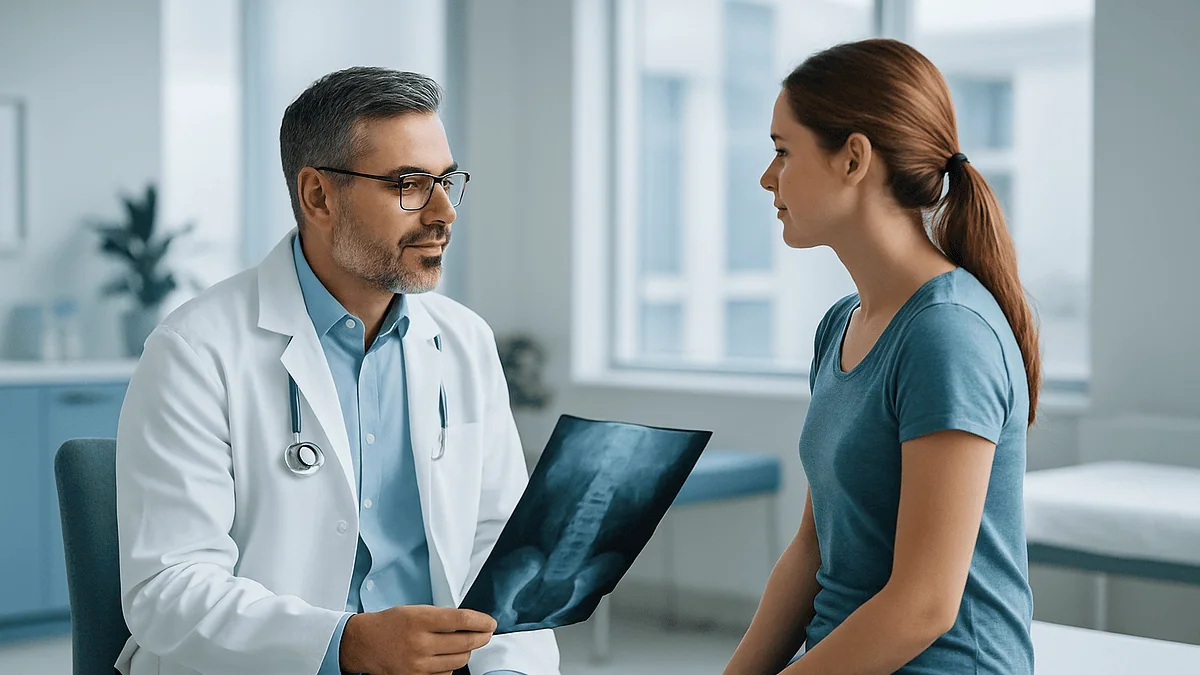
The letter arrives a week after the school screening, and it says almost nothing: “possible spinal curvature, please follow up with your physician.” A parent reads it twice, then stands the child in front of the bathroom mirror and stares at a pair of shoulders that suddenly look uneven in a way they never did yesterday.
Or the scene is different. An adult with a nagging lower back books an X-ray for something else entirely, and the report mentions, almost in passing, a “mild scoliotic curve.” The internet does the rest, serving up braces, surgery photos and promises to “fix” the spine in twelve sessions.
The honest picture is calmer than either version. A mild curve is common, usually silent and often stable. Understanding what the number on the X-ray actually measures, what tends to change it, and which few signs genuinely warrant a specialist visit takes most of the fear out of the word.
What does “mild scoliosis” actually mean on an X-ray?
Every spine curves from front to back; that is normal anatomy. Scoliosis describes a sideways curve, often with a twist, seen when the spine is viewed from behind. Radiologists measure it with the Cobb angle: they draw lines along the most tilted vertebra at the top and bottom of the curve and measure the angle where those lines meet. A curve of 10 degrees or more is the conventional threshold for calling it scoliosis at all, according to the National Institute of Arthritis and Musculoskeletal and Skin Diseases.
“Mild,” “moderate” and “severe” are working categories rather than diagnoses in themselves. The boundaries vary slightly between sources, but the following ranges reflect mainstream orthopedic practice.
| Category | Cobb angle | Typical approach in a growing child |
|---|---|---|
| Below threshold | Under 10° | Called spinal asymmetry, not scoliosis |
| Mild | 10° to about 24° | Observation with periodic X-rays |
| Moderate | About 25° to 40° | Bracing often discussed while still growing |
| Severe | Above 40° to 50° | Surgery may be considered |
Two things matter more than the label. One is measurement error: the same X-ray read by two clinicians can differ by a few degrees, which is why a “change” of three or four degrees between visits rarely means anything on its own. The other is context. A 20-degree curve in a nine-year-old with years of growth ahead is a different clinical question from the same curve in a 45-year-old whose spine finished growing decades ago.
How common is mild scoliosis, and who tends to get it?
Scoliosis affects roughly 2 to 3 percent of the population, and the great majority of those curves are small. Most people carrying one have no idea it exists until a screening, a sports physical or an unrelated X-ray reveals it.
About eight in ten cases are labeled idiopathic, a word that simply means the cause is unknown. Idiopathic scoliosis most often appears during the growth spurt just before puberty, typically between ages 10 and 15. It shows up in girls and boys at similar rates when curves are small, but girls are considerably more likely to have a curve that progresses to a size needing treatment. Family history raises the odds, which points to a genetic contribution, though no single gene explains it and most children with scoliosis have no affected relatives.
The remaining cases have identifiable causes. Congenital scoliosis stems from vertebrae that formed unevenly before birth. Neuromuscular scoliosis accompanies conditions such as cerebral palsy or muscular dystrophy, where uneven muscle pull shapes the spine over time. In adults, degenerative scoliosis develops as discs and facet joints wear asymmetrically, so a spine that was perfectly straight at 30 may show a modest curve at 70.
What does not cause scoliosis is worth stating plainly, because the myths persist. Heavy backpacks, slouching, sleeping on one side and carrying a toddler on the same hip do not create a structural curve. They can make a person look lopsided or feel sore, but the underlying vertebral shape and rotation of true scoliosis come from somewhere else.
What does mild scoliosis look like?
Often, it looks like nothing. That is the honest answer, and it explains why school screenings exist and why so many adults learn about their curve incidentally.
When signs are present, they are subtle asymmetries rather than a dramatic S-shape. One shoulder sits slightly higher. One shoulder blade sticks out more than the other. The waistline creases more deeply on one side, so a belt or waistband looks tilted. One hip may appear higher, or a shirt seems to hang unevenly even when freshly ironed. In a small curve these differences can be a centimeter or less, easy to miss in daily life and easy to over-notice once you start looking.
Clinicians use the Adam’s forward bend test to make the invisible visible. The person bends forward from the waist with knees straight and arms hanging loose. In scoliosis, the rotation of the vertebrae pushes the ribs on one side upward, producing a hump that is far more obvious bent over than standing straight. A handheld inclinometer, sometimes called a scoliometer, can estimate the tilt, but only an X-ray gives the Cobb angle that defines severity.
Photographs online tend to show severe curves, which skews expectations. If you are examining a child, look at the whole picture across weeks rather than one anxious evening in front of the mirror. Uneven shoulders alone have many causes, including simple handedness and habitual posture. Asymmetry that is new, clearly progressing, or paired with a visible rib hump on bending is the pattern worth a professional look.
How serious is mild scoliosis?
For most people, a mild curve is a finding rather than a disease. It does not shorten life, it does not prevent sports or physical work, and in the 10-to-24-degree range it does not compress the lungs or heart. Those organ effects are a concern of large curves, typically well beyond 50 degrees, and even then not universally.
The seriousness of a mild curve lies almost entirely in one question: will it grow? A curve that stays at 15 degrees for life is a footnote. A curve at 15 degrees in a child about to hit a growth spurt deserves attention, because the spine lengthens fastest in exactly the window when idiopathic curves tend to progress. That is why the same number leads to “come back in six months” for a ten-year-old and “no follow-up needed” for a thirty-year-old.
Outcomes for people with mild idiopathic scoliosis are, on the whole, good. Long-term follow-up studies of people whose curves never required treatment show that they work, exercise, have children and age much like everyone else. Some report slightly more back ache in adulthood than their peers, but the difference is modest and function is preserved.
Where mild scoliosis does become clinically serious is when it is a signal rather than the main event. A curve in a young child under ten, a curve with unusual features on X-ray, or a curve accompanied by neurological symptoms may point toward a congenital or neuromuscular cause that needs its own evaluation. Specialists look for these patterns precisely so that the reassuring majority can be reassured with confidence.
Will a mild curve get worse? What predicts progression
Progression is not random, and clinicians have a reasonable sense of who is at risk. Three factors dominate.
Remaining growth comes first. A child who has not yet started puberty has the most spinal lengthening ahead and therefore the widest window for a curve to increase. Orthopedic teams estimate skeletal maturity from hand or pelvic X-rays and from milestones such as the onset of menstruation, after which growth slows markedly. Once the skeleton is mature, small idiopathic curves rarely change meaningfully.
Curve size at diagnosis comes second. A 12-degree curve has less momentum than a 22-degree curve; larger curves are more likely to continue enlarging under the same growth pressure. This is one reason the mild category spans such different clinical conversations at its lower and upper ends.
Sex is the third. Girls are several times more likely than boys to have curves that progress to the point of needing treatment, though the reasons remain unclear.
What this means in practice is that a specialist can often give a family a rough probability rather than a shrug. A skeletally mature teenager with a 14-degree curve can usually be discharged. A premenarchal girl with a 22-degree curve will be followed closely, because she sits in the group where a modest curve most often becomes a moderate one. Neither scenario calls for alarm, but the second calls for a calendar.
In adults, a different logic applies. Degenerative curves can slowly increase as discs collapse asymmetrically over decades, but the pace is measured in a degree or so per year at most, and pain and function drive decisions far more than the angle does.
Does mild scoliosis cause back pain?
Usually not in children and teenagers. Adolescent idiopathic scoliosis in the mild range is characteristically painless, which is why it slips by unnoticed. When a young person with a small curve has significant back pain, clinicians take the pain seriously in its own right rather than blaming the curve, and may look for other explanations such as a stress injury or, rarely, a spinal cord problem.
Adults are a different story, and the relationship is looser than people assume. Back pain is extraordinarily common in adulthood regardless of spinal shape; national surveys consistently find that most people experience it at some point. So when an adult with back pain receives an X-ray showing a 15-degree curve, the temptation is to connect the two. Sometimes they are connected. Often the pain is coming from the same muscles, discs and joints that hurt in people with straight spines, and the curve is a bystander.
That said, larger adult curves, and degenerative curves in particular, do have a plausible mechanism for discomfort. Uneven loading wears facet joints faster on the concave side, muscles on the convex side work harder to hold the trunk upright, and narrowed openings between vertebrae can irritate nerve roots. These effects scale with curve size, and in the mild range they are typically small.
The practical upshot: pain in someone with mild scoliosis is managed much like pain in anyone else, with activity, strengthening and attention to sleep and stress, while keeping an eye out for the uncommon red flags covered later in this article.
Can mild scoliosis be corrected?
This is the question behind most searches, and it deserves a precise answer. A structural scoliotic curve involves vertebrae that are rotated and, over time, subtly wedge-shaped. Nothing short of surgery reliably changes that bony geometry, and surgery is reserved for large curves because the risks would be indefensible for a mild one.
What can change is how the curve behaves and how the body carries it. In a growing child, a brace worn for many hours a day can hold a moderate curve and reduce the chance of it reaching surgical size; the landmark trial that established this showed bracing clearly lowered progression compared with observation. For curves under 25 degrees, though, most guidelines do not recommend bracing, because the natural history is favorable enough that the burden of a brace outweighs the benefit for most children.
Exercise programs, physical therapy and postural training can improve muscle balance, trunk strength and how straight a person can stand when they try. Some studies report small reductions in Cobb angle with intensive scoliosis-specific exercise, but the effects are a few degrees at most, the studies are small, and it remains uncertain whether the changes hold up years later. Describing that as “correcting” scoliosis overstates the evidence.
So the fair framing is this: a mild curve generally does not need correcting, cannot be straightened by manual methods, and in many people never changes at all. The goal of care is to catch the minority of curves that grow, not to erase the majority that will not.
Can a chiropractor fix mild scoliosis?
Manual therapies, including chiropractic adjustment, have no convincing evidence that they reduce a scoliotic curve or stop it from progressing. Published reviews of spinal manipulation for scoliosis find studies that are small, uncontrolled or both, and none that demonstrate durable changes in Cobb angle. Major medical bodies do not include manipulation among the interventions shown to alter the course of the condition.
The mechanism argument matters here. Spinal manipulation moves joints through their range and can ease muscle tension and stiffness. A structural scoliotic curve, however, is built into the shape and rotation of the vertebrae themselves. Adjusting the joints between them does not reshape the bone, any more than stretching a bent branch changes the wood.
None of this means a person with mild scoliosis cannot visit a chiropractor or manual therapist for back stiffness. Some people find relief from soreness with hands-on care, and that is a reasonable choice for symptom comfort. The line to watch is the claim. Any practitioner, of any discipline, who promises to reduce or reverse a curve with a package of sessions is making a promise the evidence does not support, and a child in a progression-risk window should not have specialist monitoring delayed while a program of adjustments is tried.
A useful test for any offered therapy: ask what outcome is being promised, over what timeframe, and what published evidence supports it. Honest answers acknowledge uncertainty. Marketing does not.
Do exercises help mild scoliosis? What the evidence really shows
Exercise helps almost everyone, and people with mild scoliosis are no exception. The question is whether specific exercises change the curve, and the answer is “possibly, a little, and we are not sure for how long.”
Scoliosis-specific exercise programs, such as those built on the Schroth approach, teach patients to breathe and hold their trunk in ways that counter the rotation of their particular curve. Small randomized trials have reported modest improvements in Cobb angle and in how the curve looks, compared with general exercise or no exercise. The programs are intensive, requiring trained therapists and daily home practice, and long-term follow-up is thin. Guidelines generally describe them as an option that may help some patients rather than an established standard.
General exercise has a firmer footing. Core and back strengthening, swimming, yoga, running and team sports all build the muscles that support the spine and reduce the risk of the ordinary back pain that adults with or without scoliosis experience. There is no evidence that any common sport, including gymnastics, dance or weightlifting, makes an idiopathic curve worse, and no reason to steer a child away from activities they love.
A sensible plan for someone with a mild curve looks much like a sensible plan for anyone: regular movement they enjoy, some strength work for the trunk and hips, and attention to flexibility. If a physical therapist trained in scoliosis-specific methods is available and the person is motivated, adding that work is reasonable, provided it supplements rather than replaces the monitoring a growing child needs.
What to avoid if you have mild scoliosis
The list of true restrictions is remarkably short, which surprises people who expect a catalog of forbidden movements.
Avoid, first, the assumption that posture caused the curve or that better posture will cure it. Sitting up straight is good for comfort and confidence, but no amount of it changes vertebral rotation. Children with scoliosis sometimes end up policed about their slouching by well-meaning adults, which adds stress without altering the spine.
Avoid stopping activity. Withdrawing a child from sports “to protect the back” removes the very loading and strengthening that keeps a spine healthy, and it reinforces the idea that they are fragile. Mainstream orthopedic guidance places no sports restrictions on mild idiopathic scoliosis. Adults, similarly, gain more from staying active than from resting.
Avoid unproven programs sold with certainty. Devices, supplements, traction tables and session bundles promising to reverse a curve share a common feature: they lack controlled evidence. Money is one cost. Delayed specialist follow-up during a growth spurt is the more serious one.
Avoid skipping scheduled X-rays in a growing child. Monitoring is the one intervention with clear value in mild scoliosis, because it is how a progressing curve gets caught while a brace can still help. Missing a year of follow-up in a twelve-year-old can mean discovering a 35-degree curve where a 20-degree one was last seen.
Finally, avoid the search-result spiral. Images of severe deformity and surgical hardware dominate online, and they do not represent the likely path for a mild curve. The single most useful thing to “avoid” may be catastrophizing a number that, for most people, will never matter.
What does “watch and wait” actually involve?
Observation sounds passive, but it follows a structured rhythm designed around growth.
For a child or teenager with a mild curve, a specialist typically schedules a repeat examination and standing X-ray every four to six months while growth continues. The interval shortens during the fastest phase of the adolescent spurt and lengthens as the skeleton matures. Each visit repeats the forward bend test, measures height to track growth velocity, and compares the new Cobb angle against previous films. Because measurement variation runs a few degrees, clinicians look for a change of about five degrees or more, sustained over visits, before concluding the curve is genuinely progressing.
Radiation exposure is a reasonable concern for families facing several years of X-rays. Modern imaging uses substantially lower doses than older techniques, and many centers now use low-dose systems designed specifically for repeated spinal imaging. Clinicians balance the small cumulative exposure against the value of catching a progressing curve, and they stop imaging once growth is complete and the curve is stable.
Once a young person reaches skeletal maturity with a curve still under about 25 degrees, observation usually ends. There is little to watch for, because small mature curves rarely change. Some clinicians suggest a single check in early adulthood; many simply discharge with advice to return if symptoms develop.
Adults with an incidentally found mild curve and no symptoms generally do not need scheduled imaging at all. Follow-up is driven by pain, function or neurological symptoms rather than the calendar, and repeat X-rays are ordered only when something changes.
Mild scoliosis in adults: is it different?
Adult scoliosis comes in two flavors, and they behave differently.
The first is an idiopathic curve carried since adolescence. Many adults have no idea they have one until an X-ray for a rib injury or a kidney stone reveals it. These curves are usually stable, and for those in the mild range, the practical significance is close to nil. Long-term studies of untreated adolescent scoliosis show that people with small curves function normally in adulthood, with perhaps a modest increase in back ache compared with peers.
The second is degenerative, or de novo, scoliosis, which develops later in life as spinal discs lose height and facet joints wear unevenly. This kind is often accompanied by the ordinary changes of an aging spine, including narrowing of the spinal canal or the openings where nerves exit. When adults with degenerative curves have symptoms, those symptoms usually come from these accompanying changes, including leg pain, numbness or a heavy feeling in the legs on walking, rather than from the sideways tilt itself.
Treatment in adults is symptom-led. A mild degenerative curve with no pain needs nothing. A mild curve with back or leg pain is managed with the same tools used for any adult spine problem: activity and strengthening, physical therapy, weight and bone health, and medications for pain when appropriate, with decisions about any prescription resting with the treating clinician. Surgery is uncommon for mild adult curves and is generally reserved for people with significant nerve compression or deformity affecting their ability to stand and walk.
One adult-specific consideration deserves mention: bone density. Osteoporosis can accelerate degenerative curvature and complicates any future treatment, so adults with scoliosis, especially postmenopausal women, benefit from having bone health assessed on the usual schedule.
When do bracing and surgery enter the conversation?
Not for mild curves, in almost all cases, but understanding the thresholds helps families see where the observation period is heading.
Bracing is considered for growing children whose curves reach roughly 25 to 40 degrees. The brace does not straighten the spine; it holds the curve and reduces the chance of progression to surgical size while the child finishes growing. The best evidence comes from a large trial in which bracing significantly cut the rate of progression to 50 degrees compared with observation, and effectiveness tracked closely with hours worn. Braces are typically prescribed for 13 to 16 hours a day and are discontinued at skeletal maturity. For a child with a 15- or 20-degree curve, none of this applies unless follow-up X-rays show the curve growing.
Surgery, most often spinal fusion, is reserved for curves that exceed about 45 to 50 degrees in adolescents, or for adults with severe pain or nerve compression that has not responded to other measures. The procedure connects vertebrae so they heal into a single, straighter segment. Newer growth-modulating techniques exist for selected younger patients, but they too target moderate-to-large curves.
The distance between a mild curve and a surgical one is therefore substantial, both in degrees and in likelihood. Most children monitored for mild scoliosis never wear a brace, and the majority of those who do wear one never need surgery. The purpose of monitoring is to identify the small group who will cross those thresholds early enough that the least invasive option remains available.
When to see a doctor or specialist about scoliosis
Any newly noticed spinal asymmetry in a child or teenager warrants a visit to a primary care clinician or pediatrician, who can perform the forward bend test and decide whether an X-ray and a referral to an orthopedic or spine specialist are needed. Screening letters from school fall into this category; they are prompts for evaluation, not diagnoses.
A specialist referral is usually appropriate when a curve measures 20 degrees or more in a child who is still growing, when any curve is found in a child under ten, when a curve has visibly progressed between visits, or when the curve is accompanied by features that suggest a cause other than idiopathic scoliosis.
Certain signs should prompt prompt medical attention rather than routine scheduling. These include back pain in a child or teenager that is persistent, worsening or wakes them at night; numbness, tingling or weakness in the legs; changes in bladder or bowel control; a curve that appears to be changing quickly over weeks rather than months; a rib hump or asymmetry that appeared suddenly after an injury; and, in adults, leg pain or heaviness that limits walking distance. Unexplained weight loss or fever alongside back pain also needs urgent assessment. These symptoms are uncommon in idiopathic scoliosis, and their presence means the curve may not be the whole story.
Adults who learn of a mild curve incidentally and feel fine do not need a specialist. A conversation with their regular clinician about what the finding means is enough, with the door open to return if pain, numbness or walking difficulty develops.
Living well with a mild curve: what matters most
If one thing deserves emphasis, it is this: for the overwhelming majority of people, mild scoliosis is a fact about their anatomy in the same category as being left-handed or having flat feet. It is worth knowing, occasionally worth watching, and rarely worth worrying about.
For families with a growing child, the single most valuable action is keeping the follow-up appointments through the growth spurt. Everything else is secondary. A child who keeps playing sports, keeps their scheduled X-rays and avoids being made to feel fragile has the best possible path, whatever their curve decides to do.
For adults, the priorities are the ones that protect any spine: regular movement, trunk and hip strength, healthy body weight, not smoking, and attention to bone density as the decades pass. None of these will straighten a curve. All of them reduce the ordinary back pain that most people, curved or straight, will encounter.
The psychological dimension deserves a word, especially for teenagers. Being told the spine is “abnormal” at an age when self-image is fragile can sting more than the condition itself. Parents and clinicians help most by being matter-of-fact, by not hovering over posture, and by letting a young person see that the diagnosis changes nothing about what they can do.
Evidence supports a calm approach. The curves that need intervention announce themselves through monitoring; the curves that do not, which is most of them, can be filed away with the other quiet quirks of being human.
Frequently asked questions
How serious is mild scoliosis?
Mild scoliosis is usually not serious. Curves between 10 and about 24 degrees typically cause no pain, do not affect the heart or lungs, and place no restrictions on activity. The main concern is whether the curve will grow in a child who is still developing, which is why growing children are monitored with periodic X-rays. In skeletally mature adults, a mild idiopathic curve rarely changes and seldom needs any treatment beyond ordinary back care.
Can a mild scoliosis be corrected?
Not in the sense of being straightened. The bony rotation of a structural curve cannot be reversed by exercise, posture or manual therapy, and surgery is reserved for large curves. Scoliosis-specific exercise programs have shown small changes of a few degrees in some studies, but long-term results are uncertain. For most people with a mild curve, correction is not the goal; monitoring growth and staying active are what matter.
What does mild scoliosis look like?
Often it is invisible. When signs are present, they are subtle: one shoulder or hip slightly higher, one shoulder blade more prominent, or an uneven waistline. Bending forward from the waist makes a curve easier to see, because rotated vertebrae push the ribs up on one side, creating a small hump. Only an X-ray can measure the curve, so visible asymmetry should be evaluated rather than self-diagnosed.
What should you avoid if you have mild scoliosis?
Very little is truly off-limits. Mainstream guidance places no sports or activity restrictions on mild idiopathic scoliosis. What to avoid is stopping exercise out of fear, paying for programs or devices that promise to reverse the curve without evidence, and skipping scheduled follow-up X-rays in a growing child. Heavy backpacks and slouching do not cause or worsen a structural curve, so posture policing is unnecessary.
Does mild scoliosis get worse with age?
In adults with a mild idiopathic curve, progression is uncommon and usually slow, on the order of a degree or less per year if it happens at all. Degenerative scoliosis that develops later in life can increase gradually as discs and joints wear unevenly. In children, the risk of progression is highest during the adolescent growth spurt and largely ends once the skeleton matures.
Can a chiropractor fix mild scoliosis?
No controlled study has shown that chiropractic adjustment reduces a scoliotic curve or prevents it from progressing. Manipulation moves joints and may ease muscle stiffness, but it does not change the shape or rotation of vertebrae. Seeing a manual therapist for comfort is a personal choice; relying on it to alter the curve, especially in a growing child who needs specialist monitoring, is not supported by evidence.
Does a 10 degree scoliosis curve need treatment?
Almost never. A 10-degree curve sits at the very threshold of the definition of scoliosis and is well below the range where bracing is considered. In a growing child, a clinician may schedule a follow-up examination to confirm the curve is stable. In an adult, a 10-degree curve found incidentally typically requires no treatment or follow-up unless symptoms develop.
Is mild scoliosis painful?
In children and teenagers, mild idiopathic scoliosis is characteristically painless, and significant back pain in a young person with a small curve is usually investigated for other causes. Adults with mild curves may have back pain, but back pain is extremely common regardless of spinal shape, and the curve is often not the source. Pain is managed with activity, strengthening and standard back care.
What exercises are good for mild scoliosis?
Any regular activity that builds trunk and hip strength and keeps the spine mobile is beneficial, including swimming, walking, running, yoga and general strength training. Scoliosis-specific programs taught by trained physical therapists may offer small additional benefits for some patients, though evidence is limited. No common sport has been shown to worsen an idiopathic curve, so children should continue the activities they enjoy.
When should you see a specialist for scoliosis?
See a specialist when a curve measures around 20 degrees or more in a growing child, when any curve is found in a child under ten, when a curve is visibly progressing, or when back pain is accompanied by leg numbness, weakness, or bladder or bowel changes. Adults with a mild, painless curve found incidentally usually need only a conversation with their regular clinician.
References
- Scoliosis (NIH – National Institute of Arthritis and Musculoskeletal and Skin Diseases)
- Scoliosis (NHS)
- Scoliosis (MedlinePlus)
This article is for general information only and is not a substitute for professional medical advice. Please consult a qualified doctor about your individual situation.

More from the Blog

Local, Regional or General? Anesthesia Options for Finger and Toe Surgery Explained
Most finger and toe operations can be done under local anesthesia, usually a digital block that numbs only the affected digit while you stay…

Who May Be a Candidate for Proximal Fibular Osteotomy When Inner-Knee Arthritis Is Mild?
Proximal fibular osteotomy is usually considered for adults whose knee osteoarthritis is confined mainly to the inner (medial) compartment, who have mild to moderate…

Knee Pain Causes: Why Knees Hurt (and Why It Differs in Women)
Knee pain in women most often comes from patellofemoral (front-of-knee) pain, osteoarthritis, tendon or bursa irritation, meniscus wear, or ligament injury. Women see certain…

Shoulder, Elbow, Wrist or Hand: How Upper Limb Surgery Is Planned for Each Joint
Upper limb surgery covers operations on the shoulder, elbow, wrist and hand, from nerve releases and tendon repairs to fracture fixation and joint replacement.…

Life After Adult Reconstruction Surgery: Why High-Impact Sport Is Limited and What Replaces It
After adult reconstruction surgery, the orthopedic term for hip and knee replacement, most care teams advise a long-term shift away from running, jumping and…

How Foot Surgery Is Performed: Bunion Correction, Fusion and Tendon Repair Step by Step
Foot surgery is usually performed as a day procedure under a nerve block, spinal or general anesthetic. The surgeon makes one or more small…