

No-Shave vs Shaved Hair Transplant: What Keeping Your Length Changes in the Operating Room
Key Takeaways
- The follicle grows the same way whether the scalp around it was shaved or not; the differences between approaches lie in visibility, speed and session size during the harvest.
- No-shave is an umbrella term covering partial shaves with hidden windows, true individual-unit trimming and long hair FUE, and providers use the labels inconsistently.
- Crowding extractions into a narrow hidden band can leave a thinned patch that only becomes visible years later at a short haircut, so ask how the harvest will be spread.
- No independent trial has compared growth from shaved and unshaven FUE, so any percentage quoted in either direction comes from a single provider's own data.
- MedlinePlus describes transplanted hairs shedding within the first several weeks and regrowing over months, so the immediate preview from long hair FUE is temporary.
- The hairline is usually trimmed close even in a no-shave plan, because it is designed and populated on bare skin.
A no-shave hair transplant keeps most of your hair at its existing length, while a shaved transplant trims the donor area, and often the whole scalp, to stubble. Keeping length mainly changes the harvest: the surgeon sees less, works more slowly, and usually moves fewer grafts per session. The follicles themselves grow the same way once placed correctly. Suitability depends on your hair, your goals and your surgical team's assessment.
The question usually arrives in front of a bathroom mirror. Someone has spent years growing hair long enough to sweep across a thinning crown, and now the consent form for a hair transplant mentions clippers. Losing the camouflage, even for a few weeks, can feel harder than the surgery itself.
That reaction is why so many people type no shave vs shaved hair transplant into a search bar late at night. The answers they find tend to come from providers with something to sell, and they lean in one of two directions: either shaving is presented as an outdated inconvenience, or refusing to shave is framed as vanity that compromises results.
Neither framing is honest. Keeping your length changes real, physical things in the operating room, and it changes very little about how a follicle behaves once it is in its new home. This explainer walks through both halves of that sentence, so the conversation with your care team starts from facts rather than fear.
No shave vs shaved hair transplant: what the terms actually mean
A hair transplant moves follicular units, the natural clusters of one to four hairs that grow together, from a donor area that resists balding, usually the back and sides of the head, to a recipient area that is thinning. Nothing about that definition mentions clippers. The shaving question comes from how the donor hair is harvested.
Two harvesting families exist. Follicular unit transplantation, often called the strip method, removes a narrow band of scalp that is then divided under magnification into individual grafts. Follicular unit excision, or FUE, takes each unit out separately with a small circular punch. The NHS describes both as standard approaches performed under local anesthesia, typically as a day-long procedure.
A shaved transplant trims the donor area, and frequently the recipient area too, to a few millimeters of stubble before the first incision. A no-shave transplant is an umbrella term rather than a single technique. It covers three quite different things:
- a partial shave, where thin horizontal windows are clipped beneath longer hair that is combed back down to hide them;
- a true no-shave harvest, where each follicular unit is trimmed individually just before it is removed, leaving surrounding hair untouched;
- long hair FUE, where grafts are removed and placed with their shafts intact, so the person can preview the design on the day.
These labels are not standardized across the field, and they are often used interchangeably in marketing. When a consultation mentions an unshaven approach, the most useful first question is a simple one: which of these three do you mean, and which parts of my scalp will still be clipped?
What actually happens in the operating room when the donor hair stays long
Picture the back of a scalp under a surgical lamp. After local anesthetic numbs the skin, the surgeon positions a punch narrower than a grain of rice over a follicular unit and scores the skin around it, following the angle at which the hair exits. The follicle sits below the surface at a slant, not straight down. Match the slant and the graft comes out whole. Miss it and the follicle is transected, meaning cut through, which can leave it unable to grow.
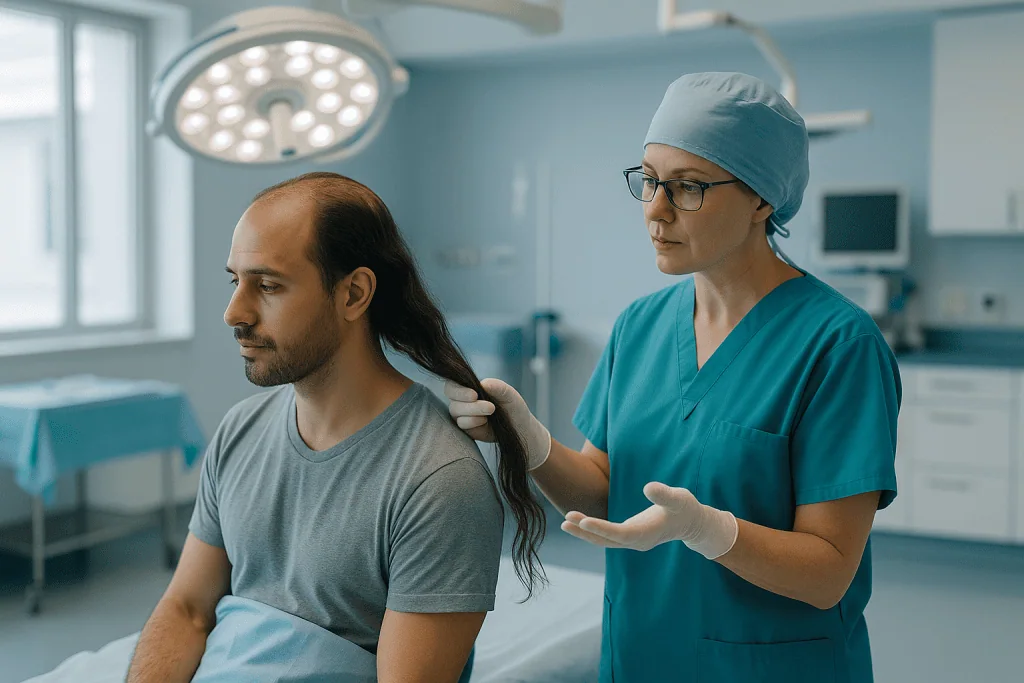
On a shaved scalp, that angle is obvious. Every stubbled hair is a tiny arrow pointing the way, and nothing hangs across the field. On an unshaven scalp the surgeon reads the same arrows through a curtain. Assistants part and tape the surrounding hair, or the surgeon snips each target unit short with fine scissors moments before punching it. Loose hairs drift into the wound, blood wicks along neighboring shafts, and the team pauses to clear the view again and again.
Extracted grafts are lifted with forceps and kept in a chilled holding solution while the recipient sites are made with a fine blade or needle. Placement then happens either by hand or with an implanter pen, a spring-loaded device that pushes the graft into a pre-made or self-made channel. If the recipient area has also been left unshaven, each site has to be created between existing hairs without nicking them, and every graft is threaded into a space that is partly hidden.
The mechanics are identical to a shaved case. What differs is the pace, the amount of hair the team must manage, and how much of the donor zone can realistically be reached in one sitting.
Why do many surgeons still prefer a full shave?
Preference here is about visibility, distribution and safety margins, not habit. Three practical arguments come up repeatedly.
The first is transection risk. Cutting through follicles wastes donor hair that will never grow back, since the donor supply is finite. Working through longer hair reduces how clearly the exit angles can be seen, and it is reasonable to expect a slower, more error-prone harvest when the field is obscured. No mainstream guideline quantifies that difference, so any percentage you are quoted comes from a single provider’s own numbers rather than from independent evidence.
The second is even harvesting. A donor area looks natural after FUE only when the tiny dot scars are spread across a broad zone. When the hair is left long, a surgeon may be tempted, or forced, to concentrate extractions in a hidden band. Take too many units from a narrow strip and the result is a patch that looks thinned or moth-eaten once the hair is later cut short. A full shave lets the surgeon see the whole map and space the harvest deliberately.
The third is aftercare. Freshly placed grafts are held in place by a clot for the first days; MedlinePlus and the NHS both describe a period of careful, gentle washing while the scabs form and lift. Long hair that mats into those crusts, or that catches in a comb, raises the chance of dislodging a graft before it has anchored.
None of this makes a full shave mandatory. It explains why, when a surgeon recommends one, the reasoning is usually about protecting your donor supply rather than about convenience.
Partial shave hair transplant, hidden windows, and true no-shave: three ways to keep your length
Because the no-shave label covers several approaches, it helps to know the trade-offs of each before you sit down for a consultation.
A partial shave hair transplant clips one or more horizontal strips at the back and sides while the hair above stays long enough to fall over them. The surgeon gets a clear, shaved field inside each window, so harvest speed and visibility are close to a fully shaved case within that zone. The limitation is geography. Only the windows are available, which caps how many grafts can be taken without crowding them, and it pushes the team toward the narrow-band overharvesting problem described above. Hair on the sides of the head often needs to be a few finger-widths long for the camouflage to work.
A true no-shave harvest leaves the surrounding hair untouched and trims each follicular unit individually just before it is punched. Nothing visible changes from the outside. The cost is time: each graft takes longer to prepare and extract, so sessions are typically smaller and a person who needs a large number of grafts may be asked to return more than once.
Long hair FUE goes a step further. Grafts are extracted and implanted with the shaft intact, so the recipient area shows an immediate, if temporary, preview of the planned density and hairline. Those long shafts shed in the following weeks along with the rest of the transplanted hair, exactly as MedlinePlus describes for any transplant, so the preview is not the result. Handling grafts by their long shafts also demands particular care, since pulling on the hair can damage the bulb below.
Many teams blend these methods, shaving a small window where hair is densest and trimming individual units elsewhere.
Is no shave FUE less effective? What the evidence does and does not show
Here is the honest answer: nobody has published a high-quality, independent trial comparing growth from unshaven FUE hair transplant sessions with growth from shaved ones, and the mainstream medical sources this article relies on, including the NHS, Mayo Clinic and Cleveland Clinic, do not grade the two separately. Claims in either direction sit at the level of expert opinion and individual practice data.
What can be said rests on mechanism. A follicle does not know whether the hair around it was shaved. If a graft is removed intact, kept cool and moist, and placed at the right depth and angle, it should behave like any other graft. In that sense the technique is not inherently less effective.
The concern lives in the harvest, not the follicle. Reduced visibility can raise the chance of transection. Slower extraction can extend how long grafts wait outside the body. Smaller sessions can mean several procedures to reach the same total. Each of those factors is plausible, each depends heavily on the experience of the team, and none has an agreed figure attached to it.
The practical translation is this. If your goal is modest, your donor hair is dense, and your team performs unshaven harvests routinely, the evidence gives no reason to expect a different outcome. If your goal requires a large graft count in one sitting, the physical constraints of working through long hair become real, and a surgeon who recommends at least a partial shave is not being lazy.
Ask any provider quoting a growth percentage where the number comes from, whether it was independently audited, and how transection was measured.
Who is a no-shave hair transplant usually for, and who is usually asked to wait?
Suitability is decided by the treating team after an examination, not by an article. The patterns below describe who tends to be offered an unshaven approach and who is commonly steered elsewhere.
People who most often benefit have hair on the sides and back long enough to cover clipped windows, a defined and moderate goal such as refining a hairline or filling a limited area of the crown, and jobs or lives where several weeks of visible stubble would be genuinely disruptive. Women are frequently in this group. Female pattern hair loss tends to be diffuse across the top of the scalp rather than confined to a receding line, and Harvard Health notes that a stable donor zone is a prerequisite for transplant candidacy in women, so the assessment starts with whether the back and sides are truly spared.
People who are commonly asked to reconsider, or to accept some shaving, include those needing a large graft count in a single session, those whose hair is already too short to hide any window, and those with very fine or very curly hair where the exit angle is harder to judge even on a shaved scalp.
Timing questions apply to everyone. Mayo Clinic describes pattern hair loss as progressive, and surgeons generally want to see a stable pattern before designing a permanent hairline, which is why younger people are sometimes asked to wait and to discuss medical management first. Active scalp inflammation, uncontrolled medical conditions that affect healing or bleeding, and current smoking are typical reasons for postponement in any cosmetic surgery, as the NHS outlines in its general guidance.
No shave vs shaved hair transplant at a glance
The table below gathers the practical differences in one place. Every row describes tendencies drawn from how the techniques work, not guaranteed outcomes, and the right column for you may look different once your surgeon has examined your scalp.
| Factor | Fully shaved | Partial shave (windows) | True no-shave or long hair FUE |
|---|---|---|---|
| Visibility of follicle angle | Clearest | Clear inside windows only | Most obscured |
| Typical grafts per session | Largest | Limited by window size | Usually smallest |
| Procedure time per graft | Shortest | Moderate | Longest |
| Spread of donor harvest | Whole zone available | Risk of crowding in bands | Whole zone, but slow |
| Visible change immediately after | Stubble, dots and redness on show | Hidden when hair is down | Largely hidden |
| Ease of early washing and care | Simplest | Moderate | Most fiddly |
| Preview of design on the day | No | No | Yes, with long hair FUE only |
| Biology of graft growth | Same follicle, same growth cycle once placed correctly |
Two rows deserve emphasis. The last row is the reassuring one: shaving does not change what a follicle does after surgery. The spread-of-harvest row is the cautionary one, because a crowded hidden band is a mistake that reveals itself years later, the first time you ask a barber for a short cut.
Does keeping your length change the recipient area too?
Most of the discussion focuses on the donor zone, but the top of the head raises its own questions. Surgeons sometimes shave the recipient area even when the donor hair is left long, and the reasons are worth understanding before you assume everything stays as it is.
Shaving the recipient area lets the surgeon see exactly where existing hairs stand, so new sites can be made between them without cutting through healthy follicles. It also lets the team judge density and direction as the grafts go in, because every placed graft is visible against skin rather than lost in surrounding hair. When the recipient area is left unshaven, each site is created by feel and partial sight, and placement slows.
Leaving native hair long over the recipient area has its own advantage: the redness and small crusts that follow any transplant are partly concealed from the first day. That matters to people whose main worry is being seen during healing rather than the shave itself.
The hairline is the exception that is nearly always shaved or trimmed close, regardless of approach. A hairline is drawn on bare skin, and its shape, irregularity and angle are the design elements that most determine whether a result looks natural. Few surgeons will draw and populate a hairline through a fringe.
The realistic picture, then, is a spectrum rather than a switch. Your donor hair may stay long, your crown may be left alone, and a narrow strip at the front may still be clipped. Asking the team to sketch on a photograph exactly which zones will be shaved removes most of the surprises.
Hair transplant without shaving head: what the first days and weeks look like
Whatever the approach, the first fortnight follows a shared script. The recipient sites form pinpoint crusts. The forehead may swell for a few days, sometimes drifting toward the eyes. The donor dots redden and then fade. The NHS notes that most people can return to work within a few days, and both the NHS and MedlinePlus describe a period of gentle, instructed washing rather than normal shampooing while the grafts anchor.
The shaved and unshaven versions diverge in the small, daily details.
After a full shave, everything is on display. Colleagues will see stubble, dots and a pinkish recipient area, and there is no hiding it without a loose hat once the team says a hat is allowed. In exchange, care is simple: nothing tangles, nothing catches, and the scalp can be rinsed exactly as instructed.
After an unshaven procedure, the outside world sees far less, but the person doing the aftercare has more to manage. Long hair mats into crusts overnight, combing near grafts must be avoided, and drying takes longer. Teams often give specific instructions on how to lift and part hair while washing so that nothing tugs on a fresh graft.
The shared timeline that follows is the one people find hardest emotionally. MedlinePlus explains that the transplanted hairs commonly fall out within the first several weeks, that new growth begins over the following months, and that the appearance continues to change for roughly a year. Someone who chose long hair FUE for the immediate preview should expect that preview to shed like any other transplanted hair. Anyone who chose an unshaven method to avoid a bald phase should know that the transplanted area itself, once the shafts shed, will look much as it did before surgery until regrowth arrives.
Is it better to get a hair transplant or shave my head?
This question sits underneath the shaving debate, and it deserves a straight answer: neither choice is medically better, because pattern hair loss is not a disease that threatens health. Mayo Clinic frames treatment as optional and preference-led. What differs is what each path asks of you.
Shaving your head is reversible, carries no surgical risk, and costs nothing in recovery time. For many people it is a complete solution, and a substantial number who were sure they would hate it find the opposite.
A transplant is surgery. The NHS and Cleveland Clinic list the recognized risks in similar terms: infection, bleeding, scarring at donor and recipient sites, temporary numbness or altered sensation, folliculitis where hairs regrow, and shock loss, meaning temporary shedding of existing hair near the surgical area. Results can look unnatural if the hairline is drawn too low or too straight, and the donor supply is finite, so a poorly planned first procedure limits what can be done later. Ongoing loss around the transplanted hair is likely unless it is managed, which is why medical treatment is often discussed alongside surgery.
Between those poles sit alternatives that Mayo Clinic and the NHS describe in neutral terms: medicines that slow loss or prolong the growth phase, cosmetic camouflage powders and fibers, scalp micropigmentation that tattoos the appearance of stubble, hairpieces, and simply choosing a shorter style. Low-level light devices are marketed widely, but Mayo Clinic notes that evidence for them remains limited.
The useful reframing is not which option wins, but how much you want hair on that part of your head, how much certainty you need, and how you feel about surgery. Those answers belong to you, and the clinical judgment about whether surgery suits your scalp belongs to the team examining it.
What people often get wrong about unshaven hair transplants
Myths collect around anything sold as convenient. These are the ones that most often shape decisions for the worse.
No-shave means no cutting. In every unshaven method, the follicular units that are removed are trimmed short first. What stays long is the hair around them, not the hair that moves.
No-shave leaves no scars. FUE leaves a small dot scar at every extraction point whether or not the surrounding hair was shaved. Long hair hides them; it does not prevent them. The NHS is explicit that all transplant methods leave some scarring.
Nobody will know. Swelling, pinpoint crusts and a numb, tender scalp are the same in both approaches. Long hair conceals a great deal, but a close friend across a dinner table may still notice something in the first week.
Shaved is always better, or unshaven is always worse. The follicle behaves identically once placed. The differences are practical and depend on session size and the team’s experience, not on a law of biology.
DHI is the no-shave method. DHI, often expanded as direct hair implantation, describes placing grafts with an implanter pen rather than with forceps into pre-made sites. It is a placement tool. It says nothing about whether the donor area is shaved, and it can be used with any of the harvesting styles described here.
A well-known person regrew hair with one product, so that product works. Public figures rarely disclose their full treatment history, and any visible change may reflect surgery, medicine, styling, lighting or all four. Evidence for what works comes from controlled studies, which Mayo Clinic summarizes, not from photographs of celebrities.
Where medicines fit into a no-shave plan
Surgeons ask about hair-loss medicines for a reason that has little to do with shaving and a great deal to do with the plan. Transplanted follicles come from a zone that resists pattern loss, but the native hairs around them do not, so what happens to those neighbors over the following years shapes how the result ages.
Two medicine classes come up in nearly every consultation, and Mayo Clinic lists both as the mainstream options with the most supporting evidence. Topical minoxidil is thought to work by widening small blood vessels and prolonging the growth phase of the follicle; it is applied to the scalp. Oral finasteride belongs to a class called 5-alpha reductase inhibitors, which lower the conversion of testosterone into dihydrotestosterone, the hormone that miniaturizes susceptible follicles. Mayo Clinic notes that several months of consistent use are typically needed before judging whether either is helping, and that benefit is lost if the medicine is stopped.
Neither is prescribed by the transplant itself. Whether one is appropriate for you, at what strength, and for how long are decisions for the prescribing clinician, weighed against side effects that should be discussed openly. Finasteride in particular carries recognized sexual and mood side effects in a minority of users, and it is not used in women who are or may become pregnant.
For someone weighing an unshaven approach specifically, the relevant point is this: a stable, medically managed pattern makes a smaller, targeted session more likely to hold its value, and a smaller session is exactly the kind that suits a no-shave harvest. Bring your full medication list, including supplements, to the consultation, and let the team coordinate rather than starting or stopping anything on your own.
Questions to ask your care team about long hair FUE and shaved options
A good consultation should leave you able to draw your own surgical plan on a napkin. These questions tend to get you there, and the way they are answered tells you as much as the answers themselves.
- Which zones of my scalp will be shaved, trimmed or left untouched, and can you mark them on a photograph of my head?
- Do you mean a partial shave, a true no-shave harvest or long hair FUE, and which do you perform most often?
- How many grafts do you plan to move in this session, and would that number be higher with a shave?
- How will you spread the harvest across the donor area so that a short haircut in future does not reveal a thinned band?
- How do you track transection in your own cases, and what did that look like in your most recent unshaven procedures?
- Who will be extracting and placing the grafts: the surgeon, technicians, or both, and how much of the day will the surgeon be present?
- How long will grafts wait outside the body, and how are they stored during that time?
- What exactly will washing and sleeping look like in the first week with my hair length, and will I be shown how to do it before I leave?
- Will the hairline be shaved even if everything else is not?
- If my pattern is still progressing, what would you want to see before operating, and what medical options should I discuss first?
- What is your plan if I need a second session, and how does today’s harvest protect the donor supply for it?
- Who do I contact after hours if something worries me, and what would you consider urgent?
Write the answers down, take them home, and give yourself time. A transplant is elective, and a team confident in its approach will not mind being asked to explain it twice.
When to call your doctor
Most people recover from a hair transplant with nothing more dramatic than itching, tight-feeling skin and a forehead that looks puffy for a few days. The NHS and Cleveland Clinic describe swelling, mild pain, crusting and temporary numbness as expected. Long hair over the surgical area can hide early problems, which is one reason to take a good look, or have someone look for you, each day during the first two weeks.
Contact your surgical team the same day if you notice any of the following:
- redness that spreads outward from the donor or recipient area rather than fading, or skin that feels hot and increasingly tender;
- yellow or green discharge, a bad smell from the scalp, or pustules that multiply rather than settle;
- a fever or chills, or feeling generally unwell in a way you cannot explain;
- bleeding that does not stop after several minutes of gentle, steady pressure with clean gauze;
- pain that escalates despite the pain relief you were advised to take, or pain that wakes you at night;
- swelling severe enough to close an eye, or swelling that appears suddenly on one side only;
- numbness that is worsening rather than slowly improving, or new weakness in the face;
- several grafts lifting away with visible bleeding, rather than the expected shedding of hairs without their roots.
Seek emergency care immediately, without waiting for a call back, for signs of a serious allergic reaction such as swelling of the lips or tongue, difficulty breathing or a widespread rash; for chest pain or breathlessness; or for a swollen, painful calf, which can signal a clot after any procedure that involves sitting still for hours.
When in doubt, call. Teams would far rather reassure you about a harmless crust than hear about an infection a week late, and the number they gave you exists for exactly this purpose.
Frequently asked questions
Is no shave FUE less effective?
Not inherently, but it is harder to do well. A follicle placed correctly grows the same regardless of whether the surrounding hair was shaved. Working through long hair does reduce the surgeon’s view of the follicle angle, which can raise the risk of cutting through grafts, and it slows the harvest so sessions tend to be smaller. No independent trial compares the two, so ask any provider quoting a growth figure how it was measured.
Do you have to shave your head before a hair transplant?
Not always. Many surgeons prefer a full shave because it makes every follicle angle visible and allows an even harvest across the whole donor zone, but partial shaves, individually trimmed units and long hair FUE all allow most hair to stay at its length. The hairline is usually clipped close in any approach. Which option suits you depends on your goals, your hair density and your team’s assessment.
What is the difference between long hair FUE and a true no-shave hair transplant?
In a true no-shave harvest, each follicular unit is trimmed short just before it is removed, while the hair around it stays long; the transplanted area then looks like fine stubble. In long hair FUE, grafts are removed and implanted with their shafts intact, giving an immediate preview of the design. That preview sheds within weeks, as MedlinePlus describes for all transplanted hair, before regrowth begins.
Is it better to get a hair transplant or shave my head?
Neither is medically better, because pattern hair loss does not threaten health. Shaving is reversible and risk-free; a transplant is surgery with recognized risks including infection, scarring, shock loss and results that depend on a finite donor supply. Between them sit medicines, camouflage products, scalp micropigmentation and hairpieces. The right choice rests on how much you want hair there and how you feel about surgery, discussed with a treating team.
Does an unshaven FUE hair transplant take longer in the operating room?
Usually, yes. Parting and taping hair, trimming individual units and clearing loose hairs from the field all add time to every graft, and if the recipient area is also unshaven each site must be made between existing hairs. That is why unshaven sessions typically move fewer grafts than shaved ones, and why someone needing a large number may be offered more than one procedure or a partial shave.
Can women have a hair transplant without shaving their head?
Often, and many women are offered exactly that because longer hair hides clipped windows well. The bigger question for women is candidacy itself. Female pattern loss tends to be diffuse across the top of the scalp, and Harvard Health notes that a stable, spared donor zone at the back and sides is essential. A specialist examination, sometimes with tests to rule out other causes, comes before any decision about shaving.
Why doesn't this article say what a celebrity used to regrow hair?
Because nobody outside a person’s care team knows their treatment history, and public speculation is neither accurate nor fair. A visible change on camera may reflect surgery, medicine, styling or lighting. What works is established by controlled studies, which Mayo Clinic summarizes: the best-supported medical options are topical minoxidil and oral 5-alpha reductase inhibitors, alongside surgical transplantation, each with trade-offs to discuss with a clinician.
Why doesn't this article give a cost for 3,000 grafts?
This magazine does not publish prices, and a graft number pulled from a search bar is not a plan. The number of grafts you might need depends on the area to be covered, your hair caliber and density, and how much donor supply should be held back for the future. A consultation should produce a written, itemized plan that explains the count before it discusses anything else.
Is DHI the same as a no-shave hair transplant?
No. DHI, usually expanded as direct hair implantation, describes placing grafts with a spring-loaded implanter pen rather than with forceps into pre-made sites. It is a placement technique and says nothing about how the donor area is harvested. It can be combined with a full shave, a partial shave hair transplant or a true no-shave harvest, so ask separately about shaving and about placement.
How long until a partial shave hair transplant looks normal?
The clipped windows are hidden under longer hair from day one, and the crusts at the recipient sites typically lift within the first couple of weeks under instructed washing. The NHS notes most people return to work within a few days. MedlinePlus describes the transplanted hairs shedding in the following weeks, with new growth appearing over months and the appearance continuing to change for roughly a year.
References
This article is for general information only and is not a substitute for professional medical advice. Please consult a qualified doctor about your individual situation.

More from the Blog
Non-Surgical Hair Restoration Results: Why Months of Consistency Matter More Than One Session
Non-surgical hair restoration works with the hair growth cycle, so results unfold over months rather than after a single session. Topical minoxidil typically needs…

When Can Coloring, Heat Styling and Ponytails Resume After a Hair Transplant for Women?
Most surgical teams ask women to wait until the scalp has fully healed before coloring hair after a hair transplant, which usually means several…
Is a Sapphire Transplant Painful? Local Anesthesia, Channel Opening and Scalp Soreness
A sapphire transplant is usually not described as painful during the procedure, because the scalp is numbed with local anesthetic before incisions are made.…
Is a Hair Transplant Permanent? What Stays, What Thins, What Ages
Mostly, yes. Transplanted follicles come from areas of the scalp that are genetically resistant to pattern balding, so they usually keep growing for decades,…
Hair Transplant for Women Recovery: Gentle Washing, Sprays and the Shedding Phase Week by Week
Recovery after a hair transplant for women usually follows a predictable arc: swelling and small crusts in the first week, gentle washing and saline…
After a Hair Operation: Normal Swelling vs Signs of Infection Your Clinic Wants to Hear About
After a hair operation, soft, painless swelling of the forehead and around the eyes in the first week is usually part of normal healing.…