

Permanent Dentures: What Fixed, Implant-Held Teeth Really Are
Key Takeaways
- "Permanent" dentures are fixed to four to six jaw implants and removed only by a dentist: the implants can last decades, but the visible tooth portion typically needs refurbishing or replacing within about five to fifteen years.
- Osseointegration, bone fusing to the implant surface, takes roughly three to six months, and the same-day "teeth in a day" you see advertised are provisional teeth placed while that fusion is still underway.
- Long-term studies commonly report implant survival above 90 percent at ten years, but some reviews estimate peri-implantitis eventually affects roughly one in five implant patients, making daily under-bridge cleaning non-negotiable.
- US dental insurance annual maximums typically run one to two thousand dollars, so even plans that nominally cover implants pay only a small fraction of a full-arch fee often quoted in the tens of thousands per jaw.
- Smoking is associated with roughly double the implant failure risk in some analyses, and poorly controlled blood sugar independently impairs the healing that osseointegration depends on.
- Snap-in implant overdentures, two to four implants supporting a removable denture, deliver much of the stability of fixed teeth at a fraction of the cost, especially for the lower jaw.
Permanent dentures are full-arch replacement teeth fixed to dental implants, usually four to six posts that fuse with the jawbone over several months, so they stay in the mouth around the clock and come out only in a dental chair. With good hygiene the implants can last decades, though the attached tooth portion typically needs refurbishing or replacing after roughly five to fifteen years.
There is a moment many longtime denture wearers describe almost identically: the pause before biting into corn on the cob, an apple, a crusty roll. A quick mental calculation, will it hold?: that people with natural teeth never make. For a lot of them, that pause is the real reason they start asking about implant-held teeth.
The phrase “permanent dentures” gets tossed around loosely in ads, and it deserves a more honest translation. What dentists actually place is a full row of prosthetic teeth screwed or bonded onto implants anchored in the jaw. Nothing about the human body is truly permanent, and these teeth are no exception, but they change the daily experience of eating, speaking, and smiling in ways a suction-held plate never quite matches.
Here is what the evidence, not the billboards, says about how they work, what they demand of you, what they realistically cost, and where they can go wrong.
What does "permanent dentures" actually mean?
The term is marketing shorthand, not a clinical name. What most people mean by permanent dentures is a fixed, implant-supported full-arch prosthesisa complete row of upper or lower teeth attached to dental implants with small screws or dental cement. You cannot take it out at night. A dentist can, with the right instruments, and periodically does for deep cleaning and maintenance.
Dentists use several near-interchangeable terms for the same idea: hybrid denture, fixed full-arch bridge, implant-supported denture. The concept of anchoring a whole arch on as few as four angled implants is sometimes sold under trademarked names, but the underlying approach is the same regardless of branding.
Two distinctions matter before anything else. First, fixed implant dentures are different from snap-in overdentures, which also attach to implants but click on and off so you can remove them for cleaning. Second, “permanent” describes where the teeth live, in your mouth, full-time, not how long they last. According to the Cleveland Clinic, the implants themselves can serve for decades, while the tooth-bearing portion wears like any dental appliance and eventually needs servicing or replacement.
Roughly 1 in 6 US adults aged 65 and older have lost all of their natural teeth, according to CDC data, so this is not a niche question. For many of those people, the choice between a removable plate and a fixed arch shapes daily life more than almost any other dental decision they will make.
How do implant-held teeth stay in? The science of osseointegration
The anchor is a small post, most often titanium, sometimes a ceramic called zirconia, placed surgically into the jawbone where tooth roots used to be. What happens next is the quietly remarkable part. Bone cells grow directly onto the implant’s textured surface over the following months, locking it in place. Researchers call this osseointegration, and it was discovered somewhat by accident in the 1960s when a Swedish scientist found he couldn’t retrieve titanium chambers he’d placed in bone for an unrelated experiment.
This is why an implant feels different from anything glued or suctioned in place. The Mayo Clinic notes that because implants fuse with the jawbone, they won’t slip, make noise, or cause the bone damage that ill-fitting removable dentures can. The implant behaves mechanically like a root: chewing forces travel through it into the bone, which matters more than it sounds.
Bone is living tissue that remodels according to the load it carries. When teeth are lost, the jaw stops receiving that stimulation and gradually shrinks, one reason removable dentures loosen over the years and faces can take on a sunken look. Implants restore some of that functional loading, which helps preserve bone in the areas around them.
A full fixed arch typically rests on four to six implants per jaw. The bridge spanning them distributes bite forces across all the posts, which is how a handful of anchors can support a dozen or more teeth.
Removable vs. fixed dentures: what actually changes at the dinner table
Comparison charts online tend to declare a winner. Real life is more specific than that. Here is where the two options genuinely differ, based on descriptions from MedlinePlus, the NHS, and the Cleveland Clinic:
| Everyday reality | Conventional removable denture | Fixed implant denture |
|---|---|---|
| Stays in around the clock | No, removed nightly for cleaning | Yes, removed only by a dentist |
| Chewing power | A modest fraction of natural bite force; tough and chewy foods are difficult | Substantially closer to natural function; most foods are back on the menu |
| Upper palate coverage | Usually covers the roof of the mouth, which can dull taste and trigger gagging in some people | Typically leaves the palate open |
| Adhesive creams | Often needed as fit loosens | Never needed |
| Bone preservation | Jawbone continues to shrink under the plate | Implants stimulate and help maintain surrounding bone |
| Cleaning | Simple, brush and soak outside the mouth | More demanding, cleaning under a fixed bridge takes tools and technique |
| Upfront cost | Lower by a wide margin | High; often the largest dental expense of a lifetime |
Notice the pattern: fixed teeth win on function and stability, removable dentures win on cost and simplicity. Neither column is trivial, and the right answer depends heavily on health, bone, budget, and how much daily maintenance a person can realistically sustain.
Who is a good candidate, and who may not be
Implant candidacy comes down to three things: enough healthy bone, healthy gums, and a body that heals well from minor surgery.
The Mayo Clinic lists the basics: a fully grown jawbone (which rules out adolescents), adequate bone or the ability to receive a bone graft, healthy oral tissues, and no health conditions that would interfere with bone healing. People who have lost teeth long ago often have significant bone shrinkage, especially in the upper jaw near the sinuses. That doesn’t automatically disqualify anyone; grafting procedures can rebuild bone, and angled or longer implants can sometimes work around thin areas, though each workaround adds time and cost.
Certain factors deserve a frank conversation with a dentist or oral surgeon rather than a quick yes or no:
- Smoking, which impairs blood flow to the gums and is consistently associated with higher implant failure rates
- Diabetes that isn’t well controlled, since elevated blood sugar slows healing and raises infection risk
- Heavy tooth grinding (bruxism), which can overload implants and crack prosthetic teeth
- A history of radiation therapy to the jaw, which changes how bone heals
- Certain medicines that affect bone metabolismyour dental team will review your full medication list for this reason
None of these is necessarily a hard stop. What the evidence shows is that success rates drop when risk factors stack up, and an honest clinician will weigh them with you rather than promise a guaranteed result. Anyone who guarantees one is selling, not advising.
What the procedure involves, step by step
Getting a fixed implant denture is a process measured in months, not a single dramatic appointment. The sequence usually runs like this:
- Planning. A three-dimensional CT scan maps your bone volume, nerve locations, and sinus position. The surgical plan, how many implants, where, at what angle, is built from this image.
- Extractions, if needed. Any remaining failing teeth come out, sometimes in the same visit as implant placement.
- Implant surgery. Four to six posts per arch are placed into the jaw under local anesthesia, often with sedation. Mayo Clinic describes this as typically an outpatient procedure, with soreness, minor bleeding, and swelling managed at home over the following days.
- The provisional phase. Many practices attach a temporary fixed set of teeth the same day or within days: the “teeth in a day” you see advertised. The phrase is true as far as it goes, but the teeth are provisional and the implants underneath are still fusing with bone. A softer diet protects them during this window.
- Healing. Osseointegration takes roughly three to six months.
- The final prosthesis. Once the implants are solid, impressions or digital scans are taken and the definitive arch, acrylic on a metal or high-strength frame, or milled zirconia, is fabricated and attached.
From first consult to final teeth, expect several months at minimum, and closer to a year if bone grafting comes first.
How long does healing really take?
Two clocks run at once after implant surgery, and it helps to keep them straight.
The first is soft-tissue healingthe gums closing over and settling around the surgical sites. This is the part you feel: swelling, tenderness, and bruising that generally ease over one to two weeks. Most people are back to normal routines within a few days, eating carefully on the other considerations below.
The second clock is osseointegration, and it runs silently for three to six months. During this stretch, bone is knitting onto the implant surfaces, and the connection is at its most vulnerable. Excessive force too early can cause a micro-movement that prevents the bone from bonding, one of the main causes of early implant failure. This is why, even when a provisional set of fixed teeth goes in on surgery day, dentists prescribe a soft-food diet for weeks to months. The temporary teeth are there for appearance and basic function, not for steak.
Timelines stretch when preparation is needed. A sinus lift or bone graft typically has to heal for several months before implants can even be placed, per Mayo Clinic guidance, which can push the total journey past a year. Frustrating, yes, but bone biology does not respond to impatience, and rushing this stage is how expensive problems begin.
Follow-up visits during healing are not optional extras. They are how your team catches a struggling implant while it can still be addressed simply.
How long do permanent dentures usually last?
Split the answer in two, because the implants and the teeth attached to them age on different schedules.
The implants are the durable part. The Cleveland Clinic notes that with proper care, dental implants can last decades, and long-term studies commonly report survival rates above 90 percent at the ten-year mark. Plenty of implants placed in the 1980s and 1990s are still in service. “Can last decades” is not “will last forever,” though, gum disease around an implant, called peri-implantitis, can shorten that lifespan considerably, which is why maintenance matters so much (more on that below).
The prosthesisthe visible teeth and the framework carrying them, is a wear item, the way tires are on a well-built car. Acrylic teeth on a hybrid denture gradually flatten, stain, and occasionally chip; a common expectation is refurbishment or replacement somewhere in the five-to-fifteen-year range depending on materials, bite forces, and habits. Zirconia arches resist wear better but can still chip and cost more to make and to remake. Small components, the screws that hold the arch down, for instance, are periodically checked and sometimes replaced during maintenance visits.
Budget-wise, the honest framing is this: the surgical investment is designed to last a very long time, but plan for meaningful prosthetic upkeep costs over the decades rather than assuming a one-and-done purchase. People who go in with that expectation tend to be the satisfied ones twenty years later.
What are the downsides of permanent dentures?
Every option in dentistry involves trade-offs, and fixed implant teeth have real ones that glossy brochures skip past.
- Cost. This is often the single largest dental expense of a person’s life, and insurance rarely covers most of it.
- Surgery, with surgery’s risks. Infection, nerve injury causing numbness or tingling, sinus complications in the upper jaw, and implant failure are all uncommon but documented: Mayo Clinic lists each of them plainly.
- Hygiene gets harder, not easier. Food and plaque collect under a fixed bridge, and cleaning that space takes daily effort with special tools. People who struggled to maintain natural teeth sometimes assume implants remove the burden; if anything, the stakes rise.
- Peri-implantitis. Gum infection around implants can destroy supporting bone. Some published reviews estimate it affects roughly one in five implant patients over time, and treating it is difficult.
- Speech and sensation adjustments. A new fixed arch can alter speech for weeks, and because implants lack the nerve endings of natural tooth roots, chewing feedback feels different, most people adapt, but not everyone loves it.
- Repairs require the dentist. A chipped tooth or loose screw on a fixed arch is not a home fix, and remakes are costly.
- Limited reversibility. Once bone has been shaped and implants placed, going backward is not simple.
None of this argues against fixed implant dentures. It argues for choosing them with clear eyes, which, in the long run, is what predicts satisfaction.
What is the average cost of permanent dentures?
Here is an honest answer you will rarely see: no reliable national average exists, and the major medical references, MedlinePlus, Mayo Clinic, the NHS, deliberately don’t publish price lists because fees vary so widely by region, provider, materials, and case complexity.
What can be said responsibly: in the United States, a fixed full-arch implant restoration is commonly quoted in the tens of thousands of dollars per arch, with figures from the mid-teens to well past thirty thousand appearing routinely, and full-mouth treatment doubles that. Several factors move the number substantially:
- How many implants and whether angled placement can avoid grafting
- Bone grafting or sinus lifts, each adding procedures and months
- Prosthesis materialacrylic hybrid arches cost less than milled zirconia
- Sedation choices, imaging, extractions, and provisional teeth
- Geography, since fees track local costs of practice
Two cautions belong in any honest cost discussion. First, headline prices in advertising sometimes exclude extractions, grafting, sedation, or the final (versus temporary) teeth, ask for a comprehensive written treatment plan itemizing everything. Second, a dramatically low quote deserves scrutiny rather than celebration: implant success depends on planning, surgical skill, and component quality, and complications are far more expensive than the savings.
Dental schools with supervised clinics and staged treatment plans (implants now, final prosthesis later) are legitimate ways some people manage the expense. What matters is comparing complete, itemized plans, not headline numbers.
Will insurance pay for permanent dentures?
Usually only a small slice, and the arithmetic explains why. Most US dental plans carry an annual maximumcommonly in the range of one to two thousand dollars: that caps what the plan pays in a year, regardless of what treatment costs. Against a full-arch fee in the tens of thousands, even a plan that nominally “covers implants” contributes a modest fraction.
The details vary enough that verification beats assumption:
- Some dental plans exclude implants entirely but cover part of the denture component, since dentures are a listed benefit.
- Others cover implants at a major-services percentage (often around half) up to the annual cap, sometimes after waiting periods.
- Medical insurance rarely pays for tooth replacement, with exceptions sometimes made when tooth loss stems from an accident, tumor surgery, or certain diseases, documentation requirements are strict.
- Traditional Medicare has historically excluded most routine dental care, including dentures; some Medicare Advantage plans include limited dental benefits, with caps that again fall far below full-arch costs.
- Funds in FSA or HSA accounts can generally be applied to implant treatment, which at least uses pre-tax dollars.
Before committing, ask the dental office to submit a pre-treatment estimate to your insurer: a standard process that returns, in writing, what the plan will actually pay. Spreading treatment across two calendar years can sometimes capture two annual maximums. Small levers, admittedly, but on a purchase this size every legitimate one is worth pulling.
How do you clean teeth that don't come out?
This is the part of ownership that determines how the whole investment ages, and it deserves more attention than it usually gets in consultations.
A fixed arch sits just above the gumline, and the narrow space beneath it is prime real estate for plaque and trapped food. Implants can’t get cavities, but the gum and bone around them absolutely can become infected, and peri-implantitis, once established, is harder to treat than ordinary gum disease. Daily hygiene is the main defense, and the evidence on this point is unambiguous.
A workable routine looks like this:
- Brush twice daily, angling bristles toward the gumline where the prosthesis meets tissue; electric brushes work well
- Clean under the bridge every day using a water flosser, interdental brushes, or floss threaders, most people settle on a water flosser for speed and reach
- Rinse after meals to dislodge trapped food, especially early on while you learn where things collect
- Professional maintenance two to four times a year, where a hygienist cleans areas you can’t reach and the dentist checks screws, bite, and gum health
Periodically, often every year or two, the dentist may unscrew the arch entirely for a thorough cleaning and inspection, then reattach it. That appointment is also when small problems like a worn component or early gum inflammation get caught cheaply.
Total daily time commitment: perhaps five to ten minutes. Skipping it is the single most reliable way to turn a decades-long solution into a five-year one.
What can go wrong: peri-implantitis and implant failure
Implant dentistry has excellent statistics, and it’s precisely because the numbers are good that the failures deserve a clear-eyed look.
Early failure happens when an implant never fuses with bone, typically discovered within the first months, when an implant remains loose or painful. Estimates commonly put this in the low single digits per implant. The usual response is removal, healing time, and often a second attempt, which frequently succeeds. Full-arch designs carry built-in redundancy: because the bridge spans multiple implants, losing one doesn’t always doom the prosthesis.
Late failure is a different animal, and its main driver is peri-implantitisa bacterial infection of the gum and bone around an established implant. It behaves like an aggressive cousin of gum disease: plaque accumulates at the gumline, tissues become inflamed (a reversible stage called peri-implant mucositis), and if unchecked, the infection eats away the supporting bone. Some systematic reviews estimate peri-implantitis eventually affects roughly one in five implant patients, though definitions and study populations vary enough that the true figure is debated. What’s not debated: it is far easier to prevent than to treat.
Other documented complications include nerve irritation causing lip or chin numbness, sinus issues with upper-jaw implants, and mechanical problems, loosened screws, chipped prosthetic teeth, fractured frameworks. Mechanical issues are usually fixable; biological ones are the real threat to longevity.
The pattern across all of it: problems caught early are managed simply, and problems ignored become expensive. Regular maintenance visits exist for exactly this reason.
Smoking, diabetes, and bone health: what tilts the odds
Implant success is not random. A handful of factors show up again and again in the research, and most of them are at least partly within a patient’s influence.
Smoking sits at the top of the list. Nicotine constricts blood vessels in the gums, and smoke exposure impairs the healing that osseointegration depends on. Studies consistently associate smoking with substantially higher implant failure and peri-implantitis rates, some analyses suggest roughly double the failure risk of nonsmokers. Many surgeons ask patients to stop for a period before and after surgery at minimum; quitting entirely improves the odds across the board, and the NHS and CDC both offer free evidence-based quitting support.
Blood sugar control matters more than a diabetes diagnosis itself. The research picture shows that people with well-managed diabetes achieve success rates approaching those without the condition, while poorly controlled blood sugar slows wound healing and feeds infection risk. If your control has drifted, stabilizing it before surgery is a genuinely useful investment.
Bone-related medicines deserve a specific mention without naming names: certain drugs used for osteoporosis and some cancer treatments alter bone remodeling, and in rare cases affect jaw healing after oral surgery. This is not a reason to stop any medicine: it is a reason your dental team and prescribing physician should talk before implants are placed.
Grinding and clenching quietly overload implants and crack prosthetic teeth. A night guard is a small, boring, highly effective piece of insurance. Ask about one; not every office volunteers it.
When to see your dentist or doctor
Most recoveries and most years of implant ownership are uneventful. Certain signs, though, warrant a prompt call rather than watchful waiting.
In the days after surgery, contact your surgical team if you notice worsening swelling or pain after the third day (healing should trend better, not worse), bleeding that won’t settle with gentle pressure, fever, or persistent numbness or tingling in the lip, chin, or tongue: the last of these can signal nerve irritation, and early evaluation matters.
At any point afterward, these deserve attention within days, not months:
- Gums around the implants that bleed when you clean, look red or swollen, or feel tender: the earliest, most treatable stage of peri-implant disease
- A bad taste, odor, or pus near the gumline, suggesting infection under the bridge
- Any sense that the arch moves, clicks, or feels looseoften just a loosened retaining screw, which is a quick fix caught early and a framework-damaging problem ignored
- Pain when biting on a previously comfortable arch
- A chipped or fractured tooth on the prosthesis, since sharp edges and altered bite forces cause knock-on damage
Seek urgent medical care, not a routine appointment, for spreading facial swelling, difficulty swallowing or breathing, or high fever, which can indicate a serious infection.
One more sign people overlook: nothing wrong at all, for years. That’s precisely when maintenance visits get skipped, and when early peri-implantitis develops unwatched. Keep the schedule even when everything feels perfect, especially then.
Alternatives worth an honest look
Fixed implant dentures are one point on a spectrum, and the best choice is the one matching your bone, budget, health, and tolerance for maintenance.
Implant-retained overdentures (“snap-in” dentures) attach to two to four implants with clips or ball attachments, dramatically improving stability over a conventional denture, no more adhesive, far less slipping, while remaining removable for easy cleaning. Because they use fewer implants and simpler prosthetics, they typically cost a fraction of a fixed arch. For the lower jaw especially, where conventional dentures perform worst, a two-implant overdenture delivers a large share of the fixed option’s daily benefit at a much lower price. Many prosthodontists consider it the best value in tooth replacement.
Conventional complete dentures remain a legitimate choice, particularly when surgery isn’t advisable or affordable. The NHS notes that well-made dentures restore appearance and reasonable function; their weaknesses, movement, bone loss over time, dietary limits, are real but manageable for many people, and modern materials fit better than the dentures your grandparents wore.
Tooth-supported bridges or partial dentures apply when some sound natural teeth remain. Which raises the option nobody advertises: keeping your natural teeth. Extracting salvageable teeth to “upgrade” to implants trades irreplaceable biology, nerve feedback, natural bone stimulation, for hardware. Evidence-based dentistry treats implants as a superb replacement for missing teeth, not an improvement on healthy ones.
A useful test of any consultation: a clinician who walks you through several of these options, trade-offs included, is advising you. One who presents a single premium solution is selling to you.
The bottom line on fixed, implant-held teeth
Strip away the marketing and the picture is straightforward. Fixed implant dentures are the closest current dentistry comes to giving back a full set of working teeth: stable, palate-free, capable of handling nearly any food, and anchored in bone that they help preserve. The evidence behind osseointegration is deep and decades old, and long-term implant survival above 90 percent at ten years is a genuinely strong track record for any medical device.
The honest counterweight has three parts. The money is substantial and mostly out of pocket, since insurance annual maximums were never designed for treatment at this scale. The process takes months and includes real, if uncommon, surgical risks. And the teeth are permanent in location only: they demand daily under-the-bridge cleaning, professional maintenance for life, and periodic prosthetic refurbishment that should be budgeted from day one.
Who tends to do best? People who go in with accurate expectations: that healing takes a season, that hygiene is a lifelong contract, that the visible teeth will need work in a decade or so even when the implants beneath are thriving. People who addressed smoking and blood sugar first. People who compared complete, itemized treatment plans, including the humbler snap-in overdenture, before signing anything.
If the pause before biting into an apple has become part of your daily life, that’s reason enough to have the conversation. Just have it with a clinician who tells you everything in this article unprompted. Those are the ones worth trusting with your jaw.
Frequently asked questions
What is the average cost of permanent dentures?
There is no reliable national average, but fixed full-arch implant dentures in the US are commonly quoted in the tens of thousands of dollars per jaw, with figures from the mid-teens to over thirty thousand appearing routinely. Costs vary with the number of implants, bone grafting needs, prosthesis material, sedation, and geography. Always request a comprehensive written treatment plan itemizing extractions, grafts, temporary teeth, and the final prosthesis before comparing quotes.
How long do permanent dentures usually last?
The implants can last decades, studies commonly report survival above 90 percent at ten years, while the attached tooth portion is a wear item, typically needing refurbishment or replacement after roughly five to fifteen years. Acrylic arches wear faster than zirconia. Longevity depends heavily on daily hygiene, regular professional maintenance, whether you smoke, and whether grinding is managed with a night guard.
What are the downsides of permanent dentures?
The main drawbacks are high mostly out-of-pocket cost, months of treatment including minor surgery, and lifelong maintenance demands. Cleaning under a fixed bridge takes daily effort with special tools, and peri-implantitis, gum infection around implants, can destroy supporting bone if hygiene lapses. Surgical risks such as infection, nerve irritation, and sinus problems are uncommon but real, and repairs to a fixed arch always require a dental visit.
Will insurance pay for permanent dentures?
Usually only a small portion. Most US dental plans cap annual benefits at roughly one to two thousand dollars, far below full-arch costs, and some exclude implants while covering part of the denture component. Medical insurance rarely pays except after accidents or disease-related tooth loss, and traditional Medicare has historically excluded routine dental care. Ask your dental office to submit a pre-treatment estimate so the insurer confirms coverage in writing first.
Are permanent dentures painful to get?
The surgery itself is done under local anesthesia, often with sedation, so you shouldn’t feel pain during placement. Afterward, expect soreness, swelling, and minor bruising for several days to two weeks, generally manageable with measures your surgical team recommends. Most people return to normal routines within days. Pain that worsens after the third day, or persistent numbness or tingling, is not normal and warrants a prompt call to your provider.
Can you really get permanent teeth in one day?
Partly. Many practices place implants and attach a fixed provisional arch the same day, so you leave with non-removable teeth. However, the implants still need three to six months to fuse with bone, the temporary teeth require a softer diet during that period, and the final, definitive prosthesis is made only after healing completes. So the smile is same-day; the finished result takes months.
Can I get permanent dentures if I've worn removable dentures for years?
Often yes, but long-term denture wear causes jawbone shrinkage, so a CT scan is needed to assess remaining bone. Some people have enough for standard placement, while others need bone grafting or angled implant techniques to work around thin areas, adding time and cost. Severe upper-jaw bone loss is the most challenging scenario. An implant-experienced dentist or oral surgeon can tell you which category you fall into.
How do you clean permanent dentures if they don't come out?
Brush twice daily along the gumline and clean under the bridge every day using a water flosser, interdental brushes, or floss threaders. Professional cleanings two to four times a year are essential, and your dentist will periodically unscrew the arch entirely for deep cleaning and inspection. Implants can’t decay, but the gums and bone around them can become infected, so this routine directly determines how long the whole restoration lasts.
What's the difference between snap-in and fixed implant dentures?
Snap-in overdentures attach to two to four implants with clips and can be removed at home for cleaning; fixed dentures are screwed onto four to six implants and come out only at the dentist. Fixed arches offer greater stability, no palate coverage, and the closest-to-natural feel, but cost substantially more and are harder to clean. Snap-ins deliver much of the functional benefit at lower cost, particularly for the lower jaw.
Do permanent dentures feel like natural teeth?
Closer than any removable option, but not identical. Because implants fuse with bone, the teeth don’t slip or shift, and chewing power approaches natural function. However, implants lack the nerve endings of natural tooth roots, so bite feedback feels somewhat different, and speech may take a few weeks to adjust to the new arch. Most wearers adapt fully within a couple of months and report the teeth quickly feel like their own.
References
- Cleveland Clinic: Dental Implants
- Cleveland Clinic: Dentures
- MedlinePlus: Dentures
- NHS: Dentures (false teeth)
This article is for general information only and is not a substitute for professional medical advice. Please consult a qualified doctor about your individual situation.

More from the Blog
Who Benefits Most From Dental Robotics? Tight Spaces, Full-Arch Cases and Limited Bone
Dental robotics most often helps when the margin for error is thin: a single narrow gap between healthy teeth, a full-arch case where several…
How Inlays and Onlays Are Placed: Shaping, Impressions, Lab Fabrication and Bonding Explained
An inlay onlay procedure usually takes two visits. First, the dentist numbs the tooth, removes decay or an old filling, and shapes the cavity…
Imaging in Implantology: How Panoramic X-Rays and 3D Scans Guide Implant Position and Depth
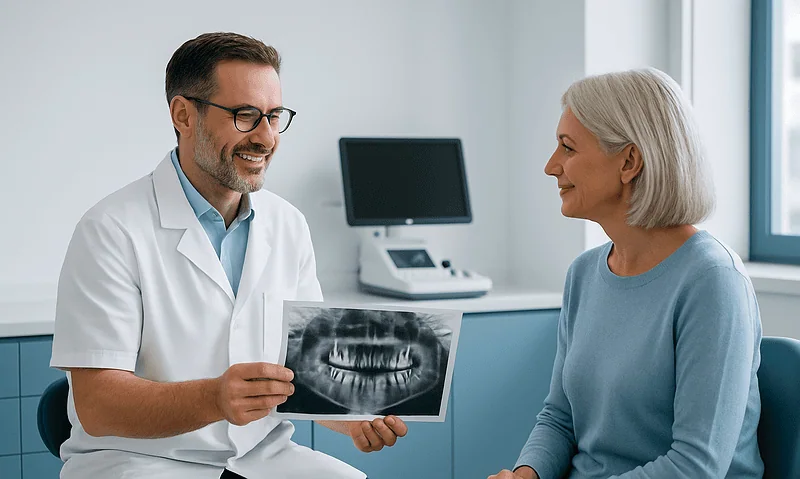
Implantology imaging combines two-dimensional dental X-rays, most often a panoramic film, with a three-dimensional cone beam CT (CBCT) scan when the clinician needs to…
Why Jaw Growth Decides When Implantology Can Place an Implant in a Younger Patient
Dental implants for teenagers are usually postponed until the jaw has stopped growing, because an implant fuses to bone and cannot move with the…
How Mini Implants Are Placed: Flapless Insertion, Same-Day Denture Fitting and What to Expect
A mini implant procedure places one or more narrow titanium posts into the jawbone, usually through a small pierce in the gum rather than…

All On 4 Healing Timeline: Soft Diet Weeks, Bone Integration and the Final Bridge Switch
All-on-4 healing usually unfolds in stages. Swelling and soreness peak in the first two to three days and settle over one to two weeks,…