

Porcelain Crowns for People Who Grind Their Teeth: Night Guards, Materials and Bite Checks
Key Takeaways
- Grinding damages porcelain by fatigue: repeated nightly loading grows microscopic cracks until a cusp chips, which is why toughness matters more than hardness in material choice.
- Monolithic crowns made from a single ceramic block avoid the weaker veneering layer where most chips in layered crowns occur.
- Polished zirconia is gentler on opposing enamel than a worn-through glaze on softer porcelain, so re-polishing after any adjustment protects the other tooth.
- A custom hard night guard shields both the crown and the tooth opposite it, but Mayo Clinic notes that splints limit damage rather than stop the grinding itself.
- Cleveland Clinic gives a typical crown lifespan of 5 to 15 years, with grinding and clenching among the habits that shorten it.
- Many clinical studies of ceramic crowns exclude severe bruxism, so evidence in heavy grinders specifically is thinner than headline durability figures suggest.
People who grind their teeth can have porcelain crowns, but material choice, design and follow-up matter more than usual. Dentists often favor tougher ceramics such as monolithic zirconia or lithium disilicate over thin layered porcelain, check and adjust the bite at fitting and at review, and usually recommend a custom night guard to protect the crown and the teeth around it. The treating dentist decides which option suits each mouth.
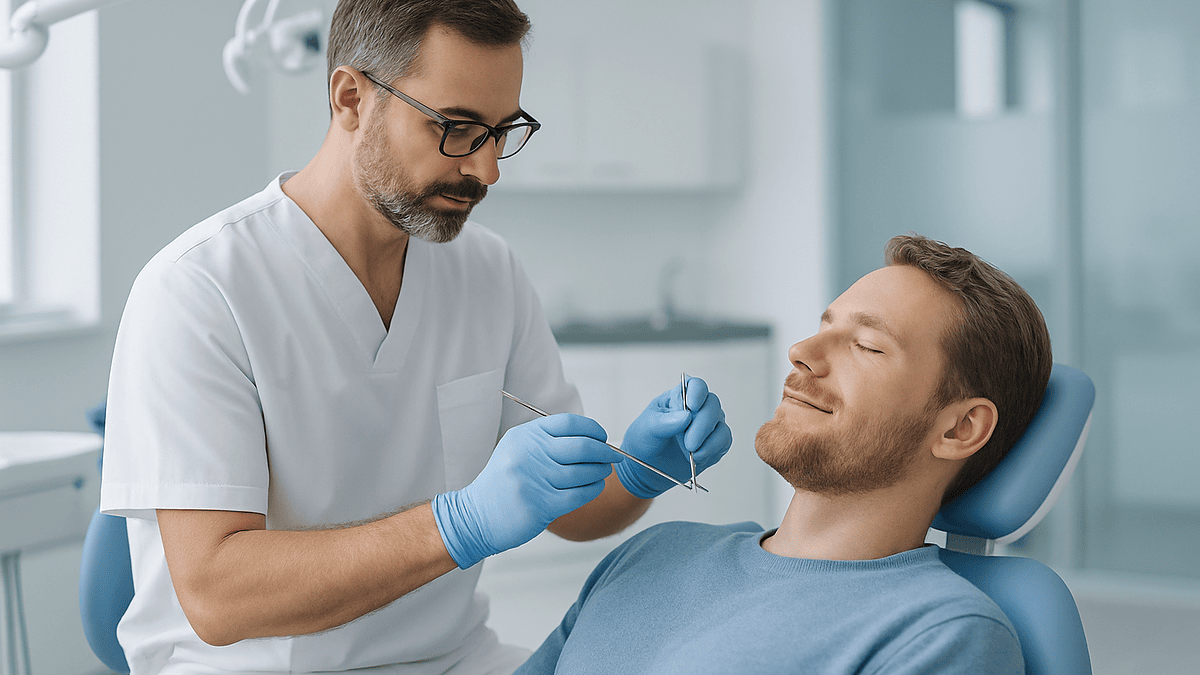
The chip is tiny, a flake of enamel on a back molar that your tongue keeps finding. The dentist looks at it, then looks at the flattened edges on your other teeth, and asks a question you did not expect: do you wake with a tight jaw? You do. That is how many conversations about porcelain crowns teeth grinding begin, not with a toothache but with a worn tooth and a habit you barely knew you had.
Grinding changes the arithmetic of a crown. A ceramic that performs beautifully in a relaxed mouth can crack under thousands of nightly clenches. The good news is that dentists have learned to plan for this, choosing sturdier materials, shaping crowns differently and pairing them with a guard and careful bite checks.
This explainer walks through what that planning involves, what the evidence supports, where it is still thin, and which questions are worth raising before anyone picks up a drill.
How does teeth grinding wear down porcelain crowns?
Bruxism is the medical term for clenching or grinding your teeth, either while awake or, more commonly, during sleep. Mayo Clinic describes it as a condition many people are unaware of until a partner hears the noise or a dentist spots the damage. The forces involved are not like chewing. When you eat, teeth touch briefly, with food cushioning the contact. When you grind, enamel slides against enamel or ceramic for long stretches with nothing in between.
Porcelain is a glass-based ceramic. It is hard, which is why it resists everyday wear, but hardness and toughness are different qualities. A hard material resists scratching; a tough material resists cracking. Dental porcelain is hard yet relatively brittle, so it fails by fatigue: microscopic cracks form under repeated loading and grow until, one night, a cusp breaks away. Grinding accelerates that process because it multiplies the number of loading cycles and often concentrates them on one spot.
Damage does not stop at the crown. Ceramic that has lost its polish can act like fine sandpaper on the opposing natural tooth. Repeated heavy loading can also stress the cement layer, loosen the crown, or, in the worst case, split the root beneath it. Cleveland Clinic lists grinding and clenching among the habits that shorten a crown’s life for exactly these reasons.
Occlusion, the way upper and lower teeth meet, is the variable a dentist can influence most. A crown that sits a fraction too high, or that has steep cusps catching during a sideways grind, takes a disproportionate share of the load. Much of the planning described in the sections below is aimed at spreading that load rather than fighting it.
What actually happens when a crown is placed on a tooth that grinds
The visit begins with the mouth as a whole, not the single tooth. A dentist treating someone with bruxism will typically look for flattened wear facets, cracks, tender jaw muscles and any clicking or discomfort at the jaw joint, then check how the teeth slide against each other. This informs both the material and the shape of the crown.
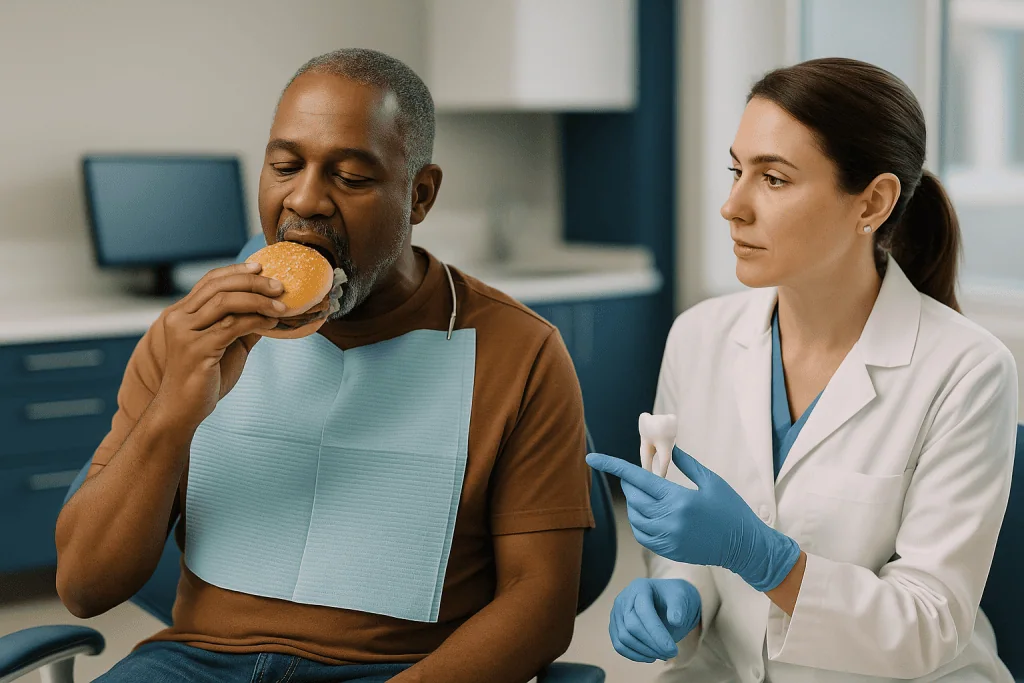
Next comes preparation: the tooth is numbed and reshaped to make room for the crown. Cleveland Clinic explains that the amount removed depends on the material chosen. Stronger ceramics can sometimes be made thinner, which preserves more of the natural tooth. Grinders present a balance: enough thickness for the ceramic to resist fracture, while keeping as much sound tooth structure as possible to anchor it.
An impression or digital scan records the prepared tooth and the way the jaws meet. Most crowns are then made in a laboratory, and a temporary crown covers the tooth in the meantime. Cleveland Clinic notes this interim period usually lasts a couple of weeks, though some practices mill certain crowns on site in a single visit.
At the fitting appointment the dentist tries the crown in, checks the contacts against neighboring teeth and the opposing arch, and adjusts it before cementing. Articulating paper, a thin colored strip that leaves marks where teeth touch, shows exactly where the new crown meets its partners. For a grinder, the dentist will also check contacts during sideways and forward jaw movements, not just a straight bite. If a night guard is planned, an impression for it is often taken once the final crown is in place, so the guard fits the new shape.
Who is usually a good candidate, and who is often asked to wait
A crown makes sense when a tooth has lost too much structure for a filling to hold: a cracked cusp, a large old restoration breaking down, or heavy wear that has exposed softer dentin. Cleveland Clinic lists protecting weak or worn teeth and covering a tooth after root canal treatment among the common reasons. People who grind fall into these categories more often than average, so the question is rarely whether a crown is reasonable but how to build one that survives.
Someone is more likely to proceed comfortably when the grinding is acknowledged and there is a plan to manage it, usually a custom guard. It also helps when the bite is stable, gums are healthy and there is enough remaining tooth to grip.
Dentists commonly suggest a pause in several situations:
- Unresolved tooth pain, which may point to a nerve problem that needs treating first.
- Active gum disease, since inflamed gums make accurate margins harder and shift the tissue line later.
- Suspected but unassessed sleep apnea. Mayo Clinic notes an association between sleep bruxism and sleep-related breathing disorders, and addressing the breathing problem may change how forcefully someone grinds.
- A bite that is still changing, for example during orthodontic treatment or in a teenager whose jaw is growing. Mayo Clinic observes that many children outgrow bruxism, so permanent restorations are often deferred where possible.
- Very little tooth left above the gum, where alternatives such as a post and core, or in severe cases removal and an implant-supported crown, come into the conversation.
None of these is an absolute barrier. They are reasons for the treating team to sequence care, and that sequencing is theirs to decide with the patient.
Which crown material holds up when you grind your teeth?
The word porcelain covers several quite different materials, and the differences matter more for grinders than for anyone else. Cleveland Clinic groups crown options into metal, porcelain-fused-to-metal, all-ceramic, zirconia and combinations. Here is how the main tooth-colored choices compare, described qualitatively because head-to-head clinical data in confirmed heavy grinders remains limited.

| Material | How it is built | Strengths for a grinder | Trade-offs |
|---|---|---|---|
| Feldspathic porcelain | Layered glass ceramic, often on a thin core | Most lifelike translucency | Most prone to chipping under heavy load; usually reserved for front teeth in low-force mouths |
| Porcelain-fused-to-metal | Metal shell veneered with porcelain | Rigid metal base resists fracture of the whole crown | The porcelain layer can still chip; a dark line may show at the gum |
| Lithium disilicate | Glass ceramic, monolithic or lightly layered | Good balance of appearance and toughness | Less fracture-resistant than zirconia in thin sections |
| Monolithic zirconia | Single block of zirconium dioxide ceramic | Highest fracture resistance among tooth-colored options | Older versions look opaque; very hard surfaces must be polished to protect opposing teeth |
| Gold or metal alloy | Cast or milled metal, no porcelain | Very forgiving, wears at a rate similar to enamel | Not tooth-colored; usually offered for back teeth |
Two points stand out. First, appearance and toughness pull in opposite directions; the most translucent ceramics are the most brittle. Second, laboratory strength tests do not automatically translate into years in a grinding mouth. Fatigue, moisture, cement quality and how much tooth remains all shape the outcome. Dentists weigh these against where the tooth sits, how visible it is and how forceful the grinding appears.
Monolithic or layered: why construction matters as much as material
Ask what a crown is made of and you will get one answer. Ask how it is built and you may get a more useful one. A monolithic crown is milled from a single block of one ceramic, so the material at the biting surface is the same as the material at the core. A layered crown has a strong core with a more translucent porcelain baked over it for appearance.
Chips in layered crowns almost always happen in that outer veneering layer, because it is the weaker component and it sits exactly where grinding forces land. For a back tooth in a grinder, many dentists lean toward monolithic construction for that reason. The trade-off is purely visual: a single-material crown can look flatter or more uniform in color, which matters more at the front of the mouth than at the back.
Surface finish is the second design choice with real consequences. Ceramic can be glazed, coated with a thin glassy layer, or hand-polished to a mirror finish. Once a glaze wears through, the rougher ceramic beneath can abrade the opposing tooth. Polished zirconia, by contrast, tends to be gentle on enamel despite its hardness. Whenever a dentist adjusts a crown at the chair, re-polishing the adjusted area is part of the job, not an optional extra.
Shape completes the picture. Steep, pointed cusps interlock nicely in a still mouth but catch during a sideways grind, concentrating force on small areas. Slightly flatter cusps and smooth slopes let teeth glide rather than snag. Thickness matters too: ceramic below the thickness its manufacturer specifies is where fatigue cracks tend to start, which is one reason the dentist may remove a little more tooth than you expected.
Do you really need a night guard for crowns if you grind?
An occlusal splint, more commonly called a night guard, is a custom-fitted device, usually of hard acrylic, worn over the upper or lower teeth during sleep. Mayo Clinic describes splints and mouth guards as a mainstay of bruxism management: they keep teeth apart and prevent the damage grinding causes. What they generally do not do is stop the grinding itself. Think of the guard as a sacrificial layer, wearing so that enamel and ceramic do not.
For someone with a new crown, that protection is doubly relevant. The crown is protected from direct contact with the opposing tooth, and the opposing tooth is protected from the ceramic. The NHS similarly advises a mouth guard to reduce damage in people who grind at night.
Custom guards and store-bought boil-and-bite versions are not equivalent. A custom guard is made from an impression or scan taken after the crown is in place, so it fits the new contours precisely and distributes load evenly. Off-the-shelf soft guards are bulkier, fit loosely and, in some people, seem to invite chewing rather than rest. Evidence comparing the two in crown longevity specifically is sparse, so most guidance rests on the mechanical logic and clinical experience rather than trials.
Practical points people often miss:
- A guard made before a crown may no longer fit afterward and can rock or press on the new tooth; it typically needs relining or remaking.
- Guards wear too. Deep grooves or cracks in the acrylic are a sign to have it checked.
- Cleaning matters: rinse and brush it with a soft brush, store it dry, and bring it to check-ups so the dentist can inspect both guard and bite.
What is a bite adjustment after crown placement, and why do grinders need careful ones?
A bite adjustment is a small, precise reshaping of a crown’s surface so that it meets the opposing teeth evenly. Dentists call a spot that touches first and hardest a high spot. In a relaxed mouth, a slightly high crown is an annoyance. In a grinding mouth, it becomes the focal point for every nightly clench, and both the crown and the tooth beneath it pay for that.
At the fitting visit, the dentist places articulating paper between the teeth and asks you to bite, then to slide your jaw left, right and forward. The colored marks show where contacts land. Ideal contacts on a new crown are light, even and spread across several points rather than one dark smudge. Any heavy spot is reduced with a fine polishing instrument and the surface is re-polished, because a freshly ground ceramic patch is rough and can wear the opposing tooth.
Why more than one check? Numbness during fitting can make it hard to feel whether the bite is right. Muscles that have been guarding a sore tooth relax over the following days, changing how the jaw closes. Grinders in particular may only notice a high spot after a few nights, when the tooth or its opposite partner feels tender to pressure. Cleveland Clinic advises contacting the dentist if a crown feels high or uncomfortable rather than waiting for it to settle.
Tell the dentist plainly if the crown feels like it hits first, if biting on it aches, if the tooth above or below it has started to complain, or if morning jaw tightness has worsened. These are ordinary reasons for a short review, and the fix is usually measured in minutes. The dentist decides how much to adjust and when to stop; over-adjusting thins the ceramic, so a light touch and a second look are the norm.
Zirconia vs porcelain crown: what the evidence actually shows for grinders
Zirconia is zirconium dioxide, a crystalline ceramic rather than a glass. Its structure allows it to resist crack growth in a way glass ceramics cannot, which is why it has become a common choice for back teeth in people who clench. The first generations were dense and opaque, suited to molars but unconvincing at the front. Newer formulations trade some of that toughness for translucency, so the phrase zirconia crown now covers a range of materials with different properties.
Traditional porcelain, in the sense most people mean, is a layered glass ceramic prized for its ability to mimic enamel. Lithium disilicate sits between the two: a glass ceramic with considerably better fracture resistance than layered feldspathic porcelain, and better esthetics than most zirconia.
What does the research support? Systematic reviews of tooth-supported single crowns generally report low fracture rates for both monolithic zirconia and lithium disilicate over medium-term follow-up, with chipping of veneering porcelain remaining the most frequently reported complication in layered designs. Two caveats matter for this article’s readers. First, many clinical studies exclude people with severe bruxism, so the strongest evidence comes from mouths unlike theirs. Second, the newest translucent zirconias have been in patients’ mouths for fewer years than the materials they are replacing, so long-term data is still accumulating.
The honest summary is this: for a molar under heavy grinding force, monolithic zirconia or monolithic lithium disilicate has stronger mechanical rationale than layered porcelain, and clinical experience supports that reasoning, but nobody can quote a guaranteed survival figure for a confirmed grinder. Cleveland Clinic frames the choice as a conversation about location, appearance, remaining tooth and habits, which is where the treating dentist’s judgment comes in.
What the first days and weeks usually look like
The temporary phase comes first. A temporary crown is made of acrylic or composite and cemented lightly so it can be removed later, which makes it the weakest link in the process. Cleveland Clinic advises avoiding sticky or very hard foods and chewing on the other side while it is in place. For a grinder this phase deserves extra attention: an existing guard may not fit the temporary, and the dentist may advise on whether to wear it, adapt it or go without for the interim.
After the permanent crown is cemented, numbness fades over a few hours. Some sensitivity to hot and cold in the first days is common, particularly if the tooth still has a live nerve, and Cleveland Clinic notes it usually eases on its own. Gums around the margin may feel slightly tender where the impression and cementing pressed on them.
The bite deserves your attention during the first week. Notice whether the crown feels taller than its neighbors, whether it aches when you bite down, or whether the opposing tooth has started to feel sore. Any of these is a reason to book a short adjustment visit rather than hoping it settles.
If a new guard is being made, it usually arrives within the following weeks. The first nights can feel strange: more saliva, a sense of bulk, occasionally a mildly sore spot where the acrylic presses. Most people adapt quickly, and a persistent sore spot is easily relieved by the dentist. Bring the guard to the review appointment so its fit and wear pattern can be checked alongside the crown.
From then on the pattern is routine care: brushing and flossing around the margin where decay tends to start, regular check-ups, and a fresh look at both bite and guard at each visit.
How long do crowns last if you grind your teeth?
Cleveland Clinic gives a typical range of 5 to 15 years for a dental crown with good care, while listing grinding and clenching among the habits that push a crown toward the shorter end. That range is an average across all materials and all mouths; it is not a forecast for any individual tooth.
It helps to separate what actually fails. Sometimes it is the ceramic: a chipped cusp or a crack through the crown. Sometimes the crown is intact but the cement has given way and the crown loosens. Often the culprit is the tooth beneath: decay creeping under the margin, or a root that fractures under repeated heavy load. Grinding raises the risk of all three, but each responds to different precautions.
Levers that influence longevity, in rough order of how much they seem to matter for grinders:
- Wearing a well-fitting guard consistently, since it removes most of the nightly load from the crown.
- Material and design chosen for the force involved: monolithic construction, adequate thickness, polished surfaces, gentler cusp slopes.
- Even contacts confirmed at fitting and rechecked at review.
- Daily cleaning at the gum margin, where bacteria and food collect against the crown edge.
- Addressing drivers of grinding, including stress and any suspected sleep-breathing problem, as discussed in the next section.
Implant-supported crowns deserve a note here, since heavy grinders sometimes end up with one after a root fracture. An implant has no periodontal ligament, the thin cushion of fibers that lets a natural tooth flex slightly under load, so the ceramic and screw components take force more directly. Guards are commonly advised for implant crowns in grinders for that reason. How long any of these restorations lasts in a particular mouth is a question only the treating team can weigh, and even they will speak in ranges rather than promises.
Treating the grinding itself: what helps and what the evidence says
A crown protects one tooth. Bruxism affects all of them, along with the jaw muscles and joints, so most dentists pair restorative work with an attempt to understand why the grinding is happening. Mayo Clinic lists stress and anxiety, sleep disorders including sleep apnea, certain medications such as some antidepressants, and stimulants including caffeine, tobacco and alcohol among the factors linked to bruxism. Family history plays a part as well.
Management follows from those causes. For awake clenching, simple awareness often helps: noticing when teeth are pressed together during concentration and letting the jaw hang loose. For sleep bruxism, Mayo Clinic notes that stress management, behavioral strategies and good sleep habits are the first-line approaches, alongside a splint to limit damage. The NHS makes similar points, adding that reducing alcohol and stimulants before bed is reasonable.
If snoring, gasping during sleep or daytime sleepiness accompany the grinding, a conversation with a physician about sleep apnea is worthwhile. Treating a breathing disorder is a medical decision, not a dental one, and improved sleep sometimes reduces grinding as a side benefit rather than a guaranteed result.
Medication has a modest role. Mayo Clinic describes muscle relaxants used short term in some cases, and botulinum toxin injections into the jaw muscles as an option considered for severe bruxism that has not responded to other measures, while noting that medicines in general have not proved very effective for this condition. Where a prescribed antidepressant appears to be contributing, the prescribing clinician is the person to raise it with; no one should adjust or stop such a medicine on their own. Evidence for many of these approaches is limited and mixed, and honest clinicians say so.
Risks and alternatives to a porcelain crown in neutral terms
Every crown carries some risk, and grinding shifts the odds on several of them. Cleveland Clinic lists sensitivity, chipping, loosening, a crown falling out, gum irritation and, rarely, an allergic reaction to metal components among possible complications. Reshaping a tooth can also irritate its nerve; a minority of crowned teeth later need root canal treatment, and a heavily worn tooth that has already been through years of grinding is somewhat more vulnerable to this. Wear on the opposing tooth, discussed earlier, is a risk specific to hard, unpolished ceramics.
Alternatives exist along a spectrum from less to more invasive:
- Monitoring with a guard alone, appropriate when wear is present but the tooth is structurally sound and not cracked.
- Composite build-ups, tooth-colored resin bonded to worn surfaces. Less durable under grinding force but reversible and tooth-conserving.
- Onlays, partial-coverage restorations that replace only the damaged part of the biting surface. These preserve more tooth but rely on adequate remaining structure.
- Gold or metal-alloy crowns, which wear at a rate close to enamel and rarely fracture, at the cost of appearance.
- Removal and replacement with an implant-supported crown or a bridge when a root has split beyond repair.
Each option trades durability, appearance and how much tooth is sacrificed. A dentist weighs them against how much structure is left, where the tooth sits, how forceful the grinding appears and the patient’s priorities. The NHS is clear that heavily damaged teeth may need crowns while milder wear may need no restoration at all, only protection. That judgment, and its timing, belongs with the treating team and the person in the chair.
What people often get wrong about crowns and grinding
Myths cluster around this topic, partly because dental materials have changed faster than public understanding. A few corrections, grounded in what the evidence actually supports.
Zirconia cannot break. It is the toughest tooth-colored option, not an indestructible one. Thin sections, poor cement, heavy lateral forces and manufacturing flaws can all lead to fracture, and the tooth beneath can still fail even when the ceramic does not.
A crown fixes grinding. A crown repairs one tooth. It does nothing to the habit, and without a guard the crown simply becomes the next surface to wear. Mayo Clinic describes dental correction as a way to repair damage, not to stop bruxism.
Wearing a guard weakens the crown or the bite. A well-fitted hard guard distributes force and spares the crown. Problems arise from ill-fitting guards, not from guards as such.
A soft drugstore guard is just as good. Soft, bulky guards fit imprecisely and can encourage chewing. Direct comparisons in crown longevity are lacking, but the mechanical case for a custom hard guard is strong and mainstream sources favor professionally made devices.
Adults grow out of grinding. Mayo Clinic notes that children often do; adults generally do not without addressing the drivers such as stress or sleep disorders.
All ceramic is equally harsh on opposing teeth. Roughness matters more than hardness. A polished zirconia surface is gentler than a worn glaze on a softer porcelain.
If the crown does not hurt, the bite must be fine. Grinding damage accumulates silently. Even contacts are confirmed with articulating paper at review, not by comfort alone.
Questions to ask your care team before a crown when you grind
A ten-minute conversation before treatment often prevents a much longer one afterward. Bring these questions and expect answers that reflect judgment rather than certainty, since an honest dentist will describe ranges and trade-offs.
- Which material and construction are you recommending for this tooth, and what makes it suited to my grinding pattern?
- Will the crown be monolithic or layered, and how will the biting surface be finished to protect the opposing tooth?
- How much of my natural tooth will need to be removed to reach the thickness this material requires?
- Do you see signs of a crack or nerve involvement that might change the plan?
- Should my existing night guard be remade or relined once the crown is in, and when will the new impression be taken?
- How will you check my bite during sideways and forward movements, not just when I close straight down?
- When is the review appointment for a second bite check, and what should prompt me to come in sooner?
- Would a partial-coverage onlay, a metal crown or monitoring with a guard be reasonable alternatives in my case?
- Are there signs in my mouth or my sleep history that suggest I should discuss sleep apnea with a physician?
- How do I clean around the crown margin, and what does wear on my guard look like when it is time to replace it?
Write the answers down or ask for them in writing. Materials, guard plans and review timing are easy to forget once the numbness wears off, and having a record makes future visits, possibly with a different clinician, far more useful.
When to call your doctor or dentist
Most of what follows a crown is uneventful, but grinding raises the stakes on a few specific problems, and some of them are urgent. Contact the dental practice the same day if a crown comes off or feels loose, if a piece of ceramic breaks away leaving a sharp edge, if biting on the crown produces a sharp or lingering pain, or if the crown still feels high after the first few days. A loose or lost crown leaves prepared tooth exposed, and Cleveland Clinic advises keeping the crown and seeing the dentist promptly rather than attempting a home repair.
Seek care urgently, through the dentist or an emergency department, for any of these red flags:
- Swelling of the face, jaw or gum, especially with fever or a foul taste, which may indicate infection.
- Difficulty swallowing or breathing alongside facial swelling; this is an emergency.
- A crown that has been inhaled rather than swallowed, suggested by coughing or breathlessness after it dislodged.
- The jaw locking open or closed, or a sudden inability to bring the teeth together.
- Pain that wakes you at night or is not relieved by the measures the dentist advised.
- Bleeding from the gum around the crown that does not stop.
Speak to a physician as well if the grinding is accompanied by loud snoring, pauses in breathing during sleep, morning headaches or marked daytime sleepiness. Mayo Clinic links sleep bruxism with sleep-related breathing disorders, and that assessment sits with medical rather than dental care. Persistent ear pain, jaw joint pain or headaches centred at the temples also warrant a visit; they may reflect muscle overload from clenching. In every case, the treating team decides what the symptoms mean and what to do next.
Frequently asked questions
Can I get a porcelain crown if I grind my teeth at night?
Yes, in most cases, but the dentist will usually adjust the plan. Tougher ceramics such as monolithic zirconia or lithium disilicate are often favored over thin layered porcelain, the crown is shaped with gentler slopes, and a custom night guard is typically recommended. The decision depends on how much tooth remains, where it sits and how forceful the grinding appears, all of which the treating dentist assesses.
Is a zirconia vs porcelain crown a meaningful difference for grinders?
It can be. Zirconia is a crystalline ceramic that resists crack growth better than glass-based porcelain, which is why it is commonly chosen for back teeth under heavy force. Layered porcelain looks more lifelike but chips more readily. Lithium disilicate sits between them. Long-term data in confirmed heavy grinders is limited, so dentists rely on mechanical reasoning and clinical experience alongside published follow-up.
Do I need a night guard for crowns if I only clench during the day?
Daytime clenching is often managed by awareness rather than a device, since you can notice and release it. A guard is mainly for sleep, when you cannot. Many people do both without realizing it, so a dentist may look for wear patterns and ask a partner about noises at night before deciding. Mayo Clinic lists both splints and behavioral strategies as standard approaches.
How long do crowns last for people who grind their teeth?
Cleveland Clinic gives a general range of 5 to 15 years for a crown with good care, and lists grinding and clenching among the habits that shorten that span. No specific figure exists for grinders as a group. Consistent guard use, a durable material and design, even bite contacts and careful cleaning at the margin all influence where an individual crown lands within that range.
What does a bite adjustment after crown placement involve?
The dentist places thin colored articulating paper between your teeth, asks you to bite and slide your jaw in different directions, and reads the marks to find any spot on the crown that touches first or hardest. That spot is reduced with a fine instrument and re-polished. The process takes minutes and is often repeated at a review visit once numbness and muscle guarding have settled.
Will a porcelain crown wear down the tooth opposite it?
It can if the surface is rough. Roughness matters more than hardness: a worn glaze on softer porcelain can abrade enamel, while highly polished zirconia tends to be gentle despite being harder. This is why dentists re-polish any area they adjust and why a night guard, which keeps the two surfaces apart during sleep, protects the opposing tooth as much as the crown.
Can a crown stop my teeth grinding?
No. A crown repairs a single damaged tooth; it has no effect on the habit itself. Mayo Clinic describes dental restoration as a way to repair grinding damage, while stress management, sleep improvements, treating any sleep-breathing disorder and wearing a splint are the approaches aimed at the grinding. Without those, a new crown simply becomes the next surface to wear.
Should I wear my old night guard over a new crown?
Check with the dentist first. A guard made before the crown was placed may no longer fit the new contour, and a guard that rocks or presses on one tooth can do more harm than good. Dentists commonly reline or remake the guard after the final crown is cemented, often taking the impression at the fitting visit or at review.
Why did my dentist mention sleep apnea when I asked about a crown?
Because sleep bruxism and sleep-related breathing disorders are associated, according to Mayo Clinic. Signs such as loud snoring, gasping during sleep, morning headaches or daytime sleepiness alongside worn teeth may prompt a referral to a physician. Assessing and treating a breathing disorder is a medical decision, and improved sleep sometimes reduces grinding, though that benefit is not guaranteed.
Are there alternatives to a full porcelain crown for a worn, grinding tooth?
Several, depending on how much tooth remains. Options include monitoring with a guard alone, composite build-ups bonded to worn surfaces, partial-coverage onlays that preserve more tooth, and gold or metal-alloy crowns that rarely fracture and wear at a rate close to enamel. Each trades durability, appearance and tooth conservation differently, and the treating dentist weighs them against the individual tooth.
References
- NHS: Teeth grinding (bruxism)
- Cleveland Clinic: Dental crowns
- Cleveland Clinic: Bruxism (teeth grinding)
- MedlinePlus: Bruxism
This article is for general information only and is not a substitute for professional medical advice. Please consult a qualified doctor about your individual situation.

More from the Blog

Is All On 4 Possible With Bone Loss? How Angled Implants Use the Bone You Still Have
Often, yes. All-on-4 with bone loss is frequently possible because the technique places four implants where bone usually remains, at the front of the…
Which Zirconium Crown Suits Front or Back Teeth? Layered vs Monolithic Zirconia Compared
For most back teeth, a monolithic zirconia crown, milled from a single block with no porcelain layer, is usually preferred because there is no…
How Removable Dentures Are Made: Impressions, Bite Records, Try-In and the Final Fitting
Removable dentures are made over several appointments, usually spread across a few weeks. The dentist takes preliminary and then detailed impressions of the gums,…
Implant-Supported Dentures: Fixed vs Removable: the Honest Comparison
Implant-supported dentures replace a full arch of teeth using implants anchored in the jawbone. Removable (snap-in) overdentures usually rest on two to four implants,…
Which Dental Prosthetic Fits Your Situation? From a Single Missing Tooth to a Full Arch
The dental prosthetic you need depends mainly on how many teeth are missing, where they sit, the health of the neighboring teeth and jawbone,…
All On 6 Surgery Explained: Implant Positions, Same-Day Temporary Bridge and the Final Teeth
The all on 6 procedure replaces a full upper or lower row of teeth with a single fixed bridge anchored to six dental implants…