

Preparing for Facial Augmentation: Facial Analysis, Implant Choices and Stopping Smoking
Key Takeaways
- A thorough facial augmentation consultation measures facial thirds, fifths and profile angles to separate what you dislike from what is causing it, and may end in a referral rather than a booking.
- Chin implants add forward projection well but cannot add vertical height or correct tooth position; those problems point toward genioplasty or jaw surgery instead.
- Solid silicone implants are easy to remove because tissue forms a capsule around them, while porous polyethylene anchors through tissue ingrowth and is harder to take out later.
- The WHO reports that stopping smoking about four weeks or more before surgery lowers complication risk, with each further smoke-free week adding roughly a fifth more benefit.
- Hyaluronic acid fillers can be dissolved and used as a temporary preview of added volume before committing to a permanent implant.
- The NHS advises a cooling-off period, typically two weeks, between a cosmetic surgery consultation and consent, and flags pressure to decide quickly as a warning sign.
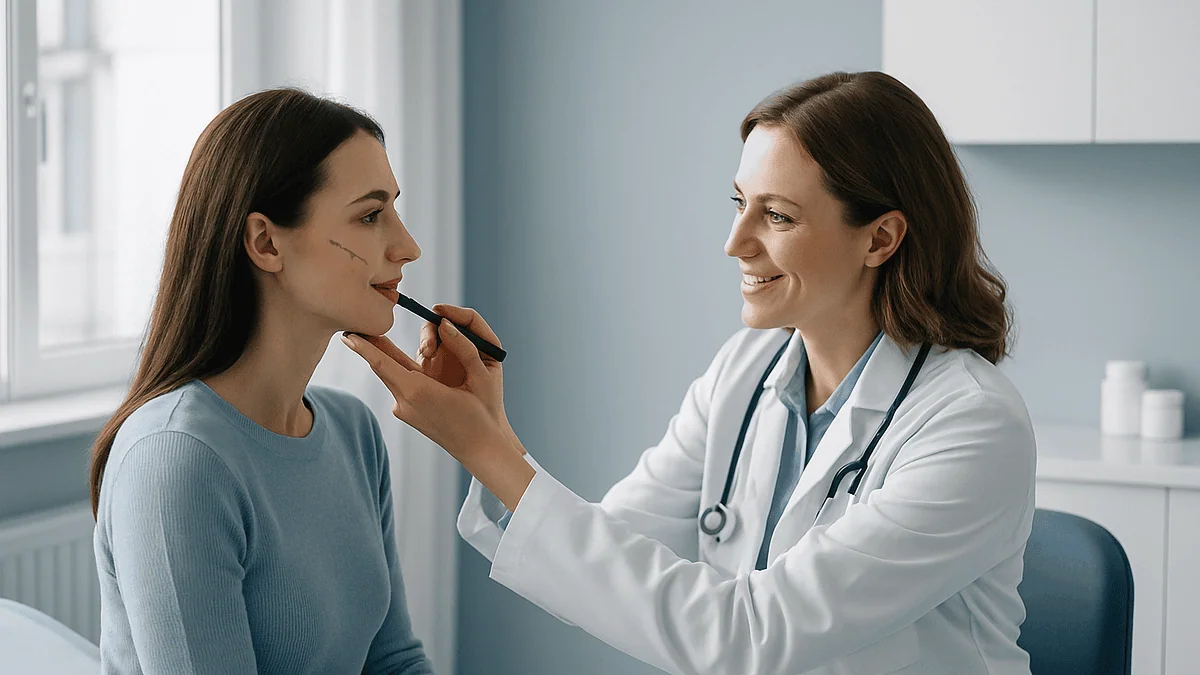
A facial augmentation consultation is a structured assessment before surgery to add volume or projection to the chin, cheeks or jaw. The surgeon measures facial proportions, reviews your health and goals, and explains options such as solid implants, fat grafting or fillers. Expect questions about smoking, medicines and expectations, a cooling-off period, and a decision that stays with you and your treating team.
Maria noticed it first in a video call. Not the wrinkles she had braced herself for, but the way her chin seemed to retreat every time she turned her head. She searched, half-embarrassed, and found glossy pages full of profiles that looked nothing like hers. What she did not find was a plain account of what actually happens when you sit down with a surgeon to talk about it.
That is the gap this article fills. A facial augmentation consultation is not a sales appointment and it is not a quick chat about “a bit more chin.” Done properly, it is closer to an engineering review of your face: angles, bone, soft tissue, airway, bite, skin quality, health history and, crucially, whether you smoke.
We will walk through the measurements, the implant materials, the alternatives, the honest limits of the evidence and the one lifestyle change that changes outcomes more than any other.
What happens at a facial augmentation consultation?
Most people picture a mirror and a marker pen. The real appointment starts with talking. The surgeon wants to know what bothers you, when you first noticed it, what you have already tried and what you hope will change. Vague answers such as “I just want to look better” are not wrong, but they prompt more questions, because the surgeon cannot plan around a feeling.
Next comes a medical history: past operations, healing problems, bleeding tendencies, allergies, dental work, jaw pain, snoring, current medicines and supplements, and tobacco or nicotine use in any form. The NHS advises that a reputable practitioner should ask about your physical and mental health and explain why they are asking, rather than skipping to the procedure.
Then the examination. You will be looked at from the front, both sides and often from below, at rest and while smiling and speaking. Standardized photographs are taken under fixed lighting. Some surgeons use three-dimensional imaging; others rely on calipers and trained eyes. Both are legitimate. What matters is that the assessment is systematic.
Only after that does the conversation turn to options: implant, fat graft, filler, orthognathic (jaw-repositioning) surgery, or no treatment at all. A good surgeon will spend real time on risks and alternatives and will not expect a decision in the room. The NHS recommends a cooling-off period, typically two weeks, between consultation and consent for cosmetic surgery, and describes pressure to book quickly as a warning sign.
You should leave with written information, a clear idea of what was recommended and why, and permission to say no.
Facial analysis: what the surgeon is really measuring
Facial analysis is the systematic measurement of how the parts of the face relate to one another in size, position and angle. It sounds clinical because it is. The point is to separate what you dislike from what is actually causing it.
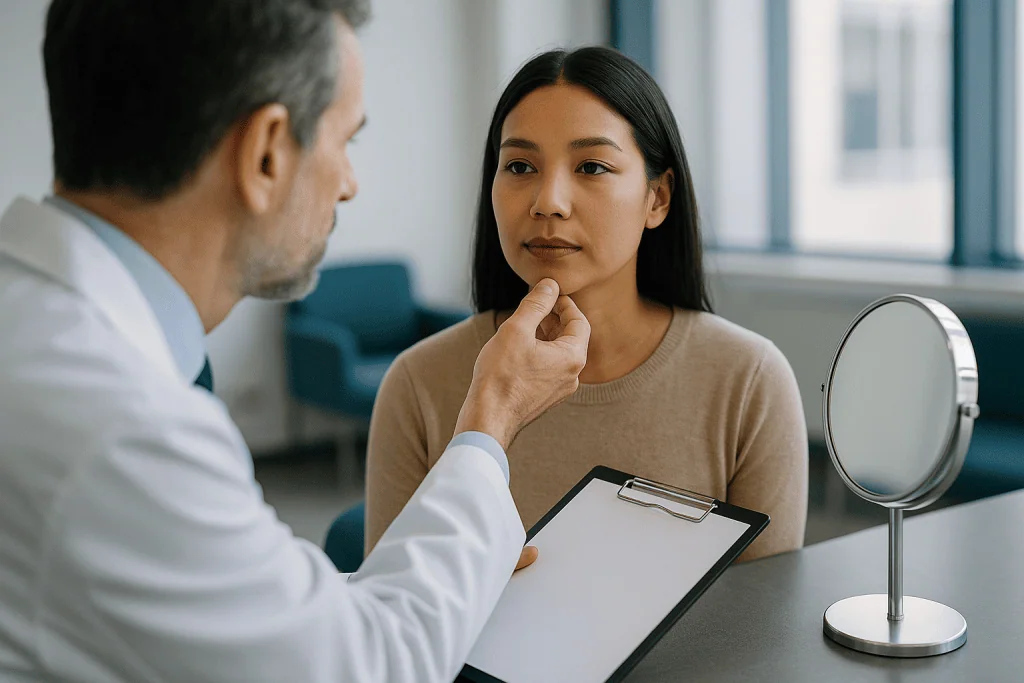
A common starting framework divides the face into horizontal thirds (hairline to brow, brow to base of nose, nose to chin) and vertical fifths (roughly one eye-width each). Nobody fits these ratios exactly, and surgeons treat them as a language for describing proportion, not a target to hit. A chin that appears small may in fact be a normal chin sitting under a prominent nose, or a lower face that is short from top to bottom rather than short from front to back.
In profile, the surgeon draws or imagines a vertical line dropping from the lower lip and checks where the chin sits relative to it. The angle between the neck and the jawline, the depth of the fold between lip and chin, and the fullness of the tissue under the jaw all feed into the plan. Cheek assessment looks at where the highest point of the cheek sits relative to the eye and nose, and whether the hollow beneath it comes from bone shape, fat loss with age, or both.
Bite and teeth matter too. If the upper and lower teeth do not meet properly, the visual problem may be a jaw position issue that an implant would only disguise. That is why some consultations end with a referral to an orthodontist or maxillofacial surgeon rather than a booking.
Skin thickness, symmetry (nearly everyone is asymmetric) and how the tissues move when you talk complete the picture.
Chin implant consultation: profile, bite and the question behind the question
Chin augmentation is the most common reason people book a facial augmentation consultation, and it has a longer safety track record than most cosmetic operations. MedlinePlus describes it as surgery to reshape or enhance the size of the chin, usually with an implant placed through a small cut inside the mouth or under the chin.
The examination focuses on projection, meaning how far forward the chin sits, and on vertical height. Implants add projection well. They are far less good at adding height or correcting a chin that is off to one side, and they do nothing for the position of the teeth. When the underlying issue is a jaw that sits too far back, surgeons may raise the alternative of a sliding genioplasty, an operation that cuts and repositions the chin bone itself, or a jaw operation. These are bigger procedures with different trade-offs, and hearing about them is a sign of a thorough consultation, not an upsell.
Expect questions about the nose. A retruding chin makes an average nose look large, and some people who arrive asking about rhinoplasty leave discussing the chin, or the reverse. The surgeon is checking the balance of the whole profile rather than one feature.
You will also be asked about numbness, since the nerve supplying feeling to the lower lip runs close to where an implant sits. MedlinePlus lists numbness and implant movement among the specific risks of chin surgery, alongside general surgical risks such as infection and bleeding. Ask how often the surgeon has seen these and what they do about them.
Finally, expect the question behind the question: what do you think will be different in your life afterwards? A calm, specific answer helps both of you.
Cheek and jaw augmentation: how the options differ
Cheeks and jawline follow the same principles as the chin, with two differences. The anatomy is more complex, and the choice between surgical and non-surgical approaches is more finely balanced.

Cheek augmentation aims to restore or create fullness over the cheekbone. Solid implants sit directly on bone through an incision inside the mouth or occasionally through the lower eyelid. They provide a permanent, fixed shape. Fat grafting, meaning fat removed from elsewhere on your body, processed and injected in small amounts, gives a softer result whose volume partly resorbs over the first months. Fillers, injectable gels most commonly based on hyaluronic acid, a sugar molecule already present in skin, add volume temporarily and are the least invasive option. The NHS notes that filler results typically last months rather than years and that they carry their own risks, including lumps, infection and, rarely, blockage of a blood vessel.
Jaw angle augmentation adds width and definition to the back corner of the lower jaw. It is technically demanding because the muscles used for chewing lie directly over the site, and swelling and temporary difficulty opening the mouth are expected in the early days.
The consultation should make clear which structure is being changed. Many people who ask for “cheekbones” actually have age-related loss of the fat pads below the cheek, and adding bone-level projection would leave the hollow untouched. Others have genuinely flat malar bones (the cheekbones themselves) and would gain little from soft filler.
There is no strong comparative evidence ranking these approaches against each other for appearance. The honest summary is that implants offer permanence and predictability of shape at the cost of surgery; injectables offer reversibility at the cost of repetition.
Facial implants vs fillers vs fat grafting: a side-by-side comparison
People searching “facial implants vs fillers” usually want a straight answer about which is better. There is not one. There is a set of trade-offs, and the right column depends on your anatomy, your tolerance for surgery and how you feel about permanence. The table summarizes what mainstream sources such as the NHS and MedlinePlus describe.
| Feature | Solid implant | Fat grafting | Injectable filler |
|---|---|---|---|
| Setting | Operating room, local with sedation or general anesthesia | Operating room, usually sedation or general | Clinic room, topical or local anesthetic |
| Durability | Intended to be permanent | Surviving fat is long-lasting; part resorbs early | Months, varies by product and site |
| Reversibility | Removable with further surgery | Difficult to remove precisely | Hyaluronic acid types can be dissolved |
| Best suited to | Bone-level deficiency, clear structural change | Soft-tissue hollowing, blending contours | Trial of a look, small refinements |
| Main specific risks | Infection, shifting, numbness, visible edges | Uneven take, lumps, donor-site bruising | Lumps, asymmetry, rare vascular blockage |
| Downtime | Days to a few weeks of visible swelling | Similar, plus donor site | Usually a day or two |
Two points deserve emphasis. First, a filler trial is a genuinely useful diagnostic tool: seeing a temporary version of added chin or cheek volume tells you and the surgeon whether the direction is right before anything permanent happens. Second, “permanent” does not mean maintenance-free. Faces keep aging around an implant, and a shape that suits a thirty-year-old face may need reassessment decades later.
Whichever column you lean toward, the decision belongs to you and your treating team, made after examination, not from a chart.
Implant materials explained without the marketing
Facial implants are made from a small number of materials, and the differences matter for how they feel, how they are fixed and what happens if they need to come out. Your surgeon will have preferences based on training and experience. Ask them to explain the reasoning rather than the brand.
Silicone here means solid, medical-grade silicone rubber, not the gel used inside breast implants. It is smooth, flexible enough to pass through a small incision, and easy to carve during surgery. Tissue forms a thin capsule around it rather than growing into it, which makes later removal relatively straightforward. The same property means the implant relies on a snug pocket, and sometimes a small screw, to stay put.
Porous polyethylene is a firmer plastic with tiny interconnected pores. Surrounding tissue and blood vessels grow into those pores over months, which anchors the implant and may lower the chance of it shifting. The trade-off is that removal, if ever needed, is more involved because the implant has become part of the surrounding tissue.
Expanded polytetrafluoroethylene, a soft, sheet-like material, is used less often for volume and more for subtle contour work.
There is no high-quality trial evidence that one material produces reliably better appearance than another. Infection and displacement rates reported in surgical literature vary with site, technique and how the studies were run, and mainstream patient sources such as MedlinePlus list these as known risks of chin implant surgery without ranking materials. Treat any claim that a particular product is “the safest” or “the most natural” as a claim to be questioned, not a fact.
What you can reasonably ask is which material the surgeon uses most, why, and what their approach is when a complication occurs.
Who is facial augmentation usually for, and who is asked to wait?
The typical candidate is an adult in good general health with a specific, stable concern about facial proportion, realistic expectations and no pressure from anyone else to have surgery. Age itself is not a barrier, but surgeons generally want facial bone growth to be complete, which is why augmentation is rarely considered before the late teens, and many prefer to wait longer.
People are commonly asked to wait, or are advised against surgery for now, when:
- They currently smoke or use nicotine products, for reasons covered in the next section.
- Blood sugar, blood pressure or another chronic condition is not yet well controlled, because these affect healing and anesthesia safety.
- They have an active dental or gum infection, since an intraoral incision opens a path for bacteria to reach an implant.
- Their concern about the feature is severe, preoccupying and out of proportion to what others can see. The NHS describes body dysmorphic disorder as a mental health condition in which a person spends a lot of time worrying about flaws in their appearance that are often unnoticeable to others, and notes that cosmetic procedures do not help and can make symptoms worse. Surgeons who screen for this are protecting you, not judging you.
- A major life event, bereavement or relationship breakdown is the trigger. Motivation tends to be steadier when it has lasted through calm periods too.
- They are pregnant, breastfeeding or planning pregnancy soon.
None of these is a moral judgment. They are risk factors for poor healing or for regret, and a consultation that raises them is doing its job. If you are asked to wait, ask what would need to change and whether a review appointment makes sense. Some people return months later in a better position; others find that the pause resolved the question entirely.
How long to quit smoking before surgery, and why it matters more for the face
If you take one thing from this article, take this. Nicotine narrows small blood vessels, and carbon monoxide from smoke reduces how much oxygen the blood can carry. Healing tissue needs both blood flow and oxygen. The face is well supplied with blood, which is a mercy, but an implant sits in a closed pocket where the surrounding tissue must seal cleanly around a foreign body. Reduced oxygen delivery raises the odds of infection, wound breakdown and, in the worst case, an implant that has to be removed.
The World Health Organization, drawing on a joint review with surgical and anesthesia bodies, states that people who stop smoking around four weeks or more before an operation have a lower risk of complications and better results six months afterwards, and that every additional tobacco-free week after that point improves outcomes further, by roughly a fifth per week in their analysis. The WHO also notes that smokers face a higher risk of heart and lung complications during and after anesthesia and of delayed wound healing.
Vaping and nicotine patches are not a loophole for the vascular effect, because nicotine itself constricts vessels. Nicotine replacement is, however, far less harmful than smoke overall, and whether to use it in the run-up to surgery is a judgment for you and the prescribing clinician. There are also prescription medicines that reduce craving by acting on nicotine receptors in the brain; if one is suggested, the choice, timing and monitoring belong with the clinician who prescribes it.
Surgeons commonly ask for a smoke-free window before and after surgery and some test for nicotine breakdown products. This is not gatekeeping for its own sake. It is the single most modifiable factor in whether a facial implant heals uneventfully.
Medicines, supplements and health checks before facial surgery
Bring a complete list of everything you take, including over-the-counter products, herbal remedies and vitamins. Several common items affect bleeding or anesthesia, and the surgeon and anesthetist need to know about them well in advance so that any change can be planned by the prescribing clinician rather than improvised the night before.
Classes that typically come up include anticoagulants and antiplatelet medicines (blood thinners prescribed for clots, stents or heart rhythm problems), non-steroidal anti-inflammatory painkillers, and certain supplements such as fish oil, high-dose vitamin E, ginkgo and garlic extracts, which can increase bruising. Never stop a prescribed medicine on your own initiative because you have surgery booked; the risk of a clot or stroke from stopping some blood thinners can outweigh the bleeding risk they pose. The instruction to pause, continue or bridge must come from the doctor who prescribes it, coordinated with the surgical team.
Diabetes, high blood pressure, thyroid disease and sleep apnea all influence anesthesia planning. Sleep apnea deserves a specific mention for chin and jaw surgery, because the airway is close to the operative field and swelling can narrow it temporarily. Tell the team if you snore heavily or have been told you stop breathing in your sleep.
Depending on your age and history, you may be asked for blood tests, an electrocardiogram or a dental check. A dental review before intraoral implant surgery is sensible because an unnoticed gum infection is an avoidable route for bacteria.
Mayo Clinic’s general guidance on cosmetic surgery stresses choosing a surgeon certified in the relevant specialty, having procedures in accredited facilities, and disclosing your full health history. Those are unglamorous points. They are also where most avoidable problems are prevented.
Photographs, simulations and the expectations conversation
Standardized photographs are taken at every serious facial augmentation consultation, and they serve you as much as the surgeon. Taken again after surgery under the same lighting and angles, they are the only objective record of what changed. Casual phone photos flatter or distort depending on lens distance and lighting; clinical images do not.
Some practices offer computer simulations that morph your image toward a proposed result. These can be genuinely helpful for showing direction and scale, and equally useful for showing you that what you imagined might look wrong on your face. Treat a simulation as a sketch, not a contract. Skin, swelling and healing do not follow software, and the NHS warns against any promise of a specific result from cosmetic surgery.
The expectations conversation is where honest surgeons earn their keep. Facial augmentation can change proportion. It cannot make a face symmetrical, because no face is, and asymmetry that was invisible before can become noticeable once you start studying your profile daily. It does not change skin texture, remove jowls or lift a sagging neck. It will not make a person who felt unseen at parties feel seen.
Ask to view photographs of the surgeon’s own patients with a starting point similar to yours, including cases they consider average rather than their best, and cases where something needed revision. A surgeon willing to show a problem they fixed is displaying judgment, not weakness.
Write down the two or three specific changes you want before the appointment. If the surgeon’s plan does not address them, or addresses different things, that mismatch is the most useful thing the consultation can reveal.
What actually happens on the day of facial implant surgery
Facial implant procedures are usually day surgery. Chin augmentation is often done under local anesthetic with sedation, meaning you are relaxed and drowsy but breathing on your own; cheek and jaw angle implants and combined procedures more often use general anesthesia. The anesthetist decides this with you based on your health and the plan, not on preference alone.
You will be asked not to eat or drink for a set period beforehand, to arrive without makeup or jewelry, and to have an adult available to take you home and stay with you the first night. Surgical marking is done while you are awake and upright, because facial contours change when you lie down.
For a chin implant, the incision is either inside the lower lip or in the natural crease under the chin. MedlinePlus describes the surgeon creating a pocket over the bone, placing the implant and closing with stitches, with the whole operation typically taking about an hour or two. Cheek implants usually go in through an incision inside the upper lip. Jaw angle implants go in through the mouth near the back molars. Some surgeons secure implants with a tiny screw; others rely on a precisely sized pocket.
Fat grafting adds a harvesting step, commonly from the abdomen or thigh, before the fat is prepared and injected in many small passes.
Afterwards you may wake with a light dressing or tape over the chin or cheeks to limit swelling and hold the implant position during the first days. Pain is generally described as pressure and tightness rather than sharp pain; your team will prescribe what they judge appropriate and give written instructions on mouth care, diet and activity. Follow those instructions over anything you read online, including this article.
Cheek implant recovery time and what the following weeks look like
Recovery after facial augmentation is front-loaded. The first two to three days bring the most swelling and stiffness. Chewing feels awkward, smiling feels strange, and if the incision is inside the mouth you will be on soft foods and rinsing after every meal. Bruising can migrate downward into the neck for a chin procedure or toward the lower eyelids for cheeks; this is gravity, not a complication.
MedlinePlus advises that after chin augmentation you can expect swelling and bruising that improves over the first week or two, with most people returning to routine activities within a week and to strenuous exercise once cleared, often a few weeks later. Cheek implant recovery time follows a similar pattern, though numbness of the upper lip and cheek from stretched nerves can take longer to fade. Jaw angle implants tend to produce the most prolonged stiffness because the chewing muscles are disturbed.
A rough timeline that many teams describe, always subject to your own surgeon’s instructions:
- Days one to three: peak swelling, head elevated when resting, cold compresses if advised, liquids and soft food.
- Days four to ten: stitches inside the mouth dissolve or are removed, bruising yellows, many people feel presentable with light makeup.
- Weeks two to six: residual swelling settles, sensation returns gradually, return to exercise as directed.
- Months three to six: the final contour becomes clear as deep swelling resolves and, for fat grafting, as surviving fat stabilizes.
Do not judge the result in the first month. Faces look over-projected while swollen, and the moment of doubt around week two is common enough that some surgeons warn about it in advance. Your follow-up appointments exist to catch problems and to talk you through this phase.
Risks of facial augmentation and how a good surgeon discusses them
Every operation carries the general risks of bleeding, infection, poor scarring and reaction to anesthesia. Facial implants add a specific set, and a trustworthy consultation names them plainly.
Infection around an implant is the complication surgeons worry about most, because an infected foreign body often cannot be rescued with antibiotics alone and may need to come out, with re-insertion considered only after the tissues have healed. Smoking, diabetes, intraoral incisions and poor dental health all raise the odds. Implant shifting or rotation can produce visible asymmetry; it is more likely with unsecured smooth implants and usually correctable with revision. Altered sensation, from tingling to numbness of the lip or cheek, is common early and usually improves, but a small proportion of people are left with permanent change. MedlinePlus lists numbness and implant movement among the risks of chin surgery specifically.
Less often discussed is bone resorption, a slow thinning of the bone under a chin implant over years; it is generally mild and not visible, but it exists. Visible or palpable implant edges, especially in people with thin skin, and a result that looks over-projected or simply not what you imagined round out the list. Fat grafting adds unevenness and partial loss of volume; fillers, per the NHS, add lumps, infection and rare vascular blockage.
Mainstream patient sources do not publish reliable complication percentages for facial implants, and numbers quoted in individual surgical series vary widely with technique and follow-up. Be wary of anyone who gives you a confident single figure. Ask instead how the surgeon handles each complication, how quickly they would see you, and who covers the cost of revision surgery in their practice, a question worth asking even though this magazine does not quote figures.
What people often get wrong about facial augmentation
Myth: an implant fixes a weak jawline. An implant adds projection to a bony point. If the softness along the jaw comes from loose skin or fat under the chin, the implant may sharpen the profile slightly while leaving the actual complaint untouched, and a neck procedure or weight discussion may be more relevant.
Myth: fillers are risk-free because they are “just an injection.” The NHS is clear that dermal fillers carry real risks, including infection and, rarely, blockage of a blood vessel that can damage skin or vision. The lower risk profile compared with surgery is real; zero risk is not.
Myth: switching to vaping or patches before surgery removes the healing problem. Nicotine itself constricts small vessels. The WHO’s advice on preoperative quitting concerns tobacco smoke specifically, and stopping smoke is the largest gain, but nicotine in any form is a topic to raise honestly with your team rather than a technicality to work around.
Myth: a good surgeon will tell you exactly what you will look like. Simulations and measurements narrow the range; they do not eliminate it. Skin, swelling and healing vary, and the NHS warns against promises of specific results.
Myth: the surgeon who says yes fastest is the most confident. The NHS lists pressure to decide quickly and reluctance to discuss risks or alternatives as warning signs, and recommends a cooling-off period. Being told to wait, to see a dentist first, or to stop smoking for a month is evidence of care.
Myth: regret is rare and only happens to unreasonable people. Regret after cosmetic surgery is under-studied, but the pattern in what evidence exists points to unrealistic expectations, external pressure and untreated body image distress rather than to any single operation. That is why the questions about motivation matter.
Questions to ask your care team at a facial augmentation consultation
Arrive with questions written down. Nerves erase memory, and the surgeon will respect preparation. These are the ones that tend to change decisions.
- Based on your analysis, what exactly is causing the appearance I dislike, bone, soft tissue or both?
- Which options would address it, including options you do not offer yourself, and why do you recommend this one for me?
- Would a temporary filler trial be a sensible way to preview the change before anything permanent?
- Which implant material and size do you propose, how do you secure it, and what is your approach if it shifts or becomes infected?
- How many of this specific procedure do you perform, and may I see photographs of patients whose starting point resembles mine, including revisions?
- What is your policy on smoking and nicotine before and after surgery, and will you test for it?
- Which of my medicines and supplements need review, and who will coordinate that with my prescribing doctor?
- What type of anesthesia do you propose, who provides it, and is the facility accredited?
- What will the first two weeks realistically look like, and when can I return to work, exercise and dental appointments?
- How will I reach the team after hours if something worries me, and how quickly would you see me?
- What is your revision policy if the result does not meet the plan we agreed?
- Is there a cooling-off period, and what written information will I take home?
Notice what is missing: any question that begins “Can you guarantee.” No honest surgeon can, and Mayo Clinic’s guidance on cosmetic surgery emphasizes understanding limitations and risks over chasing promises. Notice also that several questions are about process, not the procedure. That is deliberate. Complications are managed well or badly by systems, and the consultation is your one chance to inspect the system before you depend on it.
When to call your doctor after facial augmentation
Most recovery worries turn out to be ordinary swelling. Some do not, and facial implants are one situation where early contact genuinely changes the outcome, because an infection caught in its first day is managed very differently from one discovered a week later. Call your surgical team promptly, or seek emergency care if you cannot reach them, for any of the following.
- Increasing redness, heat or throbbing pain over the implant site after the first two to three days, when swelling should be settling rather than worsening.
- Fever, chills or feeling generally unwell.
- Pus, cloudy fluid or a foul taste from an incision inside the mouth, or an incision that opens or gapes.
- Sudden new swelling on one side, especially if firm and tense, which can signal bleeding into the pocket.
- An implant that feels as though it has moved, or a contour that has changed abruptly.
- Any difficulty breathing or swallowing after chin or jaw surgery, or swelling under the tongue or in the floor of the mouth. Treat this as an emergency.
- Skin over the implant that turns pale, dusky or blistered.
- After fillers, blanching, mottled or dark skin, severe pain out of proportion to the injection, or any change in vision. The NHS lists these as signs of a blocked blood vessel needing immediate care.
- Chest pain, shortness of breath or a swollen, painful calf in the weeks after any operation, which are red flags for a blood clot.
Numbness that is slowly improving, bruising that migrates downward, mild asymmetry of swelling and feeling low around the second week are common and worth mentioning at follow-up rather than reasons to panic. When in doubt, call. Teams that operate on faces expect these calls and would far rather hear from you early than late.
Frequently asked questions
Is it normal for plastic surgeons to charge a consultation fee?
Yes, many surgeons charge for an initial consultation, and it is neither a warning sign nor a guarantee of quality. A paid appointment often reflects the time spent on examination, photographs and discussion of alternatives. Ask when booking whether a fee applies and whether it is credited toward any later procedure. This magazine does not quote fees; what matters is that you are given time, information and a cooling-off period regardless of how the appointment is billed.
What is the most regretted cosmetic surgery?
There is no reliable ranking, because regret is rarely measured consistently across procedures. What the available evidence and clinical experience point to is that regret tracks with unrealistic expectations, decisions made under pressure or after a life crisis, and untreated body image distress such as body dysmorphic disorder, rather than with any particular operation. That is why a careful facial augmentation consultation spends as much time on motivation and expectations as on implant sizes.
How long after a consultation do you have facial augmentation surgery?
It varies, but rarely straight away. The NHS recommends a cooling-off period, usually at least two weeks, before consenting to cosmetic surgery. If you smoke, the WHO evidence supports a smoke-free window of around four weeks or more before an operation, which will shape timing. Pre-operative tests, dental review and medication planning with your prescribing doctor can add time. Many people find that a gap of one to three months between first consultation and surgery is typical, though this is not a rule.
What happens at a chin implant consultation specifically?
The surgeon assesses your chin’s forward projection and vertical height against your lips, nose and neck, checks how your teeth meet, and examines skin and soft tissue under the jaw. They will discuss whether an implant, a bone-repositioning genioplasty or a jaw operation best matches the underlying cause, describe implant materials and incision sites, and name specific risks such as numbness and implant movement. Photographs are taken, and you should leave with written information and time to decide.
Facial implants vs fillers: which should I choose?
Neither is universally better. Implants suit bone-level deficiency and offer permanence and a fixed shape at the cost of surgery and its risks. Fillers suit soft-tissue hollowing and smaller refinements, last months rather than years, and can be dissolved if you dislike the result. Many surgeons suggest a filler trial to preview a change before committing to an implant. The decision rests on your anatomy and priorities, assessed in person by your treating team.
How long before surgery should I stop smoking?
The World Health Organization reports that people who quit smoking about four weeks or more before an operation have fewer complications and better results at six months, and that each additional smoke-free week adds further benefit. Individual surgeons may ask for longer, and many also want you smoke-free for weeks after surgery while the implant pocket heals. Nicotine in vapes or patches still constricts blood vessels, so discuss any nicotine use openly with your team and prescribing clinician.
What is the typical cheek implant recovery time?
Most swelling and bruising peaks in the first two or three days and improves over the following one to two weeks, with many people returning to desk work within about a week and to strenuous exercise once their surgeon clears them, often a few weeks later. Numbness of the upper lip or cheek can take longer to settle. The final contour becomes clear over three to six months as deep swelling resolves. Your own surgeon’s instructions take precedence over any general timeline.
Can a facial implant be removed later if I change my mind?
Yes, though the ease depends on material. Solid silicone implants sit within a thin tissue capsule and are usually removed through the original incision with relatively little difficulty. Porous polyethylene implants become anchored by tissue growing into their pores, so removal is more involved. Removal is a further operation with its own recovery and may leave the tissues slightly changed. Ask your surgeon about their approach to removal and revision before you proceed.
Will a chin or cheek implant look fake?
A well-chosen implant placed on bone in the correct position generally reads as part of your own structure, because it changes proportion rather than adding an obvious feature. Results look less natural when the implant is too large for the face, sits too high or low, or when thin skin reveals its edges. This is why facial analysis and size selection dominate the consultation, and why many surgeons prefer modest changes. No surgeon can promise a specific appearance.
Should I see a dentist before facial implant surgery?
It is a sensible step, particularly when the incision will be inside the mouth, as it often is for chin, cheek and jaw angle implants. An untreated gum or tooth infection provides bacteria a direct route to the implant pocket, and infection around an implant frequently means removal. Your surgeon may request a dental check as part of pre-operative preparation. Tell both your dentist and surgeon about the planned procedure so timing can be coordinated.
References
- Chin augmentation: MedlinePlus Medical Encyclopedia
- Cosmetic surgery: NHS
- Dermal fillers: NHS
- Body dysmorphic disorder (BDD): NHS
This article is for general information only and is not a substitute for professional medical advice. Please consult a qualified doctor about your individual situation.

More from the Blog

Genioplasty Risks Explained: Lip Numbness, Bone Healing and Plate-Related Problems
Genioplasty risks are generally considered modest for a healthy adult, but they are real. The most common problem is temporary numbness of the lower…

Does a Weak Chin Need Genioplasty or Jaw Surgery? How Surgeons Tell Bite Problems Apart
A weak chin can come from a small chin bone sitting on a normal jaw, or from a whole lower jaw that sits too…

Lip Reconstruction After Tumor Removal: How Surgeons Plan for Speech, Eating and Symmetry
Lip reconstruction after cancer is planned around three jobs the lip performs: sealing the mouth so food and saliva stay in, shaping sounds such…

Is a Lip Lift Right for You? Philtrum Length, Tooth Show and Facial Proportions Explained
A lip lift candidate is usually an adult with a long upper lip (the skin between nose and lip), little or no upper tooth…

How Long Does Rhinoplasty Swelling Last? Why the Nasal Tip Is the Last Part to Settle
Rhinoplasty swelling usually follows a long, uneven curve. Visible puffiness and bruising peak in the first few days, most obvious swelling fades over the…

How Lip Reconstruction Rebuilds the Lip: Local Flaps, Staged Repair and Restoring Function
Lip reconstruction rebuilds a missing part of the lip by moving nearby tissue that keeps its own blood supply, called a flap, from the…