Facial Augmentation
Facial augmentation enhances facial contours and proportions using options such as cheek, chin or jaw implants and fat transfer. It aims to restore volume, balance features and create natural-looking definition.

Quick answer
Facial augmentation is a group of surgical procedures that add projection or volume to the cheeks, chin or jawline, usually with solid implants or the patient's own transferred fat. It is used to improve facial proportion, restore age-related volume loss or correct asymmetry. Surgery is usually performed under general anaesthesia, and swelling settles gradually over weeks to months as the final contour emerges.
What Is Facial Augmentation?
Facial augmentation is a group of surgical procedures that add structure, projection or volume to specific areas of the face, most commonly the cheeks, chin and jawline. It is performed with solid implants placed over the facial bones, with fat taken from elsewhere in your own body, or with a combination of the two. It suits people whose features feel underdefined or out of proportion, whether that has always been the case or has developed with age, weight change, trauma, previous surgery or a medical condition.
The aim is not a different identity. When facial augmentation is planned well, it improves the relationship between features rather than simply making one of them bigger. A refined result depends on reading the face as a whole: bone structure, soft-tissue thickness, skin quality, asymmetry, the way the face moves when you speak and smile, and what you actually want to see in the mirror. A chin brought forward by a few millimetres can change a profile. A modest addition to the cheeks can restore support to the midface. The measure of success is whether the face looks balanced and still looks like you.
If you are weighing this decision, you are probably comparing surgical and non-surgical options, asking how natural the result can look and trying to understand what recovery demands. This page sets out what facial augmentation can reasonably achieve, what it cannot change, and how the main techniques differ. It sits within the broader field of facial aesthetics, which also covers non-surgical approaches to facial appearance.
Facial implants
Facial implants are shaped pieces of medical-grade material, most often solid silicone or porous polyethylene, placed over the facial bones to add projection or definition where the skeleton does not provide it. Cheek implants create more visible midface contour. Chin implants improve a small or recessed chin. Jaw implants strengthen the lower face along the mandibular border or angle. The implant does not sit loosely under the skin; the surgeon creates a precise pocket against the bone so the implant behaves like an extension of your own skeletal structure. The two main materials behave differently, and the choice is a genuine clinical decision. Solid silicone implants have a smooth surface, sit within a capsule of your own tissue and are comparatively straightforward to remove or exchange later if that is ever wanted. Porous polyethylene has a textured structure that allows surrounding tissue to grow into it, which makes the implant very stable but also makes any future removal a more involved procedure. Neither material is universally superior; the right choice depends on the site, the anatomy and the goals discussed in planning. Shape and size are chosen from facial measurements, the thickness and quality of the overlying soft tissue, and the degree of change agreed in planning. The right implant for one face is often the wrong implant for another, which is why sizing is an examination decision, not a catalogue decision.
Fat transfer (facial fat grafting)
Fat transfer, also called facial fat grafting, uses fat harvested from another part of your body, commonly the abdomen, thighs or flanks, by gentle liposuction. The fat is processed to separate healthy fat cells from fluid and other components, then injected into selected facial areas in small, layered amounts to restore volume or soften hollowing. Because transferred fat is living tissue, some of it is absorbed by the body during healing. The fat that establishes a blood supply and survives can provide longer-lasting volume, though how much survives varies from person to person and cannot be promised in advance. Fat transfer adds softness rather than skeletal projection, which is why it is often the better tool for hollowing and the weaker tool for a genuinely recessed chin or flat jaw.
Can facial augmentation be combined with other procedures?
Yes, when the overall treatment plan supports it. Facial augmentation is frequently combined with rhinoplasty, facelift, eyelid surgery or neck contouring, because features influence each other: a recessed chin exaggerates a prominent nose, and a heavy neck blurs even a well-defined jawline. Combining procedures can address these relationships in a single operation and a single recovery. It is not appropriate for everyone. Medical fitness, the expected length of surgery, anaesthesia considerations, recovery demands and the complexity of the individual case all determine whether a combined plan is sensible or whether staging the procedures is safer.
Who Considers Facial Augmentation?
People arrive at this decision from very different starting points. Some are younger adults whose natural bone structure has never provided the definition they want: a chin that has always been small, cheekbones that have always been flat. Others are older patients seeking to restore volume that has gradually decreased with age. A third group considers facial augmentation after trauma, previous surgery, congenital asymmetry or significant weight loss has changed the contours of the face.
The concerns patients describe tend to fall into recognisable patterns:
- Flat or poorly defined cheekbones and a midface that lacks support
- A small or recessed chin, particularly noticeable in profile
- A jawline without clear definition between face and neck
- Hollowing in the cheeks, temples or under-eye region
- Imbalance between the nose and chin
- Looking tired, drawn or older than you feel because of volume loss
- Noticeable asymmetry between the two sides of the face
Who is a good candidate for facial augmentation?
A good candidate is generally healthy, has realistic expectations, understands what recovery involves and wants improvement rather than perfection. Just as importantly, a good candidate has a concern that augmentation can actually solve. If the underlying issue is skeletal projection or soft-tissue volume, implants or fat transfer can address it. If the underlying issue is skin laxity, dental bite or a functional jaw problem, adding volume will not fix it and may make the imbalance more visible. Distinguishing between these situations is the central task of the assessment.
When is facial augmentation not appropriate?
Facial augmentation is generally not appropriate for patients with an active infection, uncontrolled medical conditions, or significant body image distress that surgery cannot resolve. It is also unsuitable when expectations do not align with what the procedure can safely achieve, for example, expecting an implant to reproduce a specific face from a photograph, or expecting fat transfer to tighten loose skin. Patients with significant skeletal discrepancies or bite problems may be better served by corrective jaw surgery than by an implant placed over a misaligned skeleton; that distinction is made during evaluation, sometimes with input from oral and maxillofacial surgery specialists.
How You Are Assessed Before Surgery
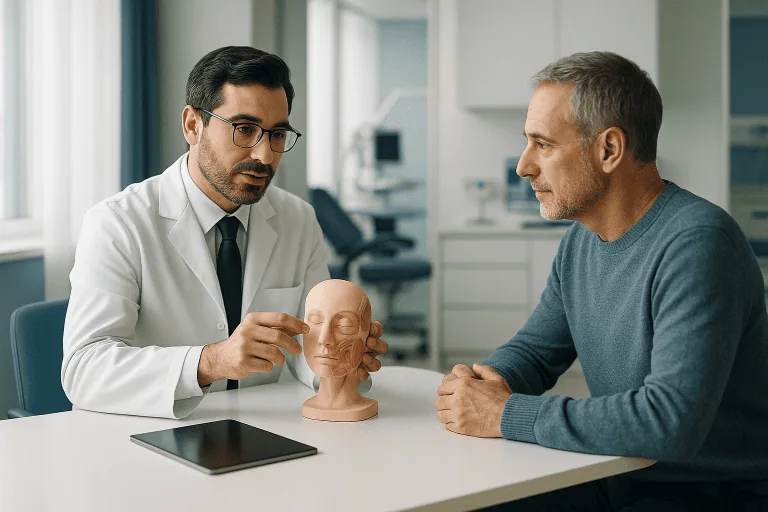
Assessment begins with a structured facial analysis. Your physician evaluates proportions from the front, side and three-quarter views, paying attention to symmetry, skeletal projection, soft-tissue volume, dental bite, skin elasticity and how your face behaves in motion. A contour that looks balanced in a still photograph can look wrong when you speak or smile, so the dynamic examination matters as much as the static one. The examiner is also deciding which anatomical layer is responsible for your concern, bone, fat, muscle or skin, because that determines which technique will actually work.
Medical history carries real weight in planning. Prior facial surgery, previous filler treatments, dental procedures, autoimmune conditions, smoking, bleeding disorders, current medications and any history of facial infection can all influence which options are open to you and how the operation is planned. Be complete and honest here; details that seem minor to you can change surgical decisions. Any adjustment to medication is decided by your treating doctor, never on your own initiative.
Photography is standard for documentation and planning. Imaging studies may be recommended for some patients, particularly where there is a history of trauma, congenital asymmetry, previous implants or concerns involving the facial bones or bite. Digital planning tools can help your surgeon explain proportions and possible changes, but treat computer-generated images as planning aids, not previews. They show intent; they do not predict biology.
Concerns Facial Augmentation Can Address
Facial augmentation serves both aesthetic and reconstructive purposes. In aesthetic care, it enhances contour, improves profile balance and restores volume. In reconstructive or corrective settings, it can improve asymmetry, contour deficits or tissue loss related to trauma, previous surgery or congenital development.
Cheek augmentation
Cheek augmentation is considered for flat cheekbones, midface deficiency, age-related volume loss or proportions that would benefit from stronger upper facial support. Enhancing the cheeks can make the midface appear more defined and, in selected patients, soften the transition between the lower eyelid and the cheek, one of the areas where volume loss most reliably reads as tiredness. The choice between a cheek implant and fat grafting depends on whether the deficit is skeletal or soft tissue, and on how much structural support the overlying skin needs.
How long does cheek augmentation last?
It depends on the technique. Cheek implants are solid devices designed for durable, long-term structural support; they do not wear out on a schedule and generally remain in place unless a complication develops or you choose to have them removed or exchanged. Fat transfer behaves differently: a portion of the grafted fat is absorbed during the first months of healing, and the fat that survives that period tends to remain as living tissue, though it ages with you and can change with significant weight fluctuation. Injectable fillers, by contrast, are temporary and need repeating. No honest surgeon attaches a fixed number of years to any of these options, because individual biology varies.
Chin augmentation
Chin augmentation is usually considered when the chin is small or recessed relative to the nose, lips and jawline. A well-planned chin implant improves the side profile and can make the nose appear more proportionate without touching the nose itself, which is why surgeons assess the chin in almost every rhinoplasty consultation. The important caveat: some patients with an apparently weak chin actually have a skeletal or bite discrepancy that would be better treated with orthognathic jaw surgery than with an implant. Camouflaging a functional problem with a cosmetic implant serves nobody, and a careful evaluation separates the two situations before anything is planned.
Jawline augmentation
Jawline augmentation helps patients who want a more structured lower face or whose jaw contour is soft because of skeletal anatomy, ageing or soft-tissue distribution. It requires particularly careful planning. The jaw frames the entire lower face, and overly aggressive augmentation can look unnatural, interfere with expression or create imbalance with the chin and neck. The best jawline results usually come from restraint: enough added definition to create a clear border between face and neck, not so much that the lower face dominates.
Fat transfer for facial volume loss
Fat transfer is frequently used for generalised or localised volume loss: hollow cheeks, temple hollowing, under-eye support in carefully selected cases, facial asymmetry, or soft-tissue thinning after weight loss. It also works alongside implants, refining the transitions around a structural change so the result reads as one continuous contour rather than a device under the skin. Because fat is placed in small amounts across multiple planes, it excels at gradual, diffuse correction rather than sharp projection.
In practice, the best results often come from subtle changes in more than one area rather than a large change in a single feature. A patient considering rhinoplasty may also have a recessed chin distorting the profile. A patient chasing a sharper jawline may actually need attention to the chin, the neck soft tissue or skin laxity to get a balanced outcome. Treating the face as a system, not a collection of parts, is what separates thoughtful planning from feature-by-feature enlargement.
How Facial Augmentation Is Performed
The process starts with assessment and aesthetic planning, as described above. The final surgical plan is confirmed only after a direct, in-person examination: a photograph cannot tell a surgeon how thick your soft tissue is or how your face moves, and any prior records or images are reviewed alongside that examination rather than in place of it.
Preparation typically includes blood tests, an anaesthesia assessment and, where needed, imaging or input from related specialists. You will be advised to stop smoking before and after surgery, because smoking impairs healing and reduces fat graft survival. Your surgeon reviews your medications and supplements, since some affect bleeding; any changes are directed by your treating doctor. If fat transfer is planned, the donor area is assessed as well. You should also plan enough recovery time before returning to demanding commitments, with the early follow-up visits built into that schedule from the start.
Facial augmentation is usually performed under general anaesthesia or, for selected limited procedures, under local anaesthesia with sedation. The choice depends on the areas treated, the expected duration, your health status and whether procedures are being combined. Airway management, monitoring and postoperative observation are planned as carefully as the aesthetic details.
How is facial implant surgery done?
The operation follows a consistent sequence:
- Small incisions are made in positions chosen to minimise visible scarring, under the chin or inside the mouth for chin implants, and usually inside the mouth for cheek and jaw implants.
- A precise pocket is created directly over the facial bone, sized to hold the implant snugly.
- The implant is inserted and positioned to achieve the planned contour, with symmetry checked against the opposite side.
- Where indicated, fixation methods are used to keep the implant stable while tissues heal around it.
- The incisions are closed in layers with careful attention to the tissue planes.
Intraoral incisions leave no external scar but demand disciplined oral hygiene afterwards. The submental (under-chin) approach leaves a small external scar in a natural shadow. Your surgeon explains which approach suits your anatomy and why.
How does facial fat transfer work?
Fat grafting also follows defined stages:
- Fat is harvested from the donor area, commonly the abdomen, thighs or flanks, using gentle liposuction designed to keep the fat cells intact.
- The collected fat is processed to separate viable fat cells from fluid, oil and debris.
- Using fine cannulas, the surgeon injects small amounts of fat into selected facial planes, building volume in thin layers rather than single large deposits.
- The treated areas are shaped and checked for symmetry before the entry points are closed or dressed.
The layered technique is not a stylistic preference; it is biology. Each small parcel of fat needs contact with surrounding tissue to receive a blood supply and survive. Overfilling is avoided, though surgeons may account for the expected partial absorption when judging volumes during the operation.
Combining implants and fat transfer
When the two techniques are combined, implants provide the deep structural support and fat grafting refines the softer transitions above and around them. This is useful when both skeletal projection and soft-tissue volume need improvement: a flat midface with hollow cheeks, for example. Combined treatment must be planned conservatively, because stacking volume on volume risks excessive fullness and prolonged swelling.
Modern facial augmentation draws on a range of supporting technology: high-quality medical photography for planning and comparison, imaging to evaluate bone structure in complex cases, digital planning systems to sharpen communication between you and your surgeon, and controlled anaesthesia monitoring in the operating room. The honest way to think about all of it is this: technology supports precision, but the decisions that determine your result, which procedure, which implant shape, where the fat goes, how much change is enough, are made by an experienced team applying judgment to your specific anatomy.
Procedure time varies with the plan. A single chin implant is a shorter operation than combined cheek, jaw and fat transfer surgery. Many facial augmentation procedures are performed as same-day surgery; more complex or combined operations may require overnight observation. Your team confirms what applies to your case before treatment.
Immediately after surgery, expect swelling, tightness, bruising and mild to moderate discomfort. Pain is managed with prescribed medication, and antibiotics may be prescribed when indicated. If your incisions are inside the mouth, you receive specific instructions on oral hygiene and diet. You will sleep with your head elevated and avoid pressure on the treated areas. Early follow-up visits check healing, manage swelling and confirm that any implants remain properly positioned.
Recovery After Facial Augmentation
Recovery varies with the procedure type, the number of areas treated, the anaesthesia used, your individual healing and whether implants, fat transfer or a combination was performed. The broad pattern looks like this:
| Time Period | What Patients Can Expect |
|---|---|
| Day 1 | Swelling, tightness and bruising begin. Discomfort is managed with prescribed medication. You rest with your head elevated and follow diet and oral-care instructions if intraoral incisions were used. |
| First week | Swelling and bruising are at their most noticeable. Light walking is encouraged; strenuous activity is not. Follow-up visits assess incision healing, implant position and early recovery. |
| First month | Most patients return to normal social and work activities as bruising fades, though residual swelling can persist. Exercise resumes gradually on your surgeon’s advice. |
| Three to six months | Contours refine as swelling continues to settle. Fat transfer volume stabilises gradually, and implant results look more natural as tissues adapt around them. |
| Longer term | Final definition is judged once healing is mature. Natural ageing continues, and long-term care centres on skin quality and healthy habits. |
Two practical points deserve emphasis. First, do not judge your result early. The face immediately after augmentation surgery is swollen and can look overdone; the true contour emerges over months, not days. Second, the timing of your return to work depends less on medical healing than on how visible you are willing to be, bruising around the lower face and midface takes time to fade, and intraoral incisions can make speaking and eating temporarily awkward.
Build your calendar around the early follow-up visits rather than around the operation date alone. Those appointments are where healing is checked, swelling is managed and questions get answered while they still matter. Your surgical team advises when each activity can safely resume and what continued follow-up should look like over the longer term, typically a combination of clinical review and photographic comparison at defined intervals, with external scars protected from sun exposure while they mature.
Benefits of Facial Augmentation
Performed for the right patient, with a plan that respects the face it is changing, facial augmentation offers several concrete benefits:
| Benefit | What It Means for You |
|---|---|
| Improved facial balance | Enhancing the chin, cheeks or jawline helps features relate more proportionately to one another, especially in profile and three-quarter views. |
| More defined contours | Implants or fat transfer add structure to areas that appear flat, recessed or poorly supported. |
| Restoration of lost volume | Fat transfer can soften hollowing and restore fullness lost to age, weight change or tissue thinning. |
| Natural-looking refinement | A conservative, anatomy-based plan improves definition while preserving your facial character and expression. |
| Longer-lasting correction than temporary options | Implants are designed for durable structural support, and grafted fat that survives healing can provide lasting volume, unlike fillers, which require ongoing repetition. |
| A stronger foundation for other procedures | Augmentation can improve the overall result of rhinoplasty, facelift or neck contouring when combined appropriately. |
Risks and the Factors That Shape a Good Result
A good facial augmentation result rests on accurate diagnosis, careful planning and realistic expectations. The face is three-dimensional and dynamic; changes must work not only in still photographs but in speech, smiling and natural expression. That is why experienced assessment matters more than any single piece of equipment or technique.
Anatomy comes first. Patients with strong bone structure but volume loss usually benefit from fat transfer. Patients with skeletal underprojection need implants, or, in some cases, bone surgery rather than any soft-tissue solution. Skin thickness matters too: thin skin reveals implant edges more easily, while thick soft tissue may need different sizing or shaping to show visible definition at all.
Proportion is where results are won or lost. A chin implant that looks right from the side can be too wide from the front if selected carelessly. Cheek augmentation improves midface contour, but excessive fullness looks artificial. Jawline enhancement must stay in balance with the chin, neck and lower facial width. In this field, subtle almost always beats dramatic.
Technique affects both safety and appearance. Implant pockets must be created precisely, implants positioned symmetrically and held securely. Fat grafting demands delicate harvesting, processing and placement to give the transferred cells the best chance of survival. Sterile technique, gentle tissue handling and clear postoperative instructions all reduce complication risk.
Healing biology differs between individuals. Swelling lasts longer in some people. Fat retention varies, and a further grafting session is sometimes discussed after healing if more volume is wanted. Scarring tendencies, smoking, nutrition, sleep, medical conditions and medication use all influence how you recover.
Your own behaviour after surgery matters as much as anything done in the operating room. Following instructions on activity, oral hygiene, sleeping position, smoking avoidance and follow-up visits protects the result. Pressure on implants too early, strenuous exercise before clearance or poor oral care after intraoral incisions all raise the risk of problems.
The risks themselves should be discussed openly before you decide. They include:
- Infection or bleeding
- Asymmetry, or implant shifting from its planned position
- Visible or palpable implant edges, particularly in thin-skinned patients
- Numbness or altered sensation, usually temporary but occasionally persistent
- Scarring, and irregularity or unpredictable absorption after fat transfer
- Dissatisfaction with size or shape, and the possibility of revision surgery
- Anaesthesia-related risks
Serious complications are uncommon in appropriately selected patients, but every operation carries some risk, and a responsible surgeon will say so plainly rather than talk around it.
What is the most regretted cosmetic surgery?
There is no single procedure that reliably tops regret lists, and this page will not pretend otherwise. What the pattern behind regret consistently shows is more useful: patients regret operations chosen for the wrong reasons, planned around a trend rather than their own anatomy, oversized relative to their features, or performed before expectations were honestly tested against what surgery can deliver. Facial augmentation is well placed to avoid these traps precisely because good planning is conservative, small, measured changes to structure, but it falls into them quickly when patients or surgeons chase dramatic transformation. If a proposed plan sounds dramatic, that is a reason to slow down, not to book faster.
Facial Augmentation Compared With Other Options
Injectable fillers are the most common alternative patients have already tried before considering surgery. Fillers are non-surgical, adjustable and reversible in many cases, which makes them a reasonable first step for modest volume concerns. Their limits are equally clear: the effect is temporary, repeated treatment accumulates cost and appointments over years, and no filler provides genuine skeletal projection. Surgical facial augmentation exists for patients who want structural, durable change, a chin that projects properly, cheeks with real support, rather than a maintenance routine.
Lifting procedures solve a different problem again. If your concern is sagging skin and descended soft tissue rather than missing volume, a facelift or related facial rejuvenation procedure addresses the laxity that augmentation cannot. Many mature faces need elements of both, repositioned tissue and restored volume, which is why honest assessment of the anatomical layers comes before any choice of technique.
What is the new facelift everyone is getting?
The technique most discussed in recent years is the deep plane facelift, which repositions the deeper muscular and fascial layer of the face together with the skin rather than pulling the skin alone. It is a lifting operation, not an augmentation: it treats descent and laxity, not skeletal deficiency or hollowing. The reason it belongs on this page at all is that patients often conflate the two. If your midface looks flat because the tissue has descended, lifting helps. If it looks flat because the bone and fat were never there or have thinned, augmentation helps. Some patients benefit from both, staged or combined, but no facelift, however fashionable, substitutes for structure the face does not have.
Why Timing Matters
Facial augmentation is elective; there is almost never urgency. But timely evaluation still has value. When the concern involves ageing, volume loss and early skin laxity, earlier planning may allow a more conservative approach, fat transfer or limited augmentation, where more advanced laxity later would require additional lifting or skin-tightening procedures to achieve balance.
For patients with facial asymmetry, trauma-related contour changes or complications from previous surgery, delay can genuinely complicate planning. Scar tissue matures, soft tissues shift, and compensatory changes become more entrenched over time. Early specialist assessment clarifies whether observation, non-surgical treatment, fat grafting, implant reconstruction or a facial correction procedure is the right path, and that clarity is valuable even if you decide to wait.
The other cost of delay is decision quality. Many people spend years uncertain because they compare isolated procedures without understanding their own anatomy. A structured evaluation identifies whether the real issue is skeletal projection, soft-tissue volume, dental bite, skin laxity or some combination, and that prevents unnecessary treatment and choices that never touch the actual problem, including years of temporary procedures that keep failing to create the contour you want.
None of this means you should feel pressured toward surgery. The right timing is when the indication is clear, your expectations are realistic and any medical conditions are optimised. A surgeon who pushes you faster than that is answering their schedule, not your anatomy.
How Much Do Full Facial Implants Cost?
There is no single answer, and any clinic quoting one price for “full facial implants” before examining you is guessing. Cost is built from the specifics of an individual plan, and the same label can describe very different operations. The main drivers are:
- How many areas are treated, chin alone, cheeks and chin, or cheeks, chin and jawline together
- Implant type and material for each site
- Whether fat transfer is added and how many regions it covers
- The anaesthesia required and the length of the operation
- Same-day surgery versus overnight hospital observation
- The complexity of the case, first-time surgery, revision, asymmetry or reconstruction after trauma
- Preoperative tests, imaging and the follow-up schedule included in the plan
A meaningful quotation therefore follows assessment, not the other way round. When comparing offers, ask exactly what each covers, surgeon and anaesthesia fees, hospital stay, implants themselves, follow-up visits and the approach to revision if one is ever needed, because a low headline figure that excludes half of these is not actually lower.
Facial Augmentation at Acibadem
Patients undergoing facial augmentation usually need more than a surgeon. They need a hospital environment with structured safety processes, coordinated care and clear communication before, during and after treatment. Cosmetic surgery is still surgery: it requires careful anaesthesia planning, infection prevention, surgical discipline and proper postoperative monitoring, and the setting should reflect that.
At Acibadem, treatment planning is personalised. Physicians evaluate facial anatomy, medical history, prior treatments and expectations before recommending implants, fat transfer, a combined approach, or an alternative when augmentation is not the right answer. Where a case involves dental bite concerns, trauma history, congenital asymmetry or complex reconstruction, collaboration with relevant specialists is considered, so that cosmetic contouring is properly separated from problems needing maxillofacial, dental or reconstructive input.
Diagnostic and surgical resources, high-resolution imaging, medical photography, digital planning tools and modern operating room systems, support planning and precision. They serve clinical judgment rather than replace it. The decisions that matter remain human ones: which procedure, which implant shape, where fat is placed, and how much correction will look balanced on your face. Millimetres matter here. A small change in chin projection alters a profile; a subtle increase in cheek volume refreshes the midface, while too much looks heavy.
Wherever you ultimately choose to be treated, the same questions deserve clear answers: the surgeon’s approach and experience with your specific procedure, incision placement, implant selection or fat transfer strategy, the anaesthesia plan, realistic recovery time, the risks as they apply to you, how revisions are handled, and, most fundamentally, whether the proposed change actually suits your face. A responsible discussion covers limitations as openly as possibilities.
Moving Forward With Clarity
Facial augmentation is a meaningful option if you want better facial balance, restored volume or more defined contours, provided the plan is built around your anatomy rather than a template. The results that hold up are the ones that look natural, move naturally and age well, and those come from thoughtful evaluation and conservative, precise technique. Understand what the procedure can achieve, take what it cannot change seriously, give recovery the time it needs, and judge the outcome when healing is mature rather than in the first swollen week. Approached that way, the decision stops being a leap and becomes what it should be: an informed choice about your own face.
Preparation
- Preparation includes a detailed facial analysis, medical history review and discussion of goals, implant choices or fat transfer options. Patients may need blood tests and anesthesia assessment. Smoking, alcohol and certain blood-thinning medicines are usually stopped before surgery as advised.
Aftercare
- Aftercare focuses on reducing swelling, protecting incisions and keeping the head elevated in the first days. Patients should follow medication, wound care and activity instructions closely. Strenuous exercise and facial pressure are usually avoided until the surgeon confirms healing is adequate.
Frequently Asked Questions
What affects the cost of facial augmentation?
The final cost depends on the technique used, the number of facial areas treated, implant or filler choice, whether fat transfer is needed, anesthesia, hospital facilities, surgeon expertise, and the level of aftercare and travel support included.
How can I get a personalised quote from Acibadem?
You can request a free consultation and share photos, medical history, previous procedure details if relevant, and your aesthetic goals. A specialist review helps determine suitability and allows the international patient team to prepare a personalised treatment plan and quote.
Are travel, hotel, and interpreter services included?
In Turkey, international patient packages may include or coordinate airport transfers, hotel assistance, interpreter support, appointment scheduling, and follow-up planning. Inclusions vary, so the written quote should be reviewed carefully before travel.
Is facial augmentation cheaper with fillers than surgery?
Fillers may involve a different upfront cost structure because they do not require an operating room or surgical implant, but they are usually temporary and may require maintenance. Surgical options may involve higher procedural complexity but can be more durable depending on the case.
Can I combine cheek, chin, jaw, or fat transfer procedures?
Combination treatment may be appropriate for selected patients who need balance across several facial areas. Suitability, safety, recovery time, and cost should be assessed by a plastic surgery specialist.
Is the quote the same for every patient?
No. Facial anatomy, treatment goals, medical history, implant or fat transfer needs, anesthesia plan, and expected recovery support differ between patients. This information is general and not medical or financial advice; a consultation is needed for an individual plan.
Medically reviewed by the Acıbadem International Medical Board September 13, 2026
See our medical review board →
Update history
- PublishedJune 8, 2026
- Medical review approvedSeptember 13, 2026
- Last content updateSeptember 12, 2026
Trusted care for international patients
From the Acibadem Blog

Facial Augmentation Recovery: Swelling, Head Elevation and When Contours Start to Show
Facial augmentation recovery usually means visible swelling that peaks around the second or third day, eases noticeably over two to three weeks, and settles…
Doctors Performing This Treatment



Aesthetic Plastic & Reconstructive Surgery
Prof. Mehmet Veli Karaaltın, MD


Aesthetic Plastic & Reconstructive Surgery
Assoc. Prof. Erdem Güven, MD

Aesthetic Plastic & Reconstructive Surgery
Assoc. Prof. Ahmet Küçükçelebi, MD

Aesthetic Plastic & Reconstructive Surgery
Assoc. Prof. Mehmet Altıparmak, MD

Aesthetic Plastic & Reconstructive Surgery