Facial Implants
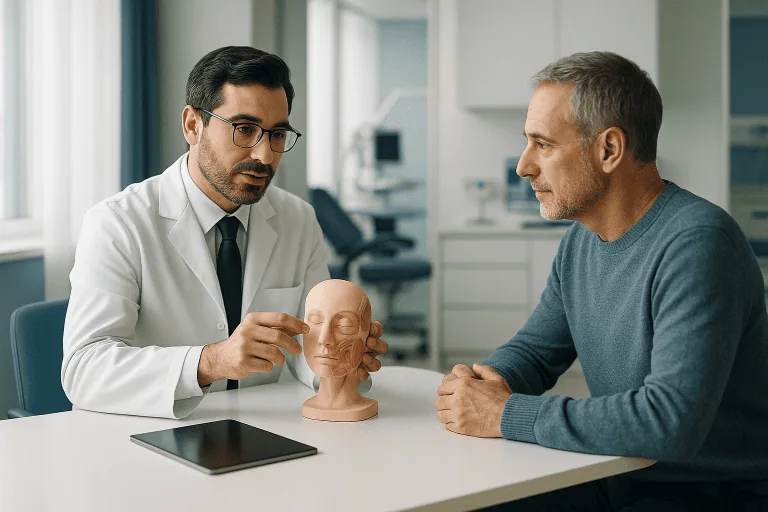
Facial implants enhance facial balance by adding definition to areas such as the chin, cheeks, or jawline using biocompatible implants tailored to the patient’s anatomy.
Quick answer
Facial implants are solid, biocompatible devices placed under the soft tissue of the face, usually directly over bone, to add lasting projection to the chin, cheeks or jawline. Surgery is performed under anaesthesia through small incisions, often inside the mouth or under the chin. Unlike temporary fillers, implants provide durable structural definition and are removable or replaceable if needed.
Facial Implants: Rebalancing the Chin, Cheeks and Jawline
Facial implants are solid, biocompatible medical devices placed beneath the soft tissue of the face, usually directly over bone, to add projection and definition where natural skeletal structure is limited. The most frequently requested is the chin implant, used to strengthen a small or recessed chin; cheek and jaw implants work on the same principle in the midface and lower face. They are surgical devices, not injectables, and they suit adults who have finished facial growth and want a lasting structural change rather than a temporary one.
Considering this kind of surgery is often less about changing who you are and more about bringing certain features into better proportion. A recessed chin can make the nose appear larger and the neck less defined. Flat cheeks can create a tired look even when you feel well. A softly defined jawline changes how the lower face reads in photographs, on video calls and in everyday interactions. These concerns tend to be subtle but persistent, and they can wear on confidence over years.
At the same time, the decision carries weight, and patients tend to ask the same careful questions. Will the result look natural? How is the implant selected? What happens if you do not like the change? How long does swelling last? None of these has a one-size-fits-all answer. Each depends on your anatomy, your goals and the judgment of the surgeon planning the operation.
It also helps to be clear at the outset about what facial implants do not do. They do not tighten loose skin, correct a dental bite, smooth deep wrinkles or replace generalised volume loss. A chin implant can improve the projection of the chin point; it cannot reposition a jaw that sits too far back. The best results come from precise planning, respect for the anatomy you already have, and an honest match between the problem and the tool.
At Acibadem, facial implant surgery is treated as both a medical procedure and an aesthetic decision. Depending on the case, evaluation may involve plastic surgeons, maxillofacial surgeons, ear, nose and throat specialists, and dermatology or dental specialists. That breadth matters most when the concern touches the bite, facial asymmetry, prior trauma, nasal proportion or earlier cosmetic procedures. The aim is a recommendation that fits your facial structure, medical history and expectations, including, sometimes, the recommendation not to operate.
What Are Facial Implants?
Facial implants are specially shaped devices positioned under the soft tissues of the face to create or restore definition, most commonly at the chin, cheeks and jaw angle. Because they sit deep, often directly against the facial skeleton, they behave like an extension of the bone rather than an addition to the soft tissue. Many patients are well served by standard implant shapes and sizes carefully matched to their anatomy; more complex cases, particularly asymmetry or post-trauma contour problems, may call for customised planning based on imaging and detailed facial analysis.
What are facial implants made of?
Most facial implants are made of solid silicone elastomer or porous polyethylene, both long-established biocompatible materials designed to remain stable in the body. Solid silicone implants are smooth and flexible, which makes them straightforward to insert through small incisions and comparatively straightforward to remove or exchange later if needed. Porous polyethylene implants have a textured surface that allows some tissue ingrowth, which can improve stability but makes later removal more involved. Expanded polytetrafluoroethylene (ePTFE) is another material used in selected settings. None of these materials is inherently “best”: the sensible choice depends on the implant site, the thickness of your soft tissue, whether fixation with small screws is planned, and your surgeon’s experience with the material. What matters more than the brand is that the implant is a regulated medical device of appropriate shape and size, placed in the correct pocket.
Is a chin implant better than filler?
A chin implant is better than filler when you want a defined, durable, structural change; filler is better when you want a small, reversible or trial change. Fillers are placed in soft tissue and are usually temporary, although some longer-lasting products exist. They can soften a mild chin deficiency, but they cannot replicate the crisp, skeletal projection an implant creates, and repeating filler for years to manage a genuinely recessed chin often costs more effort than it returns. An implant, by contrast, is a single surgical event with a recovery period and surgical risks that filler does not carry. Some patients reasonably use filler first to preview the direction of change, then move to an implant once they are confident. Neither option is right for everyone, and a consultation should compare both honestly rather than default to the more invasive one.
The common implant types map onto the areas of the face where bone projection most often falls short. Chin implants improve the projection of a small or recessed chin and can sharpen the chin–neck angle in profile. Cheek implants add definition to the midface and can improve the transition between the lower eyelid and the cheek in carefully selected patients. Jawline implants enhance the angle or contour of the lower jaw, adding width or definition where the mandible is naturally narrow. Some patients need one area only; others benefit from a combined approach: a chin implant planned alongside rhinoplasty to balance the profile, for instance, or cheek implants combined with eyelid or facelift surgery when age-related changes are also present.
Facial implants are not the right answer for every concern. Skin laxity, deep wrinkles, dental bite problems, significant skeletal deformity and generalised facial volume loss usually require different or additional treatments. Part of the value of a proper consultation is triage between tools: an implant, fat grafting, filler, bone surgery, orthodontic care or a soft-tissue procedure. The broader options are described on our facial augmentation page, which sets implants in the context of the alternatives.
Who May Need Facial Implants?
Patients arrive at this decision from very different starting points. Some have always felt that one part of the face is underdeveloped: a small chin, flat cheekbones, a narrow jaw. Others notice changes with age, including loss of midface support or a jawline that has lost its edge. Some are recovering from trauma or previous surgery and want to restore symmetry. In every case, the process should begin with a detailed assessment rather than a request for a particular implant size, because the right treatment depends on the cause of the concern, not just its appearance.
The concerns that most often lead to a facial implant consultation include a recessed or weak chin, lack of cheek projection, soft jawline definition, facial asymmetry, an imbalance between nose and chin, or a lower face that simply appears less structured than the rest of the face. Patients often describe looking tired, having a poorly defined profile, or noticing that the face lacks contour in photographs taken from the side. These observations are real and worth taking seriously, but they have to be evaluated in the context of the whole face, because changing one feature changes how every other feature reads.
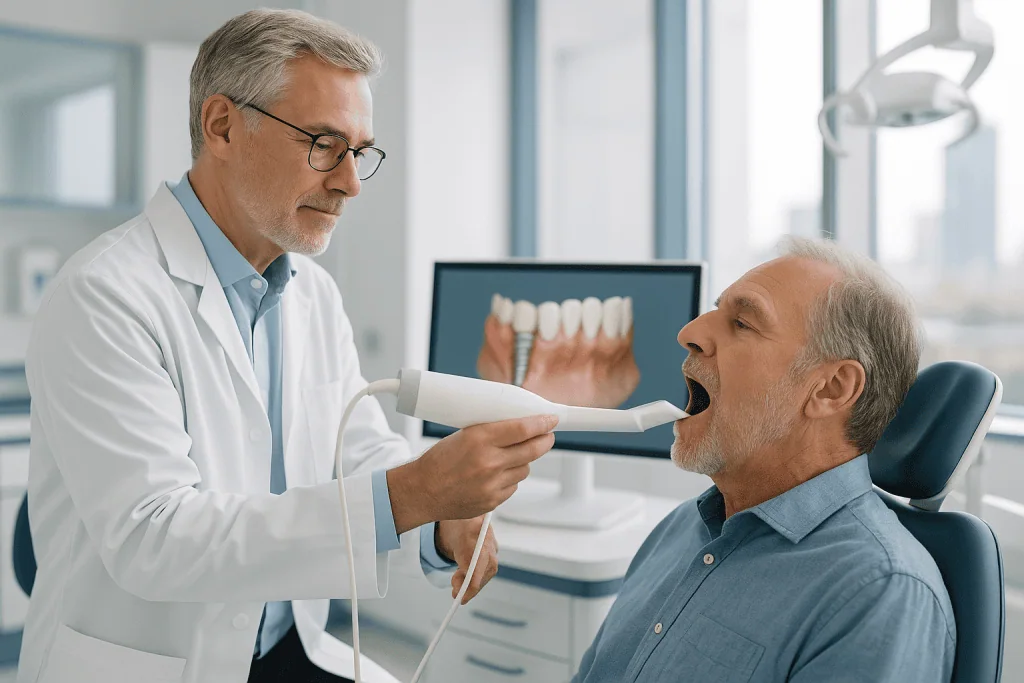
Assessment usually begins with a medical history, a discussion of goals and a physical examination. The surgeon studies facial proportions from the front, side and three-quarter views, and considers the thickness and elasticity of the skin, the position of the facial muscles, the dental bite, the chin–neck angle, cheek volume and jaw symmetry. Standardised medical photography supports planning and communication. In some patients, particularly where jaw structure, asymmetry, previous trauma or combined facial surgery is involved, three-dimensional imaging, facial scanning, dental evaluation or computed tomography may be recommended before any decision is made.
Good candidates are generally in stable health, have completed facial growth, have no active infection in the mouth or face, and hold realistic expectations about the degree of improvement possible. Smoking, uncontrolled diabetes, bleeding disorders, immune suppression and certain medications can increase surgical risk and require additional planning with the treating doctor. Patients with untreated dental disease or gum infection may need dental care first before an implant placed through an incision inside the mouth can be considered safely.
Psychological readiness matters as much as physical suitability. Facial implant surgery can improve contour and proportion; it cannot resolve every concern related to self-image, and it will not transform a face into someone else’s. A responsible surgeon discusses the expected change honestly and may advise against surgery when the requested change is unlikely to look natural, when expectations sit outside what the anatomy allows, or when a different treatment would better address the underlying issue. Being told “not yet” or “not this operation” is a sign of careful practice, not a failed consultation.
Conditions and Indications Facial Implants Can Address
Facial implants serve both aesthetic and reconstructive purposes. In aesthetic care they are most often chosen to improve facial harmony by adding structure where natural bone projection is limited. In reconstructive care they help restore contour after injury, congenital underdevelopment or previous operations. The indications below cover the main areas.
Chin augmentation with a chin implant
Chin augmentation with a chin implant is indicated when the chin is recessed or small but the dental bite is essentially normal. In that situation the implant strengthens the chin point, balances the profile against the nose and can sharpen the definition between chin and neck. The distinction from a jaw-position problem is critical: if the whole lower jaw sits too far back and the bite is affected, moving the bone, through orthognathic surgery or a sliding genioplasty, addresses the cause, while an implant would only mask it. This is exactly the kind of judgment call where evaluation by a team that includes oral and maxillofacial surgery expertise earns its keep.
Cheek implants and midface definition
Cheek implants add projection to a midface that is naturally flat or has lost skeletal-looking support, and they can improve the transition between lower eyelid and cheek in carefully selected patients. The alternative for age-related volume loss is often fat grafting or filler rather than an implant, because soft-tissue deflation and skeletal deficiency are different problems that happen to look similar. Our cheek augmentation page compares these approaches in more detail.
Jaw implants and jawline definition
Jaw implants add contour to the mandibular angle or the lower border of the jaw when the jaw appears narrow, softly defined or asymmetric. This is the territory patients often search for as jawline surgery, and it is technically the most demanding of the three implant areas: the pocket must respect the mental and marginal mandibular nerves, the implant frequently needs fixation, and small errors in position show. In men, jawline definition is often the stated priority; in women, chin and cheek balance tend to be weighted differently depending on facial shape and personal preference. These are patterns, not rules: the plan should follow the individual face.
Reconstructive and asymmetry indications
Reconstructive uses include correction of selected facial asymmetries, contour irregularities after injury, congenital underdevelopment of specific facial regions, and changes following previous operations. Planning here is more complex: scar tissue, altered bone shape, thinned soft tissue, nerve position and the relationship between the implant and surrounding structures all constrain what is possible. Customised implants planned from computed tomography are more often useful in this group than in routine aesthetic cases.
There are also clear situations where an implant is not the primary solution. A recessed chin driven by a significant jaw-relationship problem points to bone surgery. Sagging skin under the chin points to a neck lift or skin-tightening approach. A small or temporary desired change points to filler. Broad facial volume loss points to fat grafting. Matching treatment to cause is the whole purpose of a thorough consultation, and it is why an assessment that considers alternatives is worth more than one that only quotes for the operation you asked about.
How Facial Implant Surgery Is Performed
The operation begins well before the day of surgery. During preparation, the surgeon reviews your medical history, current medications, allergies, previous procedures and any relevant imaging. Blood tests or additional medical assessments may be requested depending on age, health status and the anaesthesia plan. Patients are usually advised to stop smoking well in advance because nicotine impairs healing, and the treating doctor will review any medications or supplements that affect bleeding, decisions about those always sit with the doctor, never with a website.
Planning is arguably the most important stage. The surgeon evaluates facial proportions and discusses the degree of change you want. The aim is not to pick a bigger or smaller implant off a shelf, but to select a shape, size and position that work with your anatomy. Digital photography, facial analysis software, three-dimensional imaging or computed tomography may be used where helpful; these tools let the team assess skeletal contours, soft-tissue thickness and asymmetry precisely, and they support clearer conversation about the plan. Simulated images are educational tools, not exact predictions: a surgeon who presents them that way is being straight with you.
On the day, facial implants are usually placed under general anaesthesia or, in selected cases, deep sedation with local anaesthesia. The choice depends on the implant area, the complexity of the case, whether other procedures are being performed at the same time and overall safety considerations. The team confirms the plan, marks the relevant landmarks and follows infection-prevention protocols; antibiotics may be used according to the surgeon’s protocol and your individual risk profile.
Incision placement depends on the area treated. A chin implant may be placed through a small incision under the chin or through an incision inside the lower lip: the external route gives direct access and avoids the oral cavity, while the intraoral route leaves no skin scar but demands careful oral hygiene afterwards. Cheek implants are most often placed through incisions inside the mouth, although other approaches may be used when the implant is combined with eyelid or facelift surgery. Jaw-angle implants may require intraoral incisions, external approaches or a combination, depending on implant position and anatomy.
The core surgical sequence is consistent across implant sites:
- Access. The planned incision is made, hidden inside the mouth or in a natural crease.
- Pocket creation. The surgeon develops a precise pocket, usually directly on the bone, exactly matched to the implant. Pocket accuracy is critical: too loose and the implant can shift; too tight or misplaced and symmetry or contour suffers.
- Insertion and positioning. The implant is placed, checked against the midline and landmarks, and adjusted until position is correct.
- Fixation where needed. Small screws or other techniques may secure the implant, particularly for jaw-angle or customised implants.
- Closure. Incisions are closed in layers; dressings, supportive taping or a compression garment may be applied depending on the site.
An isolated chin implant is a relatively short operation; combined cheek and jaw procedures, or implants performed alongside rhinoplasty or facelift surgery, take longer. Most patients return home the same day or after a short hospital stay, depending on the extent of surgery, the anaesthesia used and individual medical needs.
Technology supports safety and precision throughout rather than replacing judgment. High-resolution imaging helps evaluate bone structure and asymmetry; digital planning assists implant selection and surgical strategy; in appropriate cases, three-dimensional models or cutting guides help translate the plan into the operating room. Advanced anaesthesia monitoring, sterile operating environments and structured postoperative follow-up complete the picture. The specific tools used depend on the hospital, the anatomy and the plan.
Recovery begins immediately. Swelling, tightness, bruising and mild to moderate discomfort are expected, especially in the first several days, and are usually managed with prescribed medication. You may be advised to sleep with the head elevated, use cold compresses as directed and avoid pressure on the treated area. Where incisions sit inside the mouth, a soft diet and antiseptic mouth rinses are typically recommended. Strenuous exercise, heavy lifting and contact sports are restricted until the surgeon confirms it is safe to resume them.
Follow-up is part of the operation, not an afterthought. Before leaving the hospital, you should have written aftercare instructions, prescriptions explained clearly, and scheduled review appointments, typically an early check of the incisions and implant position, then later visits as swelling settles. Ask explicitly how to reach the medical team between appointments and what the plan is if something does not feel right. Sutures placed in the skin may need removal at a set interval, while intraoral incisions are usually closed with dissolving material; your surgeon will confirm which applies to you. Build your work, exercise and social commitments around this schedule rather than compressing it.
Why Acting Early Can Matter, and the Risks of Delay
Facial implant surgery is elective, so “acting early” does not mean rushing into an operation. It means seeking expert evaluation at the right time, before decisions get made on incomplete information or a sequence of treatments begins that never addresses the real problem. Many patients spend years applying temporary solutions to a structural issue, repeated filler for a significantly recessed chin, for example, or for underdeveloped cheekbones. Filler is entirely appropriate for some of those patients; for others it never delivers the definition or durability an implant would, and the years of maintenance add up to more than they bargained for.
Early consultation matters most when facial imbalance may be linked to dental bite problems, jaw development, trauma or asymmetry. If the underlying issue calls for orthodontic care, jaw surgery or reconstruction, an implant alone is the wrong first step, and placing one can complicate the operation that should have come first. A specialist evaluation at the outset prevents a chain of procedures that later needs unpicking.
Timing also interacts with ageing. Loss of skin elasticity, progressive tissue descent and changes in facial fat all affect which procedure suits you. A patient who is a candidate for a limited implant procedure at one stage may later need a more comprehensive plan involving soft-tissue lifting, skin treatment or volume restoration to achieve the same visual result. That is not an argument for operating early on everyone: it is an argument for discussing timing with a qualified surgeon rather than assuming the options will stay the same indefinitely.
Finally, there are emotional and practical dimensions. Living with a long-standing facial concern wears on confidence, but deciding under pressure leads to regret more reliably than almost anything else in aesthetic surgery. A careful, unhurried consultation lets you compare options, understand recovery honestly and plan your commitments around it. Early planning also leaves time for medical records, imaging, scheduling and aftercare arrangements to be organised without shortcuts.
Benefits of Facial Implant Treatment
When the indication is correct and the plan is well made, facial implant surgery can offer several meaningful benefits for facial proportion and definition. The table below summarises them plainly, note that every one of these depends on appropriate patient selection.
| Benefit | What It Means for You |
|---|---|
| Improved facial balance | Adding projection to the chin, cheeks or jawline can help features appear more proportionate from the front and profile views. |
| More defined contours | Implants can create structural support in areas where soft-tissue treatments may be limited, especially along the chin and jawline. |
| Durable augmentation | Unlike many injectable treatments, facial implants are designed as a long-term surgical option when stable contour enhancement is desired. |
| Customised planning | Implant selection and placement can be tailored to facial anatomy, gender characteristics, skin thickness and aesthetic goals. |
| Potential combination with other procedures | Facial implants may be planned with rhinoplasty, facelift, eyelid surgery, fat grafting or reconstructive procedures when clinically appropriate. |
| Restoration after asymmetry or trauma | In selected reconstructive cases, implants can help improve contour irregularities and restore a more balanced appearance. |
Facial Implant Recovery Timeline
Recovery differs by implant area, surgical extent and individual healing, but most patients follow a broadly similar pattern. Treat this as orientation, not a schedule; your surgeon’s instructions override any general timeline.
| Time Period | What Patients Can Expect |
|---|---|
| Day 1 | Swelling, tightness and discomfort are expected. Patients rest with the head elevated and follow instructions for medication, cold compresses and incision care. |
| First Week | Bruising and swelling usually become most noticeable and then begin to improve. A soft diet may be recommended for intraoral incisions. Light walking is encouraged. |
| First Month | Many patients return to routine social and work activities, depending on visibility of swelling and the nature of their job. Exercise is resumed gradually with approval. |
| Three to Six Months | Facial contours become more refined as swelling decreases and tissues settle. Numbness or tight sensations, if present, often improve over time. |
| Longer Term | The implant is expected to remain stable, although natural ageing continues. Long-term follow-up is advised if discomfort, infection, shifting or aesthetic concerns develop. |
Social recovery varies more than the physical timeline suggests. Some patients feel comfortable in public within a week or two; others prefer longer, particularly after cheek or jaw-angle implants where swelling sits in the most visible part of the face. The final contour emerges gradually as swelling settles and tissue adapts around the implant, with subtle refinement continuing for several months. Written aftercare instructions explain which findings fall outside normal healing; anything of that kind is a matter for the treating team rather than for guesswork.
Factors That Influence Outcomes, and What a Good Result Looks Like
The quality of a facial implant result depends on far more than the implant itself. The first factor is correct diagnosis. A weak chin caused by a normal but recessed chin point is a different problem from a small lower jaw with a bite discrepancy. Flat cheeks due to skeletal anatomy are different from age-related fat loss. A soft jawline caused by limited bone definition is different from loose skin or excess fat under the chin. When the cause is identified correctly, the plan matches the problem; when it is not, even flawless surgery disappoints.
Implant selection comes next. Size, shape, thickness and edge design determine whether the result reads as natural. An oversized implant looks artificial, strains the soft tissue and unbalances the other features; an undersized one fails to achieve the change that justified surgery in the first place. The best choice is almost always the one that improves proportion without drawing attention to itself.
Surgical technique matters significantly. Precise pocket creation, stable placement, protection of the sensory nerves and careful closure all affect healing and symmetry. The surgeon must know the facial anatomy in detail, nerves, muscles, vessels and dental roots, which is especially true for chin and jaw-angle work, where implant position affects comfort and sensation as well as appearance.
Soft-tissue quality shapes what is achievable. Thicker tissue camouflages implant edges; thin tissue reveals contour irregularities more readily. Marked skin laxity limits how much definition an implant can create on its own, and in some patients combining the implant with soft-tissue tightening, fat grafting or skin treatment produces a more balanced plan than the implant alone.
Your own health and aftercare carry real weight. Smoking, poor nutrition, uncontrolled medical conditions and infection risk all affect healing. Following the instructions on oral hygiene, diet, activity restriction and follow-up visits meaningfully reduces the chance of complications: this is the part of the outcome that belongs to the patient.
Are facial implants safe?
Facial implants have a long track record and are considered a well-established procedure when performed by an appropriately trained surgeon in a proper surgical environment, but no operation is without risk. Possible complications include bleeding, infection, scarring, asymmetry, implant shifting, numbness or altered sensation, dissatisfaction with size or shape, the need for revision surgery, and anaesthesia-related risks. Incisions inside the mouth carry a different infection profile from external incisions. Rarely, an implant needs to be removed or replaced. Safety in practice comes from patient selection, sterile technique, sensible implant sizing and structured follow-up; a candid preoperative discussion should cover all of these possibilities alongside the expected benefits and the alternatives.
What are the downsides of getting a chin implant?
The main downsides of a chin implant are that it is genuine surgery with a recovery period, it carries the complication risks listed above, and it cannot fix problems that are not about chin projection. Swelling and tightness last weeks; temporary numbness of the chin or lower lip can occur while nerves recover; an implant placed through the mouth demands disciplined oral hygiene during healing. There is also the possibility of choosing a size you later wish were different, one reason conservative sizing is standard advice. Set against fillers, the trade is straightforward: more commitment and more risk up front in exchange for a structural, long-lasting result. Set against sliding genioplasty, an implant is a smaller operation but works only when the bone position is fundamentally acceptable.
How long does a chin implant last?
A chin implant is designed to last indefinitely: the materials do not degrade, dissolve or need scheduled replacement. Most patients who are satisfied with the result never have further surgery on it. That said, “permanent material” is not the same as “permanent guarantee of satisfaction”: an implant can be removed or exchanged later if infection, displacement or a change in aesthetic preference makes that appropriate, and the face around the implant continues to age normally. Long-term follow-up is advised if discomfort, shifting or new asymmetry ever develops.
How much does a chin implant cost?
The cost of a chin implant varies too widely for a single figure to be honest, which is why this page does not quote one. What actually drives the price: the type and manufacturer of the implant, whether the plan is a single chin implant or combined chin, cheek and jaw work, the anaesthesia required, operating-theatre and hospital-stay arrangements, the imaging and planning involved (a customised implant planned from computed tomography costs more than a standard one), and the surgeon’s and institution’s setting. When you compare quotes, compare what they include, preoperative assessment, anaesthesia, the implant itself, hospital fees, medications and follow-up reviews, because a low headline figure that excludes half of these is not a low price.
Finally, hold a realistic picture of what a good result is. It is rarely a dramatic change. The most satisfying outcome is usually one that looks like your face, better balanced, colleagues notice you look more rested or defined without immediately identifying surgery. Achieving that takes restraint, careful planning and clear communication between patient and surgeon, in both directions.
How Facial Implant Care Is Organised at Acibadem
Choosing where to have facial implant surgery involves more than comparing procedures. It requires confidence in the medical team, the hospital environment, the quality of communication, the follow-up plan and the ability to manage an unexpected issue if one arises. At Acibadem, facial implant patients are evaluated with attention to both aesthetic goals and medical safety, within a hospital setting equipped for surgical care rather than an isolated clinic environment.
Depending on the case, care may involve plastic, reconstructive and aesthetic surgery, maxillofacial surgery, ENT, dental specialists, dermatology, anaesthesiology and radiology. This multidisciplinary structure matters most when facial balance involves the nose, jaw, bite, prior trauma or previous procedures, because complex cases can be discussed across specialties so that the recommendation reflects the full clinical picture rather than a single department’s view.
Personalised planning is central. The physician assesses your facial proportions, listens to your goals and explains the suitable options. Some patients are advised to have an implant; others are better served by filler, fat grafting, genioplasty, orthognathic surgery, rhinoplasty, neck contouring, or by no procedure at that time. Ethical aesthetic care includes knowing when surgery is appropriate and saying plainly when it is not. Diagnostic pathways may include standardised photography, advanced imaging, digital planning and pre-anaesthesia evaluation, with the specific tools depending on the hospital, the anatomy and the plan.
Coordination around the surgery itself is organised so that decisions are never rushed: medical records and imaging are reviewed before recommendations are made, appointments are scheduled to leave proper time for reflection between consultation and surgery, consent discussions cover benefits, risks and alternatives in plain language, and follow-up pathways are clarified in advance. Being understood clearly when discussing facial goals, consent, recovery instructions and postoperative concerns is not a luxury; it is part of safe medical care.
Experience matters here because facial implant surgery demands aesthetic judgment as much as technical skill. The face is the most visible and emotionally significant area a surgeon operates on, and differences of millimetres change the overall impression. Surgeons must balance symmetry against natural variation, definition against softness, and patient preference against anatomical limits. A responsible care pathway also includes honest education about normal swelling and the signs that need review, clear medication and wound-care instructions, and structured access to the medical team for questions, no surgical process removes all uncertainty, but organised follow-up removes most of the confusion.
Making a Well-Informed Decision
Facial implants can be a refined, durable way to improve facial balance when the indication is correct and the plan is individualised, whether the question is chin augmentation, cheek definition, jawline contour or revision of a previous procedure. The useful first step is always a detailed consultation with a qualified specialist who can evaluate anatomy, goals and medical suitability together, and who is willing to recommend an alternative when an implant is not the answer.
Before committing to surgery, a second opinion is worth its time. It tests whether an implant is truly the right approach, surfaces the alternatives and clarifies what recovery genuinely involves. Photographs, prior operative reports, dental records and imaging all make any specialist’s assessment more specific and more useful. Take the time the decision deserves: a well-chosen facial implant is measured in years of quiet satisfaction, and the few extra weeks spent deciding carefully cost nothing by comparison.
Preparation
- Preparation includes a detailed facial assessment, medical history review, and discussion of goals and implant options. Patients may need blood tests or imaging, and should stop smoking and avoid blood-thinning medicines as advised before surgery.
Aftercare
- After surgery, swelling, bruising, and mild discomfort are expected and usually improve gradually. Patients should follow wound care instructions, avoid pressure on the treated area, sleep with the head elevated, and attend follow-up visits for monitoring.
Frequently Asked Questions
What affects the cost of facial implant surgery?
The final cost depends on the implant area, implant material, whether standard or custom planning is needed, surgeon experience, hospital facilities, anaesthesia, tests, and follow-up care. Combined procedures or revision surgery can also affect the quote.
How can I get a personalised quote for facial implants in Turkey?
You can request a free consultation by sharing medical history, facial photos, previous surgery details if relevant, and your aesthetic goals. A specialist review is needed before a personalised treatment plan and quote can be prepared.
Are facial implant packages all-inclusive?
Package contents vary by hospital and patient needs. A package may include consultation, hospital services, anaesthesia, standard tests, implant-related items, interpreter support, and transfer guidance, but inclusions should always be confirmed in writing.
Does a custom facial implant cost more than a standard implant?
Custom implants may involve additional imaging, design, manufacturing, and planning steps, which can influence cost. A specialist will decide whether a custom approach is medically and aesthetically appropriate.
Is facial implant surgery suitable for medical travel?
Many international patients travel for facial implant surgery, but suitability depends on general health, surgical complexity, recovery needs, and follow-up planning. The care team should advise when it is safe to travel after surgery.
Is this information medical or financial advice?
No. This is general educational information. Treatment suitability and final cost can only be confirmed after specialist assessment, and patients are encouraged to request a free personalised consultation.
Medically reviewed by the Acıbadem International Medical Board September 13, 2026
See our medical review board →
Update history
- PublishedJune 8, 2026
- Medical review approvedSeptember 13, 2026
- Last content updateSeptember 12, 2026
Trusted care for international patients
From the Acibadem Blog

Facial Implant Risks Explained: Shifting, Infection and Bone Changes Under the Implant
Facial implant complications are uncommon but real. The problems most often reported are implant shifting or asymmetry, infection around the implant, bleeding or a…
How Facial Implants Are Placed: Chin, Cheek and Jaw Incision Sites, Pockets and Fixation
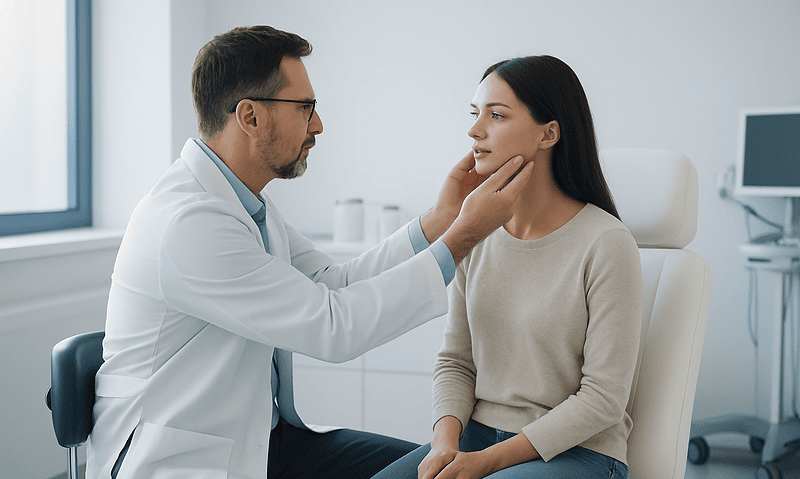
Facial implants are placed through short incisions hidden inside the mouth or under the chin, then slid into a precisely sized space, called a…
Doctors Performing This Treatment



Aesthetic Plastic & Reconstructive Surgery
Prof. Mehmet Veli Karaaltın, MD

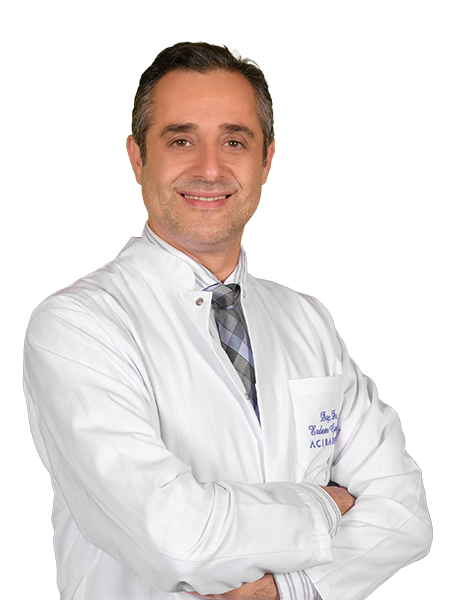
Aesthetic Plastic & Reconstructive Surgery
Assoc. Prof. Erdem Güven, MD

Aesthetic Plastic & Reconstructive Surgery
Assoc. Prof. Ahmet Küçükçelebi, MD
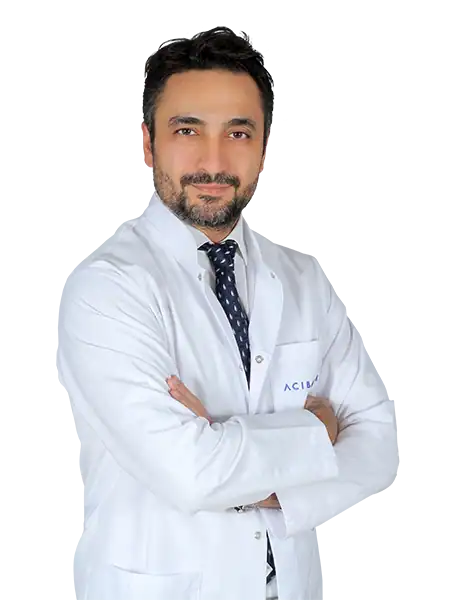
Aesthetic Plastic & Reconstructive Surgery
Assoc. Prof. Mehmet Altıparmak, MD

Aesthetic Plastic & Reconstructive Surgery