

Preparing for Microsurgery: Imaging, Fitness for Anesthesia and Specialist Consultations

Key Takeaways
- Microsurgery joins vessels and nerves only a millimeter or two across with sutures finer than a hair, so anything that narrows small vessels or thickens blood, especially nicotine, directly threatens the repair.
- CT angiography before a free flap maps both the donor vessels and the recipient vessels in the neck, and its findings routinely change which tissue the surgeon can safely borrow.
- The NHS advises fasting from solid food for about six hours and clear fluids for about two hours before a general anesthetic, but your written instructions always take precedence.
- Anesthesia risk tracks with conditions such as sleep apnea, smoking, diabetes and heart or lung disease rather than with age alone, which is why the pre-assessment clinic asks so many questions.
- Never stop, start or alter any medicine or supplement before microsurgery on your own; blood thinners in particular are balanced individually between bleeding risk and the risk of the new vessel join clotting.
- A flap that turns pale and cool or dusky and purple in the days after surgery is an emergency, because a blocked artery or vein can often be rescued only if it is acted on quickly.
Preparing for microsurgery usually means three things running in parallel: imaging such as CT angiography or Doppler ultrasound to map the tiny blood vessels and nerves the surgeon will join; a pre-anesthesia assessment of your heart, lungs, blood sugar and medicines; and consultations with the specialists involved in your care. Stopping nicotine, reviewing blood thinners with the prescriber and following fasting instructions are the steps your team will stress most.
The letter arrives with a list: a CT scan on one date, a pre-assessment clinic on another, a phone call from the anesthesia team, an appointment with a physiotherapist who works on faces. Marta reads it at her kitchen table with her hand resting, out of habit, over the side of her mouth that no longer moves. She had expected one surgeon and one operation. Instead she has a month of appointments before anyone picks up a scalpel.
That month is not bureaucracy. When a surgeon plans to join a vessel narrower than a strand of spaghetti, the odds are decided long before the operating room lights come on. Preparing for microsurgery is, in the most literal sense, preparing your circulation.
This explainer walks through what those appointments are for, what the scans reveal, why the anesthesia team asks so many questions, and what your part in the process actually is.
What is microsurgery, and why does preparation matter more than for most operations?
Microsurgery is surgery performed under an operating microscope or high-magnification loupes so that a surgeon can repair structures far too small for the naked eye: blood vessels, nerves and lymphatic channels a millimeter or two across, using sutures finer than a human hair (Cleveland Clinic). It is a technique rather than a single operation, and in facial work it shows up in several places.
Free tissue transfer, usually called a free flap, moves skin, muscle or bone from one part of the body to the face along with its own artery and vein, which are then plugged into vessels in the neck. Facial reanimation takes a paralyzed side of the face and gives it either a new nerve supply or a new, working muscle. Nerve repair rejoins or grafts a damaged facial nerve. Replantation reattaches a severed ear, lip or scalp. Lymphatic surgery reroutes fluid drainage after lymph node removal.
What unites them is a single vulnerable point: a hand-stitched join in a vessel that must carry blood from the moment the clamps come off. Anything that makes blood clot faster, makes vessel walls twitch shut, or slows healing threatens that join. Nicotine does all three. High blood sugar impairs the white cells that fight infection and the fibroblasts that knit tissue. Dehydration and low blood pressure reduce flow through a channel that has very little margin.
That is why the preparation phase is longer and more layered than for, say, a hernia repair. The imaging tells the surgeon which vessels are healthy enough to use. The anesthesia assessment predicts whether your body can hold steady for a long operation. The consultations bring in everyone whose knowledge changes the plan. None of it is optional in the eyes of the team, and understanding why makes it easier to do your part well.
How microsurgery actually works in the operating room
Picture two teams working at once. One prepares the recipient site on the face or neck, finding an artery and a vein of suitable caliber and trimming them back to healthy, undamaged tissue. The other harvests the donor tissue with its pedicle, the stalk of artery and vein that keeps the tissue alive. For jaw reconstruction that donor might be a segment of the fibula, the slender bone of the outer lower leg; for facial reanimation it is often a strip of gracilis muscle from the inner thigh.
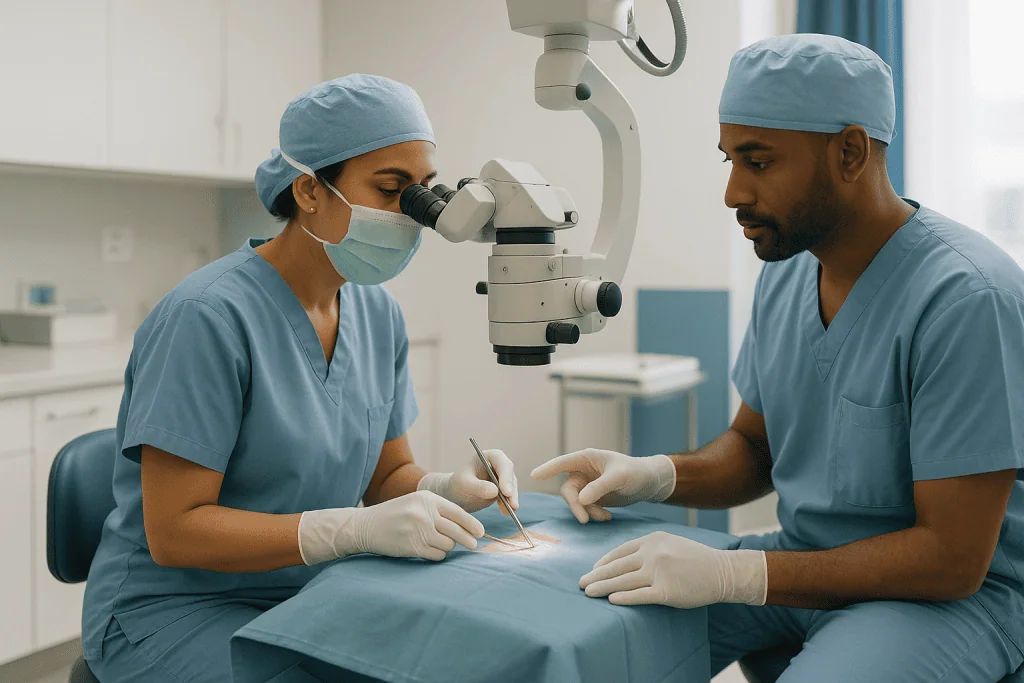
Once both sites are ready, the flap is detached, its vessels briefly without blood, and carried to the face. Under the microscope the surgeon performs the anastomosis, the sewing together of two vessel ends, placing perhaps a dozen sutures around a circle you could hide behind a grain of rice. Then the clamps come off and everyone watches. The vein should fill and darken; the flap should pink up and bleed briskly from its cut edge when pricked. If a nerve is being joined as well, its fascicles, the bundles of fibers inside the nerve, are aligned and stitched to the outer sheath.
The anesthesia team’s job during these hours is less visible but just as decisive. They keep blood pressure within a steady band so the new join neither starves nor strains, keep the patient warm because cold vessels constrict, manage fluids so blood is neither too thick nor too dilute, and avoid drugs that clamp down small vessels. They also protect a body that will lie still for a long time: padding pressure points, protecting the eyes, watching the airway.
Every question you are asked in the weeks beforehand traces back to one of those tasks. Your heart tracing predicts how it will tolerate hours under anesthesia. Your kidney function decides how contrast dye and fluids are handled. Your smoking history tells the surgeon how much spasm to expect in the vessels they are about to sew.
Who microsurgery is usually for, and who is usually asked to wait
Microsurgery in the face is reserved for problems that simpler methods cannot solve well. Reconstruction after a tumor has been removed from the tongue, jaw or cheek. Rebuilding after trauma or burns. Restoring movement to a face paralyzed by nerve injury, a tumor, or a birth condition. Reattaching a body part after an accident. Treating lymphedema, the persistent swelling that can follow lymph node removal. Reconstructive surgeons think of options as a ladder, from letting a wound heal on its own, through skin grafts and local flaps, up to free tissue transfer at the top; they climb only as high as the problem demands.
Being asked to wait is common, and it is not a rejection. Surgeons typically ask for time when something fixable would raise the risk of the flap failing or of a serious anesthesia complication. Active nicotine use tops the list. Poorly controlled diabetes, uncontrolled high blood pressure, a recent heart attack or stroke, an active infection anywhere in the body, untreated sleep apnea, severe anemia and significant malnutrition all prompt an optimization period rather than a date. Pregnancy generally means deferral unless the surgery is urgent. Ongoing cancer treatment introduces its own timing questions, since radiation changes vessel quality and chemotherapy affects healing and immunity.
Facial reanimation has a further clock that runs in the other direction. A muscle deprived of its nerve signal for long enough eventually loses the ability to be reinnervated, so the choice between repairing the original nerve, borrowing signal from a nearby nerve, or transplanting a fresh muscle depends on how long the paralysis has lasted and what electrical testing shows. Here waiting too long can close doors, which is one reason the workup is front-loaded.
Expectations are assessed as carefully as blood tests. A candid conversation about what a rebuilt face or a reanimated smile can and cannot do is part of preparation, and a team that spends time on it is doing its job.
Preparing for microsurgery starts with imaging: what the scans are actually looking for
Most people expect the surgeon to look at the problem. Fewer expect a detailed look at the solution, which is what pre-operative imaging mostly is: a map of the vessels and nerves that will be borrowed or joined.

CT angiography is a CT scan taken while a contrast dye travels through the arteries, producing a three-dimensional picture of where they run and how healthy they are. Before a fibula flap it shows whether the three arteries of the lower leg are all open, so that taking one leaves the foot safely supplied. Before any free flap to the face it maps the recipient vessels in the neck, which matters enormously if previous surgery or radiation has scarred them. Some centers use the same scan data to print models of the jaw and cutting guides so the bone can be shaped with precision.
Doppler ultrasound uses sound waves to detect blood moving through a vessel; you may hear the whooshing pulse as the probe passes over your skin. It is quick, painless and often repeated on the morning of surgery to mark the exact position of small perforating vessels with a skin pen.
MRI shows soft tissue in fine detail and is favored when the question is the extent of a tumor or the state of a nerve. For facial palsy, electromyography and nerve conduction studies, tests that place fine needles or surface electrodes on the facial muscles and measure their electrical activity, tell the team whether the muscles are still capable of responding if a nerve signal is restored.
Your part is practical. Tell the imaging staff about any previous reaction to contrast dye, any kidney problems, and any chance you could be pregnant. A blood test to check kidney function usually precedes contrast. If you take a diabetes medicine that interacts with contrast, the prescriber will tell you how to handle it; do not change it yourself. Arrive hydrated, and bring any earlier scans on disc so they can be compared.
Fitness for anesthesia: what the pre-assessment clinic checks and why
A long operation is a different physiological event from a short one. Hours of anesthesia mean hours of fluid shifts, of lying in one position, of heat loss, of the clotting system being nudged by immobility. The pre-assessment clinic exists to predict how your body will handle that and to fix what can be fixed first (NHS).
Expect a detailed history: heart disease, breathing problems, previous anesthetics and how you reacted, snoring or daytime sleepiness that might point to sleep apnea, reflux, allergies, and any family history of a rare inherited reaction to anesthetic drugs called malignant hyperthermia. Someone will look in your mouth and at your neck to judge how easy it will be to place a breathing tube. Blood tests usually cover blood count, kidney and liver function, clotting and blood sugar, with a blood group sample held in case transfusion is needed. An electrocardiogram records the heart’s rhythm; an echocardiogram, an ultrasound of the heart, or lung function tests are added when the history suggests they would change the plan.
The anesthesiologist then assigns a physical status grade, a simple scale that summarizes how healthy or unwell a person is overall. It is not a verdict; it is a shared language for how much extra care the operation will need.
Fasting instructions follow from all this. The NHS advises that before a general anesthetic you usually stop eating solid food about six hours beforehand and clear fluids about two hours beforehand, because a full stomach risks food entering the lungs during induction. Your own instructions may differ, and the written ones you receive override anything here.
Serious anesthesia complications are uncommon, and risk rises with age, smoking, obesity, sleep apnea, high blood pressure, diabetes and heart, lung or kidney disease rather than with the anesthetic itself (Mayo Clinic). Being honest at pre-assessment, even about things that feel embarrassing, is the most effective safety measure you control.
Why specialist consultations come first, and which specialists you may meet
Marta’s letter listed more names than she expected because facial microsurgery is genuinely a team sport. The reconstructive surgeon plans the flap; if a tumor is involved, a head and neck surgeon plans the removal and the two operate together. The anesthesiologist owns the middle hours. Beyond that core, the cast depends on your history.
A cardiologist may be asked to review a heart murmur, a stent, or a rhythm problem and to advise on whether heart medicines continue through surgery. A diabetes team may tighten control in the weeks beforehand. A hematologist becomes involved if you have a clotting disorder or take long-term anticoagulants, because the surgeon needs to balance bleeding against the risk of the new vessel join clotting. An oncologist and a radiation oncologist coordinate the timing of surgery with other treatment. For jaw reconstruction a dentist or prosthodontist plans how teeth will eventually be restored and may treat any infected teeth beforehand, since mouth bacteria and a fresh bone flap are a poor combination.
Then come the people who shape recovery. A speech and swallowing therapist assesses how you eat and speak now so that changes can be managed afterward. A facial physiotherapist begins the exercises and mirror work that reanimation depends on. A dietitian checks protein and micronutrient intake, because a body cannot build new tissue from an empty pantry. An ophthalmologist protects an eye that cannot fully close. A psychologist helps with the identity questions that come with a changed face.
Many hospitals bring these people together in a multidisciplinary team meeting, a regular case conference where the plan is agreed before it is presented to you. Ask whether your case will be discussed in one. Bring to every appointment a complete list of medicines including inhalers, patches and supplements, copies of earlier operation notes and scans, and, if you can, a companion who will remember what you forget.
Is microsurgery risky? An honest account of what can go wrong
Yes, in the way that any long operation under general anesthesia is risky, plus one hazard that is specific to the technique. Pretending otherwise would be poor preparation.
The general risks first. Anesthesia itself can cause nausea, sore throat, chipped teeth from the breathing tube, temporary confusion, and, rarely, heart or breathing complications; Mayo Clinic notes that serious problems are uncommon and cluster in people with significant medical conditions rather than in healthy adults of any age. Long surgery adds pneumonia, pressure injuries to skin, and blood clots in the legs that can travel to the lungs, which is why you will be given compression stockings, early mobilization and often a blood-thinning injection afterward.
The specific risk is flap compromise: a clot forming in the freshly joined artery or, more often, the vein. An arterial blockage starves the tissue and turns it pale and cool; a venous blockage congests it and turns it dusky or purple. Either is an emergency that usually means a return to the operating room to reopen the join, and it is the reason nurses check the flap at short intervals in the first days. Some flaps cannot be rescued and are lost, which means a further reconstruction later. Bleeding, infection, wound breakdown at the edges and injury to nearby nerves are the other surgical possibilities. Donor sites carry their own: numbness, weakness, scarring, a leg that aches on stairs for a while.
Alternatives exist and a good consultation covers them. Local flaps borrow nearby tissue without a microsurgical join. Skin grafts cover but do not fill. Static slings can lift a paralyzed mouth corner without restoring movement. Prosthetics can replace an ear or part of a nose. Sometimes the best option is to do nothing surgical yet. Which route suits you depends on the defect, your health and your priorities, and the decision rests with you and your treating team, not with an article.
What not to do before surgery: the two weeks that matter most
People search this question hoping for a short list, and a short list exists, but each item has a mechanism behind it that is worth knowing.
Do not use nicotine in any form, including vaping, patches or pouches, unless your team has explicitly discussed it with you. Nicotine narrows small vessels and carbon monoxide from smoke lowers the oxygen the blood can carry; both act directly on the join the surgeon is about to make. The NHS advises stopping smoking as far ahead of any operation as possible because it lowers the risk of wound and lung complications.
Do not start any new supplement or herbal remedy, and do declare the ones you already take. Several common ones affect clotting or interact with anesthetic drugs, and the pre-assessment team will want the full list (NHS).
Do not stop, skip or double any prescribed medicine on your own initiative. Some will be continued right up to the morning of surgery, some paused, some swapped; that plan belongs to the prescriber and the anesthesiologist together.
Do not crash-diet or fast beyond what you are told. Tissue repair needs protein, and the last two weeks are the wrong time to run short of it. Do not drink heavily; alcohol affects clotting, the liver’s handling of drugs and wound healing. Do not shave or wax the operative area at home; if hair needs removing, staff will do it with clippers immediately beforehand to avoid tiny nicks that bacteria can enter.
Do not hide a cold, cough, urinary infection, dental abscess or skin infection. Any of these may change the date, and a postponed operation is far better than an infected flap. Do not eat or drink past the fasting cutoff on your instruction sheet.
Meanwhile, do arrange transport home, help for the first days, time off work, and a bag packed with loose front-opening clothes that will not need to be pulled over a swollen face.
Medicines, supplements and the conversation you must have before the date
Nothing in microsurgery preparation causes more anxiety, or more avoidable mistakes, than medicines. The principle is simple: every decision about what to continue, pause or change belongs to the prescribing clinician and the surgical team, and your job is to make sure they know everything you take.
Anticoagulants, medicines that slow clotting, and antiplatelet drugs, which stop platelets sticking together, are the delicate case. Too much blood thinning and the operation bleeds; too little and the new vessel join may clot. The surgeon and anesthesiologist weigh why you take the drug in the first place, whether a heart valve, a stent or a previous clot, against the surgical plan, sometimes with a cardiologist or hematologist. The result is an individual timeline, not a rule you can look up.
Non-steroidal anti-inflammatory painkillers also affect platelets, which is why you may be asked about them specifically. Diabetes medicines interact with fasting, since a drug that lowers blood sugar taken on an empty stomach can drop it too far; the diabetes team or anesthesiologist will tell you exactly what to do on the morning. Blood pressure medicines are often continued because a steady pressure is exactly what the flap needs. Hormone therapies and combined contraceptives raise clot risk during immobility and will be discussed. Inhalers should come to the hospital with you.
Supplements deserve the same honesty. Fish oil, vitamin E, garlic, ginkgo and ginger are all reported to affect bleeding; St John’s wort interacts with anesthetic and pain medicines; high-dose vitamin C or zinc taken for healing is best discussed rather than assumed helpful. The NHS pre-operative guidance specifically asks patients to mention herbal remedies for these reasons.
The easiest tool is a single sheet of paper listing every product, its purpose and when you take it, handed to each specialist you meet. When two clinicians give you instructions that seem to conflict, say so at once; the anesthesiologist is usually the person who reconciles them.
Preparing for microsurgery when you smoke, live with diabetes or have high blood pressure
Three conditions come up in almost every microsurgery consultation, and each has a clear mechanism that explains the team’s insistence.
Smoking acts on the exact tissue the surgeon is protecting. Nicotine causes small arteries to constrict, carbon monoxide displaces oxygen from red blood cells, and the combination reduces the oxygen reaching the edge of a flap where healing is already precarious. Smokers also cough more after anesthesia and clear their lungs less well. The NHS is unambiguous that stopping before an operation lowers complications and that the earlier you stop, the greater the benefit. Nicotine replacement raises a specific question in microsurgery because nicotine itself is a vessel constrictor; some teams accept it as the lesser evil, others ask for a nicotine-free window. Ask yours directly rather than assuming.
Diabetes affects healing through glucose itself. High blood sugar impairs the white cells that clear bacteria, stiffens small vessels over time, and slows collagen formation. Your team will look at your HbA1c, a blood test reflecting average glucose over roughly the preceding three months, and may set a target to reach before booking a date. During surgery the anesthesiologist monitors and manages glucose directly. The target and the medicine adjustments are theirs to set; the daily work of reaching them is yours.
Blood pressure matters because of swings rather than a single number. Pressure that runs too high during or after surgery increases bleeding into the flap; pressure that falls too low reduces flow through the anastomosis. Untreated hypertension is therefore usually treated first, and treated hypertension is usually continued through surgery as directed.
Weight is discussed in these clinics too, and it deserves respectful handling. Body size influences anesthesia planning, positioning and clot risk, but what surgeons care about most is nutritional status: adequate protein, corrected anemia, replenished iron and vitamin D where low. A dietitian’s visit before surgery is about building materials, not about a number on a scale.
How long does microsurgery take, and what the day itself looks like
Microsurgical operations are long. Cleveland Clinic describes them as lasting several hours, and complex free-flap reconstructions with two surgical teams commonly fill most of a working day. Your surgeon will give you a range for your operation; treat it as an estimate, since the time taken to find good vessels and confirm flow cannot be scheduled to the minute.
The day begins early. You will confirm your identity and the planned operation more times than feels necessary; that repetition is a safety system. The surgeon marks the skin, often with the Doppler probe to pinpoint vessels, while the anesthesia team places an intravenous line. Many people ask whether they will be exposed. Once you are asleep, you are covered with sterile drapes so that only the operative sites, in this case parts of the face, neck and the donor area, are visible; genitals and other areas remain covered throughout, and a urinary catheter for the long operation is placed after you are asleep and usually removed within a day or two. Staff follow dignity protocols even when you cannot see them.
After induction, an arterial line, a thin cannula in a wrist artery that reads blood pressure continuously, is often placed so pressure can be held steady. Warming blankets, padded supports and eye protection go on. Family members are typically given a contact number and periodic updates rather than a fixed finish time.
You will wake in a recovery area, and for flap surgery you will usually then move to a high-observation or intensive care bed where nurses can check the flap’s color, warmth and Doppler signal at short intervals. Expect drains, a swollen face you may not want to look at yet, a sore throat, and, after jaw or tongue surgery, possibly a temporary breathing tube or feeding tube. None of this reflects how the operation went; it is what the first night after a long reconstruction looks like.
What the days and weeks before and after usually look like
Preparation and recovery are two halves of one arc, and seeing them side by side helps make sense of why the early appointments are spaced the way they are.
| Phase | What typically happens | Who is usually involved |
|---|---|---|
| Weeks before | Imaging, specialist consultations, nicotine cessation, diabetes and blood pressure optimization, dental review, nutrition assessment, multidisciplinary planning | Reconstructive surgeon, anesthesiologist, relevant physicians, dentist, dietitian, therapists |
| Days before | Pre-assessment results reviewed, medicine plan confirmed in writing, fasting and washing instructions given, transport and home help arranged | Pre-assessment nurse, anesthesiologist, pharmacist |
| Day of surgery | Skin marking with Doppler, lines placed, long operation, wake in recovery, transfer to monitored bed | Two surgical teams, anesthesia team, theater nurses |
| First days | Frequent flap checks, head kept in a neutral position, no nicotine, early sitting out and walking to prevent clots, drains removed as output falls | Ward and critical care nurses, surgeons, physiotherapist |
| First weeks | Swelling settles, wounds checked, diet advances, speech and swallowing work begins, donor site rehabilitation | Surgeon, speech therapist, physiotherapist, dietitian |
| Months | Nerves regrow slowly; movement after facial reanimation appears gradually; scars mature; secondary refinements considered | Surgeon, facial therapist, psychologist as needed |
Two details in that table deserve emphasis. In the first days, nurses will ask you to avoid turning your head sharply, lying on the operated side, or wearing anything tight around the neck, because pressure or kinking on the pedicle can compromise flow. And the ban on nicotine does not end when you leave the hospital; a flap remains vulnerable while its new vessels mature.
The final phase is the one people find hardest. After facial reanimation, the transplanted muscle or rerouted nerve does nothing for a while, then produces a flicker, then a movement. Nerves grow along their sheath slowly, over months, and the therapist’s exercises exist to make the most of each millimeter. Recovery from facial microsurgery is measured in seasons, not weeks.
What people often get wrong about preparing for microsurgery
The word itself is the first trap. Micro describes the size of the vessels, not the size of the operation. A free flap to the face is major surgery with a long anesthetic and a hospital stay, and people who arrive expecting a day case are understandably shaken by the pre-assessment list.
Quitting nicotine the night before is the second. The vessel-constricting effect fades within hours, but the lung and healing benefits accumulate over weeks, which is why every guideline that addresses the question, including NHS pre-operative advice, says stop as early as you can rather than as late as you can get away with. Vaping is not exempt; the nicotine is the problem, not the smoke alone.
Stopping every medicine to be safe is the third, and it can be dangerous. Some drugs, particularly certain heart and blood pressure medicines, cause problems when withdrawn abruptly, and the anesthesiologist may want others continued precisely because the flap needs steady pressure and, in some plans, a degree of anticoagulation. The safe rule is the opposite: change nothing until someone with prescribing authority tells you what to change.
Treating the scan as a formality is the fourth. The CT angiogram routinely alters the plan, revealing a leg whose foot depends on the very artery the surgeon hoped to borrow, or a neck whose vessels have been scarred by radiation. It is part of the operation, performed early.
Expecting to see the result when the dressings come off is the fifth. Swelling, bruising and a flap that is deliberately made bulky at first because it can be trimmed later all mean the early appearance is not the final one, and reanimation results emerge over months.
The last is believing that age alone rules someone out. Mayo Clinic’s guidance on anesthesia risk points to overall health, not birth date, as the determinant. Older adults with well-managed conditions undergo long reconstructions routinely; the pre-assessment exists to find out whether you are one of them.
Questions to ask your care team before you agree a date
A good consultation leaves you with fewer questions than you arrived with, but only if you bring them. The list below is a starting point; strike out what does not apply and write the answers down, because the details blur once anxiety sets in.
- Which type of microsurgery are you proposing, where will the donor tissue come from, and what will that donor site look and feel like afterward?
- What are the alternatives, including doing nothing for now, and why do you favor this option for me?
- Which scans do I need, what are you hoping to learn from each, and could the results change the plan?
- Roughly how long will the operation take, and how long do you expect me to stay in hospital?
- Who will be checking the flap afterward, how often, and what happens if it shows signs of trouble?
- What is the plan for each of my medicines, in writing, and who do I call if two instructions seem to conflict?
- How far in advance do you want me completely nicotine-free, and does that include replacement products?
- Are there targets for my blood sugar or blood pressure that you would like me to reach first?
- Will my case be discussed at a multidisciplinary meeting, and which specialists will I meet beforehand?
- What will I be able to eat, speak and do in the first weeks, and who will help me with each?
- What is realistic for the final appearance or movement, over what timeframe, and what might need a second procedure?
- If I get a cold or an infection in the week before surgery, whom do I tell and how?
One further question matters more than it sounds: what would make you postpone? Hearing the surgeon’s own list of reasons to wait tells you what the team is watching for and turns the preparation period from a series of hurdles into a shared checklist.
When to call your doctor
Before surgery, contact the pre-assessment team or the surgeon’s office promptly if you develop a fever, a new cough or chest infection, a urinary infection, a dental abscess, a skin infection or open sore anywhere near the planned operative or donor sites, or if you have missed doses of a medicine you were told to continue. Call urgently, or use emergency services, for chest pain, sudden breathlessness, a swollen painful calf, or any sign of stroke such as facial drooping that is new, arm weakness or slurred speech; these are emergencies in their own right and would also change the surgical plan.
After surgery, the flap is the priority. Tell the nursing staff or, once home, the surgical team immediately if the reconstructed tissue changes color, becoming pale and cool or dusky, purple and swollen, if it stops feeling warm, if there is sudden new swelling or bleeding at the face, neck or donor site, or if a dressing becomes soaked. These can indicate a blocked vessel, and the sooner it is seen the greater the chance of salvage. Other red flags include a temperature that rises or persists, wound edges that separate or discharge, increasing rather than settling pain, difficulty breathing or swallowing, a calf that becomes painful or swollen, chest pain, or new confusion. For breathing difficulty, chest pain or heavy bleeding, call emergency services rather than waiting for a clinic to open.
Less dramatic changes still warrant a call: persistent nausea preventing fluids, a blood sugar you cannot keep in the range you were given, a blood pressure reading far outside your usual, or an eye that feels gritty and will not close after facial surgery. Your team would rather hear about a concern that turns out to be nothing than miss one that mattered. Keep the contact numbers you were given somewhere visible, and if in doubt, call.
Frequently asked questions
How long does microsurgery take?
Microsurgical operations typically last several hours, and complex facial free-flap reconstructions involving two surgical teams often fill most of a day (Cleveland Clinic). The time depends on finding healthy vessels, completing the anastomosis and confirming blood flow before closing, none of which can be rushed. Your surgeon will give you a range for your specific procedure, and relatives are usually offered periodic updates rather than a fixed finish time.
What is microsurgery, in plain terms?
Microsurgery is surgery performed under a microscope or high-power magnifying lenses so the surgeon can repair very small structures such as blood vessels, nerves and lymphatic channels. In the face it is used to move living tissue from elsewhere in the body, to restore movement to a paralyzed face, to repair nerves and to reattach severed parts. It describes a technique rather than one operation.
Is microsurgery risky?
It carries the general risks of a long operation under anesthesia, such as bleeding, infection, blood clots and breathing complications, plus a specific risk that the newly joined vessel clots and the transferred tissue is compromised. Serious anesthesia complications are uncommon and cluster in people with significant medical conditions (Mayo Clinic). Preparation, especially stopping nicotine and optimizing blood sugar and blood pressure, is how the team lowers those risks.
What should I not do in the two weeks before surgery?
Avoid nicotine in any form, avoid starting new supplements, and do not stop or change prescribed medicines without instruction. Do not crash-diet, drink heavily, shave or wax the operative area yourself, or hide a cold, cough, dental or skin infection from the team. Follow the fasting cutoff exactly. The NHS pre-operative guidance also asks that you declare herbal remedies, since several affect clotting or interact with anesthetic drugs.
Do they cover your privates during surgery?
Yes. Once you are asleep you are covered with sterile drapes so that only the operative areas, in facial microsurgery the face, neck and the donor site, are exposed. Genitals and other areas stay covered throughout, and a urinary catheter, if needed for a long operation, is placed after you are unconscious and removed as soon as it is no longer required. Operating teams follow dignity protocols whether or not you are aware.
Why do I need a CT angiogram before a free flap?
The CT angiogram maps your arteries in three dimensions using contrast dye. It confirms that removing the donor tissue with its artery will leave the rest of that limb safely supplied, and it shows whether the recipient vessels in your neck are healthy enough to use, which matters after radiation or previous surgery. The findings can change which flap is chosen, so it is part of the operation rather than a formality.
Can I take my blood pressure and heart medicines on the morning of surgery?
Often yes, but only your anesthesiologist and prescriber can say which ones. Many blood pressure medicines are continued because steady pressure protects the flap, while some other drugs are paused or adjusted. You should receive a written medicine plan at pre-assessment; if you did not, or if two instructions conflict, call the pre-assessment team before the day rather than guessing.
What happens if I get a cold the week before microsurgery?
Tell the surgical or pre-assessment team as soon as symptoms appear. A chest infection increases breathing complications under a long anesthetic, and any active infection raises the risk of the flap becoming infected, so the operation may be postponed. A delayed date is disappointing but far safer than operating through an infection, and rescheduling is a routine part of how these teams work.
Does vaping count as smoking before microsurgery?
For the purposes of vessel healing, yes. Nicotine itself constricts small blood vessels and reduces flow through the freshly joined artery and vein, regardless of whether it arrives by cigarette, vape, patch or pouch. Teams differ on whether nicotine replacement is acceptable as a stepping stone, so ask yours directly how long they want you completely nicotine-free before and after the operation.
Am I too old for a long microsurgical operation?
Age by itself does not decide fitness for anesthesia; overall health does. Mayo Clinic identifies conditions such as heart, lung or kidney disease, diabetes, sleep apnea, obesity and smoking as the factors that raise anesthesia risk. Older adults with well-managed conditions undergo long reconstructions routinely. The pre-assessment clinic exists to find out whether your body can hold steady for the operation and what can be optimized first.
References
This article is for general information only and is not a substitute for professional medical advice. Please consult a qualified doctor about your individual situation.

More from the Blog
Is Surgical Tattoo Removal an Option for You? Size, Location and Skin Elasticity Explained
Yes, tattoos can be surgically removed, but excision suits a narrow group: small to medium tattoos on areas with loose, elastic skin, in people…
How Masseter Botox Is Injected: Locating the Chewing Muscle and What the Session Involves
In a masseter botox procedure, a clinician first asks you to clench your teeth so the masseter, the thick chewing muscle at the back…

Fibroblast Plasma Skin Tightening Results: What Changes, How Gradually and How Long It Lasts
Fibroblast plasma treatment results tend to be modest and gradual rather than dramatic. Small dark crusts usually lift within one to two weeks, pinkness…

How Long Does a Thread Lift Last? Honest Longevity and Who It Suits
A thread lift typically lasts one to three years, depending on the suture material, your age, skin quality, and how much lift was attempted.…

Recovery After Retinal or Glaucoma Laser Treatment: Blurry Hours, Follow-Up and Milestones
After most retinal or glaucoma laser treatments, vision is blurry or dazzled for a few hours, mainly because of dilating drops, the bright treatment…

Flap or Graft? How Reconstructive Surgeons Choose Between the Two Ways to Rebuild Tissue
A skin graft is tissue detached completely from one site and laid onto a wound, where it must grow a new blood supply from…