

Pulmonary Rehabilitation After Lung Cancer Treatment: Rebuilding Stamina Safely
Key Takeaways
- Removing one lung lobe takes away roughly a fifth of lung tissue, but the stamina loss people feel comes mostly from weakened leg and breathing muscles, which rehabilitation can rebuild.
- Supervised pulmonary rehabilitation typically runs for several weeks to a few months with two or three sessions a week, and intensity is set by monitored oxygen levels and a 0–10 breathlessness score, not by a treadmill number.
- Deep breathing cycles and supported coughing in the first days after surgery help re-expand collapsed lung segments and lower pneumonia risk, which is why physiotherapy starts before you leave hospital.
- Evidence that exercise after lung cancer surgery improves walking distance and quality of life is moderate and growing; evidence that it affects recurrence or survival does not exist, and no program should imply otherwise.
- Rehabilitation can continue during chemotherapy or immunotherapy with cycle-based scheduling, but new breathlessness during immunotherapy or after chest radiation needs prompt assessment for lung inflammation rather than pushing through.
- Public health guidance for able adults, including cancer survivors, aims toward 150 minutes of moderate activity plus two strength days a week, and rehabilitation is designed to build toward that target in small increments.
Pulmonary rehabilitation after lung cancer is a supervised program of graded exercise, breathing training, and education that helps people rebuild stamina once surgery, chemotherapy, radiation, or immunotherapy is complete or ongoing. Programs typically run for several weeks to a few months with two or three sessions a week, and the treating team decides when it is safe to start and how hard to push.
The stairs were the giveaway. Four months after a lobectomy, Marcus could sit through a whole movie without coughing, but the eleven steps to his bedroom still left him gripping the banister, waiting for the air to come back. His scan was clear. His surgeon was pleased. And yet the body he lived in felt borrowed from someone twenty years older.
That gap between “the cancer is treated” and “I can do my life again” is exactly where pulmonary rehabilitation after lung cancer sits. It is not a spa, not a gym membership, and not a pep talk. It is a structured medical program, run by physiotherapists, respiratory therapists, and nurses, that teaches a damaged respiratory system and a deconditioned body to work together again.
This explainer walks through what actually happens in a session, who it suits, what the evidence can and cannot promise, and the warning signs that mean you stop and call your team.
What is pulmonary rehabilitation after lung cancer, and why does it exist?
Pulmonary rehabilitation is a supervised program that combines exercise training, breathing techniques, and education for people whose lungs limit what they can do. It was designed decades ago for chronic obstructive pulmonary disease (COPD), a group of long-term lung conditions that narrow the airways, and the same framework has since been adapted for people recovering from lung cancer treatment.
The logic is simple. Lung cancer treatment removes or damages lung tissue, and the fatigue, bed rest, and reduced appetite that come with it shrink the muscles that do the breathing and the walking. A person can end up short of breath for two separate reasons at once: less lung to exchange gas, and weaker muscles demanding more oxygen for the same task. Rehabilitation targets the second problem directly and helps the body adapt to the first.
What distinguishes it from simply “being more active” is the supervision. Oxygen levels, heart rate, and breathlessness scores are monitored during exercise, so the intensity can be raised in small, safe steps. The National Heart, Lung, and Blood Institute describes programs that generally run for several weeks to a few months, with sessions a few times a week, followed by a home plan to keep the gains.
Three ingredients appear in nearly every program:
- Endurance work, usually walking or cycling, started well below what the person can tolerate.
- Strength work for the legs, arms, and the muscles between the ribs.
- Education on breathing control, energy conservation, nutrition, and recognizing warning signs.
None of this is exotic. The value is in the dosing of effort, the monitoring, and the steady accumulation of small wins over weeks.
How pulmonary rehabilitation after lung cancer actually works, session by session
The first appointment is mostly measurement. Expect a walking test, often a six-minute walk test, which records how far you can travel on a flat corridor in six minutes while your oxygen saturation and heart rate are tracked. Saturation, in plain terms, is the percentage of your red blood cells carrying oxygen, read by a clip on your finger. You will also be asked to rate breathlessness on a 0–10 scale, and a therapist will check leg strength, balance, and sometimes grip strength.
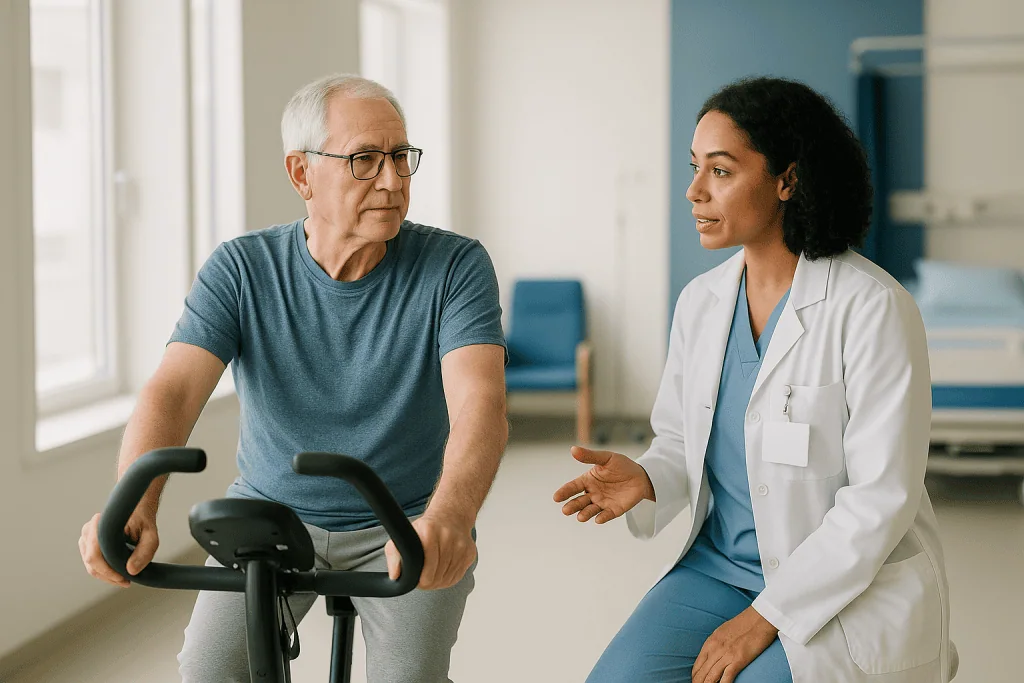
These numbers set your starting point. They are not a judgment; they are the baseline that lets the team prove progress later.
A typical session then follows a predictable shape. A warm-up of five to ten minutes of easy movement. Twenty to thirty minutes of aerobic work on a bike, treadmill, or track, broken into intervals if continuous effort is too much. Resistance training using bands, light weights, or body weight, usually two or three sets per muscle group. A cool-down with stretching and breathing practice. Throughout, a therapist watches the finger clip and asks for your breathlessness score, adjusting speed or resistance so you stay in a working but safe zone.
Between sessions you get homework: a walking target, a few strength moves, and breathing drills. The education half of the program happens in short group or one-to-one talks covering topics like managing a cough, pacing a day, and what to eat when appetite is poor.
Progress is reviewed every few weeks against the baseline tests. The goal is not a heroic single effort but a measurable upward curve in distance walked, weight lifted, and ease of breathing during ordinary tasks.
Who pulmonary rehabilitation is usually for, and who is asked to wait
The clearest candidates are people who notice that breathlessness, fatigue, or weakness is limiting daily life after lung cancer treatment. That includes people recovering from lobectomy or pneumonectomy (removal of a lung lobe or a whole lung), people who have finished radiation to the chest, and people who are partway through or past systemic treatment such as chemotherapy or immunotherapy.
Pre-existing lung disease strengthens the case. Many people with lung cancer also have COPD from the same smoking history, and the combination of surgery plus narrowed airways makes supervised rehabilitation especially useful.
Referral usually comes from the oncology or surgical team, sometimes from a primary care clinician. The treating team decides on timing, and that is the part people most often want to rush.
Reasons a team may ask you to wait, or to start with a gentler home program first, include:
- A surgical wound or chest drain site that is not yet healed.
- Unstable heart rhythm, uncontrolled blood pressure, or recent chest pain.
- A blood clot in the leg or lung that has not yet been treated.
- Very low blood counts during chemotherapy, which raise infection and bleeding risk.
- Bone metastases in weight-bearing areas, where some exercises need modifying.
- An active infection or fever.
None of these is a permanent no. They are reasons to adjust the plan, and most people with these issues still receive some form of rehabilitation once the acute problem is handled. Advanced disease is not an exclusion either; the goals simply shift toward maintaining independence and easing breathlessness rather than chasing fitness records.
Why does stamina drop so sharply after lung cancer treatment?
People are often surprised that losing one lobe, roughly a fifth of total lung tissue, can make a flight of stairs feel like a hill. The explanation is that several losses stack on top of each other.
First, there is less lung. Surgery removes tissue; radiation can stiffen and scar what remains. The lungs that are left must do the same work with less surface area for oxygen to cross into the blood.
Second, the muscles that pump the chest get weaker. The diaphragm and the intercostal muscles between the ribs are muscles like any other, and weeks of shallow, guarded breathing after a chest incision train them to do less. Pain makes people avoid deep breaths, and the habit outlasts the pain.
Third, the rest of the body deconditions. Hospital stays, fatigue from chemotherapy, and reduced appetite strip muscle from the legs within days. Weaker leg muscles need more oxygen per step, which means more breathing for the same task.
Fourth, anemia (a low red blood cell count, common after chemotherapy) lowers the blood’s oxygen-carrying capacity, so even healthy lungs cannot deliver as much.
Finally, there is the nervous system. Breathlessness is frightening, and fear changes breathing patterns: faster, shallower, higher in the chest. That pattern is less efficient and creates a loop where anxiety produces breathlessness, which produces more anxiety.
Rehabilitation cannot regrow lung tissue. What it can do is rebuild muscle so each step costs less oxygen, retrain breathing so the diaphragm does more of the work, and break the fear loop through repeated safe exposure to effort. That is why people often report feeling less breathless even when their lung function tests barely change.
Prehab before lung cancer surgery: does getting fit first matter?
Prehabilitation, or prehab, is the same mix of exercise, breathing training, and nutrition started before surgery instead of after. The idea has gained ground in thoracic surgery over the past decade, and the reasoning is intuitive: a stronger person on the operating table has more reserve to lose.
What happens in prehab is modest in scope because the window is short. Surgery for lung cancer is usually scheduled within weeks of diagnosis, so programs focus on what can shift quickly: daily walking, a few leg-strength exercises, inspiratory muscle training using a small handheld device that adds resistance to breathing in, and stopping smoking. Quitting even shortly before surgery lowers the risk of chest complications, and the surgical team will usually raise this early.
What the evidence shows is encouraging but not settled. Small trials and reviews suggest that preoperative exercise can improve walking distance and may reduce some postoperative lung complications and hospital stay. The quality of that evidence is mixed, with small sample sizes and varied programs, so guideline bodies describe prehab as reasonable and promising rather than proven. It is fair to say it is unlikely to harm and may help; it is not fair to say it guarantees a smoother recovery.
Practically, if you are waiting for surgery, ask your team whether a prehab referral exists locally and what you can safely do at home in the meantime. Many surgical units now include a brief exercise and breathing plan as part of pre-admission preparation, and the mechanics you learn before the operation (controlled breathing, supported coughing, getting out of bed efficiently) are the same ones you will need in the first days afterward.
Recovery after lobectomy: what the first weeks usually look like
Recovery is not a straight line, and the timeline below is a typical range drawn from general surgical recovery guidance rather than a promise. Your team will give you the version that fits your operation.
Days 1 to 3, still in hospital. You will be asked to sit out of bed and walk short distances within a day of surgery, often while a chest drain is still in. Physiotherapists will teach deep breathing cycles and a supported cough, where you hug a folded towel against the incision to brace it. This is the earliest form of rehabilitation and it matters most: it keeps the small airways open and lowers the risk of pneumonia.
Weeks 1 to 2 at home. Short walks several times a day, gradually lengthened. Breathlessness on stairs is normal. Pain around the incision and along the ribs usually improves steadily, though nerve-related aching can linger. Fatigue is often the dominant symptom.
Weeks 3 to 6. Walking distance builds. Many people can manage light household tasks. Driving, lifting, and returning to work depend on the operation and the job, and the surgical team sets those limits. The NHS notes that recovery after lung surgery can take several weeks to a few months, with keyhole (video-assisted) procedures tending to allow a quicker return than open surgery.
Weeks 6 to 12 and beyond. This is the window when formal pulmonary rehabilitation most often begins, once wounds have healed and the team is confident the heart and lungs are stable. People who start at this stage frequently say the structured program gave them permission to push, which fear had been withholding.
If adjuvant chemotherapy follows surgery, rehabilitation may be paused, slowed, or run alongside it in a modified form.
Breathing exercises after lung surgery: what they do and what they do not
Breathing exercises are the part of rehabilitation people can picture, and also the part most surrounded by exaggerated claims. Here is what they genuinely achieve.
Deep breathing cycles re-expand parts of the lung that collapse slightly after surgery, a change called atelectasis. Taking a slow full breath, holding for a moment, then letting it out keeps small airways open and shifts secretions toward the larger airways where a cough can clear them. This is why it is taught on day one.
Diaphragmatic breathing teaches you to let the belly rise on the in-breath, which recruits the diaphragm rather than the small muscles of the neck and upper chest. It is more efficient and tends to calm the breathing rate. The sensation feels odd at first, especially with a sore chest, and takes repetition to become automatic.
Pursed-lip breathing, breathing in through the nose and out slowly through gently pursed lips, is borrowed from COPD care. It slows the out-breath and keeps a little back-pressure in the airways so they do not collapse early. For people with coexisting COPD it can ease the feeling of air hunger during exertion; for people with healthy airways its benefit is smaller but it still helps pace effort.
Inspiratory muscle training uses a handheld device that resists each in-breath, strengthening the diaphragm over weeks. The evidence suggests it improves inspiratory muscle strength; whether that translates reliably into fewer complications is less certain.
What breathing exercises cannot do is regrow lung, reverse scarring, or substitute for the leg and arm training that drives most of the stamina gain. Think of them as the technique layer, with endurance and strength work as the engine.
Lung cancer rehabilitation exercises: what a core program includes
Programs vary, but the components are consistent enough that a summary is useful. The table shows what each element targets and roughly how it is prescribed, based on general pulmonary rehabilitation practice described by the National Heart, Lung, and Blood Institute and MedlinePlus. Your own plan will be individualized.
| Component | What it targets | How it is typically prescribed |
|---|---|---|
| Aerobic training (walking, cycling) | Heart and lung endurance; oxygen use in muscle | 20–30 minutes per session, continuous or in intervals, at a moderate breathlessness rating |
| Lower-limb strength (sit-to-stand, step-ups, leg press) | Thigh and calf muscles that drive walking and stairs | 2–3 sets of 8–12 repetitions, two or three days a week |
| Upper-limb strength (bands, light weights) | Shoulder and arm muscles used for lifting, dressing, and accessory breathing | Similar sets; shoulder range work after chest surgery |
| Breathing control | Diaphragm efficiency; recovery from breathlessness | Short daily practice, integrated into warm-up and cool-down |
| Inspiratory muscle training | Strength of breathing-in muscles | Brief daily sessions with a resistance device, if prescribed |
| Flexibility and posture | Chest wall mobility, scar stiffness | Gentle stretching after each session |
| Education | Pacing, nutrition, inhaler technique, warning signs | Short talks across the program |
Two points deserve emphasis. Leg strength is the single biggest lever for day-to-day stamina, because the legs are where most of the body’s oxygen demand lives during walking. And intensity is set by how you feel and what the monitor shows, not by a number on the treadmill. A “moderate” effort is one where you can speak a short sentence but not sing.
For context, public health guidance for adults, including cancer survivors who are able, aims toward 150 minutes of moderate activity a week plus two days of muscle strengthening. Rehabilitation builds toward that target gradually; nobody is expected to start there.
Pacing, breathlessness, and the problem of too much versus too little
The most common mistake in recovery is not laziness. It is the boom-and-bust cycle: a good day prompts a big effort, the next two days are spent exhausted on the sofa, and the net result is less activity than a steady plan would have produced.
Rehabilitation teaches pacing, which means planning effort in advance rather than reacting to how you feel in the moment. A simple version: pick a walking distance you can manage comfortably on a bad day, do that every day for a week, then add a little. The increments are small, often five to ten percent, which feels frustratingly slow and is exactly why it works.
Breathlessness during exercise is expected and is not, by itself, dangerous. Therapists use the 0–10 scale to keep you in a zone of roughly 3 to 5, described as moderate to somewhat severe, and teach you to recover from it with controlled breathing rather than stopping dead. Learning that breathlessness rises, plateaus, and then falls when you slow down is one of the most valuable things rehabilitation gives people. It converts a frightening sensation into a predictable one.
Energy conservation is the daily-life side of pacing. Sitting to shower, keeping frequently used items at waist height, spreading chores across the week, and resting before you are exhausted rather than after. These are not signs of giving up; they are ways to spend limited energy on what matters.
The “too little” side is just as real. Fear of breathlessness, or well-meaning family members who do everything for you, can shrink activity to almost nothing, and muscle loss accelerates. The honest message from rehabilitation is that rest heals wounds but does not rebuild stamina; only graded effort does that.
Rehab during chemotherapy, immunotherapy, radiation, or advanced disease
Rehabilitation is not reserved for people whose treatment is finished. Many programs now run alongside systemic therapy, with adjustments.
During chemotherapy, the main concerns are low blood counts and fatigue that follows a cycle pattern, usually worst in the days after each infusion. Teams often schedule heavier sessions in the recovery week and lighter ones around infusion days. A blood count check before resuming harder work is common. Nausea, mouth soreness, and nerve tingling in the feet (peripheral neuropathy) may change which exercises are safe, particularly for balance.
Immunotherapy, which works by releasing the immune system to act against cancer cells, carries a different risk: inflammation of healthy organs, including the lungs (pneumonitis) and heart. New or worsening breathlessness or chest discomfort during an immunotherapy course should always be reported promptly rather than pushed through, because it may be a treatment effect that needs assessment.
Radiation to the chest can cause inflammation of lung tissue that appears weeks after treatment ends and may cause cough and breathlessness. Exercise is generally still encouraged once the team has assessed the lungs, but the timeline may be slower.
For people living with stage 3 disease, which means cancer that has spread to lymph nodes in the chest but not to distant organs, or stage 4 disease, where it has spread further, the goals of rehabilitation shift toward symptom control and independence. Secondary lung cancer, meaning cancer that started elsewhere and spread to the lungs, follows the same principles. Evidence suggests supervised exercise can help with fatigue and quality of life in advanced disease, and palliative care teams often incorporate breathlessness management techniques directly from the rehabilitation toolkit. The decision on what is appropriate always sits with the treating team, and the plan is revisited as circumstances change.
What the evidence actually shows about pulmonary rehabilitation after lung cancer
Readers deserve a clear-eyed account rather than a sales pitch, so here is a graded summary.
Strong evidence exists for pulmonary rehabilitation in COPD, where decades of trials show improvements in walking distance, breathlessness, and quality of life, and reductions in hospital admissions. Because many people with lung cancer also have COPD, this evidence is directly relevant to a sizeable share of patients.
Moderate and growing evidence supports exercise training after lung cancer surgery. Systematic reviews of trials in people who have had lobectomy or similar operations report improvements in exercise capacity, measured as six-minute walk distance or peak oxygen uptake, and in some measures of quality of life. Effects on breathlessness scores and lung function tests are smaller and less consistent.
Promising but less certain evidence covers prehabilitation before surgery and exercise during chemotherapy or in advanced disease. Trials are often small, programs vary widely, and outcomes are measured differently, which makes pooling results difficult. The direction of effect is generally favorable; the size of the benefit is uncertain.
What the evidence does not show is any effect of rehabilitation on cancer recurrence or survival specific to lung cancer. Observational studies link higher physical activity with better outcomes across several cancers, but observational links cannot prove cause, and no responsible program should imply that exercise treats the cancer itself.
Safety data are reassuring. Serious adverse events in supervised exercise trials for lung cancer are rare, which is why guidance from bodies such as the NHS and the National Heart, Lung, and Blood Institute positions rehabilitation as a standard supportive measure rather than an experimental one. The honest summary: it is very likely to make you fitter and more able; it is not a cancer treatment.
What people often get wrong about pulmonary rehabilitation after lung cancer
“If I’m breathless, I should rest until it passes.” Breathlessness during effort is the signal that training is happening, not that harm is. The exception is breathlessness that is new, severe, at rest, or paired with chest pain, which belongs in the red-flag list below. Everything else is managed by pacing, not avoidance.
“Breathing exercises alone will fix my stamina.” They improve technique and clear the lungs, but the stamina gain comes mostly from leg strength and endurance work. Skipping the exercise half leaves most of the benefit on the table.
“My lung function test didn’t change, so rehab didn’t work.” Spirometry measures how much air the lungs can move; it says little about how efficiently muscles use oxygen. People routinely walk further and feel less breathless with unchanged spirometry.
“I’m too old or too unwell to be referred.” Programs are built for people with limited reserve. Age alone is not an exclusion, and modified programs exist for people with advanced disease or coexisting heart conditions.
“Oxygen at home means I can’t exercise.” Supplemental oxygen during exercise is common in rehabilitation and is managed by the team. It is a tool that allows training, not a reason to avoid it.
“I can just do it myself from videos.” Home exercise is valuable, and the maintenance phase depends on it. But the initial supervised phase is where intensity is set safely against monitored oxygen levels and heart rate, and where early warning signs are caught. Self-directed programs tend to err on the side of too easy, or occasionally too hard.
“A supplement or device will speed this up.” No vitamin, herbal product, or gadget has evidence for restoring lung stamina. Nutrition matters in the ordinary sense of adequate protein and calories, which a dietitian can help with; the rest is marketing.
Questions to ask your care team before starting
A referral conversation goes better when you arrive with specific questions. These are the ones rehabilitation teams say they wish more people asked.
- When is it safe for me to start, and what needs to have healed or stabilized first?
- Will the program run alongside my chemotherapy, immunotherapy, or radiation, and how will sessions be timed around treatment cycles?
- What baseline tests will you do, and how will you measure whether I’m improving?
- Do I have COPD or another lung condition alongside the cancer, and does that change my program?
- Will I need supplemental oxygen during exercise, and how will that be decided?
- Are there movements I should avoid because of my incision, a port, or any bone involvement?
- What breathlessness level is acceptable during a session, and what level means I should stop?
- How long does the supervised phase usually last, and what does the home maintenance plan look like afterward?
- Who do I contact between sessions if something feels wrong?
- Can a family member or caregiver attend, so they understand what I’m being asked to do and not to do?
- Is there dietitian or psychological support within the program, since fatigue, appetite, and anxiety all affect how well I can train?
- If I cannot attend in person, is there a supervised home-based or remote option?
Write the answers down. Treatment fatigue makes it easy to forget details, and the answers to these questions form the practical contract between you and the team: what you will do, what they will watch, and what either side should flag.
One further question worth raising with your oncologist rather than the rehabilitation team: how will my cancer follow-up and my rehabilitation communicate with each other? Scan results, blood counts, and changes in treatment all affect what is safe in the gym, and the two teams need to be talking.
When to call your doctor
Most discomfort during rehabilitation is ordinary: muscle soreness, tiredness later in the day, breathlessness that settles within a few minutes of slowing down. The signs below are different. They are reasons to stop exercising and contact your treating team the same day, or to seek emergency care where indicated.
Seek emergency care immediately for:
- Chest pain or pressure, especially if it spreads to the arm, jaw, or back, or comes with sweating or nausea.
- Sudden severe breathlessness at rest, or breathlessness that does not ease with rest and controlled breathing.
- Coughing up more than streaks of blood.
- Fainting, near-fainting, or a racing or irregular heartbeat that does not settle.
- Sudden swelling, warmth, or pain in one calf, particularly with breathlessness, which can signal a blood clot.
- Blue or gray lips or fingertips.
Contact your team the same day for:
- Fever, especially during chemotherapy, when infection can become serious quickly.
- A new or steadily worsening cough or breathlessness over days, particularly during immunotherapy or after chest radiation, which may indicate lung inflammation.
- Redness, discharge, or increasing pain at a surgical wound or port site.
- Oxygen saturation readings that are consistently lower than your usual range, if you monitor at home.
- New bone pain, numbness, or weakness, which should be assessed before continuing weight-bearing exercise.
- Dizziness or confusion that is new for you.
Rehabilitation staff are trained to recognize these signs during sessions, which is one of the reasons supervised programs are valued. At home, the rule is simple: if a symptom is new, severe, or does not behave the way your team told you to expect, stop and ask. Every decision about pausing, modifying, or restarting the program rests with the treating team, and they would far rather hear from you about a false alarm than miss a real one.
Frequently asked questions
When can I start pulmonary rehabilitation after lung cancer surgery?
Formal supervised programs most often begin once surgical wounds have healed and the team is satisfied that heart and lung function are stable, commonly in the range of six to twelve weeks after surgery, though gentle walking and breathing exercises start within a day of the operation. Timing depends on the type of surgery, any adjuvant treatment, and coexisting conditions, and your surgical or oncology team makes the call.
What are the best lung cancer rehabilitation exercises to do at home?
Daily walking at a pace where you can speak a short sentence, sit-to-stand repetitions from a chair, step-ups on a low stair, and light arm work with resistance bands cover the essentials, combined with a few minutes of diaphragmatic breathing. Start well below your limit and add small increments weekly. Ask your rehabilitation team to tailor the plan, since incision sites, ports, and bone involvement can change what is safe.
Do breathing exercises after lung surgery really help, or are they just for comfort?
They help in specific, measurable ways: deep breathing cycles re-expand lung segments that collapse after surgery and move secretions toward the larger airways, lowering pneumonia risk, and diaphragmatic breathing improves efficiency and calms the breathing rate. They do not regrow lung tissue or replace strength training, which drives most stamina gain. Think of them as technique, with endurance and leg work as the engine.
Is prehab before lung cancer surgery worth doing in a short window?
Probably, although the evidence is promising rather than settled. Small trials suggest preoperative walking, leg strengthening, and inspiratory muscle training can improve walking distance and may reduce some chest complications, but studies are small and varied. Stopping smoking before surgery has clearer benefit. Prehab is unlikely to cause harm, so most surgical teams encourage it; ask yours what is available locally.
What is stage 3 lung cancer, and can people with it do rehabilitation?
Stage 3 means the cancer has spread to lymph nodes within the chest but not to distant organs; it is often treated with combinations of chemotherapy, radiation, surgery, or immunotherapy. People with stage 3 disease can usually take part in rehabilitation, with the program adjusted around treatment cycles and side effects. The goals and intensity are set by the treating team and revisited as treatment progresses.
What is secondary lung cancer, and does rehabilitation apply?
Secondary lung cancer means cancer that started in another organ, such as the breast, bowel, or kidney, and spread to the lungs; it is treated according to the original cancer type, not as lung cancer. Rehabilitation principles still apply, with the emphasis shifting toward easing breathlessness, preserving strength, and maintaining independence. The oncology team advises on what is appropriate alongside ongoing treatment.
What is the life expectancy for extensive-stage small cell lung cancer?
Extensive-stage small cell lung cancer means the cancer has spread beyond one side of the chest, and it is generally treated with chemotherapy, often combined with immunotherapy, rather than surgery. Published survival statistics are averages drawn from large groups and vary widely with age, overall health, and response to treatment, so they cannot predict an individual’s course. Your oncologist can explain what the figures mean for your situation.
What are the typical symptoms of stage 1 lung cancer?
Stage 1 lung cancer frequently causes no symptoms at all, which is why many early cancers are found on scans done for other reasons or through screening programs for people at higher risk. When symptoms occur they are nonspecific and overlap with many benign conditions, so they cannot be used for self-diagnosis. Any persistent change in cough, breathing, or voice should be assessed by a clinician rather than interpreted at home.
How long does recovery after lobectomy take before stamina feels normal?
General recovery guidance describes a return to most daily activities over several weeks to a few months, with keyhole surgery tending to allow a quicker return than open surgery. Stamina on stairs and hills often lags behind, and a structured rehabilitation program is where most people regain it. The pace varies with age, prior lung disease, and whether chemotherapy follows, so your team’s estimate is the one to rely on.
Can I do pulmonary rehabilitation if I need home oxygen?
Yes, in most cases. Supplemental oxygen during exercise is common in rehabilitation programs and is managed by the team, who monitor your saturation and adjust flow during sessions. Needing oxygen is a reason for supervision, not exclusion. The program will also teach you how to pace effort and use breathing techniques so that daily tasks demand less, which can reduce the sense of being tethered to the equipment.
References
- National Heart, Lung, and Blood Institute (NIH): Pulmonary Rehabilitation
- MedlinePlus: Pulmonary Rehabilitation
- NHS: Lung cancer, Living with
- CDC: Adult Activity, Physical Activity Guidelines
This article is for general information only and is not a substitute for professional medical advice. Please consult a qualified doctor about your individual situation.

More from the Blog
Removing Part or All of the Thyroid for Cancer: How Surgeons Weigh the Options
For thyroid cancer, surgeons choose between removing one lobe (partial thyroidectomy, also called lobectomy or hemithyroidectomy) and removing the whole gland (total thyroidectomy) based…
How Long to Stay Near the Hospital After CAR-T Infusion: Planning as an International Patient
After a CAR-T infusion, most programs keep patients in hospital for roughly one to two weeks of monitoring, then ask them to remain within…
Cervical Cancer Treatment When You Hope to Have Children: Fertility-Sparing Options
Fertility-sparing cervical cancer surgery removes the cancer while leaving the uterus in place, so pregnancy may remain possible. Options range from a cone biopsy…
Infection Risk During Multiple Myeloma Treatment: Vaccines, Precautions and Urgent Signs
Multiple myeloma raises infection risk in two ways: the disease itself suppresses normal antibody production, and treatments such as steroids, proteasome inhibitors, anti-CD38 antibodies,…
Infection Precautions During Acute Lymphocytic Leukemia Treatment and Why Fever Is Urgent
During acute lymphocytic leukemia treatment, chemotherapy lowers neutrophils, the white cells that fight bacteria, so ordinary germs can become serious within hours. Careful hand…
What a Skin Cancer Biopsy Report Tells Your Team and How It Shapes Treatment
A skin cancer biopsy report names the cancer type (most often basal cell carcinoma, squamous cell carcinoma or melanoma), describes how deeply it grows,…