

Recovery After Breast Fat Transfer: Healing Two Areas, Garments and Sleeping Positions

Key Takeaways
- Breast fat transfer creates two healing zones with opposite rules: firm compression on the liposuction donor site, but only soft, non-compressive support on the grafted breasts.
- Transferred fat has no blood supply on arrival and depends on new capillaries growing in over the first one to two weeks, which is the biological reason for early restrictions on pressure, heat and exercise.
- The breasts usually look largest in the first weeks because of swelling and fat that has not yet been reabsorbed; the result is generally judged at around six months, in line with NHS liposuction timelines.
- NHS guidance for breast enlargement and liposuction gives one to two weeks off work and around a month without strenuous activity as typical ranges, with the donor site often taking longer to look settled than the breasts.
- Nicotine in any form narrows small blood vessels and is one of the few recovery factors consistently linked to poorer wound healing and graft survival.
- Fat necrosis, oil cysts and calcifications can develop where grafted fat did not survive, so anyone performing future breast imaging should always be told about prior fat grafting.
Fat transfer breast recovery means healing two areas at once: the breasts that received the fat and the liposuction donor site. Most people return to desk work within one to two weeks, wear a compression garment on the donor area and a soft support bra for several weeks, avoid pressure on the breasts, and see the volume settle over roughly three to six months. Exact timelines depend on the surgical plan and the treating team.
The night before surgery, a woman lays two things on the chair by her bed: a front-fastening bra with no underwire, and a beige compression garment that looks like a wetsuit cut off at the knee. She has read that she should sleep on her back. She is a lifelong side sleeper. She wonders which item goes on first, how long she will be wearing either of them, and whether the fat her surgeon plans to move from her thighs will actually stay where it is put.
Those are the right questions. Fat transfer breast recovery is unusual in aesthetic surgery because there is no single wound to protect. The breasts are healing in one way, the donor site in another, and the two do not follow the same clock. The bra is doing one job; the garment is doing a different one.
This explainer walks through what the evidence and mainstream surgical guidance actually say about the weeks that follow, where the advice is well established, and where it is honestly still a judgment call for you and your care team.
What actually happens during breast fat transfer, and why recovery has two halves
Breast fat transfer, also called autologous fat grafting, is a two-step operation. Autologous simply means the tissue comes from your own body. First, a surgeon removes fat by liposuction, a technique that loosens fat under the skin and draws it out through a thin tube called a cannula. Common donor areas are the abdomen, flanks and thighs. Second, that fat is processed to remove blood, fluid and oil, then injected into the breast in many small deposits rather than one large pocket.
The reason for those small deposits is biological, not cosmetic. Transferred fat cells have no blood supply when they arrive. They survive only if they sit close enough to living tissue for new capillaries to grow into them over the following days. A large blob of fat would starve at its center. Thin threads of fat, spread through the breast, give each cell a better chance.
That is why recovery has two halves. At the donor site you are healing a liposuction wound: a broad area of bruised, swollen tissue where fat used to be. The NHS describes liposuction recovery as involving bruising, swelling and numbness that can take weeks to settle, with the final contour often not visible for around six months. At the breast you are protecting something more delicate: newly placed fat that is trying to establish a blood supply. Pressure, heat and vigorous movement are the enemies of that process during the early weeks.
Understanding this split makes the rest of the advice sensible. Compression is helpful on the donor site because it limits swelling and supports skin as it redrapes. Compression is avoided on the breasts because it may squeeze fat that has not yet anchored. Two areas, two sets of rules, one body trying to do both at once.
Fat transfer breast recovery timeline: the first 48 hours to 6 months
No two recoveries are identical, and your surgical team will give instructions specific to how much fat was moved and from where. What follows are typical ranges drawn from NHS and Mayo Clinic guidance on breast augmentation and liposuction, not promises.
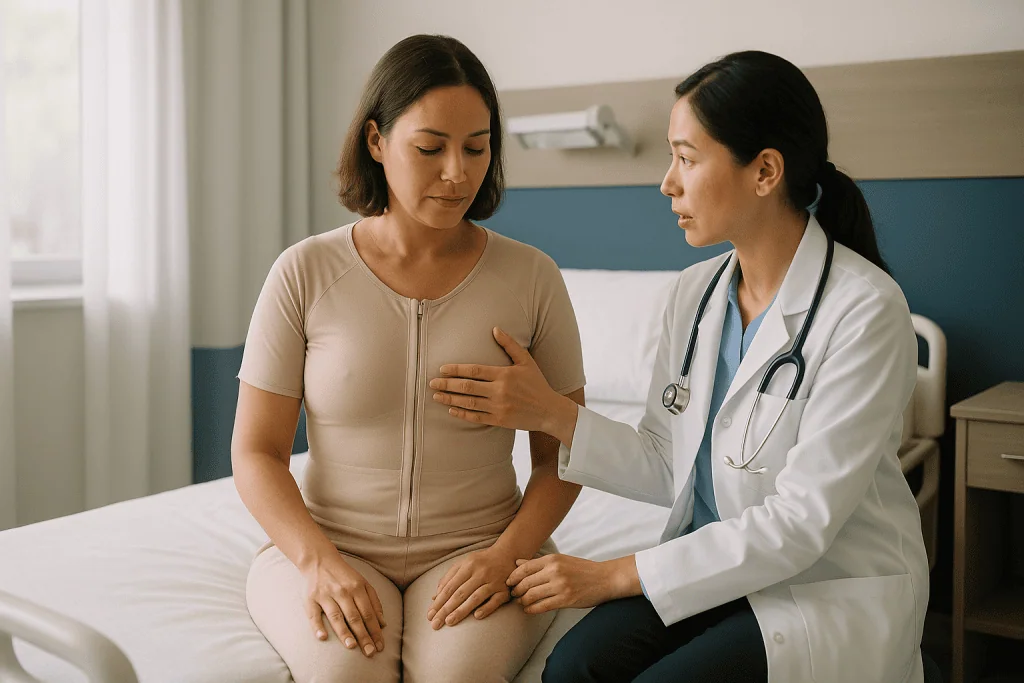
| Stage | Breasts | Donor site | Typical guidance |
|---|---|---|---|
| First 48 hours | Swollen, tender, may feel firm | Bruising begins, fluid may leak from small incisions | Rest, gentle walking, soft support bra, garment on |
| Days 3–7 | Swelling peaks then eases | Bruising darkens, numbness common | Short walks; most people manage light home tasks |
| Weeks 1–2 | Less tender; avoid pressure | Bruising yellows and fades | Many return to desk work (NHS: 1–2 weeks) |
| Weeks 3–6 | Volume looks fuller than final result | Swelling slowly reduces | Gradual return to exercise as cleared; garment often still worn |
| Months 2–3 | Some volume loss as non-surviving fat is reabsorbed | Contour becomes clearer | Most restrictions lifted by the team |
| Months 3–6 | Volume stabilizing | Final shape emerging (NHS: up to 6 months) | Follow-up review of result |
Two features of this table surprise people. The first is that the breasts look their largest in the early weeks, when swelling and not-yet-reabsorbed fat inflate the result. The second is that the donor site, which felt like the minor part of the operation, often takes longer to look settled than the breasts do. Liposuction disturbs a wide area of tissue; the skin has to shrink back and the swelling has to drain, and that is slow work.
How long does fat transfer to breasts take to heal?
The honest answer splits into three layers: feeling functional, looking settled, and reaching a final result.
Functional recovery comes first. The NHS advises that after breast enlargement most people need one to two weeks off work and should avoid strenuous activity, including heavy lifting and driving until it is comfortable, for around a month. Liposuction guidance from the NHS and Cleveland Clinic is similar: a week or two before returning to non-physical work, several weeks before vigorous exercise. Because breast fat transfer combines both, expect to plan around the longer of the two, which is usually the donor site.
Looking settled takes longer. Bruising at the donor site typically fades over two to three weeks, but swelling is stubborn. MedlinePlus notes that swelling after liposuction can persist for weeks to months, and the NHS gives up to six months for the final liposuction result to appear. On the breast side, early swelling drops away over the first few weeks, then a quieter, slower change follows as fat that did not survive is gradually broken down and cleared by the body.
The final result, meaning the volume you will actually keep, is generally judged at around six months. Surgeons often wait until then before discussing whether a second session might be wanted, because assessing earlier risks judging swelling rather than surviving fat.
What speeds healing is unglamorous: sleeping enough, eating adequate protein, walking daily, not smoking, and following the garment and bra instructions you were given. What slows it is equally unglamorous: early return to hard exercise, pressure on the breasts, and nicotine, which narrows small blood vessels at exactly the moment new ones are trying to grow.
When does fat transfer stop dying? What the evidence actually shows
People search this question because they have heard that some transferred fat is always lost, and they want to know when they can stop worrying. The evidence does not give a single day, and anyone who offers one is guessing.

Here is the mechanism. Injected fat cells have no blood supply on arrival. In the first days they survive by absorbing nutrients from surrounding fluid, a process sometimes called plasmatic imbibition. Over roughly the first one to two weeks, new capillaries grow in from neighboring tissue. Cells that sit close enough to that new supply live. Cells at the center of a deposit, or in an area under pressure, or in a person whose vessels are constricted by nicotine, are more likely to die. Dead fat is then broken down by the immune system over weeks to months and either reabsorbed or occasionally walled off as a firm lump called an oil cyst.
So the period of greatest risk is the first few weeks, when blood supply is being established. That is the biological basis for the early rules about pressure, sleeping position and activity. The period of visible volume loss is later, mostly across months two to four, as the body clears fat that failed earlier. By around six months, most surgical guidance treats the remaining volume as broadly stable, though the breast continues to change with weight, hormones and age like any other fat.
How much fat survives varies widely between studies, techniques and individuals, and published systematic reviews report a broad range rather than a fixed figure. Your surgeon may quote their own typical retention; treat that as their experience, not a guarantee. The one consistent finding is that stable body weight after surgery helps, because transferred fat behaves like the fat it came from and shrinks if you lose weight.
Healing the donor site: liposuction bruising, swelling and numbness
Ask anyone a week after breast fat transfer what hurts and they will usually point to their stomach or thighs, not their chest. The donor site is where the mechanical work of the operation happened, and it shows.
Bruising appears within a day or two and often spreads beyond the treated area as blood tracks down under gravity. Bruises on the abdomen can drift toward the groin; thigh bruises can appear at the knee. This looks alarming and is usually normal. Colors move from purple to green to yellow over two to three weeks.
Swelling is the longer story. The tunnels left by the cannula fill with fluid, and the tissue responds with inflammation. Cleveland Clinic and NHS guidance describe compression garments as the main tool for managing this, worn continuously at first and then for a period your team specifies, commonly several weeks. The garment does not make the result better in itself; it limits fluid build-up, reduces discomfort and supports skin as it contracts.
Numbness or altered sensation over the donor area is common because small skin nerves are disturbed. MedlinePlus notes that numbness after liposuction usually improves over weeks to months as nerves recover. Some people notice patches that feel tingly or oversensitive along the way; that is a nerve waking up, not a nerve failing.
Firmness and small lumps under the skin can develop as healing tissue organizes. Gentle massage is sometimes advised once incisions are closed, but only when your team says so. Persistent hard areas, uneven contour or fluid pockets that fluctuate when pressed should be shown to your surgeon rather than managed alone.
Compression garments and support bras: what each one does and for how long
The two pieces of clothing on that bedroom chair are doing opposite jobs, and mixing them up is one of the more common recovery mistakes.
The compression garment belongs on the donor site. Its purpose is to apply firm, even pressure to tissue that has just had fat removed, reducing swelling and bruising and helping the skin settle against the new contour. NHS liposuction guidance describes wearing an elasticated garment or bandages for several weeks. Many teams ask for it around the clock initially, then during the day only, then not at all. The garment should feel snug, not painful; numbness, pins and needles or skin marks that do not fade within a short time after removal suggest it is too tight, which is worth a call.
The bra belongs on the breasts and is deliberately gentle. Surgeons commonly recommend a soft, wire-free, front-fastening bra that supports without compressing. Firm compression on newly grafted breasts is generally avoided because pressure may reduce blood flow to fat that is still trying to establish itself. The NHS advises wearing a sports-style bra day and night for the first weeks after breast enlargement, with some surgeons extending that to around three months. Fat transfer teams often adapt that advice toward softer garments, so follow yours rather than a generic rule.
Practical points that rarely make it into the discharge leaflet:
- Buy two garments so one can be washed while the other is worn.
- Put the bra on before the garment if both are worn; it is easier to adjust.
- Check skin folds under the garment daily for redness or rubbing.
- Underwire, push-up styles and anything that squeezes the lower breast are usually asked to wait until your team clears them.
Sleeping positions after fat transfer breast augmentation
Sleep is where good intentions meet habit. You can control how you lie down; you cannot control how you roll at 3 a.m. That is why surgeons spend so much time on this.
The standard advice is to sleep on your back, propped up slightly, for the first few weeks. Lying on your front would put your body weight directly on grafted fat. Lying on your side compresses one breast against the mattress and lets the other pull downward, and if your donor site is the flank or thigh, side-lying presses on that too. Back sleeping with the head and shoulders raised also encourages fluid to drain away from the breasts and eases the sensation of chest tightness that many people describe in week one.
How long varies. Many teams ask for strict back sleeping for two to four weeks, then allow side sleeping with a pillow between the breasts and mattress once the graft has had time to establish blood supply. Front sleeping is usually the last position to be cleared. These are typical instructions rather than evidence-based thresholds; there are no trials comparing sleeping positions after fat grafting, so your surgeon’s plan is the reference point.
Tricks that side sleepers find useful:
- A wedge pillow or two firm pillows under the shoulders to create a gentle recline.
- A pillow under each arm to discourage rolling.
- A rolled towel or body pillow along one side as a physical reminder.
- Sleeping in a recliner for the first nights if getting in and out of a flat bed pulls on the abdomen.
If you wake having rolled onto your side, do not panic; brief, unintended pressure is not the same as sustained pressure. Reposition and mention it at follow-up if it keeps happening.
Who breast fat transfer is usually for, and who is usually asked to wait
Recovery goes more smoothly when the operation suited the person in the first place, so it is worth knowing how surgeons generally think about candidacy.
Fat transfer is most often discussed for people who want a modest increase in breast volume, want to soften the edges of an existing implant, want to correct asymmetry or contour irregularities, or are having reconstruction after breast surgery. It requires enough donor fat to harvest; very lean people may simply not have the reserve for a meaningful change. Mayo Clinic and NHS guidance on breast augmentation stress realistic expectations, and that applies with particular force here because final volume is not fully predictable.
People are commonly asked to wait, or offered a different plan, when:
- they are actively losing or gaining weight, because transferred fat follows body weight;
- they smoke or use nicotine products, since nicotine constricts small blood vessels and impairs both wound healing and graft survival;
- they are pregnant, breastfeeding, or planning pregnancy soon, because the breast will change substantially;
- they have uncontrolled diabetes or another condition that slows healing;
- they have a personal or family history that makes breast imaging surveillance especially important, in which case the team will want a baseline plan first.
Age itself is not a barrier. General health, stable weight and realistic goals matter far more than the number on a birth certificate.
None of this is a checklist you can score at home. The candidacy conversation belongs with a qualified surgeon who examines you, reviews your history and explains what your body can realistically offer. If the answer is not now, that is information about timing, not a verdict.
What not to do after breast fat transfer
Most recovery instructions are about protecting two things: the blood supply growing into the graft, and the healing tissue at the donor site. Seen that way, the list of do-nots stops feeling arbitrary.
Do not put pressure on the breasts. That includes sleeping on your front, wearing underwire or compressive bras before you are cleared, carrying a heavy bag strap across the chest, and letting a seatbelt sit tight against the breast without a small folded towel to cushion it.
Do not smoke, vape or use nicotine patches or gum unless your prescribing clinician has specifically discussed it. Nicotine narrows small blood vessels, and the first weeks are when those vessels are supposed to be growing into the graft.
Do not rush exercise. The NHS advises avoiding strenuous activity for around a month after breast enlargement, and liposuction guidance is similar. Walking from day one is encouraged; it lowers the risk of blood clots and helps swelling drain. Running, chest exercises, hot yoga and anything that bounces or heats the breasts wait for clearance.
Do not apply heat. Saunas, hot tubs and heating pads increase blood flow and swelling in ways that are not helpful for a graft trying to settle, and some teams also ask you to avoid submerging incisions until they are fully closed.
Do not diet aggressively. Rapid weight loss shrinks the fat you just had moved along with everything else.
Do not massage the breasts unless told to. Donor-site massage is sometimes recommended later; breast massage after grafting generally is not.
Do not stop, start or change any prescribed medicine, including blood thinners or supplements, without checking with the clinician who prescribes it. Your surgical team will coordinate this.
Pain, swelling and medicines: what to expect and how they work
Discomfort after breast fat transfer is real but usually described as soreness rather than sharp pain, with the donor site as the main source. People often compare it to the deep ache after an unusually hard workout, heaviest in the first three to five days and easing steadily after that.
Your team will prescribe or recommend pain relief. Rather than naming what you should take, it helps to understand the categories they may discuss. Simple analgesics act centrally on pain signaling and are commonly the first line. Anti-inflammatory pain relievers reduce swelling by blocking inflammatory chemicals, but they also affect platelets, so some surgeons prefer to avoid them in the first days when bruising is forming; others allow them. Short courses of stronger analgesics are sometimes provided for the first nights. Which of these applies to you, and for how long, is a decision for the prescriber who knows your history.
Swelling follows a predictable curve. It peaks around day two or three, then declines over weeks. Cleveland Clinic guidance for liposuction lists compression, elevation and gentle movement as the mainstays. On the breast side, sleeping propped up and avoiding heat help.
Itching around incisions in week two is usually healing, not infection. Occasional sharp, zinging sensations at the donor site are typically nerves recovering. Both are worth mentioning at follow-up but rarely need urgent action.
Bowel changes are common after surgery, partly from anesthesia and partly from certain pain medicines. Fluids, fiber and walking help; your team can advise if it persists.
If pain escalates rather than improving after the first few days, or is markedly worse on one side, that pattern matters more than the intensity and should prompt a call.
What is the downside of breast fat transfer? Risks in plain language
Every operation trades one set of problems for another, and it is fairer to spell those trades out than to bury them.
The most predictable downside is unpredictability of volume. Some transferred fat does not survive, the proportion varies, and the result cannot be fully known until several months have passed. People wanting a large increase often need more than one session, each with its own recovery.
Fat necrosis is the term for grafted fat that dies and forms a firm lump or oil cyst. These are usually harmless but can be felt, can occasionally be tender, and can appear on imaging. Calcifications, small mineral deposits left where fat has broken down, are also possible. Radiologists can generally distinguish these from other findings, but you should always tell anyone performing breast imaging that you have had fat grafting so images are read in context.
Donor-site problems include contour irregularities, dents or waves where fat was removed unevenly, prolonged swelling, fluid collections called seromas, and numbness. NHS liposuction guidance lists these among the recognized complications along with infection and bleeding.
General surgical risks apply: infection, hematoma (a collection of blood under the skin), poor wound healing, anesthesia reactions, and blood clots in the legs or lungs, the risk of which rises with immobility. Rare but serious complications of fat injection, such as fat entering a blood vessel, are described in the surgical literature and are part of an informed consent discussion.
Alongside those, there is the practical downside: two healing areas, two sets of garments, and a longer wait for a final answer than many people expect. Whether that trade is worth it is a personal judgment made with your treating team, not a question with a universal answer.
Alternatives to consider: implants, hybrid approaches and no surgery
A good recovery plan starts before surgery, with confidence that this operation was the right one for your goal. Knowing the alternatives helps that confidence.
Breast implants remain the most common augmentation method. Mayo Clinic describes them as offering a more predictable and larger increase in volume than fat transfer typically provides, at the cost of a foreign device that may need replacement, can develop capsular contracture (a tightening of scar tissue around the implant), and carries its own imaging considerations. Recovery is a single site, usually with clearer timelines.
Hybrid augmentation combines a smaller implant with fat grafting around it to soften edges and improve cleavage. Recovery then involves both an implant pocket and a donor site.
Fat transfer alone suits people who prefer their own tissue, want a modest change, or want to correct asymmetry or contour. It avoids a device but accepts volume uncertainty and possibly a second session.
Fat transfer after implant removal is increasingly discussed for people who no longer want implants but would like to keep some volume. The same recovery principles apply, with the added variable of how the breast envelope behaves once the implant is gone.
Not having surgery is also an alternative, and a legitimate one. Well-fitted bras, physical training that strengthens the chest wall and posture, and simply time can change how people feel about their bodies. No guideline treats aesthetic surgery as necessary; it is a choice among options.
Neutral comparison is only useful if it leads to an informed conversation. The surgeon who examines you can say which options fit your anatomy, your health and your goals, and which recoveries you would realistically be signing up for.
What people often get wrong about fat transfer breast recovery
Some recovery myths circulate so widely that they sound like instructions. A few deserve correcting.
Myth: the bigger the breasts look in week one, the better the result will be. Early size is mostly swelling plus fat that has not yet been reabsorbed. Judging the outcome before three months is judging inflammation.
Myth: eating more fat feeds the graft. Transferred fat cells survive on blood supply, not on dietary fat. Adequate protein and calories support wound healing generally, but there is no evidence that eating fatty foods increases graft survival. Stable weight, not weight gain, is the relevant goal.
Myth: compression on the breasts helps the fat take. The opposite reasoning applies: pressure is thought to restrict the small vessels the graft depends on, which is why teams recommend soft, non-compressive bras for the breasts while using firm compression only on the donor site.
Myth: massaging the breasts spreads the fat evenly. Breast massage after grafting is not generally recommended and could disrupt fat that is settling. Donor-site massage is a different matter and is sometimes advised later.
Myth: once the swelling is gone, the result is final. Fat that failed to survive is cleared over months, and NHS guidance gives up to six months for liposuction contours to settle. Patience is part of the treatment.
Myth: numbness at the donor site means nerve damage. Altered sensation is expected after liposuction and, according to MedlinePlus, usually improves over weeks to months.
Myth: fat transfer results are permanent and unchanging. Surviving fat is permanent in the sense that it behaves like your other fat, which means it responds to weight change, hormones and aging like the rest of you.
Questions to ask your care team before and after surgery
The most useful preparation for recovery is a specific conversation with the people who will look after you. Written answers to these questions will save anxious searching later.
Before surgery:
- Which areas will be used as donor sites, and what does recovery for each usually look like in your practice?
- How much volume change is realistic for my body, and how do you decide whether a second session might be discussed?
- What garment will I wear on the donor site, for how many hours a day, and for how many weeks?
- What kind of bra do you want me to wear on the breasts, and when can underwire or compressive styles return?
- Which sleeping positions do you allow at each stage, and when can I return to side or front sleeping?
- Which of my current medicines and supplements need adjusting, and who will manage that?
- What is your plan for breast imaging before and after grafting, and how should I inform future imaging providers?
After surgery:
- Which symptoms do you want a same-day call about, and what number do I use out of hours?
- When can I shower, submerge incisions, drive, lift, and exercise, and in what order?
- Do you recommend donor-site massage, and if so, when and how?
- At which follow-up visit will you assess the final result, and what happens if volume is less than hoped?
- Is there anything about my healing so far that changes the plan?
Notice what is missing: any question about guarantees. Good surgical teams do not offer them, and asking for one tends to produce reassurance rather than information. Ask instead how they handle it when things do not go as planned. The quality of that answer tells you a great deal.
When to call your doctor: red-flag signs after breast fat transfer
Most of what you will feel in the first weeks is expected: soreness, bruising, swelling, numbness, itching, and the odd nerve twinge. A small number of signs are different in kind and should prompt a call to your surgical team the same day, or emergency care if severe.
Call your team promptly if you notice:
- a breast or donor area that becomes rapidly more swollen, tense or painful, particularly on one side, which may signal bleeding under the skin;
- spreading redness, warmth, increasing pain, or pus or foul-smelling discharge at any incision;
- a fever, chills or feeling generally unwell in the days after surgery;
- skin over the breast or donor site that turns dusky, purple-black or very pale and does not improve;
- a fluid pocket that keeps enlarging or fluctuates when pressed;
- pain that escalates after the first few days rather than easing, or pain not controlled by what you were prescribed.
Seek emergency care immediately for:
- sudden shortness of breath, chest pain, coughing up blood, or a racing heart, which can indicate a blood clot in the lung;
- a swollen, painful, warm calf, which can indicate a clot in the leg;
- sudden confusion, weakness, difficulty speaking or vision change;
- heavy bleeding that soaks through dressings.
Blood clots deserve a specific mention because immobility after surgery raises the risk. Walking regularly from the first day, staying hydrated and following any clot-prevention measures your team prescribes are the standard defenses described by the NHS and CDC.
If you are unsure whether something is normal, call. Surgical teams would far rather answer a question at 9 p.m. than treat a complication that waited until morning. Every decision about assessment and treatment rests with them, and a phone call is how that assessment begins.
Frequently asked questions
How long does fat transfer to breasts take to heal?
Functional recovery, meaning desk work and light daily tasks, typically takes one to two weeks, with strenuous activity avoided for around a month according to NHS guidance on breast enlargement and liposuction. Visible settling takes longer: donor-site swelling can persist for weeks to months, and the final result is usually assessed at about six months once non-surviving fat has been reabsorbed. Your surgical team will give timelines specific to your operation.
When does fat transfer stop dying?
There is no single day. Grafted fat is most vulnerable in the first one to two weeks while new blood vessels grow into it; cells that fail during that window are then broken down and cleared by the body over the following months, which is when volume visibly drops. By around six months most surgical guidance treats the remaining volume as broadly stable, although it will still change with weight, hormones and age.
What is the fat transfer breast augmentation recovery time compared with implants?
Fat transfer recovery is often described as similar in length to implant recovery for the breasts themselves, but the addition of a liposuction donor site usually extends the overall recovery. Donor-area bruising, swelling and numbness can last weeks to months, whereas implant surgery involves a single site. Mayo Clinic and NHS guidance give one to two weeks off work for breast augmentation and around a month before strenuous exercise in either case.
What not to do after breast fat transfer?
Avoid pressure on the breasts, including front sleeping, underwire or compressive bras, and tight seatbelts without padding; avoid nicotine in any form; avoid heat such as saunas, hot tubs and heating pads; avoid strenuous exercise until cleared; avoid crash dieting, which shrinks transferred fat; and avoid breast massage unless your surgeon specifically recommends it. Do not change any prescribed medicine without checking with the prescribing clinician.
What is the downside of breast fat transfer?
The main downside is unpredictable volume: some transferred fat does not survive, the proportion varies between people, and a second session is sometimes discussed. Other recognized downsides include fat necrosis or oil cysts, calcifications that appear on imaging, donor-site contour irregularities, prolonged swelling and numbness, plus the general risks of surgery such as infection, bleeding and blood clots. Recovery also involves two healing areas rather than one.
How long do I wear a compression garment after breast fat transfer?
The compression garment is worn on the liposuction donor site, not the breasts, and NHS liposuction guidance describes wearing it for several weeks. Many teams ask for continuous wear at first, then daytime only, then stopping. The exact schedule depends on how much fat was removed and from where, so follow your surgeon’s instructions rather than a general rule, and report any garment that causes numbness or persistent skin marks.
Can I sleep on my side after fat transfer to the breasts?
Usually not at first. Most surgeons ask for back sleeping, propped up slightly, for around two to four weeks so that no body weight rests on grafted fat or the donor site. Side sleeping is typically allowed after that, often with a pillow for cushioning, and front sleeping is generally the last position to be cleared. There are no trials comparing sleeping positions after fat grafting, so your surgeon’s plan is the reference.
Why do my breasts look smaller a few months after fat transfer?
Because the early size included swelling and fat that had not yet been reabsorbed. As inflammation settles and the body clears fat cells that did not establish a blood supply, volume decreases, usually across months two to four. This is expected and is why final results are assessed at around six months rather than earlier. If the loss seems sudden, uneven or accompanied by lumps, mention it to your team.
Does breast fat transfer affect mammograms?
It can. Fat that did not survive may form oil cysts or calcifications that show on imaging. Radiologists can generally distinguish these from other findings, particularly when they know about prior grafting, so always tell anyone performing breast imaging that you have had fat transfer. Your surgical team may recommend baseline imaging before surgery and a follow-up plan afterward; that decision sits with them and your usual clinicians.
Will losing weight after surgery affect the transferred fat?
Yes. Surviving grafted fat behaves like the fat it came from, so it shrinks with weight loss and can grow with weight gain. That is why surgeons prefer a stable weight before and after surgery and advise against aggressive dieting during recovery. Gradual, modest changes have a smaller effect than rapid ones. If you are planning significant weight change, discuss timing with your surgeon beforehand.
References
This article is for general information only and is not a substitute for professional medical advice. Please consult a qualified doctor about your individual situation.

More from the Blog
Breast Augmentation Before Future Pregnancies: Breastfeeding, Changes and Planning Timing
Having breast augmentation before pregnancy is medically possible, and most people with implants can later carry a pregnancy and breastfeed. The trade-off is unpredictability:…
After Gynecomastia Surgery: Swelling That Is Expected vs Fluid Build-Up That Needs a Check
After gynecomastia surgery, soft, symmetric swelling and bruising across both sides of the chest are expected and usually settle over several weeks. Fluid build-up…

Augmentation, Lift or Reduction? How Breast Aesthetics Consultations Match Surgery to Goals
The right breast surgery depends on what bothers you most. Low volume points toward augmentation with implants or fat transfer; breasts that have dropped…

Breast Implant Illness: What the Evidence Shows So Far, and What Remains Unknown
Breast implant illness (BII) is the name for a broad cluster of systemic symptoms, fatigue, joint pain, brain fog, hair loss, and others, that…

Recovery After Nipple Aesthetics Surgery: Sensitivity, Support Garments and Healing Days
Nipple surgery recovery is usually measured in weeks, not days. Most people feel the sharpest soreness in the first two to three days, wear…

Male Breast Reduction (Gynaecomastia Treatment) Recovery: Day One to Week Six Milestones
Male breast reduction recovery time typically runs in stages: most people go home the same day or the next, take about a week off…