

Recovery After Meningitis or Encephalitis: Rehabilitation in Neuroinfectious Disease Care

Key Takeaways
- Meningitis inflames the membranes around the brain while encephalitis inflames brain tissue itself, and both leave surviving neurons that must rewire through practice rather than regrow.
- The NHS states that recovery from encephalitis can take months and sometimes years, with the steepest gains early and slower improvement continuing well beyond the first year.
- Hearing loss is the most common lasting complication of bacterial meningitis, which is why a hearing test is arranged soon after discharge and repeated.
- The World Health Organization reports that about one in five people who develop bacterial meningitis experience severe complications, making structured follow-up standard rather than optional.
- A normal brain scan does not rule out real deficits; neuropsychological testing often reveals memory or attention problems that imaging cannot show.
- Anyone who has had a seizure is normally required to stop driving for a period set by their jurisdiction, and the treating team confirms when it is safe to resume.
Recovery after meningitis or encephalitis usually continues long after the infection itself is treated, because inflamed brain tissue needs months, and sometimes years, to reorganize. Rehabilitation brings together physical, cognitive, speech, hearing and psychological specialists who assess what has changed and build a graded program around it. Progress is often fastest in the first months but can continue much later, and every plan is set by the treating team.
The discharge paperwork says the infection is gone. The IV line is out, the fever chart is flat, and someone has printed a follow-up appointment on a slip of paper. Yet the person in the wheelchair by the exit cannot remember the name of the nurse who has cared for them for three weeks, and the light in the corridor feels far too bright. Families often describe this moment as the strangest of the whole illness: the emergency is over, and the real work has barely begun.
Recovery after encephalitis rehabilitation, and its close cousin recovery after meningitis, is that work. It is less about killing a germ than about helping a bruised brain re-learn what it did effortlessly before. This explainer walks through what actually happens inside the skull, who the rehabilitation team are, how long things typically take according to mainstream evidence, and which signs mean you should pick up the phone.
What actually happens to the brain in meningitis and encephalitis?
Meningitis is inflammation of the meninges, the three thin membranes that wrap the brain and spinal cord. Encephalitis is inflammation of the brain tissue itself. The two can occur together, which clinicians call meningoencephalitis, and both are grouped under neuroinfectious disease, meaning conditions where an infection or an infection-triggered immune reaction damages the nervous system.
The triggers differ. Viruses such as herpes simplex, enteroviruses and mosquito-borne arboviruses are the most common causes of encephalitis, while bacteria including Streptococcus pneumoniae and Neisseria meningitidis dominate serious meningitis, according to the Mayo Clinic and the World Health Organization. A growing share of encephalitis is autoimmune, where antibodies mistakenly attack proteins on the surface of brain cells rather than any germ.
Whatever the cause, the damage follows a similar physical logic. Inflammation makes tissue swell, and the skull is a closed box. Rising pressure squeezes blood vessels, so oxygen delivery falls. Inflammatory chemicals interfere with the electrical signaling between neurons. Some cells die outright; many more are stunned rather than destroyed. In bacterial meningitis, the infection can also spread into the bloodstream as septicemia, damaging skin, limbs and organs far from the head.
This is why recovery looks the way it does. The adult brain does not regrow lost neurons in any meaningful number. Instead it relies on neuroplasticity, the ability of surviving networks to strengthen connections and reroute tasks around damaged areas. Neuroplasticity is driven by repetition and challenge, which is exactly what structured rehabilitation supplies. Rest allows swelling to settle; practice is what rebuilds function.
What does recovery after encephalitis rehabilitation actually involve?
Rehabilitation is not one treatment but a coordinated program, and the first step is measurement. Before anyone sets goals, the team needs to know precisely what has changed: how far a person can walk, how many items they hold in short-term memory, whether they can hear a whisper in each ear, how their mood and sleep are behaving.

The people involved usually include a rehabilitation physician (a doctor who specializes in restoring function, sometimes called a physiatrist), a neurologist who continues to manage seizures and the underlying condition, a physical therapist for strength and balance, an occupational therapist who works on everyday tasks such as dressing, cooking and managing money, and a speech-language pathologist who handles both communication and swallowing. A neuropsychologist, a psychologist trained to test and treat thinking and behavior after brain injury, is central when memory or personality has shifted. Audiologists join when hearing is affected, which the NHS notes is the most common complication of bacterial meningitis.
Where this happens depends on need. Someone who cannot yet stand safely may move from the acute ward to an inpatient rehabilitation unit. Someone walking but struggling with concentration may go home and attend outpatient sessions. Others are seen by community teams in their own kitchen, which is often where the real deficits show up.
Goals are written down, reviewed and adjusted. A good program is graded, meaning tasks get harder in small steps, and it is functional, meaning it practices real activities rather than abstract drills. The NHS describes this kind of support as the backbone of encephalitis recovery precisely because there is no single medicine that restores lost skills.
Who is usually referred for rehabilitation, and who is asked to wait?
Referral is driven by two questions: does this person have deficits that are likely to respond to therapy, and are they medically stable enough to take part?
People with obvious weakness, balance problems, speech difficulty, swallowing trouble or marked confusion at the point of discharge are almost always referred. So are those who spent time in intensive care, because prolonged immobility itself weakens muscles and deconditions the heart and lungs. Children who had bacterial meningitis are routinely booked for a hearing test within weeks of leaving hospital, a step the NHS describes as standard because early detection of hearing loss changes how speech and language develop.
Some people are asked to wait. Those still having frequent seizures, still running fevers, or whose intracranial pressure has not settled cannot safely do demanding physical or cognitive work, and pushing too early can worsen swelling or trigger events. Someone who is not yet alert enough to follow instructions may receive passive therapy such as positioning and gentle limb movement, with active rehabilitation starting once awareness returns. In autoimmune encephalitis, immunotherapy often needs to take effect first so that the brain is no longer under active attack.
A third group is easy to overlook: people whose illness looked mild and who walk out of hospital seemingly intact. Memory gaps, slowed thinking and fatigue frequently surface only when they try to return to work or study. Mainstream guidance from the NHS encourages anyone in this position to ask for reassessment rather than assume the problem is imagined. The door to rehabilitation is not supposed to close on the day of discharge.
Encephalitis recovery time: how long does recovery after encephalitis rehabilitation take?
Nobody can give a fixed number, and anyone who does is guessing. What the evidence supports is a shape rather than a date.
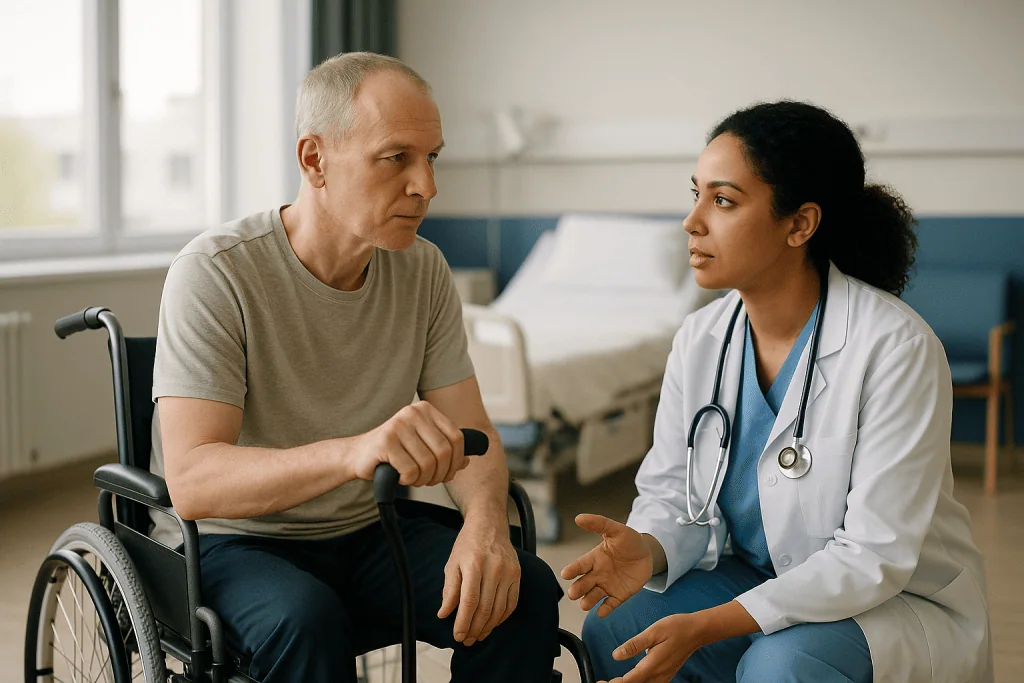
The NHS states plainly that recovery from encephalitis can take months, and sometimes years, and that some people recover fully while others live with long-term difficulties. The Mayo Clinic makes the same point, noting that the course depends heavily on the cause, the severity of the inflammation and how quickly treatment began. Herpes simplex encephalitis, for example, tends to leave more persistent memory and behavior changes than many mild viral forms, because it targets the temporal lobes where memory circuits sit.
For bacterial meningitis, the World Health Organization reports that roughly one in five people who develop it experience severe complications, which is why follow-up is built into care rather than offered only on request.
The typical pattern is a steep early climb followed by a slower slope. Swelling subsides over the first weeks, and function that was merely suppressed returns. Gains from neuroplasticity accumulate more gradually, over months. Clinicians often warn against reading a plateau as the end; skills sometimes improve again when a person returns to a demanding environment that pushes the brain in new ways.
Factors that shape the timeline include age, how long a person was unconscious, whether seizures occurred, the presence of other health conditions and, in autoimmune cases, how fast the immune reaction was brought under control. None of these can be changed retrospectively, so the useful question is not how long, but what should be happening at this stage, and the treating team is the right place to ask it.
Meningitis long term effects and what rehabilitation targets
Long-term effects after meningitis and encephalitis cluster into predictable groups, each with a mechanism and a matching specialist. The table below is drawn from complication lists published by the NHS and the Mayo Clinic; it is descriptive, not a checklist for diagnosing yourself.
| Effect | Why it happens | Who usually helps |
|---|---|---|
| Hearing loss | Inflammation damages the inner ear or auditory nerve | Audiologist, ear specialist |
| Memory and concentration problems | Injury to temporal and frontal networks | Neuropsychologist, occupational therapist |
| Seizures | Scarred tissue fires abnormally | Neurologist |
| Weakness, poor coordination | Damage to motor pathways; deconditioning | Physical therapist |
| Speech or swallowing difficulty | Language areas or brainstem affected | Speech-language pathologist |
| Vision changes | Optic nerve or visual cortex involvement | Ophthalmologist, orthoptist |
| Limb or tissue loss | Septicemia cuts blood supply to extremities | Surgeon, prosthetist, physical therapist |
| Fatigue, mood change | Altered arousal systems, sleep disruption | Rehabilitation physician, psychologist |
Two patterns deserve emphasis. Hearing loss is the single most frequent lasting problem after bacterial meningitis, and it can be partial, one-sided and easy to miss in a young child, which is why the NHS builds in a hearing test soon after discharge. And the effects that disrupt daily life most are often the invisible ones: a person can walk unaided yet be unable to hold a job because their working memory has shrunk.
Rehabilitation does not chase every item on the table at once. Teams prioritize whatever most threatens safety and independence first, typically swallowing, mobility and seizure control, then turn to thinking, communication and mood as the person is able to engage.
Memory, attention and behavior: what cognitive rehabilitation does
Ask people a year on from encephalitis what troubles them most and few mention their legs. They talk about walking into a room and forgetting why, losing the thread of a conversation, or snapping at a partner over nothing. The Cleveland Clinic and Mayo Clinic both list memory loss, trouble concentrating and personality or behavior changes among the common longer-term consequences, and these are the territory of cognitive rehabilitation.
The process starts with neuropsychological testing, a structured set of paper and computer tasks that map which mental functions are intact and which are impaired. Two people who both say their memory is bad may have very different profiles: one cannot encode new information, another stores it but cannot retrieve it on demand, a third simply cannot pay attention long enough for anything to go in.
Therapy then takes two broad routes. Restorative work drills a weakened function directly, using graded attention or memory exercises. Compensatory work builds external scaffolding: a single notebook or phone app as the one place everything is written, alarms for medicines, checklists on the fridge, a fixed daily routine so fewer decisions rely on memory. Evidence in acquired brain injury generally favors compensatory strategies for lasting real-world benefit, and most programs blend the two.
Behavior change needs its own attention. Damage to frontal and temporal regions can flatten motivation, loosen impulse control or blunt emotional responses, and families often find this harder than any physical deficit. Neuropsychologists help relatives understand that irritability or disinhibition is a symptom, not a choice, and teach practical responses. Where low mood or anxiety takes hold, psychological therapy is offered alongside, because mood disorders after brain inflammation are common and treatable in their own right.
Post encephalitis fatigue: why it lingers and how rehab handles it
Fatigue after encephalitis is not ordinary tiredness, and sleep does not reliably fix it. People describe a wall that arrives mid-afternoon, or a crash the day after a family visit that felt manageable at the time. The NHS lists persistent tiredness among the most common after-effects, and it frequently outlasts every visible deficit.
Several mechanisms overlap. An inflamed brain works less efficiently, so tasks that once ran on autopilot now demand conscious effort; this neural cost is real and measurable. The systems governing arousal and sleep-wake cycles sit deep in the brain and are often disturbed, producing fragmented nights and unrefreshing sleep. Low mood and anxiety drain energy. Some medicines used to control seizures, described here only as a class of anti-seizure drugs, can add drowsiness, and any adjustment to them belongs strictly with the prescribing clinician.
Rehabilitation approaches fatigue as something to be managed rather than pushed through. Occupational therapists typically start with an activity diary to reveal the boom-and-bust pattern most people fall into. From that, they build pacing: breaking tasks into shorter blocks, scheduling demanding thinking for the time of day when energy is highest, and inserting planned rest before exhaustion hits rather than after. Physical therapists add graded aerobic activity, because deconditioning after weeks in bed compounds central fatigue, and gentle progressive exercise tends to improve energy over time when increased slowly.
Sleep hygiene, consistent bedtimes, a dark room, limiting screens late, is addressed early, and persistent sleep disruption is reviewed medically. Families are coached to read the warning signs of overload, such as slurred words or sudden tearfulness, and to treat them as a cue to stop.
Hearing, balance and movement: the physical side of rehabilitation
Physical recovery is the part most people picture when they hear rehabilitation, and for some it dominates the early months.
Hearing comes first because it is so common and so time-sensitive. Bacterial meningitis can inflame the cochlea, the snail-shaped organ in the inner ear that converts sound to nerve signals, producing sensorineural hearing loss, meaning loss from damage to the inner ear or nerve rather than a blockage. Audiology testing is arranged soon after discharge, and repeated, because damage can progress. When loss is profound, the team may discuss hearing aids or a cochlear implant, an electronic device that stimulates the auditory nerve directly. Whether and when that is appropriate is a decision for the audiology and ear specialists together with the person or their parents.
Balance problems often travel with hearing loss because the vestibular system, the inner-ear apparatus that senses head movement, shares the same neighborhood. Vestibular rehabilitation uses repeated head and eye movements to retrain the brain to interpret the signals it still receives.
Weakness, stiffness and ataxia, the medical term for clumsy, uncoordinated movement, are addressed by physical therapists through progressive strength work, gait training and balance drills. Someone who spent weeks in intensive care may also have generalized muscle wasting that has nothing to do with the brain and responds simply to graded exercise.
The most severe physical consequences follow meningococcal septicemia, where clotting in small vessels can destroy tissue in fingers, toes or whole limbs. Recovery here involves wound care, sometimes surgery, prosthetic fitting and prolonged therapy to relearn walking or hand function. It is a long road, and the team pace it so that skin, muscle and confidence heal together.
What the first weeks at home usually look like
The first fortnight home is often quieter and harder than anyone expects. Hospital wards are noisy but structured; a house full of relieved relatives is neither.
Sleep tends to be disordered, with long daytime naps and wakeful nights, and this usually settles gradually as routine returns. Headaches are common as swelling resolves, and the treating team will have advised what to expect and what to report. Sensory overload is nearly universal: supermarkets, television and group conversations can feel physically painful, so short, single-focus outings work better than a triumphant return to normal life.
Medicines prescribed at discharge are continued exactly as directed. Someone treated for herpes simplex encephalitis may have completed a course of antiviral medicine, a class of drugs that blocks the virus from copying itself, before leaving. Someone with autoimmune encephalitis may be on immune-suppressing treatment that is reduced over months under specialist supervision. Anti-seizure medicine is often continued for a period even when no further seizures occur. None of these should be altered without the prescribing clinician, and any missed dose or new side effect is a reason to call, not to improvise.
Follow-up appointments cluster in this window: a neurology review, a hearing test, sometimes repeat brain imaging, and the first outpatient therapy sessions. Keeping a simple diary of sleep, headaches, energy and any odd episodes gives these appointments something concrete to work with.
Carers need a plan of their own. The NHS advises that supporting someone after encephalitis is demanding, and that relatives should ask about respite, carer support and their own health. Recovery is a household project, and it goes better when the household is not running on empty.
Children and school after meningitis or encephalitis
Children recover differently from adults, and not always in the direction parents hope. A young brain is more plastic, which helps, but it is also still building skills it has not acquired yet, and damage can quietly disrupt that construction for years.
The NHS describes learning difficulties, memory problems, behavior change and hearing loss as recognized complications of childhood meningitis, and notes that some effects only become obvious as the child grows and school demands rise. A four-year-old who seems fine may struggle with reading at seven or with organizing homework at twelve. For this reason pediatric follow-up is typically longer than adult follow-up, with developmental checks at intervals rather than a single sign-off.
Hearing is the priority. Even mild one-sided loss can hold back speech and language, and children rarely complain about it because they do not know what they are missing. Testing soon after discharge, then repeated as advised, is standard.
School re-entry works best as a planned, phased process. Therapists commonly write a summary for teachers explaining the child’s fatigue, attention span and any hearing needs, and recommending adjustments such as a quieter seat, shorter tasks and rest breaks. Many families find that a gradual timetable, mornings only at first, prevents the exhaustion that otherwise arrives by Wednesday.
Therapy for young children is play-based by design: balance games instead of drills, stories instead of memory lists. Parents are usually taught to carry exercises into daily routines rather than treating them as separate sessions. And children need help to make sense of what happened; simple, honest explanations pitched to their age reduce the anxiety that can otherwise masquerade as behavior problems.
Life after meningitis: work, driving and relationships
The medical discharge summary rarely mentions the parts of life that matter most: earning a living, getting around, staying close to the people you love.
Returning to work is best approached the way athletes return from injury, in stages. Occupational therapists often help draft a graded plan starting with reduced hours and simplified duties, with fatigue and concentration monitored honestly. Cognitive demands, not physical ones, are the usual limiting factor. People frequently discover that a job they did on autopilot now requires exhausting deliberate effort, and that open-plan offices are far harder than a quiet room. Disclosure to an employer is a personal choice, but a written note from the team describing needs can make adjustments possible.
Driving is a safety and legal matter. Anyone who has had a seizure is normally required to stop driving for a period defined by their jurisdiction, and rules vary between US states and countries. Persisting visual, cognitive or coordination problems also affect fitness to drive even without seizures. The treating team, not the patient, should confirm when it is appropriate to resume, and some people are referred for a formal driving assessment.
Relationships absorb much of the strain. Personality and behavior change can leave a partner feeling they live with a stranger, and the person affected may not perceive the difference, which compounds the hurt. Couples and family sessions with a neuropsychologist are commonly offered. Peer support from others who have been through the same illness is valued by many families for the simple relief of not having to explain.
Intimacy, alcohol, sport and travel all come up in clinic, and all deserve a straightforward conversation with the team rather than guesswork.
What people often get wrong about recovery after these infections
Misunderstandings about brain inflammation are common, and several of them actively slow recovery.
The first is that once the infection has cleared, the person is better. Antivirals, antibiotics and immunotherapy address the cause; they do nothing directly for neurons that were injured along the way. The NHS is explicit that recovery from encephalitis is a long process that continues well after treatment ends.
The second is that rest alone will do the job. Rest lets swelling settle in the early weeks, but neuroplasticity, the rewiring that restores function, is driven by challenge and repetition. Months of unstructured rest tend to produce deconditioning, low mood and stalled progress.
The third is that a normal scan means nothing is wrong. Imaging shows structure, not function. Many people with clear MRI results have measurable deficits on neuropsychological testing, and their difficulties are just as real.
The fourth concerns unproven remedies. Supplements, hyperbaric oxygen, stem-cell offerings and detox protocols are marketed to families at their most vulnerable. There is no good-quality evidence that any of these improve outcomes after meningitis or encephalitis, and some carry risks or cost families money better spent on proven therapy. Anything being considered should be discussed openly with the treating team.
The fifth is that recovery stops at some fixed point, often quoted as six months or a year. The evidence describes a slowing curve, not a cliff, and improvement in daily function can continue for years, particularly when a person is engaged and supported.
The last is that children bounce back automatically. They often do remarkably well, but hidden deficits can emerge later, which is why pediatric follow-up is long rather than brief.
Questions to ask your care team
Clinic appointments are short and memory may be unreliable, so writing questions down beforehand and bringing someone to take notes is sensible rather than fussy. The following are questions rehabilitation teams are used to hearing and are glad to answer.
- What exactly was the cause of my illness, and does that change what recovery is likely to look like?
- Which functions have you formally assessed, and which have not yet been tested?
- Do I need a neuropsychological assessment, and if so, when?
- When is my hearing test, and will it be repeated?
- Which medicines am I taking, what does each one do, and who decides when they change or stop?
- What should a typical week of therapy look like for me right now, and how will we know it is working?
- Am I allowed to drive, work, exercise, drink alcohol or fly, and who confirms when that changes?
- What signs of overload or setback should my family watch for?
- Which symptoms mean I should call urgently, and which number do I call?
- What support is available for the people caring for me?
- How long will follow-up continue, and who coordinates it if several specialists are involved?
Two habits make these conversations more productive. Keep a single notebook or phone file with every question, answer and appointment, so information is not scattered across relatives. And ask the team to explain any term you do not recognize; clinicians use words like sequelae, ataxia or executive function reflexively, and a good team will translate without hesitation.
Decisions about treatment, therapy intensity, medicine changes and return to activities rest with the treating team, who know the specifics of the illness and the individual. Questions are how you help them make those decisions well.
When to call your doctor
Most bumps in recovery are expected: a tiring week, a headache after a busy day, a poor night. Some signs are different, and they warrant a same-day call to the treating team or, where stated, emergency services.
Call emergency services immediately for a seizure in someone who has not had one before or whose seizures are longer or different from usual, for sudden weakness or numbness on one side, sudden difficulty speaking or understanding, sudden severe headache unlike previous ones, a fall in alertness or difficulty rousing the person, or breathing difficulty. In someone recovering from bacterial meningitis, a new rash that does not fade when a glass is pressed against it is treated as an emergency.
Contact the doctor urgently, the same day, for a return of fever with neck stiffness or headache, new or worsening confusion, persistent vomiting, new vision loss or double vision, a marked change in hearing, or a medicine side effect that is severe or unexpected. The Mayo Clinic and NHS both stress that recurrence or a new infection after encephalitis or meningitis can present in these ways and needs prompt assessment.
Mental health belongs on this list. Low mood that deepens, thoughts of self-harm, or behavior that frightens the family should prompt a call to the team or a crisis line without delay; these are recognized complications, and help exists.
A smaller group of changes are not emergencies but should be raised at the next contact rather than ignored: new headaches, sleep that is getting worse instead of better, a plateau that has lasted many weeks, or difficulties at work or school that were not obvious at discharge.
When in doubt, call. Teams who care for neuroinfectious disease would far rather hear about a false alarm than miss a real one, and every decision about what happens next rests with them.
Frequently asked questions
What is the typical encephalitis recovery time?
There is no fixed figure; the NHS describes recovery from encephalitis as taking months and sometimes years. Improvement is usually fastest in the first few months as swelling settles, then continues more slowly as the brain reorganizes. The cause, severity, age and speed of initial treatment all shape the course, and only the treating team can comment on an individual case.
What are the most common meningitis long term effects?
Hearing loss is the most frequent lasting effect after bacterial meningitis, according to the NHS. Others include memory and concentration problems, seizures, coordination difficulties, vision changes, learning difficulties in children and, after meningococcal septicemia, loss of fingers, toes or limbs. Fatigue and mood changes are also common and are treated as part of rehabilitation rather than dismissed.
Why is post encephalitis fatigue so severe even after a good night's sleep?
Because it is largely central fatigue arising in the brain, not tiredness from exertion. Inflamed networks work less efficiently, so ordinary tasks cost more effort, and the deep brain systems that regulate arousal and sleep are often disturbed. Rehabilitation manages it with pacing, activity diaries and graded exercise; persistent sleep disruption should be reviewed by the treating team.
Does rehabilitation start in hospital or after discharge?
Usually both. Assessment and gentle therapy often begin on the ward once a person is medically stable and alert enough to participate, then continue in an inpatient rehabilitation unit, outpatient clinic or at home depending on need. People still having frequent seizures or with unsettled pressure inside the skull are asked to wait until it is safe to work harder.
Can someone recover fully after encephalitis?
Some people do, and others live with long-term difficulties; the NHS states both outcomes occur. Milder viral forms tend to leave fewer lasting effects than herpes simplex or severe autoimmune encephalitis. No clinician can promise a particular result, but structured rehabilitation aims to maximize whatever recovery is possible and to build strategies around anything that persists.
What does life after meningitis look like for work and driving?
Most people return to work in stages, with reduced hours and simplified tasks at first, because concentration and fatigue rather than physical ability tend to be the limiting factors. Driving depends on seizures and any lasting visual or cognitive problems; rules vary by state and country, and the treating team confirms when resuming is appropriate.
Why is a hearing test needed after meningitis if hearing seems fine?
Because inner-ear damage from meningitis can be partial, one-sided or progressive, and young children in particular rarely notice or report it. The NHS recommends a hearing test soon after discharge from hospital and repeat testing as advised, since untreated hearing loss in a child affects speech and language development.
Do personality and behavior changes after encephalitis improve?
They often improve over months, though some changes persist, particularly after damage to the frontal and temporal lobes. A neuropsychologist can assess what has changed and work with both the person and their family on strategies. Understanding that irritability or flattened emotion is a symptom rather than a choice is itself an important part of recovery.
Are supplements or hyperbaric oxygen helpful for brain recovery after these infections?
There is no good-quality evidence that supplements, hyperbaric oxygen, stem-cell offerings or detox protocols improve outcomes after meningitis or encephalitis. Some carry risks or interact with prescribed medicines. Anything being considered should be discussed with the treating team, and the money and energy are generally better directed at evidence-based rehabilitation.
How long should children be followed up after meningitis or encephalitis?
Longer than adults, typically with developmental and hearing checks at intervals over several years. The NHS notes that learning and behavior difficulties can emerge only as school demands increase, so a child who seems fine at discharge may need support later. Parents should raise any new concern with the pediatric team rather than wait for a scheduled review.
References
- NHS: Meningitis: Complications
- World Health Organization: Meningitis fact sheet
- Cleveland Clinic: Encephalitis
- MedlinePlus: Encephalitis
This article is for general information only and is not a substitute for professional medical advice. Please consult a qualified doctor about your individual situation.

More from the Blog
How Neuroendoscopic Surgery Reaches Deep Brain Areas Through a Keyhole or the Nose
Neuroendoscopic surgery uses a thin, lighted tube with a camera to reach deep parts of the brain through a small skull opening or through…

Is Everyday Life With HSP Manageable? Stairs, Driving, Work and Pacing Strategies
For most people, daily life with HSP (hereditary spastic paraplegia) is manageable, though it usually needs adjusting over time. HSP causes gradually increasing stiffness…

Trigger Assessment Before Migraine Treatment: What Your Neurologist Wants Tracked
A migraine trigger assessment is a structured period, usually several weeks to a few months, of recording attacks alongside sleep, meals, stress, menstrual cycle,…
What to Ask Your Neurologist When an Autonomic Neuropathy Plan Involves Several Specialists
When several specialists share an autonomic neuropathy plan, ask your neurologist who coordinates the whole plan, which symptom each clinician owns, how test results…

Spinal Cord Disorder Follow-Up: Which Bladder, Bowel or Weakness Changes Need an Urgent Call
After a spinal cord disorder, call your care team the same day for any new loss of bladder or bowel control, difficulty passing urine,…
Fetal Surgery or Repair After Birth for Spina Bifida: What Does Each Pathway Involve?
Fetal surgery for spina bifida closes the spinal opening before birth, usually between about 19 and 26 weeks of pregnancy, through an incision in…