

Recovery After Robotic Lung Surgery Week by Week: Chest Drain Removal, First Walks and Work

Key Takeaways
- The chest drain comes out when the lung stops leaking air, fluid output falls and a chest X-ray shows the lung fully expanded, usually within one to three days after minimally invasive resection.
- A prolonged air leak lasting beyond about five days is the most common reason for a longer stay and is more likely in people with emphysema; some are sent home with a one-way valve while it seals.
- The ache after robotic lung surgery comes from bruised nerves between the ribs, not the small incisions, and numbness along a rib can linger for months while the nerve recovers.
- Walking within the first day lowers the risk of pneumonia and blood clots, which is why nurses ask people to move before they feel ready.
- Desk work commonly resumes within two to six weeks and physically demanding work within six to twelve, with the surgeon's clearance depending on chest wall healing and breathing reserve.
- Evidence to date shows recovery after robotic and video-assisted lobectomy to be broadly comparable; both are gentler than open thoracotomy, and that is the difference that matters.
Robotic lung surgery recovery time typically runs a few days in hospital, with the chest drain often removed once any air leak has sealed and fluid output falls, followed by several weeks of gradual rebuilding at home. Many people resume desk work within a few weeks and physically demanding work later, but the pace varies with the amount of lung removed, age, lung function and any complications, so your surgical team sets the timeline.
The night before the operation, most people are not thinking about the robot. They are thinking about the tube. Someone has explained that a drain will sit between the ribs for a day or two, and that a nurse will ask them to walk down the corridor before they feel remotely ready. Those two facts, more than the surgery itself, are what keep people awake.
It helps to know that both are ordinary, both are temporary, and both have a logic to them. Robotic lung surgery recovery time is not a single number; it is a sequence of small milestones, each with a reason behind it. The drain comes out when the lung proves it can hold air. The walk happens early because moving lungs stay clearer than still ones.
This guide walks through that sequence week by week, from the recovery room to the return to work, using what the mainstream evidence actually shows rather than what the brochure promises.
How robotic lung surgery actually works in the operating room
Picture a surgeon sitting a few feet from the table, looking into a console, while slender instruments move inside the chest through three or four incisions each roughly the width of a fingertip. That is robotic lung surgery. The robot does not operate on its own; it translates the surgeon’s hand movements into finer, tremor-free motions at the tips of the instruments, and it provides a magnified, three-dimensional view of the chest.
The operation itself is the same operation that has been done through a large incision for decades. A lobectomy removes one of the lobes, the natural sections of the lung (three on the right, two on the left). A segmentectomy removes a smaller anatomic piece within a lobe. A wedge resection takes out a small region of lung tissue around a nodule without following anatomic boundaries. Which one is chosen depends on where the abnormality sits, how large it is and what it turns out to be, and the decision belongs to the surgical team.
During the procedure the lung on the operated side is deflated so the surgeon has room to work; a breathing tube with two channels lets the anesthetist ventilate the other lung on its own. Lymph nodes near the airway are usually sampled or removed so the pathologist can stage any tumor accurately, a step recommended in lung cancer guidance from the NHS and Mayo Clinic.
Before the incisions are closed, a chest drain is placed. This is a soft tube that runs from inside the chest, out between the ribs, to a collection chamber beside the bed. Its job is to remove air and fluid so the remaining lung can re-expand fully against the chest wall. Understanding that job makes the next few days much easier to follow.
Who robotic lung surgery is usually for, and who is asked to wait
Most people who have robotic lung surgery are being treated for early-stage lung cancer, a suspicious nodule that needs a definitive diagnosis, or a cancer that has spread to the lung from elsewhere. Some have benign conditions such as a persistent infection, a collapsed lung that keeps recurring, or a cyst that needs removing. Mayo Clinic and Johns Hopkins both describe surgery as the usual first-line treatment when a lung cancer is confined to the lung and the person is fit enough for an operation.

Fitness is the pivot. Before surgery, teams measure how much air you can move (spirometry) and how well your lungs transfer oxygen into the blood. If the numbers suggest the remaining lung would struggle after a lobe is removed, the surgeon may propose a smaller resection, or the team may steer toward radiotherapy or other non-surgical treatment instead. Heart disease, recent stroke and uncontrolled diabetes are weighed in the same way.
Some people are asked to wait rather than told no. Smoking is the most common reason: quitting even a few weeks before surgery lowers the risk of chest infection and slows the build-up of mucus in the airways, which is why many programs build a smoke-free interval into the plan. Others wait while an infection clears, a blood thinner is adjusted, or a heart problem is stabilized.
Not every operation suits a robotic approach. Very large tumors, tumors stuck to major blood vessels or the chest wall, extensive scarring from previous surgery or infection, and the need to rebuild an airway can all push the surgeon toward open surgery through a larger incision. That is a judgement about safety, not a downgrade, and it is made case by case.
Robotic lung surgery recovery time at a glance
Timelines in surgery are ranges, not appointments. The figures below reflect typical patterns described in patient guidance from MedlinePlus, the NHS, Johns Hopkins and Cleveland Clinic for minimally invasive lung resection. Your own course may run faster or slower depending on how much lung was removed, your fitness beforehand and whether a complication such as a prolonged air leak occurs.
| Milestone | Typical window | What usually decides it |
|---|---|---|
| First walk | Within the first day | Blood pressure stable, pain controlled, nurse alongside |
| Chest drain removal | Often 1 to 3 days; longer if air leak persists | No air bubbling in the chamber, fluid output low, chest X-ray satisfactory |
| Discharge home | Commonly a few days; longer after open surgery | Drain out, eating, walking, pain managed with oral medicine |
| Driving | Usually a few weeks | Off sedating pain medicine, able to brake sharply without pain |
| Desk-based work | Roughly 2 to 6 weeks | Energy and concentration rather than the wound |
| Physically demanding work | Roughly 6 to 12 weeks | Chest wall healing, breathing reserve, surgeon’s clearance |
| Feeling ‘back to normal’ | Weeks to a few months | Amount of lung removed, age, pre-existing lung disease |
Two things are worth noticing. First, the early milestones are governed by the drain and the lung, and the later ones by energy and stamina. Second, the widest ranges sit at the end. Wounds heal on a fairly predictable schedule; the return of easy breathing on a flight of stairs does not. MedlinePlus notes that full recovery from lung surgery is measured in weeks to months, and that people with pre-existing lung disease tend to sit at the longer end.
The first 24 hours: waking up, the drain, and the first steps
You wake in a recovery area with an oxygen mask or nasal prongs, a pulse oximeter clipped to a finger, and a mild ache under the ribs that is duller than most people expect. The chest drain will be taped to your side and connected to a chamber on the floor or bed rail. If you look, you may see water in the chamber bubble when you cough. That bubbling is an air leak from the cut surface of the lung, and in the first day it is expected rather than alarming.
Breathing feels shallow at first, partly from the anesthetic and partly because the chest wall is sore. Nurses and physiotherapists will ask you to take slow deep breaths and to cough, sometimes hugging a rolled towel against the incisions for support. The purpose is to reopen the small air sacs that collapsed while the lung was deflated and to shift mucus before it can become a chest infection. Some units use a handheld device called an incentive spirometer, a plastic tube with a marker that rises as you inhale, to make the effort visible.
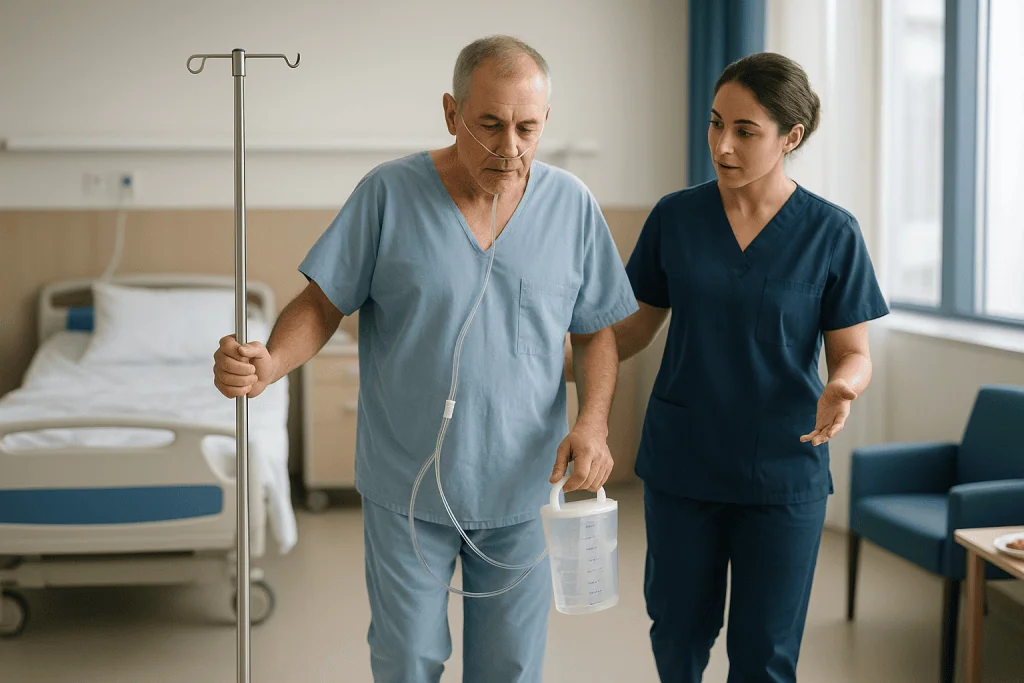
Then comes the walk. Within the first day, often the same evening, someone will help you sit, stand and take a short lap with the drain chamber wheeled beside you. Early walking after chest surgery reduces the risk of blood clots in the legs, keeps the lungs expanded, and gets the bowel moving again after anesthesia. MedlinePlus and Johns Hopkins both describe it as a standard part of care rather than an optional extra.
Fluids and food usually return quickly. Most people are drinking within hours and eating a light meal by the next day, unless nausea from the anesthetic gets in the way.
Chest tube removal after lung surgery: what decides the timing
Nobody removes a chest drain by the calendar. The team looks for three things, and the tube stays until all three are met.
- No air leak. When the water in the collection chamber stops bubbling during a cough, the stapled edge of the lung has sealed. Many modern chambers have a digital readout that shows the leak in milliliters per minute, which removes some guesswork.
- Low fluid output. The raw surfaces inside the chest weep fluid for a while. When the daily volume falls to a level the team considers safe, the body can absorb what remains on its own.
- A reassuring chest X-ray. The film should show the remaining lung fully expanded, without a large pocket of air or fluid.
Removal itself takes seconds. You breathe in, hold, and the tube slides out while a nurse or doctor pulls a purse-string stitch tight or presses a dressing over the hole. There is a brief pulling sensation. The site is checked with another X-ray a few hours later to make sure air has not crept back in.
Cleveland Clinic and MedlinePlus describe drains coming out after one to a few days for most minimally invasive resections. The common reason for a longer stay is a prolonged air leak, generally defined as one lasting beyond about five days. This is more likely in people with emphysema, where lung tissue is fragile and slow to seal. When it happens, the team may send you home with a small one-way valve attached to the tube so the leak can finish closing without an extended hospital stay. It is a nuisance, not a catastrophe, and it usually resolves on its own.
Days 2 to 5: going home and what 'ready' looks like
Discharge is a checklist, not a feeling. Teams generally want the drain out, pain manageable with oral medicine, oxygen levels steady on room air or on any home oxygen you were already using, food staying down, and the ability to walk the ward corridor unaided. MedlinePlus puts hospital stays after lung surgery at several days, with minimally invasive approaches at the shorter end and open thoracotomy at the longer.
Before you leave, someone should walk you through your incisions. After robotic surgery there are usually three or four small wounds plus the drain site, closed with dissolving stitches, surgical glue or small adhesive strips. Ask which type you have, because that determines whether anything needs removing at a clinic visit. Most people may shower within a day or two of the drain coming out, letting water run over the sites and patting them dry; baths and swimming wait until everything is sealed.
You will also receive a plan for breathing exercises, walking targets and pain relief, along with a follow-up appointment. The pathology report on any tissue removed typically takes one to two weeks, and the surgeon usually discusses it at that visit. It is worth arranging for someone to be with you at home for the first few days. Simple tasks such as reaching a high cupboard or pulling a sweater over your head are awkward while the chest wall is sore.
One practical detail people forget: bring a small pillow for the car ride home. Holding it against the chest over seat-belt pressure and bumps makes the journey far more comfortable, and it is the same trick used after heart surgery.
Pain after robotic lung surgery: what hurts, why, and how it is managed
The incisions are small, so people are often surprised that the chest still aches. The reason sits between the ribs. Each intercostal space carries a nerve, and the instruments and drain press on those nerves during and after surgery. The result is a deep, sometimes burning ache along a rib line, occasionally with a patch of numbness or hypersensitivity in the skin below the wounds. The shoulder on the operated side can also ache, a referred pain from irritation of the diaphragm. Johns Hopkins and MedlinePlus both describe this pattern as common and usually self-limiting.
Pain control is layered. Many teams place a nerve block during the operation, injecting local anesthetic around the intercostal or paravertebral nerves so the first day is more comfortable. After that, most people manage with a combination of acetaminophen and an anti-inflammatory medicine, which work through different mechanisms and can be used together when the kidneys and stomach allow, with a short course of an opioid reserved for breakthrough pain. Opioids reduce pain signaling in the brain and spinal cord but also blunt the cough reflex and slow the bowel, which is why teams try to taper them quickly. What you take, how much and for how long is a decision for the prescribing clinician, based on your kidneys, stomach, other medicines and how you respond.
Expect the ache to fade over two to six weeks. Numbness or tingling along the rib can linger for months as the nerve recovers; that is different from worsening pain, which should be reported. Pain that is well controlled is not a luxury. It is what lets you breathe deeply, cough effectively and walk, and those three activities do more to prevent pneumonia than any medicine.
Weeks 1 to 2 at home: breathing exercises, first walks and sleep
The first fortnight at home has a rhythm of its own. Mornings tend to be stiffest, energy peaks around midday, and by late afternoon most people are ready for a chair. That is normal after any major operation and reflects the body redirecting energy toward healing.
Walking is the main prescription. A common approach is several short walks a day, on flat ground, adding a few minutes each day rather than aiming for distance. MedlinePlus discharge guidance for lung surgery encourages daily walking that increases gradually, while avoiding heavy lifting and vigorous exercise until the surgeon clears it. You should be able to talk while walking; if you cannot, slow down.
Breathing exercises continue. Deep breaths held for a few seconds, repeated in sets through the day, keep the remaining lung expanded. Coughing with a pillow braced against the chest clears mucus. If you were given an incentive spirometer, use it as instructed. These small acts are the least glamorous part of recovery and among the most effective.
Sleep is a frequent complaint. Lying flat pulls on the chest wall, so many people sleep propped on pillows or in a recliner for a week or two. Lying on the operated side is uncomfortable at first but not harmful once the drain site has sealed. A little breathlessness on the stairs is expected at this stage; breathlessness at rest, or breathlessness that is getting worse day by day, is not and belongs in the red-flag list later in this article.
Appetite may be poor for a week. Small frequent meals with adequate protein support wound healing, and plenty of fluid keeps mucus thin and the bowel moving, especially if you are still taking any opioid.
Weeks 3 to 6: robotic lobectomy recovery, driving and lifting
Somewhere in the third or fourth week most people notice a corner turned. The ache is more of a twinge, the walks are longer, and the afternoon collapse into a chair becomes optional. This is the stretch where robotic lobectomy recovery moves from healing to rebuilding.
Driving usually returns in this window, with two conditions. You must be off any medicine that causes drowsiness, and you must be able to twist to check a blind spot and perform an emergency stop without hesitation or sharp pain. MedlinePlus advises against driving while taking opioid pain medicine. Some insurers and licensing authorities have their own rules after surgery, so it is worth checking.
Lifting is the other common question. The ribs were spread slightly by the instruments and the muscles between them were cut or stretched, and they need time to knit. Most surgeons set a weight limit, often described in patient guidance as roughly a gallon of milk or a light bag of groceries, for the first several weeks, then release it in stages. Pushing a vacuum, carrying a toddler and mowing a lawn all count as lifting.
Gentle exercise beyond walking can begin when your team agrees. Stationary cycling and light resistance work for the legs are usually fine before upper-body work, because the chest wall is the last thing to heal. Some centers refer people to pulmonary rehabilitation, a supervised program of exercise and breathing training that the NHS and Mayo Clinic describe as helpful after lung surgery, particularly for those with pre-existing lung disease.
The follow-up visit typically falls in this period. Bring your questions written down; the pathology discussion tends to crowd out practical ones.
Return to work after lung surgery: desk jobs, physical jobs and shift work
Return to work after lung surgery depends far more on what the job asks of your body and your concentration than on the size of the incisions. Three broad patterns emerge in patient guidance from MedlinePlus, the NHS and Johns Hopkins.
Desk and remote work. Many people return within two to six weeks, often starting with shorter days or a phased schedule. The limiting factor is usually fatigue and concentration rather than the wound. Sitting upright for long periods can ache in the first weeks, so a supportive chair and regular short walks around the room help.
Physically demanding work. Jobs that involve lifting, climbing, sustained exertion or dust exposure commonly wait six to twelve weeks, sometimes longer after a full lobectomy or in people with reduced lung function. The surgeon’s clearance usually rests on how the chest wall has healed and how your breathing reserve is recovering, which may be reassessed with repeat lung function tests.
Shift and night work. Disrupted sleep slows recovery, and fatigue is often the last symptom to lift. A temporary move to daytime hours, where the employer allows, is a reasonable request in the first weeks back.
Two practical points. First, if a cancer diagnosis leads to further treatment such as chemotherapy or immunotherapy, that schedule, rather than the surgery, may shape your working pattern for months. Second, most employers can accommodate a phased return if asked in writing with a note from the treating team. Occupational health services, where available, are set up for exactly this conversation.
A final honest note: some people feel guilty about not being ‘back’ sooner. Healing lung tissue does not respond to guilt. It responds to sleep, walking and time.
Breathlessness, energy and the lung that is left
People often ask how much breath they will lose. The answer depends on how much lung was removed and how healthy the rest of it is. A wedge resection takes a small piece and rarely changes day-to-day breathing. A lobectomy removes roughly a fifth to a quarter of total lung tissue, yet most people with otherwise healthy lungs notice little difference at rest once recovery is complete, because the remaining lung expands to fill more of the chest and the body adapts. Johns Hopkins and Cleveland Clinic describe this compensation as usual after lobectomy.
The adaptation is not instant. In the first weeks the remaining lung is still re-expanding, the chest wall is sore, and the muscles that drive breathing are deconditioned from illness and bed rest. Breathlessness climbing stairs is therefore normal early on and improves over weeks to months. Lung function tests, if repeated, typically show the largest recovery in the first three to six months after surgery.
Fatigue deserves its own mention because it surprises people. It is not the tiredness of a bad night; it is a heavy, whole-body lack of reserve that lifts slowly and unevenly. Anemia from blood loss, poor sleep, reduced appetite and the emotional weight of a cancer diagnosis all feed into it. Walking, oddly, is the treatment. Regular gentle exercise rebuilds the reserve faster than rest does, which is the rationale behind pulmonary rehabilitation programs.
People with emphysema or chronic bronchitis before surgery start with less reserve and recover it more slowly. That does not mean they should not have surgery; it means their team plans the extent of resection and the rehabilitation around it. If breathlessness plateaus or worsens rather than improving, the team will look for a reason, such as fluid around the lung, a clot, or a heart rhythm problem.
Risks and complications worth understanding before you go home
Robotic lung surgery is major surgery through small holes. The incisions shrink the recovery; they do not remove the risks that come with cutting lung tissue. Knowing the common ones helps you recognize them early rather than worry about them constantly.
- Prolonged air leak. The most frequent complication, described earlier. It extends the drain and the hospital stay and is more common with emphysema.
- Pneumonia. Mucus that is not cleared can become infected. Deep breathing, coughing and walking are the prevention; fever, worsening cough and colored sputum are the signals.
- Irregular heartbeat. Atrial fibrillation, a fast and irregular rhythm from the upper chambers of the heart, is one of the more common events after lung resection, particularly in older people. It usually settles with treatment but may need medicine or a longer stay.
- Blood clots. Clots in the leg veins can travel to the lung. Early walking, compression stockings and, in many units, a short course of an injected anticoagulant reduce the risk.
- Bleeding. Uncommon, but occasionally requires a return to the operating room.
- Wound infection. Redness, warmth and discharge at an incision, usually within the first two weeks.
- Persistent nerve pain. A minority of people have chest wall pain lasting beyond three months, which pain services can help manage.
MedlinePlus, Mayo Clinic and Johns Hopkins list these in their patient material on lung surgery. The rare but serious risks, including death, are discussed at consent and depend heavily on age, lung function and heart health, which is why the pre-operative assessment is so thorough. The alternatives to surgery, chiefly stereotactic radiotherapy for small cancers in people unfit for an operation, carry a different profile of risks, and the choice between them belongs to you and the multidisciplinary team.
Robotic vs VATS vs open: does robotic lung surgery recovery time really differ?
Three approaches can perform the same lobectomy. Open thoracotomy uses a single long incision and spreads the ribs. Video-assisted thoracoscopic surgery, or VATS, uses a camera and hand-held instruments through a few small incisions. Robotic surgery uses the same small incisions with instruments controlled from a console.
The evidence is clearest on one comparison. Minimally invasive surgery, whether VATS or robotic, is associated with less early pain, shorter hospital stays and faster return to normal activity than open thoracotomy, with equivalent cancer outcomes for early-stage disease. That conclusion appears consistently in guidance from the NHS, Mayo Clinic and Johns Hopkins, and open surgery is now generally reserved for cases where the anatomy demands it.
The comparison between robotic and VATS is less settled. Randomized trials and large registry studies to date have generally found broadly similar recovery outcomes, including length of stay, pain and complication rates, with some studies suggesting modest advantages for the robotic approach in lymph node retrieval or conversion to open surgery and others finding no meaningful difference. The honest summary is that robotic surgery is a way of performing minimally invasive surgery, not a separate category with proven faster healing. Where a robot is available and the surgeon is experienced with it, recovery tends to track that of VATS.
What matters more than the platform is the surgeon’s familiarity with the chosen technique, the volume of similar operations the team performs, and how well the recovery pathway around the operation, from nerve blocks to early walking to drain protocols, is organized. Those factors, rather than the brand of instrument, are the ones worth asking about. A good question for the consultation is simply: which approach do you use most often for this operation, and why do you recommend it for me?
What people often get wrong about recovery after robotic lung surgery
‘Small incisions mean a small operation.’ The wounds are small; the surgery inside is not. A lobe of lung has been removed and its blood vessels and airway sealed. Fatigue and breathlessness in the first weeks are the body responding to that, not to the incisions.
‘Rest is the fastest way to heal.’ Lying still after chest surgery raises the risk of pneumonia and blood clots and slows the return of stamina. Every mainstream patient guide, including MedlinePlus and Johns Hopkins, puts early and increasing walking at the center of recovery.
‘The drain is the painful part.’ Removal takes seconds and most people describe a brief pull. The discomfort of a drain is the ache along the rib while it is in place, which eases once it is out.
‘Pain medicine slows healing, so I should tough it out.’ Uncontrolled pain leads to shallow breathing and a weak cough, which is what actually slows healing. Taking pain relief as prescribed, and telling the team if it is not working, protects the lungs.
‘Numbness under the wound means something went wrong.’ Numbness or tingling along a rib is a bruised intercostal nerve and commonly lasts weeks to months. New or worsening pain, redness or swelling is different and should be reported.
‘I will have half a lung’s worth of breath forever.’ After a lobectomy the remaining lung expands and most people with otherwise healthy lungs return to near their previous everyday capacity over months.
‘Robotic surgery guarantees a faster recovery than keyhole surgery.’ The evidence shows recovery after robotic and VATS lobectomy to be broadly comparable. Both are considerably gentler than open surgery, and that is the difference that counts.
‘Once the wounds heal, recovery is over.’ Skin heals in about two weeks. Stamina, sleep and breathing reserve take longer, and that is the normal shape of recovery rather than a sign of trouble.
Questions to ask your care team before and after surgery
Consultations run short and pathology dominates them. Writing questions down beforehand changes the balance. These are the ones that tend to matter most for the weeks after surgery.
Before the operation
- How much lung do you expect to remove, and what does that mean for my breathing afterwards given my lung function tests?
- Which approach do you plan to use, and what would make you switch to open surgery during the operation?
- What is your usual chest drain protocol, and what happens if I have a prolonged air leak?
- What pain-control plan do you use, and what should I do if it is not working at home?
- Is there anything I should do now, such as stopping smoking or adjusting a medicine, and who oversees those changes?
Before going home
- How were my incisions closed, and does anything need removing?
- What weight limit should I keep to, and for how long?
- When may I shower, bathe, drive and fly?
- Who do I call out of hours if I develop a fever, worsening breathlessness or chest pain?
- When will the pathology result be ready, and who will discuss it with me?
At follow-up
- Does the pathology change the plan, and will other specialists be involved?
- Is pulmonary rehabilitation appropriate for me?
- What is a realistic timeline for returning to my specific job?
- When should lung function be rechecked, and what follow-up imaging will I have?
Bringing someone with you to take notes is not a sign of weakness. It is the single most reliable way to leave the room with the answers intact.
When to call your doctor
Most recovery worries resolve with a phone call and reassurance, and teams would rather hear from you early than late. Some symptoms, though, need same-day contact with your surgical team or, if they are severe, emergency care.
- Breathlessness that is new, worsening or present at rest, or lips or fingertips turning blue or gray.
- Sharp chest pain that is different from the surgical ache, especially if it worsens with breathing or comes with a racing or irregular heartbeat.
- Fever, shaking chills, or a cough producing green, brown or bloody sputum.
- Coughing up more than a streak of blood.
- A sudden increase in swelling under the skin around the incisions that feels crackly or spongy, which can indicate air escaping from the lung.
- Redness, warmth, spreading swelling or pus at any incision, or a wound that opens.
- Pain, swelling or warmth in one calf, which can signal a blood clot.
- Confusion, fainting or a feeling of being about to faint.
- Persistent vomiting, inability to keep fluids down, or no bowel movement for several days despite laxatives.
- Pain that is escalating rather than easing, or that prescribed medicine no longer touches.
Call emergency services rather than the clinic if breathlessness is severe, if chest pain is crushing or spreading to the arm or jaw, if you cough up a large amount of blood, or if someone with you notices confusion, a drooping face or slurred speech. These are described as urgent warning signs in MedlinePlus and NHS guidance for people recovering from lung surgery.
Every decision about investigating or treating these symptoms rests with the team caring for you. Their number should be on your discharge paperwork; if it is not, ask for it before you leave the ward.
Frequently asked questions
How long does robotic lung surgery recovery time usually take?
Most people spend a few days in hospital and then several weeks rebuilding at home, with full recovery measured in weeks to a few months according to MedlinePlus and Johns Hopkins patient guidance. The pace depends on how much lung was removed, your fitness and lung function before surgery, and whether a complication such as a prolonged air leak occurred. Your surgical team sets the milestones for your own case.
When is the chest tube removed after lung surgery?
The chest tube is removed once there is no air bubbling in the drainage chamber during coughing, the daily fluid output has fallen to a level the team considers safe, and a chest X-ray shows the remaining lung fully expanded. For most minimally invasive resections that is one to three days. A persistent air leak, more common in people with emphysema, can extend that, sometimes with discharge home on a small one-way valve.
Does chest drain removal hurt?
Removal takes only a few seconds and most people describe a brief pulling or stinging sensation rather than sharp pain. You are asked to take a deep breath and hold it while the tube slides out and the site is sealed with a stitch or dressing. The ache people associate with the drain is the discomfort along the rib while it is in place, which usually eases noticeably once the tube is gone.
What does pain after robotic lung surgery feel like?
It is typically a deep ache or burning along one rib line under the incisions, sometimes with shoulder-tip pain on the same side and a patch of skin numbness. The source is the intercostal nerves that run between the ribs, which are pressed or stretched by instruments and the drain. Pain usually fades over two to six weeks; nerve numbness or tingling can take months. Escalating pain, rather than easing pain, should be reported.
When can I return to work after lung surgery?
Desk-based or remote work often resumes within two to six weeks, frequently on a phased schedule, because fatigue and concentration rather than the wound are the limiting factors. Physically demanding jobs commonly wait six to twelve weeks or longer, until the surgeon confirms the chest wall has healed and breathing reserve is adequate. If further cancer treatment follows surgery, that schedule may shape your working pattern more than the operation itself.
How long does robotic lobectomy recovery take compared with a wedge resection?
Recovery after a wedge resection, which removes a small piece of lung, is generally quicker and has less effect on breathing than after a lobectomy, which removes an entire lobe. Both are done through the same small incisions, so wound healing is similar; the difference lies in fatigue and breathlessness, which last longer after larger resections. Johns Hopkins notes that most people with otherwise healthy lungs adapt well after lobectomy over months.
When can I drive after robotic lung surgery?
Most people drive again within a few weeks, once two conditions are met: you are no longer taking any medicine that causes drowsiness, and you can twist to check mirrors and perform an emergency stop without hesitation or sharp chest pain. MedlinePlus advises against driving while taking opioid pain medicine. Check with your surgical team and, where relevant, your insurer or licensing authority, as some have specific rules after chest surgery.
When is it safe to fly after lung surgery?
Air travel is usually deferred until your team confirms the lung is fully expanded and any air leak has sealed, because cabin pressure changes can enlarge a pocket of trapped air. Many teams also want you walking comfortably and off sedating medicine, and they may advise moving your legs regularly during a flight to reduce clot risk. Timing varies by person and procedure, so it is a question to ask before booking anything.
Will I be short of breath permanently after a lobectomy?
Most people with otherwise healthy lungs return to near their previous everyday breathing capacity within months, because the remaining lung expands to fill more of the chest and the body adapts. Breathlessness on stairs in the first weeks is expected and improves. People with pre-existing emphysema or chronic bronchitis start with less reserve and recover more slowly, which is why the extent of surgery and rehabilitation is planned around their lung function tests.
Is recovery faster after robotic surgery than after VATS or open surgery?
Minimally invasive surgery, whether robotic or video-assisted, is consistently associated with less early pain, shorter stays and faster return to activity than open thoracotomy, with equivalent cancer outcomes for early-stage disease. Between robotic and VATS, studies to date show broadly similar recovery, with no consistent advantage in pain, length of stay or complications. The surgeon’s experience with the chosen approach matters more than the instrument platform.
References
This article is for general information only and is not a substitute for professional medical advice. Please consult a qualified doctor about your individual situation.

More from the Blog

Living With Asbestosis: Pulmonary Rehabilitation, Vaccinations and Protecting Your Lungs
Living with asbestosis means managing permanent lung scarring rather than reversing it. The evidence supports four things most: joining a supervised pulmonary rehabilitation program,…

Is a Bronchoscopy Done Under General Anesthesia? Sedation Options Explained
Most bronchoscopies are not done under general anesthesia. A flexible bronchoscopy is usually performed with local anesthetic sprayed into the nose and throat plus…

How Family Can Support Someone Through a Smoking Cessation Program Without Nagging
The most effective way to support someone quitting smoking is to ask how they want help, then follow their lead: listen without lecturing, keep…

What Does Asbestosis Follow-Up Involve? Lung Tests, Imaging and Complication Checks
Asbestosis follow-up monitoring usually combines a clinical review, breathing tests such as spirometry and gas transfer, a check of resting and exertional oxygen levels,…

How Do You Prepare for a Quit Date? The Week Before a Smoking Cessation Program Starts
To prepare for a quit date, most guidelines suggest choosing a day within the next two weeks, telling people who can support you, listing…

Traveling With COPD: Flights, Altitude and Planning Oxygen for Long Journeys
Most people with stable COPD can travel, including by air, when the trip is planned with their care team. Cabin pressure on commercial flights…