

Scalp Micropigmentation Risks: Pigment Spread, Color Shift and Allergic Reactions Explained

Key Takeaways
- Scalp micropigmentation places pigment into the upper dermis through thousands of fine punctures, so it carries the same infection, allergy and scarring risks that Mayo Clinic and MedlinePlus describe for any tattoo.
- Pigment spread and blue-gray color shift share a single main cause: pigment deposited too deep, where looser tissue lets particles drift and thicker overlying skin scatters blue light.
- Black pigment causes allergic reactions less often than colored inks, but reactions to pigment carriers, numbing creams and aftercare products are all documented, and Mayo Clinic notes they can appear years later.
- A patch test screens only for immediate reactions; it cannot rule out a delayed response, so a history of eczema, metal allergy or previous tattoo reactions should be raised with the treating team regardless.
- Cleveland Clinic describes the treatment as semi-permanent, typically lasting several years, so fading and periodic touch-ups are part of the plan rather than a complication.
- Scalp pigment can occasionally cause warmth or swelling during an MRI and may affect image quality, so telling the radiographer beforehand is sensible, but a medically needed scan should not be skipped.
Scalp micropigmentation risks are mostly the risks of any cosmetic tattoo applied to a thin, sun-exposed area of skin: pigment can spread and blur if deposited too deep, dots can shift toward blue or gray as they fade, and some people react to pigment ingredients or aftercare products. Infection and scarring are uncommon but possible. Results fade over years and need touch-ups, so expectations and follow-up matter.
He had already tried the thickening shampoo, the concealer powder that washed off in the rain, and a hat he did not much like. Then a friend showed him a photo of a shaved head with a crisp, even hairline that was not hair at all, just thousands of tiny pigment dots. The question that followed was practical rather than vain: what are the scalp micropigmentation risks, and which ones should actually change his decision?
It is a fair question, because scalp micropigmentation sits in an odd space. It is a tattoo in its biology, a hair-loss treatment in its purpose, and a cosmetic service in how it is sold. The marketing tends to lean on photographs. The medical literature is thin. Between those two, a person is left guessing.
This article works through the three complications people search for most, pigment spread, color shift and allergic reactions, then adds the ones they rarely think to ask about, with the evidence graded honestly where it is weak.
What actually happens during scalp micropigmentation?
Scalp micropigmentation, often shortened to SMP, is a form of cosmetic tattooing in which a practitioner deposits tiny dots of pigment into the upper layer of the dermis, the living layer of skin beneath the surface, to mimic the look of short hair follicles. Cleveland Clinic describes it as a non-surgical option that creates the appearance of density or a shaved-head look rather than growing any hair.
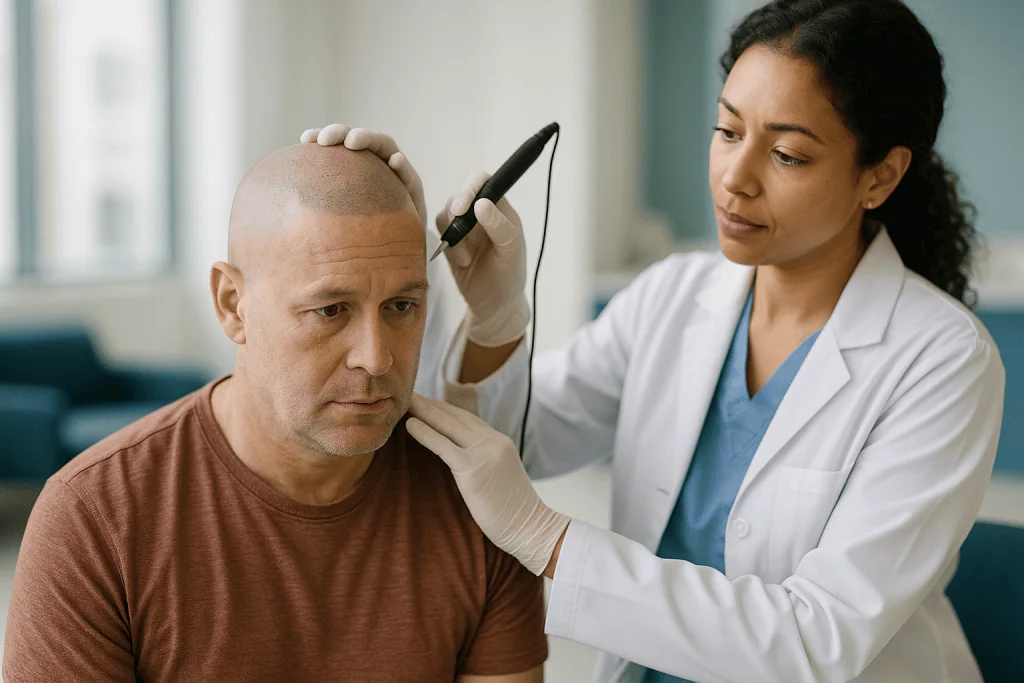
The tool is a fine needle, usually finer than a standard tattoo needle, driven by a hand-held machine. Each dot is placed individually, so a full treatment may involve many thousands of impressions, spread across a number of sessions. Cleveland Clinic notes that treatment is commonly completed over several sessions spaced weeks apart, with each session lasting a few hours.
Depth is the whole game. The epidermis, the outermost skin layer, renews itself completely roughly every month, so pigment placed there would simply shed. Pigment placed too deep, into the fatty layer or the lower dermis where the skin is looser and blood flow is richer, is far more likely to spread. The practitioner is aiming for a narrow band in between, on a surface that curves, varies in thickness from crown to temple and may already be scarred from previous hair surgery.
Pigments are typically carbon-based blacks diluted to shades of gray, chosen because carbon tends to be chemically stable. That stability is helpful, but it does not make the pigment inert in every body, and it does not stop the physics of light scattering through skin from changing how a dot looks over time. Those two facts explain most of what follows.
Scalp micropigmentation risks at a glance: the main types
When people ask what the main types of risk are, it helps to sort them by mechanism rather than by how alarming they sound. Mayo Clinic groups tattoo complications into allergic reactions, skin infections, other skin problems such as granulomas and keloids, bloodborne infections from unsterile equipment, and MRI-related reactions. Scalp micropigmentation inherits all of those, then adds two cosmetic risks of its own that come from the specific goal of imitating hairs.
| Risk | What drives it | Typical timing | How well studied |
|---|---|---|---|
| Pigment spread (blurring) | Pigment placed too deep, too much pigment per dot, thin or scarred skin | Months to years | Mostly practitioner experience, few formal studies |
| Color shift (blue or gray tint) | Light scattering through skin, pigment ingredients, depth, sun fading | Gradual, over years | Physics well understood; SMP-specific data limited |
| Allergic reaction | Pigment components, numbing agents, aftercare products | Days to years after | Documented for tattoos generally (Mayo Clinic) |
| Skin infection | Bacteria entering fresh punctures, poor hygiene | First days to two weeks | Well documented for tattoos |
| Scarring or granuloma | Individual healing tendency, trauma to skin | Weeks to months | Documented for tattoos generally |
| Bloodborne infection | Reused or unsterile needles | Weeks to months | Documented (MedlinePlus, Mayo Clinic) |
| Fading and uneven wear | Normal immune clearance, sun exposure | Years | Expected; Cleveland Clinic describes it as semi-permanent |
A pattern shows in the right-hand column. The medical risks are inherited from ordinary tattooing and reasonably well described. The cosmetic risks that people fear most are the ones with the least published evidence, which is why honest practitioners talk in ranges and conditions rather than guarantees.
Why does pigment spread or blur after scalp micropigmentation?
Pigment spread, sometimes called migration or blowout, is what happens when a crisp dot slowly turns into a soft smudge. On a forearm tattoo a little softening is tolerable. On a scalp that is pretending to be hundreds of separate follicles, it can turn a realistic result into something that reads as a shadow or a stain.
The mechanism is anatomical. The dermis is a mesh of collagen with blood vessels and lymphatic channels running through it. Pigment that lands in the upper dermis is largely trapped by that mesh and by immune cells called macrophages, which engulf the particles and hold them in place. Pigment pushed into the deeper dermis or the subcutaneous fat meets a looser structure with more fluid movement, and particles can drift outward along the path of least resistance.
Three variables raise the odds. The first is needle depth, which is harder to judge on the scalp because skin thickness changes across the head and is thinnest where many people want the most definition, at the temples and hairline. The second is pigment volume: a heavily loaded needle leaves a larger reservoir, and a larger reservoir has more to spread. The third is the skin itself. Scar tissue from a previous hair transplant, a strip scar at the back of the head, or skin that has thinned with age or sun damage behaves less predictably than healthy dermis.
There is no reliable published figure for how often blurring occurs, and anyone quoting one is estimating. What the evidence from general tattooing supports is the principle: shallower, lighter placement blurs less. That is why a conservative first session, with density built up later, is a recognized approach rather than timidity.
Does scalp micropigmentation turn blue? Understanding color shift
Few things worry people more than the idea of a scalp that slowly turns blue or green. The worry has a basis, and understanding where it comes from makes it easier to judge the real risk.

Start with light. Skin is not a window; it scatters light, and it scatters short blue wavelengths more strongly than long red ones. A particle of black pigment sitting beneath a layer of skin is viewed through that scattering, so it reads cooler and bluer than it would on paper. The deeper the pigment, the thicker the scattering layer and the stronger the blue cast. This is the same optical effect that makes veins look blue even though the blood inside is red. It means depth control protects against color shift as well as against spread.
Pigment chemistry is the second factor. Carbon black is relatively stable, but pigments vary in what they contain, and Mayo Clinic notes that tattoo inks are not uniformly regulated in the way medicines are. Mixed inks containing blue or green components, or pigments diluted with colors that fade at different rates, can drift in hue as the faster-fading components disappear.
Fading itself is the third. As macrophages gradually carry pigment away and ultraviolet light breaks down what remains, a dense black dot thins into a lighter one, and a lighter dot shows the blue scatter more plainly. Cleveland Clinic describes scalp micropigmentation as lasting several years before touch-ups are typically needed, which is also the window over which color change tends to become visible.
So the honest answer to whether it turns blue: a slight cooling of tone over years is expected physics; a frankly blue or green scalp usually points to depth or pigment choice, not bad luck.
Scalp micropigmentation allergic reaction: what the evidence shows
Allergic reactions to tattoo pigment are well documented in general, and Mayo Clinic lists them first among tattoo risks, noting that colored inks, red in particular, are the most frequent culprits. Scalp micropigmentation uses almost exclusively black and gray pigments, which are less often implicated, but less often is not never, and the scalp has features that complicate the picture.
A reaction can involve three different things. Pigment components are the obvious one, including the carbon itself, binders, preservatives and trace metals. Topical numbing agents applied before or during a session are a second and underappreciated source; contact allergy to local anesthetic creams is recognized in dermatology. Aftercare products, from fragranced moisturizers to antiseptic washes, are the third, and because they are applied to freshly punctured skin, they reach deeper than they would on intact skin.
Timing varies more than people expect. Mayo Clinic points out that allergic reactions to tattoo ink can appear years after the procedure, not only in the first week. On the scalp this can be mistaken for dandruff, folliculitis or sunburn, which delays the correct explanation.
Patch testing, placing a tiny amount of pigment in an inconspicuous spot and waiting, is commonly offered as a precaution. It is reasonable, but it has limits. A test performed days before a session cannot reveal a delayed reaction that would develop over months, and a negative test does not rule out sensitization later. People with a history of eczema, previous reactions to tattoos or cosmetics, or known metal allergies should raise this with their treating team before any pigment is placed. The decision about whether to proceed, and with which pigment, belongs with them, not with a brochure.
How likely is infection, and how does it compare with any tattoo?
Every needle puncture is a tiny breach in the skin’s barrier, and scalp micropigmentation makes thousands of them. The infection risk is therefore the same category of risk as for any tattoo, with a few scalp-specific twists.
Mayo Clinic and MedlinePlus both describe two kinds of infection. Local skin infection comes from ordinary skin bacteria entering fresh punctures, usually in the first days. Bloodborne infection, including hepatitis B, hepatitis C and HIV, comes from contaminated equipment and is the reason single-use needles, sterile pigment cups and a clean environment are not optional extras. Mayo Clinic specifically advises asking whether the practitioner follows proper sterilization and uses fresh needles for each client.
The scalp helps and hinders. It has a rich blood supply, which supports fast healing, and the skin surface typically closes within days. Against that, it is oily, it sweats, it sits under hats and helmets, and it is rubbed by pillows every night. Hair follicles, even dormant ones, are little pockets where bacteria live. Folliculitis, an inflammation of those follicles that looks like small pimples, is the most common mild complication after any scalp procedure and can be hard to tell apart from early infection.
No published study gives a reliable infection rate for scalp micropigmentation specifically, so a precise percentage would be invented. What can be said with confidence, because it is true for tattooing generally, is that hygiene at the time of treatment and in the first two weeks accounts for most of the controllable risk. The red-flag signs that separate normal healing from infection are set out in the “When to call your doctor” section further down.
Scalp micropigmentation fading: why it is expected, not a flaw
Fading is listed as a risk in many consumer articles, which slightly misrepresents it. Fading is the designed-in behavior of scalp micropigmentation. Cleveland Clinic calls the treatment semi-permanent and notes that results typically last several years before they need refreshing. A result that did not fade at all would be a result that could never be adjusted as a person’s real hairline receded, grayed or changed with age.
Why it fades is worth knowing because it links back to the other risks. Macrophages that trapped the pigment do not hold it forever; they die, release it, and new cells take it up, and a little is lost with each cycle through the lymphatic system. Ultraviolet light breaks pigment particles down, which is why sun-exposed areas fade faster than the shaded crown. Shallower placement, which protects against spread and color shift, also fades a little faster because it sits closer to the renewing surface.
Uneven fading is the real cosmetic issue. The front hairline and the top of the head receive more sun than the back and sides, so a result can lighten in patches and lose the smooth gradient that made it convincing. People who work outdoors or who never wear a hat tend to notice this sooner.
The practical consequence is that scalp micropigmentation is not a single decision but a maintenance relationship. Anyone weighing it should factor in periodic touch-up sessions, the time those take, and the possibility that the practitioner who did the original work may not be the one available later. None of this is a reason not to proceed; it is a reason to plan with open eyes rather than treating the first session as the end.
Who is scalp micropigmentation usually for, and who is asked to wait?
Cleveland Clinic describes scalp micropigmentation as an option for people with pattern hair loss, alopecia areata, thinning that is not yet surgical, scars from previous hair transplants, and anyone who prefers a shaved look with a defined hairline. Male and female pattern hair loss, which Mayo Clinic identifies as the most common cause of hair loss, is the commonest reason people enquire. Those who have had a hair transplant may use it to soften visible donor scars or add the appearance of density between grafts.
Being asked to wait is not the same as being refused. Several situations typically lead a treating team to pause.
- Active scalp conditions such as psoriasis, seborrheic dermatitis flares or infected folliculitis: pigment placed into inflamed skin heals and holds unpredictably.
- Recent hair transplant surgery: the scalp needs time to settle, and many surgeons prefer scars to mature before pigment is added, with timing decided case by case.
- Alopecia areata that is still actively shedding: the pattern may change, and pigment placed to match today’s loss may not match next year’s.
- Known history of keloid scarring, which Mayo Clinic lists among tattoo complications; raised scars at puncture sites are a real risk for people with this tendency.
- Conditions or medicines affecting bleeding, immune function or wound healing, including uncontrolled diabetes and any treatment that suppresses the immune system; the prescribing clinician’s view comes first.
- Pregnancy and breastfeeding, where the general caution applied to elective tattooing is usually extended.
A reasonable practitioner will ask about all of this before quoting a session plan, and will be comfortable suggesting a medical review first. If that conversation never happens, that is itself information.
Scalp micropigmentation side effects in the first days and weeks
Most of what people experience after a session is not a complication but ordinary healing, and knowing the normal timeline is the best defense against both panic and complacency. The outline below is drawn from how tattooed skin heals generally, as described by Mayo Clinic and MedlinePlus, applied to the scalp.
In the first hours the treated area is usually red and slightly swollen, with a sensation often compared to sunburn. Dots look darker and larger than they will settle, because the pigment is sitting in swollen tissue and some excess remains on the surface. Pinpoint bleeding or clear fluid at individual punctures is normal on day one.
Over the next few days, redness fades and a fine scab or dry flake forms over each dot. This is the stage where picking does the most damage, because a scab lifted early can take pigment with it, leaving a gap in the pattern. Mild itching is common. Tenderness when the head touches a pillow usually eases within a few days.
By roughly two weeks the surface has typically closed, which is the window Mayo Clinic gives for a tattoo to heal on the outside. Dots now appear lighter and smaller than they did on day one, sometimes alarmingly so; this is settling, not failure, and it is why follow-up sessions exist.
Over the following month the skin continues to remodel beneath the surface, and the true healed color emerges. Practitioners commonly schedule the next session only after this point so they are adding to a settled result rather than a swollen one. Any side effect that worsens rather than improves across this timeline is the exception, and it is covered in the red-flag section below.
How does scalp micropigmentation interact with hair transplants, lasers and MRI?
Because scalp micropigmentation often sits alongside other hair-loss care, a few interactions deserve plain explanation.
Hair transplant surgery and pigment can coexist, but order and timing matter. Pigment placed before a transplant can be disturbed by the incisions and may complicate the surgeon’s view of the skin. Pigment placed after a transplant goes into skin that includes scar tissue, which holds pigment differently and raises the odds of patchy uptake or spread. Neither sequence is wrong; both need the surgeon and the pigment practitioner to know about each other.
Medical hair-loss treatments, such as topical agents that prolong the growth phase of follicles or oral medicines that act on hormone pathways, do not interact with pigment chemically. The practical point is that if hair regrows or thickens, the pigment pattern may need adjusting, and if a medicine is stopped and hair thins further, the opposite applies. Decisions about starting or stopping any such medicine sit with the prescribing clinician, not with the cosmetic plan.
Laser treatments on the scalp, including laser hair removal or some skin resurfacing, can heat and break down pigment particles, altering color or causing uneven fading. Anyone considering a laser procedure should tell the operator the scalp carries pigment.
MRI scanning is a question people rarely think to ask. Mayo Clinic notes that tattoos and permanent makeup occasionally cause swelling or a burning sensation during MRI and can, in some cases, affect image quality, though this is uncommon and rarely a reason to avoid a scan. Telling the radiographer beforehand is the sensible step, and the scan should go ahead on medical advice rather than being skipped out of worry.
What people often get wrong about scalp micropigmentation risks
Myths cluster around any cosmetic procedure that is photographed more than it is studied. These are the ones that most often distort decisions.
“It is not a real tattoo, so tattoo risks do not apply.” The depth is shallower and the needle finer, but pigment is still being placed into living dermis through thousands of punctures. The infection, allergy and scarring risks described by Mayo Clinic and MedlinePlus for tattoos apply in full.
“Black pigment cannot cause an allergic reaction.” Black is less often implicated than red, but allergic responses to black inks and to their carriers are reported, and reactions to numbing creams and aftercare products are a separate route entirely.
“It turns blue because the ink is cheap.” Pigment quality matters, but the blue cast is primarily an optical effect of depth and fading. Well-made pigment placed too deep will still read blue; the ink is not the only variable.
“It is permanent.” Cleveland Clinic describes it as semi-permanent, lasting several years. That is a feature when a hairline needs updating and a nuisance when it does not.
“A patch test guarantees safety.” It screens for immediate reactions only. Delayed reactions, which Mayo Clinic notes can appear years later, are not caught by a test performed days in advance.
“Removal is easy if I change my mind.” Laser removal of scalp pigment is possible but can take multiple sessions, may leave the skin lighter or uneven, and may not clear everything. It is a fallback, not an undo button.
“More density in one session gives a better result.” More pigment per session increases the risk of spread. Building up over sessions is slower and, by the logic of every tattooing principle, safer.
How to lower scalp micropigmentation risks before you book
Most of the controllable risk is decided before the needle touches skin. The steps below are not guarantees, and the evidence for several of them comes from general tattooing rather than scalp-specific trials, but they are the measures with a plausible mechanism behind them.
Check the regulatory basics. Mayo Clinic advises confirming that a tattoo practitioner is licensed where licensing exists, uses single-use sterile needles, pours pigment into fresh disposable cups and wears gloves. The same standard applies to scalp work, and it is reasonable to ask to see it rather than take it on trust.
Get any active scalp condition reviewed first. A dermatology opinion on flaky, itchy or inflamed scalp skin before pigment is placed avoids treating into disease and makes later problems easier to interpret.
Disclose medicines and health conditions fully, including blood thinners, immune-suppressing treatments, diabetes and any history of keloid scarring or allergy. The practitioner cannot adjust for what they do not know, and the prescribing clinician may have a view on timing.
Ask what is in the pigment and whether a patch test is offered, understanding its limits. Ask the same about any numbing cream.
Favor a conservative plan. Lighter first sessions with density built later align with the mechanism of pigment spread described earlier. Impatience is a risk factor in its own right.
Plan for sun protection from the start. Ultraviolet exposure drives fading and uneven wear; a hat or sunscreen once the skin has healed is the single cheapest maintenance step. Finally, make sure there is a route to medical care if something goes wrong, because the cosmetic practitioner is not the person who treats an infection or an allergic reaction.
What happens if the result goes wrong? Correction and removal
Even with careful work, some results need fixing, and knowing the options in advance makes the risk feel proportionate rather than catastrophic.
Minor unevenness, light patches and small gaps where scabs lifted pigment are typically addressed at follow-up sessions. This is the ordinary business of scalp micropigmentation and the reason a treatment is planned as a series rather than a single visit.
Color that has cooled toward gray can sometimes be warmed by adding fresh pigment in a slightly different tone, placed shallowly. This is adjustment, not reversal, and it works best when the original dots have not spread.
Blurring and pronounced blue or green shift are harder. Once pigment has migrated into deeper tissue, adding more on top can make the area look darker and muddier rather than crisper. The usual route is laser removal, in which a device delivers short pulses of light that shatter pigment particles so the body can clear them. On the scalp this generally requires several sessions spaced weeks apart, carries its own risks of temporary or lasting changes in skin color and texture, and may not remove every trace. Laser treatment of any kind should be performed by a clinician trained in it, with a plan agreed in advance.
Allergic reactions and granulomas, which are small lumps formed by immune cells clustering around a foreign material, are medical rather than cosmetic problems. Mayo Clinic lists both among recognized tattoo complications. Management sits with a doctor, often a dermatologist, and can range from topical treatment to, in persistent cases, removal of the affected pigment. Decisions about which approach fits an individual belong with that treating team.
Documenting the original pigment used, the depth settings and the session dates makes every one of these conversations easier later.
Questions to ask your care team before scalp micropigmentation
A good consultation should leave a person better informed than the internet did. These questions are designed to surface the information that actually changes risk, and the answers are worth writing down.
- What is in the pigment you use, and can I see the ingredient information? Is it a single-component black or a mix?
- How do you decide on needle depth across different parts of my scalp, and how do you adjust for scar tissue or thinner skin?
- Do you offer a patch test, and what can and cannot it tell me?
- What numbing cream, if any, do you use, and what does it contain?
- How do you sterilize equipment, and are needles and pigment cups single-use?
- How many sessions do you anticipate for my pattern of loss, and how far apart?
- What does your version of a conservative first session look like?
- What aftercare do you recommend, and which products should I avoid on healing skin?
- What should I do, and who should I contact, if I notice signs of infection or a reaction outside your working hours?
- What has gone wrong with your past clients, and how was it handled?
- Have you worked on scalps with previous hair transplant scars, and what was different?
- How will the result be adjusted if my hair loss progresses, or if I later have a transplant or start a medical hair-loss treatment?
- What is your approach if I am unhappy with color shift or blurring in a few years?
Notice what is missing from this list: there is no question about how good the result will look. Photographs answer that. The questions above answer what the photographs cannot, which is how the risks are being managed for one particular head.
When to call your doctor after scalp micropigmentation
Most sessions are followed by a few days of redness, tenderness and flaking that steadily improve. The signs below are different. They point to infection, allergic reaction or a healing problem, and they warrant contact with a doctor, not a wait-and-see message to the practitioner.
- Redness, warmth or swelling that spreads outward from the treated area or worsens after the first two to three days instead of easing.
- Thick yellow or green discharge, or a foul smell from the scalp.
- Fever, chills or feeling generally unwell in the days after a session; Mayo Clinic lists fever alongside local signs as a reason to seek care for a suspected tattoo infection.
- Increasing pain, or pain that returns after it had settled.
- Raised, itchy, bumpy or scaly patches confined to the pigmented area, whether they appear within days or many months later, which can indicate an allergic or granulomatous reaction.
- Blistering, open sores or skin breakdown at the treated site.
- Firm lumps forming under the dots, or thick raised scar tissue developing at puncture sites.
- Tender swollen glands in the neck or behind the ears alongside any of the above.
- A rash spreading beyond the scalp, facial swelling, wheeze or difficulty breathing after a session: this is an emergency, and emergency services should be called immediately.
Anyone with diabetes, a suppressed immune system or a condition affecting healing has a lower threshold for all of these, because infections can progress faster and show fewer early signs. When in doubt, the cost of a call is small and the cost of a delayed infection on the scalp is not. The treating doctor, not the pigment practitioner, decides whether and how to treat.
Frequently asked questions
What are the main types of scalp micropigmentation risk?
They fall into two groups. Medical risks are those of any tattoo: local skin infection, bloodborne infection from unsterile equipment, allergic reactions to pigment or numbing agents, and scarring or granulomas. Cosmetic risks are specific to imitating hair: pigment spreading into blurred patches, dots shifting toward blue or gray, and uneven fading with sun exposure. The medical risks are better studied; the cosmetic ones rest mostly on practitioner experience.
What are the most common scalp micropigmentation side effects in the first week?
Redness, mild swelling, a sunburn-like tenderness and dots that look darker and larger than they will settle are typical on the first day. Fine scabbing or flaking and some itching follow over the next few days. These improve steadily. Side effects that worsen after day two or three, bring fever, or produce discharge are not normal healing and should prompt a call to a doctor.
Does scalp micropigmentation turn blue over time?
A slight cooling of tone over several years is expected, because skin scatters blue light and fading dots show that effect more plainly. A frankly blue or green scalp is different and usually traces back to pigment placed too deep or to mixed pigments whose components fade at different rates. Depth control and single-component black pigment reduce the risk; they do not abolish the physics.
How does a scalp micropigmentation allergic reaction show up?
Usually as itchy, raised, bumpy or scaly skin confined to the pigmented area, sometimes with swelling. It can appear within days of a session or, as Mayo Clinic notes for tattoo ink reactions, many months or years later. Numbing creams and aftercare products can cause similar reactions. Any such change warrants medical review rather than more product, and a severe reaction with facial swelling or breathing difficulty is an emergency.
Why does pigment spread or blur on the scalp?
Pigment that lands in the upper dermis is trapped by collagen and immune cells. Pigment pushed deeper reaches looser tissue with more fluid movement, and particles drift outward. Scalp skin is thin and varies in thickness, scar tissue holds pigment unpredictably, and heavily loaded needles leave more pigment to spread. Lighter, shallower placement built up over sessions is the recognized way to reduce it.
Can scalp micropigmentation cause an infection?
Yes, in the same way any tattoo can. Bacteria can enter fresh punctures in the first days, and contaminated equipment can transmit bloodborne infections such as hepatitis B and C. Mayo Clinic and MedlinePlus both stress single-use needles, fresh pigment cups and a clean environment. The scalp’s oiliness, sweat and contact with hats and pillows add to the importance of early aftercare hygiene.
How long does scalp micropigmentation fading take, and is it a problem?
Cleveland Clinic describes the treatment as semi-permanent, typically lasting several years before touch-ups are needed. Fading is designed in, allowing the hairline to be adjusted as real hair changes. The cosmetic problem is uneven fading, since sun-exposed areas at the front and top lighten faster than the shaded back. Sun protection once the skin has healed is the simplest countermeasure.
Is scalp micropigmentation safe after a hair transplant?
It is commonly used to soften transplant scars and add apparent density, but scar tissue holds pigment less predictably, raising the chance of patchy uptake or spread. Most surgeons prefer scars to mature first, with timing decided case by case. The surgeon and the pigment practitioner should each know what the other has done or plans to do.
Can I have an MRI if I have scalp micropigmentation?
Generally yes. Mayo Clinic notes that tattoos and permanent makeup occasionally cause swelling or a burning sensation during MRI and can sometimes affect image quality, but this is uncommon and rarely a reason to avoid a scan. Tell the radiographer about the pigment beforehand. A scan that a doctor has judged necessary should go ahead on that medical advice.
Can scalp micropigmentation be removed if I regret it?
Laser removal is possible but is a fallback rather than an undo. It typically requires several sessions spaced weeks apart, may leave the skin lighter or uneven in texture, and may not clear every trace, particularly if pigment has spread deep. It should be performed by a clinician trained in laser treatment, with the risks discussed in advance.
References
This article is for general information only and is not a substitute for professional medical advice. Please consult a qualified doctor about your individual situation.

More from the Blog

Unshaven (U-FUE) Hair Transplant Recovery: Hiding Redness, Washing Long Hair and Work Return
Unshaven FUE recovery follows the same biology as any follicular unit extraction, but the surrounding long hair changes the practical details. Grafts typically anchor…

What Robotic Hair Surgery Results Depend On: The Robot, the Team and Time
Robotic hair surgery results depend far more on the donor hair supply, the surgical team's planning and graft handling, and the pattern of underlying…

Eyebrow Transplant Results Over the First Year: Shedding, Regrowth and When the Shape Settles
Eyebrow transplant results change markedly across the first year. Most transplanted hairs shed within roughly two to eight weeks, then regrow from about month…

How Many Days in Turkey for a Hair Transplant? The Realistic Itinerary
Plan for five to seven days in Turkey for a hair transplant. The procedure itself usually takes one day (about four to eight hours),…

When Does an Old Hair Transplant Need Repair? Hairline Angle, Pluggy Grafts and Uneven Density
An old hair transplant usually needs repair when it no longer looks natural or no longer matches the rest of the scalp: a hairline…

Biofibre Hair Implants: What UK Patients Should Know Before Considering Them
Biofibre hair implants are synthetic polyamide fibers anchored into the scalp, not a transplant of living hair. The fibers never grow, shed at an…